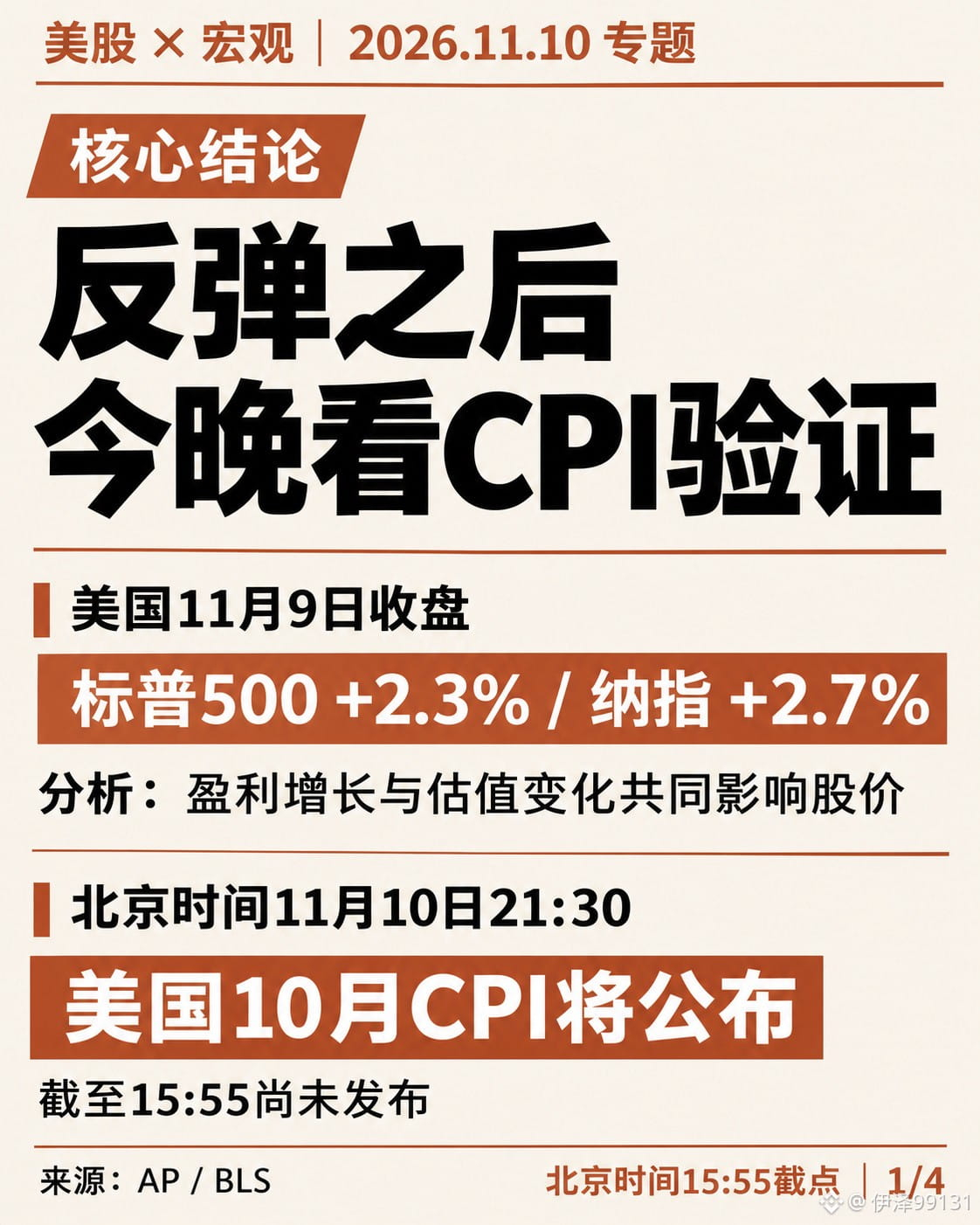
After the U.S. stock market rebound, can tonight’s CPI support a valuation recovery?
U.S. stocks rebounded sharply last night, but what I’m more interested in is whether this recovery can withstand the test of tonight’s inflation data.
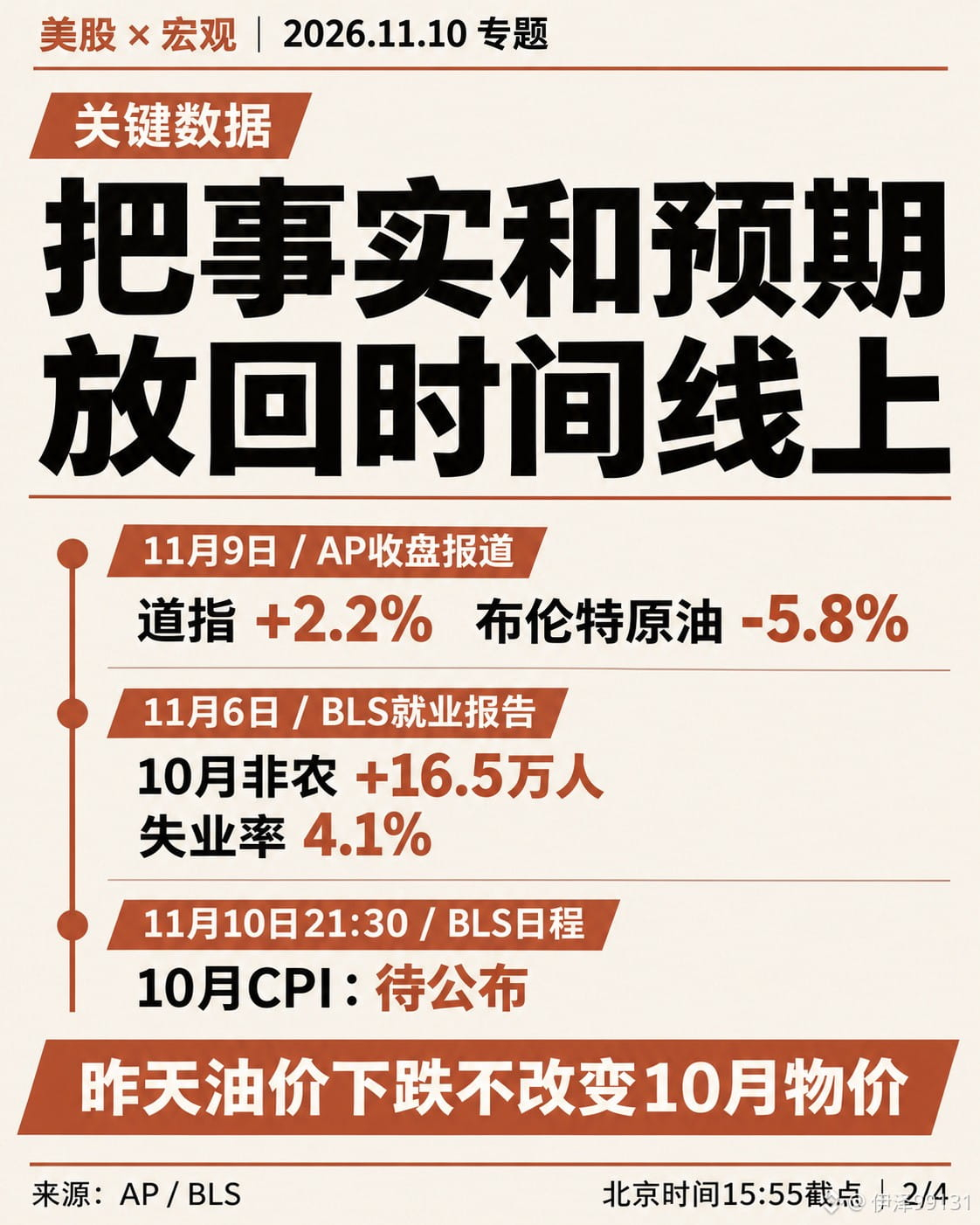
The S&P 500 rose 2.3%, the Dow rose 2.2%, and the Nasdaq rose 2.7%; Brent crude fell 5.8% on the day.
Next, we need to watch two things at once: how much companies can earn, and how much the market is willing to value those profits at.
First, the macro picture. The pullback in oil prices may help ease pressure on future energy prices, but the change in oil prices on November 9 cannot retroactively change prices that were already recorded in October. Tonight’s release is the U.S. October CPI, which measures inflation over the previous month. Saying that yesterday’s drop in oil prices means tonight’s CPI must come in lower would confuse the order of events.
First look at month-over-month core CPI, then at changes in housing and service prices. If energy alone pulls down headline inflation while core components remain firm, rate expectations may not ease for long. Conversely, if price pressures ease across a wider range of categories while economic activity remains resilient, the backdrop for equity valuations would be more favorable.
Technology stocks currently face a combination of forces: earnings growth can support share prices, while interest-rate pressures may weigh on valuations. Here’s a purely hypothetical example: if a company’s earnings per share grow 20%, but its price-to-earnings ratio falls from 30 to 25, the resulting share price would be roughly unchanged. Between a company delivering growth and shareholders receiving a similar level of returns, valuation changes still matter.
For Nvidia, AMD, and Broadcom, watch demand and deliveries; for TSMC, watch advanced process nodes and customer orders; for MU, SK Hynix, and SNDK, check the supply-demand balance and profit margins for each of their products. These companies operate at different stages of the industry, so we can’t use the same macroeconomic news to infer that their earnings will all move in sync.
The more important link is still the cloud providers. If capital spending continues to grow and actual usage and revenue keep pace, upstream orders will have stronger support. If investment grows faster than returns while financing costs remain high, the market will demand a shorter payback period. Consider both the scale of capital spending and the efficiency of that investment.
Tonight’s checklist:
Compare the actual CPI reading and its components, then watch how two-year and ten-year Treasury yields respond.
If inflationary pressures ease, Treasury yields fall, and corporate earnings expectations remain stable, conditions for a recovery will improve.