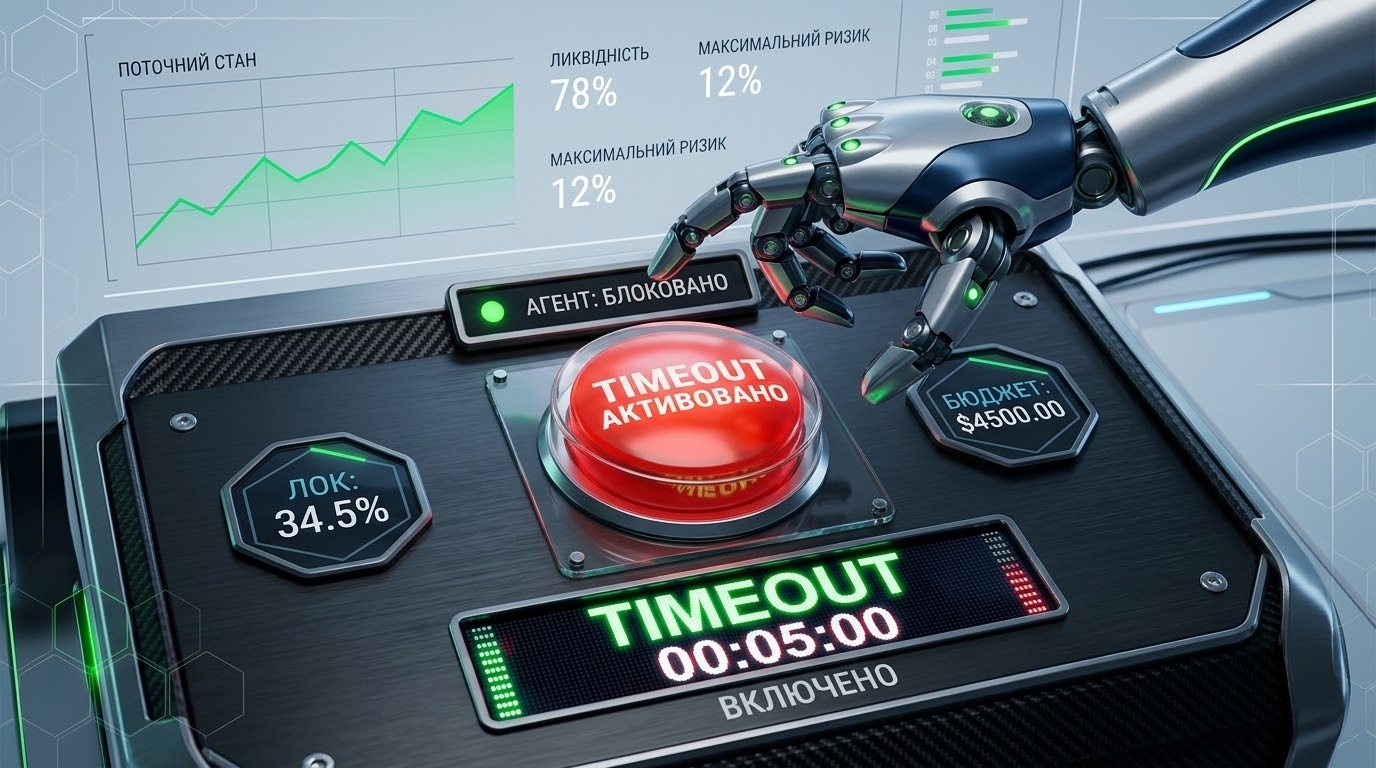

Trade automation in Web3 has reached a fundamentally new level! 🌐⚡️ Autonomous AI agents are no longer just executing pre-written scripts — they operate 24/7 to analyze market sentiment 📊, monitor on-chain liquidity 💧, and make decisions in milliseconds! ⏱🔥 However, with high speed come increased risks ⚠️📉.
When the market faces abnormal volatility 📊💥, liquidity crashes, or API failures 🔌, the main threat to the deposit becomes the algorithm itself! 😱 In such conditions, the key element of risk management is TIMEOUT (pause / timeout) 🛑⏳.
💡 What is TIMEOUT in the context of AI agents? 🤔🧠
TIMEOUT is an automatic safety feature 🛡 that temporarily or fully freezes the algorithm’s trading activity when certain critical triggers are reached 🚨.
If the classic Stop-Loss closes a specific losing position 📉, then TIMEOUT blocks the bot from opening new trades ⛔️, giving the market and the algorithm itself time to stabilize 🧘♂️📈.
⚡️ 3 Main reasons the bot needs TIMEOUT 🎯👇
1. 🔄 Protection against cascading errors (Loop-Failures)
During technical failures of exchange APIs 📡 or desynchronization of on-chain data ⛓, the AI agent may receive false signals ❌. Without a pause limit, the bot can open dozens of losing trades in a matter of seconds—completely “burning” the entire deposit! 💸💥
2. 🧊 Cooling down during abnormal volatility
During “black swans” 🦢🖤 or manipulative pump-and-dump schemes 📈📉, the order book (Order Book) thins out, and spreads widen ↔️. Entering the market at such a moment is madness and a high risk of slippage 💸. The TIMEOUT mechanism removes the bot from the game ⏸ until the spread and liquidity return to normal 🎯.
3. 👤 Human-in-the-Loop (Human control)
Autonomy is great 🤖, but final control must always remain with the trader 👨💻👑! The timeout sends alerts about abnormal behavior 📲 and provides a time window to calmly assess the situation, check the parameters, and adjust the strategy 📝👌.
📊 How to configure TIMEOUT correctly in trading: 🛠💡
📉 By number of losing trades: For example, after 3 negative trades in a row ❌❌❌ — an automatic pause of 1–2 hours ⏰.
🔻 By deposit drawdown (Drawdown): Losing >3% of capital during a session triggers TIMEOUT 🚨 until the trader confirms manually 🤝.
🌐 In the face of abnormal delays: a sudden increase in gas fee ⛽️ or an API response delay of more than 500 ms ⏱ — immediate pause mode 🛑.
🤯 An interesting fact about TIMEOUT and algorithms ⚡️🧠
🔥 Did you know? Over 60% of the largest losses in high-frequency trading (HFT) happen not because of faulty market predictions, but due to so-called “infinite loops”! 🔄💥
When the algorithm gets trapped in a technical loop due to a network failure, it can send thousands of micro-orders per second. In TradFi history, there was a case where the American company Knight Capital lost $440 million in just 45 minutes precisely because there was no strict TIMEOUT mechanism! 😱💸 One simple pause could have saved an entire business.
🎯 Summary 🏆💎
Risk management in the new era of digital finance is not only about how to enter the market effectively 🚀, but also about how to pause it in time ⏸. The ability to enable TIMEOUT preserves capital where emotions or technical glitches lead to liquidation 🛡💰✨!
💡 This article was prepared as part of the Create with Binance campaign. Word of the Day (WOTD) for this week with 7 letters: TIMEOUT! 🎁🔤
#BinanceSquare #AirdropAlert #TradingBots #RiskManagement #cryptouniverseofficial