
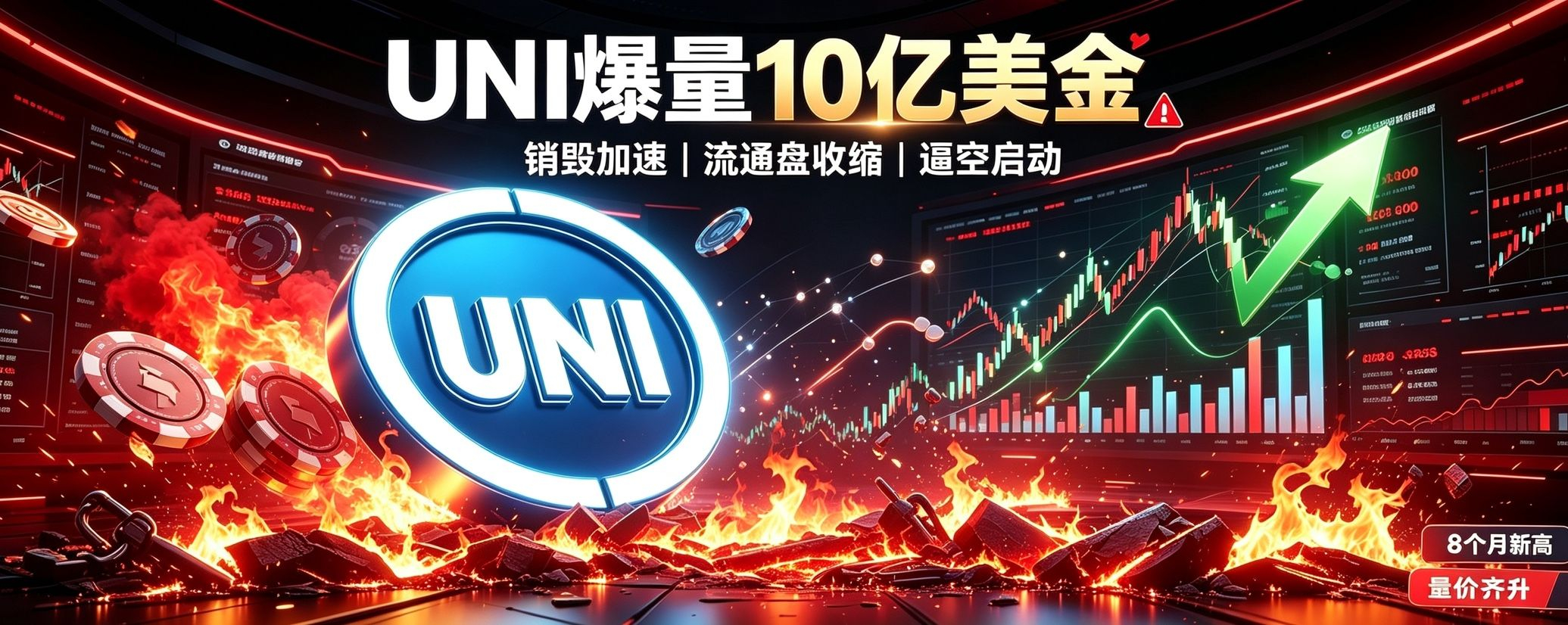
Today, UNI has gone completely off the rails.
In the past 24 hours, it surged 14.6%—trading almost up to $6.01 during the day and hitting an 8-month high; total trading volume across the entire network exceeded $1 billion in 24 hours, directly doubling versus the previous day. Volume and price are rising together—healthier couldn’t be any healthier.
This isn’t emotional hype—it’s a real fundamentals breakout. Robin Chain’s trading volume has again shattered records; Uniswap has absorbed 70% of the traffic. Every trade is accelerating the burn of UNI, and the supply-and-demand double-kill spiral has fully kicked into motion.
1. Robin Chain breaks another record Uniswap just sits back and collects a flood of traffic
The reason behind this run is Robin Chain’s exponential surge, and Uniswap is the biggest beneficiary:
• Robin Chain's daily DEX trading volume broke through $1.566 billion, surging 96% week over week, directly ranking first among global public chains in on-chain fee revenue
• Uniswap is the absolute core, accounting for over 73% of all-chain trading volume, and generating over $9 million in fees on Robin Chain in a single day, an irreplaceable liquidity powerhouse on-chain
• This has only just begun: behind Robinhood are 28 million traditional stock investors who have already deposited funds, and only a small fraction have migrated on-chain so far; the flood of incremental users is still ahead
II. Burning is the real killer: the more explosive the trading volume, the less UNI there is
What is even harder than the traffic explosion is the rigid deflation of the burn mechanism; the surge in Robin Chain activity has directly put the burn rate into the fast lane:
• After the UNIfication mechanism was implemented, all protocol fees have been used to buy back and burn UNI; cumulatively more than 101.6 million UNI have been burned, accounting for over 10% of the total supply, permanently shrinking the circulating supply
• After Robin Chain's breakout, the daily burn amount has continued to hit new stage records, and every stock token trade is quietly burning UNI
• The scariest part is the virtuous cycle: the higher the trading volume → the more fees → the faster the burn → the tighter the circulating supply → the higher the price → more funds enter → even higher trading volume
III. The supply-demand structure has already reversed, and the short-squeeze vibe is getting stronger
UNI has now entered a state of pressure from both sides:
• On the supply side: rigid burning happens every day, and the circulating supply only decreases, never increases; after long-term holders understand the deflationary logic, they collectively become reluctant to sell, low-priced chips are becoming harder to get, and selling pressure continues to shrink
• On the demand side: off-chain funds are watching Robin Chain data and moving in, on-chain trading, governance, and fee discounts bring real-use-case demand, not pure speculative hype
On one side is a continuously shrinking supply, and on the other is explosive demand growth — this is the classic shape of a short squeeze rally.
From an unnoticed governance token to a deflationary asset backed by real cash flow, and then to the DEX leader benefiting from the incremental dividend of Robin Chain, the underlying logic behind this UNI rally is more solid than that of most altcoins. This is only the first stage; when more than half of Robin Chain users have migrated and the burn rate moves up another level, the explosive power of the rally will far exceed most people's expectations.
Risk warning: The above is a market commentary and does not constitute any investment advice. The cryptocurrency market is extremely risky, prices are highly volatile, and project progress and burn intensity may fall short of expectations. Please make rational decisions and strictly control your position size.