
When blockchain projects talk about enterprise adoption, they typically focus on how “our technology is more advanced.” This time, the article Rayls put out is different. It spends the better part of the piece talking about customer complaints, and the complaints are fairly blunt. After reading it, I felt that what’s truly worth saying isn’t the list of products, but the fact that it admits something the industry is generally reluctant to acknowledge.
First, there’s something unusual about this release itself.
On August 25, Rayls launched Sovereign—a private blockchain intended for financial institutions. But according to official statements, its underlying platform has been running in production environments since June 2024, with more than 30 financial institutions already onboard and using it. Sovereign is a thoroughly rebuilt version of the earlier product called Rayls Privacy Node; the rewrite was thorough enough that they changed the name.
So it’s not a from-scratch release; it’s taking something that’s been running for two years and turning it into a product. That sequence is uncommon in the crypto industry.
What exactly are the customers complaining about?
The most valuable part of the blog post Rayls just published is the four customer feedback points it lists. I’m going to expand one of them, because it’s the starting point for the whole product.
The feedback was: shared infrastructure simply doesn’t sell.
What the official means is that a shared ledger—one used together with a counterpart—can’t pass the three hurdles of data residency, confidentiality, and operational independence before the contract is signed. Banks don’t want to share a single database with each other, and they also shouldn’t be required to do so. Each institution wants to configure systems according to its own internal policies, risk-control, and compliance benchmarks, and to build customized integrations with its own core financial systems.
This line sounds plain, but it negates a default assumption of institutional blockchain over the past few years. The entire narrative for consortium chains is built on “everyone sharing the same blockchain.” This feedback directly says that assumption dies right in the procurement stage.
Sovereign’s answer: sovereignty first, then connectivity
Their approach is to reverse the sequence.
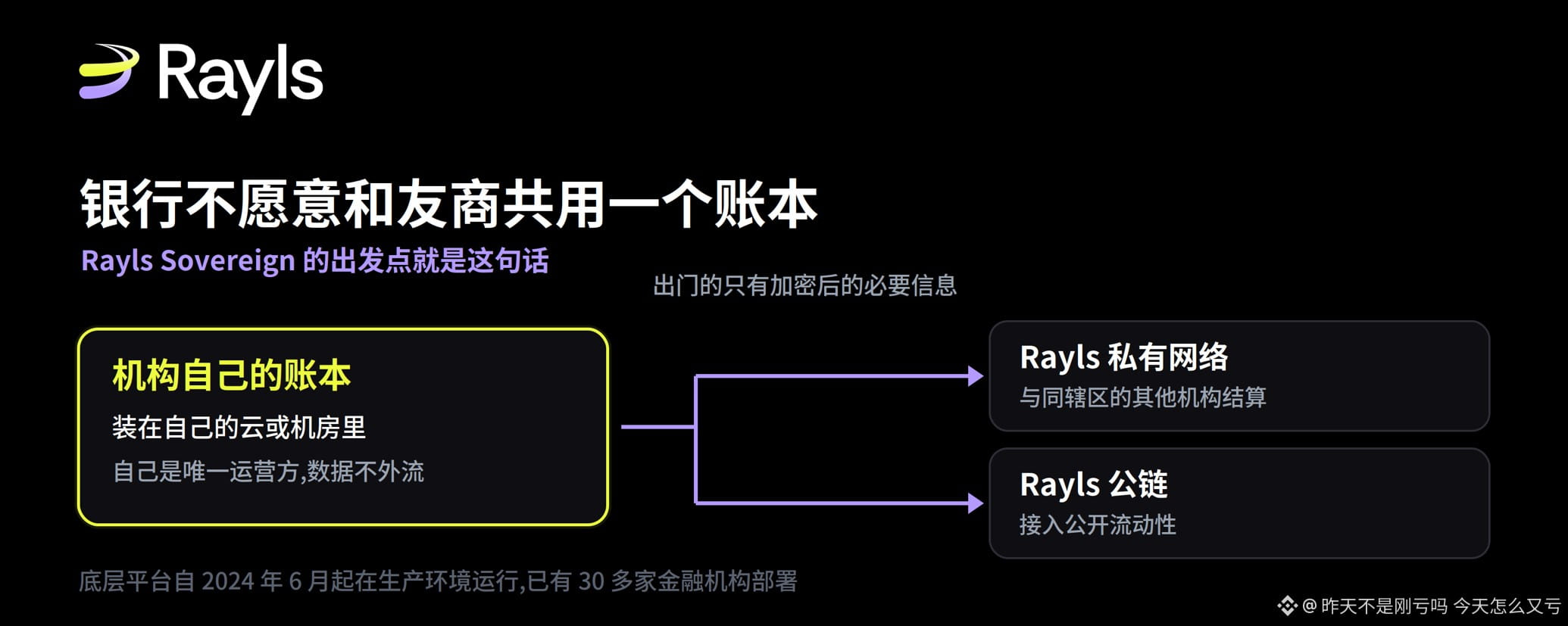
Each institution runs its own ledger, packaged in its own environment, with itself as the sole operator. No data is collected into a public pool. The only thing that goes out is the necessary encrypted information—i.e., the portion needed to transact with others and to provide the deterministic part. The official example given is zero-knowledge proofs.
Once you secure that sovereignty position, institutions connect outward: by linking through Rayls’ private network to other institutions within the same jurisdiction, and by using Rayls’ public chain to tap into public liquidity.
I think the smartest part of this design is that it separates the usually mutually competing goals of “privacy” and “connectivity” into two steps in sequence, instead of forcing them to compromise on the same layer.
The other three complaints are also worth mentioning.
The first point is why the prototype can’t make it into production. The innovation team produced a solid tokenization prototype, but then this project has to deal with other banking departments: security review, data storage and protection, security controls, procurement standards, integration with core systems, and risk and compliance. The public chain assumption is that everything on-chain is readable, exposing the attack surface; a permissioned chain either requires an alliance with competitors to share sensitive transaction data, or it reverts to a peer-to-peer architecture, re-leaning on intermediaries, and it still can’t give regulators a single source of truth. The result is that the prototype can never become part of an institutional operating model.
Second, the efficiency narrative doesn’t hold. Making an existing internal process a bit faster and cheaper isn’t enough to cover the change-management costs of replacing core infrastructure. What institutions truly want are capabilities they don’t have today—e.g., issuing tokenized deposits, holding and transferring stablecoins, distributing tokenized assets, and atomically settling with counterparties—while not giving up control over their own data and customer relationships.
Third, every incumbent platform provider comes with a cost. The official called out a few: implicit vendor lock-in, incompatibility with EVM standards, discovering later that the implicit license fees are expensive, and settlement uncertainty from probabilistic finality—this creates risk and locks up capital. It also requires using volatile crypto with unclear regulatory prospects to pay transaction fees.
Sovereign’s answer is an open-source EVM codebase, institutional own KMS or HSM-managed keys, role-based access control, high availability and monitoring, and parallel deployment with core banking systems rather than replacement. The official has a line describing it that I think is quite accurate: at its core, it’s a banking system, with an EVM ledger running on top.
Implementation depth needs to be considered separately.
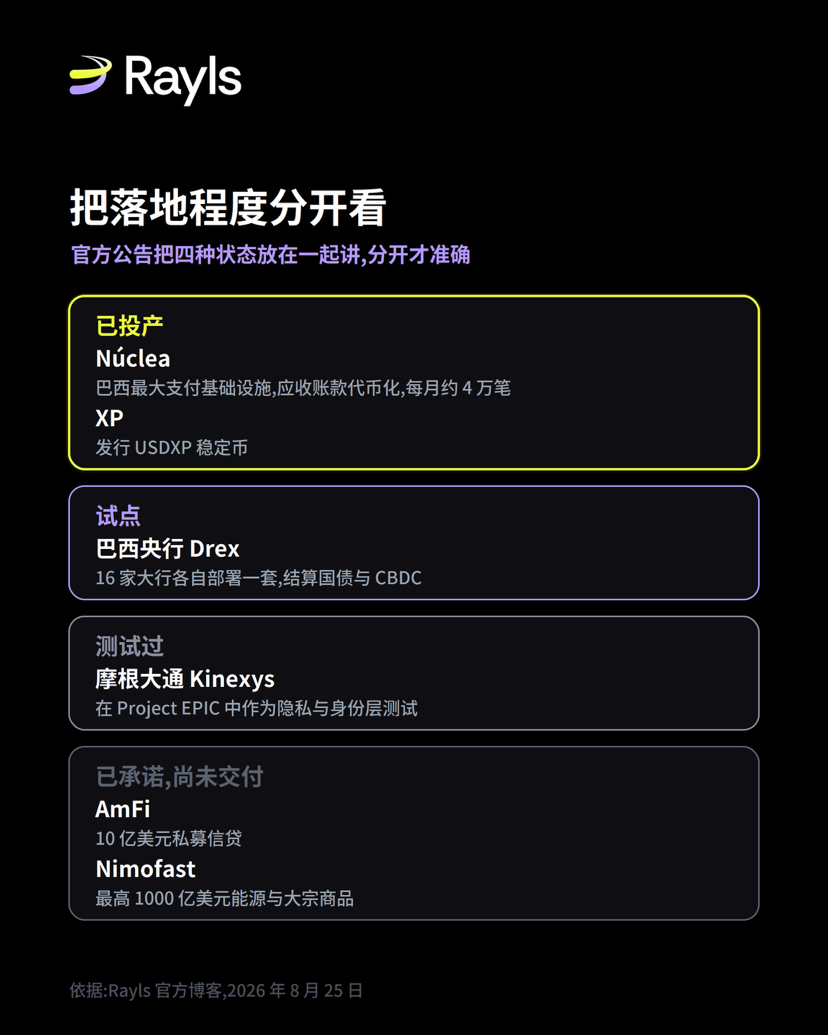
In this section, the official lists quite a few names, but their statuses aren’t all the same. Reading them together can easily inflate expectations. I’m dividing them into four tiers by implementation depth.
There are already two running in production. Núclea is Brazil’s largest payments financial market infrastructure, processing $3.5 trillion in payments per year. The official compares it to Brazil’s DTCC. On Rayls, it tokenizes corporate receivables, at a scale of about 40,000 tokenized assets per month. XP is the leading broker platform in Latin America, managing $400 billion in assets, and on Rayls Sovereign it issues fully USD-backed stablecoin USDXP.
Quick cross-check too: I previously looked up XP’s investor relations page. In Q1 2026, customer assets were 1.529 trillion reais. At roughly the 3.8 exchange rate, that’s close to $400 billion—consistent with what’s being said here.
At the pilot level, it’s Brazil’s central bank Drex. The central bank chose Rayls. Sixteen Brazilian large banks each deployed their own Sovereign instances, including Santander and the Brazilian Stock Exchange, using central bank digital currency to settle government bonds and other assets. Note the wording here is pilot, meaning a trial.
What was tested was JPMorgan’s Kinexys. The official says it tested Rayls Sovereign in Project EPIC as an institutional tokenization privacy and identity layer. Testing doesn’t equal going live. There are also distributed ledger innovation challenge competitions from the Bank of England and the BIS Innovation Hub—that was a challenge competition, not production.
The two asset issuers that have been promised but not yet delivered. AmFi plans to bring $1 billion in private credit to the network, and Nimofast has promised up to $100 billion in energy and commodities assets. Those numbers are huge, but the wording is “is bringing” and “promises up to,” not “already issued.”
After separating these four tiers, the list still carries weight, but its weight comes from having complete coverage of institutional types—from central banks, commercial banks, and market infrastructures to asset issuers—not from summing up the promised amounts into a single number.
My take
The real informational content in this release isn’t in the product feature list; it’s in the fact that it admits the road of a shared ledger can’t work in the procurement stage, and it reorganizes the architecture based on that judgment.
To judge whether it works, I’ll look at two things. First, those two promised asset categories—the $1 billion private credit and the up to $100 billion energy and commodities—whether they truly get issued in the coming few quarters. Second, global rollout: the official says it’s expanding from Brazil’s production base to the U.S., the U.K., and Europe. Regulatory environments in those markets are very different from Brazil. Whether the model can be replicated is another question.
Before that, the two already in production and the sixteen banks in the pilot are the most tangible evidence we have.
Reference source: Rayls official blog (Introducing Rayls Sovereign: the onchain gateway for institutions)
Official blog link: https://www.rayls.com/blog/introducing-rayls-sovereign-the-onchain-gateway-for-institutions
(Peter Bidewell, August 25, 2026); XP data cross-checked from XP Inc.’s investor relations page, 1Q26