


$WMT This earnings report is the most worth reading. It’s not just that revenue continues to grow; e-commerce, advertising, and membership services are still expanding at a relatively fast pace. The company has also raised its full-year revenue and profit guidance. However, the strong growth in operating profit is also influenced by factors such as tariff refunds, so it can’t be simply understood as all growth coming from an improvement in underlying operations.
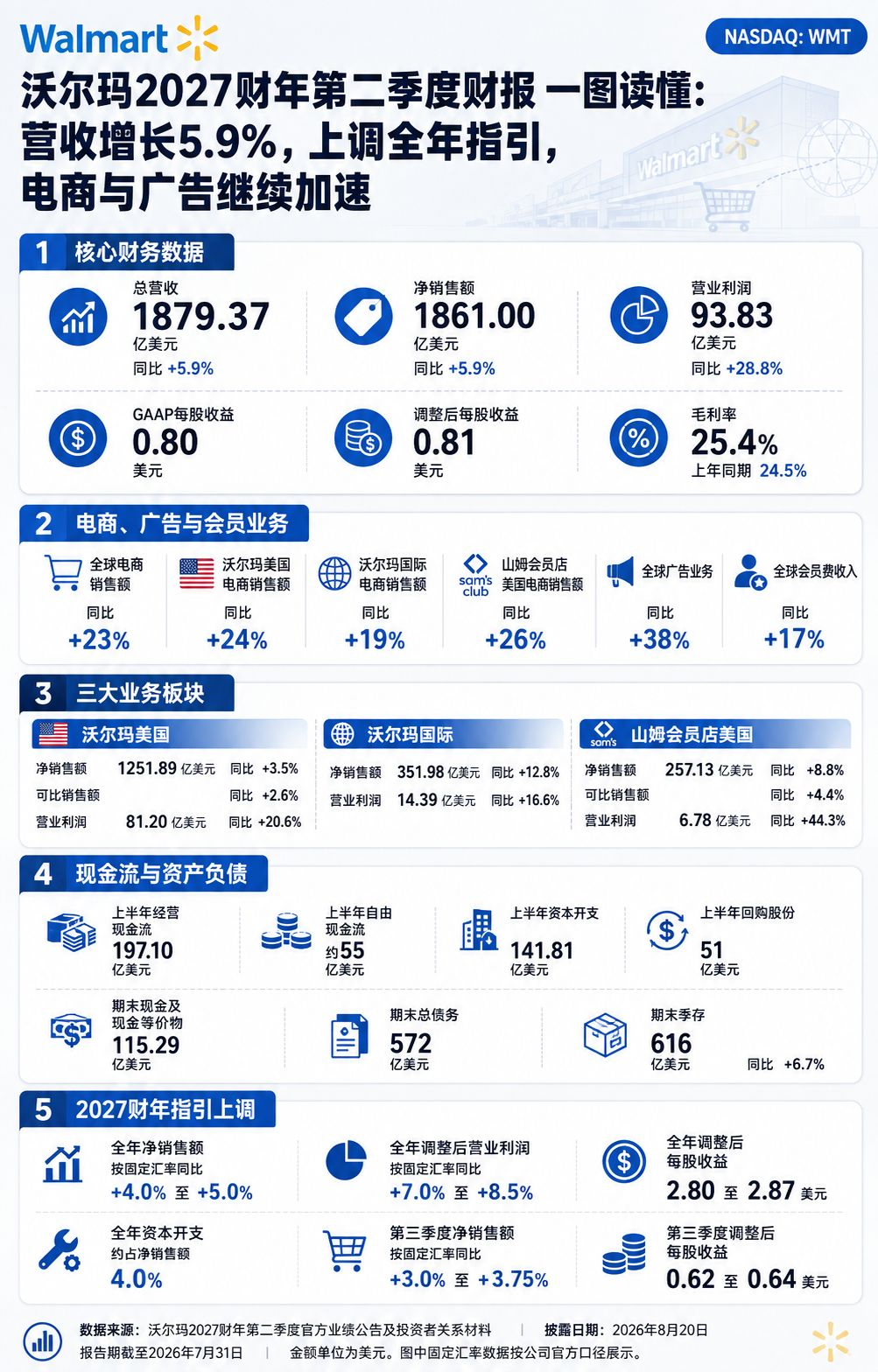
First look at the core data
Walmart’s total revenue for fiscal year 2027 Q2 was $187.937 billion, up 5.9% year over year; net sales were $186.100 billion, up 5.9% year over year. Operating profit was $9.383 billion, up 28.8%; GAAP earnings per share were $0.80, with adjusted EPS of $0.81. Gross margin was 25.4%, higher than 24.5% in the same period last year.
On the surface, this is an earnings report with stable revenue and clearly growing profits. However, net income attributable to Walmart shareholders was $6.366 billion, down 9.4% year over year, mainly due to changes in other gains and losses. Therefore, this quarter is more suitable for focusing on operating performance at the business level and adjusted metrics, rather than only looking at net profit year-over-year.
E-commerce and advertising are still the growth engines.
Global e-commerce sales grew 23% year over year. Walmart U.S. e-commerce grew 24%, Walmart International grew 19%, and Sam's Club U.S. grew 26%. From the business structure perspective, store-based fulfillment delivery and pickup, third-party marketplaces, and the scale effects brought by online businesses are still the main drivers supporting e-commerce expansion.
Advertising growth is also particularly strong. Walmart’s global advertising business grew 38% year over year. Walmart U.S. advertising also grew 38%, and Walmart Connect grew 43% after excluding VIZIO. Membership fee revenue grew 17% year over year. Walmart U.S. said Walmart+ net added members hit a quarterly record high.
The three major business segments do not perform exactly the same.
In the second quarter, Walmart U.S. net sales were $125.189 billion, up 3.5% year over year. Comparable sales grew 2.6%, and operating profit was $8.120 billion, up 20.6%. Of this, the number of transactions increased 1.5%, average basket size grew 1.1%, and e-commerce contributed about 510 basis points to comparable sales growth. Note that U.S. comparable sales were also held back by the health and wellness business by about 125 basis points.
Walmart International net sales were $35.198 billion, up 12.8%; on a constant-currency basis, growth was 7.9%. Operating profit was $1.439 billion, up 16.6%, but on a constant-currency basis growth was 5.7%. International revenue is growing faster, and currency movements provide some support to the headline growth rate. When reading, distinguish between reported figures and constant-currency figures.
Sam’s Club U.S. net sales were $25.713 billion, up 8.8%, with fuel excluded up 4.5%. Comparable sales grew 4.4%; the number of transactions increased 7.0%; and operating profit was $678 million, up 44.3%. Sam’s growth comes more from higher transaction activity and the membership system. However, average basket size fell 2.5% year over year, indicating that while consumers are buying more frequently, spending per trip is still under pressure.
Look at cash flow and profit quality together.
Operating cash flow in the first half of the year was $19.710 billion, higher than $18.352 billion in the same period last year. Free cash flow in the first half was about $5.5 billion, down from about $6.9 billion in the same period last year. Capital expenditures in the same period reached $14.181 billion, up significantly from $11.409 billion in the same period last year. This increase mainly reflects investments in stores, supply chain, and digital infrastructure.
Walmart repurchased about $5.1 billion worth of shares in the first half of the year. Cash and cash equivalents at period end were $11.529 billion, total debt at period end was $57.2 billion, and inventory was $61.6 billion, up 6.7% year over year. The inventory increase is higher than the sales increase, so subsequent inventory turnover and promotional intensity need to be monitored, especially given the company’s continued price investment.
In addition, second-quarter operating profit growth was impacted by tariff refunds. The company said clearly that part of the refunds will continue to be used for price investments in the second half of the year. Management also reminded investors that the second and third quarters should be observed together, because price investment and refund timing could cause period-specific fluctuations in the profit performance of the two quarters.
Full-year guidance raised again.
Walmart raised its net sales growth guidance for fiscal year 2027 to 4.0%–5.0% on a constant-currency basis, previously 3.5%–4.5%. Full-year adjusted operating profit growth guidance was also raised to 7.0%–8.5%, previously 6.0%–8.0%. Full-year adjusted earnings per share guidance was raised to $2.80–$2.87. Capital expenditures are expected to be about 4.0% of net sales.
Third-quarter net sales are expected to grow 3.0% to 3.75% on a constant-currency basis. Adjusted operating profit is expected to grow 2.0% to 4.0%. Adjusted earnings per share are expected to be $0.62 to $0.64. The company also mentioned that Flipkart’s major promotional activities moved from the third quarter to the fourth quarter, which will create a timing impact of more than 100 basis points on third-quarter sales growth.
Therefore, the key takeaway from this earnings report is not that “all Walmart businesses are accelerating,” but rather that core consumer demand and digital businesses remain steady. The company’s confidence in full-year revenue and profit has increased, but quarter-to-quarter results will be affected by tariff refunds, price investments, and the timing of promotions.
In one sentence: The highlights of Walmart’s earnings report are that e-commerce, advertising, membership, and profit guidance all improve in parallel. But tariff refunds, price investments, inventory, and free cash flow are still variables that must continue to be watched when judging the quality of growth.

Follow me—I will continue updating a one-page readout of key earnings reports for Hong Kong and U.S. listed companies.