
Jia Lilly
11k Posts

Jia Lilly
 Square Verified+
Building the future with NFTs, Web3, and crypto.
KOL Promotion & Project Marketing $ AMA
Open Trade

USD1 Holder
High-Frequency Trader
4.5 Years
299 Following
75.9K+ Followers
71.0K+ Liked
Posts
Portfolio
All
Quotes
Videos
Live

$MARSCOIN is extremely bullish. Will my short trade be successful or will I lose money again ? 😭😭 #Trading
Partly True
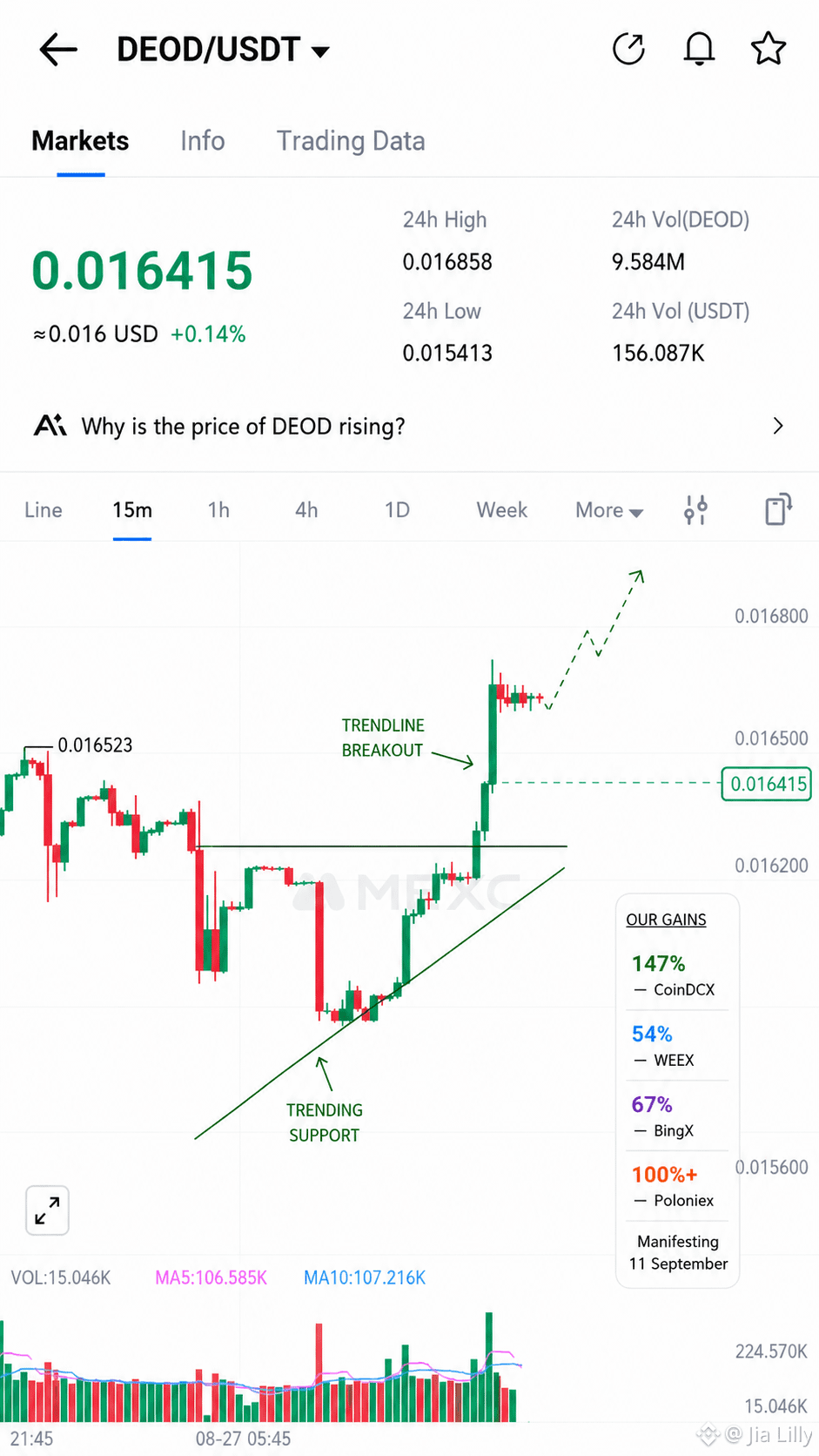
$DEOD/USDT is now generating more than $757,000 in daily volume on BingX!
I gave this gem call when $DEOD was below a $5M market cap almost 5X after my call.
Now here is my NEXT CALL, based on the upcoming Poloniex listing on 11 September.
🟢 BUY $DEOD: $0.016–$0.017 current levels
🎯 TARGET: $0.035 around the 11 September exchange launch 100%+ potential
Look at the last 3 exchange listing moves:
147% — June: CoinDCX listing
54% — July: WEEX listing
67% — August: BingX listing day
In trading, we predict the future based on history and patterns repeat themselves.
If you have funds, this is the opportunity. I’m already in.
I gave this gem call when $DEOD was below a $5M market cap almost 5X after my call.
Now here is my NEXT CALL, based on the upcoming Poloniex listing on 11 September.
🟢 BUY $DEOD: $0.016–$0.017 current levels
🎯 TARGET: $0.035 around the 11 September exchange launch 100%+ potential
Look at the last 3 exchange listing moves:
147% — June: CoinDCX listing
54% — July: WEEX listing
67% — August: BingX listing day
In trading, we predict the future based on history and patterns repeat themselves.
If you have funds, this is the opportunity. I’m already in.
Verified
Found something in the @Dusk docs I hadn't seen anyone break down: every block reward on the network splits by fixed percentages. Block generators take 70%, possibly up to 80%. The development fund gets 10%. Validation committee 5%. Ratification committee 5%. Every single block, forever, no vote needed to keep it flowing.
Why does that split matter?
Because most chains pay validators and nothing else, then beg for grants later. Dusk hardwired ecosystem funding into consensus itself. On top of that, the foundation committed 15 million $DUSK to a development fund for builders. That's treasury by protocol rule, not by promise.
Also quietly notable is this 21X, the first EU firm with a DLT-TSS license, has had live trading since September 8, 2025, and Dusk is on boarded as a trade participant. Regulated rails, already running.
My unease that 10% development fund slice compounds into serious long-term power. Who decides where it goes?
Governance question is that if $DUSK holders voted on fund allocation, would spending improve or just become politics? #dusk
Why does that split matter?
Because most chains pay validators and nothing else, then beg for grants later. Dusk hardwired ecosystem funding into consensus itself. On top of that, the foundation committed 15 million $DUSK to a development fund for builders. That's treasury by protocol rule, not by promise.
Also quietly notable is this 21X, the first EU firm with a DLT-TSS license, has had live trading since September 8, 2025, and Dusk is on boarded as a trade participant. Regulated rails, already running.
My unease that 10% development fund slice compounds into serious long-term power. Who decides where it goes?
Governance question is that if $DUSK holders voted on fund allocation, would spending improve or just become politics? #dusk

Verified
Digging into @Dusk 's Phoenix model and it finally clicked why their privacy is different from a mixer. Your funds don't sit as a public balance. They exist as encrypted notes UTXO-based, like cash in envelopes instead of a bank statement anyone can read. Each transaction proves correctness with zero-knowledge: no double spends, amounts add up, but sender, receiver, and value stay hidden.
The clever bit is this is a transaction model, not a bolt-on. Tornado-style tools add privacy on top of a transparent chain Phoenix makes confidentiality the default accounting layer, with Zedger extending it for securities that need compliant, selective disclosure.
Where I push back: encrypted notes make light wallets and indexers harder to build. Explorers, analytics, portfolio trackers the whole tooling ecosystem assumes readable balances. That's real friction for users who just want to see their money.
The governance angle that defaults matter more than options. If $DUSK holders could vote on the balance between shielded-by-default and transparent-by-default across the stack, which should win?
Do you actually use privacy features when available, or just like knowing they exist? #dusk
The clever bit is this is a transaction model, not a bolt-on. Tornado-style tools add privacy on top of a transparent chain Phoenix makes confidentiality the default accounting layer, with Zedger extending it for securities that need compliant, selective disclosure.
Where I push back: encrypted notes make light wallets and indexers harder to build. Explorers, analytics, portfolio trackers the whole tooling ecosystem assumes readable balances. That's real friction for users who just want to see their money.
The governance angle that defaults matter more than options. If $DUSK holders could vote on the balance between shielded-by-default and transparent-by-default across the stack, which should win?
Do you actually use privacy features when available, or just like knowing they exist? #dusk

·
--
🎙️ $DUSK CURRENT ANALYSIS AND TRADING STRATEGIES
End
02 h 08 m 21 s
1k
0
$TAC is getting out of the range again 😔
The reds are getting ugly now in my portfolio. What can I do 😔 😭😭 #trading
The reds are getting ugly now in my portfolio. What can I do 😔 😭😭 #trading
Most people arguing about @Dusk today don't know how long this thing has been cooking. The incentivized testnet's first phase wrapped on December 31, 2022 with over 600 provisioners and almost 2,000 signups. The mainnet date was only announced September 20, 2024, and the first immutable block landed January 7, 2025.
Read that again. Years of testnet before a single production block. In a market where teams ship a chain in a weekend and patch it live, that pacing says something about who this is built for.
Regulated finance doesn't forgive "move fast and break things" a broken settlement is a lawsuit, not a postmortem thread.My concern is the flip side of patience. Mainnet is barely 19 months old. The ecosystem is still young, tooling is thin, and 600 testnet provisioners doesn't automatically become 600 mainnet operators. Testnets pay incentives; mainnet demands conviction.
Governance thought: the people who ran nodes through a two-year testnet earned their say. Should early provisioners carry extra weight in $DUSK governance, or is one token one vote the only fair model? #dusk
Read that again. Years of testnet before a single production block. In a market where teams ship a chain in a weekend and patch it live, that pacing says something about who this is built for.
Regulated finance doesn't forgive "move fast and break things" a broken settlement is a lawsuit, not a postmortem thread.My concern is the flip side of patience. Mainnet is barely 19 months old. The ecosystem is still young, tooling is thin, and 600 testnet provisioners doesn't automatically become 600 mainnet operators. Testnets pay incentives; mainnet demands conviction.
Governance thought: the people who ran nodes through a two-year testnet earned their say. Should early provisioners carry extra weight in $DUSK governance, or is one token one vote the only fair model? #dusk

Verified
One thing that surprised me after reading the @Dusk docs that you only need 1,000 $DUSK to run a provisioner and participate in consensus. No massive capital gate. Your stake activates at the epoch boundary, roughly 6 to 12 hours, and then you're in the sortition pool.The consensus itself works differently than I assumed. Instead of every validator voting on every block, provisioners get selected through stake-weighted deterministic sortition into small committees per block.
Fewer signatures, faster finality, lower hardware burden. Right now the network runs on roughly 30 provisioners. That's the part I keep going back and forth on.
Thirty independent operators can be meaningfully decentralized if they're genuinely independent but it's not Ethereum-scale, and pretending otherwise would be unfair.
Low entry is great for participation, but it doesn't fix distribution if a handful of large stakers dominate committee selection anyway.
Governance angle with sortition being stake-weighted, big $DUSK holders get picked more often. Does that count as fair representation or soft capture?
What's your take is 30 provisioners enough for regulated finance? #dusk
Fewer signatures, faster finality, lower hardware burden. Right now the network runs on roughly 30 provisioners. That's the part I keep going back and forth on.
Thirty independent operators can be meaningfully decentralized if they're genuinely independent but it's not Ethereum-scale, and pretending otherwise would be unfair.
Low entry is great for participation, but it doesn't fix distribution if a handful of large stakers dominate committee selection anyway.
Governance angle with sortition being stake-weighted, big $DUSK holders get picked more often. Does that count as fair representation or soft capture?
What's your take is 30 provisioners enough for regulated finance? #dusk

·
--
🎙️ $DUSK NEW HIGH LEVELS AND TRADING STRATEGY
End
01 h 27 m 43 s
796
1
Guys again at this point almost all traders can sense the manipulation from the $BEAT pump 🤔
What can I say at this point guys?
should I accept my loss 😭😭 #trading
What can I say at this point guys?
should I accept my loss 😭😭 #trading
Verified
Most people miss what @Dusk actually inherits through NPEX. Not one license three. MTF license to operate a regulated secondary market. Broker license to source and distribute assets. ECSP license for crowdfunding-style issuance. All under AFM supervision in the Netherlands.
Stack those together and you get the full asset lifecycle legally covered: issue it, list it, trade it. Most crypto projects have zero of these. Dusk effectively has the regulatory plumbing for a complete securities venue before DuskEVM mainnet even ships. Pair that with ~10 second deterministic finality and selective disclosure, and the compliance story writes itself. Partners like 21X, licensed under the EU DLT Pilot Regime, and Quantoz's regulated stablecoin plug into the same rails.
But here's the thought I keep circling. Licenses are jurisdiction-bound. This stack works in the EU the US and Asia are a whole separate battle, possibly years of it.
Governance bit if NPEX holds the licenses, how much leverage does the $DUSK community really have? Are we co-owners or just along for the ride?
Honest answers welcome. #dusk
Stack those together and you get the full asset lifecycle legally covered: issue it, list it, trade it. Most crypto projects have zero of these. Dusk effectively has the regulatory plumbing for a complete securities venue before DuskEVM mainnet even ships. Pair that with ~10 second deterministic finality and selective disclosure, and the compliance story writes itself. Partners like 21X, licensed under the EU DLT Pilot Regime, and Quantoz's regulated stablecoin plug into the same rails.
But here's the thought I keep circling. Licenses are jurisdiction-bound. This stack works in the EU the US and Asia are a whole separate battle, possibly years of it.
Governance bit if NPEX holds the licenses, how much leverage does the $DUSK community really have? Are we co-owners or just along for the ride?
Honest answers welcome. #dusk
Partly True
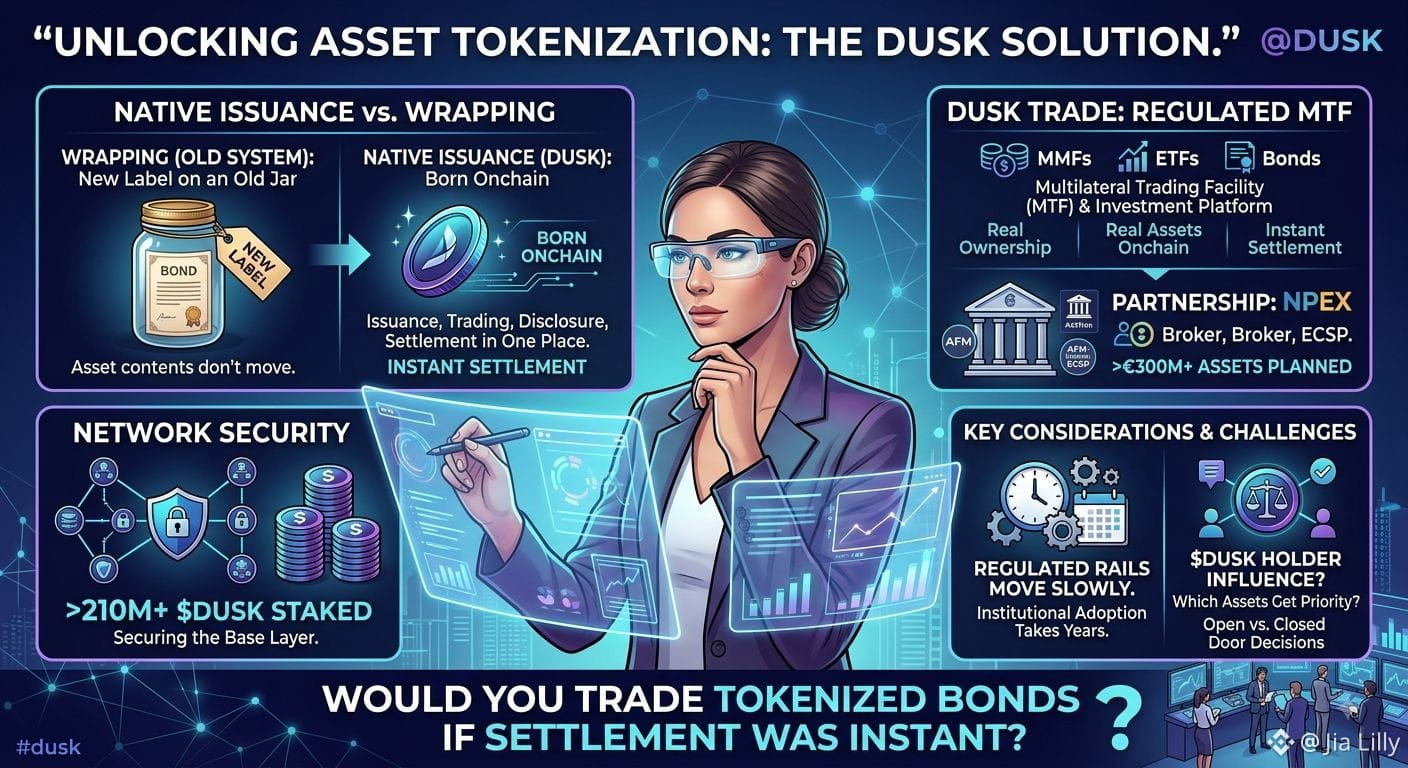
These numbers rewired my brain about @Dusk . Owning a stock through a traditional broker takes around 3 days to fully settle. Dusk Trade is promising 3 seconds. T+0, 24/7, no clearing house middleman.
That's not a small upgrade, it's a different category. Traditional settlement ties up capital for 2-3 days because paper-era plumbing never got replaced. On Dusk Trade, MMFs, ETFs, and bonds settle atomically against payment and you actually own the asset, not an IOU from your broker.
The credibility piece: it's built with NPEX, a licensed exchange running €300M AUM with 20,000+ existing investors, structured as a regulated MTF. This isn't a DeFi degen app wearing a suit.
Honest doubt: 24/7 trading sounds great until you realize institutions still work office hours. Weekend liquidity could be a ghost town at first. Though for retail like us, buying a bond on a Sunday night is genuinely new.
Governance angle should $DUSK holders vote on which asset classes list first? Bonds or ETFs what would you prioritize? #dusk
That's not a small upgrade, it's a different category. Traditional settlement ties up capital for 2-3 days because paper-era plumbing never got replaced. On Dusk Trade, MMFs, ETFs, and bonds settle atomically against payment and you actually own the asset, not an IOU from your broker.
The credibility piece: it's built with NPEX, a licensed exchange running €300M AUM with 20,000+ existing investors, structured as a regulated MTF. This isn't a DeFi degen app wearing a suit.
Honest doubt: 24/7 trading sounds great until you realize institutions still work office hours. Weekend liquidity could be a ghost town at first. Though for retail like us, buying a bond on a Sunday night is genuinely new.
Governance angle should $DUSK holders vote on which asset classes list first? Bonds or ETFs what would you prioritize? #dusk

Verified
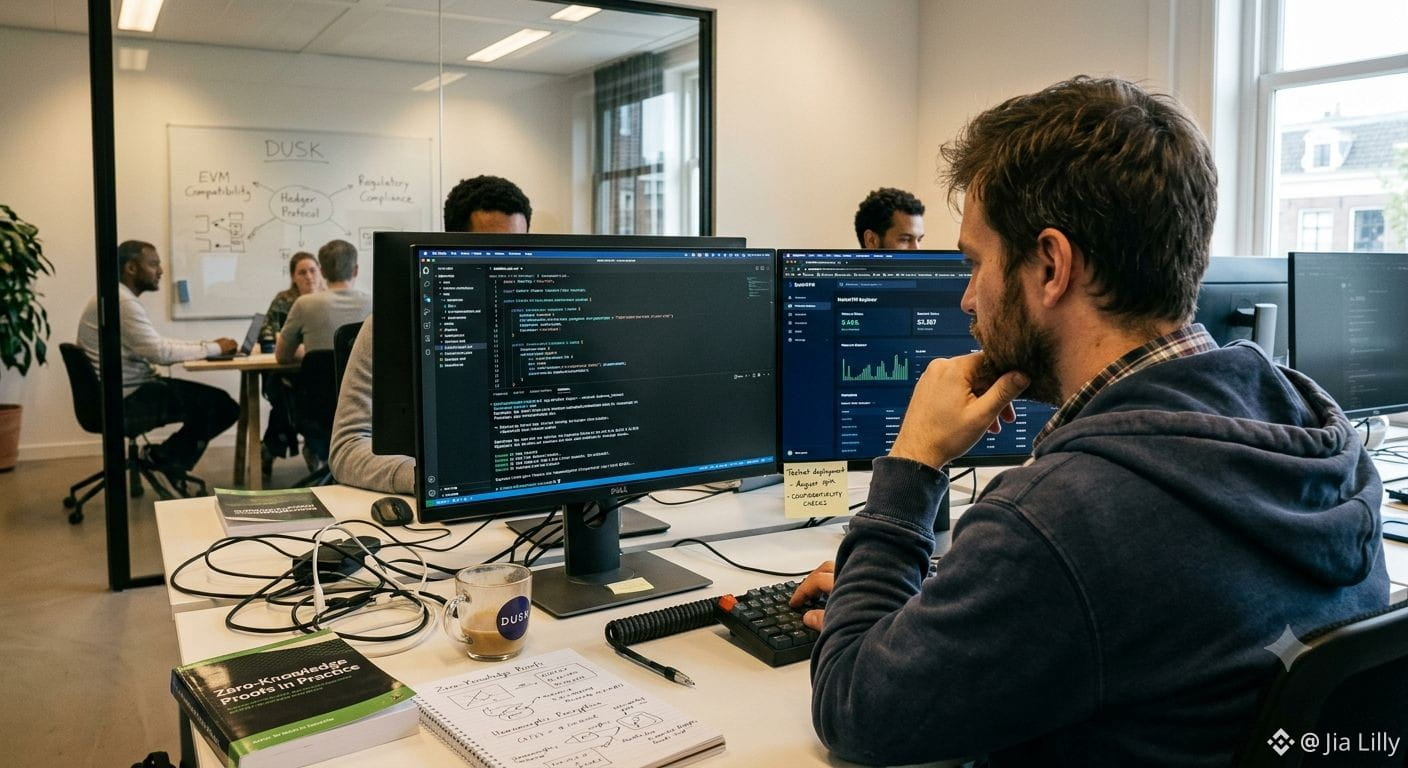
August 10 might end up being the date that mattered for @Dusk . The DuskEVM public testnet went live, and the team calls it the final stage before mainnet. Not another roadmap slide man actual environment where devs can deploy Solidity contracts today using Hardhat and standard Ethereum tooling.
Why I care the EVM has something like 80%+ of all smart contract devs. Forcing institutions to learn a custom stack was always Dusk's adoption bottleneck. Now they get a familiar door in, with Hedger behind it confidential EVM via homomorphic encryption and zero-knowledge proofs, but reviewable for regulators.
Skeptical side testnet to mainnet is where timelines slip in crypto. A confidential EVM is genuinely hard engineering; bugs here aren't just exploits, they're compliance failures. One leaked trade on a regulated venue and the whole pitch collapses. I want it to work, but I'm watching carefully.
Governance thought that who decides when testnet is "ready" the foundation, or $DUSK holders? Do you think mainnet ships this year? #dusk
Why I care the EVM has something like 80%+ of all smart contract devs. Forcing institutions to learn a custom stack was always Dusk's adoption bottleneck. Now they get a familiar door in, with Hedger behind it confidential EVM via homomorphic encryption and zero-knowledge proofs, but reviewable for regulators.
Skeptical side testnet to mainnet is where timelines slip in crypto. A confidential EVM is genuinely hard engineering; bugs here aren't just exploits, they're compliance failures. One leaked trade on a regulated venue and the whole pitch collapses. I want it to work, but I'm watching carefully.
Governance thought that who decides when testnet is "ready" the foundation, or $DUSK holders? Do you think mainnet ships this year? #dusk
Verified
One detail in the @Dusk x Chainlink partnership that people glossed over: CCIP becomes the canonical cross-chain layer for tokenized assets issued by NPEX on DuskEVM. Canonical is the keyword. Not "one of many bridges" THE bridge.
Why that matters: a regulated security can't have five competing wrapped versions floating across chains with different risk profiles. Fragmented liquidity kills institutional products. One canonical standard means an NPEX-issued bond moves between chains wAugust 10 might end up being the date that mattered for $DUSK . The DuskEVM public testnet went live, and the team calls it the final stage before mainnet. Not another roadmap slide an actual environment where devs can deploy Solidity contracts today using Hardhat and standard Ethereum tooling.
Why I care the EVM has something like 80%+ of all smart contract devs. Forcing institutions to learn a custom stack was always Dusk's adoption bottleneck. Now they get a familiar door in, with Hedger behind it confidential EVM via homomorphic encryption and zero-knowledge proofs, but reviewable for regulators.
Skeptical side testnet to mainnet is where timelines slip in crypto. A confidential EVM is genuinely hard engineering; bugs here aren't just exploits, they're compliance failures. One leaked trade on a regulated venue and the whole pitch collapses. I want it to work, but I'm watching carefully.
Governance thought is that who decides when testnet is "ready" the foundation, or $DUSK holders? Do you think mainnet ships this year? #dusk
Why that matters: a regulated security can't have five competing wrapped versions floating across chains with different risk profiles. Fragmented liquidity kills institutional products. One canonical standard means an NPEX-issued bond moves between chains wAugust 10 might end up being the date that mattered for $DUSK . The DuskEVM public testnet went live, and the team calls it the final stage before mainnet. Not another roadmap slide an actual environment where devs can deploy Solidity contracts today using Hardhat and standard Ethereum tooling.
Why I care the EVM has something like 80%+ of all smart contract devs. Forcing institutions to learn a custom stack was always Dusk's adoption bottleneck. Now they get a familiar door in, with Hedger behind it confidential EVM via homomorphic encryption and zero-knowledge proofs, but reviewable for regulators.
Skeptical side testnet to mainnet is where timelines slip in crypto. A confidential EVM is genuinely hard engineering; bugs here aren't just exploits, they're compliance failures. One leaked trade on a regulated venue and the whole pitch collapses. I want it to work, but I'm watching carefully.
Governance thought is that who decides when testnet is "ready" the foundation, or $DUSK holders? Do you think mainnet ships this year? #dusk
Log in to explore more content