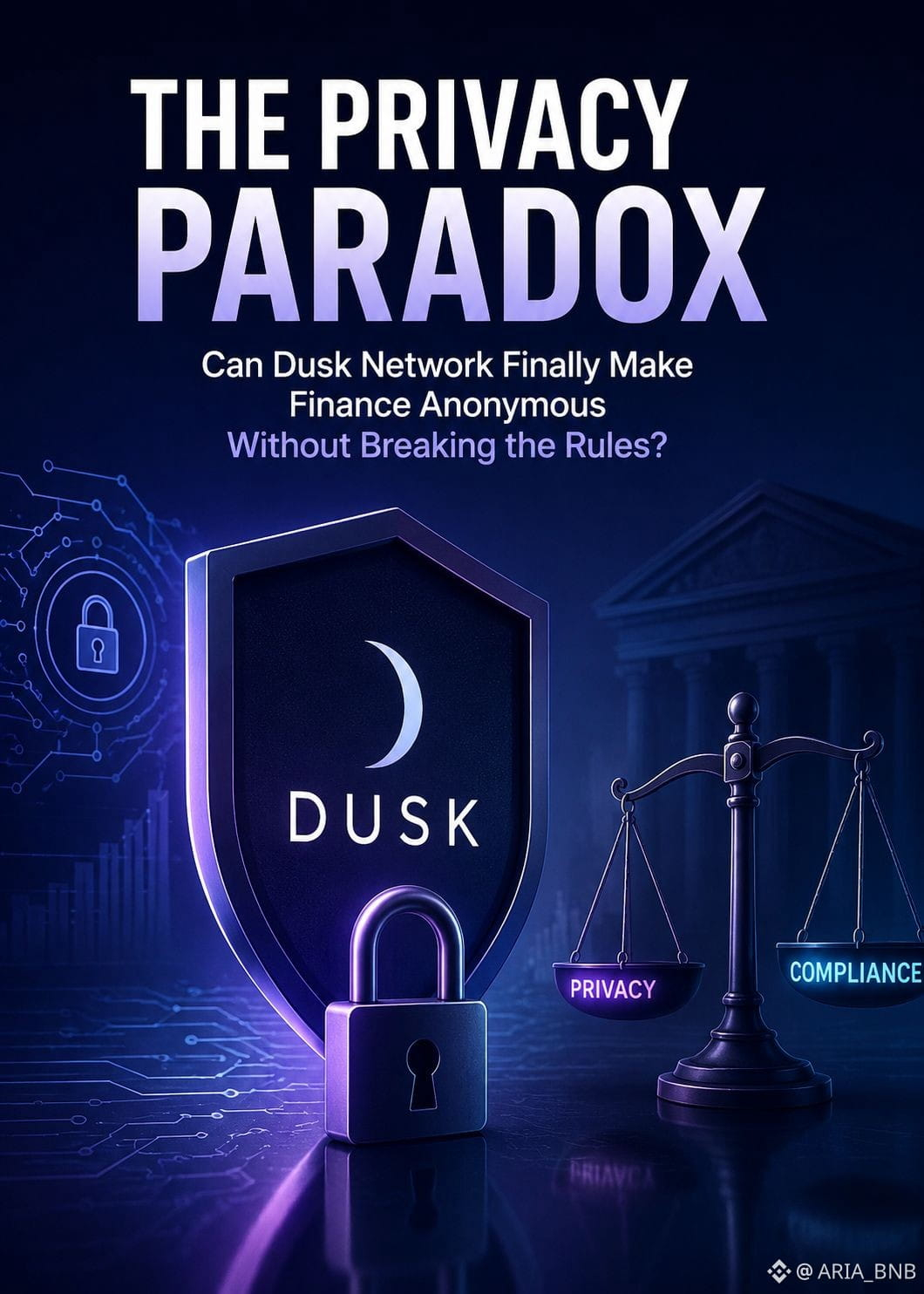
The Privacy Paradox: Can Dusk Network Finally Make Finance Anonymous Without Breaking the Rules?
I remember when I first stumbled across Dusk Network. It was late 2020, and I was deep in a rabbit hole about zero-knowledge proofs, convinced that the future of finance had to be private but completely stuck on how to make that work with regulators breathing down everyone's neck. The whole thing felt like an impossible puzzle.
Then I found Dusk, and something clicked.
Here's a layer-1 blockchain that's not trying to be everything to everyone. That's rare these days. Every other project wants to be the "Ethereum killer" or the "Solana alternative" or whatever marketing buzzword gets the most attention on Crypto Twitter. Dusk instead said: "What if we just focused on making financial transactions actually private?" Not pseudo-private. Not "anonymity for the technically savvy." Actually private.
The Confidential Security Contract (XSC) standard is where things get interesting. Most smart contracts are like glass houses—everyone can see what's happening inside. Even on privacy-focused chains, the execution logic often leaks information. XSC changes that by making the contract itself confidential. The inputs, the outputs, the state transitions, all hidden.
This matters more than most people realize.
Think about an institutional investor moving millions in assets. They're not doing that on a public chain where everyone can front-run their trades or copy their strategy. That's career suicide. Dusk creates a space where those transactions can happen without broadcasting your entire playbook to the world.
But here's where Dusk separates itself from the "privacy coins" that regulators love to hate. The network was built with compliance in mind from day one. Not as an afterthought, not as a PR move, but as a fundamental design principle. You can have privacy and auditability when needed. Selective disclosure isn't just a feature—it's the entire philosophy.
@Dusk #dusk $DUSK
I remember when I first stumbled across Dusk Network. It was late 2020, and I was deep in a rabbit hole about zero-knowledge proofs, convinced that the future of finance had to be private but completely stuck on how to make that work with regulators breathing down everyone's neck. The whole thing felt like an impossible puzzle.
Then I found Dusk, and something clicked.
Here's a layer-1 blockchain that's not trying to be everything to everyone. That's rare these days. Every other project wants to be the "Ethereum killer" or the "Solana alternative" or whatever marketing buzzword gets the most attention on Crypto Twitter. Dusk instead said: "What if we just focused on making financial transactions actually private?" Not pseudo-private. Not "anonymity for the technically savvy." Actually private.
The Confidential Security Contract (XSC) standard is where things get interesting. Most smart contracts are like glass houses—everyone can see what's happening inside. Even on privacy-focused chains, the execution logic often leaks information. XSC changes that by making the contract itself confidential. The inputs, the outputs, the state transitions, all hidden.
This matters more than most people realize.
Think about an institutional investor moving millions in assets. They're not doing that on a public chain where everyone can front-run their trades or copy their strategy. That's career suicide. Dusk creates a space where those transactions can happen without broadcasting your entire playbook to the world.
But here's where Dusk separates itself from the "privacy coins" that regulators love to hate. The network was built with compliance in mind from day one. Not as an afterthought, not as a PR move, but as a fundamental design principle. You can have privacy and auditability when needed. Selective disclosure isn't just a feature—it's the entire philosophy.
@Dusk #dusk $DUSK