
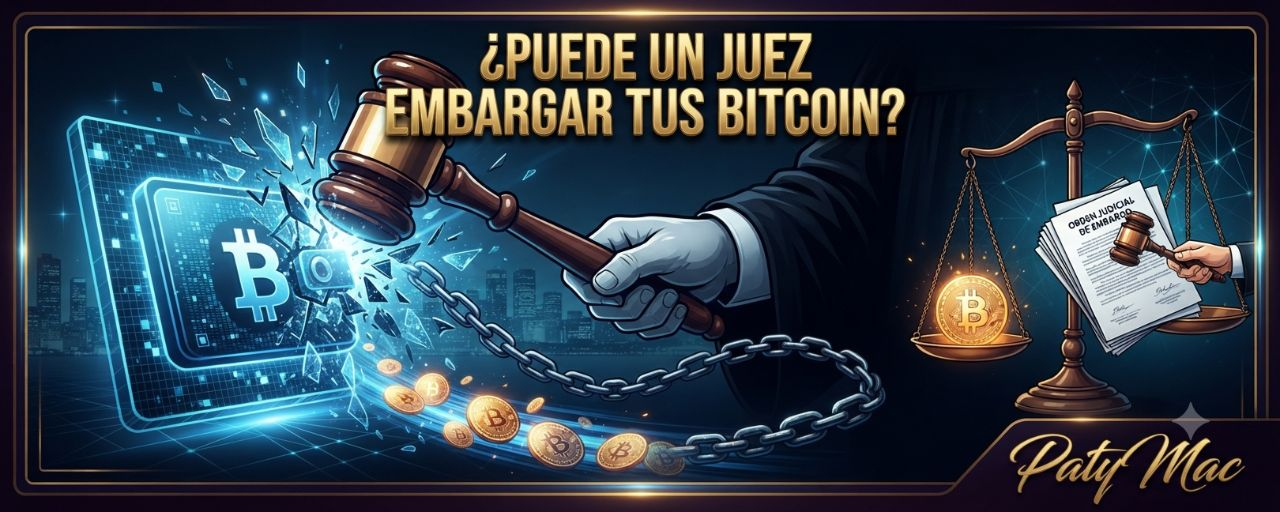
⚖️ Can a judge seize your Bitcoin?
Blockchain is not above Justice. But seizing Bitcoin isn't as simple as seizing a car.
This is one of the questions that is going to grow the most as cryptoassets become part of people's assets.
Let's imagine a simple case:
A person has a debt.
A creditor initiates a legal proceeding.
The judge orders a precautionary measure on the debtor's assets.
The person has:
🏠 a property;
🚗 a vehicle;
🏦 money in a bank account;
₿ and Bitcoin.
The first assets have known legal and registry mechanisms.
But...
what do we do with the Bitcoin?
That’s where the real challenge begins.
🔗 FIRST: BITCOIN IS NOT "INSIDE" THE BLOCKCHAIN AS A PHYSICAL OBJECT
This clarification is important.
When we say that someone "has Bitcoin," we normally mean units of value recorded on a blockchain network and controlled through cryptographic mechanisms.
There is no physical coin stored inside the computer.
What exists is a distributed ledger and a way to prove/control the possibility to dispose of certain assets through cryptographic keys.
So, to analyze a seizure, it’s not enough to ask:
"Where is the Bitcoin?"
We have to ask:
"Who has legal and technical control over that asset?"
⚖️ WHAT IS A SEIZURE?
In general terms, a seizure is a measure intended to affect certain property or rights of the obligated party to secure the outcome of a proceeding or a possible future execution.
With an automobile we can identify:
🚗 brand;
🚗 model;
🚗 license plate;
🚗 registered title holder.
With real estate, we can turn to registries and title records.
With a bank account, there is an institution that maintains the relationship with the account holder.
But with a self-custodial wallet, we can run into something completely different:
a blockchain address and a private key that controls the ability to perform certain operations.
🏦 CASE 1: BITCOIN IS ON AN EXCHANGE
Suppose a person keeps their Bitcoins on a centralized platform.
The situation may be legally simpler than in a fully self-custodial wallet.
Why?
Because there is an identifiable third party that maintains a relationship with the user and may be subject to certain legal or judicial obligations, depending on the applicable jurisdiction.
In Paraguay, for example, virtual asset service providers are contemplated within the regulatory framework for preventing money laundering and terrorist financing. This shows that virtual assets and those who provide certain related services are already part of the regulated universe, although that does not mean there is a single, complete piece of legislation covering all forms of cryptocurrency seizure.
That’s why it’s important not to confuse:
"crypto currencies are regulated in some way"
with:
"there is a specific, complete procedure to seize any cryptocurrency."
These are completely different statements.
🔐 CASE 2: BITCOIN IN A SELF-CUSTODIAL WALLET
Now comes the interesting case.
The person has Bitcoin in a self-custodial wallet.
There is no bank.
There is no exchange that controls the funds.
There is no third party that necessarily holds the keys.
The holder controls the wallet through their cryptographic credentials.
Then a question appears:
Can a judge order a seizure?
A court order can legally affect the debtor’s property rights under the applicable procedure and legislation.
But...
how is it executed technically?
That’s the problem.
A judge can’t simply write on the blockchain:
"These Bitcoins are seized."
The network doesn’t work that way.
Execution requires a legal and technical mechanism compatible with the type of asset, its custody, and the people or entities that can carry out the order.
🧠 A COURT ORDER AND ACCESS TO THE WALLET ARE TWO DIFFERENT THINGS
This is probably the most important point.
Let’s suppose there is a court order.
The order can set a measure over certain assets.
But if those assets are in a self-custodial wallet and only the holder knows the private key...
the existence of the order does not magically create the key.
That’s why we can have:
A legal reality:
"These assets are covered by a court measure."
And simultaneously:
A technical reality:
"There is no third party that can directly execute the transfer."
The difference between these two realities will be one of the great challenges for the law in relation to digital assets.
⛓️ AND WHAT ABOUT DECENTRALIZATION?
Another frequent error appears here.
Some people say:
"Bitcoin is decentralized, so no judge can touch it."
That’s too simplistic.
Decentralization of the network means there is no central authority that unilaterally controls the Bitcoin protocol.
But that doesn’t mean that people who own Bitcoin are outside the reach of the laws.
One thing is:
network decentralization.
Another:
legal responsibility of the holder.
A judge may issue orders regarding people and their assets according to the applicable jurisdiction and procedure.
The difficulty may lie in how to make the measure effective over a self-custodied digital asset.
🌎 THE PROBLEM GETS COMPLICATED WHEN THERE ARE MULTIPLE COUNTRIES
Now let’s imagine:
🇵🇾 The debtor lives in Paraguay.
🇺🇸 The exchange is incorporated in the United States.
🇧🇷 The creditor is in Brazil.
₿ The Bitcoins are in a self-custodial wallet.
Who has jurisdiction?
Which law applies?
How is the measure executed?
Is international judicial cooperation required?
These questions can turn an apparently simple seizure into a Private International Law and cross-border enforcement problem.
And this is especially relevant because cryptoassets can circulate internationally in a matter of seconds.
🚨 CAN THE DEBTOR TRANSFER THE BITCOIN BEFORE THE SEIZURE?
This is another issue that deserves attention.
If a person knows that a judicial process exists and deliberately transfers their assets to frustrate a legitimate measure, legal consequences may arise depending on the specific case and the applicable legislation.
That’s why we also shouldn’t confuse:
"I have a self-custodial wallet."
with:
"I can legally make my assets disappear."
Self-custody can make execution technically difficult.
It doesn’t necessarily eliminate the holder’s legal obligations.
🔥 THE BIG CHALLENGE FOR THE COURTS
Judicial systems were designed for decades around assets that could:
📋 register;
📍 to be located;
🔒 to be immobilized;
📑 to be seized;
💰 be sold through the courts.
Now an asset appears that can:
🌎 cross borders in seconds;
🔐 be protected by cryptography;
📱 be controlled from a device;
💻 be in a self-custodial wallet;
and not depend on a central institution.
This forces us to rethink how certain property-related measures are executed.
🇵🇾 AND WHAT HAPPENS IN PARAGUAY?
We must be especially rigorous here.
It would not be correct to claim that Paraguay already has a specific, detailed, and uniform procedure to "seize Bitcoin" in any situation.
What we can observe, however, is that the Paraguayan legal system already legally recognizes certain phenomena linked to virtual assets and virtual asset service providers, within the corresponding regulatory framework.
Moreover, recent Paraguayan legislation has advanced the use of electronic means and the regulation of systems related to payments, custody, and transfer, showing an evolution toward a legal infrastructure better suited to the digital economy.
But one thing is legally recognizing certain aspects of digital assets...
and quite another is to have resolved every possible procedural scenario.
There is still a huge space for legal development.
💡 WHAT SHOULD A MODERN REGULATION CONTEMPLATE?
A specific piece of legislation should answer, among other things, questions like:
How is a cryptoasset belonging to the debtor legally identified?
How do you order a measure over a self-custodial wallet?
What obligations does an exchange have toward a court order?
How is the asset valued when its price is extremely volatile?
How would an eventual execution be carried out?
What happens if the asset is located in a foreign jurisdiction?
How do we protect privacy without preventing the legitimate execution of a court order?
What do we do when the holder loses their keys?
These are questions that do not have a purely technological answer.
These are legal questions.
🧠 THE GREAT CONFUSION
There are two extremes we should avoid.
EXTREME 1:
"Crypto currencies are completely untouchable because they are on the blockchain."
❌ Incorrect as a general statement.
EXTREME 2:
"A judge can enter any wallet and take your Bitcoin."
❌ That doesn’t work like that either.
Reality is in the middle:
⚖️ There may be a legal effect on the debtor’s assets.
But
🔐 the technical execution will depend on how the asset is being held in custody.
And that difference is fundamental.
🚀 THE NEXT BIG DEBATE
For years we asked:
Will Bitcoin replace money?
Now we should start asking more legal questions:
How is it seized?
How is it inherited?
How do you divide it in a divorce?
How is a debt executed?
How is it declared in an inheritance?
How do we protect against insolvency?
Because when Bitcoin stops being only an investment and becomes part of the assets of millions of people...
the law inevitably has to deal with it.
And perhaps the most interesting question is not:
"Can a judge seize your Bitcoin?"
So:
"How do you execute a court order over an asset that was designed not to depend on a central authority?"
That’s where the debate really begins.
💬 Now it’s your turn:
If a judge ordered you to have your Bitcoin seized and they were in a self-custodial wallet...
how do you think that order should be executed?
Should there be a specific legal procedure?
Or should Bitcoin’s decentralized nature prevent that kind of intervention?
I’ll read you. 👇



#Criptomonedas #DerechoDigital #Embargo #Justicia #ActivosDigitales
