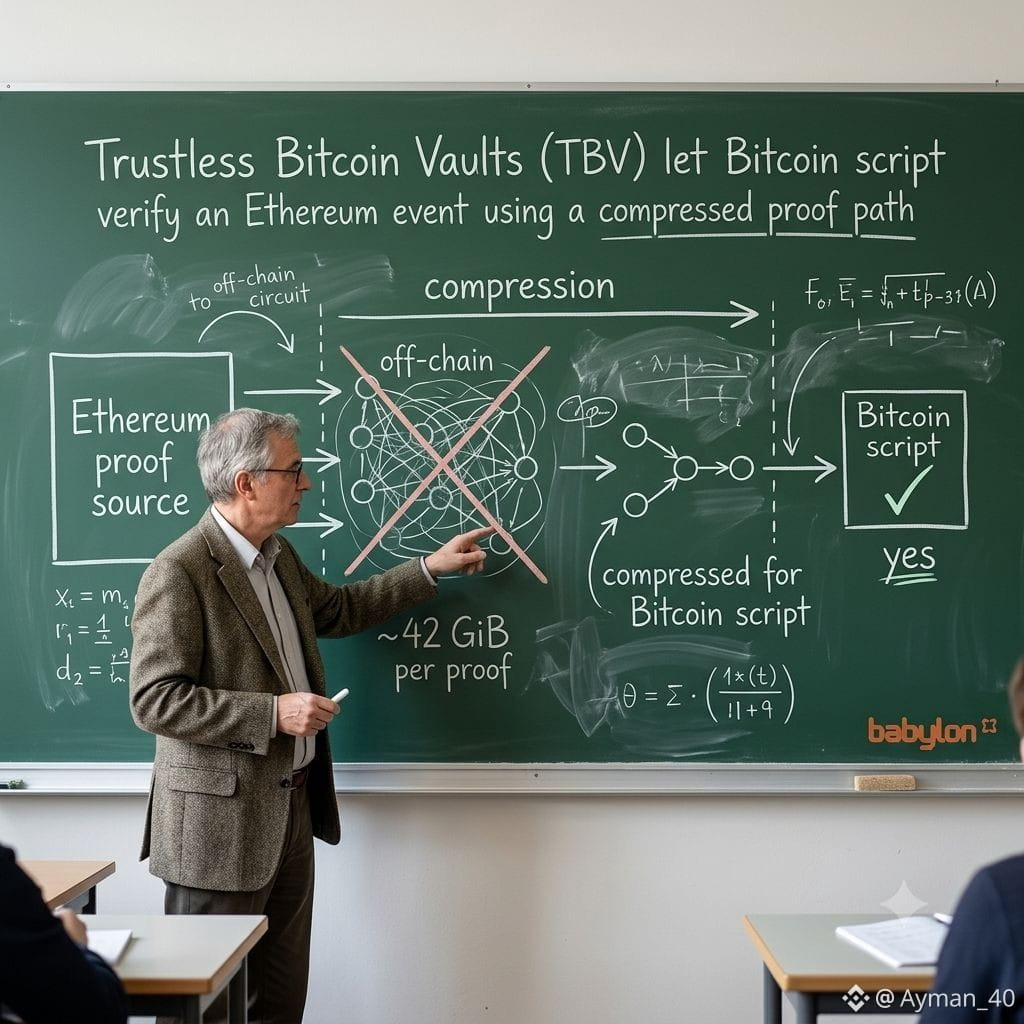
The more I read about how TrUstless Bitcoin Vaults (TBV) actually prOves something happened on Ethereum, using only Bitcoin's own script, one number stopped me completely.
I always assumed Bitcoin simply couldn't do this. Its script has no loops, no arbitrary state, nothing close to what verifying a real cryptographic proof normally requires. So how do you check something that complex using a language deliberately built to check almost nothing.
The honest answer, bEfore this, was you mostly didn't. Earlier attempts to verify a succinct proof dirEctly on Bitcoin needed one of two bad options. Either transaction fees high enough to make it pointless at real scale, or a garbled circuit stored off chain that ran close to 42 GiB, per proof, per instance. Not a typo. Forty two gigabytes, just sitting there, for one verification.
That's when the actual dEsign clicked for me. TBV doesn't ask Bitcoin to understand more. It compresses what Bitcoin needs to check into something small enough that Bitcoin's existing, unchanged script can still verify it, cutting that offline cost by roughly a thousand times without ever touching Bitcoin's consensus rules.
I stopped thinking of this as making verification cheaper. It's closer to asking the least flexible ledger in cryPto to trust math it was never designed to read, and getting a yes.
@BabylonLabs_io $BABY #baby