Sometimes I catch myself assuming that if I control my Bitcoin, I'm the one signing every transaction. That seems to be how self-custody works. You hold the key, you decide when funds move, the chain confirms. Then I started looking at Babylon Labs, and I realized their Trustless Bitcoin Vaults are built around a different assumption.
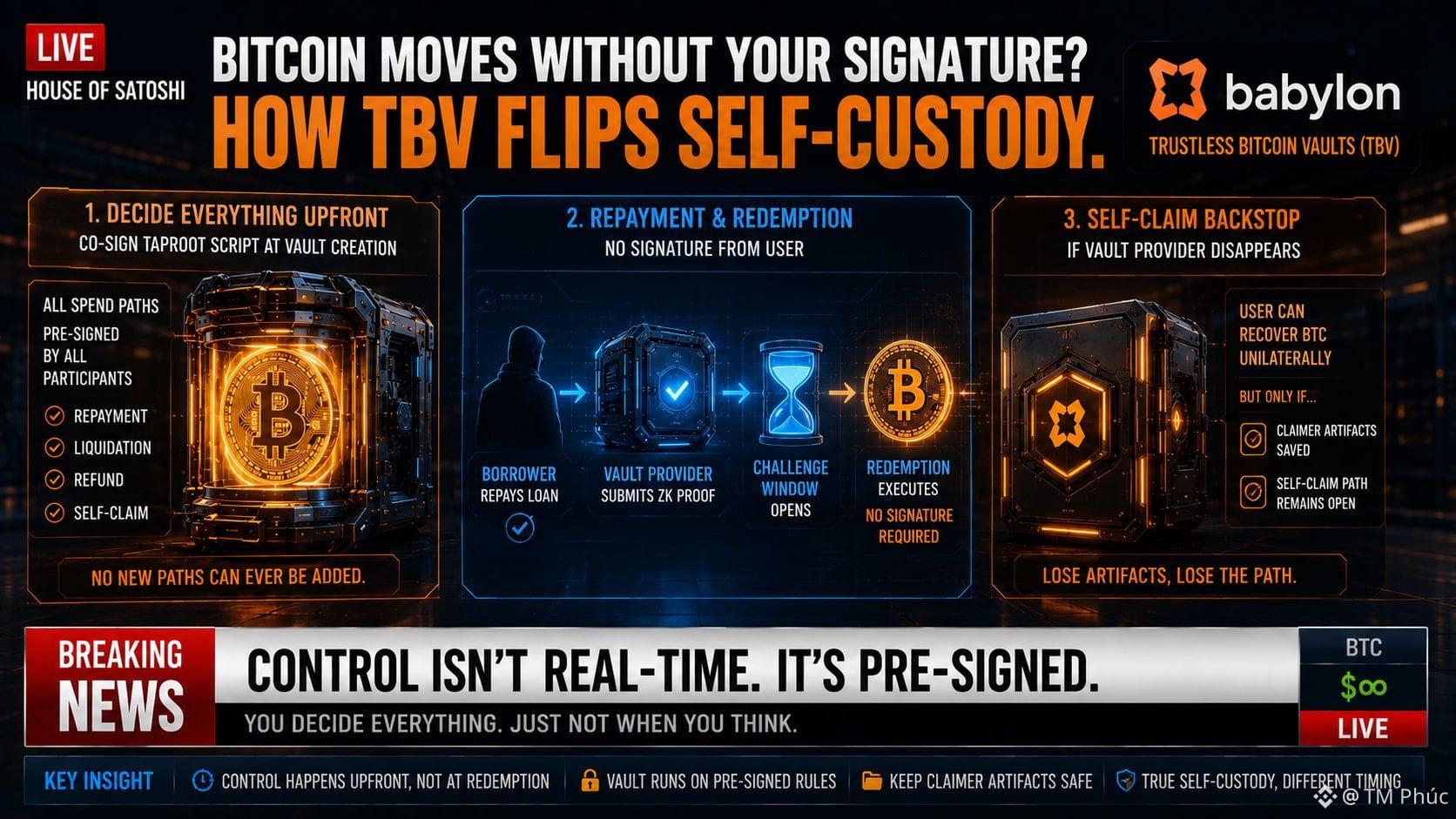
The interesting part isn't really the vault creation itself. Lots of protocols let you lock Bitcoin. What caught me off guard was the redemption flow. The borrower repays their loan. Then nothing. The Vault Provider submits a proof, a challenge window opens. The user's private key sits idle. No signature required. If this is still self-custody, why isn't the person who supposedly owns the asset approving its final movement?
I had to trace that backwards twice because I first thought redemption must involve a hidden signature somewhere. It doesn't. The answer sits in vault creation. Before the vault activates, the user co-signs a Taproot script containing every possible spend path: repayment, liquidation, refund. All pre-signed by every participant. After activation, no new path can be introduced. So the redemption isn't asking for permission because permission was already granted. Possibly weeks earlier.
That shifts when control actually happens. It's not exercised at the moment of movement. It's embedded in the vault's architecture before anything moves. The user still decides everything. But they decide upfront, not in response to events.
Of course, that means the self-claim fallback becomes another thing that has to be right. If the Vault Provider disappears, the user can still recover their BTC unilaterally. But only if they saved the claimer artifacts from vault creation. Lose those, and that path closes. I'm still not sure whether the harder problem is designing the pre-signed scripts, or getting users to keep a file safe that they might not need for months. Just my own take, not investment advice.
#baby $BABY @BabylonLabs_io
The interesting part isn't really the vault creation itself. Lots of protocols let you lock Bitcoin. What caught me off guard was the redemption flow. The borrower repays their loan. Then nothing. The Vault Provider submits a proof, a challenge window opens. The user's private key sits idle. No signature required. If this is still self-custody, why isn't the person who supposedly owns the asset approving its final movement?
I had to trace that backwards twice because I first thought redemption must involve a hidden signature somewhere. It doesn't. The answer sits in vault creation. Before the vault activates, the user co-signs a Taproot script containing every possible spend path: repayment, liquidation, refund. All pre-signed by every participant. After activation, no new path can be introduced. So the redemption isn't asking for permission because permission was already granted. Possibly weeks earlier.
That shifts when control actually happens. It's not exercised at the moment of movement. It's embedded in the vault's architecture before anything moves. The user still decides everything. But they decide upfront, not in response to events.
Of course, that means the self-claim fallback becomes another thing that has to be right. If the Vault Provider disappears, the user can still recover their BTC unilaterally. But only if they saved the claimer artifacts from vault creation. Lose those, and that path closes. I'm still not sure whether the harder problem is designing the pre-signed scripts, or getting users to keep a file safe that they might not need for months. Just my own take, not investment advice.
#baby $BABY @BabylonLabs_io