
Let's talk about recent thoughts on AI. Yesterday, Google released its earnings report: expected revenue was 117 billion, but actual revenue was 119.8 billion, beating expectations. However, the stock still fell. The main reason is that AI spending is too high and the cash flow has turned negative.
So the AI arms race may slow down going forward. The stock is falling, and shareholders don't agree with increasing AI spending—after all, a listed company needs ROI (return on investment).
So in the future, the AI arms race may see a shift: it won't be that investment stops, but that instead of unlimited spending, we'll move into a stage that focuses more on efficiency and returns.
So why is it necessary to push for computing power so desperately right now?
Because the AI industry has a very important theory: Scaling Law (the scaling law).
Actually, research has already found that today’s AI becomes “smarter” the more compute is投入, the larger the AI parameters, and the more training data it has—this is a linear relationship!
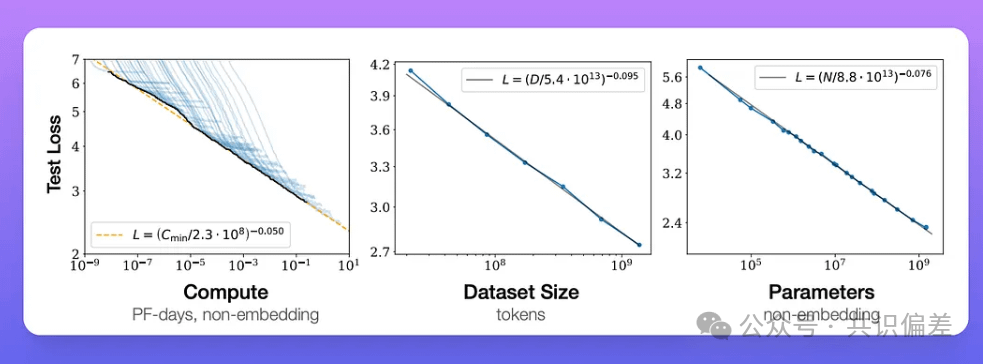
That’s why it also makes the major AI vendors start stacking compute power with all their might. The more money someone invests, the smarter their AI becomes—and they can lead the industry.
But right now, AI is actually still in a very early stage. It hasn’t reached the stage where it can evolve on its own. In other words, when it encounters a problem, it doesn’t develop awareness that it can’t do it, doesn’t proactively seek knowledge, doesn’t modify its own abilities, and doesn’t make it learn something permanently for next time.
None of today’s large models can do this. At most, they can only achieve “limited self-improvement”!
For example, humans make a model write 1,000 pieces of code, then let the AI run itself to find problems, analyze the reasons for failure, retrain with improved data, and enhance its capabilities. But this kind of limited self-improvement is still happening in labs right now. It requires humans to continuously update the model, release new versions. That means humans are currently driving the evolution of AI.
In terms of truly “pure online” self-evolution, it’s still far from being reached. That’s why we see major vendors release a new version every so often. This new version is the AI model optimized and evolved by humans.
Why can’t we do that now?
First, the essence of today’s models is basically a huge collection of parameters. These parameters are called model weights. The model cannot change its own weights. It can only remember context, and then, based on the predefined weights and the data it was trained on, produce your answer.
Second, AI currently cannot judge what “true knowledge” is—for example, in philosophy, medicine, and economics, many things can be argued convincingly on both sides: the pro side has its reasons, and the con side also has its reasons. Take a classic debate topic: “A person cannot step into the same river twice.” How would the AI say that? Even humans don’t have a standard answer. If you ask the AI to give you a standard answer.
Also, when I say Xiaomi is good and the stock can be bought, others say Xiaomi is trash and the stock will trap you if you buy it—this AI also can’t judge.
Third, maybe the more errors it learns, the more it learns them. If an AI can adjust its own weights—then if something is wrong but it insists it’s correct, it would walk farther and farther down the wrong path, and finally the model might collapse.
Fourth, the cost is too high. Training AI once requires a lot of GPUs and electricity. You keep changing models and updating parameters, and the economic cost can’t be sustained.
So this is also the current “bottleneck.” That’s why, in today’s top AI industry, people are studying team-up and collaboration modes. For example, you form a team: some work on research models, some on reading models, some on experimental models, some on programming models, some on evaluation models—forming a closed loop.
So earlier I thought the future AI would be a single dominant winner, and the “winner takes all” scenario might not hold. In the future, it’s very likely that we’ll see many flowers blooming. And if we can connect AI models from different vendors, then it could very possibly become a super AI intelligent agent. Because each company’s training data may be different, but if all the data can be connected, then the AI’s capabilities could increase exponentially.
Because as the AI model parameters keep getting larger, although the AI’s capability and parameters, compute power, and the amount of training data are proportional. But it’s possible that, with changes in the model parameters, the AI’s capability could suddenly “emerge” a new ability—like suddenly “getting it,” for example, a model that has been learning math abilities, and then one day it solves advanced equations.
And currently, each company’s AI model actually has its own strengths. For instance, Claude is better at programming, GPT is stronger in math, and Gemini excels at video capabilities. So, in the end, if there’s a front-end scheduler, or if the model capabilities can be connected, then every model has a chance to survive.
If you treat each AI like a person, it’s clearly that teamwork collaboration is a bigger advantage—not that you need one person to be a jack-of-all-trades.
Based on the thoughts above, I think we can focus on AI large-model companies right now. In the future, these companies all have opportunities, and the AI infrastructure is already laid out. The key is to watch which large models are underappreciated—then act decisively.
Because the next round of AI competition probably won’t be a war of a single model.
It’s a battle: an AI ecosystem war.
And the real winner might not be a single AI, but a super intelligent network made up of a group of AIs.$ZHIPU