

In one sentence, what is ZAMA?
ZAMA is not a new public blockchain. It’s a "cryptographic layer" installed on existing blockchains (such as Ethereum, BNB Chain, Solana, etc.). Once installed, smart contracts can perform computation while data remains encrypted end to end—like adding HTTPS to your transactions: others can see that you’re making a move, but they can’t see the specific contents.
For example: FIL is for building warehouses, while ZAMA is for making safes.
Project background
Established: 2020
Founder: Rand Hindi (worked on the voice assistant company Snips) + Pascal Paillier (a cryptography expert; the Paillier encryption algorithm was invented by him)
Core team: 120 people; among them 40+ PhDs; published 77 papers; obtained 30 patents
Funding method: In January 2026, it did a crypto Dutch auction, raising about $44 million
Token launch: Feb 2, 2026
Key timeline:
Dec 2025: Mainnet starts
March 2026: becomes the default encryption layer for T-REX (an RWA tokenization standard)
June 2026: partnered with Morpho to launch the cUSDC encrypted investment/treasury vault
How tokens are issued and how they leak
Total supply and distribution
Total supply: 11 billion tokens, fixed and unchanged
Circulating supply at launch: ~2.25 billion tokens (20.5%)
Who has how much:
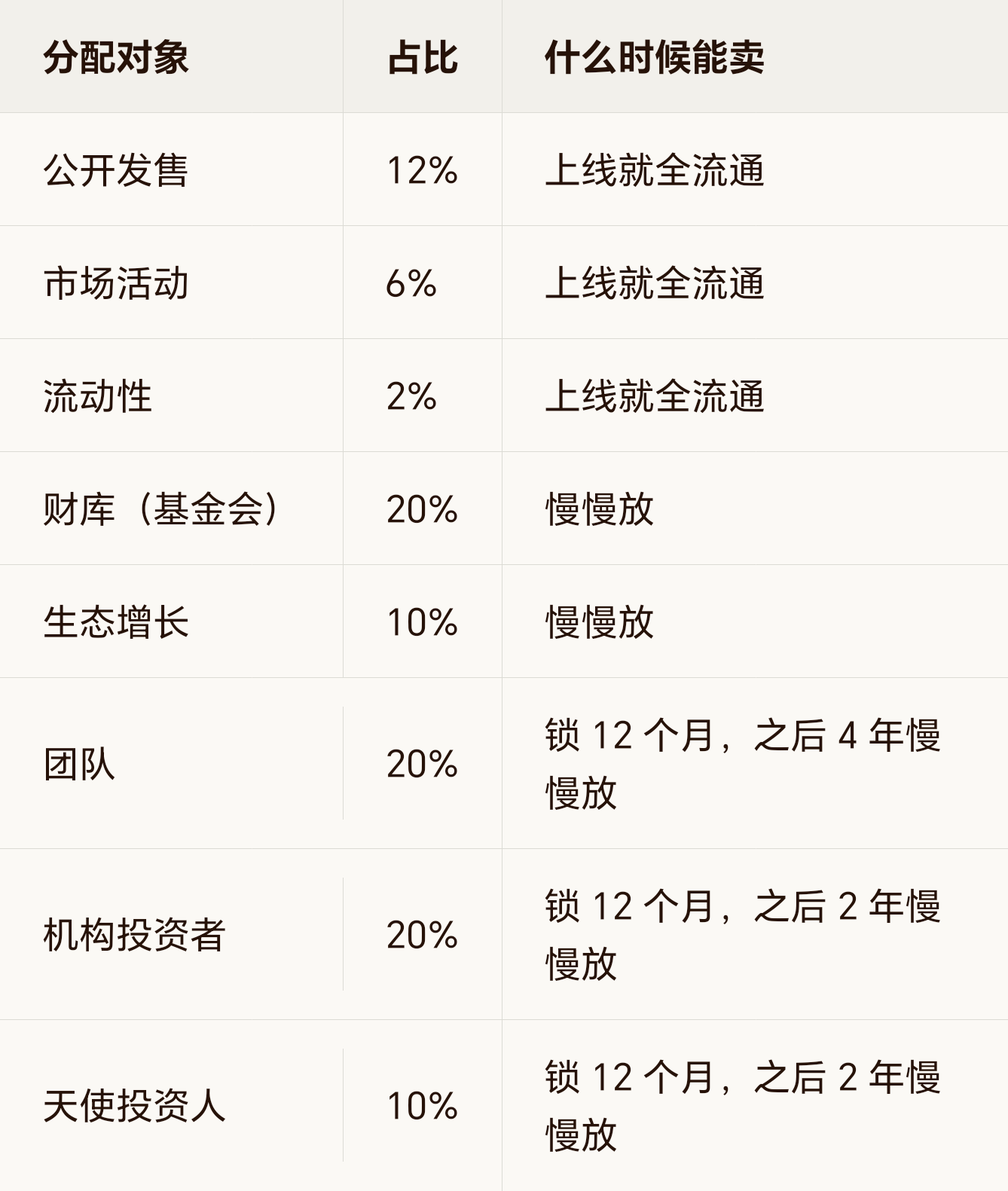
Key date: Feb 2, 2027 (one year after launch). The lockups of the team, institutions, and angels expire at the same time—this is ZAMA’s biggest sell-pressure stress test.
Inflation and burn
5% inflation per year (about 55 million new coins)
All operational fees are 100% burned (including validation, decryption, cross-chain, etc.)
Current status: burn volume is far behind inflation volume, resulting in net inflation
An analogy: ZAMA’s token model is like a pool. The water inflow tap (inflation) keeps pouring in continuously, while the drain outlet (burn) is too small—so the water level will only keep rising.
Staking
In the early period, about 34%–50% of circulating supply participated in staking
Unstaking takes 7 days
Staking rewards come from newly minted coins, not from the protocol’s earned revenue
How is the technology?
Core technology: Fully Homomorphic Encryption (FHE)
Simple understanding: computation can be done even when data remains fully encrypted end-to-end; only after computing the result can it be decrypted to see it
Security level: 128-bit, resistant to quantum computer attacks
Audit status: multiple institutions including Trail of Bits and OpenZeppelin have reviewed it, with no critical vulnerabilities
Performance bottlenecks
Current speed: ~20 ops/sec/chain
End of 2026 target: 500–1,000 ops/sec (via GPU acceleration)
2027–2029 targets: 10,000+ ops/sec (via in-house chips)
Real-world issue: FHE computation is 100–1,000x slower than normal computation—this is its biggest technical weakness.
Multi-chain support
Integrated with: Ethereum, BNB Chain, Solana, Hyperliquid
Has its own token standard: ERC-7984
Who runs this network
18 node operators, split into two categories:
KMS nodes (13): manage encryption keys, including Ledger, Fireblocks, Etherscan, LayerZero, Figment, and other well-known institutions
Co-processors (5): for computation, including Artifact, Blockscape, etc.
Governance: only these 18 nodes have voting power; ordinary token holders can only delegate to them.
Differences from FIL: FIL has more than 3,000 storage providers, while ZAMA has only 18 nodes. ZAMA is more centralized, but the nodes are all real-name, reputable institutions, so it’s unlikely they’ll do anything shady.
Where is ecosystem development at?
On-chain data
Total confidential asset value (TVS): ~250 million USD
During the testnet period: 27,000+ contracts, 6.9 million+ transactions, 120,000+ wallets
Real-world applications
RWA tokenization: becomes the default encrypted layer for the T-REX standard; the Apex group plans to place $100 billion in assets on top of it before 2027
Confidential treasury/financing: a cUSDC vault in partnership with Morpho—once you deposit, others can’t see your position
Enterprise use cases: GSR for confidential over-the-counter trading; Bron for confidential payroll disbursements
Developer ecosystem
In the second-quarter activity, 234 project applications were received
Most FHE projects use Zama’s codebase
Pros and cons—and what to watch
Advantages
Deep technical moat: in the FHE space there are almost no rivals, and the team is strong
Strong institutional resources: node operators are well-known institutions, and partners have high credibility
Lower compliance pressure: no ICO history, so SEC risk is far lower than FIL’s
Clear use cases: RWA and confidential DeFi are real demand, not storytelling
Weaknesses
Too slow: FHE computation is hundreds of times slower than normal computation, limiting large-scale applications
Too few nodes: 18 nodes are overly concentrated, so decentralization is insufficient
Unhealthy tokenomics: burn volume is far lower than inflation volume, so tokens keep being diluted
There will be a large unlock in Feb 2027: the lockups for the team and investors expire at the same time, with significant sell pressure
The niche is too small: the overall market size of FHE is far smaller than the storage sector
Main risks
Technical risks: whether the FHE performance bottleneck can be broken, and whether the in-house chip will slip
Economic risk: If 5% annual inflation can’t be continuously destroyed to offset it, the token will keep depreciating
Unlock risk: the large unlock in Feb 2027 is the biggest uncertainty
Adoption risk: if RWA and enterprise adoption don’t meet expectations, the valuation will be adjusted downward significantly
Competition risk: the ZK and TEE routes may divert market demand
Nodes worth paying attention to
2026 Q3–Q4: Can the TVL of confidential treasury/financial products grow quickly?
Feb 2027: after large unlocks, can the market absorb the supply?
For all of 2027: can the burn-to-inflation ratio improve?
Long term: progress on in-house chips and enterprise-grade adoption
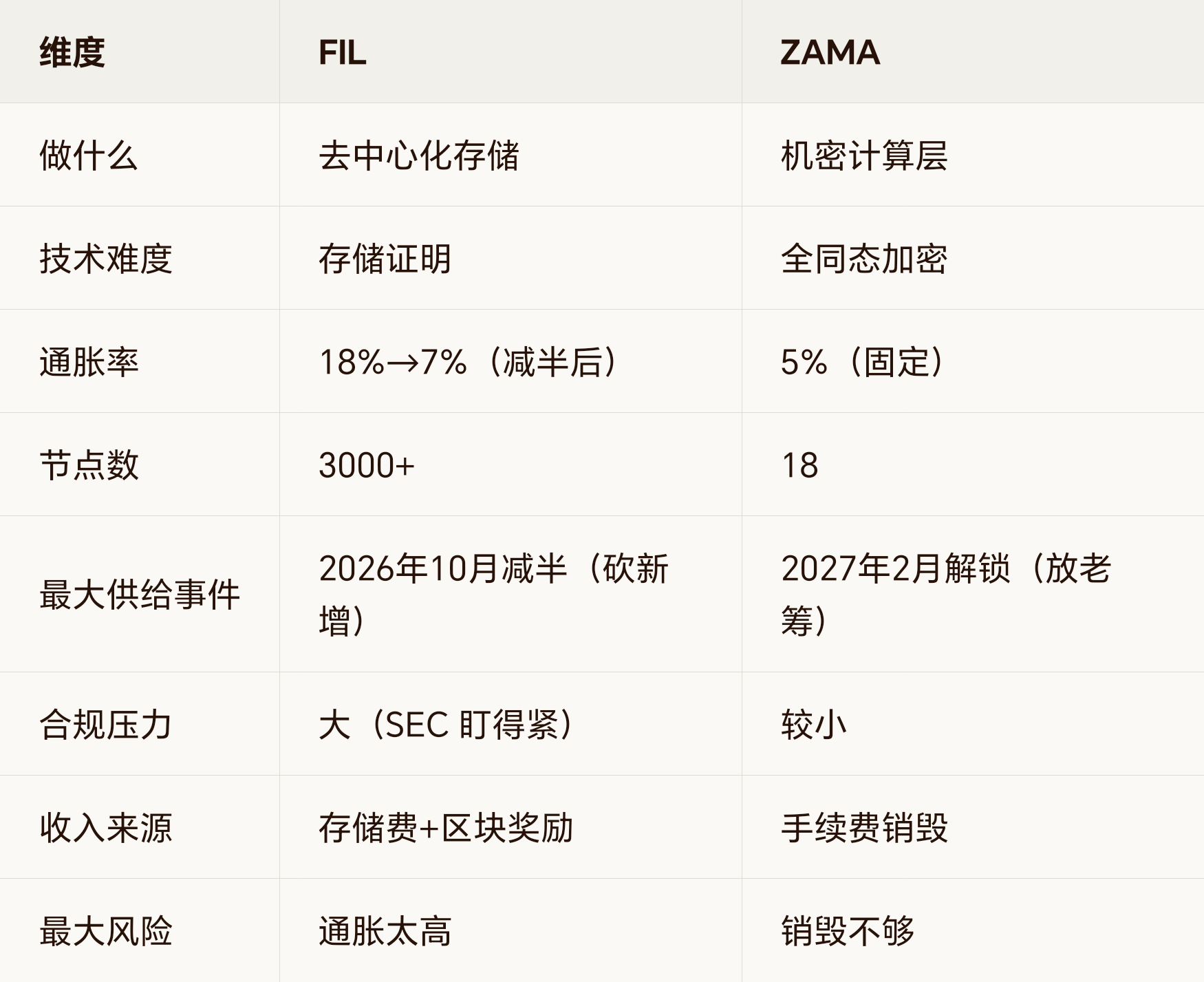
Comparison summary with FIL
Final honest thoughts
ZAMA’s technology is indeed solid, and it dominates the FHE track. The team is also reliable. But the tokenomics problem is essentially the same as FIL’s: the money earned (burned) can’t keep up with the money minted (inflation).
FIL bets on an AI-driven explosion in storage demand; ZAMA bets on an institutional chain-ification and privacy-compliance demand explosion. Both stories can be told, but ZAMA’s unlocking in Feb 2027—half as much as FIL’s Oct 2026—will be harder to digest: one reduces supply, the other increases supply.
As for token price: is it a reasonable reflection of a tech premium, or a liquidity game before unlock? Everyone has their own answer.
