

Newton Protocol’s Mainnet Beta has been live for a little over half a month. During this time, the most “writeable” content in the market naturally includes the roster of partners, the technical architecture, and “institutional funds are about to be on-chain.” These things can definitely be written, and they look lively: Base, Ethereum, Euler, EigenLayer, Succinct, RedStone, Credora, Chainalysis, vaults.fyi, Webacy—once you line up the names, the projects’ vibe instantly shifts from startups to a kind of financial infrastructure “United Nations.”
But over the past few days, I’ve gone back over Newton’s mainnet logic again. The truly basic question that concerns me is this: when a real transaction violates the rules, does Newton actually have the nerve to let it fail?
Because the authorization layer, that line of business is the easiest to turn into an expensive prompt box. The system detects that the position concentration is too high and pops a message saying “There is a risk”; if it detects that an address has a bad reputation, it pops another message saying “Please operate with caution.” Then once the admin clicks confirm, the trade still executes as usual. This is also called risk control, can generate reports, and can be used to make PPTs for investors—only the problem is that it’s basically useless at the critical moment.
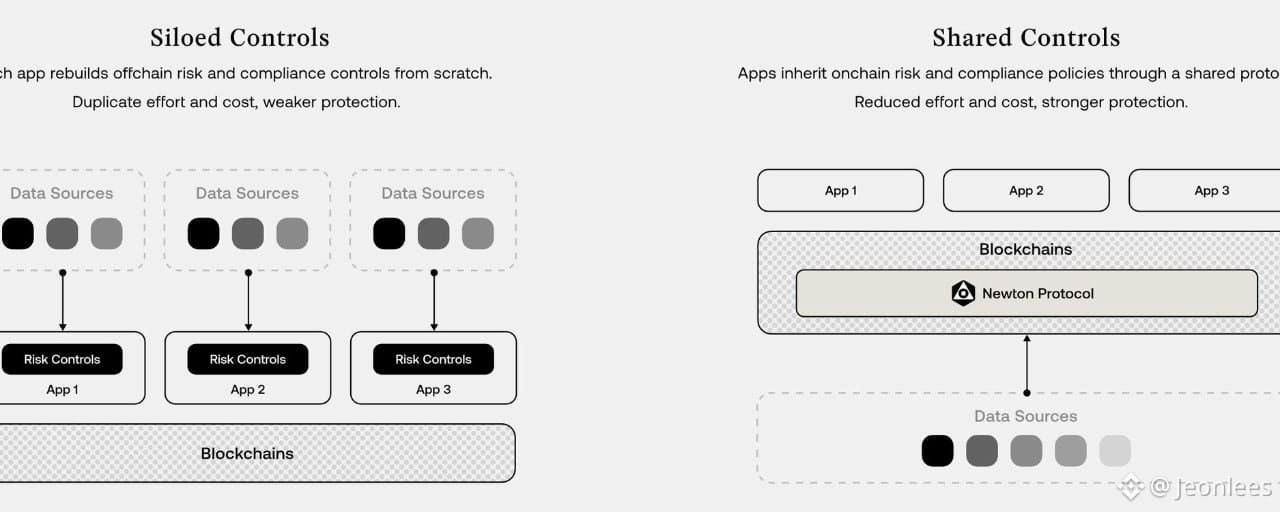
What’s worth looking at in this Newton Mainnet Beta is precisely this. It places itself between the transaction initiation and the final settlement: it first reads the preset policy, then makes a decision based on on-chain and off-chain data. Only the actions that pass authorization are forwarded to the underlying contracts. Each decision also generates a timestamped signed record and stores it on-chain for external verification. In other words, Newton isn’t trying to be a monitoring dashboard after accidents—it’s a gate that every transaction execution must pass through.
That difference sounds like it’s separated by just one word—“before”—but the engineering difficulty and commercial value are several orders of magnitude apart.
In DeFi’s current risk management, a lot relies on multisigs, admin keys, strategy files, and internal operational team processes. Project teams can spell out rules like “no single market can exceed 40%,” “a certain type of collateral must not fall below a specified liquidity level,” “some addresses must not become counterparties,” and “if oracle deviation exceeds a threshold, pause rebalancing.” The issue is that these rules often remain in documents and promises. When real actions are executed on-chain, the contract only knows that someone with admin permissions has sent a valid instruction—it doesn’t know whether this instruction violates the risk limits the team promised users yesterday.
When the market is stable, this setup doesn’t show major problems. Once the market sharply drops, liquidity starts to contract, and the temptation and pressure facing admins will both be amplified. No matter how beautifully the rules are written, as long as key holders can still bypass them, the so-called risk framework will end up carrying a strong “just trust people” vibe.
Newton’s current entry point through VaultKit is very concrete in terms of thinking. VaultKit won’t let users migrate assets into a brand-new insurance vault, and it doesn’t take over user funds. Instead, it sits between the management team’s existing SDK and the underlying vaults. Curators continue using the original dashboard and workflow; the only difference is that operations issued by management keys must first pass the policy checks of VaultKit. If it passes, the instruction continues to be forwarded; if it’s rejected, the transaction stops immediately.
And its authorization results are bound to specific actions, specific vaults, and specific amounts—not a vague approval for “similar operations.” This point is extremely crucial. Financial permissions fear scope drift the most. Approve a rebalance of $1 million, and in the end it gets interpreted as allowing rebalance for the entire same market; approve one pool under a protocol, and in the end it gets expanded so that every contract of that protocol can be touched. Newton binds authorization to explicit transaction contents, at least design-wise blocking the room for concept swapping.
An even harsher part is “fail-closed.” If policy evaluation rejects, or if the evaluation process can’t complete, the action will not continue. Plainly speaking: if the system goes down, the data source has anomalies, or the judgment result is unclear, Newton chooses not to let the money move first.
This brings experience costs and business pressure as well. When the market is violently volatile, the admin might genuinely be in a hurry, and even delaying funding by ten minutes could cause losses. But if the authorization system keeps leaving a convenient admin one-click bypass backdoor for convenience, in the end it still degrades into a prompt tool. The escape design Newton provides now is a public path with time delay and observable on-chain—at least it can’t quietly skip when rules become inconvenient.
I think in the Mainnet Beta stage, the most important thing to observe is this kind of “does it dare to reject” capability. Many protocols can prove they run fast under normal circumstances. What can truly prove the value of an authorization layer is whether, in abnormal situations, it will steadfastly say no.
Of course, there are still quite a few real-world issues here that the market hasn’t discussed enough.
First, who actually formulates Newton’s policies, and who takes responsibility for mistakes in policy formulation? For example, if a vault rule says its single-market exposure must not exceed 40%, does that number come from historical backtests and liquidity models, or is it decided by an admin’s instincts? If the rules themselves are too loose, even if Newton executes accurately, it’s only precisely executing a bad policy. An authorization layer can ensure “following the rules,” but it cannot naturally ensure “the rules are reasonable.”
This means Newton’s competitive focus is likely to slowly shift from execution networks to a policy ecosystem. Whoever can provide market-validated policy templates, and whoever can combine RedStone’s price, Credora’s risk ratings, the vaults.fyi vault health, Chainalysis’ sanctions screening, and Webacy’s wallet reputation into a usable policy package, will truly hold the voice in the application layer.
Now Newton allows developers to write policies with Rego and also provides prebuilt templates and open-sourced Policy Packs. This path is the right one. It’s just that the easier templates are to use, the easier the market is to ignore the assumptions behind the parameters. A rule that says “reject if oracle deviation exceeds X%” looks professional—whether X is 1%, 3%, or 10% makes a completely different outcome. Too low a threshold leads to frequent false hits; too high a threshold fails to block real risks. In the end, it still comes down to data quality, update frequency, backtesting methodology, and real operational experience.
Second, when multiple data sources conflict, how does Newton make a decision? RedStone provides one price, other oracles provide another. Credora thinks collateral risk is rising, but vaults.fyi’s rating hasn’t updated yet. Chainalysis marks a certain address as risky, while the project’s own compliance list says interactions are allowed. Policies can combine data, but the more data there is, the more complex conflict resolution becomes.
Financial risk control has never lacked metrics; what it lacks is who has the final authority to interpret when conflicts happen. Newton turns the results into verifiable credentials, solving the question of “whether it was calculated according to rules.” But how rules are defined and how data priority is handled still requires developers and institutions to take responsibility themselves. After Mainnet Beta, if it can show data versions, judgment paths, trigger clauses, and proof status more clearly in the Explorer, outsiders can truly understand why a rejection happened.
Third, how to balance privacy and auditability. Newton emphasizes that policies can call data that institutions don’t want to disclose publicly—such as private risk models, customer eligibility information, legal jurisdiction requirements, and internal blacklists. In the end, it only writes the verifiable approval results to the chain. Technically, it will use secure multi-party computation, trusted execution environments, and zero-knowledge proofs so that outsiders can confirm the judgment is correct while still not seeing the original inputs.
This direction fits institutions, but it can also create a new information gap. When a user sees a transaction rejected, they only know it violates a policy, but they may not know the exact trigger reason. Institutions may say the original data involves privacy; users may say I can’t even understand how my funds are being restricted. Both sides have a point. Newton later needs to design disclosure mechanisms at different levels: publicly disclose the policy scope, publicly disclose the proof status, and provide more complete materials to authorized audit parties, while protecting customers and proprietary models. Full disclosure isn’t realistic, and a completely black-box approach is also hard to build trust.
Fourth, cross-chain consistency will become the real big exam. Newton is already live on Base and Ethereum, and it emphasizes that the same policy can be used across networks. The problem is that block confirmations, oracle updates, liquidity structures, and bridging risks differ across chains. The same rule—“the collateral ratio must not fall below some threshold”—may not carry the same real security meaning on Ethereum and Base. Policies can be reused, but the parameters may not be copied verbatim.
Truly mature cross-chain authorization likely needs the same policy framework paired with dynamic parameters per chain, and also has to consider cross-chain message delays and state not being synchronized. When the asset exposure on Ethereum has changed, can the strategy on Base sense it in time? When bridged assets show anomalies, should rules on both networks tighten at the same time, or should they be judged separately? Newton has shown now that the authorization layer can be integrated across chains; there’s still a way to go before cross-chain risks can be managed uniformly—this is the kind of problem that should be exposed during the Beta stage.
I’ve recently seen many people classify Newton as “AI Agent infrastructure,” and that description isn’t wrong. In the future, autonomous agents will execute trades, make payments, bridge cross-chain, and allocate assets on behalf of users—so the boundary of permissions becomes even more necessary. How much money an agent can spend, which addresses it can interact with, which contracts it can call, and whether it pauses when facing prompt injection—these can all be written as policies and verified before every transaction.
But I think Newton’s current most worth paying attention to is the DeFi vault scenario. The reason is simple: vaults already contain real funds, real admins, and real risk rules. Whether someone has management authority, whether the rules get executed, and whether accountability is possible after something goes wrong—these contradictions already exist today. Agent trade scale still needs time to grow, but the authorization gaps in vaults are already laid out on the table. Prove first with VaultKit that you can constrain real human admins, then constrain AI agents—the path is more solid.
This is also what makes Euler’s integration worth watching. Euler itself provides lending markets and vault infrastructure. If Newton can continuously generate authorization records in real vault management actions, outsiders can observe how a policy faces real market volatility. What the market needs isn’t more partnership logos, but the ability to see a concentration-limit breach being rejected, an oracle anomaly triggering protection, a high-risk counterparty transaction being blocked—and whether these actions affect normal operations.
Launching Mainnet Beta only proves that the machine is powered on. Next, it has to prove that it blocks accurately and firmly, and that it doesn’t turn normal business into a crisis of doubt. Too-loose authorization is like an empty prop; too-tight authorization turns vaults into a compliance printer that breaks down at the slightest provocation. The line in between—that’s Newton’s real technical moat.
Let’s talk again about $NEWT. When discussing the token, I will intentionally separate price sentiment from protocol value. Newton network policy evaluation is executed by independent operators, combined with EigenLayer’s economic security and Succinct zero-knowledge proofs. Whether $NEWT can form sustainable demand in the future ultimately depends on whether there is a real closed loop among validation, staking, governance, and protocol usage. You can’t prop up long-term value with just the words “institutions on-chain.” The data that needs to be watched later includes the number of transaction checks, the scale of vaults integrated, the number of active policies, operator distribution, proof costs, and protocol revenue.
The current Mainnet Beta still has obvious early-stage characteristics. The project has released the SDK, its first batch of policy packs are open-sourced, and the cooperating data and risk service providers are plenty. But whether real adoption scale, failure rate, latency, policy misjudgments, and the economic model hold up still needs time for verification. It’s too early to draw a final conclusion on Newton at this stage. I’d rather treat it as an open stress test: let the market see whether on-chain finance can bring institutional-style authorization and control into the contract execution flow without sacrificing openness.
At the end of the day, what Crypto has solved in the past was “whether money can move freely.” What Newton is trying to add is “before money moves, can we ask first whether this operation is even allowed to happen.” That sentence isn’t as sexy, and it doesn’t come with the million-TPS thrill of a new chain, but the bigger the financial system moves toward large capital, the more unavoidable this gate becomes.
Brothers, my judgment on Newton is pretty simple: the合作 roster is already good enough, and the technical narrative is already clearly explained. Next, don’t rush to keep slapping Logos onto the wall. Let Mainnet Beta refuse a few transactions that definitely shouldn’t have gone through, and then leave every reason for refusal, the proof, and the outcomes clearly on-chain. The credibility of the authorization layer isn’t built on how many times it approves—it’s built on whether, at the critical moment, it truly dares to shut the door.
For personal research records only and does not constitute any investment advice. The protocol is still in the Mainnet Beta stage. The technology, adoption, and token model all need to be further observed. DYOR.