
I did not expect Newton’s Recurring Buy agent to make me think about permission boundaries.
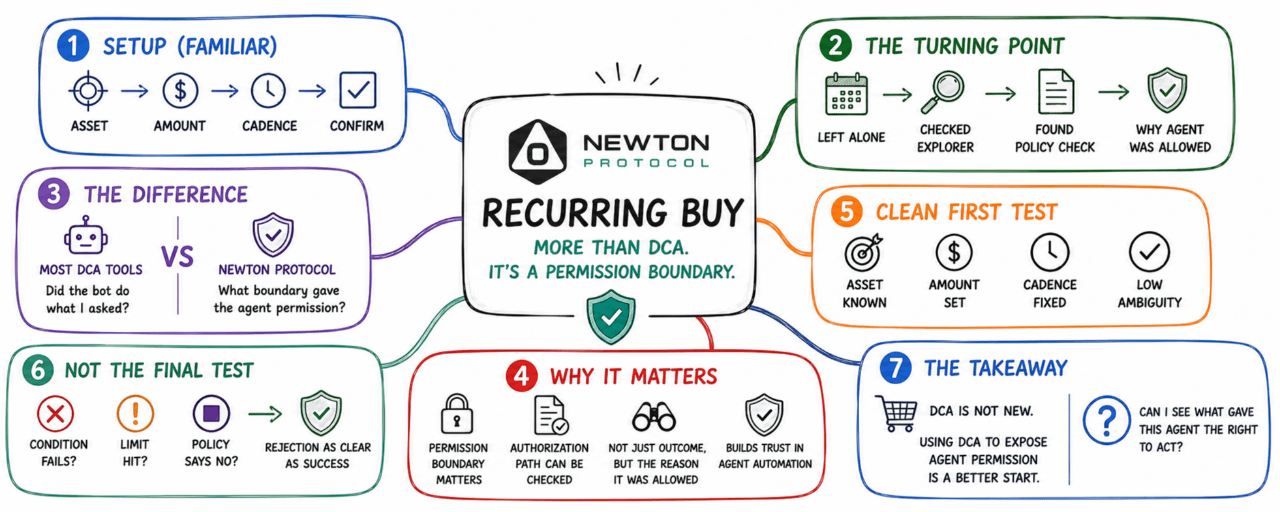
At first, I treated it like a normal DCA setup: choose the asset, set the amount, pick the cadence, confirm, and let the system run in the background. That flow is already familiar to anyone who has used recurring buys on an exchange, inside a wallet app, or through a simple bot. Nothing about the setup itself felt like it was trying to prove some futuristic agent thesis, and honestly, that made the experience feel more normal than I expected.
I did not even check it again the same day. I left it alone, then came back a few days later because I was curious whether Newton had left anything more than a normal transaction receipt.
With most automation tools, I would expect a standard record: a transaction hash, a timestamp, a completed status, maybe the amount. Useful, but still mostly outcome-level information. The app says the buy happened, and I accept that the system followed the instruction.
When I looked through Newton Explorer, the more interesting part was not just that the purchase had happened. The action pointed back to the policy check that allowed the agent to act before settlement.
I expected to skim the record and move on. Instead, I spent more time than I planned thinking about what the attestation was actually proving.
I expected to see proof that the buy happened. What I did not expect was a record that made me ask why the agent was allowed to act at all.
That was the shift for me.
With most DCA tools, the question is whether the bot did what I asked. With @NewtonProtocol , the better question is what boundary gave the agent permission to act in the first place.
A recurring buy executing correctly is not impressive by itself. A scheduled purchase is supposed to run. If it cannot run on time, the product fails at the most basic level. The action is boring by design, but the permission boundary behind that action is not boring at all.
It tells me whether the agent was operating inside a predefined rule, not just whether the final transaction appeared in a history tab. The agent did not simply “do something.” It acted after passing an authorization path that could be checked.
That also made me think differently about bigger agents. People usually talk about agents in terms of what they will eventually do: trade, rebalance vaults, move liquidity, manage treasuries, or coordinate complex DeFi strategies. But before giving agents more power, users need a clearer view of the limits around that power.
Recurring Buy is a clean first test because the boundary is narrow. The asset is known, the amount is set, the cadence is fixed, and the action has very little ambiguity. That makes it easier to inspect whether the authorization model is actually visible to the user.
Before using it, I thought of Recurring Buy as a convenience feature. After checking the record, I started seeing it as a small test of whether agent permissions can be made legible.
A transaction receipt tells me the outcome.
A policy-backed attestation tells me something closer to the reason the outcome was allowed.
One clean execution does not settle everything, though. I still want to see how clear the record looks when the agent reaches the edge of its permission: a failed condition, a hit limit, or a policy rejection. The denial path matters because an authorization layer is only truly useful if “no” is as legible as “yes.”
That is my main takeaway from using Newton’s Recurring Buy agent.
DCA is not new, but using DCA to expose an agent’s permission boundary feels like a better starting point for verifiable automation.
Before users trust agents with complex DeFi actions, they need to answer a simpler question: can I see what gave this agent the right to act?