
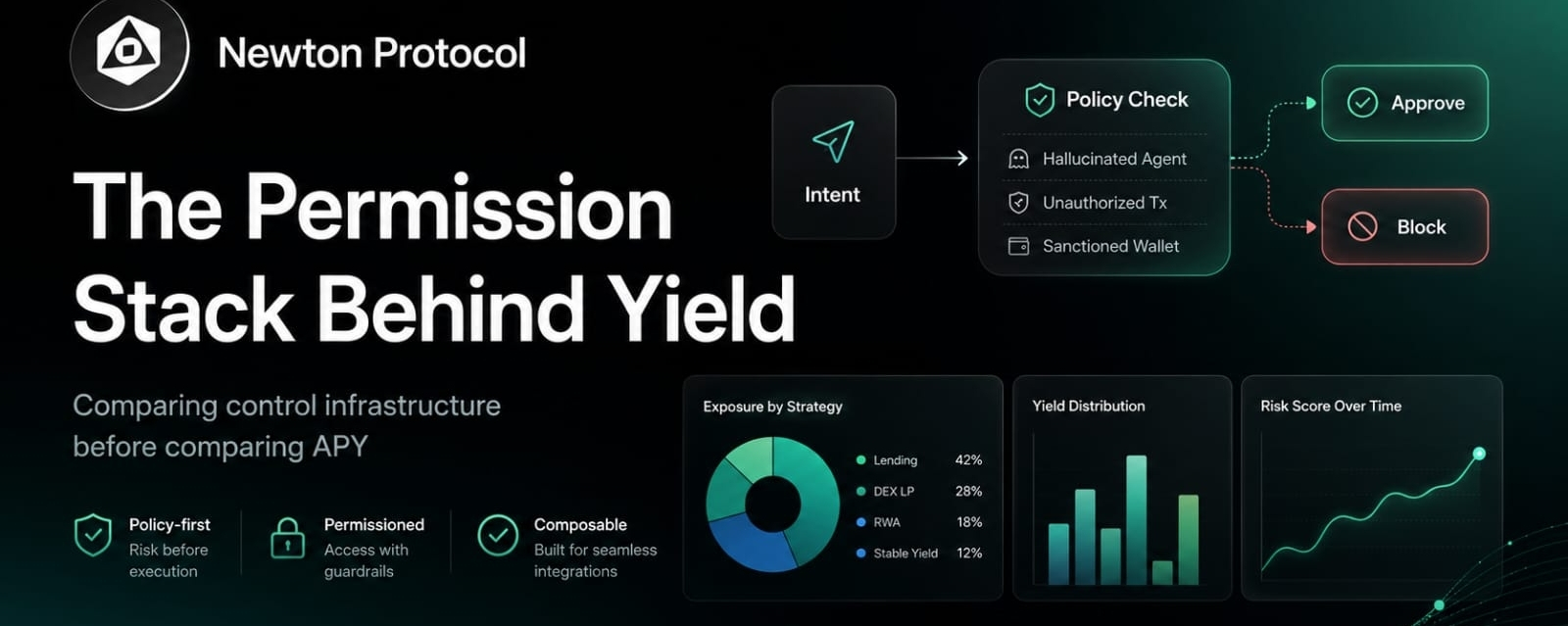
I keep noticing the same thing when I look at yield dashboards: my eyes go to APY first. Then TVL, then incentives, and suddenly I’m pretending I’ve done risk analysis. One vault shows the better yield, so attention drifts there. That habit has started to bother me. But the harder question is basic: what stops the strategy from breaking its mandate when conditions change?
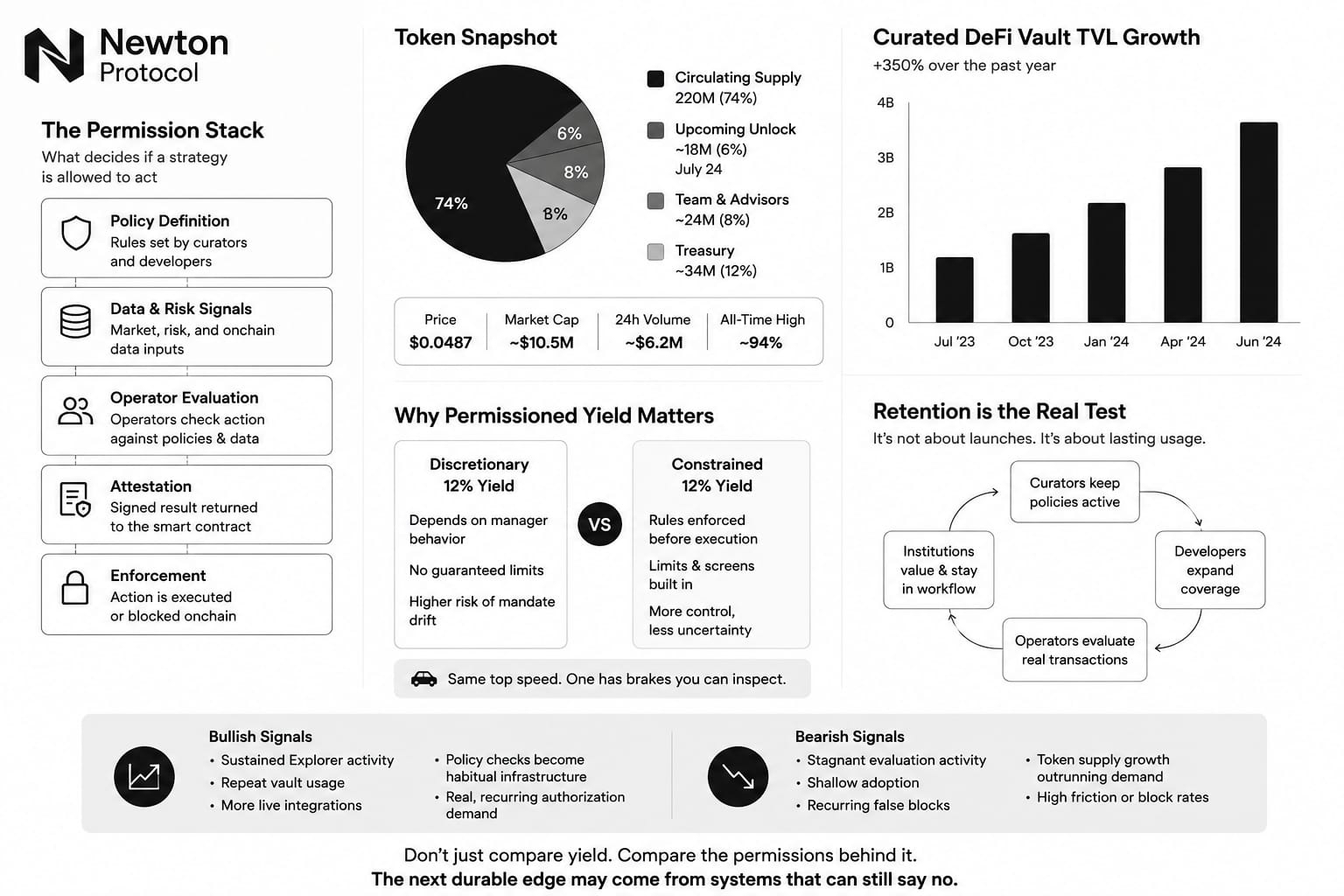
That question is why I’ve been looking at Newton Protocol differently. Not as another place to chase yield. The risk is upfront. $NEWT trades around $0.0487, roughly 94% below its all-time high, with a market cap near $10.5 million, about $6.2 million in daily volume, and 220 million tokens circulating. A July 24 unlock approaches. Product progress and token performance can diverge.
But here’s the thing. I stopped comparing yields and started comparing what I call the “permission stack” behind them.
Yield is the output. The permission stack is everything deciding whether a strategy is allowed to act before capital moves. Can a curator increase concentration beyond a limit? Can an automated agent route into a market whose risk score has deteriorated? Can a vault enable an asset after liquidity collapses? Most DeFi systems show me what happened. Far fewer enforce what is allowed to happen.
That’s the narrow part of @NewtonProtocol I find worth watching. Its mainnet beta went live on June 23 across Ethereum and Base, starting with DeFi vaults. Newton inserts a policy check between intent and settlement. Operators evaluate an action against defined rules and data, then an attestation goes back to the smart contract, where the action can proceed or be blocked. VaultKit wraps existing curator workflows rather than forcing depositors into a new vault product.
In practice, that changes how I compare two identical 12% yields. I no longer see 12% versus 12%. I see discretionary 12% versus constrained 12%. One depends on a manager behaving as expected. The other might enforce limits or screens before execution. Think of two cars with the same top speed. One has brakes you can inspect.
I’m not fully sold, though. Authorization infrastructure creates its own dependency chain. Policies can be badly written. Data providers can be wrong. A fail-closed system can block legitimate actions when markets move fastest. Newton’s operator design is still in beta, and its technical explanation says the broader multi-operator consensus model is intended for the post-beta stage. I don’t want to confuse a roadmap with battle-tested decentralization.
Then there’s the Retention Problem. Launches attract integrations, incentives, curiosity, and one-off activity. Infrastructure earns value only when users keep routing meaningful actions through it after novelty disappears. For Newton, retention is not merely wallets returning. It is curators keeping policies active, developers expanding coverage, operators repeatedly evaluating real transactions, and institutions deciding these controls matter enough to remain in the workflow.
Newton says curated DeFi vault TVL has grown more than 350% over the past year, which explains the opportunity, but opportunity is not retention. The metric I want is recurring authorization demand. Are the same vaults still generating policy evaluations months later? Are developers adding rules because they need them? Does enforcement survive volatile markets without becoming expensive friction?
This is where my bias sits. Traders spend too much time comparing yield surfaces and too little time comparing control infrastructure. As onchain strategies become more automated, the valuable layer may be the one deciding which actions never settle. That doesn’t automatically make $NEWT undervalued. The token still has to capture demand, withstand unlock pressure, and prove genuine usage persists over time.
So don’t just open the price chart. Pull up the live infrastructure, track who keeps using it, and compare the permissions behind the yield before comparing the yield itself. The next durable edge may come from recognizing which systems can still say no.
What would change my mind? Bullishly, sustained Explorer activity, repeat vault usage, more live integrations, and evidence that policy checks become habitual infrastructure rather than launch-week decoration. Bearishly, stagnant evaluation activity, shallow adoption outside partner announcements, recurring false blocks, or token supply growth outrunning genuine demand. I’m watching the return of users, not the promise of yield. That’s where conviction either earns its place or dies.