
@NewtonProtocol i caught myself dugh Newton Protocol. I was treating “verified user” as if it meant “authorized transaction.” That’s the shortcut traders make when identity infrastructure gets attached to DeFi: passport check passes, wallet gets a green light, problem solved. Except it isn’t. An identity can still make a prohibited trade, breach a vault limit, interact with the wrong counterparty, or act under market conditions the strategy was never meant to tolerate.
That’s the risk I’d put upfront with Newton. The protocol can make authorization more inspectable, but it can’t make bad policies wise or bad data true. A perfectly verified mistake is still a mistake.
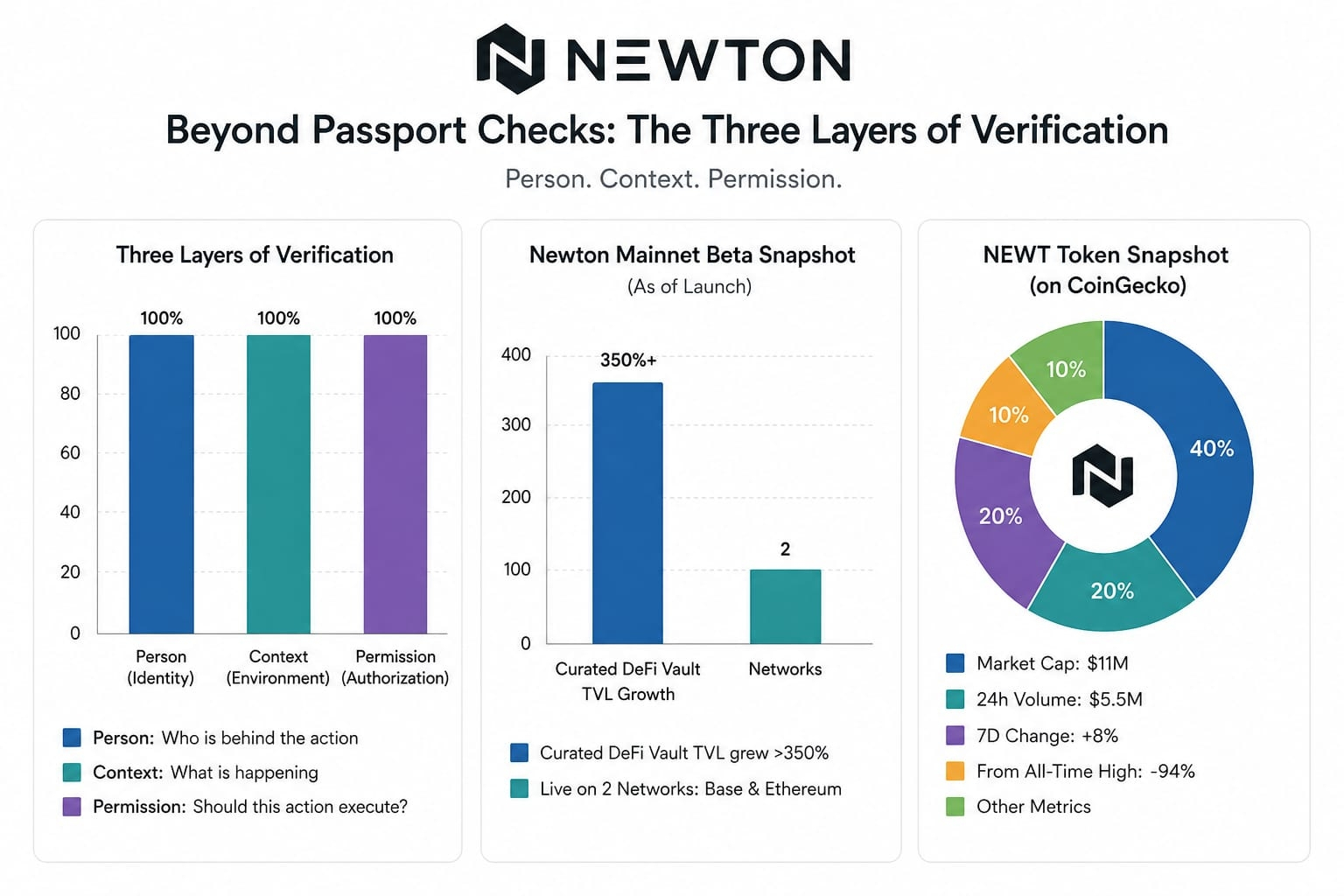
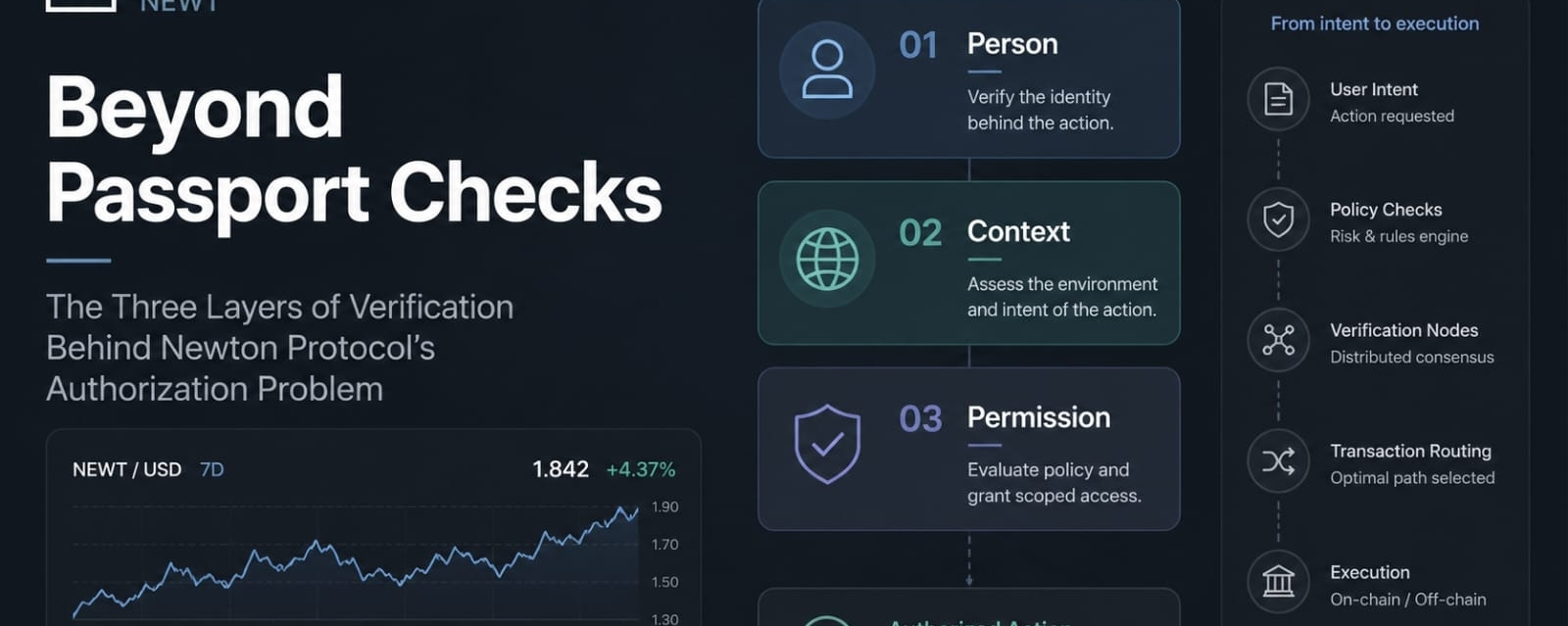
My framework is three layers: person, context, permission. The first asks who is behind the action. The second asks what is happening. The third asks whether this action should execute. Think of it like a trading floor. Your badge proves you’re you. The market screen tells you the environment. The risk system decides whether your order is allowed. One check can’t substitute for the other two.
Newton’s work makes the distinction clearer. Its Human Passport integration can feed policies with credential scores, behavioral Sybil signals, and compliance attestations. Persona adds identity and jurisdictional inputs. But here’s the thing: Newton lets policies combine those inputs with transaction and market data, then has an operator network evaluate the intent before execution and produce a BLS attestation. The smart contract can enforce the result before value moves. That’s a harder authorization problem than checking a passport. ne 23 on Base and Ethereum, is entering a market where automated vaults and agents take more discretion. Newton’s launch material says curated DeFi vault TVL grew more than 350%. I treat that as a signal, not neutral proof, but the pressure is obvious: more delegated capital means more moments where “who are you?” is insufficient. A curator can be legitimate and still exceed a cap. . NEWT trades around $0.0515, with an $11 million market cap and $5.5 million in volume on CoinGecko’s snapshot. It’s up around 8% over seven days, yet still about 94% below its all time high. That’s not a verdict on the technology. It’s a reminder that traders have separated narrative from durable demand once. e Ethereum token contract activity. Etherscan showed about 594,000 transactions. Nice number. Almost useless by itself. Token transfers, exchange flows, and contract interactions don’t tell me whether institutions, vault curators, or agents repeatedly pay for policy evaluations. This is where the real thesis lives. blem isn’t “can Newton attract integrations?” It’s “do applications keep routing consequential actions through Newton after the launch announcement fades?” I’d track repeat policy clients, evaluations per client, proof consumption rates, policy updates, and workloads active after 30, 60, and 90 days. Newton Explorer exposes tasks, policies, compliant or noncompliant results, and whether proofs are consumed or expire. That’s the operational surface traders should care about. A passport integration wins attention. Repeated authorization wins dependency. ff. More layers mean more failure points. Identity providers can misclassify users. Oracles can go stale. Policies can become too restrictive. Operators can add latency. Teams facing false positives may loosen rules until the system becomes ceremonial, or bypass it when speed matters. My frustration with compliance infrastructure is that strong controls often look great until users discover the fastest route around them.
Still, I think Newton is asking the right question. Not “is this wallet verified?” but “is this action authorized, under these conditions, against these rules, right now?” That contrast is the part I’d keep on the screen.
If you’re eyeing NEWT, don’t watch price or partnership logos. Watch whether policy usage becomes repetitive, sticky, and tied to capital that can’t bypass the check. I turn more bullish if repeat clients grow, consumed proofs outpace expired ones, and authorization volume expands without failure rates pushing users away. I turn bearish if token activity stays busy while policy clients churn, integrations remain demos, or identity checks become the whole story.
Track the permission layer, not the passport. That’s where conviction should be earned.