Aster (ASTER) entered the market with growth momentum and confidence. The project was launched in mid-2025 after Astherus and APX Finance merged into a unified Aster platform, focusing on the next-generation decentralized perpetual exchange. This platform combines leveraged derivative trading with profit-generating products across multiple blockchains.
That structure quickly attracted attention. The price of ASTER began to rise steadily, and the MASTR analyst later pointed out that the initial structure looked quite stable rather than chaotic. Rapid growth. In just a few days of September, ASTER surged over 250%, reaching a high of nearly $2.4. The developments seemed to be controlled and orderly. Then, this structure collapsed.
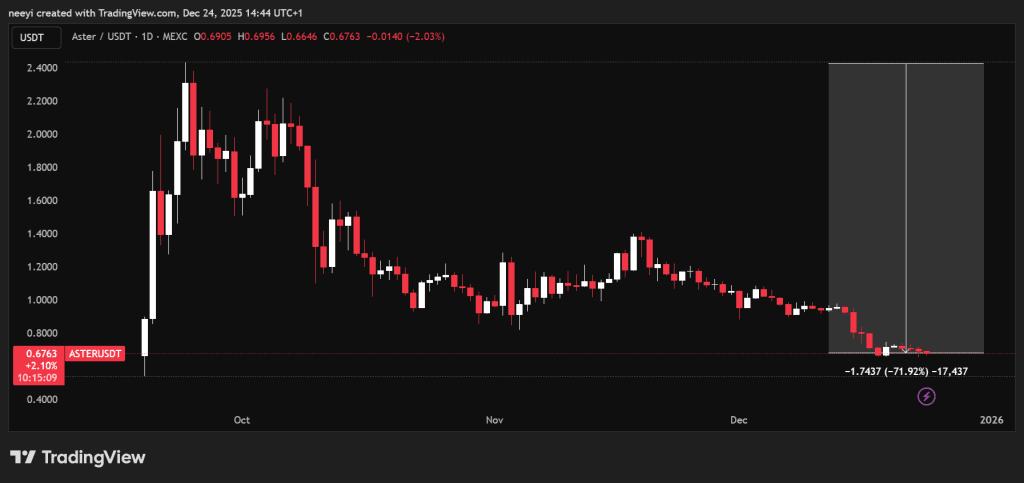
The growth momentum of ASTER seemed optimistic before the incident occurred.
Before the strong reversal, ASTER showed no clear warning signs. According to MASTR, the price movements indicate continuation rather than exhaustion. Liquidity remained strong, and the post-merger narrative provided traders with a clear framework to follow.
Projects often fail quietly, but ASTER did not. This token was deliberately pushed, supported by the narrative of broader derivative products and increased recognition. This context is crucial because what happened afterward did not resemble a natural cooling-off period.
The turning point occurred around 10/10. MASTR emphasizes that Binance recorded a record low price, which was statistically unlikely compared to other major exchanges. Over 100 trading pairs dropped more than 10%. Some pairs showed a gap from 50% to 100%. Some pairs even exceeded that range.
These discrepancies appeared simultaneously across many unrelated asset types. No major news caused this volatility. No macro event explains the timing. MASTR emphasizes that retail investor activity cannot cause hundreds of currency pairs to be mispriced at the same time. This model shows that low liquidity combined with centralized pricing dominance is a concern.
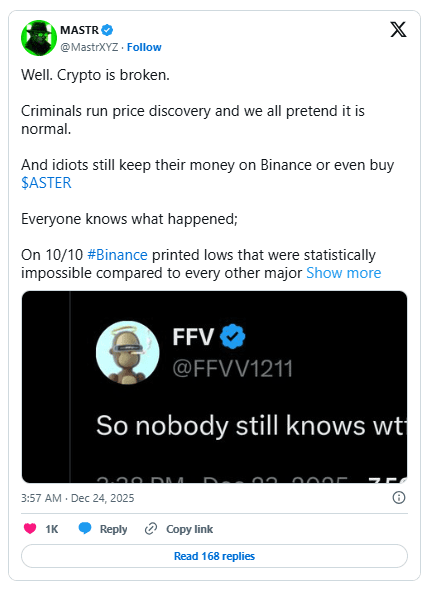
Binance's pricing system automatically switched to liquidation mode.
MASTR explains that Binance dominates the spot USDT price, which many derivative platforms and risk management tools directly reference. When Binance's price drops, the liquidation system reacts immediately. The algorithm operates without discretion. Positions are automatically closed.
As soon as Binance recorded a record low price, forced liquidations occurred. ASTER got caught in that process. Stop-loss orders were triggered. Leveraged positions collapsed. Selling pressure accelerated because the system required it, not because market sentiment suddenly changed.
The price of ASTER stock eventually fell from a peak of $2.4 to around $0.6 at the time of writing. MASTR describes this movement as a classic example of a chain liquidation phenomenon due to market structure rather than fundamental factors.
The rate of decline was completely opposite to the previous rally. Prices did not gradually decrease over time but dropped abruptly. This difference is significant. According to MASTR, the market did not re-evaluate the value of ASTER. The pricing mechanism had failed earlier, and prices fell accordingly.
What did MASTR say the ASTER event revealed?
MASTR argues that the collapse of ASTER is symptomatic of a deeper problem. Centralized exchanges act as price anchors while shifting risk to users. When that anchor wobbles, there will be no reversal and no clear accountability.
The ASTER event is not a mistake that it alone encountered. This event shows how centralized pricing determination can quickly overpower decentralized discourses. A single exchange established market reality, and everything that followed automatically adjusted to that.
ASTER may stabilize or recover. That outcome remains uncertain. What is more important to draw from MASTR's broader warning is how many assets rely on the same pricing mechanism and liquidation logic?
The event related to ASTER shows that prices do not always reflect belief or rejection. Sometimes, it reveals how fragile the underlying structure truly is. Understanding that difference may be more important than any single chart in the future.