
@NewtonProtocol had the Senate markup notes open on one screen and Newton’s transaction flow on the other when something clicked. I’d been reading the CLARITY Act the usual way, asking which agency gets what, which token lands where, and whether the Senate can finish the job. Then I stopped. The better question was simpler: what happens when legal categories become conditions software checks before capital moves?
That’s where Newton started looking different The risk is upfront. The CLARITY Act still isn’t law. Senate Banking advanced H.R. 3633 by 15 to 9 on May 14, but Reuters reported on June 30 that the bill had stalled in the Senate. Anyone buying NEWT because “regulation is coming” is trading a political assumption, not a finished framework. I don’t love that setup. Washington can turn a clean thesis into dead money quickly.
Still, I think the market may be staring at the wrong connection. My framework is “classify, condition, attest, execute.” CLARITY is trying to create clearer classifications and obligations around digital asset activity. Newton is building machinery for an adjacent problem: take a policy, evaluate a specific transaction against it, and only let the action proceed when conditions pass. Newton uses Rego policies, an EigenLayer secured operator network, and signed onchain receipts. Its docs describe sanctions checks, jurisdiction rules, exposure limits, approved protocol lists, and transaction caps.
Think of it like a nightclub rule saying underage entry is prohibited. That’s the rulebook. The operational question is who checks the ID, what data they trust, what happens when the scanner fails, and whether there’s proof the check occurred. Newton is trying to be closer to that door logic for onchain transactions.
Why does this matter now? Newton’s mainnet beta went live on Ethereum and Base on June 23. So this is a live execution experiment, not a mature adoption story. Policy pressure is rising while the product is only beginning to prove whether programmable authorization survives real workflows. RedStone’s June integration also feeds verified market data into policy enforcement around vault positions.
The onchain numbers keep me sober. Etherscan currently shows roughly 13,018 NEWT holders, a price near $0.05, about $11.2 million in circulating market cap, and roughly $5.36 million in 24 hour volume. That volume is nearly half the circulating market cap in a day. To me, that doesn’t scream durable conviction. It screams turnover. Attention is moving faster than proven usage.
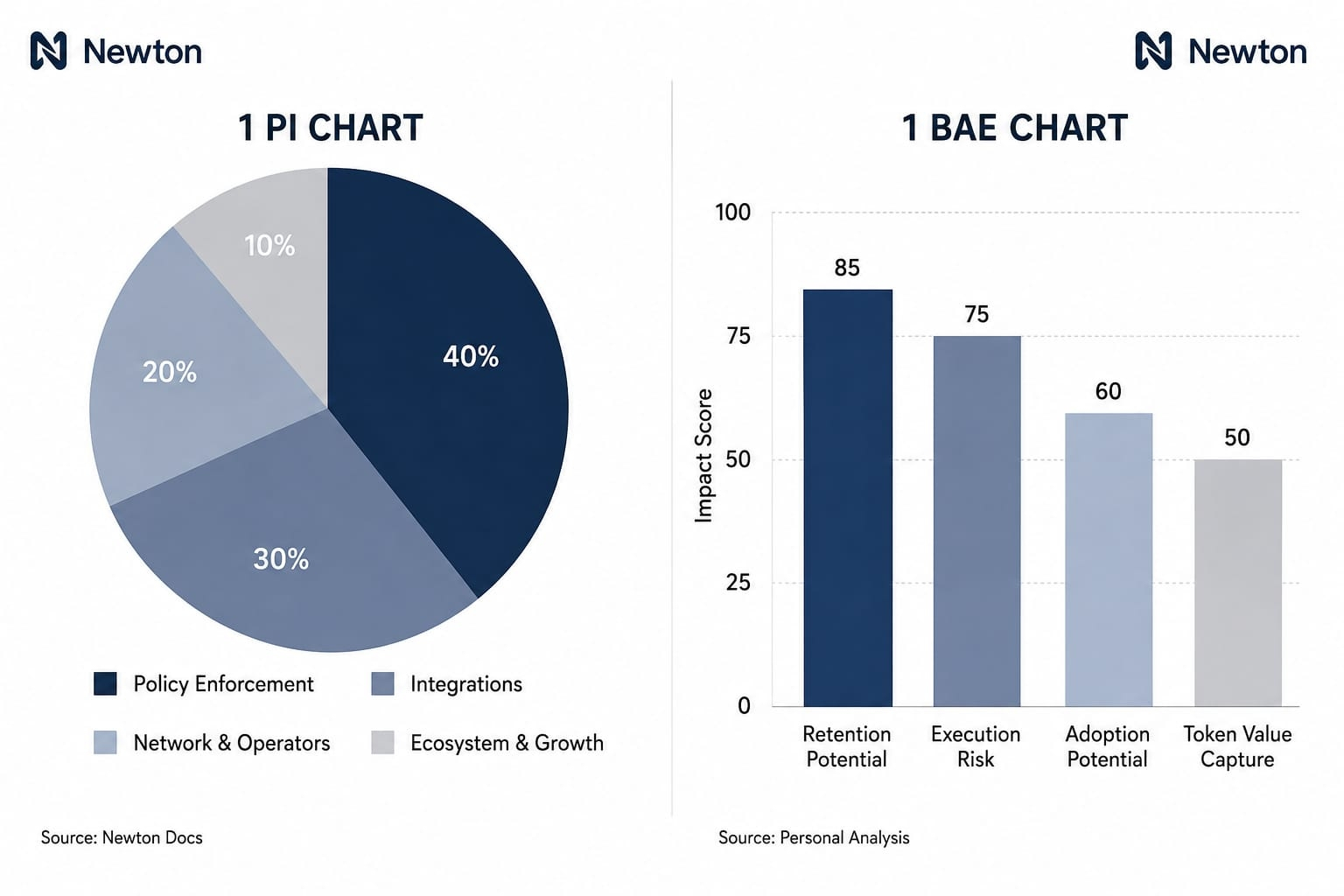
And that leads to the Retention Problem, the part I care about most. Crypto is excellent at acquiring wallets around launches, listings, rewards, and narratives. It’s worse at keeping users when the obvious incentive disappears. Newton’s real repeat customer may not be the token holder. It may be the vault curator, stablecoin issuer, RWA platform, or smart account that keeps using policy evaluation because removing the control layer becomes operationally painful.
That’s my test: does Newton become a habit inside transaction workflows?
If yes, retention looks less like daily active wallets and more like policies that stay installed, evaluations that recur, and capital that refuses to operate without the receipt. That’s a better signal than a burst of NEWT transfers. But here’s the thing: protocol usefulness and token value capture are not automatically the same trade. Newton can win integrations while NEWT holders still face weak fee capture, emissions, thin liquidity, or a market that reprices the token faster than demand arrives.
I’m also skeptical of the dependency stack. A policy can be perfectly written and still fail if an oracle is stale, an identity provider is wrong, the operator set is concentrated, or latency becomes unacceptable. Newton’s VaultKit says it fails closed when evaluation cannot complete. That’s defensible, but in a fast market a blocked legitimate action can be expensive. Safety has a cost.
So I’m not waiting for a politician to ring a bell. Bullish would be recurring mainnet evaluations, credible third party integrators, growing operator diversity, and users keeping controls after incentives fade. Bearish would be partnership logos without receipts, concentrated evaluation power, and NEWT volume staying hot while real policy usage stays cold.
If you’re eyeing Newton, stop trading the word “clarity.” Track the checks, the receipts, and who comes back to use them again. That’s where I’d place the bet, and that’s exactly what would change my mind.