

The more I look at Newton, the less I think the main question is whether it should be called a rollup, an AVS, or an AI execution layer.
That debate is useful, but only up to a point.
The quieter question is this: if Newton allows an AI-driven action today, can someone come back later and understand why?
That sounds simple, but it is a big deal.
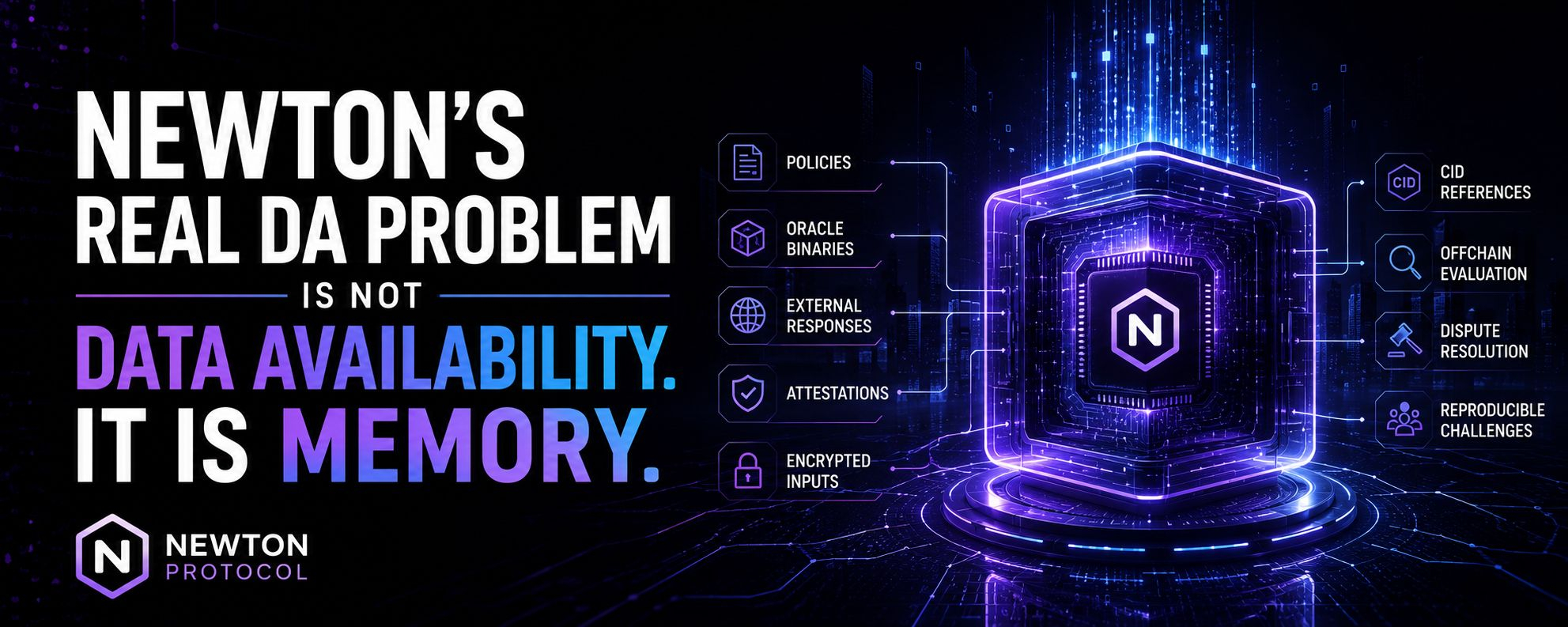
Newton’s design depends on more than one final on-chain result. A policy can be stored by CID. Operators can fetch outside data. A WASM oracle can process inputs. A quorum can sign an attestation. A contract can accept the decision.
In the moment, that may work.
But if something goes wrong later, the final signature is not enough. A challenger needs the policy that was used, the exact oracle code, the schema version, the outside data response, the timing, the operator evidence, and maybe even a way to reason about encrypted inputs without exposing private information.
That is where I get cautious.
A hash can prove something was not changed. It cannot promise the thing is still available. A CID can point to content. It cannot guarantee someone kept that content alive. An attestation can show operators agreed. It does not automatically show whether they agreed on fresh data, stale data, or a broken API response.
This is the part people often skip.
Normal rollup data availability is mostly about reconstructing execution. Can users rebuild the state? Can someone check the batch? Can fraud be challenged before the window closes?
Newton has a different problem. It has to make judgment replayable.
Not just, “did this transaction follow the rules?”
More like, “why was this AI action allowed at that exact moment?”
Those are very different questions.
I’ve seen this kind of thing before in crypto. The protocol looks clean at the signature layer, but the real trust sits in places nobody wants to talk about: logs, gateways, storage providers, old API responses, pinned files, indexers, and whoever remembered to keep the evidence.
That does not mean Newton is broken. It just means the dispute layer is only as good as the memory behind it.
Putting everything on-chain is not the answer either. That would be expensive, messy, and probably bad for privacy. The better question is what evidence must survive long enough for an independent person to replay the decision.
The policy must survive.
The oracle code must survive.
The external data record must survive.
The operator evidence must survive.
The private-input commitments must survive without turning privacy into a joke.
That is the real design challenge.
And honestly, this is why Newton feels more interesting than another “AI plus rollup” story. The hard part is not only letting autonomous capital move. The hard part is making sure it leaves behind enough of a trail that someone can question it later.
My read is simple.
If the evidence disappears, the challenge window is just a countdown.
If the evidence survives, Newton becomes something more useful: a system where AI-driven capital has to leave a reason behind.