
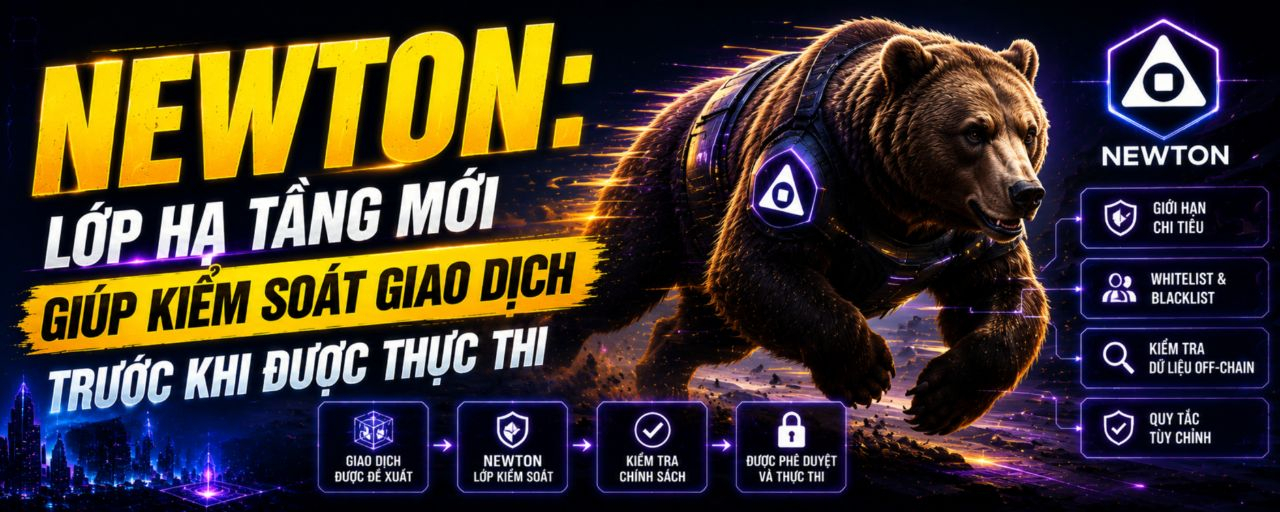
In the context of AI agents being increasingly applied in blockchain, Newton is approaching things in a rather different way. Instead of focusing on building smarter AI models or developing a new blockchain, the project aims to create an infrastructure layer that can control transactions before they are executed.
What’s noteworthy is that Newton does not require developers to switch to another blockchain or rewrite existing applications. The project simply adds an additional verification layer right before the transaction execution step.
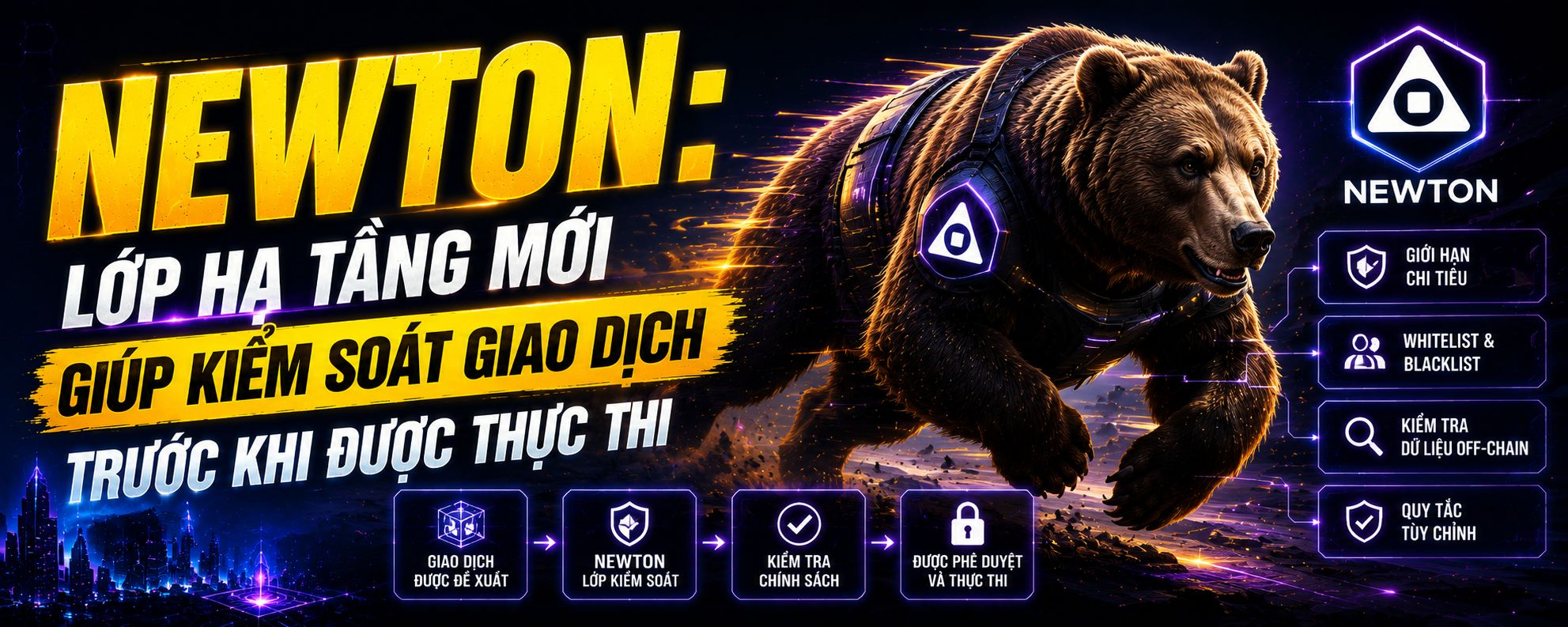
This allows developers to set multiple protection rules—such as limiting the amount of money that can be transferred, allowing transactions only to pre-approved addresses, blocking addresses in a blacklist, or checking additional data outside the blockchain before allowing a transaction to proceed.
If all the set conditions are satisfied, the transaction will be executed. Otherwise, the system will automatically reject it.
This approach helps add an extra layer of protection that many blockchain applications still lack.
Notably, Newton does not directly compete with blockchains such as Ethereum, Base, or Arbitrum. Instead, the project aims to become an infrastructure layer that can operate alongside many other blockchains.
To put it simply:
Blockchain is responsible for processing transactions.
Newton is responsible for checking whether that transaction meets the conditions to be executed.
If this model is widely adopted, it could be a more effective way to scale than building yet another new blockchain.
Another noteworthy perspective is how Newton approaches security.
Over the years, the crypto industry has mainly focused on fixing vulnerabilities in smart contracts. However, in reality, a significant number of asset losses do not originate from smart contract errors.
Many situations can happen when an AI Agent, a multisig wallet, or even the user themselves mistakenly sends to the wrong address, transfers beyond the limit, or performs incorrect actions.
In other words, the issue is not in the code, but in the permission to execute transactions.
That is also the problem Newton is aiming to solve.
However, the project still faces some challenges. If the control rules are set too tightly, the user experience may be affected. On the other hand, if they are too loose, the protective layer loses its meaning. Striking a balance between safety and convenience will be one of Newton’s most important problems to solve.
Besides that, the NEWT token is still in the early development stage. Investors should also keep track of factors such as the token unlock schedule and the token distribution model (tokenomics), rather than relying only on the project’s growth story.
If the trend of AI Agents, stablecoins, and real-world assets (RWAs) continues to expand in the coming time, Newton could become an important infrastructure layer for the blockchain ecosystem.
The core value of the project is not in building yet another new blockchain, but in adding a layer of permission control over the execution of transactions—helping blockchain applications operate more safely in the future.