
Ayat⁷⁸⁶
3.1k Posts

Ayat⁷⁸⁶
Fear is Just a Thought... Thoughts Can Be Controlled!!
5 Following
4.3K+ Followers
2.4K+ Liked
Posts
PINNED
Verified
I was checking DUSK’s tokenomics when one figure stopped me: 19.8574 DUSK emitted per block during the current first emission period.
That sounds modest until it is translated into network economics. At the scheduled block rate, emissions equal roughly 171,500 new DUSK daily.
So I started asking a less comfortable question: how much genuine activity would Dusk need before usage became a meaningful supply sink?
The obvious assumption is that more institutional transactions automatically create more DUSK demand. But that is incomplete.
DUSK is used for gas, while emissions fund staking rewards. The key distinction is simple: activity creates utility, but not necessarily equivalent net token demand.
The outcome depends on fee volume, gas prices, who pays them, and whether spent DUSK is actually removed from liquid circulation.
RWA growth could therefore increase DUSK’s usefulness without absorbing emissions at the same pace.
That is the part I keep returning to.
If institutional usage grows tenfold while fee-driven demand grows far more slowly than emissions, the network may become busier without becoming a real supply sink.
Maybe transaction count is the wrong metric. The more revealing figure could be DUSK consumed per unit of economic activity—and I’m not sure the market is measuring that yet.
#dusk $DUSK @Dusk
That sounds modest until it is translated into network economics. At the scheduled block rate, emissions equal roughly 171,500 new DUSK daily.
So I started asking a less comfortable question: how much genuine activity would Dusk need before usage became a meaningful supply sink?
The obvious assumption is that more institutional transactions automatically create more DUSK demand. But that is incomplete.
DUSK is used for gas, while emissions fund staking rewards. The key distinction is simple: activity creates utility, but not necessarily equivalent net token demand.
The outcome depends on fee volume, gas prices, who pays them, and whether spent DUSK is actually removed from liquid circulation.
RWA growth could therefore increase DUSK’s usefulness without absorbing emissions at the same pace.
That is the part I keep returning to.
If institutional usage grows tenfold while fee-driven demand grows far more slowly than emissions, the network may become busier without becoming a real supply sink.
Maybe transaction count is the wrong metric. The more revealing figure could be DUSK consumed per unit of economic activity—and I’m not sure the market is measuring that yet.
#dusk $DUSK @Dusk
I was half-watching a flat market yesterday when I reopened Dusk’s staking docs. The repeated “1,000 DUSK minimum” sounded simple, until I asked: how many provisioners hold 2×, 5×, 10×, 50× or 100× that floor? How often do soft or hard penalties occur?
Dusk’s docs say activation takes roughly 1–2 epochs, while unstaking has no protocol waiting period. Fees are gas_used × gas_price, and block rewards combine emissions with transaction fees. Block generators consider mempool transactions in descending gas-price order.
That sounded reassuring. But something didn’t line up.
The mechanism is measurable; behavior is the missing layer.
The rules prove eligibility, not decentralization.
A 1,000-DUSK minimum tells me who can participate. It doesn’t tell me stake concentration. Gas-price ordering creates selection pressure, but doesn’t prove high-fee transactions consistently land faster.
I also can’t honestly answer which contracts produce the most successful activity per million gas, which applications have the highest capital velocity, or what transaction volume makes fees equal 1%, 5%, or 10% of new emissions without historical data.
I thought that distinction was pedantic at first. It isn’t.
The real test is whether Dusk’s documented rules match observed behavior once enough value exists to make those statistics worth attacking.
#dusk $DUSK @Dusk
Dusk’s docs say activation takes roughly 1–2 epochs, while unstaking has no protocol waiting period. Fees are gas_used × gas_price, and block rewards combine emissions with transaction fees. Block generators consider mempool transactions in descending gas-price order.
That sounded reassuring. But something didn’t line up.
The mechanism is measurable; behavior is the missing layer.
The rules prove eligibility, not decentralization.
A 1,000-DUSK minimum tells me who can participate. It doesn’t tell me stake concentration. Gas-price ordering creates selection pressure, but doesn’t prove high-fee transactions consistently land faster.
I also can’t honestly answer which contracts produce the most successful activity per million gas, which applications have the highest capital velocity, or what transaction volume makes fees equal 1%, 5%, or 10% of new emissions without historical data.
I thought that distinction was pedantic at first. It isn’t.
The real test is whether Dusk’s documented rules match observed behavior once enough value exists to make those statistics worth attacking.
#dusk $DUSK @Dusk
Verified
I caught myself staring at Dusk’s documentation longer than I expected.
At first, I thought the usual question was simply, “How private is it?”
But after digging deeper, I think that’s the wrong question.
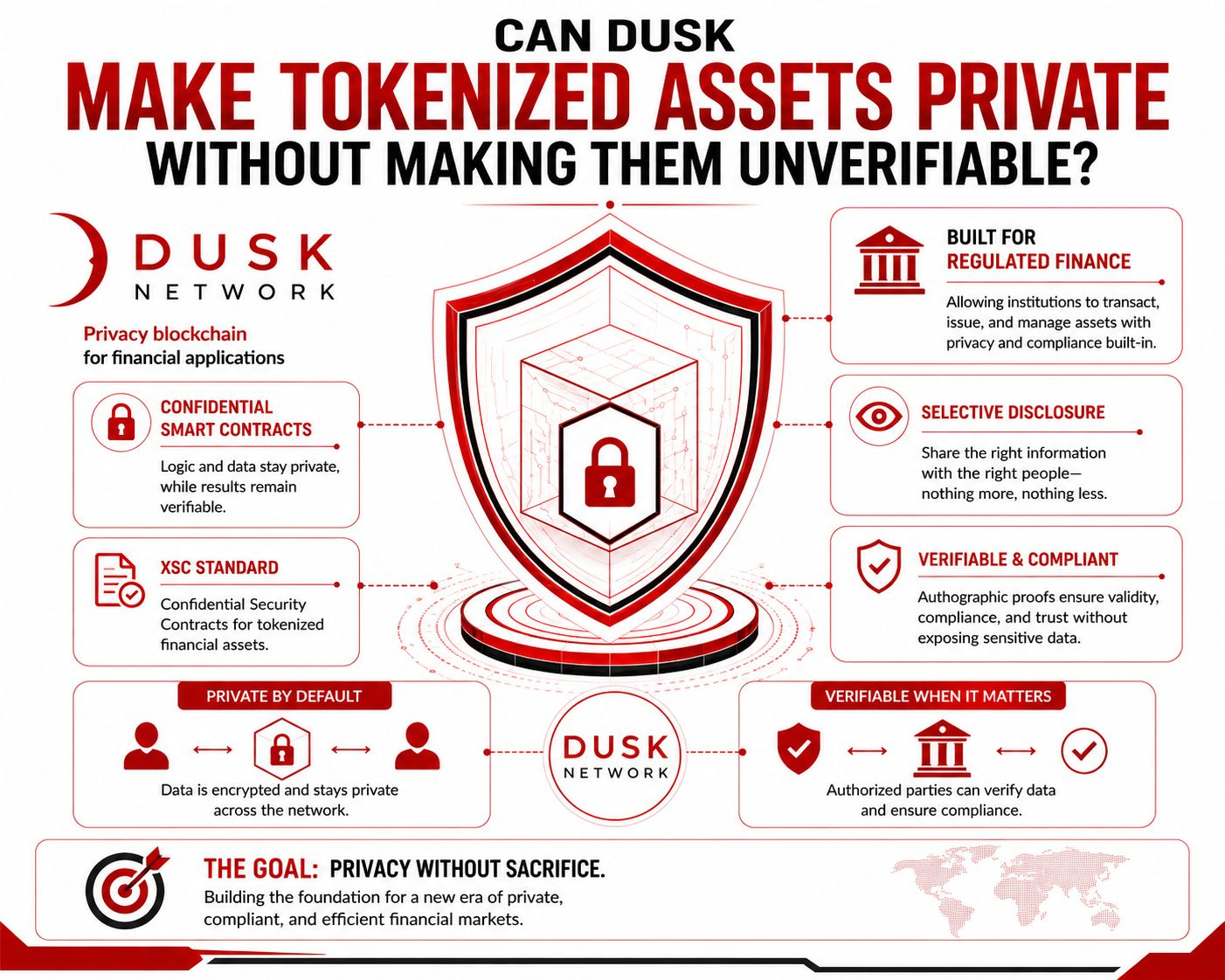
For tokenized financial assets, I don’t necessarily want everything hidden. I want sensitive information hidden from people who have no reason to see it, while the right parties can still verify what actually happened.
That’s where Dusk gets interesting to me.
Its XSC framework is built for confidential smart contracts and tokenized financial assets, with privacy and selective disclosure sitting much closer to the core of the design than they do on most transparent chains.
And honestly, that makes more sense when I think about traditional finance.
A fund probably doesn’t want its entire strategy visible on a public ledger. A regulator, however, may need proof that certain rules were followed. Those two requirements sound contradictory until you introduce controlled disclosure and cryptographic proofs.
I like that Dusk is trying to solve that middle ground.
Still, I don’t want to confuse an elegant architecture with proven adoption. The difficult part comes later: real assets, real institutions, real liquidity, and real users putting the system under pressure.
That’s the piece I keep coming back to.
Maybe the bigger opportunity for Dusk isn’t making finance completely private.
Maybe it’s making financial information private by default, but verifiable when it actually matters.
Can Dusk make that balance work outside the docs and inside real financial markets?
#dusk $DUSK @Dusk
At first, I thought the usual question was simply, “How private is it?”
But after digging deeper, I think that’s the wrong question.
For tokenized financial assets, I don’t necessarily want everything hidden. I want sensitive information hidden from people who have no reason to see it, while the right parties can still verify what actually happened.
That’s where Dusk gets interesting to me.
Its XSC framework is built for confidential smart contracts and tokenized financial assets, with privacy and selective disclosure sitting much closer to the core of the design than they do on most transparent chains.
And honestly, that makes more sense when I think about traditional finance.
A fund probably doesn’t want its entire strategy visible on a public ledger. A regulator, however, may need proof that certain rules were followed. Those two requirements sound contradictory until you introduce controlled disclosure and cryptographic proofs.
I like that Dusk is trying to solve that middle ground.
Still, I don’t want to confuse an elegant architecture with proven adoption. The difficult part comes later: real assets, real institutions, real liquidity, and real users putting the system under pressure.
That’s the piece I keep coming back to.
Maybe the bigger opportunity for Dusk isn’t making finance completely private.
Maybe it’s making financial information private by default, but verifiable when it actually matters.
Can Dusk make that balance work outside the docs and inside real financial markets?
#dusk $DUSK @Dusk
I went down a Dusk rabbit hole last night and ended up thinking less about “privacy” and more about a simple question: how private can financial data be before compliance becomes difficult?
That’s where Dusk started making more sense to me.
It’s a Layer-1 built specifically with financial applications in mind, using confidential smart contracts and the Confidential Security Contract (XSC) standard. On the surface, that sounds like another privacy narrative.
But the more I looked at it, the more I noticed the distinction.
Dusk isn’t really trying to make financial activity disappear. The bigger idea is being able to keep sensitive information out of public view while still allowing the right information to be verified by the right parties.
I kept coming back to that.
Because traditional finance already works on controlled access. A bank, regulator, investor, and counterparty don’t all need to see exactly the same information.
Public blockchains usually start from the opposite assumption: everything is visible unless privacy is added afterward.
That’s the part of Dusk I find genuinely interesting.
At the same time, I don’t want to confuse good architecture with adoption. Confidential execution and compliance-friendly infrastructure are useful only if actual financial institutions, issuers, and investors decide they need them.
So for me, the bigger question isn’t whether Dusk can make transactions private.
It’s whether Dusk can make privacy practical enough that regulated markets eventually see it as infrastructure rather than a feature.
$DUSK @Dusk #dusk
That’s where Dusk started making more sense to me.
It’s a Layer-1 built specifically with financial applications in mind, using confidential smart contracts and the Confidential Security Contract (XSC) standard. On the surface, that sounds like another privacy narrative.
But the more I looked at it, the more I noticed the distinction.
Dusk isn’t really trying to make financial activity disappear. The bigger idea is being able to keep sensitive information out of public view while still allowing the right information to be verified by the right parties.
I kept coming back to that.
Because traditional finance already works on controlled access. A bank, regulator, investor, and counterparty don’t all need to see exactly the same information.
Public blockchains usually start from the opposite assumption: everything is visible unless privacy is added afterward.
That’s the part of Dusk I find genuinely interesting.
At the same time, I don’t want to confuse good architecture with adoption. Confidential execution and compliance-friendly infrastructure are useful only if actual financial institutions, issuers, and investors decide they need them.
So for me, the bigger question isn’t whether Dusk can make transactions private.
It’s whether Dusk can make privacy practical enough that regulated markets eventually see it as infrastructure rather than a feature.
$DUSK @Dusk #dusk
What caught my attention with DUSK Network wasn’t simply the number of privacy transactions, but the possibility that the work happening behind them could be growing at a different pace.
I started looking at ZK proof activity as a separate signal rather than treating it as a mirror of private usage. If privacy transactions rise steadily while proof generation accelerates faster, that gap could reveal something important about the computational intensity of the network. More proofs per 100 privacy transactions might mean applications are becoming more complex, verification requirements are increasing, or privacy computation is being triggered in ways that transaction counts alone cannot show.
That is where DUSK Network becomes interesting to me. A 1-hour proof count compared with a 24-hour baseline could also reveal whether privacy computation is distributed naturally or concentrated into short bursts. P50, P95, and P99 windows would make those spikes easier to distinguish from normal activity.
But I would be careful about calling faster proof growth pure adoption. Higher proof activity can also mean greater computational overhead. If that workload grows faster than useful private activity, scalability becomes a real question.
I keep coming back to one metric: are ZK proofs growing because more people need privacy, or because each unit of privacy is becoming more computationally demanding?
#dusk $DUSK @Dusk
I started looking at ZK proof activity as a separate signal rather than treating it as a mirror of private usage. If privacy transactions rise steadily while proof generation accelerates faster, that gap could reveal something important about the computational intensity of the network. More proofs per 100 privacy transactions might mean applications are becoming more complex, verification requirements are increasing, or privacy computation is being triggered in ways that transaction counts alone cannot show.
That is where DUSK Network becomes interesting to me. A 1-hour proof count compared with a 24-hour baseline could also reveal whether privacy computation is distributed naturally or concentrated into short bursts. P50, P95, and P99 windows would make those spikes easier to distinguish from normal activity.
But I would be careful about calling faster proof growth pure adoption. Higher proof activity can also mean greater computational overhead. If that workload grows faster than useful private activity, scalability becomes a real question.
I keep coming back to one metric: are ZK proofs growing because more people need privacy, or because each unit of privacy is becoming more computationally demanding?
#dusk $DUSK @Dusk
I used to think a 24-hour EVM transaction number was enough to understand activity on DUSK Network. Then I started wondering what gets hidden inside that average.
A quiet day with one intense hour can look almost normal over 24 hours. But that one hour might matter more than the average suggests, especially if contracts are being used heavily for a short period.
Looking at rolling 1-hour windows makes the picture more interesting. P50 shows the normal level, while P95 and P99 can reveal those less common bursts. For DUSK Network, the gap between them may tell us whether activity is steady or concentrated around specific moments.
That’s why peak 1-hour activity divided by 24-hour activity feels like a useful contract-usage concentration metric. A high ratio doesnt automatically mean lasting adoption, but it does raise a better question: what caused the spike, and is it repeatable?
I’m still figuring out what this says about real developer behaviour on DUSK. But maybe the hidden signal isnt the average activity at all. Maybe it’s where the activity suddenly refuses to stay average.
#dusk $DUSK @Dusk
A quiet day with one intense hour can look almost normal over 24 hours. But that one hour might matter more than the average suggests, especially if contracts are being used heavily for a short period.
Looking at rolling 1-hour windows makes the picture more interesting. P50 shows the normal level, while P95 and P99 can reveal those less common bursts. For DUSK Network, the gap between them may tell us whether activity is steady or concentrated around specific moments.
That’s why peak 1-hour activity divided by 24-hour activity feels like a useful contract-usage concentration metric. A high ratio doesnt automatically mean lasting adoption, but it does raise a better question: what caused the spike, and is it repeatable?
I’m still figuring out what this says about real developer behaviour on DUSK. But maybe the hidden signal isnt the average activity at all. Maybe it’s where the activity suddenly refuses to stay average.
#dusk $DUSK @Dusk
I went down a Dusk rabbit hole last night and, honestly, I came away looking at the project a little differently.
At first, I had it filed away as another privacy-focused blockchain.
Then I started reading through how the pieces fit together.
Dusk is a Layer-1 built around financial applications, confidential smart contracts, and the Confidential Security Contract (XSC) standard. But the part I find more interesting is the problem it is trying to solve.
Financial data can’t always be public.
At the same time, you can’t build a serious financial system where nobody can verify anything.
That tension is where Dusk gets interesting to me.
I kept thinking about the difference between hiding information and selectively revealing information when it actually matters. That feels much closer to how real financial infrastructure needs to work.
Still, I’m cautious.
A clever architecture is one thing. Getting developers to build on it, users to actually use it, and financial applications to generate consistent activity is a completely different challenge.
That’s the part I’m watching now.
I don’t need Dusk to be the loudest privacy chain in crypto. I’m more interested in whether its approach quietly becomes useful for assets and transactions that simply cannot operate with everything exposed.
The more I looked at Dusk, the less I cared about the “privacy blockchain” label.
I started wondering something simpler:
Can Dusk turn a good idea into infrastructure people genuinely rely on?
#dusk $DUSK @Dusk
At first, I had it filed away as another privacy-focused blockchain.
Then I started reading through how the pieces fit together.
Dusk is a Layer-1 built around financial applications, confidential smart contracts, and the Confidential Security Contract (XSC) standard. But the part I find more interesting is the problem it is trying to solve.
Financial data can’t always be public.
At the same time, you can’t build a serious financial system where nobody can verify anything.
That tension is where Dusk gets interesting to me.
I kept thinking about the difference between hiding information and selectively revealing information when it actually matters. That feels much closer to how real financial infrastructure needs to work.
Still, I’m cautious.
A clever architecture is one thing. Getting developers to build on it, users to actually use it, and financial applications to generate consistent activity is a completely different challenge.
That’s the part I’m watching now.
I don’t need Dusk to be the loudest privacy chain in crypto. I’m more interested in whether its approach quietly becomes useful for assets and transactions that simply cannot operate with everything exposed.
The more I looked at Dusk, the less I cared about the “privacy blockchain” label.
I started wondering something simpler:
Can Dusk turn a good idea into infrastructure people genuinely rely on?
#dusk $DUSK @Dusk
The market was quiet tonight, so I opened DUSK’s docs again. I kept thinking about one metric that sounds simple: Phoenix proof verification time.
My first instinct was to look at the average. But then I wondered: what if the average is hiding the real problem?
Phoenix uses shielded, note-based transfers and zero-knowledge proofs to prove things like valid funds and no double-spending without exposing transaction details. DUSK also separates proof generation from validation; its docs describe proving as computationally heavy and sensitive to single-core performance.
That distinction matters.
A P50 verification time can look healthy while P99 quietly stretches under heavier workloads. **The average tells you how the system usually behaves; the tail tells you when the system starts struggling.**
I genuinely think Phoenix’s privacy design is useful. The interesting question is whether its verification cost remains predictable as shielded activity scales.
I’d want to test 1K, 10K and 100K transactions, then compare P50, P95 and P99—not assume the mean represents everyone.
I’m not saying Phoenix has a tail problem. I don’t have that measurement yet.
But that’s exactly the point.
The documentation tab is still open. Now I’m more interested in the worst 1% than the average.
#dusk $DUSK @Dusk
My first instinct was to look at the average. But then I wondered: what if the average is hiding the real problem?
Phoenix uses shielded, note-based transfers and zero-knowledge proofs to prove things like valid funds and no double-spending without exposing transaction details. DUSK also separates proof generation from validation; its docs describe proving as computationally heavy and sensitive to single-core performance.
That distinction matters.
A P50 verification time can look healthy while P99 quietly stretches under heavier workloads. **The average tells you how the system usually behaves; the tail tells you when the system starts struggling.**
I genuinely think Phoenix’s privacy design is useful. The interesting question is whether its verification cost remains predictable as shielded activity scales.
I’d want to test 1K, 10K and 100K transactions, then compare P50, P95 and P99—not assume the mean represents everyone.
I’m not saying Phoenix has a tail problem. I don’t have that measurement yet.
But that’s exactly the point.
The documentation tab is still open. Now I’m more interested in the worst 1% than the average.
#dusk $DUSK @Dusk
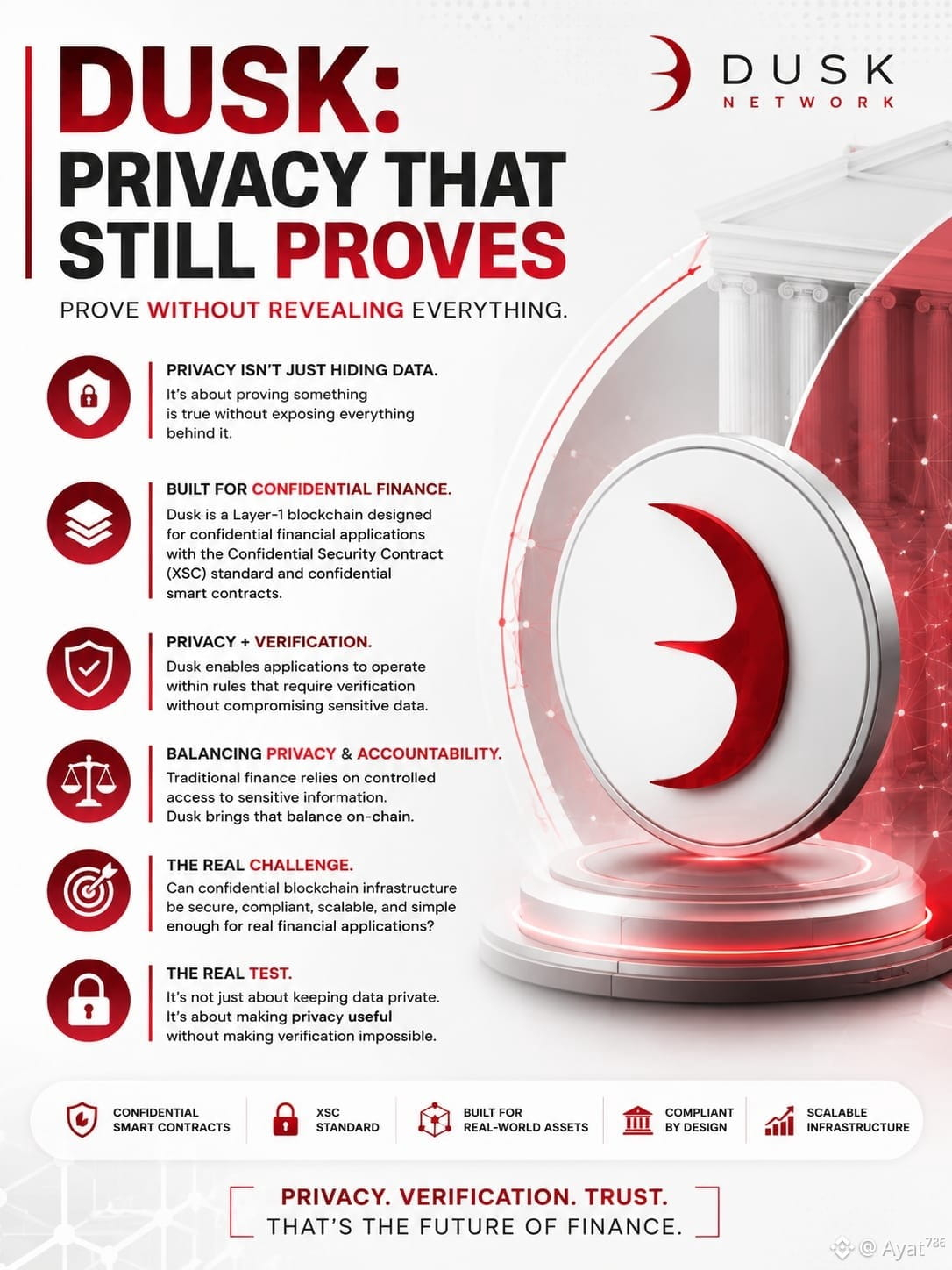
I used to think privacy on a blockchain mainly meant hiding information. Looking closer at Dusk Network made me see a different problem: financial systems often need to prove something without revealing everything behind that proof.
That distinction is what caught my attention. Dusk is a Layer-1 built around confidential financial applications, with its Confidential Security Contract (XSC) standard and support for confidential smart contracts. The interesting part is not simply that data can stay private, but that applications can still operate within rules that require verification.
The deeper challenge is balancing privacy with accountability. Traditional finance already depends on controlled access to sensitive information. Putting financial activity on a transparent blockchain can create a completely different set of problems. Dusk is trying to address that tension at the infrastructure level rather than treating privacy as an extra feature.
But the idea still has a difficult question hanging over it: can confidential blockchain infrastructure become simple enough for real financial applications while remaining secure, compliant, and practical at scale? Technology can solve part of the privacy problem. Adoption, integration, and trust are harder to engineer.
The more I look at Dusk, the more I think its real test is not whether it can keep information private. It is whether it can make privacy useful without making verification impossible.
$DUSK @Dusk #dusk
That distinction is what caught my attention. Dusk is a Layer-1 built around confidential financial applications, with its Confidential Security Contract (XSC) standard and support for confidential smart contracts. The interesting part is not simply that data can stay private, but that applications can still operate within rules that require verification.
The deeper challenge is balancing privacy with accountability. Traditional finance already depends on controlled access to sensitive information. Putting financial activity on a transparent blockchain can create a completely different set of problems. Dusk is trying to address that tension at the infrastructure level rather than treating privacy as an extra feature.
But the idea still has a difficult question hanging over it: can confidential blockchain infrastructure become simple enough for real financial applications while remaining secure, compliant, and practical at scale? Technology can solve part of the privacy problem. Adoption, integration, and trust are harder to engineer.
The more I look at Dusk, the more I think its real test is not whether it can keep information private. It is whether it can make privacy useful without making verification impossible.
$DUSK @Dusk #dusk
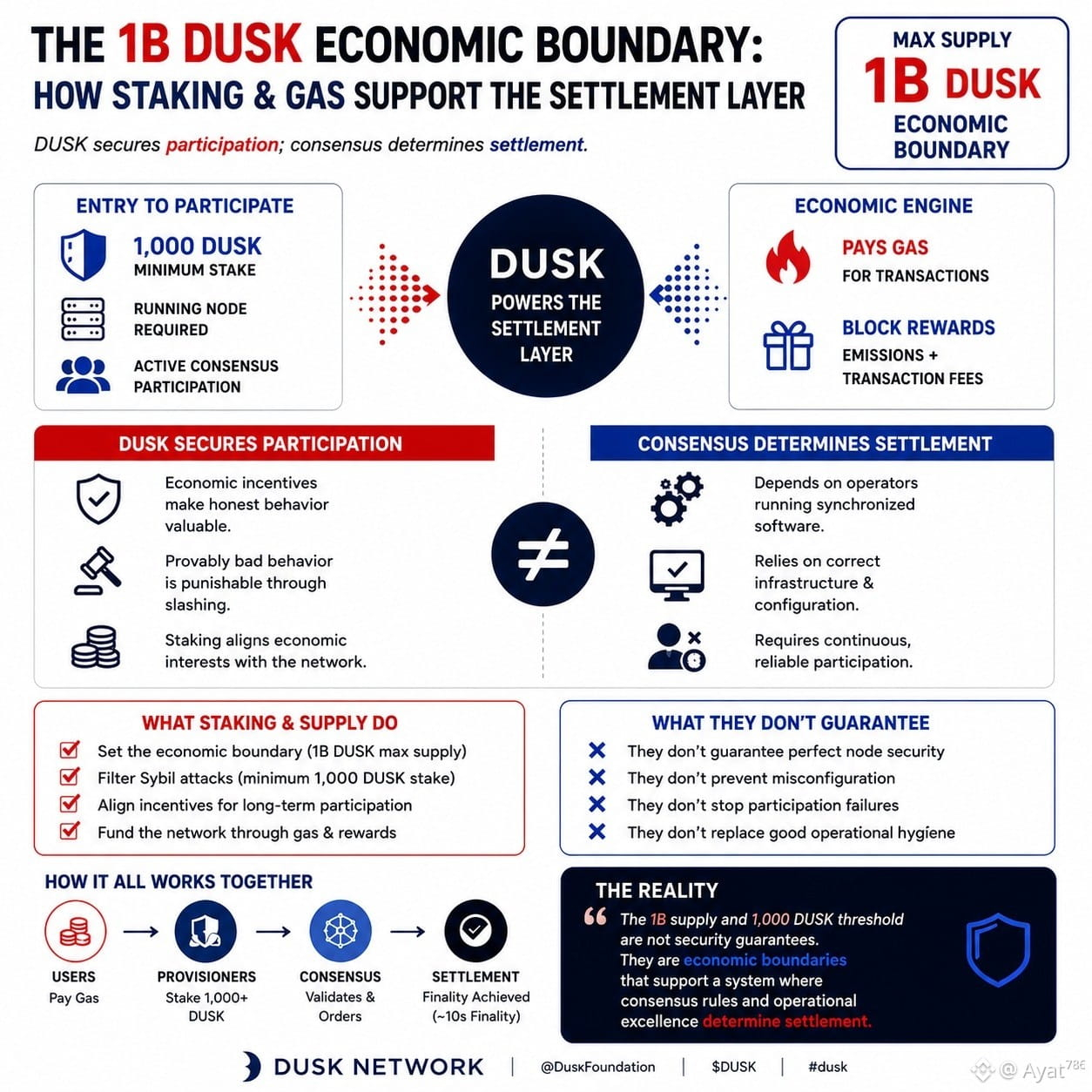
I was supposed to be checking the charts tonight, but I ended up back in Dusk Network’s documentation. The phrase that caught me was simple: a 1B DUSK maximum supply, with staking and gas supporting the settlement layer.
So I actually sat with the mechanism.
The intuitive assumption is that the 1,000 DUSK staking threshold somehow “secures” settlement by itself. It doesn’t. The threshold is an entry condition: a provisioner needs at least 1,000 DUSK, a running node, and active consensus participation. DUSK also pays gas, while block rewards combine emissions and transaction fees.
Here’s the distinction I kept coming back to:
DUSK secures participation; consensus determines settlement.
That matters. The economic layer makes honest participation valuable and provably bad consensus behavior punishable through slashing. But the guarantee still depends on operators running synchronized software and infrastructure correctly.
I initially thought that was a pedantic distinction. It isn’t.
A compromised node, poor configuration, or sustained participation failure isn’t magically fixed by the 1B supply boundary or the 1,000 DUSK threshold.
I’m not saying this is unique to Dusk Network. Most proof-of-stake systems combine cryptographic rules with operational assumptions.
The documentation tab is still open. The number now looks less like a security guarantee and mor
e like an economic boundary—and I think that difference deserves more attention.
$DUSK @Dusk #dusk
So I actually sat with the mechanism.
The intuitive assumption is that the 1,000 DUSK staking threshold somehow “secures” settlement by itself. It doesn’t. The threshold is an entry condition: a provisioner needs at least 1,000 DUSK, a running node, and active consensus participation. DUSK also pays gas, while block rewards combine emissions and transaction fees.
Here’s the distinction I kept coming back to:
DUSK secures participation; consensus determines settlement.
That matters. The economic layer makes honest participation valuable and provably bad consensus behavior punishable through slashing. But the guarantee still depends on operators running synchronized software and infrastructure correctly.
I initially thought that was a pedantic distinction. It isn’t.
A compromised node, poor configuration, or sustained participation failure isn’t magically fixed by the 1B supply boundary or the 1,000 DUSK threshold.
I’m not saying this is unique to Dusk Network. Most proof-of-stake systems combine cryptographic rules with operational assumptions.
The documentation tab is still open. The number now looks less like a security guarantee and mor
e like an economic boundary—and I think that difference deserves more attention.
$DUSK @Dusk #dusk
Verified
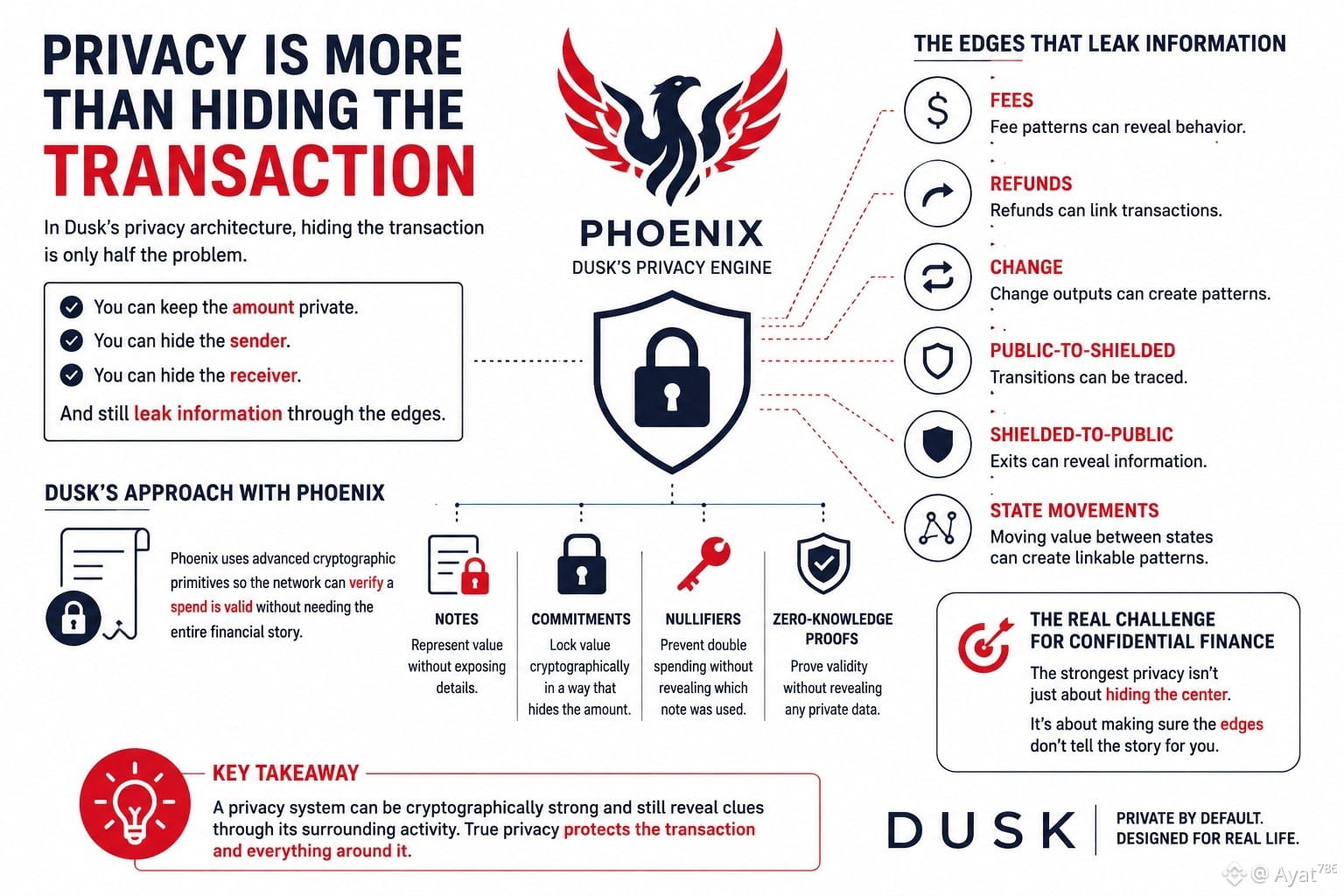
The more I looked into Dusk’s privacy architecture, the more I realized something:
hiding the transaction itself is only half the problem.
You can keep the amount private.
You can hide the sender.
You can hide the receiver.
And still leak information through the edges.
Fees.
Refunds.
Change.
Public-to-shielded transitions.
Shielded-to-public transitions.
Even the way value moves between different states can create patterns.
That’s what makes Phoenix interesting to me.
The goal isn’t simply to put a wall around a transaction and call it private.
The harder question is:
what information does the transaction leave behind without you noticing?
A privacy system can be cryptographically strong and still reveal clues through its surrounding activity.
That’s why I think Dusk’s approach is worth paying attention to.
Phoenix uses notes, commitments, nullifiers and zero-knowledge proofs so the network can verify that a spend is valid without needing the entire financial story.
But the interesting part goes beyond the proof itself.
It’s about what happens before and after the private transaction.
Because privacy shouldn't mean hiding one piece of information while accidentally exposing five others around it.
Maybe that’s the real challenge for confidential finance:
the strongest privacy isn't just about hiding the center.
It’s about making sure the edges don’t tell the story for you.
$DUSK #dusk @Dusk
hiding the transaction itself is only half the problem.
You can keep the amount private.
You can hide the sender.
You can hide the receiver.
And still leak information through the edges.
Fees.
Refunds.
Change.
Public-to-shielded transitions.
Shielded-to-public transitions.
Even the way value moves between different states can create patterns.
That’s what makes Phoenix interesting to me.
The goal isn’t simply to put a wall around a transaction and call it private.
The harder question is:
what information does the transaction leave behind without you noticing?
A privacy system can be cryptographically strong and still reveal clues through its surrounding activity.
That’s why I think Dusk’s approach is worth paying attention to.
Phoenix uses notes, commitments, nullifiers and zero-knowledge proofs so the network can verify that a spend is valid without needing the entire financial story.
But the interesting part goes beyond the proof itself.
It’s about what happens before and after the private transaction.
Because privacy shouldn't mean hiding one piece of information while accidentally exposing five others around it.
Maybe that’s the real challenge for confidential finance:
the strongest privacy isn't just about hiding the center.
It’s about making sure the edges don’t tell the story for you.
$DUSK #dusk @Dusk
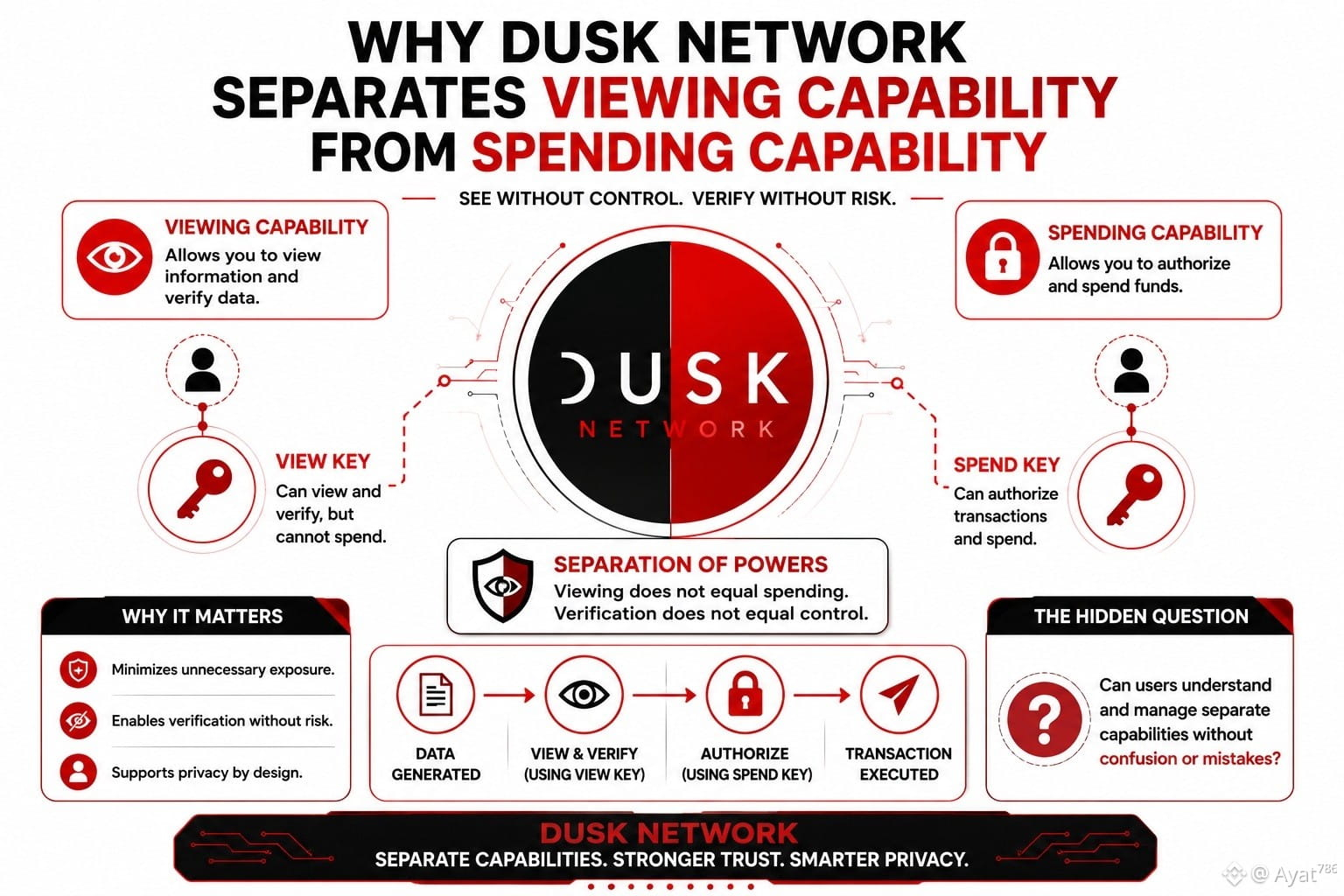
A house key is a simple thing. It can let you look inside a room without necessarily giving you the right to move everything around. I think that distinction is easy to miss in digital systems.
That is what makes DUSK’s separation between viewing capability and spending capability interesting. Seeing information and having the authority to act on it are different permissions. DUSK treats them as separate instead of assuming one should automatically unlock the other.
The hidden pressure is trust. If someone only needs to verify or observe something, why should they also hold the capability to spend? Keeping those powers apart can reduce unnecessary exposure, but it also creates another question: how easy is it for normal users to understand and manage these different capabilities?
That part may matter more than the cryptography itself. A system can be technically careful and still create confusion if people don't understand what their keys actually allow. DUSK is making a deliberate distinction, but distinctions also create responsibility.
Maybe the uncomfortable question is not whether separation is safer. It is whether people can use that separation without misunderstanding it. That is where the real test begins.
#dusk $DUSK @Dusk
That is what makes DUSK’s separation between viewing capability and spending capability interesting. Seeing information and having the authority to act on it are different permissions. DUSK treats them as separate instead of assuming one should automatically unlock the other.
The hidden pressure is trust. If someone only needs to verify or observe something, why should they also hold the capability to spend? Keeping those powers apart can reduce unnecessary exposure, but it also creates another question: how easy is it for normal users to understand and manage these different capabilities?
That part may matter more than the cryptography itself. A system can be technically careful and still create confusion if people don't understand what their keys actually allow. DUSK is making a deliberate distinction, but distinctions also create responsibility.
Maybe the uncomfortable question is not whether separation is safer. It is whether people can use that separation without misunderstanding it. That is where the real test begins.
#dusk $DUSK @Dusk
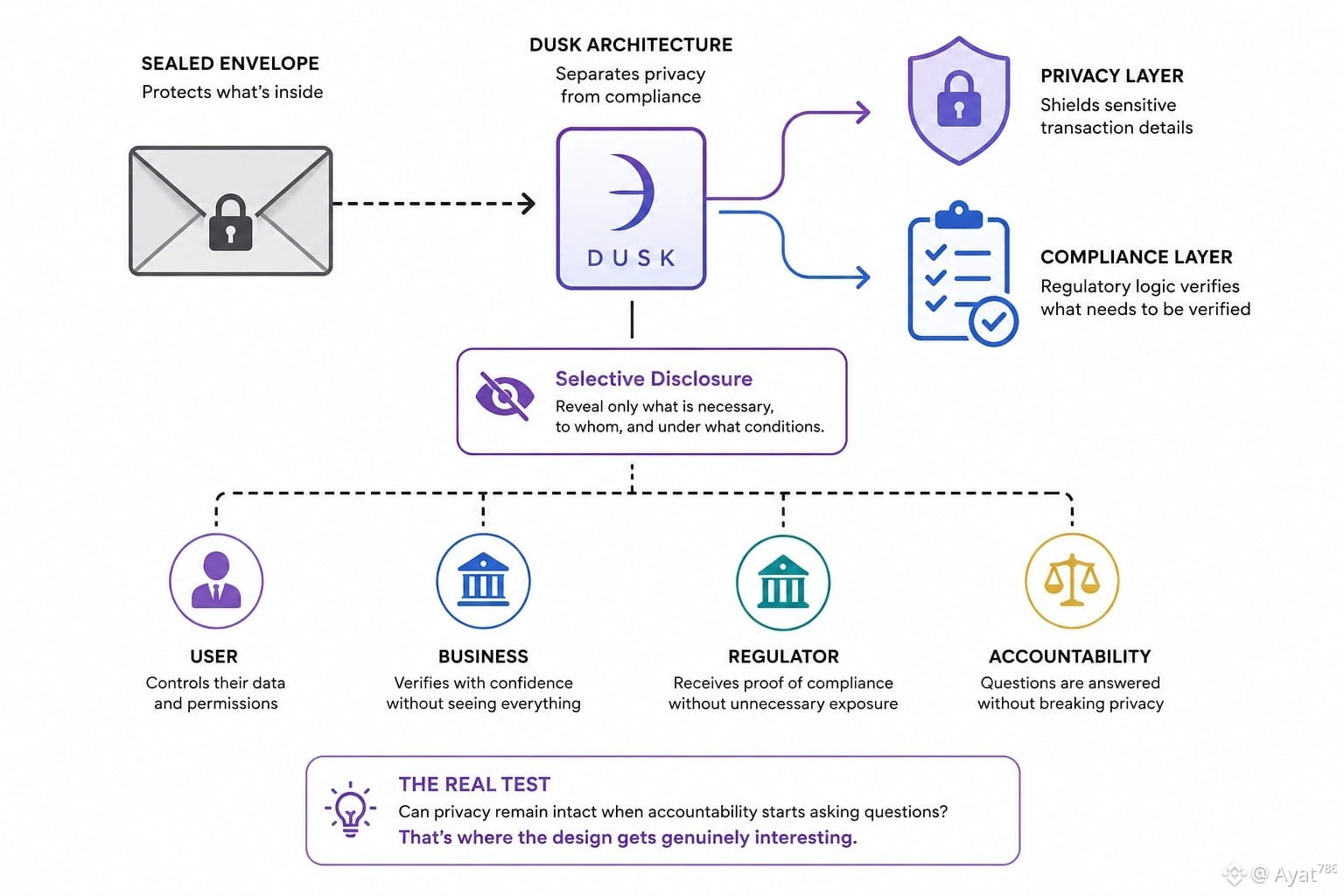
There’s something strange about a sealed envelope. It can protect what’s inside, but the moment someone needs proof of what happened, the seal becomes a problem.
That’s the tension I keep coming back to with Dusk. Privacy and compliance sound compatible until you ask a harder question: how do you prove something is valid without exposing everything behind it? Most systems solve this by sacrificing one side. Either data becomes too visible, or verification becomes too weak.
Dusk is interesting because its architecture tries to separate those two things. Privacy can shield sensitive transaction details, while regulatory logic still has a way to verify what needs to be verified. That distinction matters more than simply calling something “private.” Real privacy is not hiding everything. It is controlling what gets revealed, to whom, and under what conditions.
The uncomfortable part is execution. Compliance often depends on human institutions, rules, and changing requirements. Cryptography can make selective disclosure possible, but it cannot decide whether a regulator, business, or user will interpret that proof the same way.
So the real test for Dusk may be simple: can privacy remain intact when accountability starts asking questions? That’s where the design gets genuinely interesting.#dusk $DUSK @Dusk
That’s the tension I keep coming back to with Dusk. Privacy and compliance sound compatible until you ask a harder question: how do you prove something is valid without exposing everything behind it? Most systems solve this by sacrificing one side. Either data becomes too visible, or verification becomes too weak.
Dusk is interesting because its architecture tries to separate those two things. Privacy can shield sensitive transaction details, while regulatory logic still has a way to verify what needs to be verified. That distinction matters more than simply calling something “private.” Real privacy is not hiding everything. It is controlling what gets revealed, to whom, and under what conditions.
The uncomfortable part is execution. Compliance often depends on human institutions, rules, and changing requirements. Cryptography can make selective disclosure possible, but it cannot decide whether a regulator, business, or user will interpret that proof the same way.
So the real test for Dusk may be simple: can privacy remain intact when accountability starts asking questions? That’s where the design gets genuinely interesting.#dusk $DUSK @Dusk
Verified
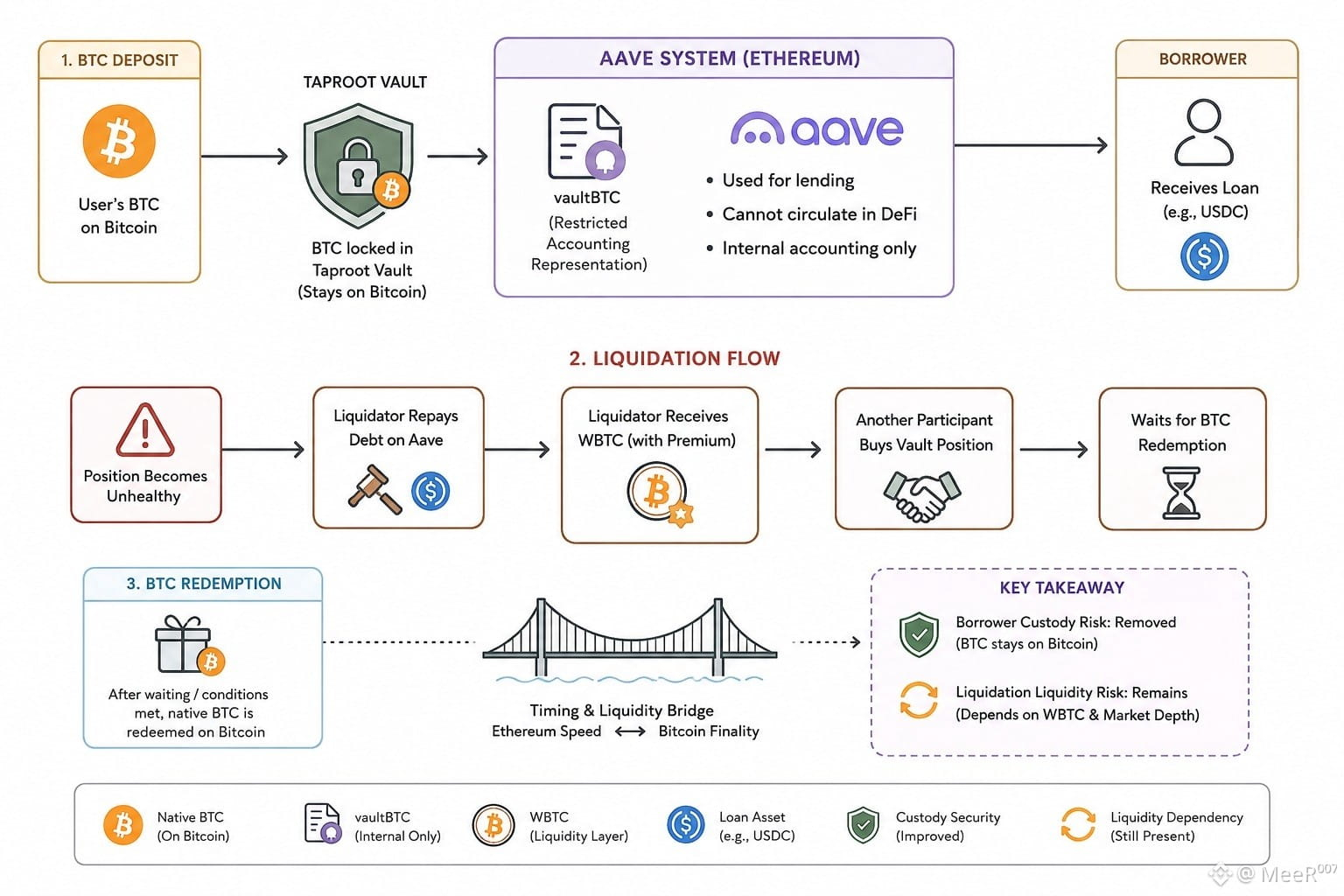
found a small detail inside Babylon’s Aave design that made “native Bitcoin lending” feel more accurate—and slightly less simple.
The borrower’s BTC really does remain on Bitcoin.
It sits inside a Taproot vault, while Aave receives a restricted accounting representation called `vaultBTC`. It is not supposed to circulate freely through DeFi like an ordinary wrapped asset.
Native collateral. Internal representation. Fair enough.
Then I reached the proposed liquidation path.
When a position becomes unhealthy, an Aave liquidator can repay the debt and receive WBTC with a small premium. Another participant can then purchase the escrowed vault position and wait for the actual native BTC to be redeemed on Bitcoin.
So the user’s Bitcoin is not wrapped.
But the fast side of the liquidation still depends on wrapped Bitcoin.
Not calling that a contradiction. @BabylonLabs_io is solving a real timing mismatch. Ethereum liquidators expect immediate settlement, while native Bitcoin redemption happens through a slower, separate process.
Someone has to carry that delay.
Still, it means WBTC has not disappeared from the architecture. Its role has simply moved—from the collateral users deposit to the liquidity the liquidation system uses.
That difference probably matters most during market stress.
In calm conditions, arbitrageurs may happily accept WBTC, acquire a vault and wait for redemption. During a violent move, available WBTC, premiums and arbitrage balance sheets could become much more important.
So I keep wondering:
Has Babylon removed wrapped-BTC custody risk from the borrower while keeping wrapped-BTC liquidity risk inside the liquidation engine?
Better custody model. Different dependency.
But maybe not complete separation from the system it is trying to replace.
@BabylonLabs_io #baby $BABY
The borrower’s BTC really does remain on Bitcoin.
It sits inside a Taproot vault, while Aave receives a restricted accounting representation called `vaultBTC`. It is not supposed to circulate freely through DeFi like an ordinary wrapped asset.
Native collateral. Internal representation. Fair enough.
Then I reached the proposed liquidation path.
When a position becomes unhealthy, an Aave liquidator can repay the debt and receive WBTC with a small premium. Another participant can then purchase the escrowed vault position and wait for the actual native BTC to be redeemed on Bitcoin.
So the user’s Bitcoin is not wrapped.
But the fast side of the liquidation still depends on wrapped Bitcoin.
Not calling that a contradiction. @BabylonLabs_io is solving a real timing mismatch. Ethereum liquidators expect immediate settlement, while native Bitcoin redemption happens through a slower, separate process.
Someone has to carry that delay.
Still, it means WBTC has not disappeared from the architecture. Its role has simply moved—from the collateral users deposit to the liquidity the liquidation system uses.
That difference probably matters most during market stress.
In calm conditions, arbitrageurs may happily accept WBTC, acquire a vault and wait for redemption. During a violent move, available WBTC, premiums and arbitrage balance sheets could become much more important.
So I keep wondering:
Has Babylon removed wrapped-BTC custody risk from the borrower while keeping wrapped-BTC liquidity risk inside the liquidation engine?
Better custody model. Different dependency.
But maybe not complete separation from the system it is trying to replace.
@BabylonLabs_io #baby $BABY
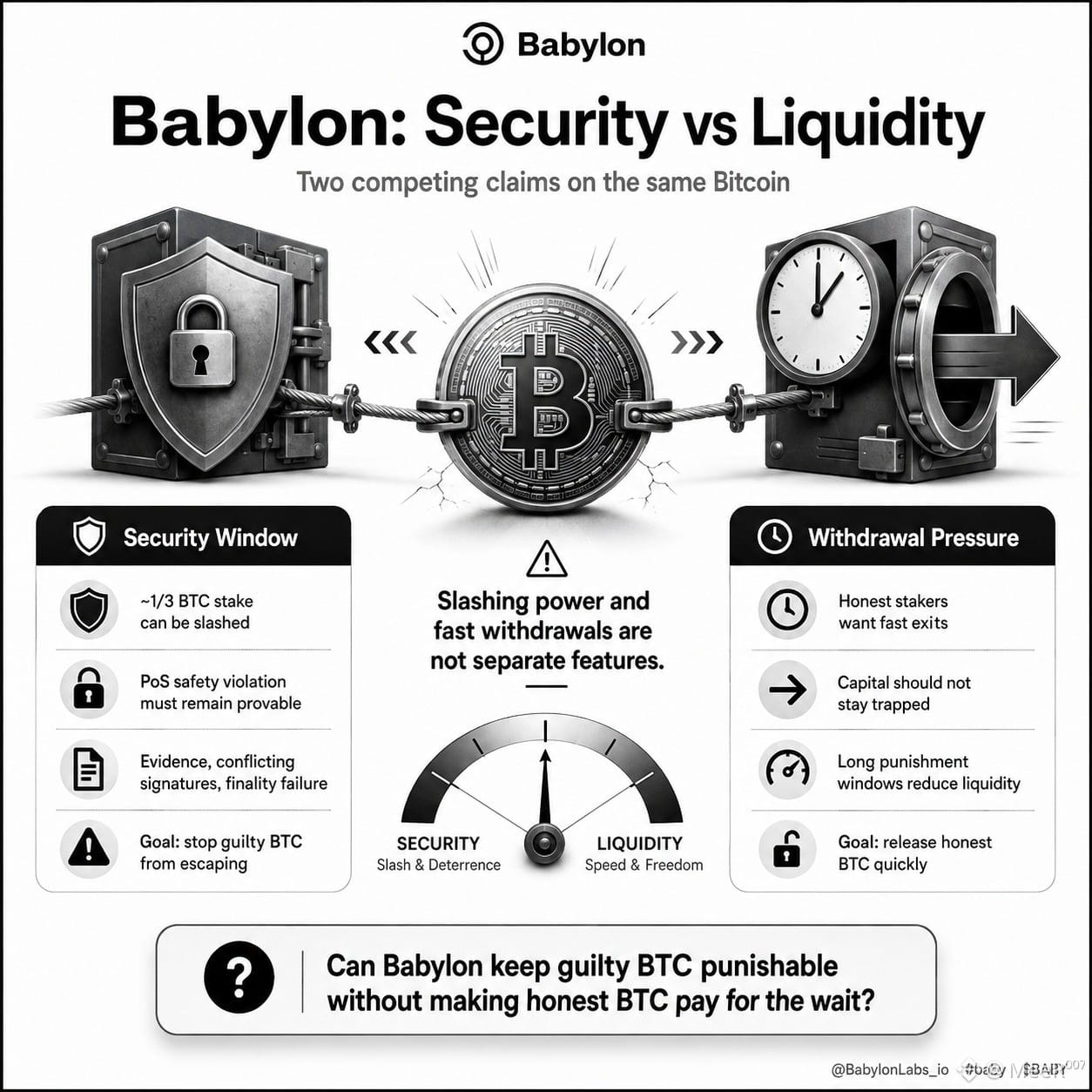
I kept thinking about a security deposit.
You only get it back after someone checks what happened in the room. That delay feels normal in real life. But in Babylon, the same logic becomes much heavier, because the “deposit” is Bitcoin, the “damage” is a PoS safety violation, and the cost of getting the timing wrong is not inconvenience. It is failed security.
Babylon says roughly one-third of the Bitcoin stake can be slashed if a supported PoS chain suffers a safety failure. That is what gives the system teeth. The BTC has to remain reachable, provably tied to wrongdoing, and punishable when something breaks. Without that, the promise of shared security starts to feel cosmetic.
But honest stakers are not joining Babylon to watch their capital sit still forever. They also expect secure and reasonably fast withdrawals. That is where the tension becomes real. Security wants the capital to remain in reach long enough for evidence, conflicting signatures, and finality failures to be detected. Liquidity wants that same capital released quickly, so honest BTC does not stay trapped inside a punishment window it may never need.
Most people will read slashing and fast withdrawal as two separate features. They are not. They are two competing claims on the same Bitcoin.
I keep wondering whether Babylon’s real strength is not the size of the slash, but whether it can reliably stop guilty BTC from escaping without making honest BTC pay for the wait.
@BabylonLabs_io #baby $BABY
You only get it back after someone checks what happened in the room. That delay feels normal in real life. But in Babylon, the same logic becomes much heavier, because the “deposit” is Bitcoin, the “damage” is a PoS safety violation, and the cost of getting the timing wrong is not inconvenience. It is failed security.
Babylon says roughly one-third of the Bitcoin stake can be slashed if a supported PoS chain suffers a safety failure. That is what gives the system teeth. The BTC has to remain reachable, provably tied to wrongdoing, and punishable when something breaks. Without that, the promise of shared security starts to feel cosmetic.
But honest stakers are not joining Babylon to watch their capital sit still forever. They also expect secure and reasonably fast withdrawals. That is where the tension becomes real. Security wants the capital to remain in reach long enough for evidence, conflicting signatures, and finality failures to be detected. Liquidity wants that same capital released quickly, so honest BTC does not stay trapped inside a punishment window it may never need.
Most people will read slashing and fast withdrawal as two separate features. They are not. They are two competing claims on the same Bitcoin.
I keep wondering whether Babylon’s real strength is not the size of the slash, but whether it can reliably stop guilty BTC from escaping without making honest BTC pay for the wait.
@BabylonLabs_io #baby $BABY
Partly True
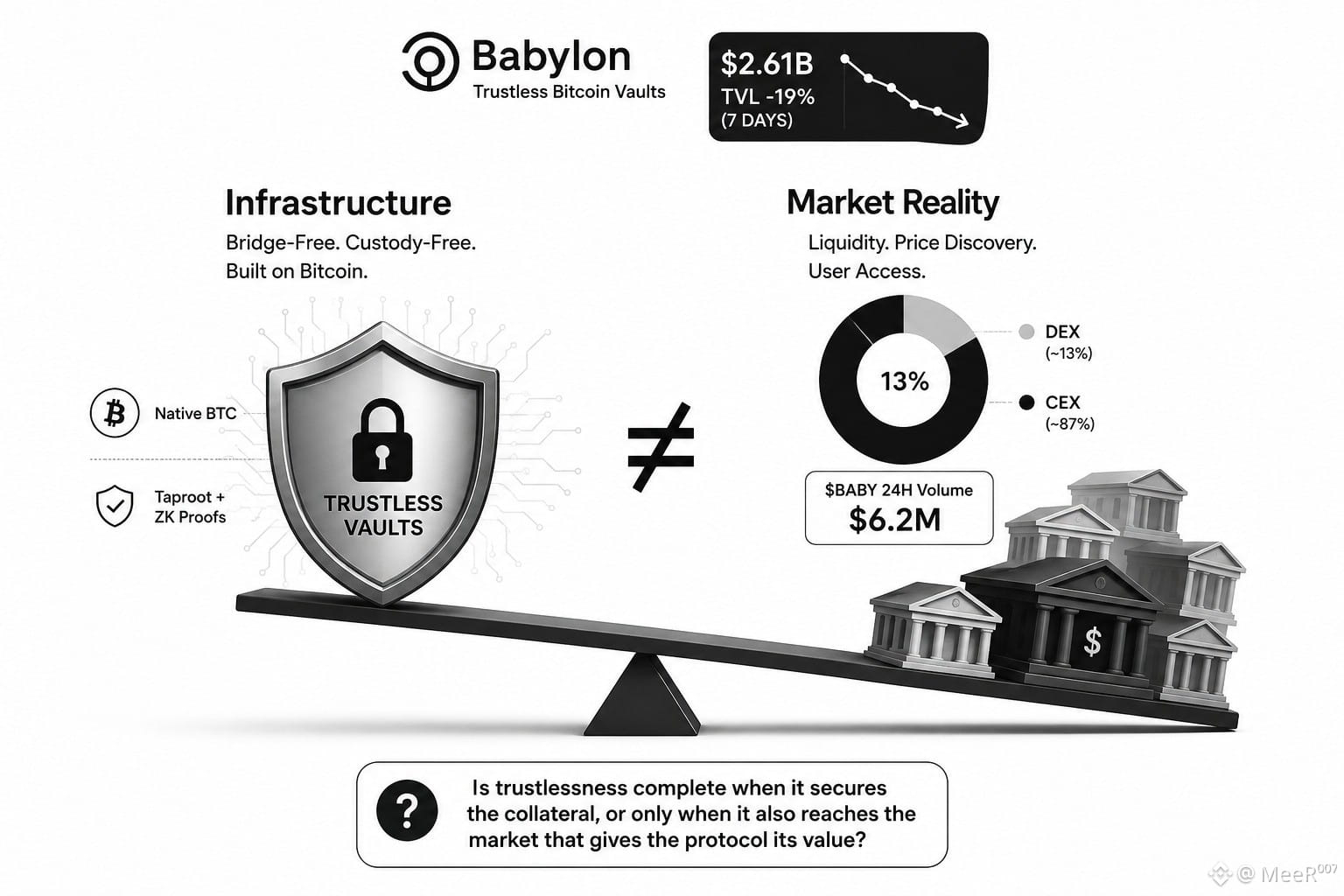
I was halfway through a snack when one number made me stop scrolling. @BabylonLabs_io presents Trustless Bitcoin Vaults as a cleaner way to bring native BTC into DeFi—no wrapped asset, no conventional bridge, and less dependence on trusted intermediaries. The logic is easy to understand. But the live numbers made the story feel less complete. DefiLlama showed roughly $2.61B locked, down nearly 19% over seven days. That alone does not mean the vault model is failing. TVL moves for many reasons. Still, it creates an uncomfortable contrast: a system described as opening a major new Bitcoin use case was losing locked value while the narrative around it was expanding. Then I looked at $BABY liquidity. Its 24-hour volume was around $6.2M, yet only about 13% appeared to come from decentralized exchanges. Roughly 87% was still flowing through centralized venues. That is the hidden contradiction. @BabylonLabs_io may be designing bridge-free collateral infrastructure, while most users still discover, trade, and price $BABY through the same trusted middlemen the broader vision is trying to reduce. The vault mechanics and token market are technically separate. Taproot and ZK-based controls can work exactly as intended even when liquidity remains centralized. But technical separation does not remove economic dependence. Markets influence access, incentives, price discovery, and behavior when pressure arrives. A protocol can protect Bitcoin without a custodian and still depend on custodians to decide what its ecosystem is worth. So I keep returning to the harder question: is trustlessness complete when it secures the collateral, or only when it also reaches the market that gives the protocol its value?
@BabylonLabs_io #baby $BABY
@BabylonLabs_io #baby $BABY
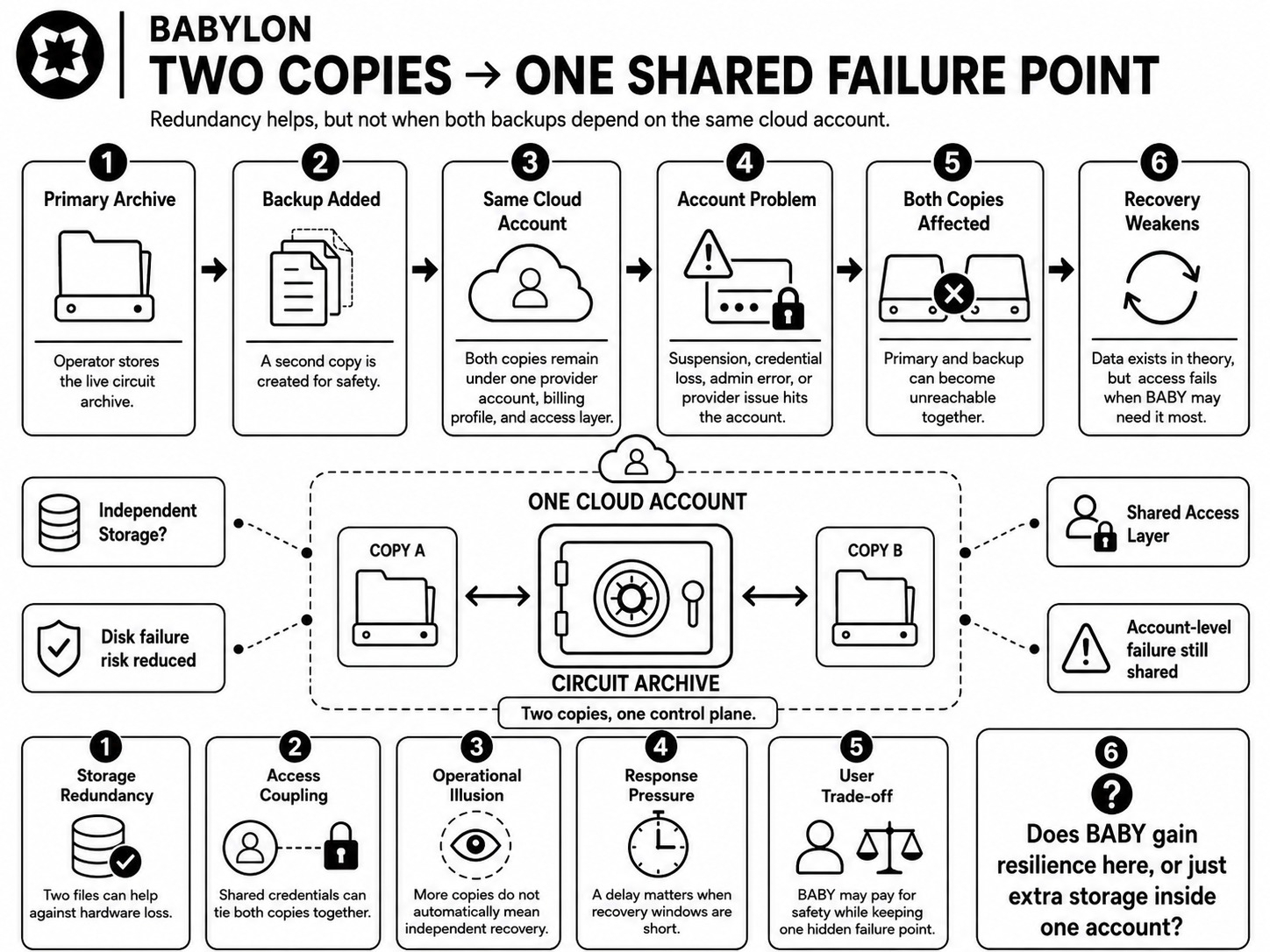
I keep two spare keys in the same kitchen drawer. Technically, that is redundancy. Practically, one spilled cup or one careless hand can remove both.
That is the quiet problem behind “two copies” when both live under one cloud account. The files may sit in separate folders, buckets, even regions, yet the same login, recovery email, billing status, permissions, or compromised administrator can still reach them. Cloud providers themselves recommend cross-account or isolated backups because duplication without an independent control boundary is not real separation.
For BABY, this matters wherever operators, teams, or users treat copied data as safety. BABY helps secure Babylon Genesis through staking and governance, but the human layer can still compress several protections into one credential. Most people will notice the copy count, not the shared account above it. It looks prepared. It feels responsible.
But if that account is locked, hijacked, misconfigured, or deleted, both copies can disappear together. Then the question is not whether BABY has backups. It is whether those backups can survive the failure of the person, permission system, or provider controlling them.
Maybe resilience begins when the second copy belongs to a genuinely different failure story.
@BabylonLabs_io #baby $BABY
That is the quiet problem behind “two copies” when both live under one cloud account. The files may sit in separate folders, buckets, even regions, yet the same login, recovery email, billing status, permissions, or compromised administrator can still reach them. Cloud providers themselves recommend cross-account or isolated backups because duplication without an independent control boundary is not real separation.
For BABY, this matters wherever operators, teams, or users treat copied data as safety. BABY helps secure Babylon Genesis through staking and governance, but the human layer can still compress several protections into one credential. Most people will notice the copy count, not the shared account above it. It looks prepared. It feels responsible.
But if that account is locked, hijacked, misconfigured, or deleted, both copies can disappear together. Then the question is not whether BABY has backups. It is whether those backups can survive the failure of the person, permission system, or provider controlling them.
Maybe resilience begins when the second copy belongs to a genuinely different failure story.
@BabylonLabs_io #baby $BABY
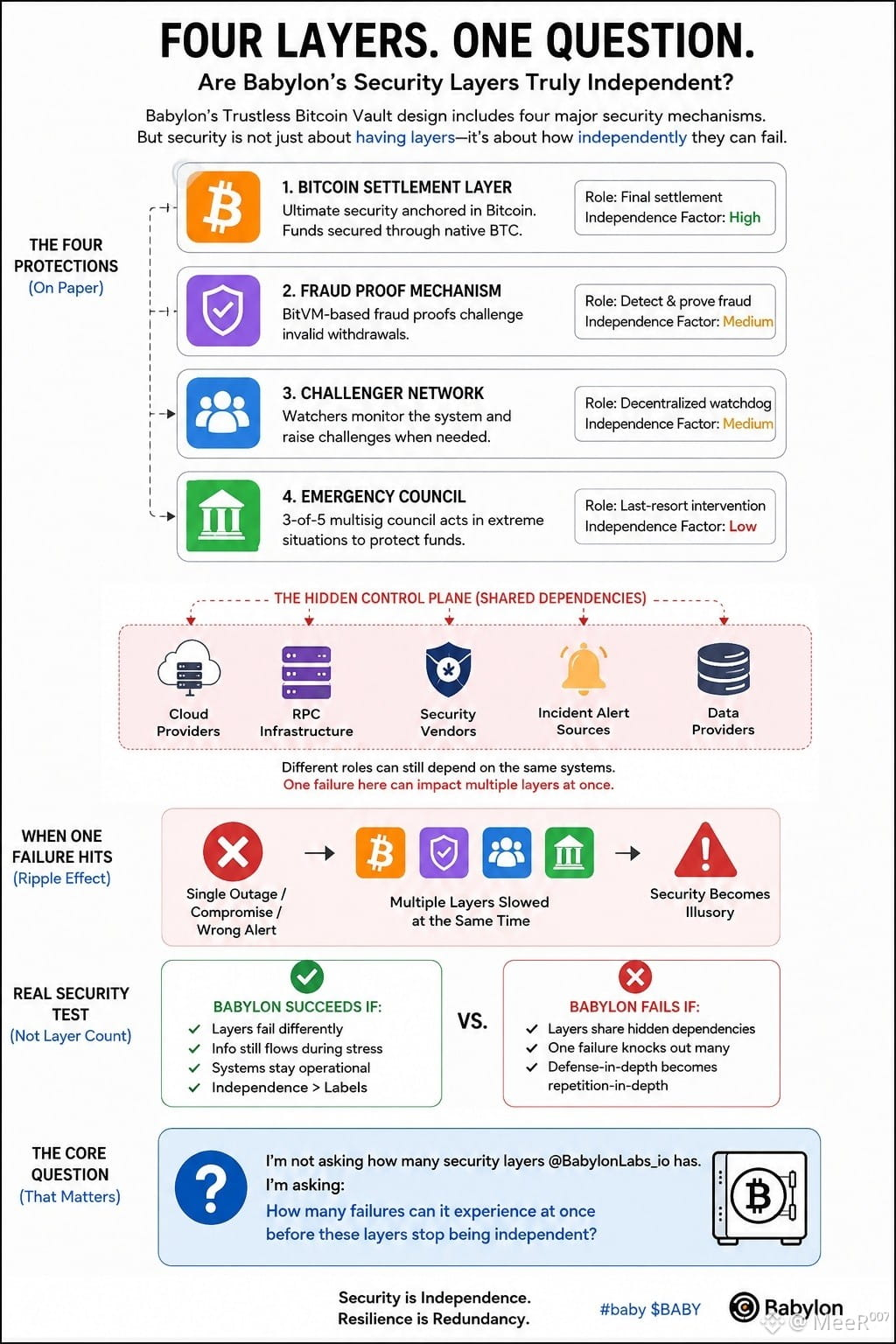
I kept counting Babylon’s security layers separately.
Bitcoin settlement underneath. Fraud proofs above it. Challengers watching withdrawals. An emergency council available if everything else goes wrong.
Four protections sounded stronger than one.
But that count may be misleading.
The real question is whether those layers are actually independent when pressure arrives.
A challenger, council member, vault operator, and monitoring service can have different roles while still relying on the same cloud provider, the same RPC infrastructure, the same security vendor, or the same source of incident information.
On paper, nothing is missing.
Every safeguard exists.
Yet one outage, compromised dependency, or incorrect alert could slow several defensive layers at the exact same moment.
That matters for @BabylonLabs_io because Trustless Bitcoin Vault security is not only about whether each mechanism works alone. It is about whether the mechanisms fail differently.
$BABY does not gain four layers of resilience if all four are waiting on one hidden control plane.
Some shared infrastructure is unavoidable. Independent systems are expensive, slower to coordinate, and harder to operate. But convenience can quietly turn defence-in-depth into repetition-in-depth.
Babylon succeeds if a failure in one layer leaves the others informed and operational.
It fails if separate safeguards become separate labels attached to the same underlying dependency.
I’m not asking how many security layers @BabylonLabs_io has.
I’m asking how many failures it can experience at once before those layers stop being independent.
@BabylonLabs_io #baby $BABY
Bitcoin settlement underneath. Fraud proofs above it. Challengers watching withdrawals. An emergency council available if everything else goes wrong.
Four protections sounded stronger than one.
But that count may be misleading.
The real question is whether those layers are actually independent when pressure arrives.
A challenger, council member, vault operator, and monitoring service can have different roles while still relying on the same cloud provider, the same RPC infrastructure, the same security vendor, or the same source of incident information.
On paper, nothing is missing.
Every safeguard exists.
Yet one outage, compromised dependency, or incorrect alert could slow several defensive layers at the exact same moment.
That matters for @BabylonLabs_io because Trustless Bitcoin Vault security is not only about whether each mechanism works alone. It is about whether the mechanisms fail differently.
$BABY does not gain four layers of resilience if all four are waiting on one hidden control plane.
Some shared infrastructure is unavoidable. Independent systems are expensive, slower to coordinate, and harder to operate. But convenience can quietly turn defence-in-depth into repetition-in-depth.
Babylon succeeds if a failure in one layer leaves the others informed and operational.
It fails if separate safeguards become separate labels attached to the same underlying dependency.
I’m not asking how many security layers @BabylonLabs_io has.
I’m asking how many failures it can experience at once before those layers stop being independent.
@BabylonLabs_io #baby $BABY
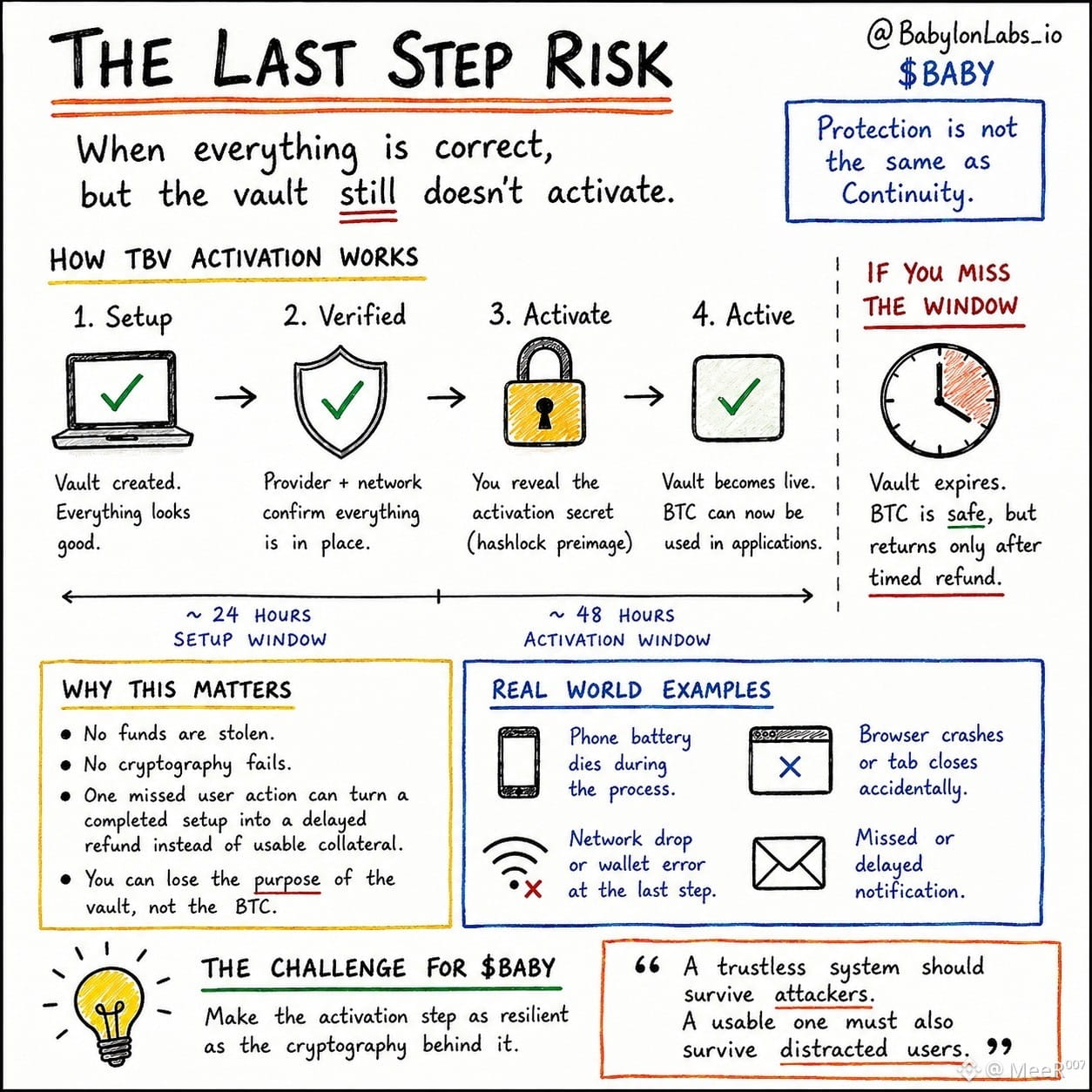
I once completed an online application perfectly, then lost the outcome because I missed one final confirmation.
That small frustration changed how I think about activation risk inside @BabylonLabs_io ’s Trustless Bitcoin Vaults.
A vault can finish setup, reach the Verified state, and still remain unusable until the depositor reveals the activation secret that was committed earlier through a hashlock.
Technically, that is a smart design.
It binds the Ethereum-side approval to the correct Bitcoin-side transaction and prevents the vault from progressing under mismatched state.
But it also creates a quieter dependency.
The Vault Provider may do everything right. The Bitcoin transaction may be correct. The application may be ready. Yet a single missed user action—wallet friction, a lost session, a failed notification, device change, or simple confusion—can turn a nearly completed vault into delay, expiry, and refund flow.
Nothing has to fail cryptographically.
No BTC has to be stolen.
Still, the user can lose the reason they opened the vault in the first place.
That matters for $BABY because protocol security is not only about preserving recoverability. It is also about whether ordinary users can reliably complete the final step before the opportunity disappears.
@BabylonLabs_io may have solved the dangerous failure: losing Bitcoin.
The harder product test is solving the ordinary failure: losing time at the last mile.
A trustless system should survive attackers.
A usable one must also survive distracted users.
@BabylonLabs_io #baby $BABY
That small frustration changed how I think about activation risk inside @BabylonLabs_io ’s Trustless Bitcoin Vaults.
A vault can finish setup, reach the Verified state, and still remain unusable until the depositor reveals the activation secret that was committed earlier through a hashlock.
Technically, that is a smart design.
It binds the Ethereum-side approval to the correct Bitcoin-side transaction and prevents the vault from progressing under mismatched state.
But it also creates a quieter dependency.
The Vault Provider may do everything right. The Bitcoin transaction may be correct. The application may be ready. Yet a single missed user action—wallet friction, a lost session, a failed notification, device change, or simple confusion—can turn a nearly completed vault into delay, expiry, and refund flow.
Nothing has to fail cryptographically.
No BTC has to be stolen.
Still, the user can lose the reason they opened the vault in the first place.
That matters for $BABY because protocol security is not only about preserving recoverability. It is also about whether ordinary users can reliably complete the final step before the opportunity disappears.
@BabylonLabs_io may have solved the dangerous failure: losing Bitcoin.
The harder product test is solving the ordinary failure: losing time at the last mile.
A trustless system should survive attackers.
A usable one must also survive distracted users.
@BabylonLabs_io #baby $BABY
Verified
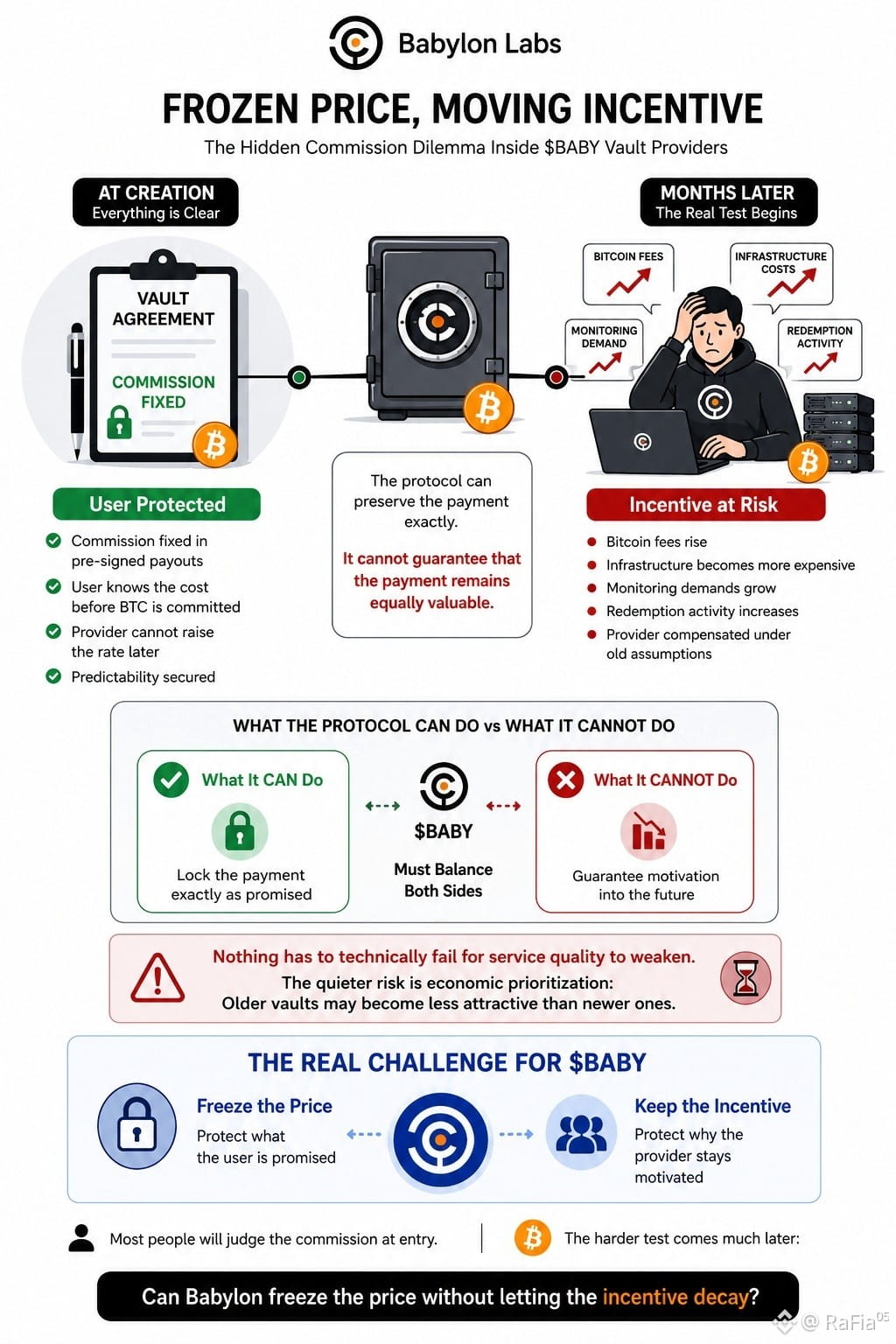
I once booked a service months early because the price looked fair.
By the time the work was due, every cost around it had changed. My agreement had not.
That made me wonder whether a fixed price also preserves fixed attention.
The same tension may exist inside @BabylonLabs_io ’s Vault Provider commission.
When a vault is created, the provider’s commission is embedded in pre-signed payout transactions. The user gets price certainty before BTC is committed, and the provider cannot raise the rate later.
That protects the depositor.
But it also freezes a nominal reward against changing real-world costs.
A vault may remain active while Bitcoin fees rise, infrastructure becomes more expensive, monitoring demands grow, or redemption activity increases. The provider is still compensated under assumptions made at creation.
The protocol can preserve the payment exactly.
It cannot guarantee that the payment remains equally valuable.
Nothing needs to break cryptographically. The quieter risk is economic prioritization: newer vaults may offer better incentives, while older ones become less attractive to monitor and support with the same urgency.
Allowing commissions to change later would weaken predictability. Freezing them forever may weaken long-term alignment.
$BABY therefore has to protect both sides of the agreement: what the user is promised and why the provider remains motivated to deliver it.
Most people will judge the commission at entry.
The harder test comes much later:
Can Babylon freeze the price without letting the incentive decay?
@BabylonLabs_io #baby $BABY
By the time the work was due, every cost around it had changed. My agreement had not.
That made me wonder whether a fixed price also preserves fixed attention.
The same tension may exist inside @BabylonLabs_io ’s Vault Provider commission.
When a vault is created, the provider’s commission is embedded in pre-signed payout transactions. The user gets price certainty before BTC is committed, and the provider cannot raise the rate later.
That protects the depositor.
But it also freezes a nominal reward against changing real-world costs.
A vault may remain active while Bitcoin fees rise, infrastructure becomes more expensive, monitoring demands grow, or redemption activity increases. The provider is still compensated under assumptions made at creation.
The protocol can preserve the payment exactly.
It cannot guarantee that the payment remains equally valuable.
Nothing needs to break cryptographically. The quieter risk is economic prioritization: newer vaults may offer better incentives, while older ones become less attractive to monitor and support with the same urgency.
Allowing commissions to change later would weaken predictability. Freezing them forever may weaken long-term alignment.
$BABY therefore has to protect both sides of the agreement: what the user is promised and why the provider remains motivated to deliver it.
Most people will judge the commission at entry.
The harder test comes much later:
Can Babylon freeze the price without letting the incentive decay?
@BabylonLabs_io #baby $BABY
Log in to explore more content