

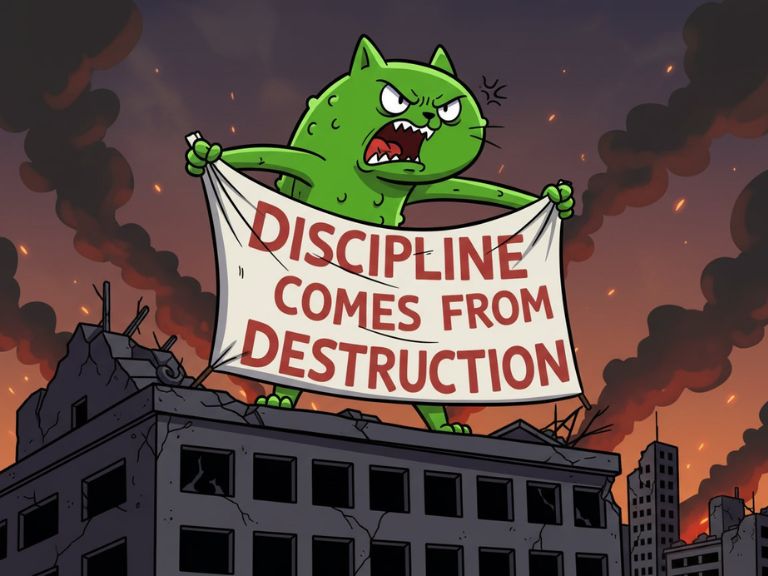
Famous trader Pickle Cat shares his trading insights on Twitter, directly pointing out the trading profit formula that everyone talks about: 'Find a trading strategy, develop discipline.' This is highly misleading because trading discipline is not cultivated through repetitive practice but comes from the real lessons of the market; you need to blow up your account at least three times to truly learn trading. He criticizes the external over-reliance on strategies, research, and knowledge, while ignoring the most difficult factor behind trading, which is oneself. Stop learning from others' successes; instead, study how they survive at the bottom.
Pickle Cat: Trading discipline is not built through repetitive practice.
Pickle Cat says: Everyone says you should first find a trading strategy and develop discipline so that you can make money. But this is the most ridiculous and misleading advice for retail investors. Discipline cannot be cultivated through repetitive practice; it cannot be developed like sports through repeated training to become more disciplined. That kind of disguised discipline may appear effective on the surface, but it will crumble under real pressure, leading to complete collapse in the end.
If your mindset is the weakest link in the entire trading system, no strategy can save you. He points out that the reason truly stable and profitable traders can remain calm is not due to successful training, but because they have long endured pain and experienced setbacks, tempered through repeated fragmentation and reorganization.
The author adds: this is very similar to the principle of strength training for muscle growth, where muscle fibers are damaged to create tiny tears, and the body activates repair mechanisms during rest and nutrition supplementation, making muscle fibers thicker.
He further stated that true discipline often does not accumulate gradually, but suddenly appears during low moments, after the old self has been torn apart. "That is not achieved through effort; it is a product of destruction." Those who remain calm in the market do so not because they have learned to control their emotions, but because they have lived through greater storms, and the current chaos cannot shake them.
Growth of trading mindset: Facing fears at the low points of life.
As for how to grow, he stated that if you are currently at a low point in your life, that is one of the few times you can truly transform. Take the energy used to attack others and use it to take care of yourself. Channel that strength into self-growth, calm down, and honestly face your shame and fears. First, write down the thirty things you fear or feel ashamed of the most one by one. Because when you are sailing smoothly, you simply will not have the courage to face these.
Pickle Cat: Don't overly trust strategies; the hardest part of trading is oneself.
He criticizes the excessive faith in strategies, research, and knowledge from the outside world, while neglecting the hardest factor to face behind trading: oneself. Stop learning from others' successes and instead study how they survived at the bottom. He emphasizes that what can truly be replicated is not technique or luck, but how others rise after failure and how to transform pain into strength.
He often tells his friends: you probably need to be liquidated three times to truly have a chance to become a profitable trader. Because "winning" does not mean making money, but rather being able to keep that money without collapsing again. He admits that after each narrow escape, he mistakenly believed he had matured and become disciplined, but the market always teaches him once again that the old self is not yet dead.
He cites concepts from Jung, Nietzsche, Buddhism, and the (Bible) to point out a common psychological truth of humanity: you must face death to truly live your true self. In the realm of trading, this death refers not to monetary loss, but to the collapse of self-illusion; and rebirth comes from truly seeing one's character, strengths, weaknesses, and desires.
He believes that most people cannot break through because they have never experienced enough fragmentation and have never forced themselves to face those buried parts. "True sense of direction and true stability will only appear when you are forced to open up and see yourself completely." This statement sparked a lot of discussion in the community, with many traders agreeing that the harshness of the market indeed does not change due to strategy, but mental maturity can determine a trader's long-term fate.
This article discusses whether three liquidations are needed to make a profit? A well-known trader states: discipline is not built through practice, but is a real lesson from the market. It first appeared in Chain News ABMedia.