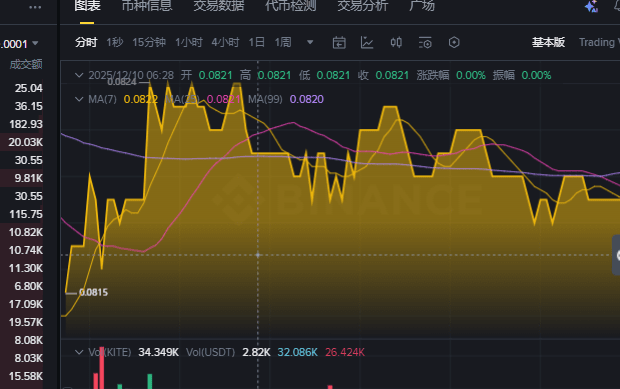
Just now, a brother urgently asked me: on a certain contract platform, he opened a position and was forcibly liquidated just one minute in, yet his account shows a profit of over 20,000 U. He was both surprised and scared, asking me, 'Can I withdraw this money? Will there be any issues?'
My first reaction is straightforward: it's likely a system display error, a price spike, or a testing environment failure; this 'profit' may not be genuinely withdrawable. In the trading world, all moments of 'money falling from the sky' often hide risks behind them. Real gains should be based on clear, sustainable logic, rather than unreplicable coincidences.
This brings to mind a deeper question: in an increasingly complex cryptocurrency market, what kind of value should we pursue? Is it this uncertain “windfall,” or those that are built on real needs and technological innovations, which can accumulate growth over the long term?
This also leads to a track I have been focusing on recently— the combination of AI and blockchain. In this field, the project vision and design logic of @GoKiteAI have shown me another more solid possibility.
In simple terms, Kite is building an “economic network designed for AI agents.” It is not meant for people to “speculate on short-term trades” or “bet on volatility,” but to solve an impending core issue: how will a multitude of AI applications automatically, reliably, and cost-effectively complete payments and settlements when they need to collaborate and exchange data and services?
It can be likened to this:
The “unexpected profit” you encounter in trading now is like finding a mysterious check on the road, which cannot be cashed and is hard to verify its authenticity.
What Kite is doing is like laying the infrastructure for future AI cities—establishing identity systems (KitePass) for thousands of AI agents, building a micro-payment network with almost zero fees, and setting programmable behavioral rules.
Its value does not depend on the luck of a single transaction, but rather stems from the massive, high-frequency, automated economic interactions between machines in the future. $KITE As the native token of this network, it will be widely needed and used in identity registration, payment settlement, governance coordination, and other aspects.
So, in comparison:
The “20,000 dollar profit” behind it is a black box, a coincidence, and an unsustainable luck.
By participating in projects like Kite, you are supporting a value logic that is explainable, situational, and has long-term network effects.
Of course, any early project comes with risks. But these risks are transparent, can be researched and assessed (such as technical implementation and ecological progress), rather than being completely random and unknown “system failures.”
Therefore, my viewpoint is:
If you are already tired of mere price games and are starting to pay attention to the underlying innovations that can truly shape the future digital world, then protocols like #KITE that are committed to building an AI machine economy are worth your time to understand.
It will not give you the instant thrill of “making twenty thousand in a minute,” but what it attempts to answer may be one of the most important questions of the next decade: how should they create and exchange value when AI becomes the main actor of productivity, between trust and efficiency?
In the world of cryptocurrency, quick money comes and goes, but what ultimately remains are those projects that solve real problems and create real value. Instead of chasing the next second's uncertain “floating profit,” it is better to focus on the builders who are laying the foundation for the future.