

There’s a different mood in crypto right now. Things feel calmer. People aren’t impressed by flashy mechanics or wild experiments anymore — they want things that actually work and won’t disappear next month. In that quieter landscape, certain projects start to stand out simply because they’re built with purpose. @Lorenzo Protocol is one of them.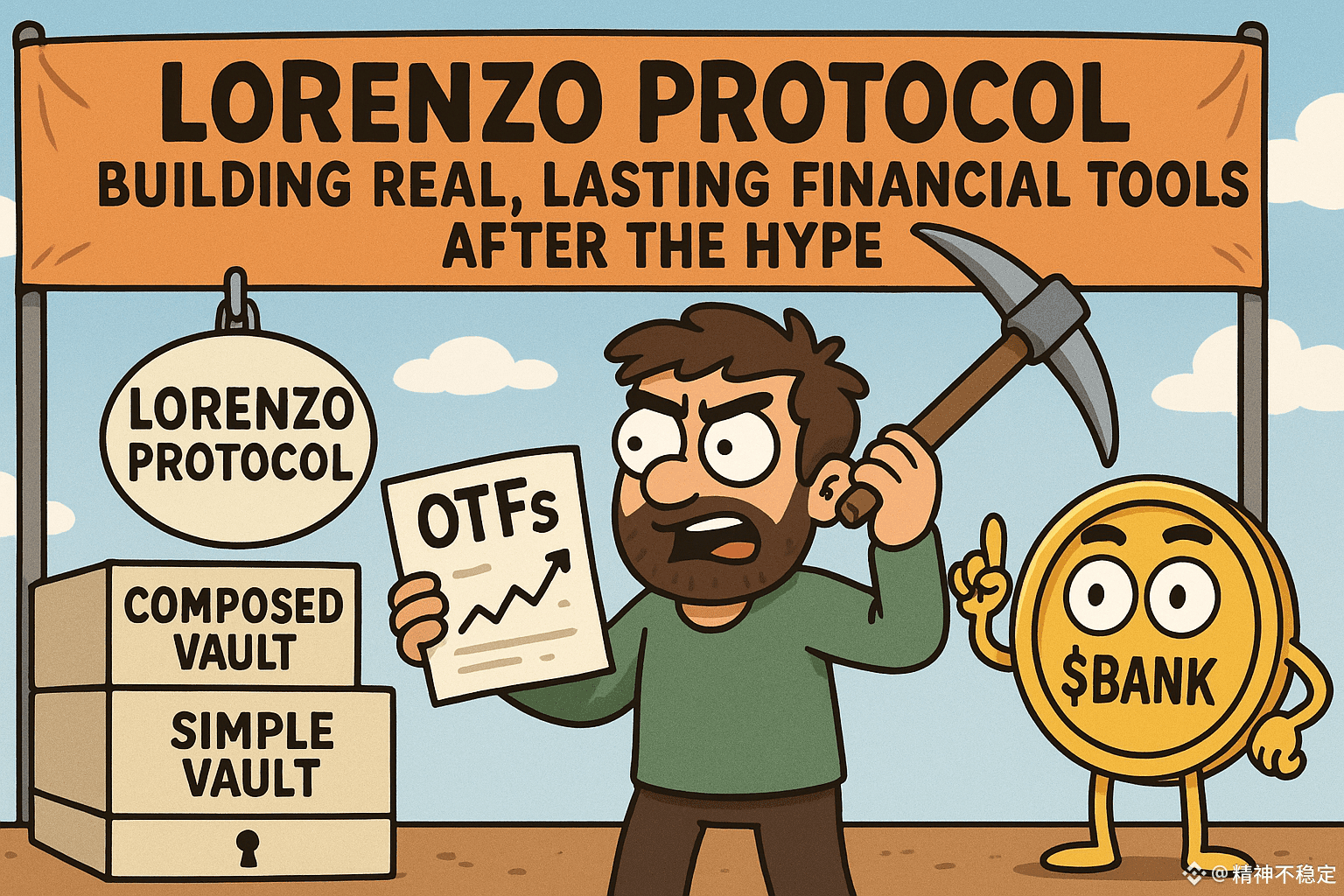
Why Lorenzo Matters
Lorenzo isn’t exciting because it invented some never-before-seen trick. It’s important because it treats structured financial strategies like real, serious products on-chain. Its On-Chain Traded Funds (OTFs) offer clear, rule-based exposures — things like volatility strategies, managed futures, and structured yield.
There’s no confusing math puzzle hiding behind incentives. A volatility fund behaves like a volatility fund. A yield strategy behaves like a yield strategy. That level of honesty is rare in DeFi, which has often preferred clever mechanisms over clarity.
Lorenzo’s message is simple:
If DeFi wants to mature, its products must be understandable.
A System Built on Clear Layers
At the heart of Lorenzo is a layered vault system:
Simple vaults:
Each vault runs one strategy in a predictable, mechanical way. No random tweaking. No governance drama changing how it works. Just clean execution.
Composed vaults:
These combine simple vaults into multi-strategy portfolios. The magic here isn’t complexity — it’s transparency. Every part of the portfolio stays visible and understandable.
Instead of creating a black box, Lorenzo creates building blocks. And that design looks a lot like how traditional finance structures products — organized, modular, and readable.
Governance With Boundaries
Lorenzo’s governance model takes a surprisingly mature stance. The $BANK token and its vote-escrow version, veBANK, don’t let token holders redesign strategies whenever they feel like it.
Token holders can adjust incentives and guide the general direction of the protocol.
But they cannot rewrite the strategies themselves.
This mirrors traditional finance, where product logic isn’t casually changed by committee. It’s a refreshing dose of discipline in a space that often tries to “govern” everything, even when it shouldn’t.
The Real Challenge: Resetting Expectations
The hardest part of Lorenzo’s mission isn’t the tech — it’s the mindset of the market.
DeFi trained many users to expect infinite yield, constant upside, and risk-free performance. But real financial strategies don’t behave like that. They go through cycles. They have downturns. They require patience.
Lorenzo’s OTFs behave like actual investment products. And while that may disappoint people looking for instant rewards, it’s exactly the kind of realism DeFi needs if it wants to grow up.
The New Type of User Lorenzo Attracts
What’s interesting is who’s showing up early:
systematic traders
strategy designers
professional allocators
institutions wanting clean on-chain exposure
These aren’t hype-chasers. They’re people who want products they can monitor, explain, and plug into portfolios. They want structure over spectacle — and Lorenzo gives them that.
A Glimpse of DeFi’s Future
Lorenzo feels less like a one-off protocol and more like a sign of where DeFi is heading:
away from experiments, toward real financial infrastructure.
OTFs hint at what on-chain asset management could look like in the next decade — modular, auditable, repeatable, and easy to understand.
How Success Will Look
If Lorenzo succeeds, it won’t be because it went viral. It will happen quietly:
Users will allocate small portions of their portfolios because the products make sense
Builders will adopt it because it respects their strategy logic
Institutions will integrate it because it acts like the tools they already use
Eventually, Lorenzo could feel less like “the new thing” and more like an obvious piece of financial plumbing — the stable foundation DeFi always needed.
@Lorenzo Protocol #lorenzoprotocol $BANK

