

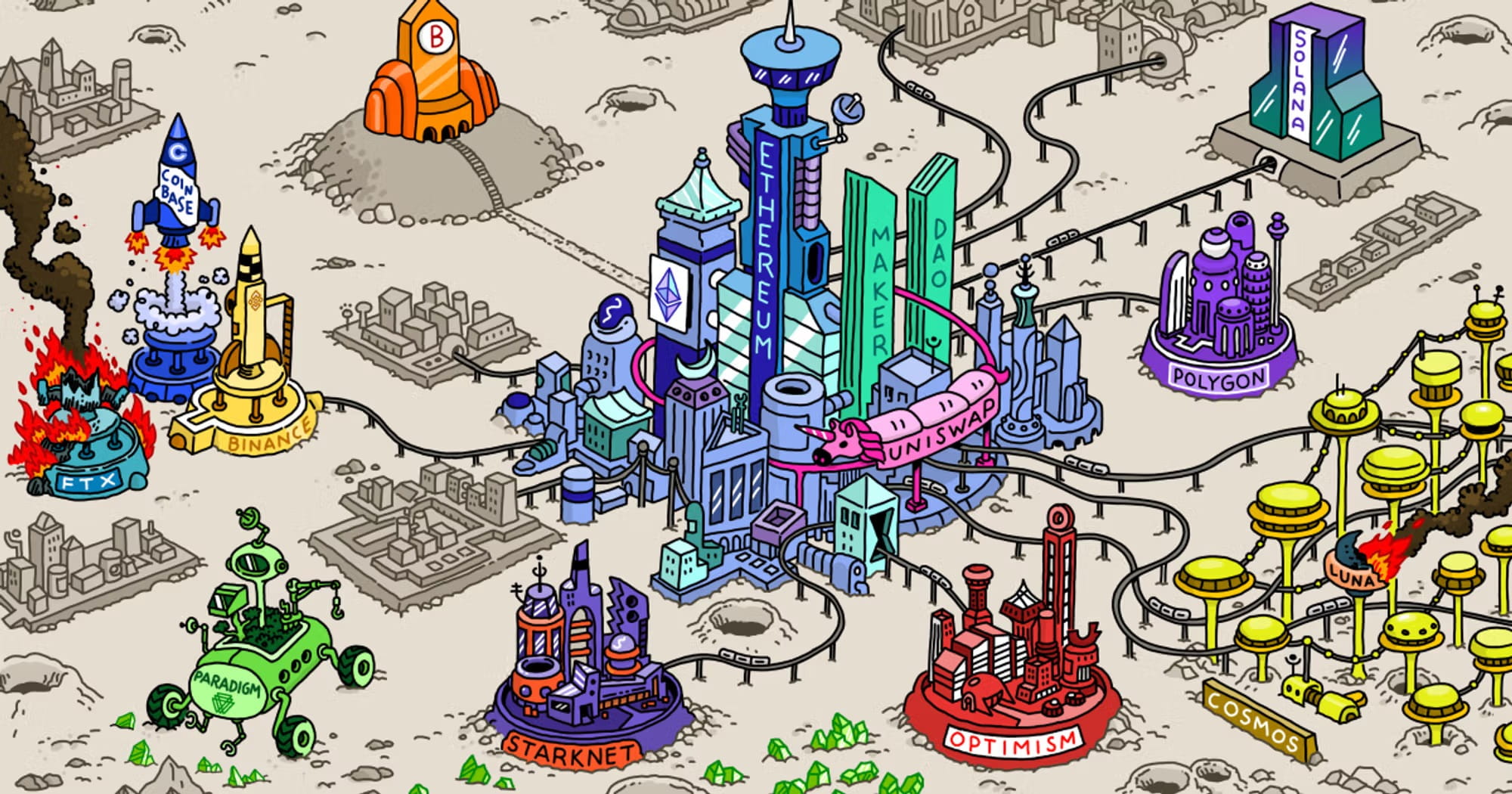
Aevo co-founder Zefram recently published a lengthy article, believing that he spent 8 years only to build a casino disguised as innovation, which sparked widespread response. Dragonfly partner Haseeb Qureshi and Bitwise CEO Hunter Horsley also responded in succession. Revisiting the true crisis of the crypto industry from vision to social impact, the culture of speculation continues to erode the mission of cryptocurrency.
The ideal has been worn away: Aevo founder admits 'spending 8 years building a casino, not future finance'
Aevo co-founder Zefram reflects on his youth inspired by libertarianism and the Cypherpunk spirit, firmly believing that cryptocurrency can reshape the financial order and return power to individuals. However, after truly engaging in the industry, what greeted him was not a revolutionary freedom but a reality dominated by speculation, which hit him hard.
He points out that many products that claim to make finance freer are actually just another speculative product: 'New L1 narratives, perpetual contracts, copy-paste trading platforms, and meme coin frenzy all make cryptocurrencies seem more like an endless zero-sum game.'
I did not build a new financial system; I built a casino, the largest and 24/7 multiplayer online casino that our generation can imagine.
He admits: "I am disgusted by how I have fostered the gambling mire of financial economics, which has completely disrupted my ability to learn how to run a sustainable business."
I have no doubt that Bitcoin will one day reach 1,000,000 dollars, but this has nothing to do with all the financial games in the cryptocurrency industry. It will lead to long-term collapse of social mobility in the younger generation.
This confession is not only about personal burnout but also reflects the long-term distortion of industry values, which may push cryptocurrencies towards an irretrievable abyss.
(Stop being a gambler! Cobie reveals the truth about crypto wealth: Not every early player can become a billionaire)
Haseeb's overarching reflection: Casinos are inevitable; periodic replacement is actually healthy.
In the face of Zefram's pessimistic emotions, Haseeb's response brings a more macro perspective. He points out that the casino in the cryptocurrency industry is not an exception but a natural expression of human nature since ancient times: 'From Satoshi Dice, the most popular gambling application on Bitcoin in 2012, to the first Ponzi-like King of the Ether Throne protocol on Ethereum in 2015.'
He emphasizes that casino culture will not destroy cryptocurrency; it is simply a necessary byproduct that accompanies the emergence of new technologies: 'If you only focus on the prosperity of casinos, you will miss the larger story.'
(Stop using P/E ratios to look at L1! Haseeb re-prices with on-chain data: Cryptocurrency is heading towards exponential growth)
Haseeb believes that today's cryptocurrency infrastructure is quietly rewriting global finance.
Bitcoin is becoming a national-level asset, stablecoins are affecting the monetary policies of various countries, and the scale of Uniswap and AAVE has surpassed that of financial startups. The world is changing around cryptocurrencies.
He reminds us that revolutions have never been instant: 'The Industrial Revolution took 50 years to reflect on economic indicators, the internet took 20 years to change the world, let alone challenge the global financial system.'
In Haseeb's view, industry burnout, pessimism, and exits are also a necessary replacement.
If you feel frustrated for not getting rich from meme coins or some L2, please note that this industry owes you nothing. Over time, these mental surrenders are actually healthy for the market.
(Rejecting pessimism, embracing exponential growth of success stories: Why does cryptocurrency always have a sense of 'apocalypse'?)
Regain the builder mindset: Bitwise CEO calls for 'change the life you want yourself'
Beyond disillusionment and rational analysis, Bitwise CEO Hunter Horsley quoted Apple founder Steve Jobs to remind us: 'Everything in life was created by people no smarter than you, anyone can change it.'
You must rid yourself of the misconception that life is just like this. You have to embrace it, change it, and improve it. Leaving your mark on it is, I believe, very important.
He calls for efforts to see changes in the world, and indifference is not a solution; action is.
The real crisis of the cryptocurrency industry is not speculation, but being lost.
The contradictions in the cryptocurrency industry have not just emerged today. The author believes that it is not only speculation that has drowned people's rationality and goodwill, but more so the self-contradiction of distorted values and notorious projects. Therefore, in this chaos that has lasted for over a decade, it becomes even more crucial to seek and maintain one's original intention.
Zefram's burnout is real, Haseeb's trend perspective is also real, perhaps the real crisis of cryptocurrency is not price volatility, nor regulatory crackdowns, but the loss of sense of mission and passion.
Under the speculative culture dominated by PvP, Builders are more likely to fall into confusion; the infrastructure innovations that developers work hard to promote may also be neglected due to attention being overwhelmed by speculative trends.
But if we are willing to return to the initial ambition of creating decentralized services, perhaps we can better see the next steps of the industry.
This article returns to the mission of cryptocurrency: from speculative culture to founder burnout, revealing the true crisis of the industry first appeared in Chain News ABMedia.


