

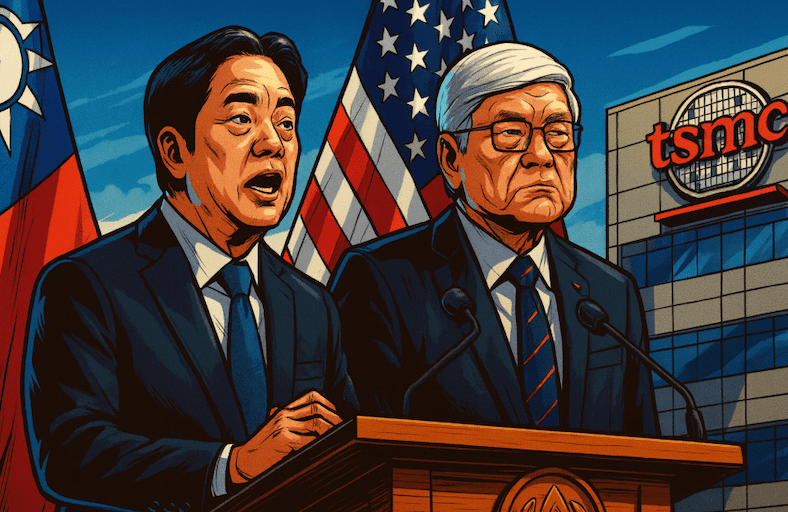
U.S. Secretary of Commerce Howard Lutnick stated in a recent interview that the U.S. is negotiating with Taiwan, hoping that Taiwan will make a 'massive' investment commitment to the U.S. Taiwan's President Lai Ching-te emphasized that Taiwan supports the U.S. push for re-industrialization and semiconductor supply chain relocation, but for related plans to truly take effect, the U.S. must improve in areas such as land, water and electricity supply, talent, and investment incentives.
U.S.-Taiwan negotiations continue, with the U.S. hoping for 50% of chip manufacturing to return domestically
Lutnick stated that the U.S. and Taiwan are in the negotiation stage, and the core goal of the Trump administration is to bring more semiconductor manufacturing back to the U.S. He expressed hope that in the future, 40% to 50% of U.S. chip demand could be met by domestic production, which is an important part of the U.S. re-industrialization effort.
(U.S. Secretary of Commerce Lutnick: Taiwan-U.S. chip production capacity needs to be split 50-50 in exchange for a defense line against China)
Taiwan supports U.S. policies, but the U.S. framework still needs to be strengthened
In response, Taiwan's President Lai Ching-te emphasized in a recorded interview at the (New York Times) DealBook Summit that Taiwan supports the re-industrialization of the U.S. promoted by the Trump administration, including the return of semiconductor production capacity to the U.S.
However, he pointed out that to achieve the goal of 40%-50% domestic supply, the U.S. side must provide sufficient guarantees in areas such as 'land acquisition, water and electricity supply, talent training, and investment incentives.' Lai Ching-te stated that as long as the U.S. takes the necessary measures, this goal will be easier to achieve.
Investment in the U.S. has accumulated astonishingly, and the injection amount may still be higher
When discussing the scale Taiwan might invest, Lutnick mentioned that TSMC has increased its investment in the U.S. to $100 billion, raising the total to $165 billion. Micron and Texas Instruments (TI) have also simultaneously increased their investment amounts.
He pointed out that the total amount of semiconductor investment within the U.S. is nearing $300 billion, and if a new agreement is reached between the U.S. and Taiwan, the amount could be even larger. However, he did not specify whether TSMC's existing scale has been included in this round of discussions.
Taiwan-U.S. cooperation continues to deepen, with the Taiwan Strait security issue remaining a focus
President Lai Ching-te also mentioned that he hopes the U.S.-Taiwan tariff negotiations can improve the U.S. trade deficit, deepen economic and trade cooperation, and strengthen bilateral industrial integration. He has recently raised Taiwan's visibility through U.S. media, including announcing an additional $40 billion defense budget and committing to increase U.S. energy and agricultural product purchases.
On the other hand, U.S. Treasury Secretary Scott Bessent stated that U.S.-Taiwan relations have not changed and refused to answer whether the U.S. would assist Taiwan in the event of Chinese military action. However, he emphasized that the biggest risk to the global economy is the disruption of Taiwan's chip supply chain, and the U.S. push for chip relocation is about risk reduction, but it does not mean that policies have changed.
(U.S. Treasury Secretary: Chip subsidies converted into Intel equity, semiconductor production capacity must reduce dependence on Taiwan)
This article states that the U.S. hopes Taiwan will increase investment, and Lai Ching-te: investment incentives must be in place for this to proceed. It first appeared in Chain News ABMedia.
