

@KITE AI decision to introduce a triple-layer identity framework for agentic transactions arrives at a moment when the world is trying to understand what it means to let software act on our behalf. 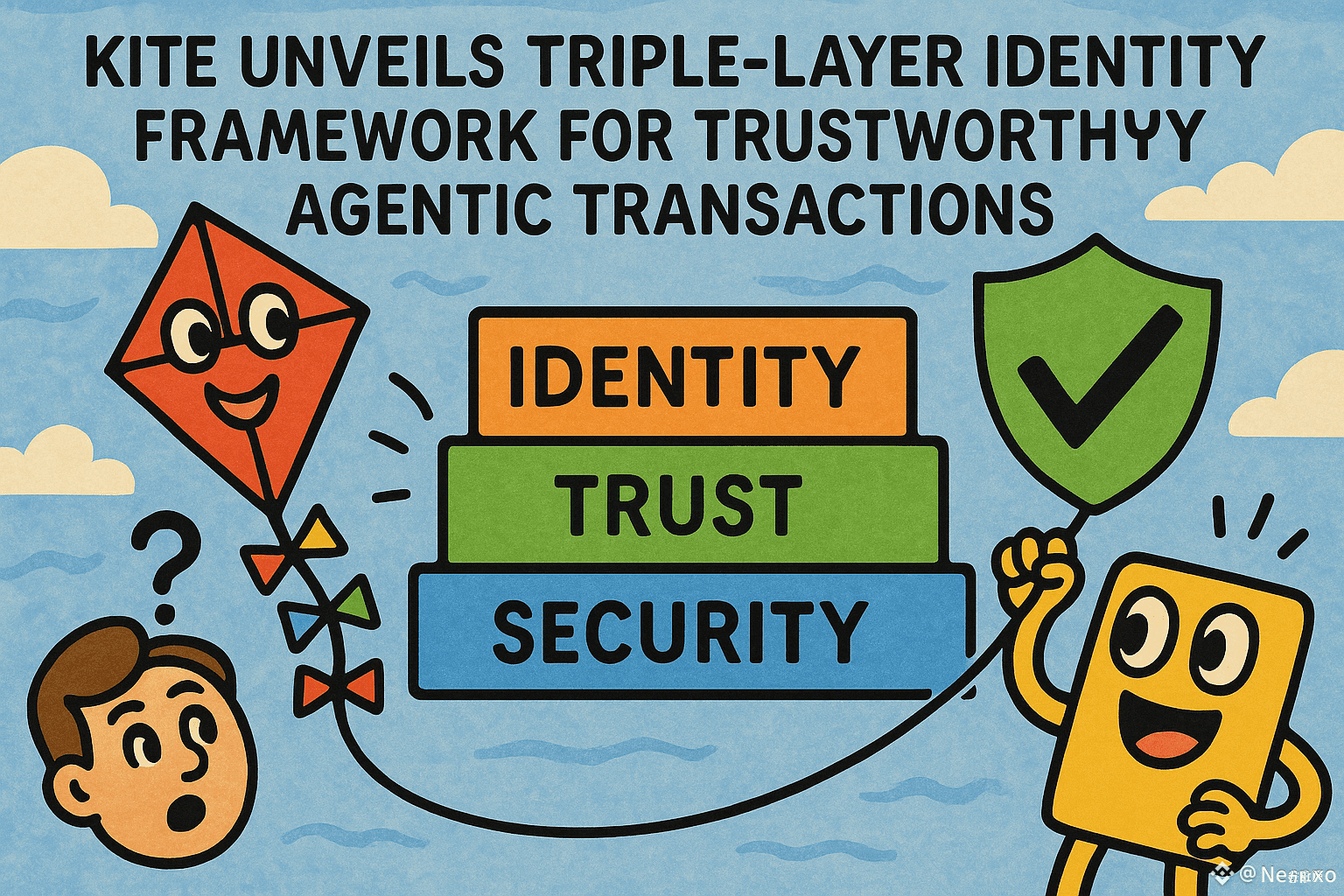
More and more, autonomous systems are doing tasks we used to manage ourselves. They follow our directions, make basic decisions, and are creeping toward bigger responsibilities. So the main issue now isn’t how advanced they are, but which ones deserve our trust to act on our behalf. It’s a topic people in tech keep wrestling with, and Kite’s framework gives a clearer way to look at it
I’ve been thinking a lot about identity in these increasingly automated environments. For years, digital identity was treated like a fixed credential—static, sometimes clumsy, usually siloed. Now it feels almost alive, woven through interactions in ways that can help or hurt depending on how well it’s handled. Kite’s approach splits identity into three interacting layers: the individual user, the agent acting for that user, and the larger ecosystem of institutions that ultimately validate or constrain behavior.
It might appear straightforward, but that’s not the full picture. The real difficulty is letting systems act on their own while still making sure someone is responsible, a problem I’ve seen come up again and again in organizations.
The timing of this framework isn’t accidental. Over the past year, agentic systems have moved faster than most people anticipated.
Developers are creating workflows where AI makes decisions for us, and many consumers are starting to accept that. But as these tools improve, a worry remains: how do we confirm the AI didn’t act without permission? Who verifies intent? What happens when agents represent multiple parties with tangled interests? These aren’t abstract concerns anymore. They’re live issues showing up in legal rooms, financial platforms, and product design conversations.
In that sense, Kite isn’t just proposing a framework; it’s attempting to bring order to a space that risks drifting into confusion. The first layer, personal identity, sounds obvious but becomes complicated when agents can mimic, translate, or infer user intent. The expectation is that an agent should understand you, but not impersonate you in ways you didn’t explicitly authorize. I’ve seen early systems falter here, often because product teams assumed a one-to-one relationship between user and action. Once agents started chaining tasks together, that assumption collapsed.
The second layer, agent identity, sits in a more ambiguous space. Agents need stable character—transparent capabilities, consistent behavior, and auditable decision trails. Without that, it becomes nearly impossible to evaluate what went wrong when something fails. I’ve spent enough time debugging automated systems to know that the absence of a well-formed identity doesn’t just frustrate developers; it erodes trust for everyone involved. People want to know which agent did what, and why. They want to feel that decisions came from a defined source, not an amorphous cloud of actions.
The third layer, institutional identity, introduces a grounding force. Agents aren’t islands. They operate within shared rules, norms, and governance structures, whether those structures are enforced by industry coalitions, regulatory bodies, or platform-level policies. Some will argue that institutional layers slow down innovation, and in certain contexts that’s true. But I find the opposite more compelling: guardrails often enable exploration, because people are more willing to delegate decisions when they believe someone has thought through the risks.
What makes Kite’s model interesting is how these layers reinforce each other. Instead of a single monolithic identity that tries to cover everything, the three-layer approach distributes responsibility. It acknowledges that trust is relational. When I talk to teams building agentic tools, a lot of them feel stuck between wanting to unleash creativity and needing to maintain order. This framework doesn’t resolve that tension, but it gives it structure. It says: here are the boundaries, here is who is accountable, here is how authority flows.
Another reason this is gaining attention now is that the industry has begun to experience real failures—situations where agents executed unintended actions, misinterpreted requests, or caused cascading errors. These stories travel fast, and they often spark a period of collective introspection. I’ve been in rooms where people suddenly realize that what they thought was a “minor risk” could become enormous when scaled across millions of actions. And that’s before we consider cross-agent collaboration, which brings its own set of identity complexities.
Kite’s model doesn’t solve everything, and we still have to see how it works in tough conditions. But it speaks to a shared concern: we need a more straightforward way to control and oversee automated systems.
If we’re moving into a time when agents make deals, communicate, and work together with very little human control, then identity becomes more than a technical feature—it becomes the core of trust.
Maybe that’s why this moment feels so important.We’re imagining a future where digital agents make their own decisions but still follow what we want. It’s tricky to manage. Sometimes it feels full of promise, and sometimes it makes you uneasy.
But having a framework like this helps guide the conversation. It shows that freedom for agents doesn’t need to become messy, and that thoughtful design can make tech feel more human and approachable.


