
I have been slacking off lately, and recently encountered a surge in privacy coins, which triggered my desire to express myself again, so let's chat casually!
Privacy coins and the privacy sector are areas that I really enjoy and have been following for a long time. I've also experienced losses in this field. In the last cycle, I bought the privacy project Torn on Ethereum, but due to its high privacy, it was exploited by many hackers, leading to the founder's arrest. However, with Trump's rise to power and the relaxation of policies in the entire crypto industry, I always feel that there is a possibility of a return in the privacy sector.
First, let's look at Figure 1, which shows the price trend of ZEC over the past two months. Zcash (abbreviated as ZEC) started its rise on the 9th of June, exactly two months ago, and has increased to 510u, a tenfold increase in two months. Given the recent volatile market, this is indeed quite remarkable. I haven't seen such a rise in a long time, it feels a bit like the 'bull market' of the last two cycles.

Figure 1. Zec price trend
Driven by ZEC, another established privacy coin, Dash, also saw a significant surge (as shown in Figure 2), nearly 5 times in a month. Even with a recent slight pullback following Bitcoin's lead, it has still achieved a 3 times increase, which is still a very good performance. If ZEC is the leading coin in this round of the privacy coin race, then Dash is the second. The question then arises: who might follow suit and become the third, fourth, fifth... leader?
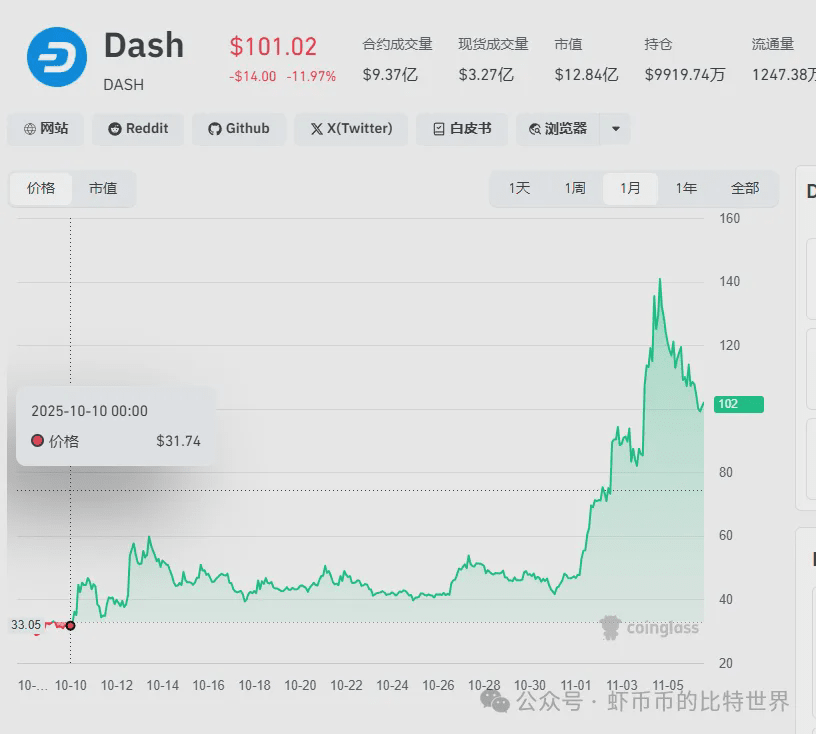
Figure 2: Dash Price Trend
The rise of Zcash largely stemmed from a tweet on October 1st by Naval, a prominent figure in the American tech industry and a social media influencer: "Bitcoin is insurance against fiat. Zcash is insurance against Bitcoin."

As a seasoned investor, I can understand Naval's explanation. BTC is a completely independent financial network parallel to the traditional financial system, characterized by decentralization, permissionlessness, and strong privacy (censorship resistance). Since BTC already possesses strong privacy (censorship resistance), why is privacy coin needed? This was a question I had when I first encountered privacy coins years ago, but after experiencing both the BTC network and privacy coin networks, I've come to realize that privacy coins are a genuine market need.
While the entire Bitcoin network is anonymous, addresses and transaction records are publicly visible on blockchain explorers. For example, if address A transfers 0.1 Bitcoin to address B, and address B transfers 0.05 Bitcoin to address C, this data can be found on a blockchain explorer (as shown in Figure 4). Generally, ordinary users can only see the transaction data between addresses when using a blockchain explorer; they cannot link an address to a specific person. This reflects the anonymity of the Bitcoin network. However, for individuals or organizations with technological or data advantages, anonymity is less pronounced. Once the relationship between a specific person and an address is identified through social means or AI technology, the tracking of the entire Bitcoin balance and transaction records becomes transparent, and anonymity and privacy disappear.
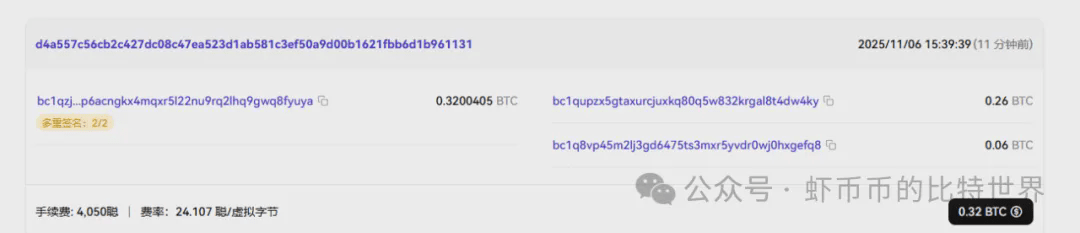
Figure 4: BTC transfer diagram
For example, if a user buys cryptocurrency through a centralized exchange, which conducts KYC (Know Your Customer) verification, then withdrawing BTC from the exchange to your wallet already establishes the connection between the user and the wallet address. It's relatively easy.
To solve this problem—how to hide addresses and transaction amounts—the founders of privacy coins began their efforts. As the saying goes, all roads lead to Rome, and various technical personnel have achieved privacy through different technological approaches.
There are roughly four technical routes:
1. Coin Mixing Technology. Dash, a representative example of privacy coins, was one of the earliest privacy coins, launched in 2014. It's an improvement on Bitcoin's early CoinJoin mixing technology; it mixes multiple user transactions together, making it difficult to trace the source of funds; the mixing process is coordinated by masternodes (rather than a centralized server), increasing decentralization. It offers a moderate level of privacy, hiding the source of funds (through scrambling during mixing), but not hiding the transaction amount or the address itself. The maximum supply is 18.9 million coins, and 12.4739 million have been mined so far, resulting in a total market capitalization of $1.311 billion.
2. Ring Signature Technology. Represented by XMR (Monero), XMR was among the earliest privacy coins, also launched in 2014. XMR is currently one of the most privacy-focused cryptocurrencies, built on the CryptoNote protocol. Its biggest feature is that privacy protection is enabled by default, with both parties and the amount of the transaction fully encrypted. XMR achieves privacy through three core technologies: first, Ring Signature, which mixes the user's signature with other signatures to conceal the source of funds; second, Stealth Address, which generates a one-time address for the recipient to prevent external tracking; and third, Ring Confidential Transactions (RingCT), which hides the transfer amount but still verifies its legitimacy. These mechanisms make transactions "unlinkable" and "untraceable," enabling anonymous on-chain payments. XMR boasts the highest privacy strength among all cryptocurrencies and is considered a model of "digital cash," but due to its excessive anonymity, it has also been subject to some regulatory restrictions and has been delisted by major exchanges such as Binance. The maximum supply is unlimited; currently, 18.4467 million coins have been mined, with a market capitalization of $6.588 billion.
3. Zero-Knowledge Proof Technology. Represented by Zcash (ZEC), a privacy coin launched in 2016, two years after XMR and DASH, Zcash was developed under the leadership of cryptographer Zooko Wilcox. It originated from Bitcoin's code and introduced revolutionary zero-knowledge proof (zk-SNARKs) technology. This mechanism allows users to prove the validity of a transaction without disclosing the parties involved or the amount, achieving a "verifiable but invisible" privacy structure. ZEC supports two address types: transparent addresses (t-addr) and protected addresses (z-addr). Ordinary transactions use transparent addresses, similar to Bitcoin; while when using protected addresses, the transaction content is completely encrypted, visible only to the two parties involved, and untraceable externally. Users can choose whether to enable privacy features, striking a balance between regulatory compliance and privacy protection. Overall, Zcash offers strong, optional privacy and represents the forefront of zero-knowledge encryption technology, making it a representative project that balances privacy and compliance potential. The total supply of ZEC is 21 million, of which 16.2862 million have been mined, and its current market value is $8.4 billion.
4. Mimble & Wimble Protocol. MimbleWimble is a blockchain privacy and scalability protocol, first proposed in 2016 by the anonymous developer "Tom Elvis Jedusor" (Voldemort's French name in Harry Potter). Its name comes from the "MimbleWimble" in Harry Potter, meaning that the contents of transactions "cannot be spoken".
MimbleWimble's privacy is not achieved through coin mixing or cryptographic layering, but through mathematical aggregation and minimizing block size: 1) Transaction amount encryption, using Pedersen Commitment to hide the amount; 2) Address-free model, where the transacting parties generate a one-time key through offline communication, without needing to disclose addresses; 3) Transaction aggregation (Cut-through), which removes unnecessary intermediate transaction records from the block, retaining only the final input and output, thereby significantly reducing the block size; 4) Natural privacy, where addresses and amounts are not visible on-chain, and transaction paths cannot be traced.
MimbleWimble's blockchain is both highly private (anonymous transactions, confidential funds) and lightweight and efficient (small block size, fast verification speed). Since its inception, two representative projects have emerged: Grin and Beam. Grin pursues minimalism and complete decentralization, with fixed inflation, unlimited issuance, and no commercial backing, emphasizing fairness and anonymity, but lacking scarcity and ecosystem development. Beam, on the other hand, adopts a Bitcoin-style halving deflationary model, driven by the Beam Foundation. It boasts a high degree of productization, offering features such as a GUI wallet, mobile app, atomic swaps, and privacy smart contracts (BeamX), positioning itself as a "privacy finance platform."
While both offer similar levels of privacy, Beam surpasses Grin in terms of currency model, user experience, governance stability, and ecosystem expansion. The former is evolving from a privacy coin into a foundational layer for privacy-focused DeFi, while the latter remains largely confined to the academic experimental stage. Overall, Beam represents the mature direction of MimbleWimble technology—making privacy truly usable, sustainable, and scalable.
Finally, it's worth mentioning that Litecoin (LTC) integrated BEAM's privacy technology—the MimbleWimble protocol—in 2022, specifically through an upgrade called MWEB (MimbleWimble Extension Block).
Litecoin founder Charlie Lee truly appreciates and endorses Beam's privacy technology, especially its design philosophy based on the MimbleWimble protocol. Back in 2019, Charlie Lee repeatedly expressed his support and willingness to collaborate with the Beam team through public tweets and conferences. He considered MimbleWimble to be the "most elegant and efficient privacy solution" at the time, achieving anonymity and scalability without compromising the blockchain structure. Compared to the complex cryptographic calculations of other privacy coins (such as ZEC's zero-knowledge proofs or XMR's ring signatures), MimbleWimble is more lightweight, verifiable, and better suited for large-scale payment systems.
Under his leadership, Litecoin collaborated with the Beam team, ultimately developing the MWEB (MimbleWimble Extension Block) feature, which was officially launched on the mainnet in 2022. This is also the world's first case of a mainstream cryptocurrency integrating Beam technology into its production network.
Currently, three privacy projects—LTC, BEAM, and GRIN—use MimbleWimble technology. Token details:
LTC: Total supply 84 million, 76.4898 million already mined, market value $6.6 billion.
BEAM: Total supply 262.8 million, 150.75 million already mined, market value $5.3 million.
GRIN: No upper limit on total supply, 214 million have been mined, with a market value of $9.02 million.
Final thoughts: ZEC's takeoff has already boosted DASH; will it also drive other privacy coins up in the future? If so, which ones will rise? This is a matter of opinion. I feel LTC has a better chance because it meets three characteristics of both ZEC and DASH: First, it has a long history, being an established coin; second, it has a large number of exchanges; and third, privacy is optional—users can choose privacy-focused transactions or non-privacy transactions subject to review. This is why, despite belonging to the same privacy coin category, ZEC and DASH haven't been delisted from exchanges. LTC seems to have a greater chance of success, especially given its privacy features, which the market doesn't seem to fully appreciate.
Additionally, there are Beam and Grin, both belonging to the MimbleWimble protocol. They have low market capitalization, few exchanges, and poor liquidity, meaning even a small amount of capital can drive up their prices significantly. They could be considered as small-scale investments, like a lottery ticket. Between these two, Beam is slightly more appealing. Beam has a limited total supply, while Grin has no upper limit. Furthermore, Beam has built its own ecosystem, including token issuance, NFT, and DeFi functionalities, offering a more compelling narrative.
That's all for today...
The above article represents purely personal opinions and should not be considered investment advice.