
This might be my first question, and many others too. There are already many projects in the market dealing with data, from Dune to Nansen, and various API services. As users, we don't seem to lack channels to access on-chain data.
But has anyone noticed a problem? Although there is a lot of data, it is extremely 'fragmented'.
For developers, if you want to build a cross-chain DeFi aggregator or an application that can analyze multi-chain NFT dynamics, you have to connect to different chain nodes and handle a variety of data formats. This process is very painful and costly, essentially killing 90% of the ideas in their infancy.
For us ordinary players, on-chain data is like isolated islands. The mining we do on BSC and the NFTs we buy on Polygon are completely disconnected at the data level. It is hard for us to have a unified perspective to examine our 'footprints' and 'asset profiles' in the entire Web3 world.
I noticed that Chainbase is trying to solve this 'fragmentation' issue. The concept they proposed, 'Hyperdata Network', sounds a bit mystical, but I understand it as a middle layer that can automatically clean, organize, and 'translate' fragmented information from all blockchains into a unified language.
It's like different chains were villages speaking different dialects, and what Chainbase aims to do is build a 'highway network' covering all villages, where the cars (data) running on this network all speak the same 'common language'.
This opens up a large imaginative space. Developers can easily call data from any chain to build applications, just like building with Legos; while the on-chain behavior of us ordinary users can finally be completely and coherently recorded and presented.
Not just data, but also an AI 'ammunition depot'.
If solving data fragmentation is just Chainbase's 'basic strategy', what truly excites me is its integration with AI.
We all know that the power of AI depends on how much high-quality data it is 'fed'. What is most lacking in the Web3 world right now? It's data. Every transaction, every interaction, and every governance vote happening on-chain every day is unprocessed 'crude oil'.
What Chainbase is doing is refining this 'crude oil' into 'aviation fuel' that AI models can use directly.
I see they have already established partnerships with giants like Google Cloud and are building what they call the 'Crypto World Model'. What does this mean?
Smarter DeFi strategies: Imagine that in the future, there might be AI agents that can help you analyze liquidity pools across the entire chain, automatically find the optimal mining strategies, and even predict which new mining pools have early bonuses.
More precise 'scientists': On-chain scientists no longer need to manually scrape data or write complex scripts to grab meme coins or monitor whale addresses. They can directly 'ask' AI, for example: 'Monitor all newly deployed contracts, and as soon as a VC-backed address injects initial liquidity, notify me immediately.'
A truly personalized Web3 experience: Your wallet address will no longer be a string of cold characters. AI can analyze your entire chain data to recommend NFTs, airdrop opportunities you might be interested in, and even remind you like a friend before you undertake some risky operations.
Data is becoming the new oil in the Web3 world. Whoever can master the most comprehensive, cleanest, and most efficient data processing capabilities may become the next 'S&P' or 'Bloomberg' of the new era.

Some personal thoughts, and I would like to hear everyone's opinions.
Having talked about so much, I am not saying Chainbase has succeeded. Any project is still in its early developmental stage and faces various challenges. But the perspective it offers is indeed worth our attention.
Data ownership vs data usage rights: Chainbase makes data easier to access and use. Will this bring new privacy issues? As users, how can we ensure our data sovereignty while enjoying convenience?
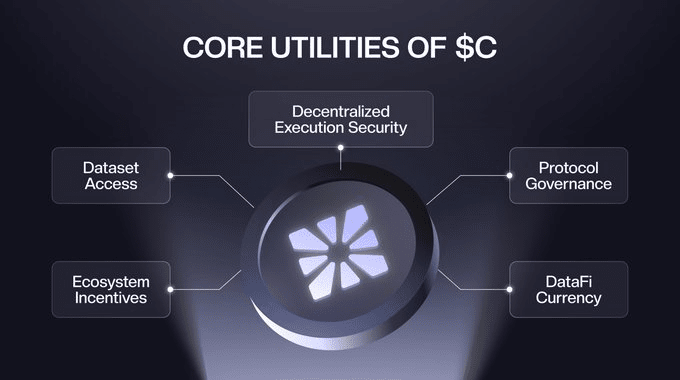
"DataFi"'s value capture: They recently issued a token ($C), primarily used as incentives and governance for the data network. Can this model succeed? How will the value of data ultimately reflect on the token? This is a very interesting economic model worth exploring.
The next killer application?: With such a powerful data infrastructure, what kind of 'killer' Web3 applications do you think are most likely to emerge? AI trading bots, on-chain credit scoring, or something we can't even imagine right now?
I always feel that looking at projects like Chainbase now is a bit like looking at cloud computing in 2010. Back then, no one thought the infrastructure of electricity and water could be so attractive, but we all know the story that followed.
Let's stop here for today, purely to spark some thoughts. What do you think about the direction of 'data + AI + Web3'? Feel free to leave your thoughts in the comments, and let's exchange ideas.