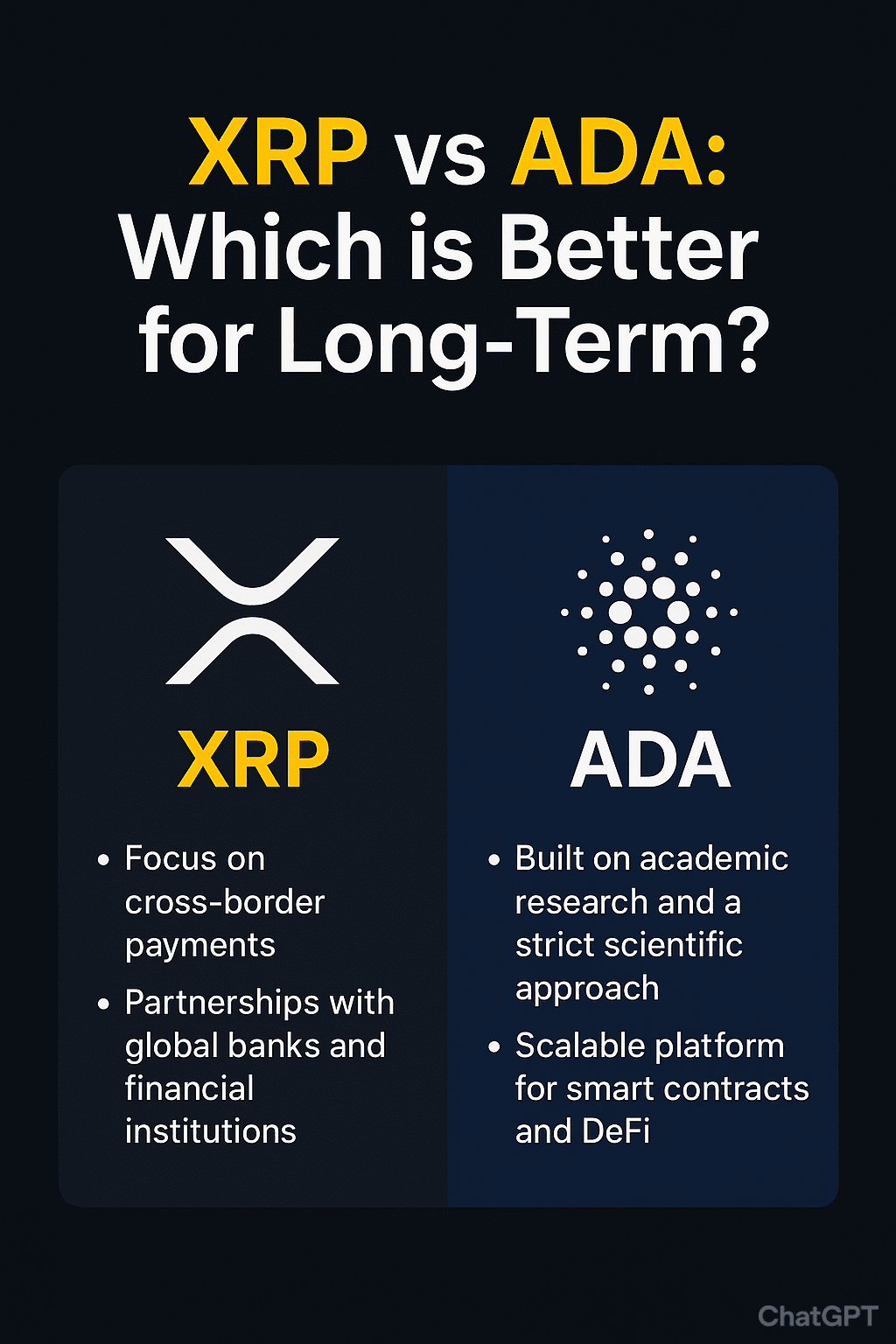
With increasing interest in alternative currencies in the digital market, the question remains: which projects are worth a long-term bet? Between XRP linked to global payments and Cardano (ADA) targeting smart contracts and third-generation blockchain infrastructure, the comparison seems necessary to understand the opportunities of each.
---
1. Vision and Core Objective
XRP (Ripple):
Centered around reshaping cross-border payment systems by offering fast, cheap, and secure transactions. With a strong network of banking and financial institution partnerships, XRP is considered closer to a bridge between traditional currencies and digital currencies.
Cardano (ADA):
Presented as a third-generation smart contract platform, built on precise scientific research and rigorous academic review. Its primary goal is to provide a flexible and scalable infrastructure to support decentralized finance (DeFi) and digital identity solutions.
---
2. Technology and Infrastructure
XRP Ledger: Characterized by ultra-fast transactions (3-5 seconds per transaction) and very low fees. However, it faces criticism due to a higher degree of centralization compared to some other networks.
Cardano (Ouroboros PoS): Utilizes the scientifically-backed proof-of-stake protocol "Ouroboros," relying on a layered architecture that separates transactions and smart contracts, enhancing long-term security and scalability.
---
3. Adoption and Practical Use
XRP: Already has a network of partners including global banks, money transfer companies, and financial institutions. Its focus on institutional use makes it closer to the traditional market.
Cardano: Despite its technical strength, the level of adoption is still relatively limited compared to Ethereum or Solana. However, it has projects in areas like education and digital identity in Africa, which could open new markets in the future.
---
4. Challenges and Obstacles
XRP: The biggest challenge is the legal aspect with the U.S. Securities and Exchange Commission (SEC). Any definitive ruling in favor of Ripple could be a huge starting point.
Cardano: The challenge lies in execution speed and adoption. Despite its great ambitions, it is criticized for the slow launch of applications compared to its competitors.
---
5. Potential Future
XRP: If it succeeds in establishing itself as a primary means for cross-border transfers, it could become a backbone for global digital payments.
Cardano: With its strong academic foundation and scientific approach, it has the chance to become a major competitor to Ethereum in the long run, especially with the evolution of Web3.
---
⚖️ Summary
XRP: A choice more connected to traditional financial institutions, and may be suitable for investors looking for real use cases in the short term.
ADA: A bet on long-term technological future, with the potential for significant leaps if the adoption of smart contract projects increases.
👉 Therefore, the choice between XRP and ADA fundamentally depends on the investor's strategy: Are you betting on near-term institutional adoption (XRP) or long-term technological development (ADA)?