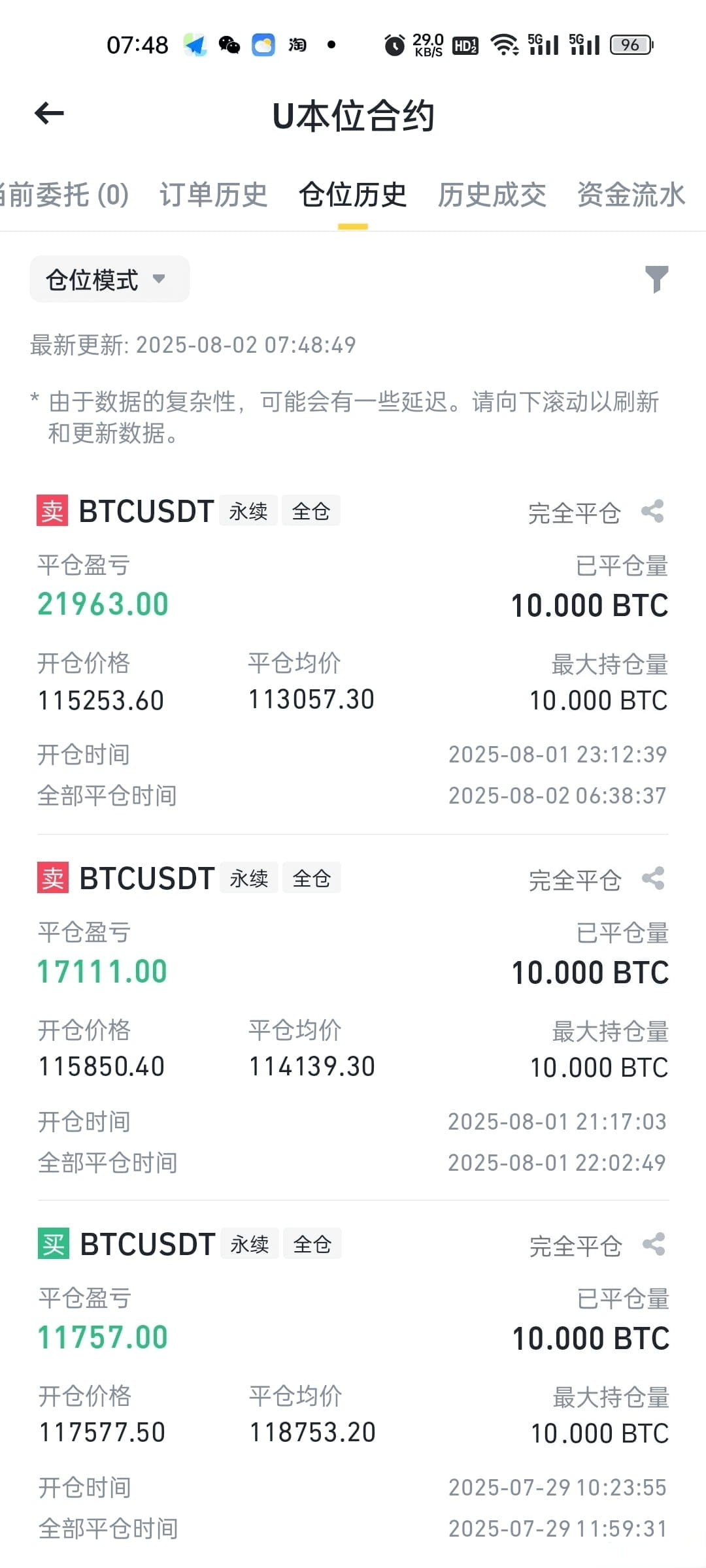
Fan Old Wu posted a screenshot yesterday; on the 37th day of following me, his account rose from 5000U to 30,000U. He said: 'I used to draw trend lines every day, now I just look at the main force addresses you post, and I sleep soundly.' This reminds me that 3 months ago, my own 8000U account was still hovering around 6000U, and it was precisely through the 'not looking at K-lines but looking at funds' stupid method that I rolled over 5 times to reach 120,000U—those who stare blankly at MACD will never understand where the main force's money has gone; that is the real secret.
One, the turnaround for 8000U: the first rollover relied on 'picking up the big players' leaks'
In April this year, BTC was hovering around $80,000, and the group was full of wails of 'it’s going to break $70,000'. I didn't look at the K-lines, I opened on-chain tools to check two pieces of data:
The top 100 BTC addresses: net buying for 3 consecutive days, with 3 addresses transferring 5000 coins each (worth $400 million at the time);
Exchange net flow: Binance's BTC flows out net 2000 coins daily, retail investors are selling, while big players are buying.
I used 30% of my 8000U (2400U) to test the waters, buying in 3 batches:
On the first day, bought 800U at $82,100;
The next day it dropped to $77,900 to add 800U;
On the third day, I added another 800U, with an average cost of $78,000.
On the 5th day, BTC suddenly surged to $85,800, I followed the rules and sold half after earning 10% (1200U earned 120U), the remaining 1200U waited for profit-taking. 10 days later it surged to $95,000, this trade earned a total of 600U, and the account finally broke 10,000—main force's money doesn't lie, K-lines can create 'downward traps.'
Two, three 'money-watching actions' against human nature, which are 10 times better than technical indicators.
I now spend 10 minutes every day doing 3 things, which is more effective than staring at K-lines for 8 hours:
1. Check the 'whale wallet movements'
Open Whale Alert and filter for 'transfers over 1000 BTC':
Transferring to the exchange = possibly selling (be cautious);
Transferring out of the exchange = possibly hoarding (pay attention).
In June, when SOL dropped to $127, I noticed an address withdrew 200,000 SOL from the exchange (worth $25.4 million at the time), immediately tried with 5000U, and 15 days later it rose to $151, earning 1800U—big players don't sell secretly; big actions always leave traces.
2. Watch the 'market during panic'
When the market plummets, don't care about K-lines, look at the depth chart:
There are large 'whole orders' in the sell orders (like 1000U, 5000U) = retail investors are cutting losses;
Hidden in the buy orders are 'irregular large orders' (like 3721U, 8945U) = the big players are secretly buying.
On the day in January when ETH dropped 10%, the order book suddenly showed 20 buy orders of '4873U', I immediately added 10,000 U, and sure enough it rebounded half an hour later—retail investors cut losses using whole numbers, big players love to use decimals; this is an unspoken rule in the crypto world.
3. Wait for the '30 minutes of emotional reversal'
When news of 'delisting' and 'zeroing out' floods the community, open the transaction volume:
When prices drop and volume increases = real panic (can prepare);
When the drop stops and volume decreases = false drop (can test the waters).
Old Wu relied on this move, when AVAX dropped to $15 (panic index 12), used 500U to test the waters, and it has now risen to $28, nearly doubling. He said: 'I used to be afraid of drops, now I look forward to others panicking; when they panic, the chips are cheap.'
Three, the core of 5 times rolling over: use profits to roll over, principal never moves.
The growth trajectory of my account hides the secret of rolling over:
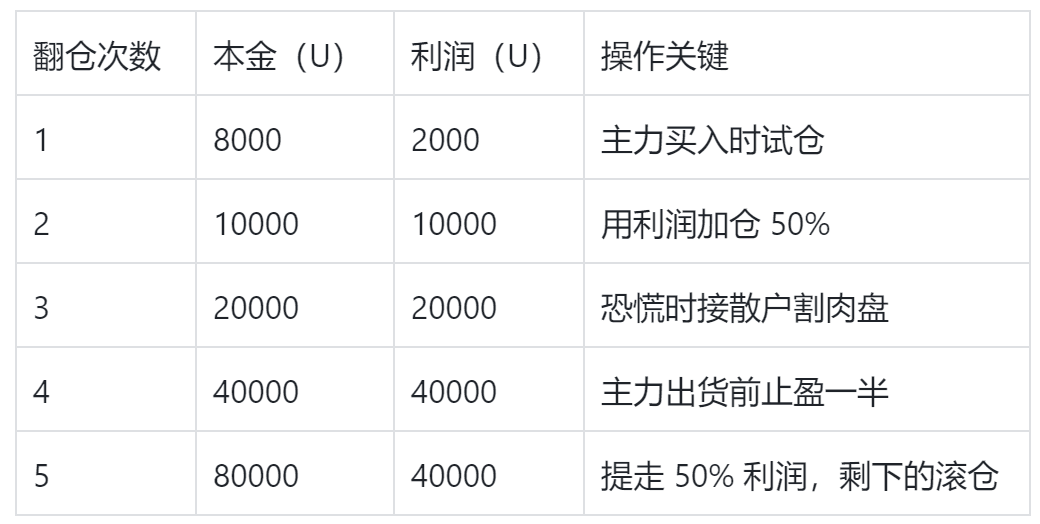
The key is that the principal never moves: after the first rollover, the 8000U principal remains in the account, using the profits to add positions. Even if there’s a liquidation, the most you'll lose is the profit, not the principal—this gives you 100 more chances to make mistakes than those who gamble with their principal.
Four, why do those who watch K-lines always lose? 3 'fund flow traps' to avoid.
Don't believe in the 'big player baiting' lies
Real main force rises; on-chain addresses will continue to increase their holdings, rather than just pulling K-lines. Last month, a certain altcoin rose by 30%, but the main force was secretly transferring to exchanges, I told the group not to chase it, and sure enough it plummeted 3 days later—K-lines can be faked, but on-chain transfers cannot.
Don't wait for the 'perfect entry point'
Retail investors always think about 'buying at the lowest', but end up missing the big players' accumulation period. I never wait for precise points; when the big players start buying, I enter in 3 batches, even if I buy 1% higher, it's better than missing out—big players' costs may be higher than yours; they’re not afraid, so what are you afraid of?
Don't monitor the market alone
I created a 'fund flow warning circle', 200 people take turns monitoring whale addresses, and if someone finds a large transfer, they @everyone. Last month, it was a circle friend who alerted us to the ETH main address activity, allowing us to catch that wave of 20% increase—one person can’t monitor everything, but a group can catch the big players.
Finally, here are 3 harsh truths for the 8000U players:
Uninstall the K-line software and switch to on-chain monitoring tools (recommended: Nansen, Whale Alert), and you can understand the main force's movements in 3 days;
When you see 'wailing in the group', open the order book; when retail investors are cutting losses, that's your opportunity to pick up bargains;
Take out your principal first after making a profit, and use the profits to roll over—big players also incur losses, but they can afford to lose, you need to ensure you can afford to lose first.
Old Wu is now following the capital signals in the group every day, turning 5000U into 30,000U in just 37 days. He said the thing he appreciates the most is not the method, but realizing that 'making money in crypto doesn't require guessing; just follow the real money.'
When the next main force enters the market, I will send real-time address screenshots. Those who want to escape the K-line nightmare can follow me—8000U to 120,000U, it's not about technique, it's about whether you dare to believe 'where the money goes, opportunities are there.'
Remember: what allows you to roll over 5 times is never complex indicators, but those shining U in the main force's account.