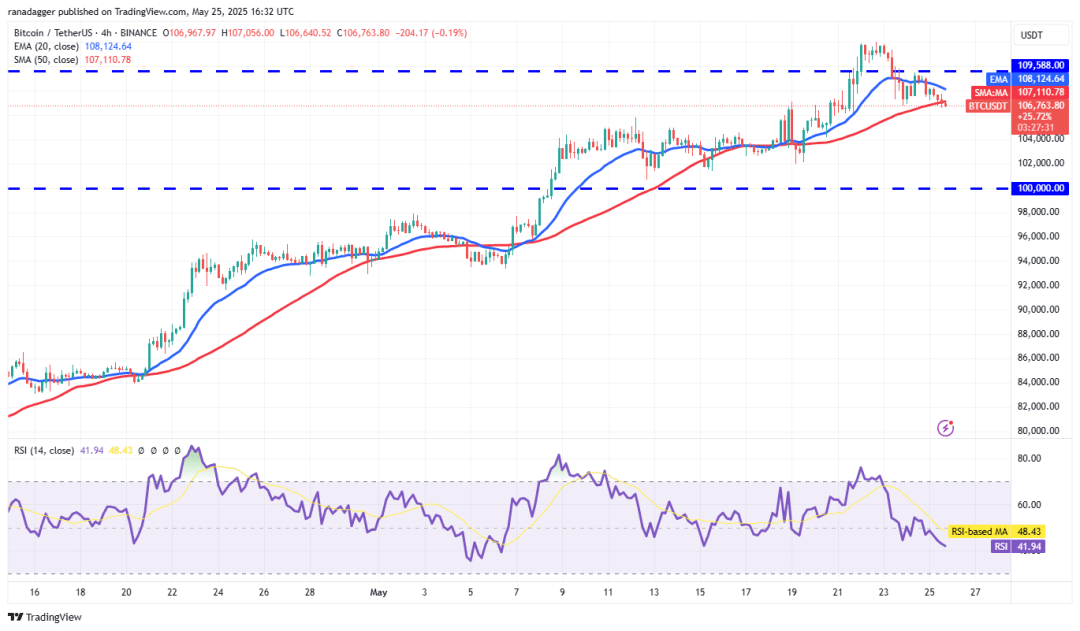
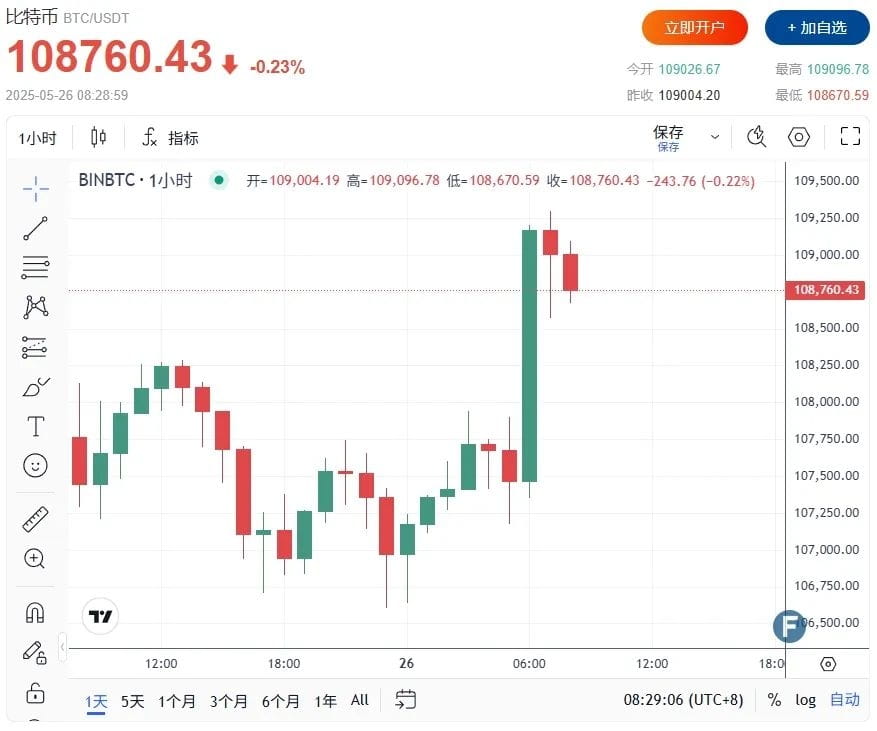
On Monday (May 26), the dollar index fluctuated at 99.01, gold fell back to $3,336, and Bitcoin surged back above $109,000. President Trump extended the July 9 deadline for imposing a 50% tariff on EU goods, reversing his previous decision to increase taxes.
Bloomberg reported that after a call with European Commission President Ursula von der Leyen, Trump stated that he would extend the deadline for the EU facing a 50% tariff to July 9.

Trump told reporters at Morristown Airport in New Jersey on his way back to Washington on Sunday, 'We had a very pleasant call, and I agreed to change the time.'
Ursula von der Leyen, head of the EU's executive body, tweeted earlier on Sunday that 'Europe is ready to move negotiations forward swiftly and decisively,' but that 'reaching a good agreement' requires 'time until July 9.'
July 9 is precisely the final end date of what Trump refers to as the 90-day pause on 'reciprocal tariffs.'
According to the reciprocal tariff rate announced in April, the EU originally planned to impose a 20% tariff, but after the pause, the rate dropped to 10% before July 9.
However, Trump threatened on Friday to impose higher tariffs of 50% on the EU starting June 1, after complaining that the EU's negotiation progress was slow and unfairly targeting American companies through lawsuits and regulations.
The EU has struggled to understand what Trump is seeking in trade negotiations. EU officials have suggested that the EU and the U.S. could reduce tariffs on many goods to zero, but Trump has focused on what he calls non-tariff trade barriers.
U.S. Deputy Treasury Secretary Michael Fukend stated a few hours ago on Fox News that the U.S. faces a 'dual challenge' of negotiating tariffs with the EU as a whole while seeking to resolve most non-tariff barriers in negotiations with individual European countries, leading to 'negotiation issues.'
According to Bloomberg Economics calculations, Trump's threat to impose a 50% tariff would hit $321 billion worth of U.S.-EU goods trade, leading to a nearly 0.6% decline in U.S. GDP and a price increase of over 0.3%.
St. Louis Fed President Alberto Musalem had a fireside chat with Kansas City Fed President Jeff Schmied at the Heartland Health Institute in Bonsaville. Musalem stated that inflation expectations among businesses and entrepreneurs are rising.
New home sales data for April increased to 743,000 units, while the figure for March was lower at 370,000 units.
The CME's FedWatch tool shows that the likelihood of the Fed cutting rates at the June meeting is only 5.3%. The minutes from the July 30 meeting indicated a 28.2% chance of rates being below current levels. Recent hawkish statements from Fed officials have reduced the likelihood of a rate cut in the short term.
Looking ahead, market participants will focus on comments from Fed officials and the upcoming release of the FOMC minutes, preliminary Q1 GDP, core PCE price index, personal income and spending, durable goods orders, and the trade balance to seek new clues about the U.S. economic outlook and monetary policy direction.
Dollar Technical Analysis
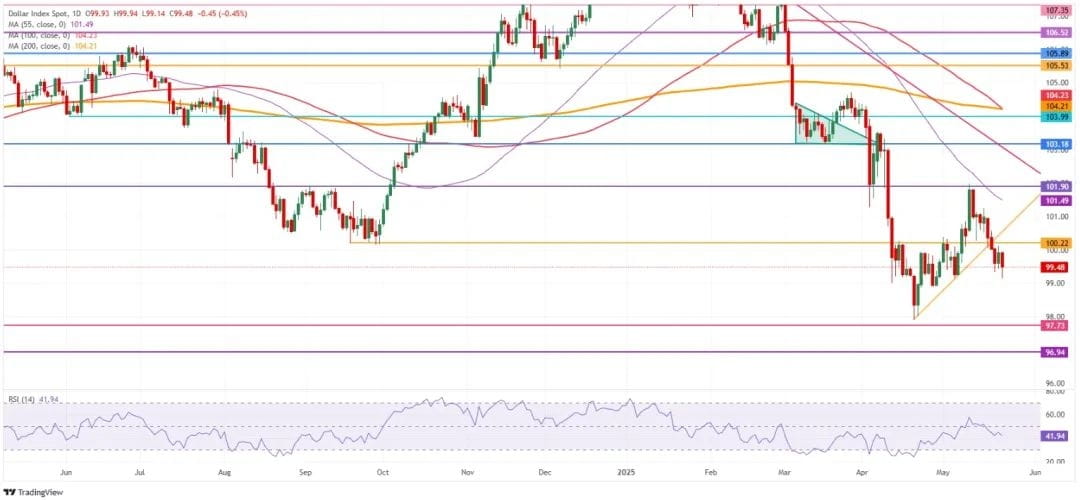
FXStreet analyst Filip Lagaart stated that the dollar index has returned to around 99.40, approaching a two-week low. As the spending bill has now cleared the first hurdle, the risk of a significant shock to U.S. debt may further emerge. The U.S. may even be considering another downgrade of its credit rating, which would further damage the image of the U.S. and the dollar. On the upside, the rising trend line that broke and the support level of $100.22 for the dollar index in September-October is the first resistance area.
On the upside, the next level to watch is the 55-day simple moving average (SMA) at 101.49, followed by 101.90, which is a key level for December 2023 and also the baseline for the head and shoulders pattern forming in the summer of 2024.
If dollar bulls further push the dollar index higher, the key level of 103.18 will come into play. If downward pressure continues, gold prices could plummet to the year's low of 97.91 and the key level of 97.73.
Further declines will see relatively weak technical support levels at 96.94, after which attention will turn to the lower levels of this new price range, which are 95.25 and 94.56, indicating new lows since 2022.
Bitcoin Technical Analysis
CoinTelegraph pointed out that Bitcoin fell back below the breakout level of $109,588, and the bears thwarted the bulls' attempts to push the price back above the upper resistance level.
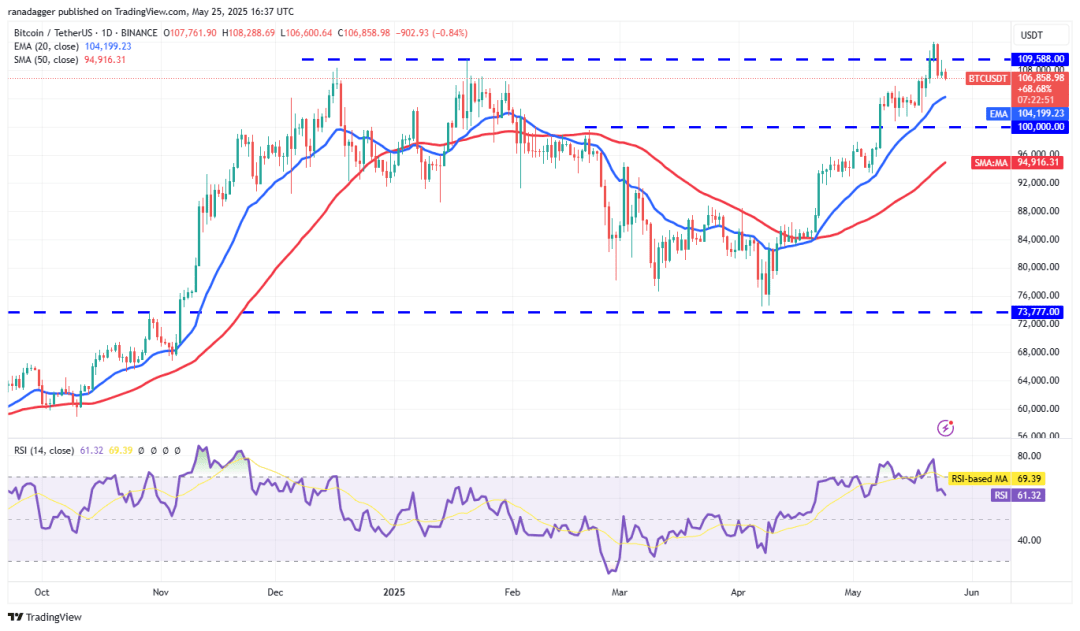
Bulls will once again attempt to push prices above the resistance level between $109,588 and $111,980. If successful, Bitcoin could rebound to the target level of $130,000. The 20-day exponential moving average (20-EMA) at $104,199 is a key level to watch in the short term.
If the support level is breached, Bitcoin could fall to $100,000, and then to the 50-day simple moving average of $94,916.
Bears have pushed prices below the 50-day simple moving average (50-SMA). The 20-day moving average has started to decline, and the relative strength index has fallen into negative territory, indicating that bears are in control. If prices remain below the 50-day moving average, Bitcoin could fall to $102,500, and then to $100,000.
If buyers push the price and maintain it above the resistance level of $109,588, they will regain control. Subsequently, Bitcoin may challenge the level of $111,980. A breakthrough above $111,980 could open the door to an increase to $116,654.