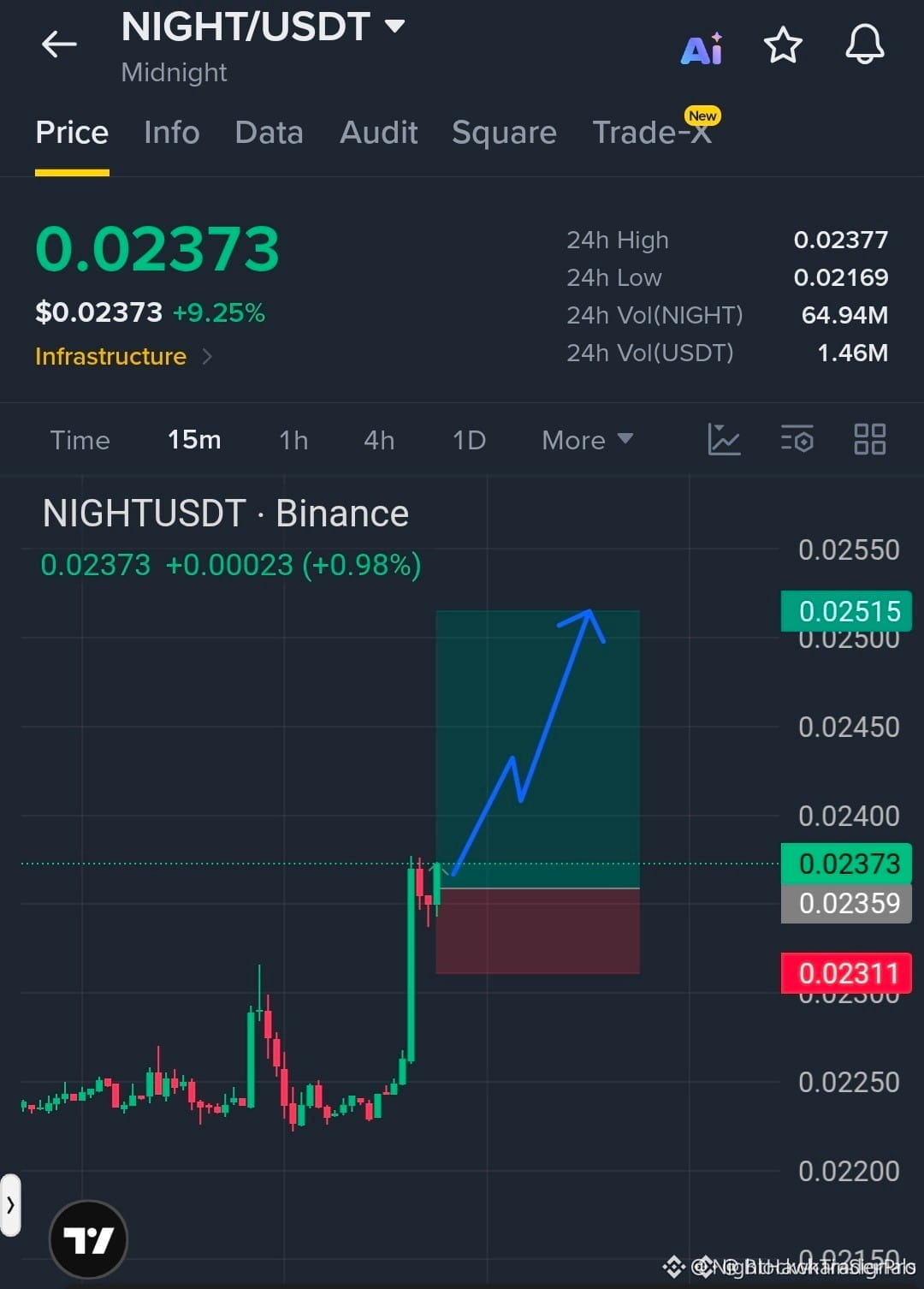
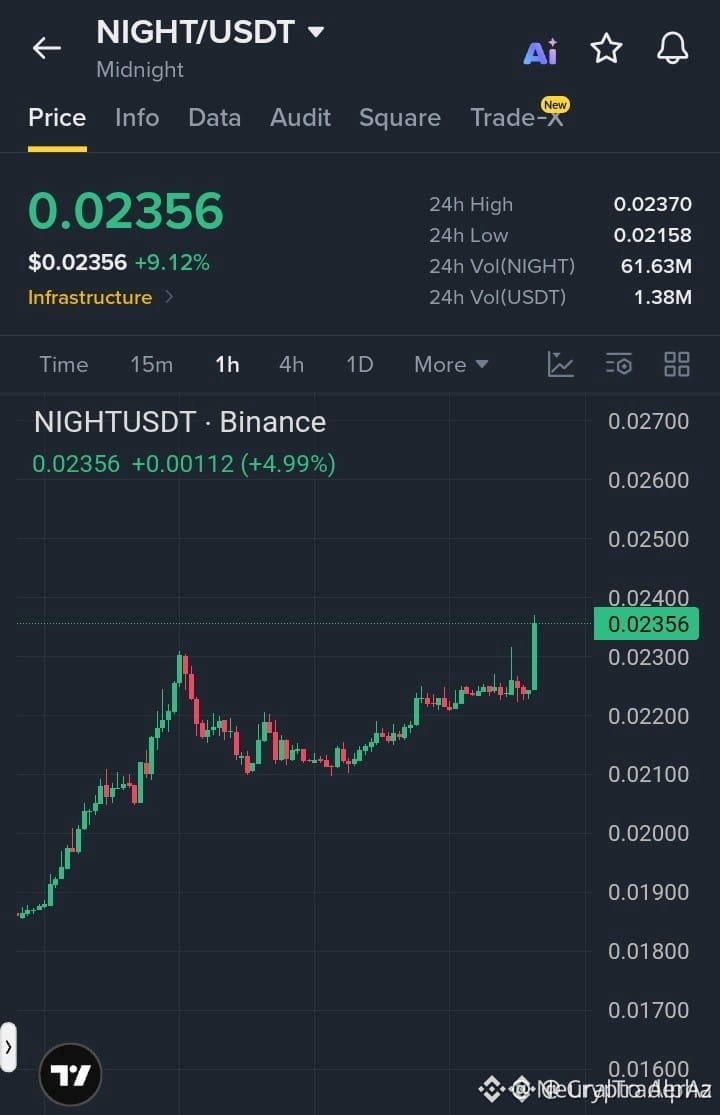
Binance Square

night

6M views
58,058 Discussing
BLAKE_JUDE
·
--
Bullish
I still remember the moment I questioned one of blockchain’s most repeated assumptions: that transparency and privacy must exist at opposite ends of the spectrum. Public chains showcase radical transparency, while privacy networks hide everything, often creating barriers for regulators, enterprises, and real-world adoption. The tension always felt like a false dilemma and that’s what makes Midnight Network ($NIGHT ) feel refreshing. Midnight approaches privacy like the real world works: through controlled disclosure. Using zero-knowledge proofs, transactions, credentials, or smart contract rules can be verified without revealing sensitive underlying data. Verification is separated from exposure, creating privacy without sacrificing accountability. Users can prove eligibility, organizations can meet compliance standards, and decentralized apps can interact securely with other networks all while maintaining selective privacy. This distinction is subtle but transformative. Early privacy-focused networks often struggled because absolute anonymity blocked integration and adoption. Midnight’s design demonstrates that privacy and transparency aren’t mutually exclusive; they can be programmable, flexible, and intentional. Looking beyond the tech, this approach feels essential for blockchain’s next phase. Financial systems, digital identities, and enterprise networks require privacy that adapts to real-world complexities. Midnight suggests a future where individuals and institutions control what, when, and why information is revealed unlocking privacy that empowers rather than restricts. #night @MidnightNetwork $NIGHT
I still remember the moment I questioned one of blockchain’s most repeated assumptions: that transparency and privacy must exist at opposite ends of the spectrum.

Public chains showcase radical transparency, while privacy networks hide everything, often creating barriers for regulators, enterprises, and real-world adoption.

The tension always felt like a false dilemma and that’s what makes Midnight Network ($NIGHT ) feel refreshing.

Midnight approaches privacy like the real world works: through controlled disclosure.

Using zero-knowledge proofs, transactions, credentials, or smart contract rules can be verified without revealing sensitive underlying data.

Verification is separated from exposure, creating privacy without sacrificing accountability.

Users can prove eligibility, organizations can meet compliance standards, and decentralized apps can interact securely with other networks all while maintaining selective privacy.

This distinction is subtle but transformative.

Early privacy-focused networks often struggled because absolute anonymity blocked integration and adoption.

Midnight’s design demonstrates that privacy and transparency aren’t mutually exclusive; they can be programmable, flexible, and intentional.

Looking beyond the tech, this approach feels essential for blockchain’s next phase.

Financial systems, digital identities, and enterprise networks require privacy that adapts to real-world complexities.

Midnight suggests a future where individuals and institutions control what, when, and why information is revealed unlocking privacy that empowers rather than restricts.

#night
@MidnightNetwork
$NIGHT
Amelia_BnB:
good 👍 information
#night $NIGHT Most networks were never built with privacy in mind. Transparency was the goal, so sensitive data got exposed alongside everything else. That worked fine for basic transfers. It breaks the moment real-world information enters the picture. @MidnightNetwork handled it differently. Sensitive inputs stay off the public ledger. Contracts run without revealing their terms. Transactions confirm on-chain — the details do not. That is the architecture serious adoption requires. Built in, not bolted on. {future}(NIGHTUSDT)
#night $NIGHT

Most networks were never built with privacy in mind. Transparency was the goal, so sensitive data got exposed alongside everything else. That worked fine for basic transfers. It breaks the moment real-world information enters the picture.

@MidnightNetwork handled it differently. Sensitive inputs stay off the public ledger. Contracts run without revealing their terms. Transactions confirm on-chain — the details do not.

That is the architecture serious adoption requires. Built in, not bolted on.
Midnight Network Full Project Update (2026) Midnight Network is a privacy-focused Layer-1 blocPrivacy.Real privacyNot the flimsy “we promise not to look” kind that most blockchains quietly rely on.That’s the nerve Midnight Network is trying to touch. Not with slogans. With math. Specifically, the kind of cryptography that lets you prove something is true without revealing the messy details underneath. It’s called Zero-Knowledge Proof. And if it works the way the architects of Midnight Network imagine, it could redraw the uneasy truce between privacy and transparency in crypto. Because right now, that truce is broken. Badly br The Public Ledger Problem Blockchains love sunlight. Every transaction on networks like Bitcoin or Ethereum sits out in the open like laundry on a clothesline. Anyone can see it. That’s the point. Transparency builds trust. But transparency also creates a strange, uncomfortable reality. Imagine proving you’re old enough to enter a casino… by handing the bouncer your passport, home address, and birth certificate. All of it. That’s roughly how most blockchain apps behave today. Too much information. Too little control Midnight’s Bet Midnight doesn’t try to hide the ledger. Instead, it hides the data inside the transaction. The trick comes from ZK‑SNARK cryptography — a way to prove a statement without showing the evidence behind it. Sounds abstract. Here’s the real-world version. You could prove you meet an age requirement… without revealing your birthday. Prove you passed compliance checks… without exposing your identity. Prove a transaction is valid… without showing who sent what. The blockchain sees the proof. Not the secret. Clean. Elegant. Slightly unsettlin The Machinery Under the Hood But here’s the catch. Zero-knowledge cryptography is powerful — and historically a nightmare to build with. Slow circuits. Exotic math. Developer headaches. So Midnight built its own strange little machine to handle it. They call it the Kachina protocol. Think of it as a backstage workshop where private calculations happen away from the public blockchain. The heavy lifting occurs off-chain, quietly, before a small mathematical proof gets posted to the ledger. The chain verifies the proof. Job done. No raw data leaks. No surveillance A Language for Secrecy Most blockchains force developers to wrestle with arcane cryptographic tooling. Midnight tries something different. A programming language called Compact, shaped like TypeScript — the familiar dialect millions of web developers already speak. It’s a subtle strategy. Lower the barrier, and suddenly privacy tech isn’t just for cryptography PhDs. It becomes something regular engineers can actually ship. That matters more than people think. Because infrastructure dies quietly when nobody builds on The Cardano Connection Midnight didn’t appear out of nowhere. It lives in orbit around Cardano, the research-heavy blockchain ecosystem founded by Charles Hoskinson. In practical terms, that means Midnight operates as a partner chain. Liquidity, assets, and community can flow between the two worlds. And its native token — NIGHT — exists as a Cardano asset. Shared gravity. Shared ecosystem. Whether that’s an advantage or a dependency… well, that’s still being tested. --- A Strange Two-Token Economy Midnight’s economy runs on two different fuels. The obvious one is NIGHT, the transferable token used for governance, staking, and validator rewards. But the more interesting piece is DUST. DUST isn’t tradable. You can’t speculate on it. It exists purely as a renewable resource used to pay transaction fees. Which is oddly refreshing in crypto terms. One token for markets. One token for mechanics. It’s like separating gasoline from the stock market. Where This Actually Matters Privacy blockchains often promise abstract things. Midnight’s pitch is more practical — maybe even uncomfortable. Imagine hospitals sharing medical research without exposing patient records. Or supply chains proving compliance without revealing trade secrets. Or financial apps verifying identity checks without storing personal data in some corporate database waiting to be hacked. These aren’t futuristic scenarios. They’re everyday problems with very expensive consequen Why Investors Are Watching Partly the technology. Partly the timing. Privacy in crypto has been politically radioactive ever since regulators began linking it to money laundering and sanctions evasion. Projects like Secret Network and Aleph Zero have wrestled with that tension for years. Midnight tries to thread the needle. Private data. But verifiable compliance. That’s the promise. Whether regulators buy it is another story entire The Quiet Rollout The network has been moving in slow, deliberate steps. The NIGHT token launched in late 2025. Early users received allocations through the Glacier Drop distribution. Developer tools have started appearing. Devnet programs are expanding. No fireworks. Just infrastructure being assembled piece by piece. Which is either disciplined engineering… or a long prelude to disappointmen The Strange Question at the Center Crypto began with radical transparency. Every transaction visible. Every wallet traceable. Midnight asks a dangerous question: What if that idea was wrong from the beginning? What if the future of blockchain isn’t radical transparency… but selective secrecy — where the truth can be verified, yet the details stay locked away? Because if that model wins, the most valuable thing on the internet might not be tokens or NFTs or memecoins. It might be something far quieter. The ability to prove something… without telling the world everything @MidnightNetwork $NIGHT #night {spot}(NIGHTUSDT)

Midnight Network Full Project Update (2026) Midnight Network is a privacy-focused Layer-1 bloc

Privacy.Real privacyNot the flimsy “we promise not to look” kind that most blockchains quietly rely on.That’s the nerve Midnight Network is trying to touch. Not with slogans. With math. Specifically, the kind of cryptography that lets you prove something is true without revealing the messy details underneath.

It’s called Zero-Knowledge Proof. And if it works the way the architects of Midnight Network imagine, it could redraw the uneasy truce between privacy and transparency in crypto.

Because right now, that truce is broken.

Badly br

The Public Ledger Problem

Blockchains love sunlight.

Every transaction on networks like Bitcoin or Ethereum sits out in the open like laundry on a clothesline. Anyone can see it. That’s the point. Transparency builds trust.

But transparency also creates a strange, uncomfortable reality.

Imagine proving you’re old enough to enter a casino… by handing the bouncer your passport, home address, and birth certificate.

All of it.

That’s roughly how most blockchain apps behave today.

Too much information. Too little control

Midnight’s Bet

Midnight doesn’t try to hide the ledger.

Instead, it hides the data inside the transaction.

The trick comes from ZK‑SNARK cryptography — a way to prove a statement without showing the evidence behind it.

Sounds abstract. Here’s the real-world version.

You could prove you meet an age requirement… without revealing your birthday.
Prove you passed compliance checks… without exposing your identity.
Prove a transaction is valid… without showing who sent what.

The blockchain sees the proof.

Not the secret.

Clean. Elegant. Slightly unsettlin

The Machinery Under the Hood

But here’s the catch.

Zero-knowledge cryptography is powerful — and historically a nightmare to build with. Slow circuits. Exotic math. Developer headaches.

So Midnight built its own strange little machine to handle it.

They call it the Kachina protocol.

Think of it as a backstage workshop where private calculations happen away from the public blockchain. The heavy lifting occurs off-chain, quietly, before a small mathematical proof gets posted to the ledger.

The chain verifies the proof.

Job done.

No raw data leaks. No surveillance

A Language for Secrecy

Most blockchains force developers to wrestle with arcane cryptographic tooling.

Midnight tries something different.

A programming language called Compact, shaped like TypeScript — the familiar dialect millions of web developers already speak.

It’s a subtle strategy.

Lower the barrier, and suddenly privacy tech isn’t just for cryptography PhDs. It becomes something regular engineers can actually ship.

That matters more than people think.

Because infrastructure dies quietly when nobody builds on

The Cardano Connection

Midnight didn’t appear out of nowhere.

It lives in orbit around Cardano, the research-heavy blockchain ecosystem founded by Charles Hoskinson.

In practical terms, that means Midnight operates as a partner chain. Liquidity, assets, and community can flow between the two worlds.

And its native token — NIGHT — exists as a Cardano asset.

Shared gravity. Shared ecosystem.

Whether that’s an advantage or a dependency… well, that’s still being tested.

---

A Strange Two-Token Economy

Midnight’s economy runs on two different fuels.

The obvious one is NIGHT, the transferable token used for governance, staking, and validator rewards.

But the more interesting piece is DUST.

DUST isn’t tradable. You can’t speculate on it. It exists purely as a renewable resource used to pay transaction fees.

Which is oddly refreshing in crypto terms.

One token for markets.

One token for mechanics.

It’s like separating gasoline from the stock market.

Where This Actually Matters

Privacy blockchains often promise abstract things.

Midnight’s pitch is more practical — maybe even uncomfortable.

Imagine hospitals sharing medical research without exposing patient records.
Or supply chains proving compliance without revealing trade secrets.
Or financial apps verifying identity checks without storing personal data in some corporate database waiting to be hacked.

These aren’t futuristic scenarios.

They’re everyday problems with very expensive consequen

Why Investors Are Watching

Partly the technology.

Partly the timing.

Privacy in crypto has been politically radioactive ever since regulators began linking it to money laundering and sanctions evasion. Projects like Secret Network and Aleph Zero have wrestled with that tension for years.

Midnight tries to thread the needle.

Private data.
But verifiable compliance.

That’s the promise.

Whether regulators buy it is another story entire

The Quiet Rollout

The network has been moving in slow, deliberate steps.

The NIGHT token launched in late 2025. Early users received allocations through the Glacier Drop distribution. Developer tools have started appearing. Devnet programs are expanding.

No fireworks.

Just infrastructure being assembled piece by piece.

Which is either disciplined engineering…

or a long prelude to disappointmen

The Strange Question at the Center

Crypto began with radical transparency. Every transaction visible. Every wallet traceable.

Midnight asks a dangerous question:

What if that idea was wrong from the beginning?

What if the future of blockchain isn’t radical transparency…

but selective secrecy — where the truth can be verified, yet the details stay locked away?

Because if that model wins, the most valuable thing on the internet might not be tokens or NFTs or memecoins.

It might be something far quieter.

The ability to prove something…

without telling the world everything

@MidnightNetwork $NIGHT #night
Amelia_BnB:
very nice 👍 information
The Night paper Reimagining Privacy in the Blockchain EraAs blockchain technology continues to evolve, one challenge has remained constant—privacy. Most public blockchains were built on radical transparency, where every transaction, wallet address, and interaction is permanently visible on the ledger. While this transparency builds trust, it also creates limitations for individuals, institutions, and enterprises that require confidentiality. Public blockchains were originally designed with openness as a core principle. However, as adoption expanded beyond early crypto communities, the limitations of complete transparency became more evident. Businesses, institutions, and individuals often need systems that protect sensitive data while still maintaining the trust and verification that blockchain technology provides. The Nightpaper introduces the vision behind Midnight Network, a blockchain designed to bring privacy and selective disclosure into decentralized systems. Instead of forcing users to choose between transparency and secrecy, Midnight proposes a model where data can remain private while still being verifiable on-chain. A New Approach to Blockchain Privacy Traditional blockchains expose nearly all transaction details. While this model works for open networks, it becomes problematic when sensitive information is involved. Financial institutions, healthcare organizations, and enterprises often require strict confidentiality—something that fully transparent ledgers cannot easily provide. Midnight addresses this issue by embedding privacy-preserving cryptography directly into its architecture. Through advanced techniques such as zero-knowledge proofs, transactions can be validated without revealing the underlying data. This allows the network to confirm that rules were followed without exposing personal or confidential information. This concept forms the foundation of Midnight’s core philosophy: programmable privacy. Developers can build decentralized applications where privacy rules are defined directly within smart contracts, enabling secure interactions without unnecessary data exposure. Selective Disclosure and Real-World Applications One of the most important ideas presented in the Nightpaper is selective disclosure. Instead of exposing all information on a public ledger, users can choose which details to reveal and to whom. For example, a transaction could be verified by the network without publicly revealing the sender, receiver, or transaction amount. This capability could significantly expand the practical use of blockchain technology. Industries that previously avoided public blockchains due to confidentiality concerns may now be able to adopt decentralized systems without compromising sensitive information. Potential applications include: Private financial transactions Secure digital identity systems Confidential enterprise data sharing Compliance-friendly blockchain solutions For developers and organizations exploring blockchain solutions, the lack of data privacy has often been a major barrier to adoption. Systems like Midnight Network attempt to remove that barrier by enabling decentralized applications that protect sensitive information while maintaining verifiable trust. Integration with the Cardano Ecosystem Midnight is being developed by Input Output Global, the organization known for building Cardano. Rather than functioning as an isolated network, Midnight is designed to complement the broader blockchain ecosystem. This interoperability allows applications built on Midnight to interact with other networks while maintaining strong privacy guarantees. The goal is not simply to create another blockchain, but to introduce a privacy-focused layer that strengthens the capabilities of decentralized technologies across multiple platforms. The Economic Model Behind Midnight The Nightpaper also outlines the economic structure supporting the network. The native asset, NIGHT, plays a central role in governance, participation, and network incentives. Alongside NIGHT, the protocol introduces DUST, a renewable resource used for transaction processing. By separating the main token from the resource required to execute transactions, the network aims to create a system where developers and users can interact with the platform more efficiently and sustainably. Another concept associated with the ecosystem is the Glacier Drop, a gradual distribution mechanism designed to introduce the NIGHT token to participants over time. Instead of a sudden token release, this model encourages long-term participation and supports the growth of a stable ecosystem. The Future of Privacy-Focused Blockchain In many ways, the privacy debate in blockchain mirrors the early evolution of the internet. Transparency helped establish trust in decentralized systems, but as adoption expanded, the need for stronger data protection became increasingly clear. The ideas presented in the Nightpaper suggest that the next phase of blockchain innovation may focus on balancing transparency with controlled privacy. By allowing disclosure to become programmable, Midnight Network proposes a framework where decentralized technology can support real-world applications without exposing sensitive information. As blockchain continues to expand into finance, identity, and enterprise systems, privacy-preserving infrastructure may become an essential part of the ecosystem. In this context, the vision outlined in the Nightpaper represents an important step toward a future where decentralization and data protection evolve together. #night $NIGHT @MidnightNetwork

The Night paper Reimagining Privacy in the Blockchain Era

As blockchain technology continues to evolve, one challenge has remained constant—privacy. Most public blockchains were built on radical transparency, where every transaction, wallet address, and interaction is permanently visible on the ledger. While this transparency builds trust, it also creates limitations for individuals, institutions, and enterprises that require confidentiality.
Public blockchains were originally designed with openness as a core principle. However, as adoption expanded beyond early crypto communities, the limitations of complete transparency became more evident. Businesses, institutions, and individuals often need systems that protect sensitive data while still maintaining the trust and verification that blockchain technology provides.
The Nightpaper introduces the vision behind Midnight Network, a blockchain designed to bring privacy and selective disclosure into decentralized systems. Instead of forcing users to choose between transparency and secrecy, Midnight proposes a model where data can remain private while still being verifiable on-chain.
A New Approach to Blockchain Privacy
Traditional blockchains expose nearly all transaction details. While this model works for open networks, it becomes problematic when sensitive information is involved. Financial institutions, healthcare organizations, and enterprises often require strict confidentiality—something that fully transparent ledgers cannot easily provide.
Midnight addresses this issue by embedding privacy-preserving cryptography directly into its architecture. Through advanced techniques such as zero-knowledge proofs, transactions can be validated without revealing the underlying data. This allows the network to confirm that rules were followed without exposing personal or confidential information.
This concept forms the foundation of Midnight’s core philosophy: programmable privacy. Developers can build decentralized applications where privacy rules are defined directly within smart contracts, enabling secure interactions without unnecessary data exposure.
Selective Disclosure and Real-World Applications
One of the most important ideas presented in the Nightpaper is selective disclosure. Instead of exposing all information on a public ledger, users can choose which details to reveal and to whom. For example, a transaction could be verified by the network without publicly revealing the sender, receiver, or transaction amount.
This capability could significantly expand the practical use of blockchain technology. Industries that previously avoided public blockchains due to confidentiality concerns may now be able to adopt decentralized systems without compromising sensitive information.
Potential applications include:
Private financial transactions
Secure digital identity systems
Confidential enterprise data sharing
Compliance-friendly blockchain solutions
For developers and organizations exploring blockchain solutions, the lack of data privacy has often been a major barrier to adoption. Systems like Midnight Network attempt to remove that barrier by enabling decentralized applications that protect sensitive information while maintaining verifiable trust.
Integration with the Cardano Ecosystem
Midnight is being developed by Input Output Global, the organization known for building Cardano. Rather than functioning as an isolated network, Midnight is designed to complement the broader blockchain ecosystem.
This interoperability allows applications built on Midnight to interact with other networks while maintaining strong privacy guarantees. The goal is not simply to create another blockchain, but to introduce a privacy-focused layer that strengthens the capabilities of decentralized technologies across multiple platforms.
The Economic Model Behind Midnight
The Nightpaper also outlines the economic structure supporting the network. The native asset, NIGHT, plays a central role in governance, participation, and network incentives.
Alongside NIGHT, the protocol introduces DUST, a renewable resource used for transaction processing. By separating the main token from the resource required to execute transactions, the network aims to create a system where developers and users can interact with the platform more efficiently and sustainably.
Another concept associated with the ecosystem is the Glacier Drop, a gradual distribution mechanism designed to introduce the NIGHT token to participants over time. Instead of a sudden token release, this model encourages long-term participation and supports the growth of a stable ecosystem.
The Future of Privacy-Focused Blockchain
In many ways, the privacy debate in blockchain mirrors the early evolution of the internet. Transparency helped establish trust in decentralized systems, but as adoption expanded, the need for stronger data protection became increasingly clear.
The ideas presented in the Nightpaper suggest that the next phase of blockchain innovation may focus on balancing transparency with controlled privacy. By allowing disclosure to become programmable, Midnight Network proposes a framework where decentralized technology can support real-world applications without exposing sensitive information.
As blockchain continues to expand into finance, identity, and enterprise systems, privacy-preserving infrastructure may become an essential part of the ecosystem. In this context, the vision outlined in the Nightpaper represents an important step toward a future where decentralization and data protection evolve together.
#night $NIGHT @MidnightNetwork
KashCryptoWave:
@Kash-Wave-Crypto-1156 And it removes the conflict of interest. When one token handles fees and governance simultaneously, holders are always choosing between using the network and protecting their voting weight. Splitting the roles means neither function compromises the other.
Midnight Devnet: Where Privacy Gets Real, Not Just TheoreticalI’ve seen a ton of crypto projects pop up, all dressed in shiny new words, acting like old problems suddenly became new because the branding got cooler. That’s probably why Midnight caught my eye differently. Not because I’m convinced it’ll definitely work—most don’t—but because underneath the noise, it’s actually asking a question most of the market stopped caring about. Crypto still has this habit of recycling itself. Same incentives, same money-chasing loops, same vague promises that this time infrastructure will finally matter more than the trade. And sure, most projects fall apart as soon as you apply real pressure. Midnight isn’t magically immune to that—but it does seem to get one thing: crypto’s idea of “transparency” has always been a little too convenient. It sounds noble… until you ask whether every user, every business, every app, and every transaction actually benefits from being constantly exposed. That’s where Midnight stands apart. This isn’t about obsession with secrecy. It’s about acknowledging the friction that comes from making everything public by default. Most blockchains were built assuming openness automatically equals trust. Sometimes it works. Sometimes it just creates a new mess. Midnight seems to be built around the idea that an app should prove what matters… without dumping every piece of sensitive info for the world to trip over. The real goal isn’t hiding for the sake of hiding, or some fantasy about disappearing into dark wallets. It’s about building systems where private stuff stays private—but users, counterparties, or whoever needs proof still get it. Sounds obvious when you say it slowly, but crypto has spent years pretending that’s impossible. The devnet is where all of this either clicks or falls apart. Every project looks polished until developers actually use it. Then you see the rough edges. The abstractions break. You figure out if it’s a real environment or just a showroom. I’m looking at Midnight with that in mind. If the devnet actually works, if devs can build apps with privacy baked in from the start instead of slapping it on at the end… then maybe it’s worth paying attention. What’s really interesting is how Midnight forces a different mindset. On most chains, you build, deploy, and let the market call it trustless because everyone can see the wreckage. Midnight asks the harder questions: what really needs to be visible? What needs proof? What should stay sealed unless there’s a reason to expose it? That’s more mature thinking for app design—but yes, it’s also more annoying. More moving parts. More mental load. More room for things to break. And break they will. Always. But that doesn’t make the approach weak. It just means Midnight is tackling a problem uglier than what most projects chase. Transparent systems are easier to reason about, even if they’re clumsy. Privacy-aware systems are messy. More infrastructure. More care in data flow, permissions, and proof-handling. Midnight is stepping into that chaos on purpose—and that’s rare in crypto. It also has something most others don’t: a thesis that actually holds up. Many teams build momentum first, philosophy later. Midnight started with the problem: privacy as a core architecture, not a side feature. That distinction changes everything—what the network is for, what apps make sense, what developers care about from day one. But a strong thesis is still just words until users show up. And that’s where I stay skeptical. Smart design choices die slowly when adoption stalls. Builders get tired. Tooling lags. Documentation comes too late. The first real app never arrives. Then attention shifts to the token, not the product, and it all gets lost in market noise. I don’t know if Midnight avoids that—no one does. What I do see is a project that understands a weak spot in blockchain design: public verifiability is useful but not sacred. Full exposure is often just bad architecture dressed as principle. Midnight treats privacy as a normal, necessary part of building serious apps. That’s a much stronger starting point than most projects. Right now, the market is noise-heavy. Narratives feel recycled before they even start. Midnight might still break that cycle—because it’s asking smaller, heavier questions instead of grand promises: Can decentralized systems handle information responsibly? Can apps prove enough without exposing everything? Can that actually work when real people start building on top? That’s what I’m watching. Not slogans. Not hype. Not recycled excitement. I’m watching whether the devnet leads to real apps—and if the privacy model survives real-world friction. Midnight isn’t finished. It’s standing at the point where smart ideas usually fail—and maybe that’s exactly why it’s worth watching. Or maybe I’ve just been around long enough to know how rare it is for a project to ask the right questions—and survive the answers. #night @MidnightNetwork $NIGHT

Midnight Devnet: Where Privacy Gets Real, Not Just Theoretical

I’ve seen a ton of crypto projects pop up, all dressed in shiny new words, acting like old problems suddenly became new because the branding got cooler. That’s probably why Midnight caught my eye differently. Not because I’m convinced it’ll definitely work—most don’t—but because underneath the noise, it’s actually asking a question most of the market stopped caring about.
Crypto still has this habit of recycling itself. Same incentives, same money-chasing loops, same vague promises that this time infrastructure will finally matter more than the trade. And sure, most projects fall apart as soon as you apply real pressure. Midnight isn’t magically immune to that—but it does seem to get one thing: crypto’s idea of “transparency” has always been a little too convenient. It sounds noble… until you ask whether every user, every business, every app, and every transaction actually benefits from being constantly exposed.
That’s where Midnight stands apart. This isn’t about obsession with secrecy. It’s about acknowledging the friction that comes from making everything public by default. Most blockchains were built assuming openness automatically equals trust. Sometimes it works. Sometimes it just creates a new mess. Midnight seems to be built around the idea that an app should prove what matters… without dumping every piece of sensitive info for the world to trip over.

The real goal isn’t hiding for the sake of hiding, or some fantasy about disappearing into dark wallets. It’s about building systems where private stuff stays private—but users, counterparties, or whoever needs proof still get it. Sounds obvious when you say it slowly, but crypto has spent years pretending that’s impossible.
The devnet is where all of this either clicks or falls apart. Every project looks polished until developers actually use it. Then you see the rough edges. The abstractions break. You figure out if it’s a real environment or just a showroom. I’m looking at Midnight with that in mind. If the devnet actually works, if devs can build apps with privacy baked in from the start instead of slapping it on at the end… then maybe it’s worth paying attention.
What’s really interesting is how Midnight forces a different mindset. On most chains, you build, deploy, and let the market call it trustless because everyone can see the wreckage. Midnight asks the harder questions: what really needs to be visible? What needs proof? What should stay sealed unless there’s a reason to expose it? That’s more mature thinking for app design—but yes, it’s also more annoying. More moving parts. More mental load. More room for things to break.
And break they will. Always. But that doesn’t make the approach weak. It just means Midnight is tackling a problem uglier than what most projects chase. Transparent systems are easier to reason about, even if they’re clumsy. Privacy-aware systems are messy. More infrastructure. More care in data flow, permissions, and proof-handling. Midnight is stepping into that chaos on purpose—and that’s rare in crypto.

It also has something most others don’t: a thesis that actually holds up. Many teams build momentum first, philosophy later. Midnight started with the problem: privacy as a core architecture, not a side feature. That distinction changes everything—what the network is for, what apps make sense, what developers care about from day one.
But a strong thesis is still just words until users show up. And that’s where I stay skeptical. Smart design choices die slowly when adoption stalls. Builders get tired. Tooling lags. Documentation comes too late. The first real app never arrives. Then attention shifts to the token, not the product, and it all gets lost in market noise.
I don’t know if Midnight avoids that—no one does. What I do see is a project that understands a weak spot in blockchain design: public verifiability is useful but not sacred. Full exposure is often just bad architecture dressed as principle. Midnight treats privacy as a normal, necessary part of building serious apps. That’s a much stronger starting point than most projects.
Right now, the market is noise-heavy. Narratives feel recycled before they even start. Midnight might still break that cycle—because it’s asking smaller, heavier questions instead of grand promises: Can decentralized systems handle information responsibly? Can apps prove enough without exposing everything? Can that actually work when real people start building on top?
That’s what I’m watching. Not slogans. Not hype. Not recycled excitement. I’m watching whether the devnet leads to real apps—and if the privacy model survives real-world friction.
Midnight isn’t finished. It’s standing at the point where smart ideas usually fail—and maybe that’s exactly why it’s worth watching. Or maybe I’ve just been around long enough to know how rare it is for a project to ask the right questions—and survive the answers.

#night @MidnightNetwork $NIGHT
YASU FUTURES:
very informative 🙌
#night $NIGHT Most networks were never built with privacy in mind. Transparency was the goal, so sensitive data got exposed alongside everything else. That worked fine for basic transfers. It breaks the moment real-world information enters the picture. @MidnightNetwork handled it differently. Sensitive inputs stay off the public ledger. Contracts run without revealing their terms. Transactions confirm on-chain — the details do not. That is the architecture serious adoption requires. Built in, not bolted on.
#night $NIGHT

Most networks were never built with privacy in mind. Transparency was the goal, so sensitive data got exposed alongside everything else. That worked fine for basic transfers. It breaks the moment real-world information enters the picture.

@MidnightNetwork handled it differently. Sensitive inputs stay off the public ledger. Contracts run without revealing their terms. Transactions confirm on-chain — the details do not.

That is the architecture serious adoption requires. Built in, not bolted on.
Coin Coach Signals:
Transactions confirm on-chain — the details do not.
·
--
Bullish
Yesterday I talked about $NIGHT and said it's one of the most important infrastructure projects. It's still in a crucial accumulation zone, around 0.05000. This is four days after its listing on Binance, having previously been on Binance Alpha. Currently, the coin is trading sideways but accumulating. With each rise, there's a quick, slight correction. However, we might see a strong rise to the 0.06500 area, a strong resistance level it could reach within a week. This is just the beginning. Furthermore, this project has ZK Proofs, which is very important in the infrastructure field. Most projects don't have them, but a team does, and that's a significant achievement for them. The project came from Alpha and then moved to a platform. The team is also very large, and the market capitalization is very high so far. The 1D RSI is positive in the 50.00 area. A rise to 54.40 and above would indicate a strong upward move for the coin and the market as a whole. At this moment, markets are waiting for the reaction of the US markets today. {future}(NIGHTUSDT) #night @MidnightNetwork
Yesterday I talked about $NIGHT and said it's one of the most important infrastructure projects. It's still in a crucial accumulation zone, around 0.05000. This is four days after its listing on Binance, having previously been on Binance Alpha. Currently, the coin is trading sideways but accumulating. With each rise, there's a quick, slight correction. However, we might see a strong rise to the 0.06500 area, a strong resistance level it could reach within a week. This is just the beginning. Furthermore, this project has ZK Proofs, which is very important in the infrastructure field. Most projects don't have them, but a team does, and that's a significant achievement for them. The project came from Alpha and then moved to a platform. The team is also very large, and the market capitalization is very high so far. The 1D RSI is positive in the 50.00 area. A rise to 54.40 and above would indicate a strong upward move for the coin and the market as a whole. At this moment, markets are waiting for the reaction of the US markets today.

#night @MidnightNetwork
#night $NIGHT Powering Privacy: The Tokenomics and Incentives Behind Midnight The tokenomics of Midnight Network are designed to support sustainable growth while maintaining a privacy-first infrastructure. The ecosystem introduces NIGHT for governance and participation, while DUST works as a renewable resource for transaction execution. This dual-resource approach separates network utility from transaction costs, creating balanced incentives for developers, validators, and users as the ecosystem continues to grow. @MidnightNetwork
#night $NIGHT
Powering Privacy: The Tokenomics and Incentives Behind Midnight
The tokenomics of Midnight Network are designed to support sustainable growth while maintaining a privacy-first infrastructure. The ecosystem introduces NIGHT for governance and participation, while DUST works as a renewable resource for transaction execution. This dual-resource approach separates network utility from transaction costs, creating balanced incentives for developers, validators, and users as the ecosystem continues to grow.
@MidnightNetwork
Dr Nohawn:
Great explanation of the Night concept. The balance between openness and controlled privacy is an important challenge in blockchain.
Yeah man, privacy stuff is getting real important now if people are actually gonna start using Web3 for anything serious. Nobody wants their whole life on a public ledger anymore. @MidnightNetwork is this privacy layer hooked up to Cardano – basically a sidechain or partner chain whatever you call it. They use zero-knowledge tech (those ZK proofs) so devs can build apps where the sensitive bits stay hidden, but you can still prove everything checks out on-chain without showing the details. It's like... you can verify a transaction happened or someone's over 18 or whatever without dumping all their personal info out there. Mixes the best of transparent blockchains with actual confidentiality. That opens it up for normal companies who need to follow rules, but also for regular people who just don't want everything exposed. Could be big for stuff like payments, identity, maybe even some enterprise tools down the line. As more people and projects jump in, $NIGHT looks like it'll be the main token driving it – governance, staking, all that. Holding it even generates this other resource called DUST for paying fees on private stuff without burning your main stack. Feels like one of those building-block things that quietly becomes essential once privacy isn't optional anymore. What do you guys think – ready for this kind of setup or still too early? #night
Yeah man, privacy stuff is getting real important now if people are actually gonna start using Web3 for anything serious. Nobody wants their whole life on a public ledger anymore.

@MidnightNetwork is this privacy layer hooked up to Cardano – basically a sidechain or partner chain whatever you call it. They use zero-knowledge tech (those ZK proofs) so devs can build apps where the sensitive bits stay hidden, but you can still prove everything checks out on-chain without showing the details.

It's like... you can verify a transaction happened or someone's over 18 or whatever without dumping all their personal info out there. Mixes the best of transparent blockchains with actual confidentiality.

That opens it up for normal companies who need to follow rules, but also for regular people who just don't want everything exposed. Could be big for stuff like payments, identity, maybe even some enterprise tools down the line.

As more people and projects jump in, $NIGHT looks like it'll be the main token driving it – governance, staking, all that. Holding it even generates this other resource called DUST for paying fees on private stuff without burning your main stack.

Feels like one of those building-block things that quietly becomes essential once privacy isn't optional anymore. What do you guys think – ready for this kind of setup or still too early? #night
B
NIGHTUSDT
Closed
PNL
+1.97%
Gourav-S:
Exactly, this setup feels like the missing piece for serious Web3 adoption - real privacy without losing verifiability... NIGHT + DUST makes it practical, and Cardano integration gives it extra credibility... Excited to see devs and projects actually start building on it...
#night $NIGHT @MidnightNetwork Everyone keeps focusing on the same headline: Midnight mainnet is expected around late March 2026. But honestly, the date isn’t the most interesting part. What caught my attention is the launch structure. Midnight isn’t jumping straight into a fully open validator network. The early phase is expected to run with a federated group of operators organizations like Google Cloud, Blockdaemon, and others helping stabilize the network in the beginning. That tells me the team is thinking about reliability first, decentralization second. For me the real question isn’t the launch itself. It’s what the network looks like after launch — how the validator set expands and how quickly the system moves toward wider participation. That transition will say a lot about where Midnight is really heading. {future}(NIGHTUSDT)
#night $NIGHT @MidnightNetwork
Everyone keeps focusing on the same headline: Midnight mainnet is expected around late March 2026.

But honestly, the date isn’t the most interesting part.

What caught my attention is the launch structure. Midnight isn’t jumping straight into a fully open validator network. The early phase is expected to run with a federated group of operators organizations like Google Cloud, Blockdaemon, and others helping stabilize the network in the beginning.

That tells me the team is thinking about reliability first, decentralization second.

For me the real question isn’t the launch itself.

It’s what the network looks like after launch — how the validator set expands and how quickly the system moves toward wider participation.

That transition will say a lot about where Midnight is really heading.
Z Y N T R A:
Interesting perspective. The post-launch validator expansion will definitely be the real test for Midnight.
$NIGHT is currently trading at $0.0518, holding a strong base above the $0.047 support after its recent Binance spot listing. This infrastructure heavy project is moving away from purely speculative price action toward utility driven growth as it prepares for its federated mainnet launch in late March. While quarterly unlocks of the 24 billion fixed supply create a predictable headwind, the network's unique ZK-proof "selective disclosure" technology has already attracted 57,000 active holders. The most effective strategy involves disciplined accumulation during this consolidation phase, avoiding low-volume spikes above $0.060. if $NIGHT maintains its structural floor, the upcoming mainnet utility could trigger a re-rating toward the $0.15–$0.20 zone. Are you positioning for the mainnet utility now, or will you wait for the late stage breakout? #night $NIGHT @MidnightNetwork
$NIGHT is currently trading at $0.0518, holding a strong base above the $0.047 support after its recent Binance spot listing. This infrastructure heavy project is moving away from purely speculative price action toward utility driven growth as it prepares for its federated mainnet launch in late March.

While quarterly unlocks of the 24 billion fixed supply create a predictable headwind, the network's unique ZK-proof "selective disclosure" technology has already attracted 57,000 active holders.

The most effective strategy involves disciplined accumulation during this consolidation phase, avoiding low-volume spikes above $0.060.

if $NIGHT maintains its structural floor, the upcoming mainnet utility could trigger a re-rating toward the $0.15–$0.20 zone.

Are you positioning for the mainnet utility now, or will you wait for the late stage breakout?
#night $NIGHT @MidnightNetwork
·
--
Bullish
Today, $NIGHT token rose after falling below 0.04950, reaching 0.05250. Currently, its price is around 0.05030, likely due to news and pressure. However, we have very important news today with the opening of the US market. We expect to see a very strong movement, anticipating an upward trend for the token because it possesses ZK Proofs and is also associated with the Midnight project, which owns two tokens: Night and Dust. This is a very strong project with a high market capitalization. Currently, the token's price is in accumulation territory due to its market capitalization and inflation. A rise in the token takes longer, but we expect it to reach 0.06500 once the accumulation phase is complete. At the end of this phase, demand will be high and supply very low, which will increase the buying rate and drive the price up significantly. Any strong news with the opening of the US market will support the token, help it, and increase its liquidity in the coming days. {future}(NIGHTUSDT) #night @MidnightNetwork
Today, $NIGHT token rose after falling below 0.04950, reaching 0.05250. Currently, its price is around 0.05030, likely due to news and pressure. However, we have very important news today with the opening of the US market. We expect to see a very strong movement, anticipating an upward trend for the token because it possesses ZK Proofs and is also associated with the Midnight project, which owns two tokens: Night and Dust. This is a very strong project with a high market capitalization. Currently, the token's price is in accumulation territory due to its market capitalization and inflation. A rise in the token takes longer, but we expect it to reach 0.06500 once the accumulation phase is complete. At the end of this phase, demand will be high and supply very low, which will increase the buying rate and drive the price up significantly. Any strong news with the opening of the US market will support the token, help it, and increase its liquidity in the coming days.

#night @MidnightNetwork
I Started Looking at Midnight Network and Ended Up Thinking More Deeply About the Hidden Design LimiProjects like Midnight Network are the ones that make me slow down. That does not happen often anymore. I have looked at too many crypto projects that arrive with the same polished language, the same clean branding, and the same promise that they are about to fix everything the market got wrong before. Most of them end up feeling interchangeable. Some disappear quietly. Some survive a little longer because the narrative is strong enough to carry them. But very few actually make me stop and think about what they are trying to solve beneath the surface. Midnight did. What caught my attention was not hype. It was not noise. It was the feeling that this project is aimed at one of the problems crypto still has not been honest enough about. The industry loves open systems, visible transactions, public ledgers, and radical transparency. For a long time, that was treated like one of blockchain’s purest strengths. But the more I study this space, the more I feel that full transparency is also one of its quietest weaknesses. That idea sits in the background of almost everything. Crypto has proven that value can move without permission. It has proven that networks can coordinate strangers at global scale. It has proven that trust can be replaced by code in ways that once sounded impossible. But it still struggles with something much more human. It still struggles with the fact that people do not want to expose everything just to do one thing. And honestly, that is normal. In real life, nobody hands over their full history just to prove one detail. A business does not open its entire internal activity to the world just to show it is operating honestly. A person does not reveal every part of their identity just to enter a system, make a payment, or interact with an application. We live through selective disclosure every day. We reveal what is necessary, not everything available. That is not secrecy. That is how normal systems function. This is where Midnight feels important to me. It seems to understand that privacy is not some extra feature for edge cases. It is part of what makes a digital system usable in the first place. That is a very different way of thinking. It moves privacy away from the old crypto framing where it is treated like something suspicious, niche, or secondary. Instead, it starts to look like infrastructure. It starts to look like one of the missing pieces that blockchain needs if it ever wants to support more than speculation and public experimentation. That is the part I think this market keeps underestimating. People still talk about privacy as if it belongs in the margins, but I think privacy is actually tied to scale. A chain can be fast, cheap, and technically impressive, but if every meaningful action comes with overexposure, then a lot of serious use cases will never feel natural there. Builders become limited. Users become cautious. Institutions hesitate. Whole categories of applications stay underdeveloped, not because the chain cannot process them, but because the environment does not respect the boundaries real activity needs. That is why I do not see privacy as just a moral debate. I see it as an architectural issue. A lot of crypto design still feels like it was made for visibility first and real-world complexity second. That worked in the early stages because the space was mostly built around traders, experimenters, and communities willing to live in public. But if Web3 wants to grow into something larger, something that touches identity, commerce, enterprise systems, consumer apps, or more sensitive forms of coordination, then this design logic starts to show its cracks. Midnight seems to be built around that crack. And that is why it stayed in my mind. I keep thinking about how many blockchain projects focus on what is easy to market. Speed is easy to market. Fees are easy to market. Throughput is easy to market. Even decentralization, at this point, has become easy to market because people know what words to say. But the harder questions are usually the ones that matter later. What kind of applications can actually live on this infrastructure? What does privacy look like when it is built into execution instead of added as an afterthought? What happens when users want proof without exposure? What happens when the market finally realizes that transparency by default does not work for every serious use case? Those are not flashy questions, but they are real ones. And I think real questions usually age better than loud answers. The other thing I find interesting is how this connects to economic design. Crypto has a habit of stuffing too many roles into one system and hoping alignment will magically appear. One token becomes the fee asset, the speculative asset, the governance asset, the incentive layer, and the identity of the network itself. Then the user experience becomes unstable and everyone acts surprised. The deeper I go into blockchain research, the more I think mature infrastructure comes from separating concerns, not blending everything together for convenience. That is another reason projects like Midnight feel worth watching. Not because they have all the answers already, but because they are at least trying to approach design with more intention. That matters. A lot of networks feel like they were built to attract attention first and figure out the deeper logic later. Midnight feels more like a project asking what kind of foundation future applications will actually need. That developer layer matters too. A project can sound intelligent on paper and still fail the moment builders try to use it. I have seen that happen too many times. A good idea without usable infrastructure stays trapped in theory. So when I look at something like Midnight, I do not only care about the vision. I care about whether it is trying to create a real path for developers to build around these ideas. Because if privacy is going to become part of the next chapter of blockchain, it cannot remain abstract. It has to become something builders can actually work with. And that is where my interest becomes stronger. I am not looking at Midnight like a trend. I am looking at it like a signal. A sign that the market may be slowly moving toward harder questions about what blockchain is actually missing. Not missing in terms of attention, but missing in terms of maturity. Missing in terms of human design. Missing in terms of long-term architecture. That is the part I keep coming back to. Crypto talks a lot about ownership, but ownership without control over information is incomplete. You can own the asset and still lose control over the story around it. You can hold value onchain and still have your behavior tracked, your relationships exposed, your patterns mapped, and your activity turned into data for everyone else. That is not full control. That is a system that gives with one hand and takes with the other. Most people do not think about that early enough. They see openness and assume it is always freedom. But too much exposure can become its own kind of limitation. It can quietly decide who feels safe to participate, what kinds of products get built, and how much real economic activity can move into these systems without friction. That is why I think privacy is one of the deepest infrastructure questions in blockchain right now. Not because it sounds dramatic, but because it affects almost everything once the industry moves beyond surface-level use. That is why Midnight Network feels different to me. It does not feel like another project trying to force itself into the cycle. It feels like something working on a problem the cycle has not fully priced in yet. And crypto has a long history of overlooking the ideas that look less exciting at first, only to realize later that those were the ones dealing with the real structural gaps all along. That is exactly the kind of pattern I think Midnight sits inside. Not loud enough for everyone to chase immediately. Not simple enough to fit into one lazy market narrative. But serious enough to matter if blockchain is going to evolve into something more durable than what we have now. And those are usually the projects I keep thinking about long after the noise moves on. #night @MidnightNetwork $NIGHT {spot}(NIGHTUSDT)

I Started Looking at Midnight Network and Ended Up Thinking More Deeply About the Hidden Design Limi

Projects like Midnight Network are the ones that make me slow down.

That does not happen often anymore.

I have looked at too many crypto projects that arrive with the same polished language, the same clean branding, and the same promise that they are about to fix everything the market got wrong before. Most of them end up feeling interchangeable. Some disappear quietly. Some survive a little longer because the narrative is strong enough to carry them. But very few actually make me stop and think about what they are trying to solve beneath the surface.

Midnight did.

What caught my attention was not hype. It was not noise. It was the feeling that this project is aimed at one of the problems crypto still has not been honest enough about. The industry loves open systems, visible transactions, public ledgers, and radical transparency. For a long time, that was treated like one of blockchain’s purest strengths. But the more I study this space, the more I feel that full transparency is also one of its quietest weaknesses.

That idea sits in the background of almost everything.

Crypto has proven that value can move without permission. It has proven that networks can coordinate strangers at global scale. It has proven that trust can be replaced by code in ways that once sounded impossible. But it still struggles with something much more human. It still struggles with the fact that people do not want to expose everything just to do one thing.

And honestly, that is normal.

In real life, nobody hands over their full history just to prove one detail. A business does not open its entire internal activity to the world just to show it is operating honestly. A person does not reveal every part of their identity just to enter a system, make a payment, or interact with an application. We live through selective disclosure every day. We reveal what is necessary, not everything available. That is not secrecy. That is how normal systems function.

This is where Midnight feels important to me.

It seems to understand that privacy is not some extra feature for edge cases. It is part of what makes a digital system usable in the first place. That is a very different way of thinking. It moves privacy away from the old crypto framing where it is treated like something suspicious, niche, or secondary. Instead, it starts to look like infrastructure. It starts to look like one of the missing pieces that blockchain needs if it ever wants to support more than speculation and public experimentation.

That is the part I think this market keeps underestimating.

People still talk about privacy as if it belongs in the margins, but I think privacy is actually tied to scale. A chain can be fast, cheap, and technically impressive, but if every meaningful action comes with overexposure, then a lot of serious use cases will never feel natural there. Builders become limited. Users become cautious. Institutions hesitate. Whole categories of applications stay underdeveloped, not because the chain cannot process them, but because the environment does not respect the boundaries real activity needs.

That is why I do not see privacy as just a moral debate. I see it as an architectural issue.

A lot of crypto design still feels like it was made for visibility first and real-world complexity second. That worked in the early stages because the space was mostly built around traders, experimenters, and communities willing to live in public. But if Web3 wants to grow into something larger, something that touches identity, commerce, enterprise systems, consumer apps, or more sensitive forms of coordination, then this design logic starts to show its cracks.

Midnight seems to be built around that crack.

And that is why it stayed in my mind.

I keep thinking about how many blockchain projects focus on what is easy to market. Speed is easy to market. Fees are easy to market. Throughput is easy to market. Even decentralization, at this point, has become easy to market because people know what words to say. But the harder questions are usually the ones that matter later. What kind of applications can actually live on this infrastructure? What does privacy look like when it is built into execution instead of added as an afterthought? What happens when users want proof without exposure? What happens when the market finally realizes that transparency by default does not work for every serious use case?

Those are not flashy questions, but they are real ones.

And I think real questions usually age better than loud answers.

The other thing I find interesting is how this connects to economic design. Crypto has a habit of stuffing too many roles into one system and hoping alignment will magically appear. One token becomes the fee asset, the speculative asset, the governance asset, the incentive layer, and the identity of the network itself. Then the user experience becomes unstable and everyone acts surprised. The deeper I go into blockchain research, the more I think mature infrastructure comes from separating concerns, not blending everything together for convenience.

That is another reason projects like Midnight feel worth watching. Not because they have all the answers already, but because they are at least trying to approach design with more intention. That matters. A lot of networks feel like they were built to attract attention first and figure out the deeper logic later. Midnight feels more like a project asking what kind of foundation future applications will actually need.

That developer layer matters too.

A project can sound intelligent on paper and still fail the moment builders try to use it. I have seen that happen too many times. A good idea without usable infrastructure stays trapped in theory. So when I look at something like Midnight, I do not only care about the vision. I care about whether it is trying to create a real path for developers to build around these ideas. Because if privacy is going to become part of the next chapter of blockchain, it cannot remain abstract. It has to become something builders can actually work with.

And that is where my interest becomes stronger.

I am not looking at Midnight like a trend. I am looking at it like a signal. A sign that the market may be slowly moving toward harder questions about what blockchain is actually missing. Not missing in terms of attention, but missing in terms of maturity. Missing in terms of human design. Missing in terms of long-term architecture.

That is the part I keep coming back to.

Crypto talks a lot about ownership, but ownership without control over information is incomplete. You can own the asset and still lose control over the story around it. You can hold value onchain and still have your behavior tracked, your relationships exposed, your patterns mapped, and your activity turned into data for everyone else. That is not full control. That is a system that gives with one hand and takes with the other.

Most people do not think about that early enough.

They see openness and assume it is always freedom. But too much exposure can become its own kind of limitation. It can quietly decide who feels safe to participate, what kinds of products get built, and how much real economic activity can move into these systems without friction. That is why I think privacy is one of the deepest infrastructure questions in blockchain right now. Not because it sounds dramatic, but because it affects almost everything once the industry moves beyond surface-level use.

That is why Midnight Network feels different to me.

It does not feel like another project trying to force itself into the cycle. It feels like something working on a problem the cycle has not fully priced in yet. And crypto has a long history of overlooking the ideas that look less exciting at first, only to realize later that those were the ones dealing with the real structural gaps all along.

That is exactly the kind of pattern I think Midnight sits inside.

Not loud enough for everyone to chase immediately. Not simple enough to fit into one lazy market narrative. But serious enough to matter if blockchain is going to evolve into something more durable than what we have now.

And those are usually the projects I keep thinking about long after the noise moves on.

#night @MidnightNetwork $NIGHT
David_John:
impressive 😍
Unlocking the Shadows: How Midnight's Compact Makes Privacy Easy for Every DeveloperLet's say you're a programmer fed up with having to make the decision between making awesome apps and having everyone's data potentially spill onto the blockchain for the world to see. That's where Midnight Network comes in: essentially, you're giving blockchain the equivalent of "private mode" while remaining completely verifiable and decentralized. In the old crypto world, everything is out in the open. Your smart contract might be processing sensitive information such as medical data, financial transactions, or business intelligence, and yet once you put it on the blockchain, it'll be there forever. Midnight turns this all around with rational privacy: you reveal just enough for everyone to see, prove the rest through "math magic" (zero-knowledge proofs), and keep the rest secret. At the center of it all is Compact, a smart contract language used by Midnight. It's built on TypeScript, so if you've ever coded a web app, you're halfway there already—no need to become a cryptography wizard overnight! You write your contract code in Compact, including your public ledger structure, support libraries, and even hooks for your users' private information, held securely off-blockchain on your phone, laptop, or server. Here's a real-world example of the process: You specify your contract specification in Compact.The Compact compiler is invoked, which produces zk-circuits in the PLONKish arithmetization of the Halo2 framework.The circuits produce succinct zk-SNARKs that verify: "Hey, the transaction is valid, the sensitive information is correct—trust me, math is involved!"The public information is published to the blockchain, where anyone can verify it.The sensitive information remains hidden, accessible only to you or the people you allow to access it. The architecture is really, really developer-friendly and light-weight: Your DApp written in TypeScript talks to Midnight client services like pub-sub indexer or non-voting nodes. The Compact compiler acts as a bridge. Heavy proof generation is done off chain on proof servers – your laptop, whatever. Wallets like Midnight Lace, a Chrome extension, make it easy on mobile or desktop. Midnight is also not alone. We have a partner chain with Cardano, utilizing cross-chain functionality via recursion and Halo2. Think hybrid apps with Midnight, Cardano, potentially even Ethereum. As of right now, in the middle of March 2026, we are building up to a mainnet launch. The final week of March is when we're launching. We're currently in Kūkolu, a phase with trusted operators like Google Cloud, Blockdaemon, Shielded Technologies, and many more to ensure a seamless, secure bootstrap process before we become decentralized. The token behind it all is NIGHT. Unshielded, it is used for governance/staking. It also creates DUST for private transactions. The market is talking about a cap of $840M-$850M, with growth happening actively. Midnight is not your average private coin. We're making it practical, compliant, easy to use. We want to make it easy to build on. Prototyping is easy. Users have control over data. The chain is verifiable. #night $NIGHT @MidnightNetwork

Unlocking the Shadows: How Midnight's Compact Makes Privacy Easy for Every Developer

Let's say you're a programmer fed up with having to make the decision between making awesome apps and having everyone's data potentially spill onto the blockchain for the world to see. That's where Midnight Network comes in: essentially, you're giving blockchain the equivalent of "private mode" while remaining completely verifiable and decentralized.
In the old crypto world, everything is out in the open. Your smart contract might be processing sensitive information such as medical data, financial transactions, or business intelligence, and yet once you put it on the blockchain, it'll be there forever. Midnight turns this all around with rational privacy: you reveal just enough for everyone to see, prove the rest through "math magic" (zero-knowledge proofs), and keep the rest secret.
At the center of it all is Compact, a smart contract language used by Midnight. It's built on TypeScript, so if you've ever coded a web app, you're halfway there already—no need to become a cryptography wizard overnight! You write your contract code in Compact, including your public ledger structure, support libraries, and even hooks for your users' private information, held securely off-blockchain on your phone, laptop, or server.
Here's a real-world example of the process:
You specify your contract specification in Compact.The Compact compiler is invoked, which produces zk-circuits in the PLONKish arithmetization of the Halo2 framework.The circuits produce succinct zk-SNARKs that verify: "Hey, the transaction is valid, the sensitive information is correct—trust me, math is involved!"The public information is published to the blockchain, where anyone can verify it.The sensitive information remains hidden, accessible only to you or the people you allow to access it.
The architecture is really, really developer-friendly and light-weight:
Your DApp written in TypeScript talks to Midnight client services like pub-sub indexer or non-voting nodes. The Compact compiler acts as a bridge. Heavy proof generation is done off chain on proof servers – your laptop, whatever. Wallets like Midnight Lace, a Chrome extension, make it easy on mobile or desktop.
Midnight is also not alone. We have a partner chain with Cardano, utilizing cross-chain functionality via recursion and Halo2. Think hybrid apps with Midnight, Cardano, potentially even Ethereum.
As of right now, in the middle of March 2026, we are building up to a mainnet launch. The final week of March is when we're launching. We're currently in Kūkolu, a phase with trusted operators like Google Cloud, Blockdaemon, Shielded Technologies, and many more to ensure a seamless, secure bootstrap process before we become decentralized.
The token behind it all is NIGHT. Unshielded, it is used for governance/staking. It also creates DUST for private transactions. The market is talking about a cap of $840M-$850M, with growth happening actively.
Midnight is not your average private coin. We're making it practical, compliant, easy to use. We want to make it easy to build on. Prototyping is easy. Users have control over data. The chain is verifiable.
#night $NIGHT @MidnightNetwork
Crypto Cell:
Just followed. Follow me back so we can grow together; Please Like and Read My Pinned Post.
While most blockchains focus on transparency, @MidnightNetwork is pushing the opposite frontier: confidential smart contracts. If businesses want to bring real financial or enterprise data on-chain, privacy is essential. That’s where $NIGHT could gain long term utility. The challenge? Building a developer ecosystem before other privacy layers catch up. If adoption grows, Midnight might become Web3’s privacy backbone. #night
S
NIGHT/USDT
Price
0.0506
When Privacy Becomes Too Complicated to BuildA friend of mine has been working in backend development for almost ten years. Databases, APIs, infrastructure — the usual things. Recently he decided to explore zero-knowledge technology. At first he was excited. Privacy, cryptography, decentralized systems… it all sounded fascinating. But two weeks later we met for coffee and his enthusiasm looked very different. He opened his laptop, showed me a page full of formulas and said: “I recognize the symbols… but somehow I feel like I accidentally enrolled in a mathematics degree.” And honestly, I understood exactly what he meant. The idea of privacy in Web3 is powerful. Almost everyone agrees that protecting data while still verifying information is one of the most important challenges in the ecosystem. But the problem is not the concept. The problem is the barrier to build with it. For many developers, zero-knowledge cryptography feels intimidating. Documentation often looks closer to an academic paper than to a development guide. Most builders want to create applications — not spend months studying complex cryptographic theory. While exploring the ecosystem around $NIGHT, I came across an interesting concept called Midnight City. Instead of only publishing technical documentation, the idea is to create an environment where developers can experiment with privacy-based systems in a more intuitive way. Modules connect. Proofs validate logic. Private components interact without exposing the underlying data. In other words, developers can begin to visualize how privacy infrastructure works, rather than only reading about it. In crypto, the technologies that change everything are rarely the ones that remain locked behind complexity. They are the ones that manage to transform complexity into usable tools. If privacy is going to scale in Web3, it will not only depend on better mathematics. It will depend on creating environments where developers can actually build. Because sometimes innovation does not start with a new theory. It starts with making powerful technology usable for the people who create the future. #night $NIGHT @MidnightNetwork

When Privacy Becomes Too Complicated to Build

A friend of mine has been working in backend development for almost ten years. Databases, APIs, infrastructure — the usual things.

Recently he decided to explore zero-knowledge technology.

At first he was excited. Privacy, cryptography, decentralized systems… it all sounded fascinating.

But two weeks later we met for coffee and his enthusiasm looked very different.

He opened his laptop, showed me a page full of formulas and said:

“I recognize the symbols… but somehow I feel like I accidentally enrolled in a mathematics degree.”

And honestly, I understood exactly what he meant.

The idea of privacy in Web3 is powerful. Almost everyone agrees that protecting data while still verifying information is one of the most important challenges in the ecosystem.

But the problem is not the concept.

The problem is the barrier to build with it.

For many developers, zero-knowledge cryptography feels intimidating. Documentation often looks closer to an academic paper than to a development guide.

Most builders want to create applications — not spend months studying complex cryptographic theory.

While exploring the ecosystem around $NIGHT , I came across an interesting concept called Midnight City.

Instead of only publishing technical documentation, the idea is to create an environment where developers can experiment with privacy-based systems in a more intuitive way.

Modules connect.

Proofs validate logic.

Private components interact without exposing the underlying data.

In other words, developers can begin to visualize how privacy infrastructure works, rather than only reading about it.

In crypto, the technologies that change everything are rarely the ones that remain locked behind complexity.

They are the ones that manage to transform complexity into usable tools.

If privacy is going to scale in Web3, it will not only depend on better mathematics.

It will depend on creating environments where developers can actually build.

Because sometimes innovation does not start with a new theory.

It starts with making powerful technology usable for the people who create the future.

#night $NIGHT @MidnightNetwork
mert tekin:
excellent
🚨 The Secret Move Whales Are Making in the Dark Don't Get Left Behind This WeekIf you are feeling stressed about the current market volatility and the endless sea of red charts today, you need to realize that this is exactly by design. The big players want retail investors shaken out. While the masses are distracted by flashy meme coins and panicking over every small dip, the real wealth is being positioned quietly in the dark. Let’s talk about the narrative nobody is paying enough attention to yet. In a market desperate for real world utility and secure infrastructure, the smart money is heavily shifting toward solid, foundational tech. Enter the hidden giant: @MidnightNetwork The visionary team behind this project isn't just riding a temporary hype wave; they are building the kind of robust infrastructure that the crypto space desperately needs for mass adoption. If you look closely at the recent market movements, there is a clear, stealthy accumulation of $NIGHT happening right now. Institutional players and whales are loading up their bags while the average trader is paralyzed by fear. Why $NIGHT? Because when the market eventually flips fully bullish again, it won't be the empty hype tokens that lead the charge. It will be the networks solving actual problems. The Midnight Network is perfectly positioned to dominate this space. Don't be the exit liquidity for someone else's top. Getting in on $NIGHT right now, while the broader market is still looking the other way, is the ultimate contrarian play that builds generational wealth. Bookmark this article, take a screenshot, and watch what happens in the coming weeks. The smart money operates at night #night $NIGHT {future}(NIGHTUSDT)

🚨 The Secret Move Whales Are Making in the Dark Don't Get Left Behind This Week

If you are feeling stressed about the current market volatility and the endless sea of red charts today, you need to realize that this is exactly by design. The big players want retail investors shaken out. While the masses are distracted by flashy meme coins and panicking over every small dip, the real wealth is being positioned quietly in the dark.
Let’s talk about the narrative nobody is paying enough attention to yet. In a market desperate for real world utility and secure infrastructure, the smart money is heavily shifting toward solid, foundational tech.
Enter the hidden giant: @MidnightNetwork The visionary team behind this project isn't just riding a temporary hype wave; they are building the kind of robust infrastructure that the crypto space desperately needs for mass adoption. If you look closely at the recent market movements, there is a clear, stealthy accumulation of $NIGHT happening right now. Institutional players and whales are loading up their bags while the average trader is paralyzed by fear.
Why $NIGHT ? Because when the market eventually flips fully bullish again, it won't be the empty hype tokens that lead the charge. It will be the networks solving actual problems. The Midnight Network is perfectly positioned to dominate this space.
Don't be the exit liquidity for someone else's top. Getting in on $NIGHT right now, while the broader market is still looking the other way, is the ultimate contrarian play that builds generational wealth. Bookmark this article, take a screenshot, and watch what happens in the coming weeks. The smart money operates at night

#night $NIGHT
The Deal No One Could See: How Midnight's ZSwap Is Rewriting Private Finance For instance, if Alice and Bob wish to conduct a trade using a blockchain, and neither party wishes to disclose their trade, its value, or their identities, then that is exactly when Midnight’s ZSwap is meant to be used. In other words, it is a transaction system that is inspired by the Zerocash protocol and is meant to be used to conduct a provably secure and private atomic swap, which means that a trade is completed in full or not at all. What is particularly remarkable about ZSwap is how it manages to preserve privacy without compromising functionality. The parties involved are able to protect their identities and details of their assets with zero-knowledge proof systems before the transaction is even made to the network. Then, the transactions are combined into a single atomic swap, which completely conceals the assets swapped while still verifying to the network that everything is legitimate. No one is able to know what was swapped or who swapped it. Beyond simple swaps, ZSwap also powers Midnight's broader token ecosystem — supporting multiple asset types, enabling transaction merging, and even underpinning features like the "Babel Station," which lets users submit transactions without holding DUST by using a ZSwap intent as payment. It's a foundational layer that quietly makes privacy-first DeFi not just possible, but practical.  #night $NIGHT @MidnightNetwork
The Deal No One Could See: How Midnight's ZSwap Is Rewriting Private Finance

For instance, if Alice and Bob wish to conduct a trade using a blockchain, and neither party wishes to disclose their trade, its value, or their identities, then that is exactly when Midnight’s ZSwap is meant to be used. In other words, it is a transaction system that is inspired by the Zerocash protocol and is meant to be used to conduct a provably secure and private atomic swap, which means that a trade is completed in full or not at all.

What is particularly remarkable about ZSwap is how it manages to preserve privacy without compromising functionality. The parties involved are able to protect their identities and details of their assets with zero-knowledge proof systems before the transaction is even made to the network. Then, the transactions are combined into a single atomic swap, which completely conceals the assets swapped while still verifying to the network that everything is legitimate. No one is able to know what was swapped or who swapped it.

Beyond simple swaps, ZSwap also powers Midnight's broader token ecosystem — supporting multiple asset types, enabling transaction merging, and even underpinning features like the "Babel Station," which lets users submit transactions without holding DUST by using a ZSwap intent as payment. It's a foundational layer that quietly makes privacy-first DeFi not just possible, but practical. 

#night $NIGHT @MidnightNetwork
狗头Y:
👍good
I’ve been watching the NIGHT/USDT pair on Binance lately, mainly because @MidnightNetwork is starting to get some attention in the market. The project is linked to Cardano and focuses on privacy using zero-knowledge proofs, which basically allows transactions to be verified without exposing sensitive data. From a trading perspective, the chart looks like typical new listing volatility. Price is hovering around $0.05, with support near $0.049 and resistance around $0.052. After the initial pump and pullback, it now seems to be consolidating in a range while volume remains fairly strong. I’m just watching how price reacts around these levels. If buyers push it above resistance, we could see another quick move up. But if support breaks, it might revisit lower levels before finding stability. For now, it’s one of those “watch closely” setups, new token, strong volume, and plenty of volatility for traders. #night $NIGHT
I’ve been watching the NIGHT/USDT pair on Binance lately, mainly because @MidnightNetwork is starting to get some attention in the market. The project is linked to Cardano and focuses on privacy using zero-knowledge proofs, which basically allows transactions to be verified without exposing sensitive data.

From a trading perspective, the chart looks like typical new listing volatility. Price is hovering around $0.05, with support near $0.049 and resistance around $0.052. After the initial pump and pullback, it now seems to be consolidating in a range while volume remains fairly strong.

I’m just watching how price reacts around these levels. If buyers push it above resistance, we could see another quick move up. But if support breaks, it might revisit lower levels before finding stability.

For now, it’s one of those “watch closely” setups, new token, strong volume, and plenty of volatility for traders.

#night $NIGHT
Why Privacy Might Become Crypto’s Next Big StoryWhen people first started talking about blockchain, transparency was the whole point. Every transaction could be seen, verified, and tracked by anyone. That open visibility helped people trust decentralized systems because nothing was hidden. It was one of the main reasons blockchain grew from a niche idea into something that powers billions of dollars in value today. But lately I’ve been thinking about something that doesn’t get discussed as much. If blockchain is supposed to support real businesses one day, can everything really stay completely transparent? Think about how companies actually operate. Businesses deal with sensitive information all the time financial records, supplier contracts, internal strategies, and customer data. None of that is information a company would want visible on a public ledger. Total transparency works well for verifying transactions, but it doesn’t always work for real-world operations. That’s why projects like @MidnightNetwork have caught my attention recently. Instead of pushing transparency even further, Midnight is exploring the other side of the equation: privacy. The idea is to create confidential smart contracts where transactions can still be verified by the network, but the actual data stays private. At the center of that system is NIGHT, which powers activity across the network. If Midnight succeeds in building a strong ecosystem, the token becomes part of the infrastructure supporting those confidential transactions and applications. Right now the crypto conversation is dominated by a few big themes. AI integrations are everywhere. Scalability improvements are constantly being discussed. Modular blockchain designs are another hot topic. All of these areas are important, but there’s still a big issue hiding underneath them: data privacy. The reality is that businesses simply can’t run everything on fully transparent systems. Imagine a company using blockchain to manage its supply chain. Transparency would allow people to verify that goods are moving correctly through the network. That part is great. But if every seller relationship and operational detail is public, opponent could easily study that information and get an advantage. That’s where secret smart contracts could make a difference. Rather than exposing every piece of information, the blockchain could confirmed that the process happened correctly while keeping the understanding data hidden. In simple terms, the network confirms that everything works as planned, but the private details stay protected. Privacy technology isn’t new to crypto, of course. We’ve seen privacy focused coins in the past that allowed anonymous transactions. But those projects often focused mainly on hiding payments rather than enabling complex applications. They also ran into regulatory concerns and limited flexibility for developers. What Midnight seems to be trying is a bit different. Instead of focusing purely on anonymous transfers, it’s building programmable privacy directly into smart contracts. That means developers could potentially create applications where certain data stays encrypted while the network still verifies outcomes. If that concept works well, it could unlock entirely new types of blockchain applications. For example, financial institutions might interact with decentralized markets without revealing their trading planned. Identity systems could verify credentials without exposing personal data. Healthcare platforms could share medical information safely without exposing patient records. Even artificial intelligence systems could use sensitive data sets while keeping the basic data protected. These kinds of applications become much easier to visualize when privacy is built directly into the infrastructure. Of course, technology alone isn’t enough to guarantee success. One thing crypto history has taught us is that ecosystems matter more than ideas. The networks that win are normally the ones that attract developers, builders, and real use cases. So one of the biggest challenges for Midnight will be growing a strong developer community. Without applications being built on top of the network, even the most advanced privacy technology won’t gain much traction. Competition is another factor to keep in mind. A lot of teams across the industry are exploring privacy solutions, especially using zero knowledge cryptography and encrypted computation. Midnight will need to prove that its approach is practical, scalable, and attractive for developers. Then there’s the controlling side of things. Privacy in crypto has always been a sensitive topic. Overseers often worry that private systems could be used for illegal activity. Projects like Midnight will likely need to show that privacy tools can exist next to compliance frameworks if they want broad adoption. Still, despite those challenges, the timing for privacy innovation might actually be pretty good. Crypto tends to move in cycles where certain ideas dominate attention for a while. We saw the ICO boom years ago, then DeFi, then NFTs, then scaling solutions. More recently, AI has become the narrative capturing everyone’s interest. But as the technology matures, the focus slowly shifts toward infrastructure that can support real world usage. And when companies start thinking about adopting blockchain seriously, privacy quickly becomes part of the conversation. Organizations don’t just want decentralized systems. They want systems that can protect their data while still allowing verification and trust. That change could create space for privacy focused networks to become a much bigger part of the Web3 ecosystem. This is one of the reasons experts and builders have started paying more attention to Midnight Network. Instead of trying to compete directly with existing smart contract platforms, it’s positioning itself as a specialized layer focused on confidential computation. If the project manages to attract developers and real applications, $NIGHT could eventually become tied to an entirely new part of blockchain infrastructure. Crypto history shows that foundational technologies are often underestimated early on. Scalability used to be considered a minor technical detail, but today it’s one of the biggest priorities across the industry. Privacy could follow a similar path. Right now it still feels like a niche feature. But if blockchain adoption expands into industries like finance, logistics, healthcare, and identity systems, protecting sensitive data will become a requirement rather than a luxury. And if that happens, the infrastructure enabling confidential smart contracts could become one of the most important layers in Web3. So while the market is currently focused on AI and scaling, I wouldn’t be surprised if privacy eventually becomes the next major narrative. If that shift happens, networks like Midnight Network and the ecosystem built around #night might end up playing a much bigger role in the future of blockchain than people expect today. Because the future of blockchain probably won’t be built on transparency alone. It will also depend on knowing what should stay private.

Why Privacy Might Become Crypto’s Next Big Story

When people first started talking about blockchain, transparency was the whole point. Every transaction could be seen, verified, and tracked by anyone. That open visibility helped people trust decentralized systems because nothing was hidden. It was one of the main reasons blockchain grew from a niche idea into something that powers billions of dollars in value today.
But lately I’ve been thinking about something that doesn’t get discussed as much. If blockchain is supposed to support real businesses one day, can everything really stay completely transparent?
Think about how companies actually operate. Businesses deal with sensitive information all the time financial records, supplier contracts, internal strategies, and customer data. None of that is information a company would want visible on a public ledger. Total transparency works well for verifying transactions, but it doesn’t always work for real-world operations.
That’s why projects like @MidnightNetwork have caught my attention recently. Instead of pushing transparency even further, Midnight is exploring the other side of the equation: privacy. The idea is to create confidential smart contracts where transactions can still be verified by the network, but the actual data stays private.
At the center of that system is NIGHT, which powers activity across the network. If Midnight succeeds in building a strong ecosystem, the token becomes part of the infrastructure supporting those confidential transactions and applications.
Right now the crypto conversation is dominated by a few big themes. AI integrations are everywhere. Scalability improvements are constantly being discussed. Modular blockchain designs are another hot topic. All of these areas are important, but there’s still a big issue hiding underneath them: data privacy.
The reality is that businesses simply can’t run everything on fully transparent systems. Imagine a company using blockchain to manage its supply chain. Transparency would allow people to verify that goods are moving correctly through the network. That part is great. But if every seller relationship and operational detail is public, opponent could easily study that information and get an advantage.
That’s where secret smart contracts could make a difference. Rather than exposing every piece of information, the blockchain could confirmed that the process happened correctly while keeping the understanding data hidden.
In simple terms, the network confirms that everything works as planned, but the private details stay protected.
Privacy technology isn’t new to crypto, of course. We’ve seen privacy focused coins in the past that allowed anonymous transactions. But those projects often focused mainly on hiding payments rather than enabling complex applications. They also ran into regulatory concerns and limited flexibility for developers.
What Midnight seems to be trying is a bit different. Instead of focusing purely on anonymous transfers, it’s building programmable privacy directly into smart contracts. That means developers could potentially create applications where certain data stays encrypted while the network still verifies outcomes.
If that concept works well, it could unlock entirely new types of blockchain applications.
For example, financial institutions might interact with decentralized markets without revealing their trading planned. Identity systems could verify credentials without exposing personal data. Healthcare platforms could share medical information safely without exposing patient records. Even artificial intelligence systems could use sensitive data sets while keeping the basic data protected.
These kinds of applications become much easier to visualize when privacy is built directly into the infrastructure.
Of course, technology alone isn’t enough to guarantee success. One thing crypto history has taught us is that ecosystems matter more than ideas. The networks that win are normally the ones that attract developers, builders, and real use cases.
So one of the biggest challenges for Midnight will be growing a strong developer community. Without applications being built on top of the network, even the most advanced privacy technology won’t gain much traction.
Competition is another factor to keep in mind. A lot of teams across the industry are exploring privacy solutions, especially using zero knowledge cryptography and encrypted computation. Midnight will need to prove that its approach is practical, scalable, and attractive for developers.
Then there’s the controlling side of things. Privacy in crypto has always been a sensitive topic. Overseers often worry that private systems could be used for illegal activity. Projects like Midnight will likely need to show that privacy tools can exist next to compliance frameworks if they want broad adoption.
Still, despite those challenges, the timing for privacy innovation might actually be pretty good.
Crypto tends to move in cycles where certain ideas dominate attention for a while. We saw the ICO boom years ago, then DeFi, then NFTs, then scaling solutions. More recently, AI has become the narrative capturing everyone’s interest.
But as the technology matures, the focus slowly shifts toward infrastructure that can support real world usage. And when companies start thinking about adopting blockchain seriously, privacy quickly becomes part of the conversation.
Organizations don’t just want decentralized systems. They want systems that can protect their data while still allowing verification and trust.
That change could create space for privacy focused networks to become a much bigger part of the Web3 ecosystem.
This is one of the reasons experts and builders have started paying more attention to Midnight Network. Instead of trying to compete directly with existing smart contract platforms, it’s positioning itself as a specialized layer focused on confidential computation.
If the project manages to attract developers and real applications, $NIGHT could eventually become tied to an entirely new part of blockchain infrastructure.
Crypto history shows that foundational technologies are often underestimated early on. Scalability used to be considered a minor technical detail, but today it’s one of the biggest priorities across the industry.
Privacy could follow a similar path.
Right now it still feels like a niche feature. But if blockchain adoption expands into industries like finance, logistics, healthcare, and identity systems, protecting sensitive data will become a requirement rather than a luxury.
And if that happens, the infrastructure enabling confidential smart contracts could become one of the most important layers in Web3.
So while the market is currently focused on AI and scaling, I wouldn’t be surprised if privacy eventually becomes the next major narrative.
If that shift happens, networks like Midnight Network and the ecosystem built around #night might end up playing a much bigger role in the future of blockchain than people expect today.
Because the future of blockchain probably won’t be built on transparency alone.
It will also depend on knowing what should stay private.
Login to explore more contents
Explore the latest crypto news
⚡️ Be a part of the latests discussions in crypto
💬 Interact with your favorite creators
👍 Enjoy content that interests you
Email / Phone number