
#tao
tao
18M views
43,491 Discussing
Hot
Latest


·
--
300$ ride for $TAO in play.
Here is the breakdown why feel confident to enter the trade.
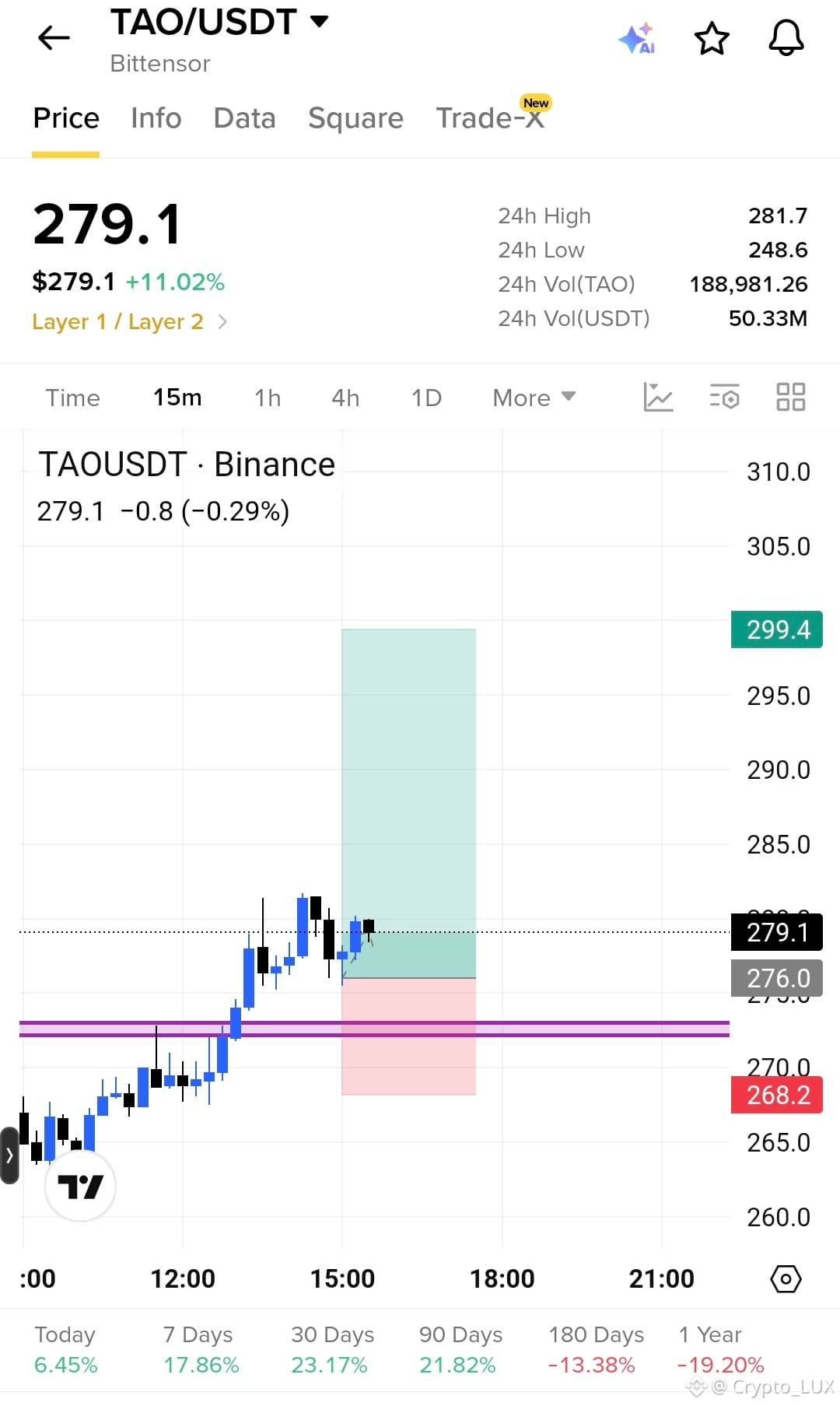
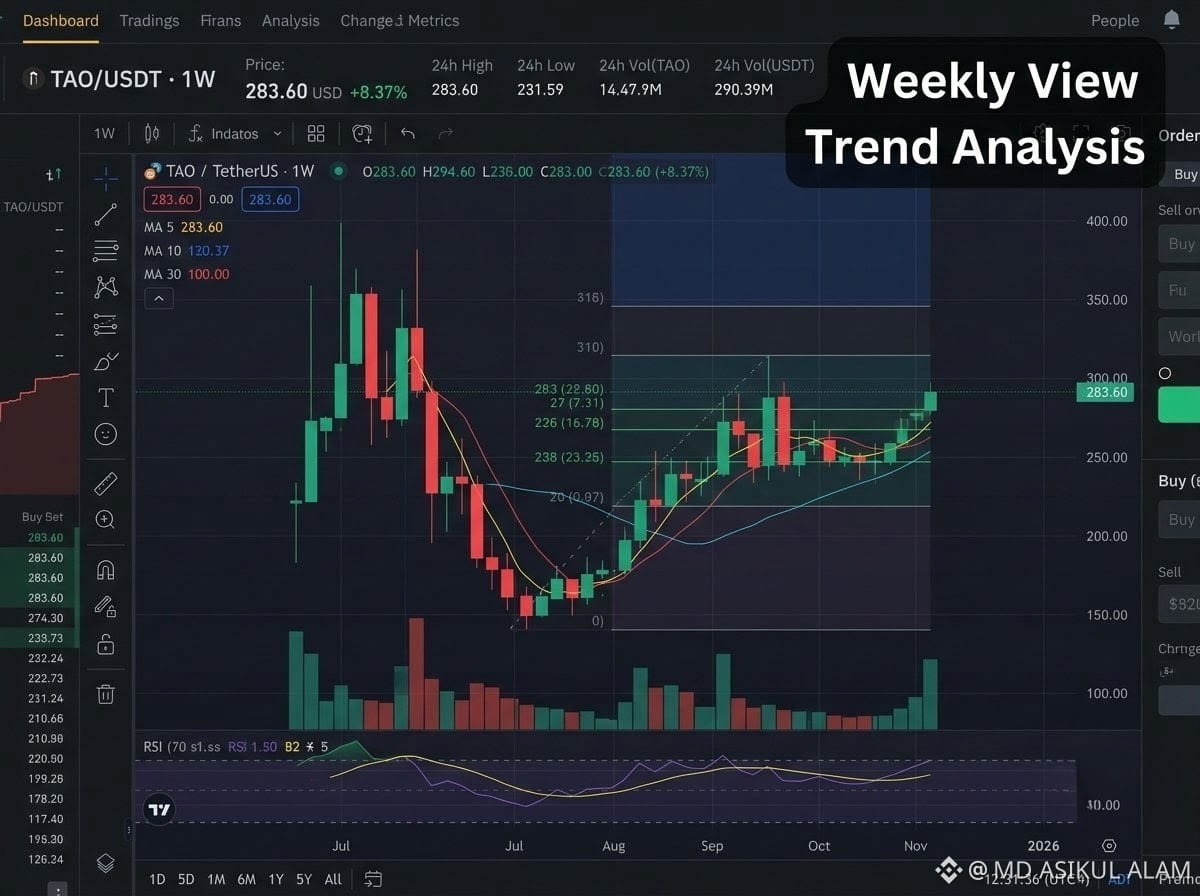
TAO has broken the most bullish pattern inverse head and shoulder and we got the exact time to ride. More over it has successfully broken resistance with candle momentum.
First Entry is at 276-277$ and Have margin for DCA around 268-269$.
Our Main target is 300$ and while extended target 310$ weekly resistance!
let's go.
stay tuned I'll be sharing the more.
#TAO
{future}(TAOUSDT)
300$ ride for $TAO in play.
Here is the breakdown why feel confident to enter the trade.
TAO has broken the most bullish pattern inverse head and shoulder and we got the exact time to ride. More over it has successfully broken resistance with candle momentum.
First Entry is at 276-277$ and Have margin for DCA around 268-269$.
Our Main target is 300$ and while extended target 310$ weekly resistance!
let's go.
stay tuned I'll be sharing the more.
#TAO
Here is the breakdown why feel confident to enter the trade.
TAO has broken the most bullish pattern inverse head and shoulder and we got the exact time to ride. More over it has successfully broken resistance with candle momentum.
First Entry is at 276-277$ and Have margin for DCA around 268-269$.
Our Main target is 300$ and while extended target 310$ weekly resistance!
let's go.
stay tuned I'll be sharing the more.
#TAO
AngelOfCrypto_-:
nice
11
14
5.9k

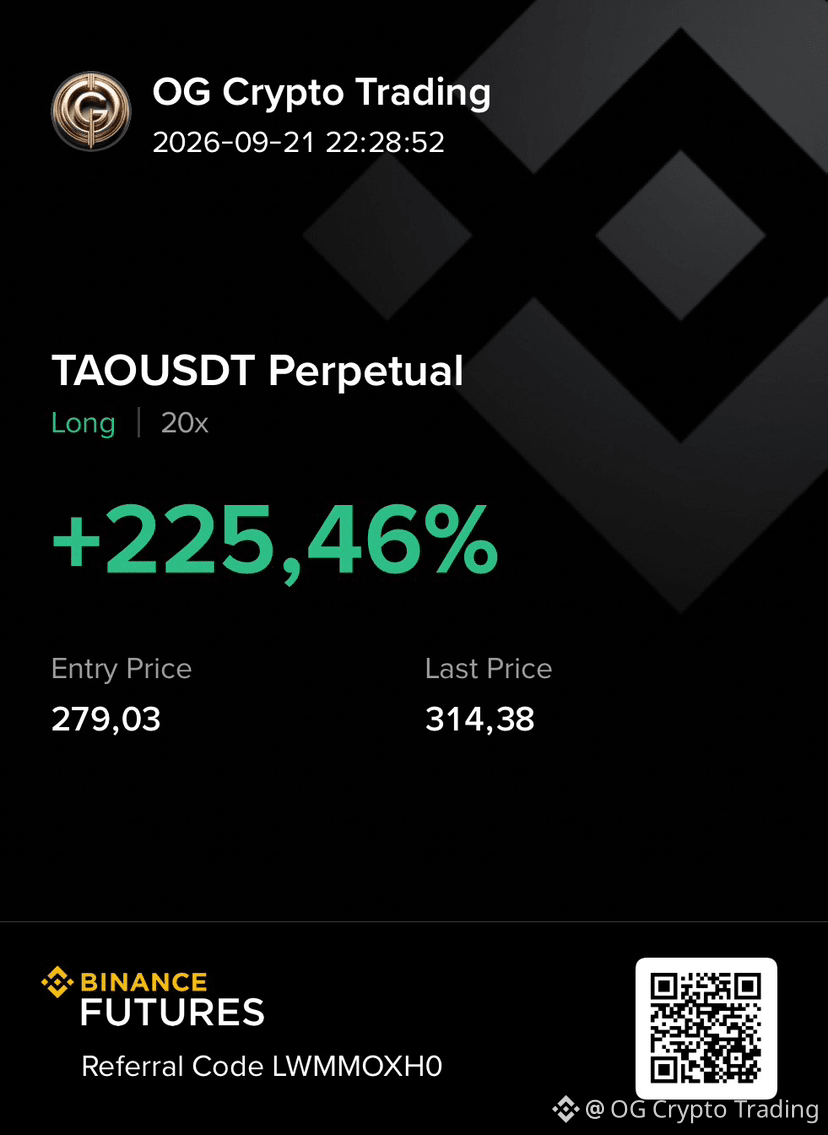
$TAO +200% PROFITS IN A DAY ✅
The market pump is still going strong, and in less than a day, our #TAO position has made more than 10% in pure upside.
I’ve taken partial profits at current levels and moved the stop-loss to breakeven.
💁♂️ Now I’m waiting for $400 to be reached over the next few days.
{future}(TAOUSDT)
$TAO +200% PROFITS IN A DAY ✅
The market pump is still going strong, and in less than a day, our #TAO position has made more than 10% in pure upside.
I’ve taken partial profits at current levels and moved the stop-loss to breakeven.
💁♂️ Now I’m waiting for $400 to be reached over the next few days.
The market pump is still going strong, and in less than a day, our #TAO position has made more than 10% in pure upside.
I’ve taken partial profits at current levels and moved the stop-loss to breakeven.
💁♂️ Now I’m waiting for $400 to be reached over the next few days.
OG Crypto Trading
·
--
$TAO - LONG 📈
TP1: $330
TP2: $390
TP3: $450
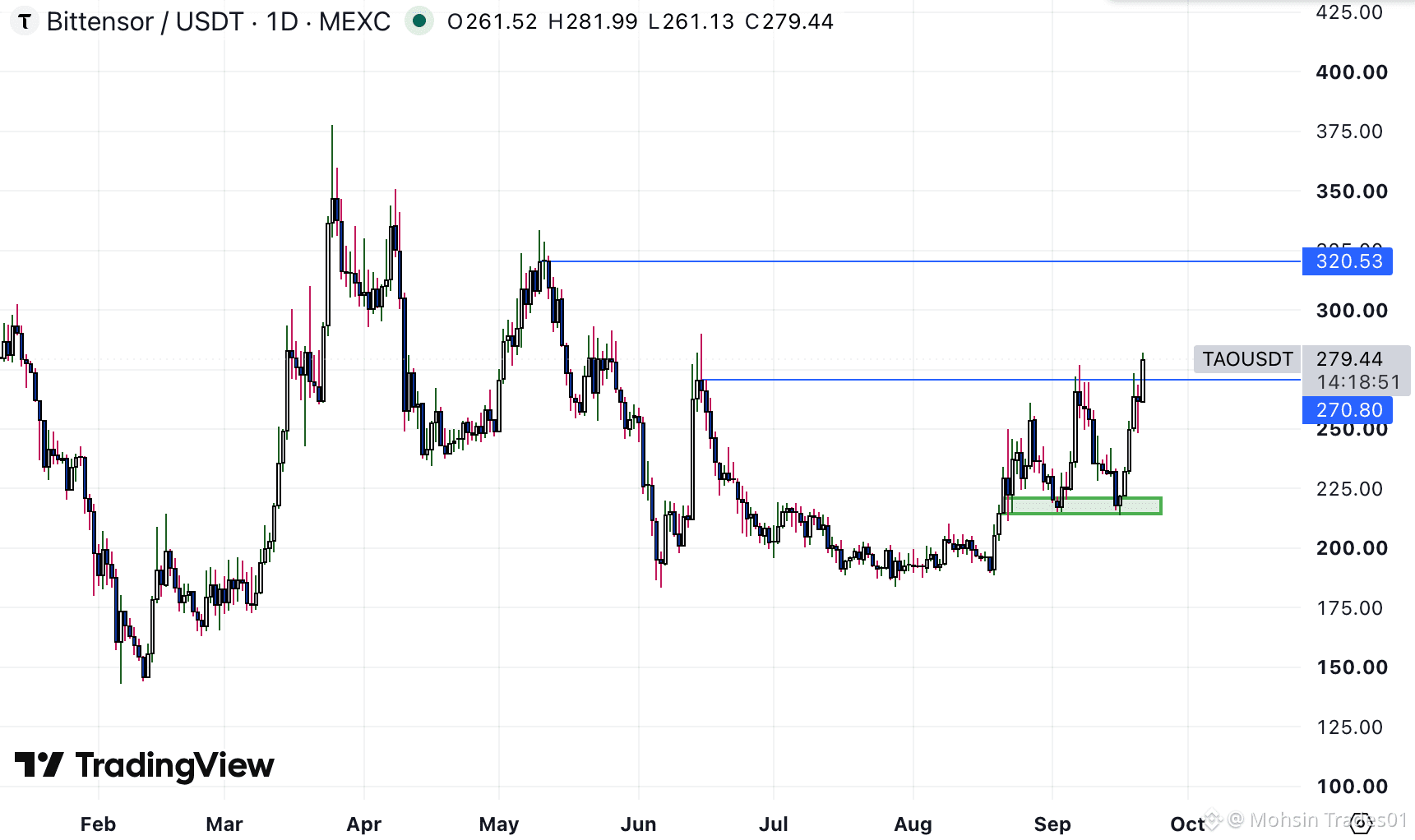
The coin broke out of the long term resistance and already retested it from above. In the near term I expect pump to continue.
$TAO
TP1: $330
TP2: $390
TP3: $450
The coin broke out of the long term resistance and already retested it from above. In the near term I expect pump to continue.
$TAO
1
799


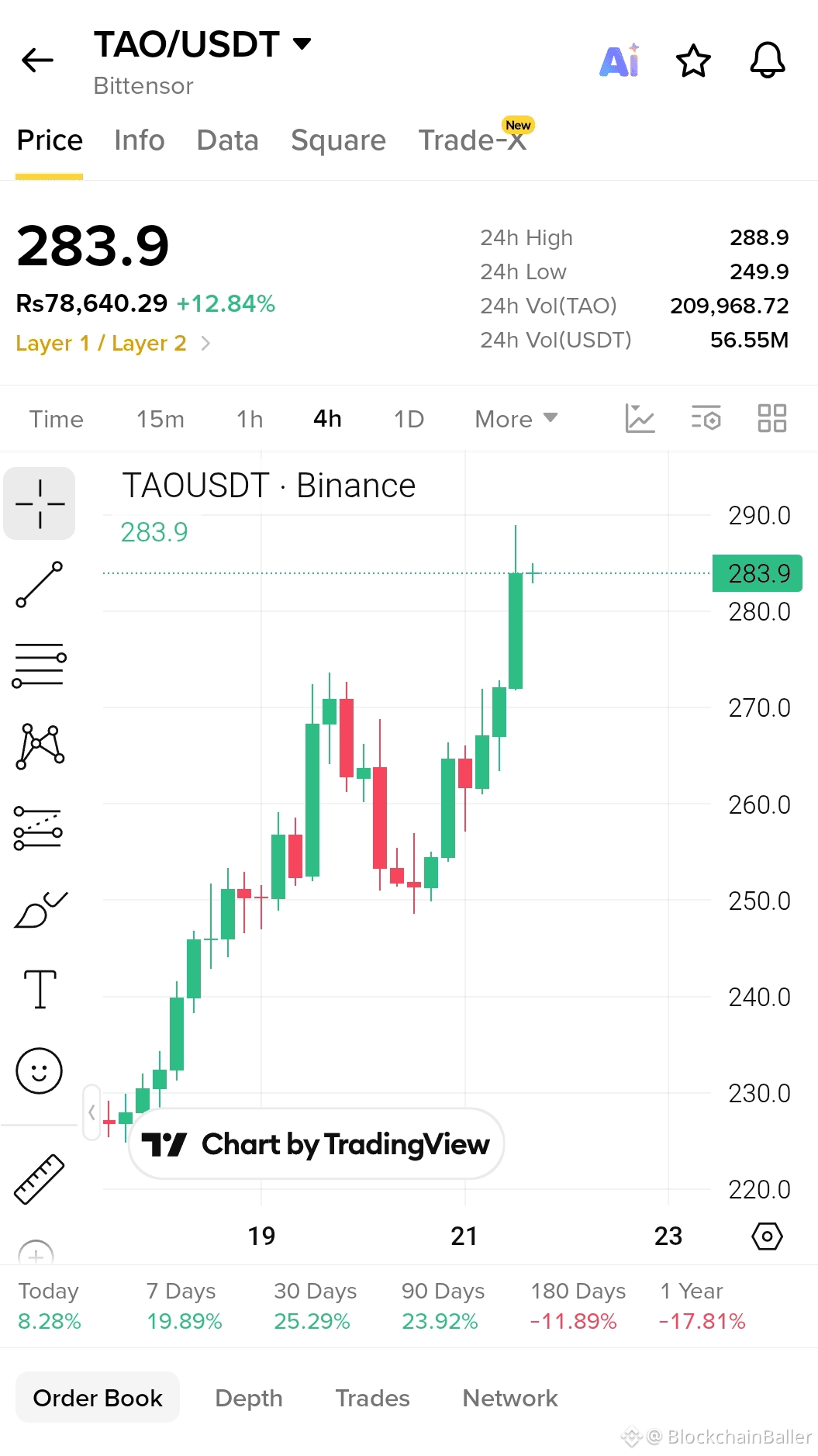
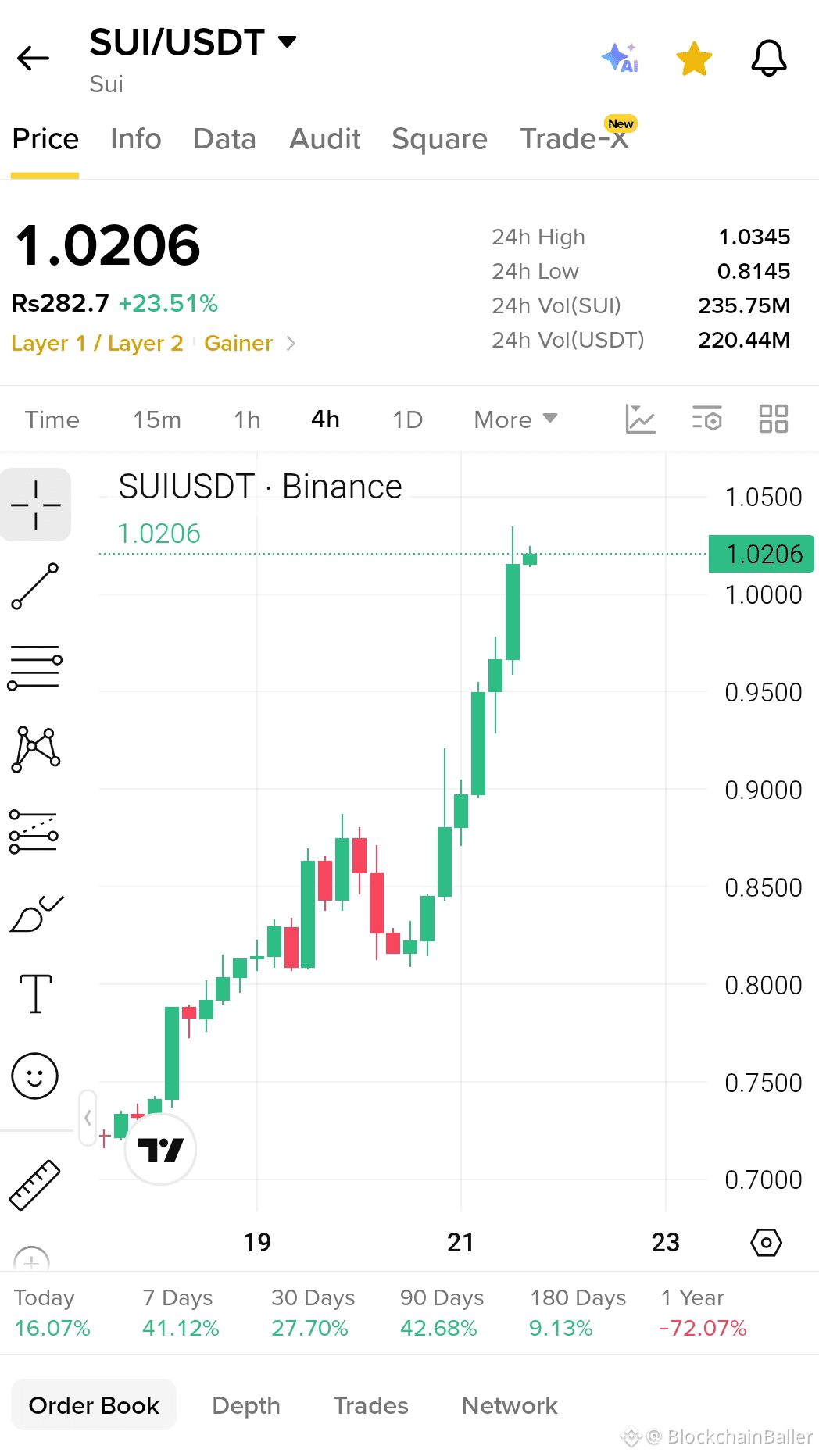
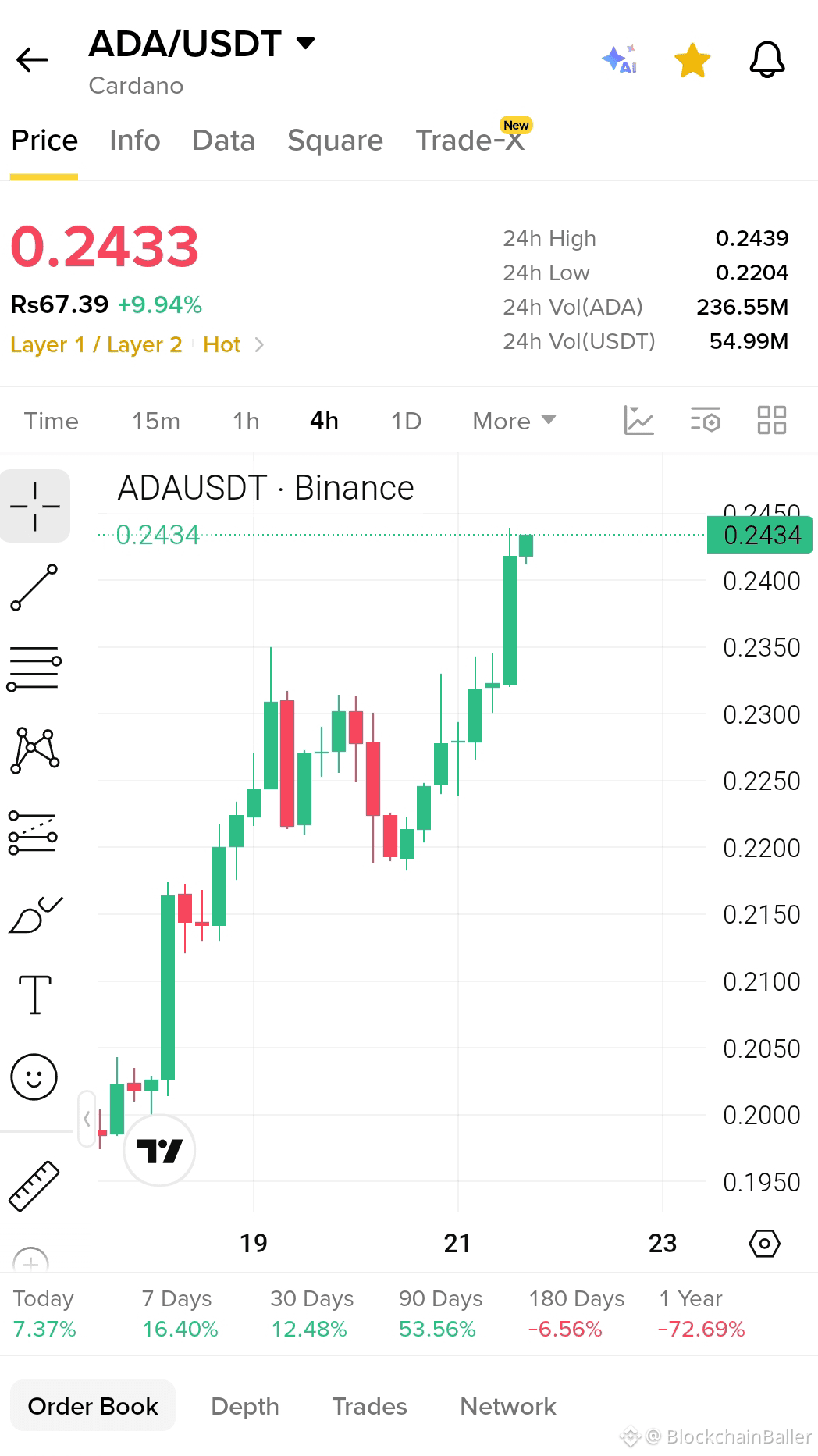
Guys, $ADA , $SUI and $TAO are showing serious strength right now…‼️ Buyers are pushing all three higher with strong momentum......
#ADA is attacking $0.25, #SUI has already reclaimed $1, and #TAO is pushing toward $290 Keep an eye on these three momentum is hot, but avoid chasing after a vertical pump.
Guys, $ADA , $SUI and $TAO are showing serious strength right now…‼️ Buyers are pushing all three higher with strong momentum......
#ADA is attacking $0.25, #SUI has already reclaimed $1, and #TAO is pushing toward $290 Keep an eye on these three momentum is hot, but avoid chasing after a vertical pump.
#ADA is attacking $0.25, #SUI has already reclaimed $1, and #TAO is pushing toward $290 Keep an eye on these three momentum is hot, but avoid chasing after a vertical pump.
5
2.5k


·
--
🚨 $TAO AWAKENS AS INSTITUTIONAL EXPANSION DRIVES STRUCTURE TOWARD $500 TARGET! 💥
Target: 500 🚀
📌 Smart money accumulation around key low-timeframe order blocks has triggered a decisive structural shift for $TAO . 📊 As sell-side liquidity gets swept, volume expansion signals a high-conviction trend continuation pushing prices toward the $500 psychological key level.
💡 The higher-timeframe structure remains strictly bullish with high market efficiency, leaving clear open air for expansion as institutional order flow dictates momentum. 💬 Do you expect $TAO to sweep $500 cleanly on this push, or will we see a temporary Fair Value Gap retest first? 👇
⚠️ Not financial advice. Always manage your risk. 🛡️
🏷️ #TAO #Crypto #MarketStructure #Breakout #Bullish
🦈 🎯
🚨 $TAO AWAKENS AS INSTITUTIONAL EXPANSION DRIVES STRUCTURE TOWARD $500 TARGET! 💥
Target: 500 🚀
📌 Smart money accumulation around key low-timeframe order blocks has triggered a decisive structural shift for $TAO . 📊 As sell-side liquidity gets swept, volume expansion signals a high-conviction trend continuation pushing prices toward the $500 psychological key level.
💡 The higher-timeframe structure remains strictly bullish with high market efficiency, leaving clear open air for expansion as institutional order flow dictates momentum. 💬 Do you expect $TAO to sweep $500 cleanly on this push, or will we see a temporary Fair Value Gap retest first? 👇
⚠️ Not financial advice. Always manage your risk. 🛡️
🏷️ #TAO #Crypto #MarketStructure #Breakout #Bullish
🦈 🎯
Target: 500 🚀
📌 Smart money accumulation around key low-timeframe order blocks has triggered a decisive structural shift for $TAO . 📊 As sell-side liquidity gets swept, volume expansion signals a high-conviction trend continuation pushing prices toward the $500 psychological key level.
💡 The higher-timeframe structure remains strictly bullish with high market efficiency, leaving clear open air for expansion as institutional order flow dictates momentum. 💬 Do you expect $TAO to sweep $500 cleanly on this push, or will we see a temporary Fair Value Gap retest first? 👇
⚠️ Not financial advice. Always manage your risk. 🛡️
🏷️ #TAO #Crypto #MarketStructure #Breakout #Bullish
🦈 🎯

86

·
--
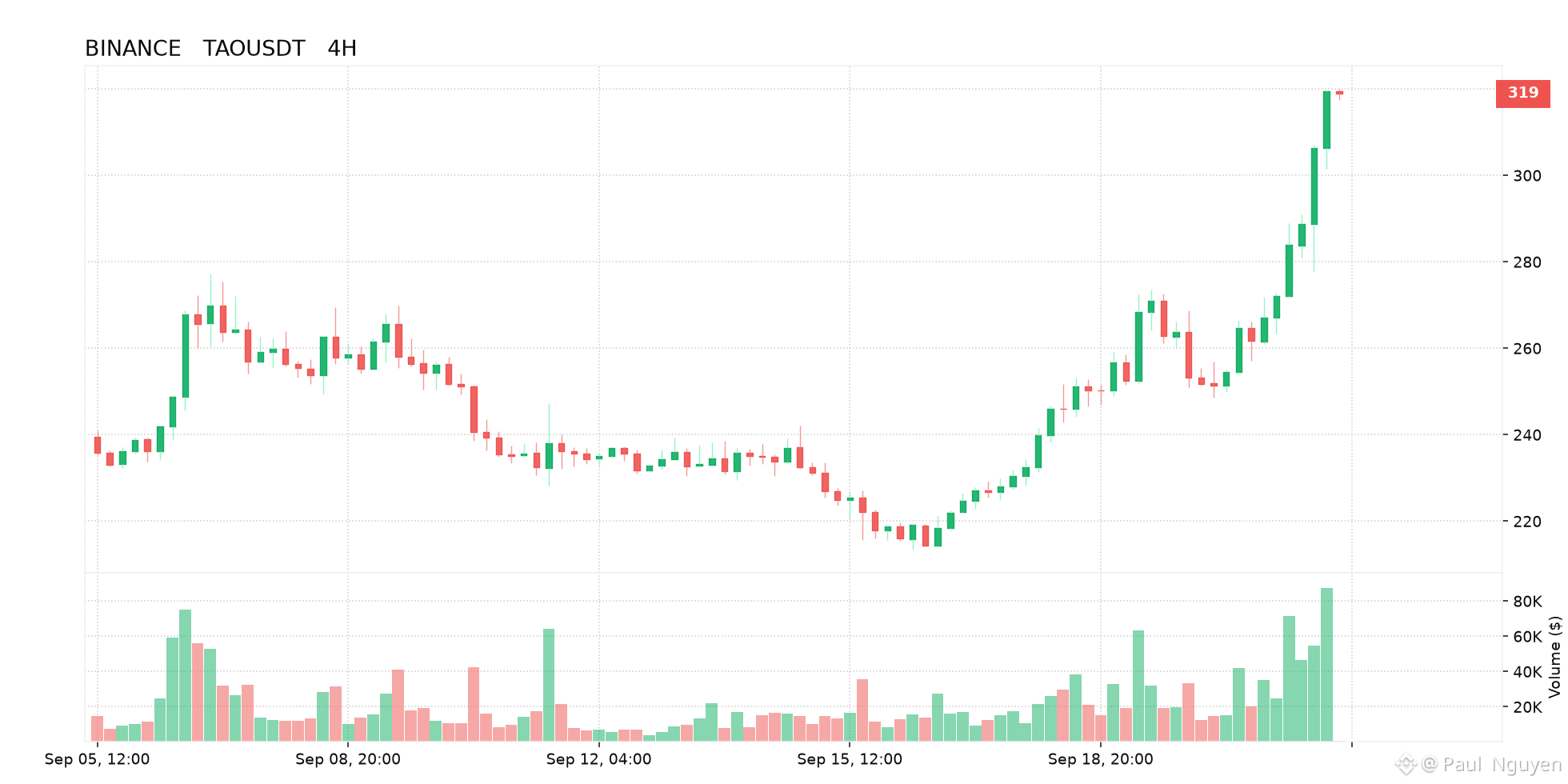
TAO is pumping as AI tokens lead and Bittensor’s subnet staking demand spikes after its latest dTAO update. Binance traders are chasing the top AI-infra coin.
$TAO #TAO
Not a financial advice. Be responsible for your own financial decision.
TAO is pumping as AI tokens lead and Bittensor’s subnet staking demand spikes after its latest dTAO update. Binance traders are chasing the top AI-infra coin.
$TAO #TAO
Not a financial advice. Be responsible for your own financial decision.
$TAO #TAO
Not a financial advice. Be responsible for your own financial decision.
120

·
--
🚨 $TAO IS APPROACHING $300! 🔥
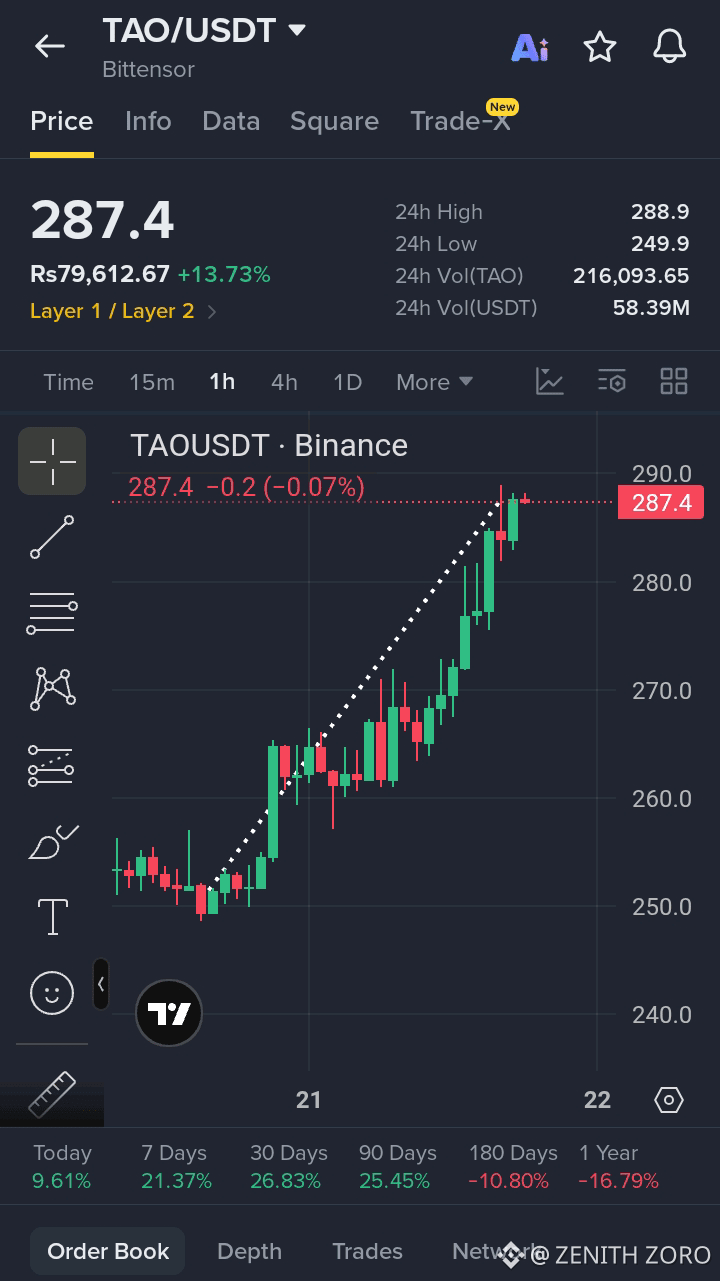
Guys, $TAO has made a strong move and is now trading near $287.
The bullish momentum is clear, but the $290–$300 zone is where we need to watch for resistance or a breakout.
🎯 Next target: $300
Will $TAO break above $300 or face a pullback first? 👀
What’s your target? Comment below! 👇
#TAO #Crypto #Binance
{future}(TAOUSDT)
🚨 $TAO IS APPROACHING $300! 🔥
Guys, $TAO has made a strong move and is now trading near $287.
The bullish momentum is clear, but the $290–$300 zone is where we need to watch for resistance or a breakout.
🎯 Next target: $300
Will $TAO break above $300 or face a pullback first? 👀
What’s your target? Comment below! 👇
#TAO #Crypto #Binance
Guys, $TAO has made a strong move and is now trading near $287.
The bullish momentum is clear, but the $290–$300 zone is where we need to watch for resistance or a breakout.
🎯 Next target: $300
Will $TAO break above $300 or face a pullback first? 👀
What’s your target? Comment below! 👇
#TAO #Crypto #Binance

505

·
--
Bullish
🚨 $ADA , $SUI & $TAO ARE SHOWING SERIOUS STRENGTH! 📈
Buyers are pushing all three higher with strong momentum.
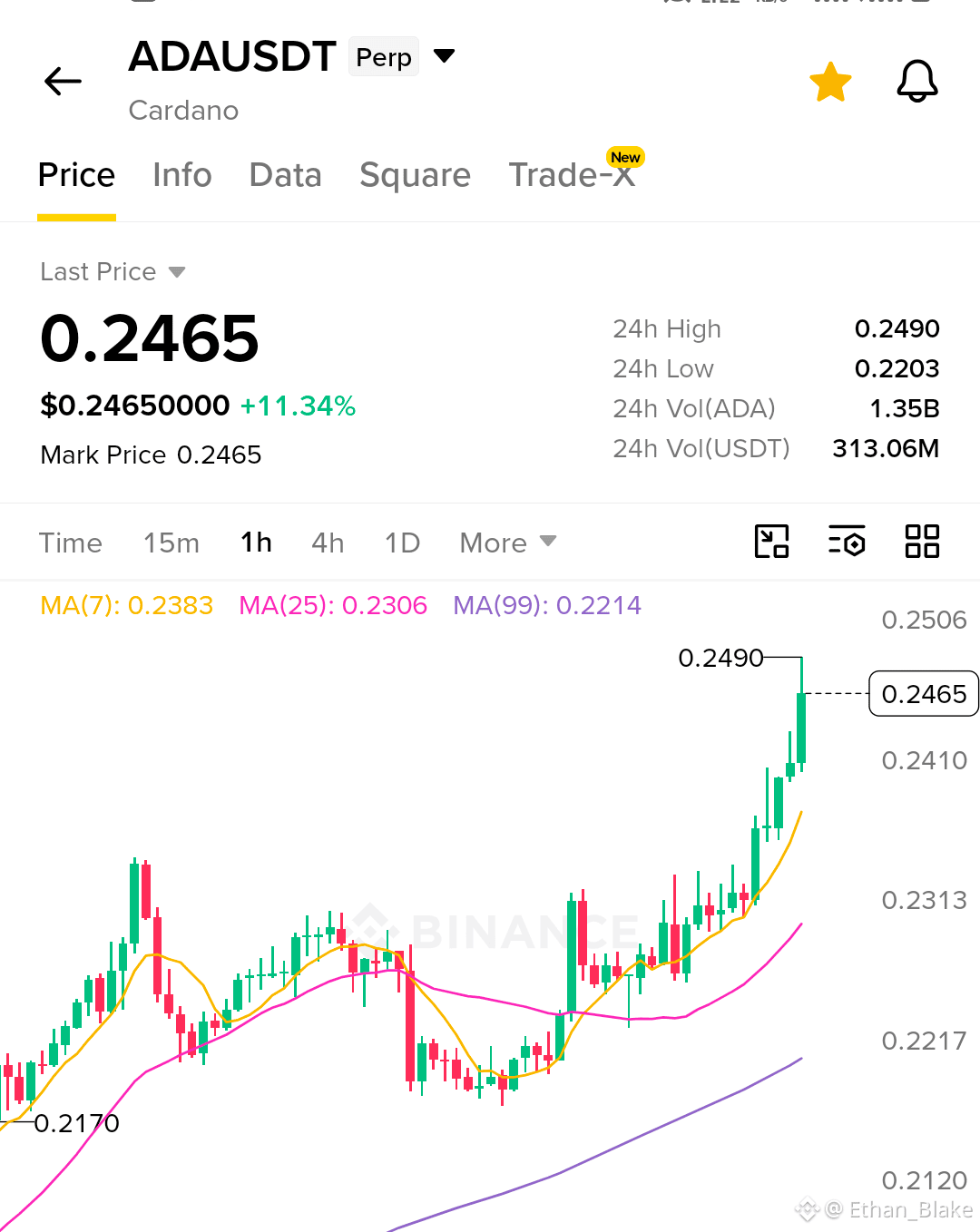
🟢 #ADA is attacking $0.25, trading around $0.2465 and up 11.34%.
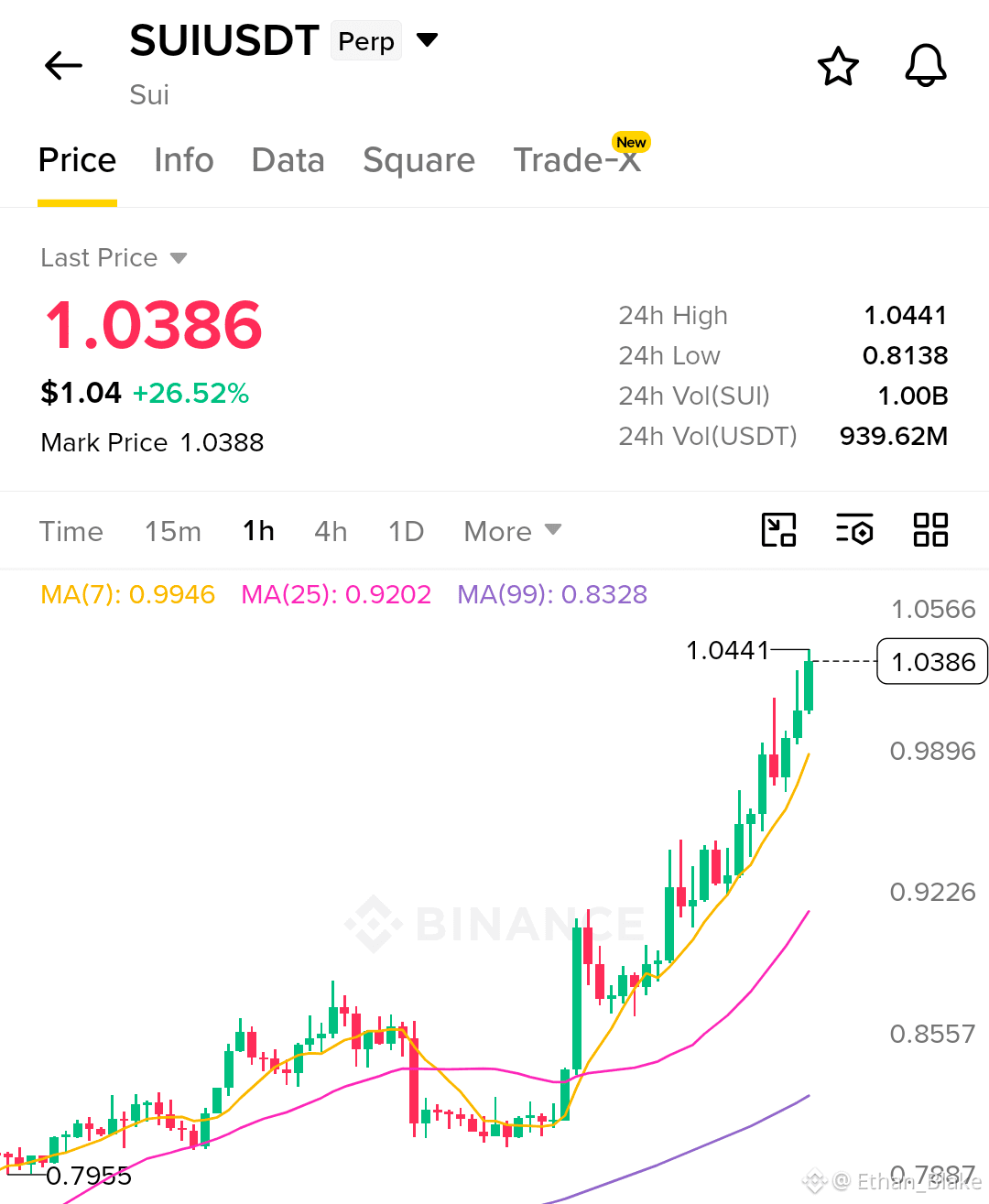
🟢 #SUI has reclaimed $1, trading near $1.0386 and up 26.52%.
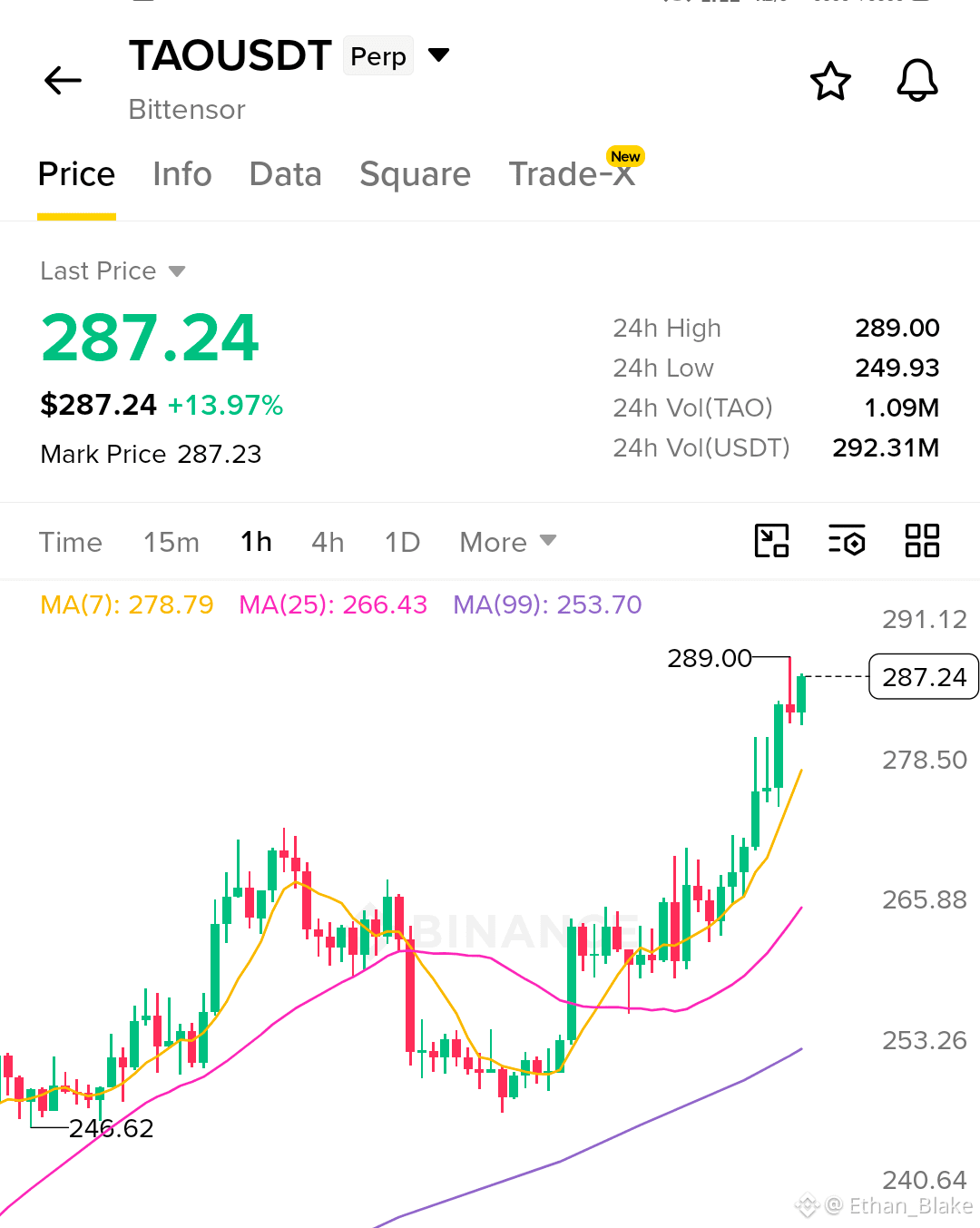
🟢 #TAO is pushing toward $290, trading around $287.24 and up 13.97%.
All three are showing strong 1H momentum, with price above their short-term moving averages.
But after such fast moves, volatility can increase quickly. Watch volume, support levels and confirmation instead of chasing a vertical pump.
Which one are you watching most — ADA, SUI or TAO? 👀
{future}(ADAUSDT)
{future}(TAOUSDT)
{future}(SUIUSDT)
🚨 $ADA , $SUI & $TAO ARE SHOWING SERIOUS STRENGTH! 📈
Buyers are pushing all three higher with strong momentum.
🟢 #ADA is attacking $0.25, trading around $0.2465 and up 11.34%.
🟢 #SUI has reclaimed $1, trading near $1.0386 and up 26.52%.
🟢 #TAO is pushing toward $290, trading around $287.24 and up 13.97%.
All three are showing strong 1H momentum, with price above their short-term moving averages.
But after such fast moves, volatility can increase quickly. Watch volume, support levels and confirmation instead of chasing a vertical pump.
Which one are you watching most — ADA, SUI or TAO? 👀
Buyers are pushing all three higher with strong momentum.
🟢 #ADA is attacking $0.25, trading around $0.2465 and up 11.34%.
🟢 #SUI has reclaimed $1, trading near $1.0386 and up 26.52%.
🟢 #TAO is pushing toward $290, trading around $287.24 and up 13.97%.
All three are showing strong 1H momentum, with price above their short-term moving averages.
But after such fast moves, volatility can increase quickly. Watch volume, support levels and confirmation instead of chasing a vertical pump.
Which one are you watching most — ADA, SUI or TAO? 👀
242

·
--
🚨 $TAO BULLS ARE FLEXING MUSCLE BUT SMART MONEY IS WAITING FOR THE FLIP! ⚡
Entry: 306 - 312 ⚡
Target: 330 - 345 🚀
Stop Loss: 298 ⚠️
📌 Buyers are driving aggressive expansion across the chart, but chasing vertical moves is where late buyers get trapped. 📊 Precision positioning happens when price retests structural demand, letting sellers exhaust themselves directly into our re-entry bid zone.
💡 Momentum is firmly on our side, but waiting for a brief cool-off yields a far superior risk-reward profile before the expansion resumes. 💬 Are you bidding this structured pullback zone or sitting on the sidelines? 👇
⚠️ Not financial advice. Always manage your risk. 🛡️
🏷️ #TAO #LongSetup #Crypto #Altcoins #Trading
🔥 💎
🚨 $TAO BULLS ARE FLEXING MUSCLE BUT SMART MONEY IS WAITING FOR THE FLIP! ⚡
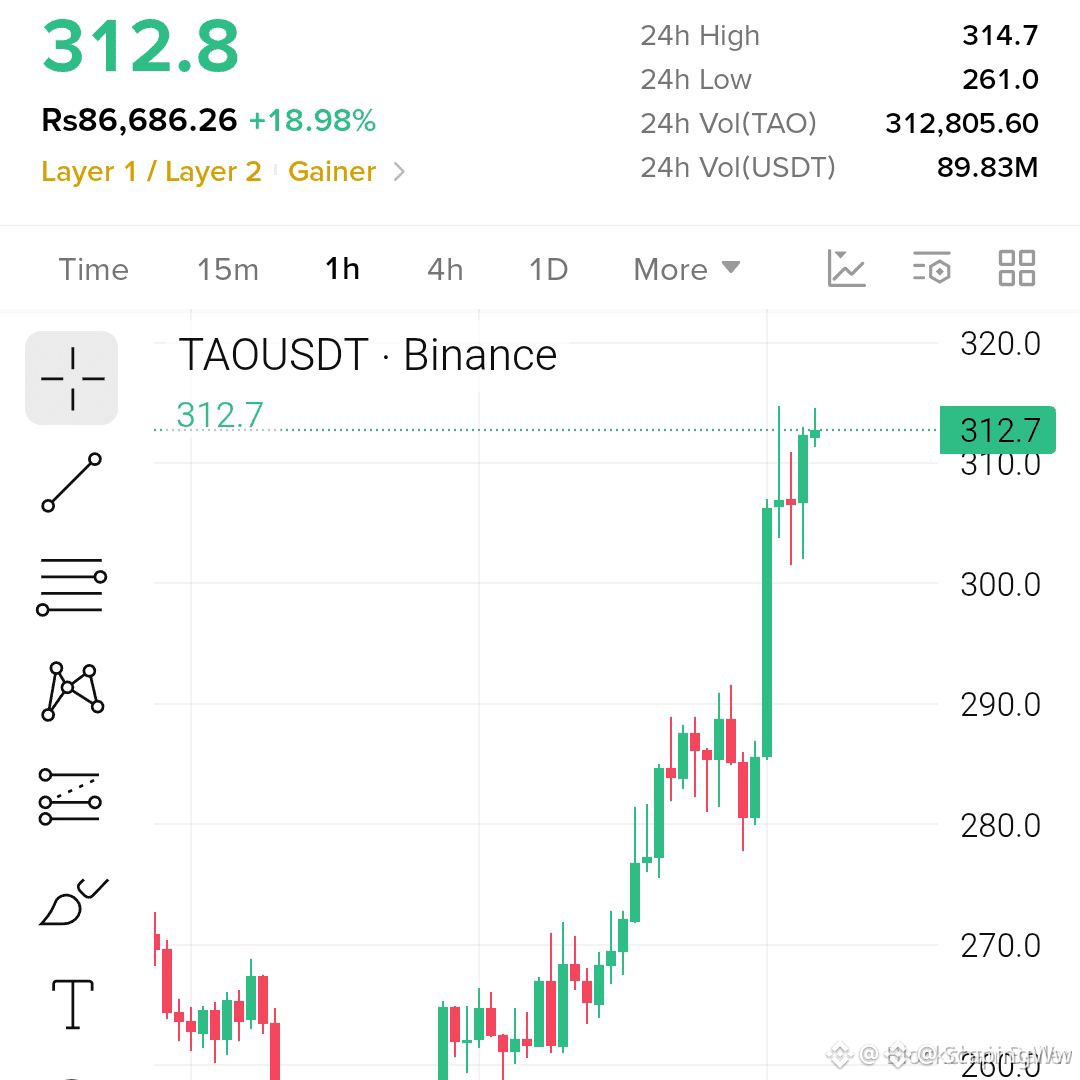
Entry: 306 - 312 ⚡
Target: 330 - 345 🚀
Stop Loss: 298 ⚠️
📌 Buyers are driving aggressive expansion across the chart, but chasing vertical moves is where late buyers get trapped. 📊 Precision positioning happens when price retests structural demand, letting sellers exhaust themselves directly into our re-entry bid zone.
💡 Momentum is firmly on our side, but waiting for a brief cool-off yields a far superior risk-reward profile before the expansion resumes. 💬 Are you bidding this structured pullback zone or sitting on the sidelines? 👇
⚠️ Not financial advice. Always manage your risk. 🛡️
🏷️ #TAO #LongSetup #Crypto #Altcoins #Trading
🔥 💎
Entry: 306 - 312 ⚡
Target: 330 - 345 🚀
Stop Loss: 298 ⚠️
📌 Buyers are driving aggressive expansion across the chart, but chasing vertical moves is where late buyers get trapped. 📊 Precision positioning happens when price retests structural demand, letting sellers exhaust themselves directly into our re-entry bid zone.
💡 Momentum is firmly on our side, but waiting for a brief cool-off yields a far superior risk-reward profile before the expansion resumes. 💬 Are you bidding this structured pullback zone or sitting on the sidelines? 👇
⚠️ Not financial advice. Always manage your risk. 🛡️
🏷️ #TAO #LongSetup #Crypto #Altcoins #Trading
🔥 💎
15

·
--
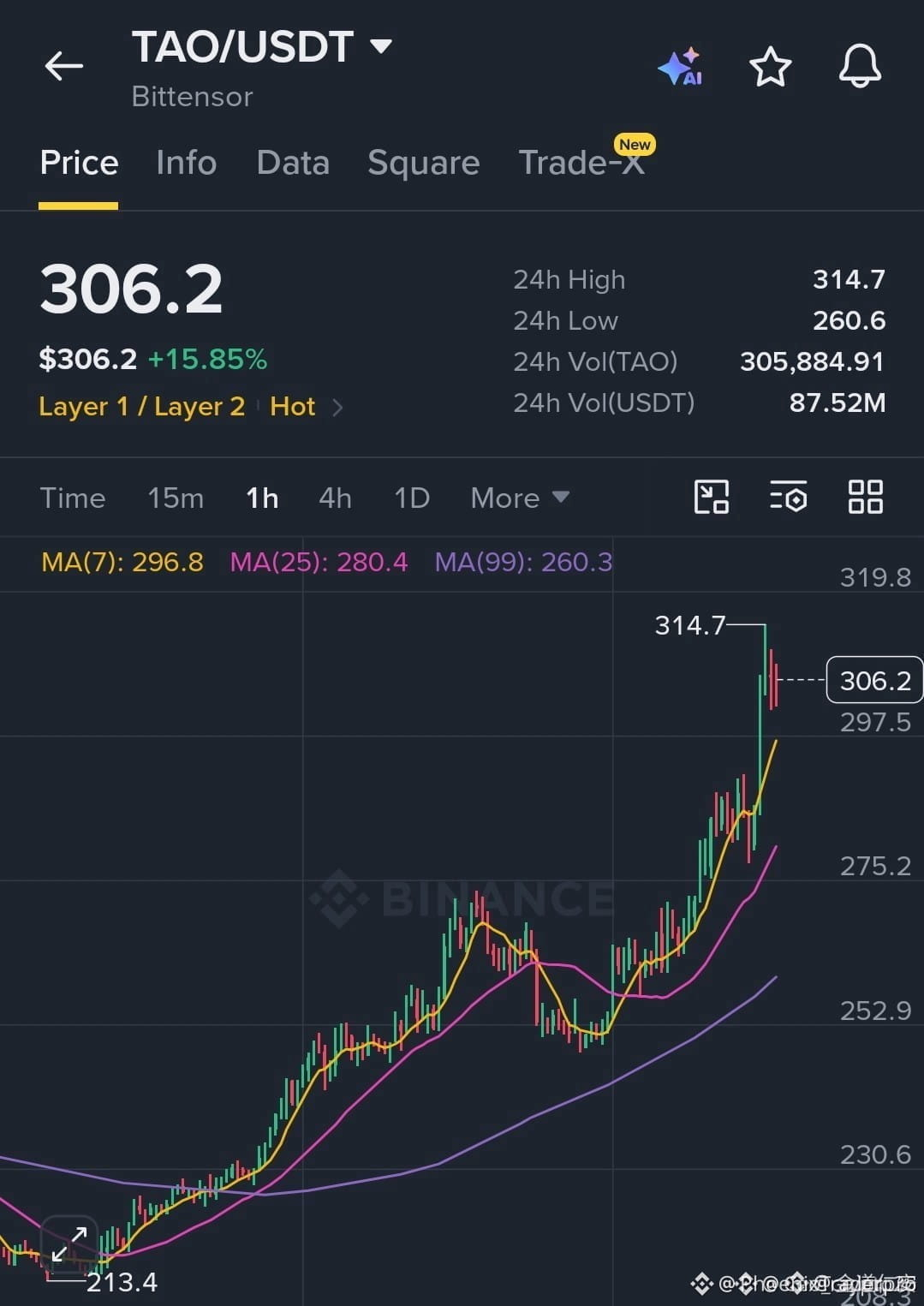
🦈 $TAO ABSORBING SELLER LIQUIDITY AS SMART MONEY PREPARES FOR NEXT EXPANSION LEG! 💥
Entry: 302.0 - 306.5 ⚡
Target: 314.7 - 350.0 🚀
Stop Loss: 288.0 ⚠️
📌 Price structure on $TAO reveals methodical institutional accumulation inside the 302.0 - 306.5 demand block following a clean sell-side liquidity sweep. 📊 Order flow metrics indicate supply is thinning rapidly, opening a prime path toward the overhead fair value gap.
💡 Higher timeframe market structure favors a high-probability long expansion as buyers defend structural support with conviction. 💬 Are you positioning early in this demand zone or waiting for a breakout confirmation above 315? 👇
⚠️ Not financial advice. Always manage your risk. 🛡️
🏷️ #TAO #LongSetup #Altcoins #Crypto #SmartMoney
🎯 🦈
🦈 $TAO ABSORBING SELLER LIQUIDITY AS SMART MONEY PREPARES FOR NEXT EXPANSION LEG! 💥
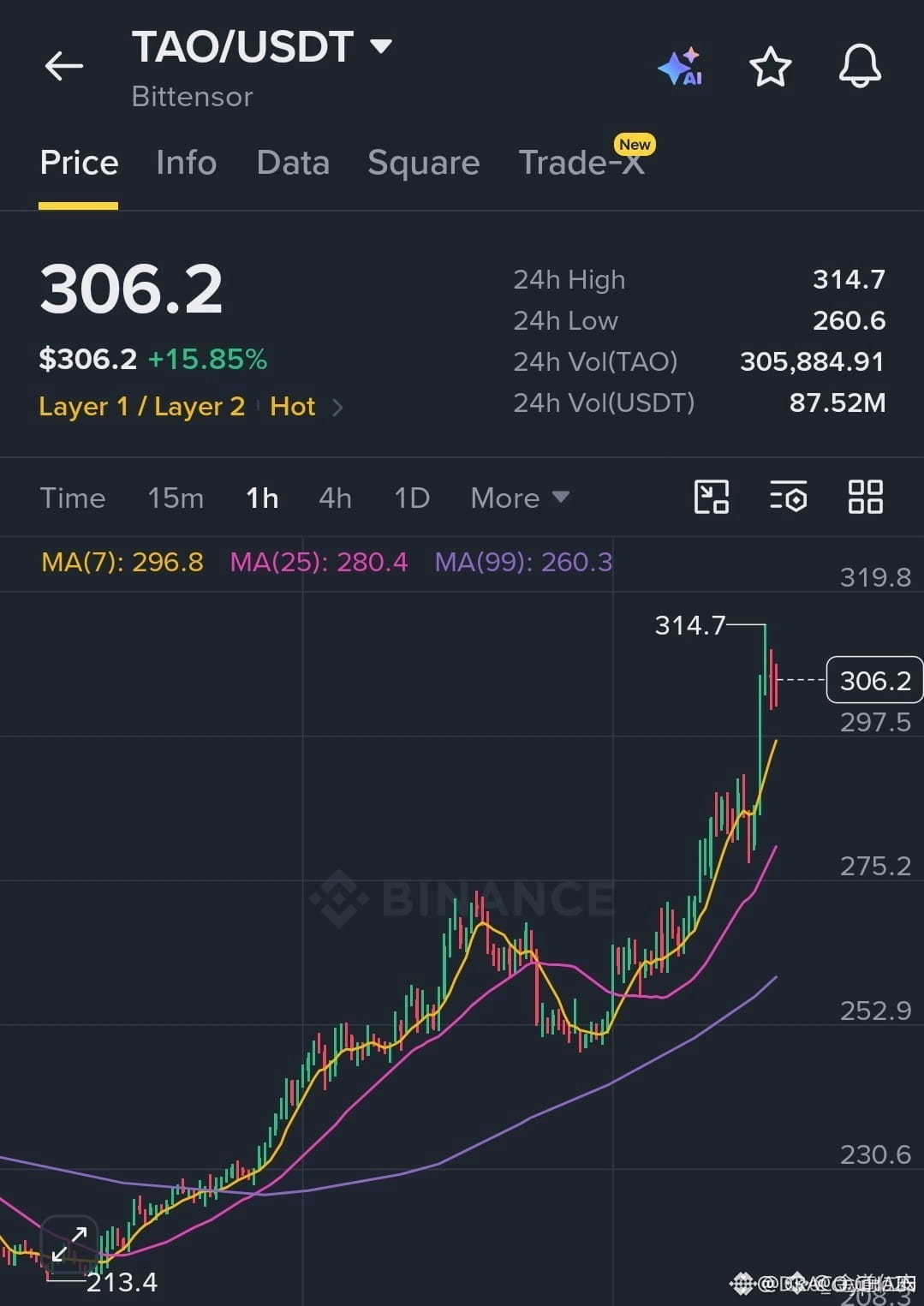
Entry: 302.0 - 306.5 ⚡
Target: 314.7 - 350.0 🚀
Stop Loss: 288.0 ⚠️
📌 Price structure on $TAO reveals methodical institutional accumulation inside the 302.0 - 306.5 demand block following a clean sell-side liquidity sweep. 📊 Order flow metrics indicate supply is thinning rapidly, opening a prime path toward the overhead fair value gap.
💡 Higher timeframe market structure favors a high-probability long expansion as buyers defend structural support with conviction. 💬 Are you positioning early in this demand zone or waiting for a breakout confirmation above 315? 👇
⚠️ Not financial advice. Always manage your risk. 🛡️
🏷️ #TAO #LongSetup #Altcoins #Crypto #SmartMoney
🎯 🦈
Entry: 302.0 - 306.5 ⚡
Target: 314.7 - 350.0 🚀
Stop Loss: 288.0 ⚠️
📌 Price structure on $TAO reveals methodical institutional accumulation inside the 302.0 - 306.5 demand block following a clean sell-side liquidity sweep. 📊 Order flow metrics indicate supply is thinning rapidly, opening a prime path toward the overhead fair value gap.
💡 Higher timeframe market structure favors a high-probability long expansion as buyers defend structural support with conviction. 💬 Are you positioning early in this demand zone or waiting for a breakout confirmation above 315? 👇
⚠️ Not financial advice. Always manage your risk. 🛡️
🏷️ #TAO #LongSetup #Altcoins #Crypto #SmartMoney
🎯 🦈
65

·
--
🚨 $TAO IMPULSIVE STRUCTURE EXPANDS AS SMART MONEY HUNTS RE-ENTRY IN DEMAND BLOCK! 💥
Entry: 306 - 312 ⚡
Target: 330 - 345 🚀
Stop Loss: 298 ⚠️
$TAO is exhibiting strong expansion velocity, but chasing market buys into local resistance exposes capital to immediate downside liquidity sweeps. Institutional positioning requires patience for structural retracements back into established fair value gaps. 🔍
The 306 - 312 region represents our primary discount zone, aligning key demand before the next leg toward liquidity pools at 330 and 345. 📊 Maintaining structural integrity above 298 keeps the bullish market order flow fully intact. 💡
Are you placing bids in the discount zone or waiting for lower timeframe confirmation? 👇
⚠️ Not financial advice. Always manage your risk. 🛡️
🏷️ #TAO #Crypto #MarketStructure #SmartMoney
🎯 🦈
🚨 $TAO IMPULSIVE STRUCTURE EXPANDS AS SMART MONEY HUNTS RE-ENTRY IN DEMAND BLOCK! 💥
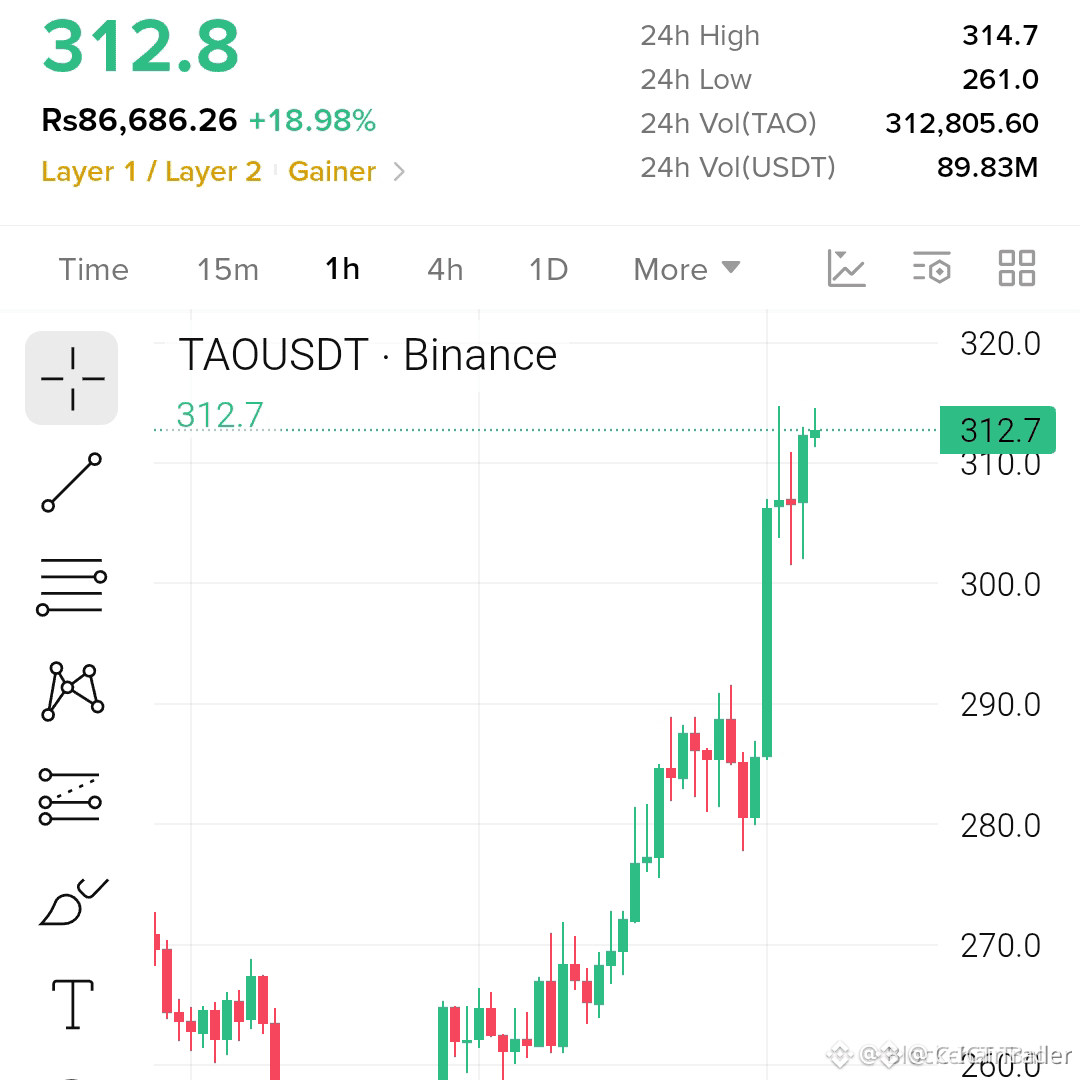
Entry: 306 - 312 ⚡
Target: 330 - 345 🚀
Stop Loss: 298 ⚠️
$TAO is exhibiting strong expansion velocity, but chasing market buys into local resistance exposes capital to immediate downside liquidity sweeps. Institutional positioning requires patience for structural retracements back into established fair value gaps. 🔍
The 306 - 312 region represents our primary discount zone, aligning key demand before the next leg toward liquidity pools at 330 and 345. 📊 Maintaining structural integrity above 298 keeps the bullish market order flow fully intact. 💡
Are you placing bids in the discount zone or waiting for lower timeframe confirmation? 👇
⚠️ Not financial advice. Always manage your risk. 🛡️
🏷️ #TAO #Crypto #MarketStructure #SmartMoney
🎯 🦈
Entry: 306 - 312 ⚡
Target: 330 - 345 🚀
Stop Loss: 298 ⚠️
$TAO is exhibiting strong expansion velocity, but chasing market buys into local resistance exposes capital to immediate downside liquidity sweeps. Institutional positioning requires patience for structural retracements back into established fair value gaps. 🔍
The 306 - 312 region represents our primary discount zone, aligning key demand before the next leg toward liquidity pools at 330 and 345. 📊 Maintaining structural integrity above 298 keeps the bullish market order flow fully intact. 💡
Are you placing bids in the discount zone or waiting for lower timeframe confirmation? 👇
⚠️ Not financial advice. Always manage your risk. 🛡️
🏷️ #TAO #Crypto #MarketStructure #SmartMoney
🎯 🦈
25

⚡ $TAO COILING FOR EXPANSION AS BUYERS ABSORB KEY SUPPORT ZONE 🟢
Entry: 302.0 - 306.5 ⚡
Target: 350.0 🚀
Stop Loss: 288.0 ⚠️
$TAO is quietly carving out a strong accumulation floor right in the 302.0 - 306.5 demand block. Sellers are losing leverage as buyers continuously defend this pivot level with tightening spread and rising volume. 📊
With structural support firmly established above 288.0, the risk-to-reward ratio leans heavily in favor of momentum buyers targeting the upper liquidity pockets toward 350.0. ⚡ Order flow indicates smart money is positioning ahead of the next volatility expansion. 💡
Are you riding this reclaim higher or waiting for a breakout confirmation above resistance? 👇
⚠️ Not financial advice. Always manage your risk. 🛡️
🏷️ #TAO #LongSetup #Crypto #Trading #Breakout
🔥 💎
⚡ $TAO COILING FOR EXPANSION AS BUYERS ABSORB KEY SUPPORT ZONE 🟢
Entry: 302.0 - 306.5 ⚡
Target: 350.0 🚀
Stop Loss: 288.0 ⚠️
$TAO is quietly carving out a strong accumulation floor right in the 302.0 - 306.5 demand block. Sellers are losing leverage as buyers continuously defend this pivot level with tightening spread and rising volume. 📊
With structural support firmly established above 288.0, the risk-to-reward ratio leans heavily in favor of momentum buyers targeting the upper liquidity pockets toward 350.0. ⚡ Order flow indicates smart money is positioning ahead of the next volatility expansion. 💡
Are you riding this reclaim higher or waiting for a breakout confirmation above resistance? 👇
⚠️ Not financial advice. Always manage your risk. 🛡️
🏷️ #TAO #LongSetup #Crypto #Trading #Breakout
🔥 💎
Entry: 302.0 - 306.5 ⚡
Target: 350.0 🚀
Stop Loss: 288.0 ⚠️
$TAO is quietly carving out a strong accumulation floor right in the 302.0 - 306.5 demand block. Sellers are losing leverage as buyers continuously defend this pivot level with tightening spread and rising volume. 📊
With structural support firmly established above 288.0, the risk-to-reward ratio leans heavily in favor of momentum buyers targeting the upper liquidity pockets toward 350.0. ⚡ Order flow indicates smart money is positioning ahead of the next volatility expansion. 💡
Are you riding this reclaim higher or waiting for a breakout confirmation above resistance? 👇
⚠️ Not financial advice. Always manage your risk. 🛡️
🏷️ #TAO #LongSetup #Crypto #Trading #Breakout
🔥 💎
87

·
--
Bullish
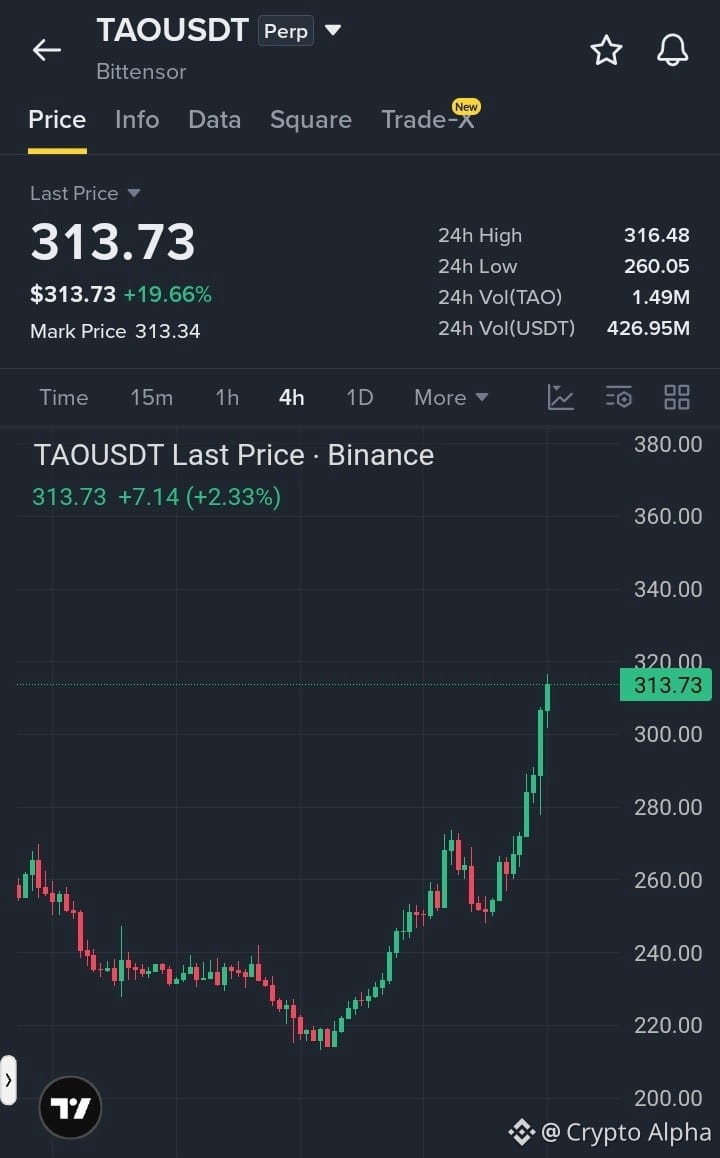
$TAO POWERFUL RECOVERY HAS TURNED INTO A BREAKOUT
BUYERS ARE HOLDING STRONG ABOVE THE $300 ZONE
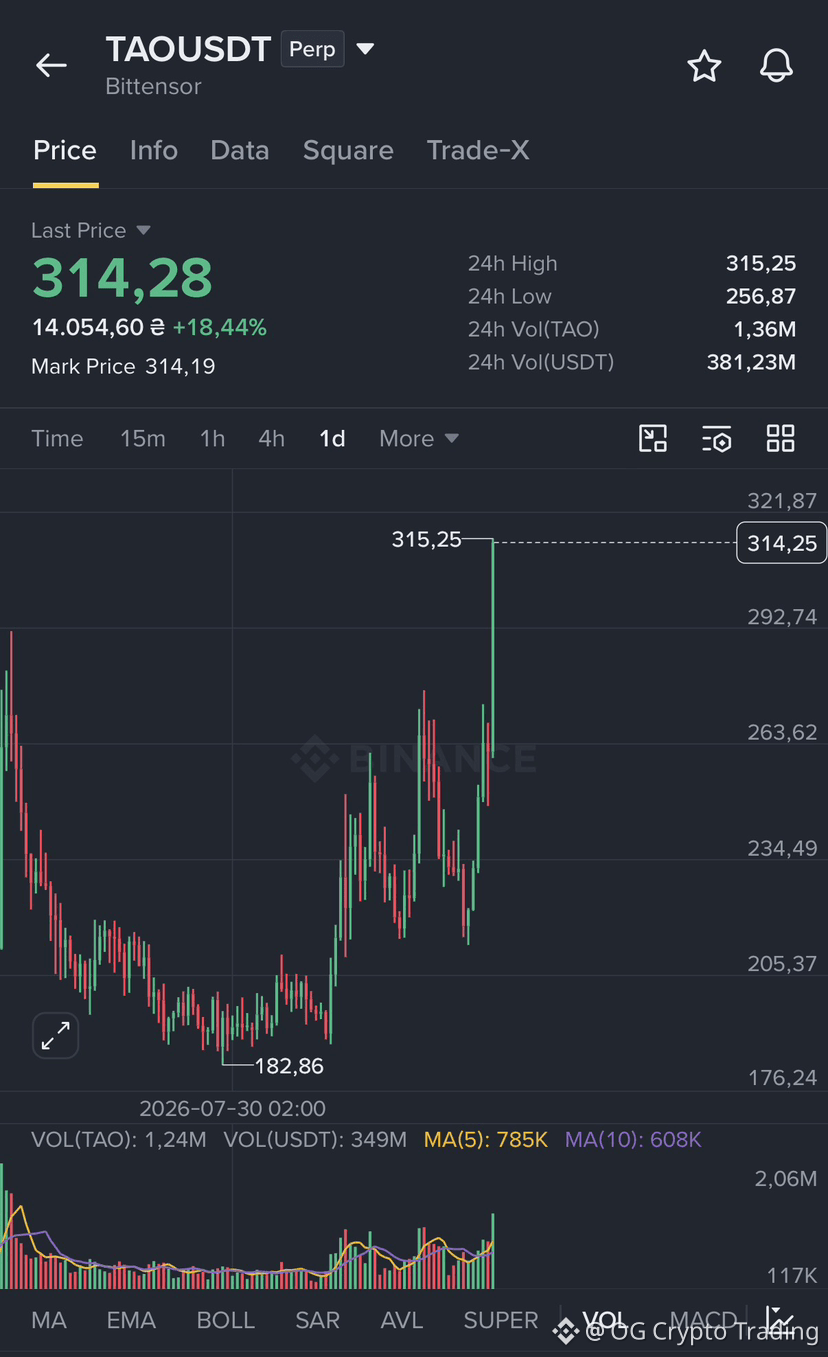
#TAO is showing strong bullish momentum on the 4H chart. Price has climbed sharply from the $215 area and is now trading near $314 after breaking through multiple resistance levels with strong green candles.
LONG TRADE SETUP
Entry: $309 – $314
TP1: $318
TP2: $322
TP3: $326
SL: $303
Buy and Trade
{future}(TAOUSDT)
$ZEC
{future}(ZECUSDT)
$龙虾
{future}(龙虾USDT)
$TAO POWERFUL RECOVERY HAS TURNED INTO A BREAKOUT
BUYERS ARE HOLDING STRONG ABOVE THE $300 ZONE
#TAO is showing strong bullish momentum on the 4H chart. Price has climbed sharply from the $215 area and is now trading near $314 after breaking through multiple resistance levels with strong green candles.
LONG TRADE SETUP
Entry: $309 – $314
TP1: $318
TP2: $322
TP3: $326
SL: $303
Buy and Trade
$ZEC
$龙虾
BUYERS ARE HOLDING STRONG ABOVE THE $300 ZONE
#TAO is showing strong bullish momentum on the 4H chart. Price has climbed sharply from the $215 area and is now trading near $314 after breaking through multiple resistance levels with strong green candles.
LONG TRADE SETUP
Entry: $309 – $314
TP1: $318
TP2: $322
TP3: $326
SL: $303
Buy and Trade
$ZEC
$龙虾
2
336

·
--
$TAO
{spot}(TAOUSDT)
$TAO — Long Setup | Market Analysis
TAO is displaying strong bullish momentum, marked by a substantial 24-hour price increase on significant volume. This sustained buying pressure indicates a potential continuation of the upward trend after a clear breakout from recent consolidation.
Market Context
- 24h change: 19.85%
- 24h volume: $88,743,664
- Momentum bias: bullish
Trade Plan
Entry: 314.00
Stop Loss: 301.00
TP1: 328.00
TP2: 335.00
TP3: 345.00
Confirmation trigger: Entry on current momentum or slight dip confirmation.
Risk note: This is not financial advice. Trade responsibly and manage your risk.
#TAO #Crypto #SwingTrading #Bullish
$TAO
$TAO — Long Setup | Market Analysis
TAO is displaying strong bullish momentum, marked by a substantial 24-hour price increase on significant volume. This sustained buying pressure indicates a potential continuation of the upward trend after a clear breakout from recent consolidation.
Market Context
- 24h change: 19.85%
- 24h volume: $88,743,664
- Momentum bias: bullish
Trade Plan
Entry: 314.00
Stop Loss: 301.00
TP1: 328.00
TP2: 335.00
TP3: 345.00
Confirmation trigger: Entry on current momentum or slight dip confirmation.
Risk note: This is not financial advice. Trade responsibly and manage your risk.
#TAO #Crypto #SwingTrading #Bullish
$TAO — Long Setup | Market Analysis
TAO is displaying strong bullish momentum, marked by a substantial 24-hour price increase on significant volume. This sustained buying pressure indicates a potential continuation of the upward trend after a clear breakout from recent consolidation.
Market Context
- 24h change: 19.85%
- 24h volume: $88,743,664
- Momentum bias: bullish
Trade Plan
Entry: 314.00
Stop Loss: 301.00
TP1: 328.00
TP2: 335.00
TP3: 345.00
Confirmation trigger: Entry on current momentum or slight dip confirmation.
Risk note: This is not financial advice. Trade responsibly and manage your risk.
#TAO #Crypto #SwingTrading #Bullish
73

·
--
Bullish
Next Crypto Gem on Binance: $TAO (Bittensor) – The Decentralized AI Revolution! 🚀
The biggest driver in the current market cycle is undoubtedly Artificial Intelligence (AI). Among all AI-focused cryptocurrency projects, Bittensor ($TAO) stands out as one of the most promising and technologically solid assets.
Why is this project capturing the attention of institutional investors and Binance traders alike? Let’s break down the details 👇
💡 What is Bittensor ($TAO)?
Bittensor is an open-source, decentralized machine-learning protocol. In simple terms, it creates a global, peer-to-peer marketplace for artificial intelligence. Developers and creators can contribute their AI models to the network and get rewarded in $TAO tokens based on the value their model provides.
🎯 Key Bullish Catalysts
1️⃣ Strong AI Narrative: As Big Tech continues to invest heavily in AI, decentralized AI protocols in Web3 are gaining massive traction. $TAO is positioned as a leader in this narrative.
2️⃣ Decentralized Alternative: Unlike centralized AI giants like OpenAI or Google, Bittensor offers a permissionless, censorship-resistant platform where AI development is democratized.
3️⃣ Scarce Tokenomics (Bitcoin Architecture):
Max Supply: Exactly 21 Million tokens (identical to Bitcoin).
Halving Mechanism: It features a halving cycle similar to BTC, reducing token emissions over time and driving scarcity as demand grows.
4️⃣ Growing Volume on Binance: Volume for both Spot and Futures on Binance shows consistent accumulation. Institutional venture funds are actively building positions in decentralized AI infrastructure.
Are you holding $TAO in your portfolio, or waiting for the next dip to accumulate? Drop your thoughts in the comments below! 👇
{spot}(TAOUSDT)
{spot}(BTCUSDT)
#BinanceSquare #CryptoUpdate #BTC
#TAO #Bittensor #CryptoAnalysis #Write2Earn
{spot}(BNBUSDT)
Next Crypto Gem on Binance: $TAO (Bittensor) – The Decentralized AI Revolution! 🚀
The biggest driver in the current market cycle is undoubtedly Artificial Intelligence (AI). Among all AI-focused cryptocurrency projects, Bittensor ($TAO) stands out as one of the most promising and technologically solid assets.
Why is this project capturing the attention of institutional investors and Binance traders alike? Let’s break down the details 👇
💡 What is Bittensor ($TAO)?
Bittensor is an open-source, decentralized machine-learning protocol. In simple terms, it creates a global, peer-to-peer marketplace for artificial intelligence. Developers and creators can contribute their AI models to the network and get rewarded in $TAO tokens based on the value their model provides.
🎯 Key Bullish Catalysts
1️⃣ Strong AI Narrative: As Big Tech continues to invest heavily in AI, decentralized AI protocols in Web3 are gaining massive traction. $TAO is positioned as a leader in this narrative.
2️⃣ Decentralized Alternative: Unlike centralized AI giants like OpenAI or Google, Bittensor offers a permissionless, censorship-resistant platform where AI development is democratized.
3️⃣ Scarce Tokenomics (Bitcoin Architecture):
Max Supply: Exactly 21 Million tokens (identical to Bitcoin).
Halving Mechanism: It features a halving cycle similar to BTC, reducing token emissions over time and driving scarcity as demand grows.
4️⃣ Growing Volume on Binance: Volume for both Spot and Futures on Binance shows consistent accumulation. Institutional venture funds are actively building positions in decentralized AI infrastructure.
Are you holding $TAO in your portfolio, or waiting for the next dip to accumulate? Drop your thoughts in the comments below! 👇
#BinanceSquare #CryptoUpdate #BTC
#TAO #Bittensor #CryptoAnalysis #Write2Earn
The biggest driver in the current market cycle is undoubtedly Artificial Intelligence (AI). Among all AI-focused cryptocurrency projects, Bittensor ($TAO) stands out as one of the most promising and technologically solid assets.
Why is this project capturing the attention of institutional investors and Binance traders alike? Let’s break down the details 👇
💡 What is Bittensor ($TAO)?
Bittensor is an open-source, decentralized machine-learning protocol. In simple terms, it creates a global, peer-to-peer marketplace for artificial intelligence. Developers and creators can contribute their AI models to the network and get rewarded in $TAO tokens based on the value their model provides.
🎯 Key Bullish Catalysts
1️⃣ Strong AI Narrative: As Big Tech continues to invest heavily in AI, decentralized AI protocols in Web3 are gaining massive traction. $TAO is positioned as a leader in this narrative.
2️⃣ Decentralized Alternative: Unlike centralized AI giants like OpenAI or Google, Bittensor offers a permissionless, censorship-resistant platform where AI development is democratized.
3️⃣ Scarce Tokenomics (Bitcoin Architecture):
Max Supply: Exactly 21 Million tokens (identical to Bitcoin).
Halving Mechanism: It features a halving cycle similar to BTC, reducing token emissions over time and driving scarcity as demand grows.
4️⃣ Growing Volume on Binance: Volume for both Spot and Futures on Binance shows consistent accumulation. Institutional venture funds are actively building positions in decentralized AI infrastructure.
Are you holding $TAO in your portfolio, or waiting for the next dip to accumulate? Drop your thoughts in the comments below! 👇
#BinanceSquare #CryptoUpdate #BTC
#TAO #Bittensor #CryptoAnalysis #Write2Earn
1
272
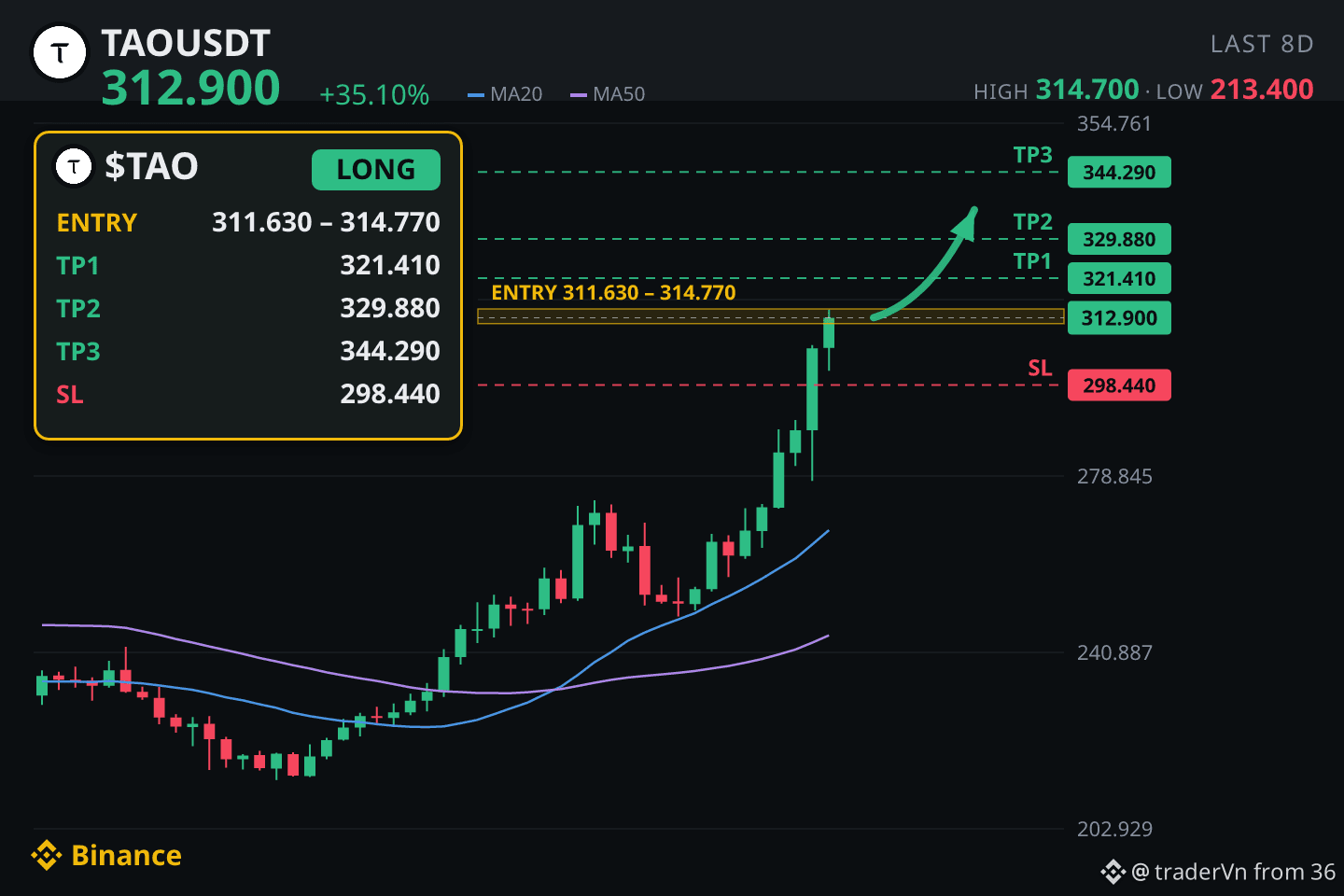
🔥 LONG TAO — TP1 is only 2.62% away
$TAO $FORM $PHA
🎯 Entry: 311.63 - 314.77
• TP1: 321.41
• TP2: 329.88
• TP3: 344.29
• DCA: 305.03
• SL: 298.44
🟢 Risk: 4/10 (low — calm setup)
• Volume: manage volume strictly
• Why these levels
• Over the last 894 days, 75% of periods touched TP1 321.41 at some point — that is why the level sits there
• A 0.6 : 1 ratio — risking 4.71% to make 2.62%. That number only means something read next to the 75% hit rate above
• The ladder fits inside the 3.19% median daily range — no breakout needed to reach the levels
• Sitting 56% below the period high
• 5.58% is the daily swing. The distance to TP1 is shorter than that, so the level can be reached intraday — and so can the stop. Risk 4/10
Hottest movers right now: FORM +38.8% · PHA +34.2%
Feel free to ask questions, request a coin review, or share your trading thoughts!
#TAO #CryptoTrading
For reference only, not financial advice (DYOR).
🔥 LONG TAO — TP1 is only 2.62% away
$TAO $FORM $PHA
🎯 Entry: 311.63 - 314.77
• TP1: 321.41
• TP2: 329.88
• TP3: 344.29
• DCA: 305.03
• SL: 298.44
🟢 Risk: 4/10 (low — calm setup)
• Volume: manage volume strictly
• Why these levels
• Over the last 894 days, 75% of periods touched TP1 321.41 at some point — that is why the level sits there
• A 0.6 : 1 ratio — risking 4.71% to make 2.62%. That number only means something read next to the 75% hit rate above
• The ladder fits inside the 3.19% median daily range — no breakout needed to reach the levels
• Sitting 56% below the period high
• 5.58% is the daily swing. The distance to TP1 is shorter than that, so the level can be reached intraday — and so can the stop. Risk 4/10
Hottest movers right now: FORM +38.8% · PHA +34.2%
Feel free to ask questions, request a coin review, or share your trading thoughts!
#TAO #CryptoTrading
For reference only, not financial advice (DYOR).
$TAO $FORM $PHA
🎯 Entry: 311.63 - 314.77
• TP1: 321.41
• TP2: 329.88
• TP3: 344.29
• DCA: 305.03
• SL: 298.44
🟢 Risk: 4/10 (low — calm setup)
• Volume: manage volume strictly
• Why these levels
• Over the last 894 days, 75% of periods touched TP1 321.41 at some point — that is why the level sits there
• A 0.6 : 1 ratio — risking 4.71% to make 2.62%. That number only means something read next to the 75% hit rate above
• The ladder fits inside the 3.19% median daily range — no breakout needed to reach the levels
• Sitting 56% below the period high
• 5.58% is the daily swing. The distance to TP1 is shorter than that, so the level can be reached intraday — and so can the stop. Risk 4/10
Hottest movers right now: FORM +38.8% · PHA +34.2%
Feel free to ask questions, request a coin review, or share your trading thoughts!
#TAO #CryptoTrading
For reference only, not financial advice (DYOR).
168
·
--
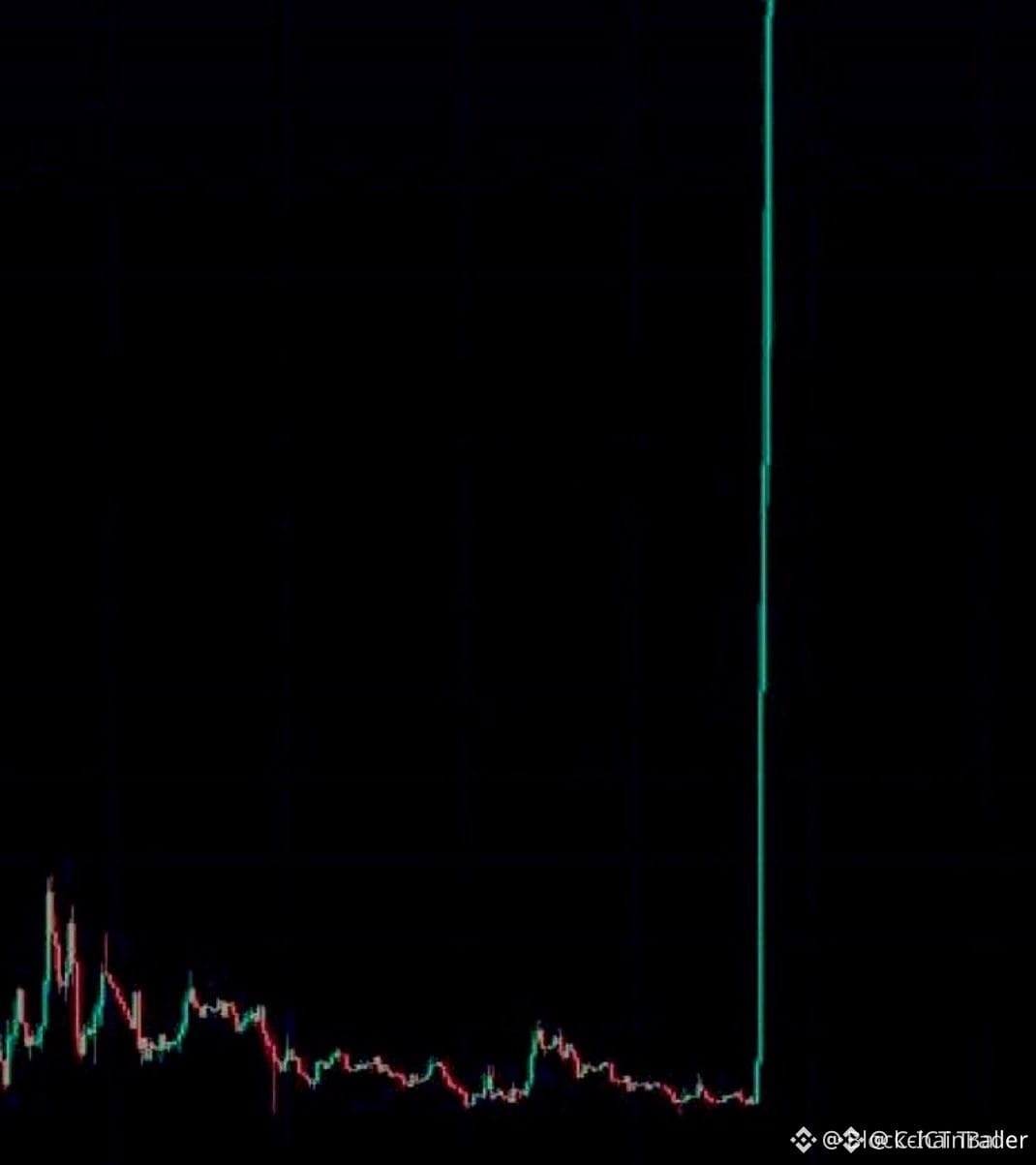
🚨 ARE INSANE MACRO EXPANSION TARGETS FOR $TAO $ZEC AND $SUI FEASIBLE? 💥
Evaluating $TAO at $5,000, $ZEC at $10,000, and $SUI at $20.00 requires looking past retail noise into structural market cap metrics and long-term liquidity engineering. 📊 While these figures represent exponential upside expansions, Smart Money footprints suggest structural repricing occurs in phases through systematic range reclaims and supply clearance.
For high-beta assets, aggressive institutional accumulation and high-conviction order flow can fuel massive price discovery once major overhead resistance shifts into foundational support. 🌊 However, sustaining such multi-fold expansions demands continuous volume continuation rather than brief speculative momentum.
🤔 Which of these macro projections aligns best with your high-timeframe structural framework? 👇
⚠️ Not financial advice. Always manage your risk. 🛡️
🏷️ #TAO #ZEC #SUI #Altcoins #Crypto
🎯 💎
🚨 ARE INSANE MACRO EXPANSION TARGETS FOR $TAO $ZEC AND $SUI FEASIBLE? 💥
Evaluating $TAO at $5,000, $ZEC at $10,000, and $SUI at $20.00 requires looking past retail noise into structural market cap metrics and long-term liquidity engineering. 📊 While these figures represent exponential upside expansions, Smart Money footprints suggest structural repricing occurs in phases through systematic range reclaims and supply clearance.
For high-beta assets, aggressive institutional accumulation and high-conviction order flow can fuel massive price discovery once major overhead resistance shifts into foundational support. 🌊 However, sustaining such multi-fold expansions demands continuous volume continuation rather than brief speculative momentum.
🤔 Which of these macro projections aligns best with your high-timeframe structural framework? 👇
⚠️ Not financial advice. Always manage your risk. 🛡️
🏷️ #TAO #ZEC #SUI #Altcoins #Crypto
🎯 💎
Evaluating $TAO at $5,000, $ZEC at $10,000, and $SUI at $20.00 requires looking past retail noise into structural market cap metrics and long-term liquidity engineering. 📊 While these figures represent exponential upside expansions, Smart Money footprints suggest structural repricing occurs in phases through systematic range reclaims and supply clearance.
For high-beta assets, aggressive institutional accumulation and high-conviction order flow can fuel massive price discovery once major overhead resistance shifts into foundational support. 🌊 However, sustaining such multi-fold expansions demands continuous volume continuation rather than brief speculative momentum.
🤔 Which of these macro projections aligns best with your high-timeframe structural framework? 👇
⚠️ Not financial advice. Always manage your risk. 🛡️
🏷️ #TAO #ZEC #SUI #Altcoins #Crypto
🎯 💎
221

·
--
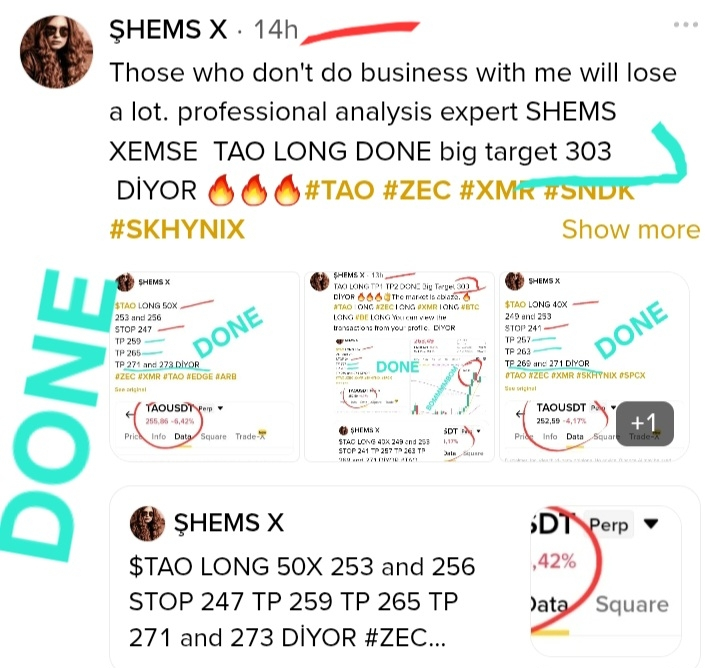
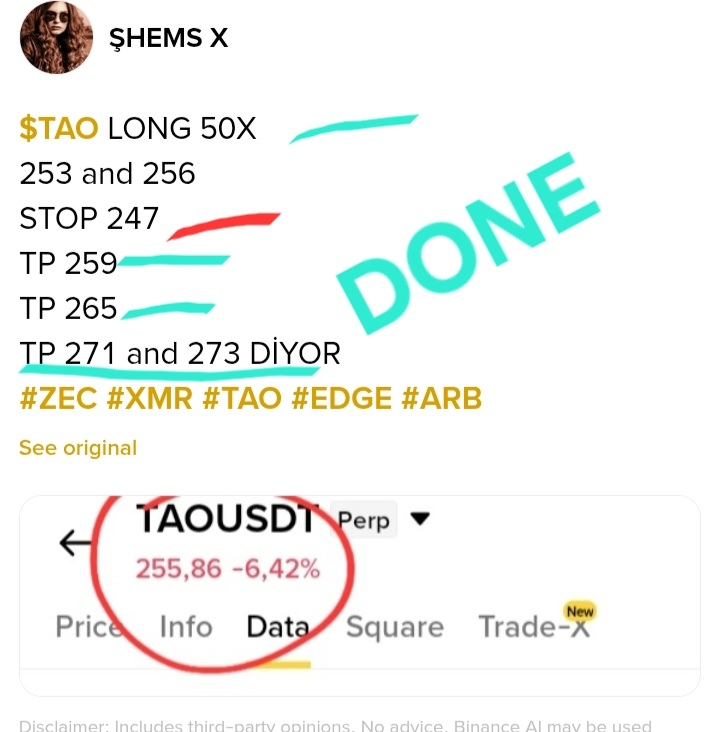
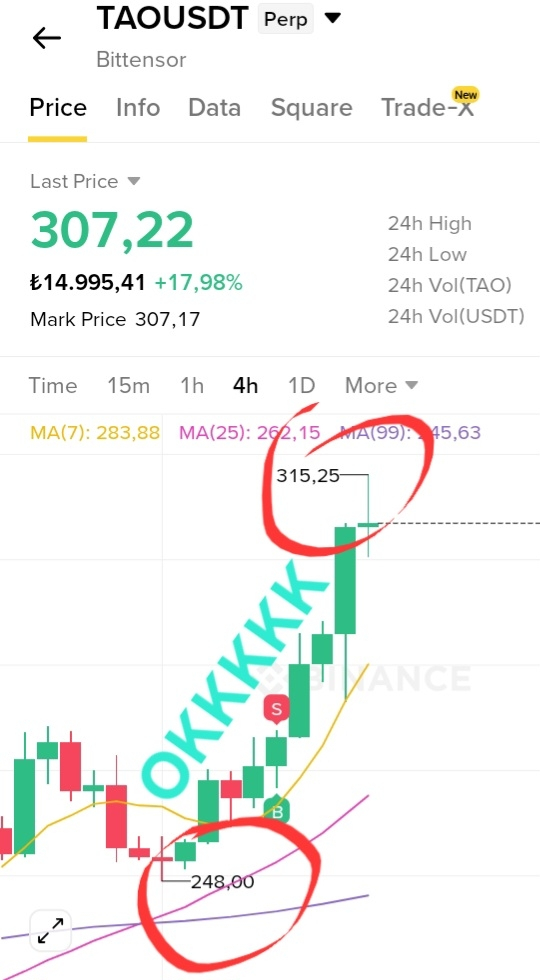
I managed to increase TAO's price by $67, even though it could only make a maximum of $10-15 in average LONG attacks. 😂😂
Even after TP is DONE, I'm telling you the big targets hours in advance: TAO 303 target is more than DONE, maximum targets are 329, 333 & 337. DİYOR 🔥🔥🔥👌OKKKKK
#TAO #ZEC #XMR #SKHYNIX #GİGGLE
I managed to increase TAO's price by $67, even though it could only make a maximum of $10-15 in average LONG attacks. 😂😂
Even after TP is DONE, I'm telling you the big targets hours in advance: TAO 303 target is more than DONE, maximum targets are 329, 333 & 337. DİYOR 🔥🔥🔥👌OKKKKK
#TAO #ZEC #XMR #SKHYNIX #GİGGLE
Even after TP is DONE, I'm telling you the big targets hours in advance: TAO 303 target is more than DONE, maximum targets are 329, 333 & 337. DİYOR 🔥🔥🔥👌OKKKKK
#TAO #ZEC #XMR #SKHYNIX #GİGGLE
ŞHEMS X
·
--
Those who don't do business with me will lose a lot. professional analysis expert SHEMS XEMSE TAO LONG DONE big target 303
DİYOR 🔥🔥🔥#TAO #ZEC #XMR #SNDK #SKHYNIX
DİYOR 🔥🔥🔥#TAO #ZEC #XMR #SNDK #SKHYNIX
Storybook:
💞💞👍
2
2
337

·
--
$TAO +18.09% | $WIF +17.99% | $ONE +17.55%
#TAO sits at $307.40, up +18.09% with $84.9 M of volume. The Bittensor protocol’s surge suggests renewed interest in decentralized AI networks, though the rapid climb could face resistance if broader market sentiment cools.
#WIF trades at $0.2381, climbing +17.99% on $10.5 M of volume. The Solana‑based memecoin’s playful branding keeps it in the spotlight, but meme‑driven rallies can be fickle.
#ONE is priced at $0.00424700, up +17.55% with $51.7 M of volume. The steady volume hints at genuine buying pressure rather than a flash move.
📌 Watch the interplay between volume strength and price momentum; the token with the highest relative volume may sustain its advance longer.
#Write2Earn #Binance
$TAO +18.09% | $WIF +17.99% | $ONE +17.55%
#TAO sits at $307.40, up +18.09% with $84.9 M of volume. The Bittensor protocol’s surge suggests renewed interest in decentralized AI networks, though the rapid climb could face resistance if broader market sentiment cools.
#WIF trades at $0.2381, climbing +17.99% on $10.5 M of volume. The Solana‑based memecoin’s playful branding keeps it in the spotlight, but meme‑driven rallies can be fickle.
#ONE is priced at $0.00424700, up +17.55% with $51.7 M of volume. The steady volume hints at genuine buying pressure rather than a flash move.
📌 Watch the interplay between volume strength and price momentum; the token with the highest relative volume may sustain its advance longer.
#Write2Earn #Binance
#TAO sits at $307.40, up +18.09% with $84.9 M of volume. The Bittensor protocol’s surge suggests renewed interest in decentralized AI networks, though the rapid climb could face resistance if broader market sentiment cools.
#WIF trades at $0.2381, climbing +17.99% on $10.5 M of volume. The Solana‑based memecoin’s playful branding keeps it in the spotlight, but meme‑driven rallies can be fickle.
#ONE is priced at $0.00424700, up +17.55% with $51.7 M of volume. The steady volume hints at genuine buying pressure rather than a flash move.
📌 Watch the interplay between volume strength and price momentum; the token with the highest relative volume may sustain its advance longer.
#Write2Earn #Binance
216
Log in to explore more content
Join global crypto users on Binance Square
⚡️ Get latest and useful information about crypto.
💬 Trusted by the world’s largest crypto exchange.
👍 Discover real insights from verified creators.
Email / Phone number
Trending Topics
1
#NEARRisesNearly80%InAWeek
36,036 views
827 Discussing
2
#MultiversXPlansHardForkRecovery
31,214 views
631 Discussing
3
#CircleLaunchesInstitutionalBTCBackedBorrowing
30,079 views
732 Discussing
4
#BitcoinHits$85K
39,316 views
294 Discussing
5
#ZetaChainVotesToMigrateZETAToSolana
21,628 views
468 Discussing
6
#ECBStartsBlockchainEuroSettlement
45,605 views
758 Discussing
7
#SouthAfricaProposesCryptoExchangeControls
57,638 views
907 Discussing
8
#SolanaCutsTargetSlotTimeTo250ms
62,285 views
845 Discussing
9
#EthereumSurpasses$2700
35,035 views
233 Discussing
10
#CanaryFilesSecondAmendmentForStakedSEIETF
71,589 views
1,138 Discussing