
#occ
occ
65,620 views
256 Discussing
Hot
Latest


OCC turns green light: Revolut and a16z-backed OpenReserve receive preliminary conditional approval for U.S. national bank charters
According to public reports, the U.S. Office of the Comptroller of the Currency (OCC) on September 2 granted preliminary conditional approval for national bank charters to fintech company Revolut (planned in Connecticut) and OpenReserve (planned in Salt Lake City, Utah), which is backed by institutions including a16z. Both clearly plan digital asset custody and stablecoin-related services; OpenReserve also plans tokenized deposits and intends to set up a separate stablecoin subsidiary (which has not yet been filed for approval separately).
Note: this is a "preliminary conditional approval," not permission to open for business immediately. OpenReserve must raise at least about $210 million in initial paid-in capital within 12 months, maintain a Tier 1 leverage ratio of no less than about 12% for the first three years after opening, and begin operations within 18 months; it must also complete prerequisites such as FDIC deposit insurance and Federal Reserve holding-company arrangements. Revolut, meanwhile, hopes to use its own national bank to replace its current model that relies on partner banks, and plans cross-border crypto/stablecoin transfers and a branded stablecoin.
Implications for U.S. stocks and the crypto market: the regulatory window is narrowing the path for "compliant crypto banking"—alongside prior SEC commodity determinations and the CLARITY agenda in Congress, this is part of the main U.S. regulatory line, but it leans more toward "licensed infrastructure." U.S. stocks were closed over the Labor Day weekend; after the next trading day (Tuesday), CPI (around 9/11) and the FOMC (9/15–16) are still the main pricing anchors.
Compiled from public social media/news sources, not investment advice. $BTC #加密银行 #OCC #美股
According to public reports, the U.S. Office of the Comptroller of the Currency (OCC) on September 2 granted preliminary conditional approval for national bank charters to fintech company Revolut (planned in Connecticut) and OpenReserve (planned in Salt Lake City, Utah), which is backed by institutions including a16z. Both clearly plan digital asset custody and stablecoin-related services; OpenReserve also plans tokenized deposits and intends to set up a separate stablecoin subsidiary (which has not yet been filed for approval separately).
Note: this is a "preliminary conditional approval," not permission to open for business immediately. OpenReserve must raise at least about $210 million in initial paid-in capital within 12 months, maintain a Tier 1 leverage ratio of no less than about 12% for the first three years after opening, and begin operations within 18 months; it must also complete prerequisites such as FDIC deposit insurance and Federal Reserve holding-company arrangements. Revolut, meanwhile, hopes to use its own national bank to replace its current model that relies on partner banks, and plans cross-border crypto/stablecoin transfers and a branded stablecoin.
Implications for U.S. stocks and the crypto market: the regulatory window is narrowing the path for "compliant crypto banking"—alongside prior SEC commodity determinations and the CLARITY agenda in Congress, this is part of the main U.S. regulatory line, but it leans more toward "licensed infrastructure." U.S. stocks were closed over the Labor Day weekend; after the next trading day (Tuesday), CPI (around 9/11) and the FOMC (9/15–16) are still the main pricing anchors.
Compiled from public social media/news sources, not investment advice. $BTC #加密银行 #OCC #美股


The OCC gave preliminary green light to OpenReserve Bank, a full-fledged national bank designed for tokenized deposits, custody, and stablecoins. Backing it are a16z, Jump, and Coinbase Ventures.
This is not another limited trust. It is a real bank with on-chain settlement. The message is clear: the convergence between traditional banking and crypto infrastructure is no longer just a narrative, it is going through regulators.
How long will it take for this to stop being "experimental" and become core infrastructure?
Source: CoinDesk
#OCC
This is not another limited trust. It is a real bank with on-chain settlement. The message is clear: the convergence between traditional banking and crypto infrastructure is no longer just a narrative, it is going through regulators.
How long will it take for this to stop being "experimental" and become core infrastructure?
Source: CoinDesk
#OCC

Verified
🚨 The USD called USD1 - A Personal Bank Future
Exclusive ⚙️
The Office of the Comptroller of the Currency (OCC) granted approval for the Trump family’s company, World Liberty Financial, to operate a federal trust bank. This will issue and custody its own dollar-backed stablecoin called USD1
What this will do for a crypto bank for and by the Trump family:
In short, the bank is approved conditionally. The Office of the Comptroller of the Currency (OCC) granted preliminary approval conditioned on mid-August 2026.
So the company is in the technical phase of meeting the mandatory requirements (such as raising $20 million in initial capital and setting up its internal structure) before it can open its doors and operate officially.
By having its own federal bank, the Trump company assumes absolute control over the issuance, redemption, and management of USD1 reserves. What’s interesting is that this is a key change: previously, an external company (BitGo) issued the token and held the physical money.
How it will generate profits: Each time someone buys USD1, the Trump bank takes those physical dollars and invests them in short-term U.S. Treasury Bonds that generate daily interest in net yield. The bank keeps those million-dollar profits while the user only retains the digital token.
#usd1 #OCC
$ZKC $HEMI $SOL
Exclusive ⚙️
The Office of the Comptroller of the Currency (OCC) granted approval for the Trump family’s company, World Liberty Financial, to operate a federal trust bank. This will issue and custody its own dollar-backed stablecoin called USD1
What this will do for a crypto bank for and by the Trump family:
In short, the bank is approved conditionally. The Office of the Comptroller of the Currency (OCC) granted preliminary approval conditioned on mid-August 2026.
So the company is in the technical phase of meeting the mandatory requirements (such as raising $20 million in initial capital and setting up its internal structure) before it can open its doors and operate officially.
By having its own federal bank, the Trump company assumes absolute control over the issuance, redemption, and management of USD1 reserves. What’s interesting is that this is a key change: previously, an external company (BitGo) issued the token and held the physical money.
How it will generate profits: Each time someone buys USD1, the Trump bank takes those physical dollars and invests them in short-term U.S. Treasury Bonds that generate daily interest in net yield. The bank keeps those million-dollar profits while the user only retains the digital token.
#usd1 #OCC
$ZKC $HEMI $SOL


OCC promises to complete GENIUS rules in November
- The U.S. central bank (OCC) has published a 376-page proposal on GENIUS rules for stablecoins.
- The public comment period is ongoing and will run until before December 31, 2026.
- The regulation will take effect starting January 2027.
#BinanceSquare #CryptoNews #OCC #GENIUSAct #Stablecoin
$btc $eth
vlikevn Titanbot
Source: CoinTelegraph
- The U.S. central bank (OCC) has published a 376-page proposal on GENIUS rules for stablecoins.
- The public comment period is ongoing and will run until before December 31, 2026.
- The regulation will take effect starting January 2027.
#BinanceSquare #CryptoNews #OCC #GENIUSAct #Stablecoin
$btc $eth
vlikevn Titanbot
Source: CoinTelegraph

OCC conditionally approves World Liberty Financial's application for a national trust bank charter, and the operating entity may be named as World Liberty Trust Company, National Association. The approval comes with regulatory and policy requirements; being approved does not mean there are no further constraints.
The application documents show that the bank plans to issue USD-backed stablecoins and to hold digital assets related to USD1 tokens in custody. Trump and his three sons are all affiliated with the company, and Trump-family entities hold 38% equity.
Senator Elizabeth Warren and nine other senators have introduced the “Ending Presidential Banking Corruption Act,” calling the OCC’s action one of the instances of patronage and delivery of benefits within the U.S. financial system.
For market observation only and does not constitute investment advice.
#OCC #WorldLibertyFinancial #stablecoin
The application documents show that the bank plans to issue USD-backed stablecoins and to hold digital assets related to USD1 tokens in custody. Trump and his three sons are all affiliated with the company, and Trump-family entities hold 38% equity.
Senator Elizabeth Warren and nine other senators have introduced the “Ending Presidential Banking Corruption Act,” calling the OCC’s action one of the instances of patronage and delivery of benefits within the U.S. financial system.
For market observation only and does not constitute investment advice.
#OCC #WorldLibertyFinancial #stablecoin

Verified
World Liberty Financial and a new step toward adopting USD1
The U.S. Office of the Comptroller of the Currency (OCC) has conditionally approved a banking license for World Liberty Financial, which could pave the way for the company to issue and hold its USD1 stablecoin directly.
This move reflects the continued overlap between the traditional banking sector and stablecoins, and may give USD1 a stronger regulatory framework and greater trust among institutions and users.
📌 Summary:
If final approvals are completed, the license could represent a major shift in the USD1 trajectory and expand the use of stablecoins within the U.S. financial system.
#Crypto #Stablecoins #USD1 #WorldLibertyFinancial #OCC
The U.S. Office of the Comptroller of the Currency (OCC) has conditionally approved a banking license for World Liberty Financial, which could pave the way for the company to issue and hold its USD1 stablecoin directly.
This move reflects the continued overlap between the traditional banking sector and stablecoins, and may give USD1 a stronger regulatory framework and greater trust among institutions and users.
📌 Summary:
If final approvals are completed, the license could represent a major shift in the USD1 trajectory and expand the use of stablecoins within the U.S. financial system.
#Crypto #Stablecoins #USD1 #WorldLibertyFinancial #OCC


Verified
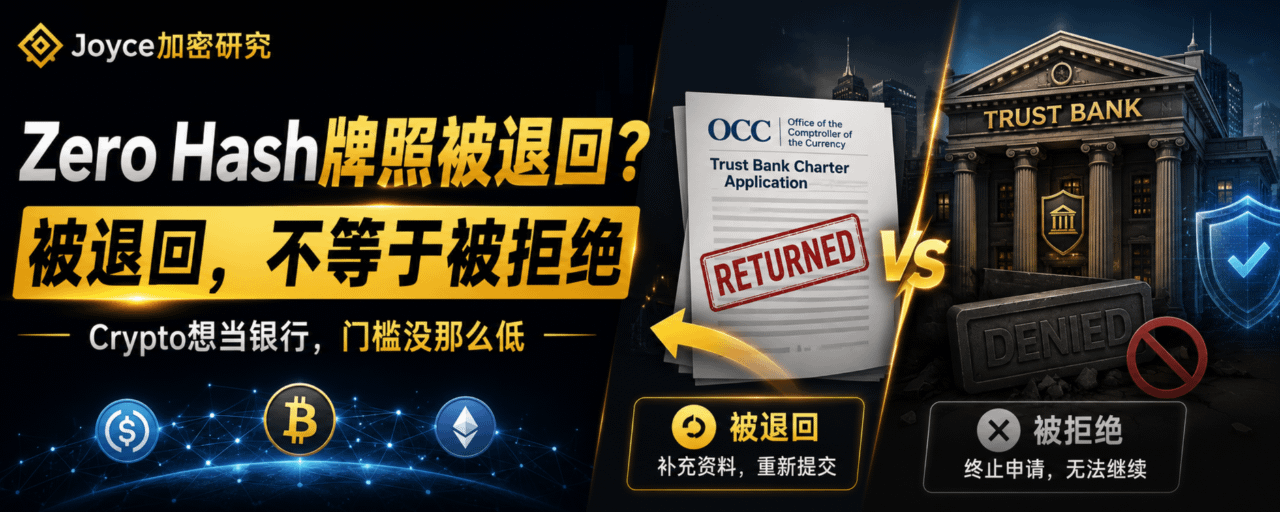

The U.S. Office of the Comptroller of the Currency (OCC) has officially approved crypto companies’ applications for national bank charters.
What makes this announcement particularly significant is this: the OCC is not the SEC, and it is not an agency that’s merely there to tell you to “don’t do anything wrong.” Instead, it is the federal regulator responsible for issuing and overseeing national bank charters. Its approval means crypto companies can now legally operate as national banks, enjoying the same legal standing and under the same federal regulatory framework as firms like JPMorgan and Goldman Sachs.
The practical impact can be broken down into three layers:
First layer: entry threshold. In the past, crypto companies that wanted access to traditional financial infrastructure (the Federal Reserve system, clearing networks, FDIC insurance) had to navigate a patchwork of interstate compliance—each of the 50 states has its own money transmitter licensing requirements. Once a national bank charter is issued, it provides direct federal-level entry, cutting through the 50-state barriers.
Second layer: the liability side opens up. The most core capability of a bank isn’t lending—it’s deposit-taking. Once a crypto-native company obtains a banking charter, it can directly absorb deposits from the public. That means crypto custodial service providers can bring customers’ U.S.-dollar deposits within the scope of FDIC insurance—an important safety net that traditional finance users have long been waiting for.
Third layer: a leverage multiplier effect. With a bank charter comes credit-creation capacity within a reserve-based framework. This is a completely different logic from the over-collateralized borrowing seen in DeFi today. Under a theoretical 10% reserve ratio, $1 of deposits could be used to generate $10 in credit. If crypto assets are included as eligible collateral, the liquidity amplification factor can far exceed what current on-chain protocols are able to achieve.
Metaplanet yesterday transferred 5,014 BTC between custody addresses (CEO gerovich confirmed), while keeping its holdings unchanged at 43,000 BTC. For a company at this scale, if it were to operate its BTC custody business in the future under a banking entity identity, the ceiling for compliance costs and customer trust would be fundamentally rewritten.
Directional judgment: The OCC’s move is structurally positive, but implementation will take time—the application process, capital requirements, and anti-money-laundering compliance setup will take at least 12–18 months. In the short term, it does not constitute a price catalyst. In the medium term (2027–2028), it will reshape the industry’s competitive landscape. Don’t chase the price at this point—reassess once the first batch of licenses is actually rolled out and you can evaluate the scale of capital inflows.
#BTC #Crypto #OCC #Bank charter
What makes this announcement particularly significant is this: the OCC is not the SEC, and it is not an agency that’s merely there to tell you to “don’t do anything wrong.” Instead, it is the federal regulator responsible for issuing and overseeing national bank charters. Its approval means crypto companies can now legally operate as national banks, enjoying the same legal standing and under the same federal regulatory framework as firms like JPMorgan and Goldman Sachs.
The practical impact can be broken down into three layers:
First layer: entry threshold. In the past, crypto companies that wanted access to traditional financial infrastructure (the Federal Reserve system, clearing networks, FDIC insurance) had to navigate a patchwork of interstate compliance—each of the 50 states has its own money transmitter licensing requirements. Once a national bank charter is issued, it provides direct federal-level entry, cutting through the 50-state barriers.
Second layer: the liability side opens up. The most core capability of a bank isn’t lending—it’s deposit-taking. Once a crypto-native company obtains a banking charter, it can directly absorb deposits from the public. That means crypto custodial service providers can bring customers’ U.S.-dollar deposits within the scope of FDIC insurance—an important safety net that traditional finance users have long been waiting for.
Third layer: a leverage multiplier effect. With a bank charter comes credit-creation capacity within a reserve-based framework. This is a completely different logic from the over-collateralized borrowing seen in DeFi today. Under a theoretical 10% reserve ratio, $1 of deposits could be used to generate $10 in credit. If crypto assets are included as eligible collateral, the liquidity amplification factor can far exceed what current on-chain protocols are able to achieve.
Metaplanet yesterday transferred 5,014 BTC between custody addresses (CEO gerovich confirmed), while keeping its holdings unchanged at 43,000 BTC. For a company at this scale, if it were to operate its BTC custody business in the future under a banking entity identity, the ceiling for compliance costs and customer trust would be fundamentally rewritten.
Directional judgment: The OCC’s move is structurally positive, but implementation will take time—the application process, capital requirements, and anti-money-laundering compliance setup will take at least 12–18 months. In the short term, it does not constitute a price catalyst. In the medium term (2027–2028), it will reshape the industry’s competitive landscape. Don’t chase the price at this point—reassess once the first batch of licenses is actually rolled out and you can evaluate the scale of capital inflows.
#BTC #Crypto #OCC #Bank charter

🚨 LATEST: The U.S. OCC is pushing to revive new bank chartering, saying companies involved in digital assets and other emerging technologies should have a path into the national banking system. 🏦⚡️ $NEAR
Comptroller Jonathan Gould said the OCC received 40 de novo charter applications over the past 18 months, including national trust bank applications, and praised the FDIC for reforms aimed at making the deposit-insurance application process clearer. $TRX
What this suggests:
• Digital-asset companies could gain a clearer route into the U.S. banking system
• The OCC is signaling greater openness toward crypto, fintech and other new technologies $ONE
• More new banks could increase competition and innovation across financial services
• The trend could strengthen institutional adoption of crypto and tokenized assets
📊 Market takeaway:
🔥 Bullish for U.S. crypto adoption. Regulators are increasingly moving toward integrating digital assets into the regulated banking system rather than keeping them at the financial system’s edges. The OCC already has multiple digital-asset charter applications in its pipeline, showing this shift is becoming concrete.
#OCC #US #crypto
Comptroller Jonathan Gould said the OCC received 40 de novo charter applications over the past 18 months, including national trust bank applications, and praised the FDIC for reforms aimed at making the deposit-insurance application process clearer. $TRX
What this suggests:
• Digital-asset companies could gain a clearer route into the U.S. banking system
• The OCC is signaling greater openness toward crypto, fintech and other new technologies $ONE
• More new banks could increase competition and innovation across financial services
• The trend could strengthen institutional adoption of crypto and tokenized assets
📊 Market takeaway:
🔥 Bullish for U.S. crypto adoption. Regulators are increasingly moving toward integrating digital assets into the regulated banking system rather than keeping them at the financial system’s edges. The OCC already has multiple digital-asset charter applications in its pipeline, showing this shift is becoming concrete.
#OCC #US #crypto

#OCCSaysDigitalFirmsCanSeekNationalBankStatus
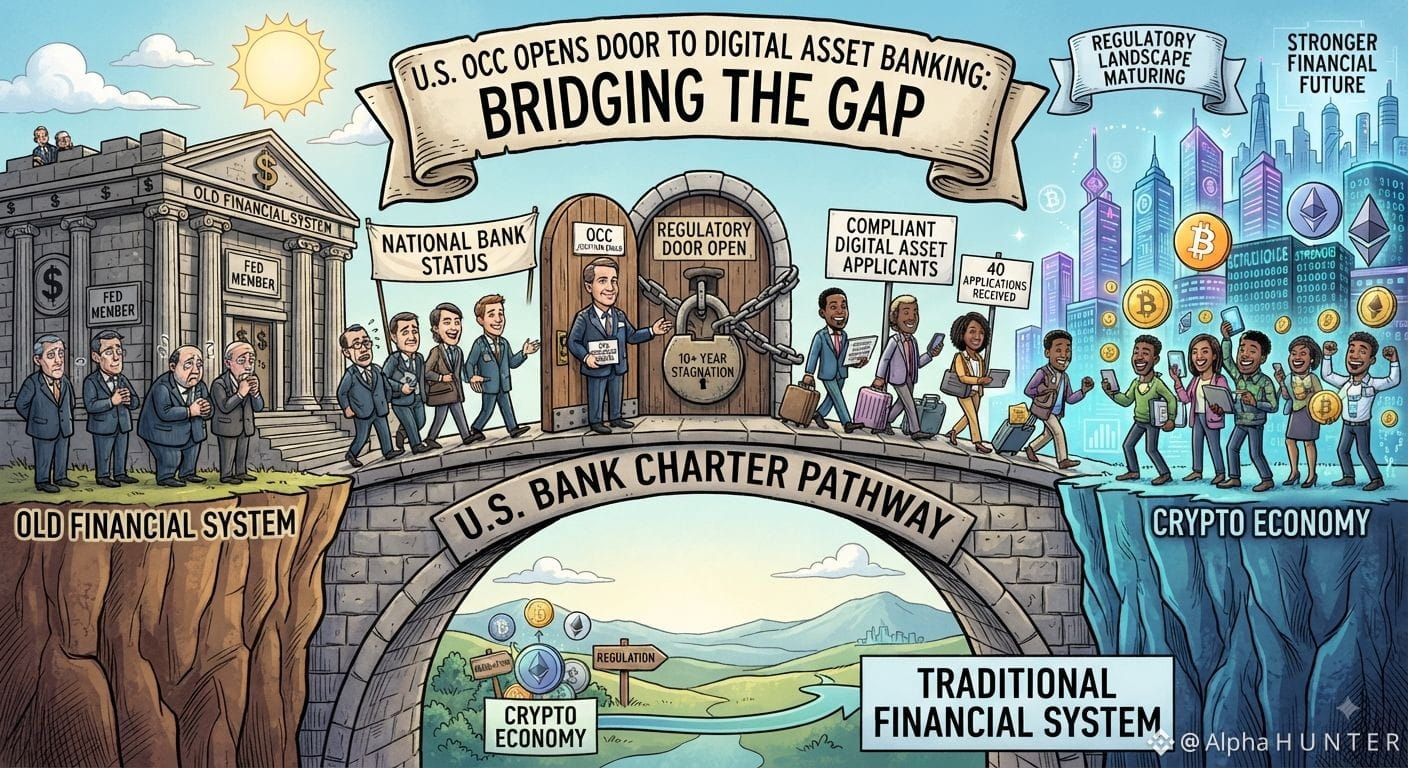
The U.S. Office of the Comptroller of the Currency (OCC) has officially signaled a major shift for the financial sector.
Comptroller Jonathan Gould announced that companies engaged in digital assets and emerging technologies should have a clear pathway to apply for national bank status.
After more than a decade of stagnation in new bank applications, the regulatory door is finally open.
Over the past 18 months, the OCC has already received 40 applications from digital asset firms.
This historic move bridges the gap between traditional banking and the crypto economy.
It provides compliant crypto firms with direct federal integration, boosting institutional trust and long-term adoption.
The regulatory landscape is maturing rapidly, paving the way for a stronger financial future.
#OCC #CryptoRegulation #DigitalAssets #BankingReform
$APR
$VELVET
$BTC
The U.S. Office of the Comptroller of the Currency (OCC) has officially signaled a major shift for the financial sector.
Comptroller Jonathan Gould announced that companies engaged in digital assets and emerging technologies should have a clear pathway to apply for national bank status.
After more than a decade of stagnation in new bank applications, the regulatory door is finally open.
Over the past 18 months, the OCC has already received 40 applications from digital asset firms.
This historic move bridges the gap between traditional banking and the crypto economy.
It provides compliant crypto firms with direct federal integration, boosting institutional trust and long-term adoption.
The regulatory landscape is maturing rapidly, paving the way for a stronger financial future.
#OCC #CryptoRegulation #DigitalAssets #BankingReform
$APR
$VELVET
$BTC

The real change isn’t that an “encryption company suddenly turns into JPMorgan,” but that the federal gateways have begun to open up to digital assets.
The Office of the Comptroller of the Currency (OCC) has said that companies that operate compliantly using new technology (including crypto)—as long as they clear the hurdles of governance, capital, and anti-money-laundering—should have a pathway to apply for a national bank charter. The FDIC is also simplifying reforms on the deposit insurance application side, and the signals from both sides are aligned.
First, a correction: “can apply” ≠ “has been approved.” National trust-type charters are more geared toward custody/stablecoin-related business; that doesn’t mean you can take deposits and make loans, and it also doesn’t automatically mean FDIC deposit insurance.
【Scenario A】If named approvals are actually rolled out later → custody and compliance pathways become more federally integrated, and the pressure of assembling the state-licensing puzzle declines.
【Scenario B】If it stays only at the “welcome applications” messaging → the market may get hot for a bit and then cool off, and the structure won’t change.
Watch point: the list of named approvals, not clickbait headlines.
#OCC #银行牌照 #稳定币 #托管 #监管
The Office of the Comptroller of the Currency (OCC) has said that companies that operate compliantly using new technology (including crypto)—as long as they clear the hurdles of governance, capital, and anti-money-laundering—should have a pathway to apply for a national bank charter. The FDIC is also simplifying reforms on the deposit insurance application side, and the signals from both sides are aligned.
First, a correction: “can apply” ≠ “has been approved.” National trust-type charters are more geared toward custody/stablecoin-related business; that doesn’t mean you can take deposits and make loans, and it also doesn’t automatically mean FDIC deposit insurance.
【Scenario A】If named approvals are actually rolled out later → custody and compliance pathways become more federally integrated, and the pressure of assembling the state-licensing puzzle declines.
【Scenario B】If it stays only at the “welcome applications” messaging → the market may get hot for a bit and then cool off, and the structure won’t change.
Watch point: the list of named approvals, not clickbait headlines.
#OCC #银行牌照 #稳定币 #托管 #监管

$TUT
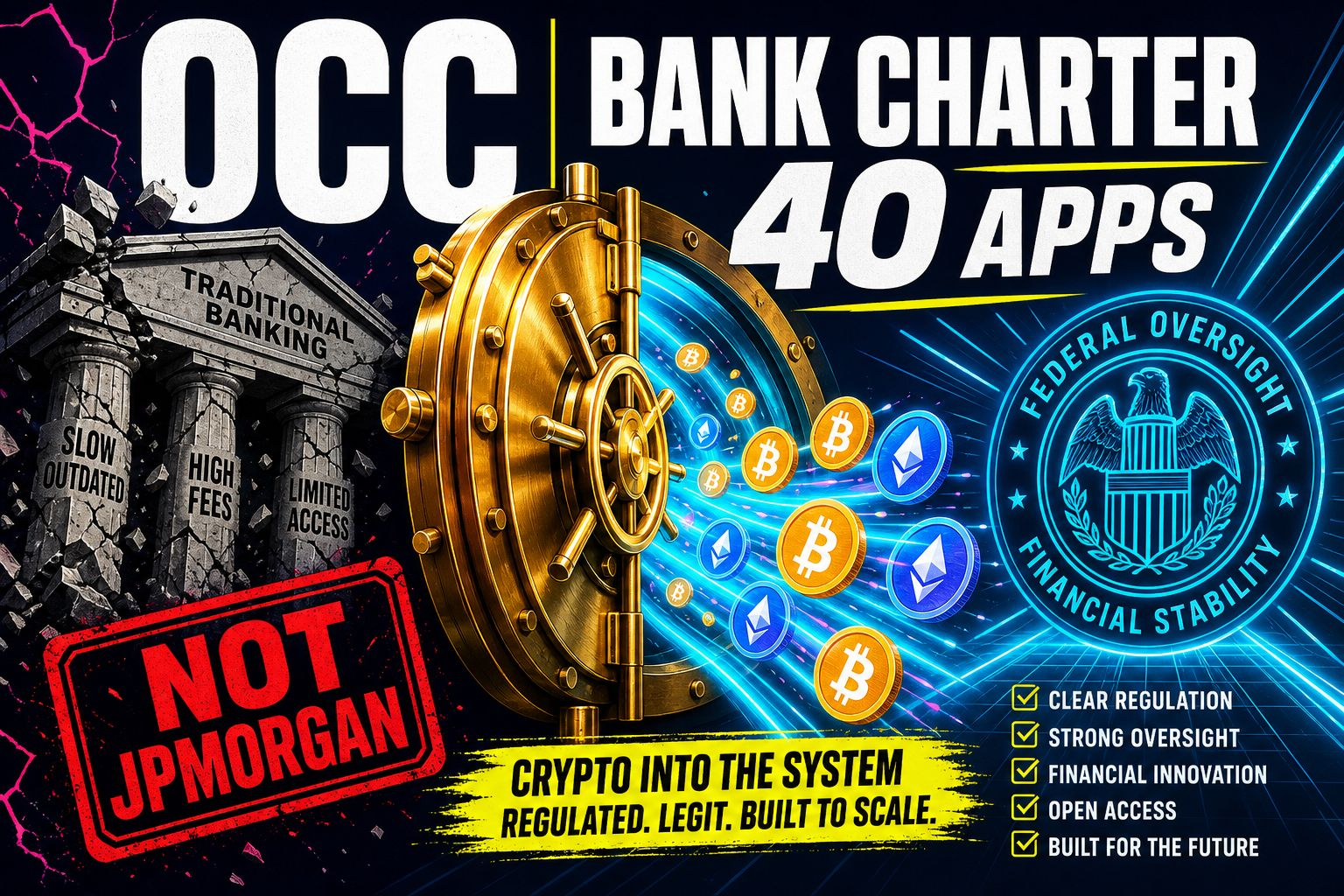
OCC opens the door 🏦
The OCC says digital firms may be able to seek national bank status. A major regulatory development.
#Crypto #BankingFailures #OCC
OCC opens the door 🏦
The OCC says digital firms may be able to seek national bank status. A major regulatory development.
#Crypto #BankingFailures #OCC

#OCCSaysDigitalFirmsCanSeekNationalBankStatus 🏛️ OCC opens its doors to crypto companies — they could become national banks!
On August 11, the Office of the Comptroller of the Currency (OCC) said that companies with digital assets have the right to apply for U.S. national bank status. OCC head Jonathan Gould emphasized: “America and the OCC are open for business again.” In 18 months, 40 applications were received; many were reviewed within 120 days. In December 2025, the OCC approved $CIRC.US , $XRP , Paxos, BitGo, and Fidelity, while Coinbase received preliminary approval in April. There are currently 13 applications under review, including Revolut and World Liberty.
A federal status will eliminate the need to obtain licenses in every state. But the path is complex: approval is not guaranteed — Wise’s application was rejected.
🔥 Do you think crypto banks will soon become a reality? Write in the comments!
👉 Subscribe to regulation news!
#OCC #Trade 👇
On August 11, the Office of the Comptroller of the Currency (OCC) said that companies with digital assets have the right to apply for U.S. national bank status. OCC head Jonathan Gould emphasized: “America and the OCC are open for business again.” In 18 months, 40 applications were received; many were reviewed within 120 days. In December 2025, the OCC approved $CIRC.US , $XRP , Paxos, BitGo, and Fidelity, while Coinbase received preliminary approval in April. There are currently 13 applications under review, including Revolut and World Liberty.
A federal status will eliminate the need to obtain licenses in every state. But the path is complex: approval is not guaranteed — Wise’s application was rejected.
🔥 Do you think crypto banks will soon become a reality? Write in the comments!
👉 Subscribe to regulation news!
#OCC #Trade 👇
XRP+0.46%
CIRCUS+2.56%

The U.S. OCC Director Jonathan V. Gould recently spoke out, clearly welcoming institutions engaged in digital assets and other emerging technologies to apply to become national banks, and stating that the agency will prioritize revitalizing the “new charter” (de novo chartering) banking framework to promote the establishment of new banks.
This is another policy signal with landmark significance after the early 21st century when the OCC opened the door for fintech companies to obtain banking charters. In his statement, Gould said plainly: “The United States and the Office of the Comptroller of the Currency are opening the doors again, and we welcome people from all walks of life to come in and discuss business.”
From a compliance perspective, the OCC’s shift in stance suggests that crypto-native institutions in the future may no longer be limited to state-level licensing (such as BitLicense and MTL). Instead, they may have the opportunity to obtain federally issued national bank charters, receive unified supervisory recognition for operating across state lines, and gain access to the Federal Reserve’s payment system. For stablecoin issuers, on-chain custody providers, and crypto banks that are compliance-friendly, this represents an entirely new “welcome into the house” pathway.
That said, it is also important to stay level-headed: the OCC has long emphasized “businesses permitted by law,” meaning applicants must still demonstrate that their business model, risk management, and consumer protection capabilities meet federal bank regulatory standards. Whether digital asset-related institutions can truly be approved still depends on case-by-case review and the progress of regulatory coordination.
The “national bank” door in U.S. regulation is being reopened for the crypto industry, and it is worth tracking over the long term.
#OCC#Digital Assets#Compliance
This is another policy signal with landmark significance after the early 21st century when the OCC opened the door for fintech companies to obtain banking charters. In his statement, Gould said plainly: “The United States and the Office of the Comptroller of the Currency are opening the doors again, and we welcome people from all walks of life to come in and discuss business.”
From a compliance perspective, the OCC’s shift in stance suggests that crypto-native institutions in the future may no longer be limited to state-level licensing (such as BitLicense and MTL). Instead, they may have the opportunity to obtain federally issued national bank charters, receive unified supervisory recognition for operating across state lines, and gain access to the Federal Reserve’s payment system. For stablecoin issuers, on-chain custody providers, and crypto banks that are compliance-friendly, this represents an entirely new “welcome into the house” pathway.
That said, it is also important to stay level-headed: the OCC has long emphasized “businesses permitted by law,” meaning applicants must still demonstrate that their business model, risk management, and consumer protection capabilities meet federal bank regulatory standards. Whether digital asset-related institutions can truly be approved still depends on case-by-case review and the progress of regulatory coordination.
The “national bank” door in U.S. regulation is being reopened for the crypto industry, and it is worth tracking over the long term.
#OCC#Digital Assets#Compliance

The U.S. Office of the Comptroller of the Currency (OCC) Director Jonathan V. Gould has clearly stated: he welcomes institutions engaged in digital assets and emerging technologies to apply to become national banks, and the OCC will prioritize reviving the “new charter” (de novo chartering) banking framework.
This marks an important shift in regulatory stance. The OCC, in effect, is opening the door to the crypto industry for compliance-licensed operations, meaning that in the future digital-asset institutions may be able to conduct business within the U.S. Federal Reserve system as national banks, benefiting from a clearer regulatory framework and more stable compliance expectations.
For major asset ecosystems such as $BTC spot and $ETH , the entry of bank-level licensed institutions may bring three potential impacts:
First, upgrades to custody and settlement systems, with traditional bank risk-control standards potentially integrating more deeply with on-chain assets;
Second, further bridging the banking pathway for stablecoin issuers and compliant exchanges;
Third, widening the compliant channels for institutional capital, as the boundaries between traditional finance and crypto markets continue to blur.
Gould’s remarks send a clear signal: regulators do not intend to be absent amid the digital-assets wave, and the window for institutional entry is opening.
#OCC #数字资产 #compliance process
This marks an important shift in regulatory stance. The OCC, in effect, is opening the door to the crypto industry for compliance-licensed operations, meaning that in the future digital-asset institutions may be able to conduct business within the U.S. Federal Reserve system as national banks, benefiting from a clearer regulatory framework and more stable compliance expectations.
For major asset ecosystems such as $BTC spot and $ETH , the entry of bank-level licensed institutions may bring three potential impacts:
First, upgrades to custody and settlement systems, with traditional bank risk-control standards potentially integrating more deeply with on-chain assets;
Second, further bridging the banking pathway for stablecoin issuers and compliant exchanges;
Third, widening the compliant channels for institutional capital, as the boundaries between traditional finance and crypto markets continue to blur.
Gould’s remarks send a clear signal: regulators do not intend to be absent amid the digital-assets wave, and the window for institutional entry is opening.
#OCC #数字资产 #compliance process

The Director of the Office of the Comptroller of the Currency (OCC), Jonathan V. Gould, has recently made his position clear: the OCC will continue to treat “new charters” (de novo chartering) as a priority and will encourage the establishment of new banks.
He specifically pointed out that entities engaged in activities permitted by law—including institutions involved in digital assets and other emerging technologies—should have a pathway to apply for a U.S. national bank charter. He emphasized: “The U.S. and the OCC are once again opening the doors, welcoming people from all walks of life to come and discuss business.”
This means that the channel for digital-asset firms to apply for a banking license within a compliance framework is being further opened. For stablecoin issuers, on-chain asset custody institutions, and other crypto businesses operating in a compliant manner, the clear regulatory stance will bring a more defined route to business. As the OCC moves to embrace the de novo chartering approval process again, the market views it as a positive signal released by the U.S. in terms of digital-asset regulation.
Which digital-asset firm do you think will be the first to obtain a national bank charter?
#OCC #数字资产银行 #Crypto Compliance
He specifically pointed out that entities engaged in activities permitted by law—including institutions involved in digital assets and other emerging technologies—should have a pathway to apply for a U.S. national bank charter. He emphasized: “The U.S. and the OCC are once again opening the doors, welcoming people from all walks of life to come and discuss business.”
This means that the channel for digital-asset firms to apply for a banking license within a compliance framework is being further opened. For stablecoin issuers, on-chain asset custody institutions, and other crypto businesses operating in a compliant manner, the clear regulatory stance will bring a more defined route to business. As the OCC moves to embrace the de novo chartering approval process again, the market views it as a positive signal released by the U.S. in terms of digital-asset regulation.
Which digital-asset firm do you think will be the first to obtain a national bank charter?
#OCC #数字资产银行 #Crypto Compliance
Sony Bank wins conditional approval for the OCC, and plans to establish Connectia Trust, a national trust bank, in the United States, aiming to officially launch USD stablecoin issuance and custody services in 2027.
This is the first time a traditional Japanese financial heavyweight has entered the USD stablecoin race via a trust license route—an important signal worth watching:
1) The license pathway. It will pursue an OCC national trust bank charter rather than assembling a patchwork across state MTLs. The regulatory level is higher, and the cost of expanding operations across states should be lower going forward.
2) The issuer structure. With bank-affiliated stablecoin issuers entering the market, reserve-asset custody, audit disclosures, and bankruptcy-remote structures will be handled according to banking standards—this is fundamentally different logic from purely on-chain issuers.
3) The timing. Launching in 2027 falls right into a window when U.S. stablecoin legislation is gradually becoming clearer and pressures from JPY depreciation remain ongoing. At the Sony Group level, there are also real use cases in cross-border settlement and content payments that the business can build upon.
In the short term, the impact on the existing stablecoin landscape may be limited. But if the number of bank-affiliated issuers keeps increasing, the market structure of USDT and USDC could be reshuffled within the next two to three years.
What to watch is how Connectia Trust will disclose its reserve assets going forward, and whether it chooses to issue on a public blockchain.
#稳定币 #索尼银行 #OCC
This is the first time a traditional Japanese financial heavyweight has entered the USD stablecoin race via a trust license route—an important signal worth watching:
1) The license pathway. It will pursue an OCC national trust bank charter rather than assembling a patchwork across state MTLs. The regulatory level is higher, and the cost of expanding operations across states should be lower going forward.
2) The issuer structure. With bank-affiliated stablecoin issuers entering the market, reserve-asset custody, audit disclosures, and bankruptcy-remote structures will be handled according to banking standards—this is fundamentally different logic from purely on-chain issuers.
3) The timing. Launching in 2027 falls right into a window when U.S. stablecoin legislation is gradually becoming clearer and pressures from JPY depreciation remain ongoing. At the Sony Group level, there are also real use cases in cross-border settlement and content payments that the business can build upon.
In the short term, the impact on the existing stablecoin landscape may be limited. But if the number of bank-affiliated issuers keeps increasing, the market structure of USDT and USDC could be reshuffled within the next two to three years.
What to watch is how Connectia Trust will disclose its reserve assets going forward, and whether it chooses to issue on a public blockchain.
#稳定币 #索尼银行 #OCC
$OCC recent price action has been notably weak, with prices continuously under pressure. The core trigger comes from the related project WLFI—its process to apply for an OCC national trust bank license has been delayed by political games, and the market’s expectations for the timeline to materialize cooled rapidly.
On top of that, overall sentiment has worsened further. The coin’s price has fallen back from the peak by about 72%; the current price is around $0.00074. Its market cap has shrunk to roughly the $73,600 level, and liquidity is extremely thin. In such micro-cap coins, rebounds before sentiment recovers are often pushed back down by sell pressure.
For the short term, keep an eye on two things: first, whether there is any substantive response regarding the WLFI licensing progress; second, whether trading volume increases again. Before license-related news is confirmed, chasing higher prices has a relatively low cost-effectiveness. It’s better to wait for signs of stabilization, with position sizing and risk control as the top priority.
#OCC #WLFI #山寨币
On top of that, overall sentiment has worsened further. The coin’s price has fallen back from the peak by about 72%; the current price is around $0.00074. Its market cap has shrunk to roughly the $73,600 level, and liquidity is extremely thin. In such micro-cap coins, rebounds before sentiment recovers are often pushed back down by sell pressure.
For the short term, keep an eye on two things: first, whether there is any substantive response regarding the WLFI licensing progress; second, whether trading volume increases again. Before license-related news is confirmed, chasing higher prices has a relatively low cost-effectiveness. It’s better to wait for signs of stabilization, with position sizing and risk control as the top priority.
#OCC #WLFI #山寨币

HISTORICAL MILESTONE: Circle Secures Final OCC Approval to Launch a US National Bank
An absolute regulatory mega-bombshell captured just 1 minute ago! CoinMarketCap reports that Circle (the issuer of $USDC) has officially secured the highly anticipated, final OCC (Office of the Comptroller of the Currency) approval to launch Circle National Trust.
This monumental decision officially births a federally regulated national bank offering top-tier fiduciary custody exclusively for Circle and its massive affiliates. By bridging the gap between digital assets and federal banking frameworks, this move establishes unprecedented trust, institutional security, and regulatory compliance for stablecoins on a global scale.
The traditional banking wall has officially cracked, and the future of institutional DeFi just got an ultimate green light.
Do you think this federal bank approval will allow $USDC to completely flip $USDT in global market share? Share your thoughts below
#Circle #USDC #OCC #writetoearn
An absolute regulatory mega-bombshell captured just 1 minute ago! CoinMarketCap reports that Circle (the issuer of $USDC) has officially secured the highly anticipated, final OCC (Office of the Comptroller of the Currency) approval to launch Circle National Trust.
This monumental decision officially births a federally regulated national bank offering top-tier fiduciary custody exclusively for Circle and its massive affiliates. By bridging the gap between digital assets and federal banking frameworks, this move establishes unprecedented trust, institutional security, and regulatory compliance for stablecoins on a global scale.
The traditional banking wall has officially cracked, and the future of institutional DeFi just got an ultimate green light.
Do you think this federal bank approval will allow $USDC to completely flip $USDT in global market share? Share your thoughts below
#Circle #USDC #OCC #writetoearn
Log in to explore more content