

#newttoken
newttoken
111,602 views
78 Discussing
Hot
Latest

·
--
Bullish
#newt $NEWT
🚨 **IS $NEWT PREPARING FOR ITS NEXT BIG MOVE?** 🚨
After an explosive launch, **Newton Protocol ($NEWT)** has entered a consolidation phase, with traders closely watching key support and resistance levels. While short-term volatility remains high, price consolidation is often a period where the market decides its next major direction.
What makes Newton Protocol interesting isn't just the token price—it's the technology behind it. The project is focused on enabling **verifiable AI agents** that can automate on-chain tasks securely, bridging the gap between artificial intelligence and decentralized finance. As AI continues to become one of the strongest narratives in crypto, infrastructure projects like Newton Protocol are attracting growing attention.
Here's what I'm watching:
📊 Price stability above key support levels
🤖 Continued development of the Newton ecosystem
👨💻 Developer and community growth
🚀 Adoption of the Mainnet Beta
📈 Long-term utility rather than short-term hype
Every young project experiences volatility after launch, but the projects that continue building during quiet market periods often stand out over time.
Remember, price action tells you what the market is doing today—but fundamentals help you understand where a project could be heading tomorrow.
What's your outlook on **$NEWT**?
🚀 Bullish long-term
👀 Watching closely
🤔 Waiting for confirmation
@NewtonProtocol $NEWT #Newt #NewtonProtocol #NEWTtoken
#newt $NEWT
🚨 **IS $NEWT PREPARING FOR ITS NEXT BIG MOVE?** 🚨
After an explosive launch, **Newton Protocol ($NEWT )** has entered a consolidation phase, with traders closely watching key support and resistance levels. While short-term volatility remains high, price consolidation is often a period where the market decides its next major direction.
What makes Newton Protocol interesting isn't just the token price—it's the technology behind it. The project is focused on enabling **verifiable AI agents** that can automate on-chain tasks securely, bridging the gap between artificial intelligence and decentralized finance. As AI continues to become one of the strongest narratives in crypto, infrastructure projects like Newton Protocol are attracting growing attention.
Here's what I'm watching:
📊 Price stability above key support levels
🤖 Continued development of the Newton ecosystem
👨💻 Developer and community growth
🚀 Adoption of the Mainnet Beta
📈 Long-term utility rather than short-term hype
Every young project experiences volatility after launch, but the projects that continue building during quiet market periods often stand out over time.
Remember, price action tells you what the market is doing today—but fundamentals help you understand where a project could be heading tomorrow.
What's your outlook on **$NEWT **?
🚀 Bullish long-term
👀 Watching closely
🤔 Waiting for confirmation
@NewtonProtocol $NEWT #Newt #NewtonProtocol #NEWTtoken
🚨 **IS $NEWT PREPARING FOR ITS NEXT BIG MOVE?** 🚨
After an explosive launch, **Newton Protocol ($NEWT )** has entered a consolidation phase, with traders closely watching key support and resistance levels. While short-term volatility remains high, price consolidation is often a period where the market decides its next major direction.
What makes Newton Protocol interesting isn't just the token price—it's the technology behind it. The project is focused on enabling **verifiable AI agents** that can automate on-chain tasks securely, bridging the gap between artificial intelligence and decentralized finance. As AI continues to become one of the strongest narratives in crypto, infrastructure projects like Newton Protocol are attracting growing attention.
Here's what I'm watching:
📊 Price stability above key support levels
🤖 Continued development of the Newton ecosystem
👨💻 Developer and community growth
🚀 Adoption of the Mainnet Beta
📈 Long-term utility rather than short-term hype
Every young project experiences volatility after launch, but the projects that continue building during quiet market periods often stand out over time.
Remember, price action tells you what the market is doing today—but fundamentals help you understand where a project could be heading tomorrow.
What's your outlook on **$NEWT **?
🚀 Bullish long-term
👀 Watching closely
🤔 Waiting for confirmation
@NewtonProtocol $NEWT #Newt #NewtonProtocol #NEWTtoken
91


Verified
What if compliance happened before assets moved instead of after? That's the part of @NewtonProtocol I keep coming back to.
#NewtonProtocol isn't trying to make checks faster. #Newt is changing when they happen. The protocol places programmable policies in front of settlement, so a transaction is evaluated before it becomes final. That small shift changes the entire flow.
Three things stood out while I looked through Newton:
• Policies run before settlement, not after.
• Rules can cover sanctions, investor eligibility, or AI agent spending limits.
• Every operator stakes $NEWT , with a fixed supply of 1 billion tokens, creating economic accountability for policy enforcement.
The practical example is simple. An institution can require a wallet to pass identity and jurisdiction checks before moving tokenized assets. If the policy fails, the transaction never settles. No rollback. No manual review afterward.
That's why I think Newton is worth watching. Most discussions focus on throughput or fees. Newton is focused on authorization instead. Different problem. Different trade-off.
I'm still wondering how this model performs as policy complexity grows and transaction volume increases. That's probably the part that deserves the most attention next.
#NEWTtoken #NEWTUSDT $ETH $LAB
Would you use on-chain policy enforcement?
_Yes, definitely
_Depends on the use case
_Need to learn more
{future}(NEWTUSDT)
What if compliance happened before assets moved instead of after? That's the part of @NewtonProtocol I keep coming back to.
#NewtonProtocol isn't trying to make checks faster. #Newt is changing when they happen. The protocol places programmable policies in front of settlement, so a transaction is evaluated before it becomes final. That small shift changes the entire flow.
Three things stood out while I looked through Newton:
• Policies run before settlement, not after.
• Rules can cover sanctions, investor eligibility, or AI agent spending limits.
• Every operator stakes $NEWT , with a fixed supply of 1 billion tokens, creating economic accountability for policy enforcement.
The practical example is simple. An institution can require a wallet to pass identity and jurisdiction checks before moving tokenized assets. If the policy fails, the transaction never settles. No rollback. No manual review afterward.
That's why I think Newton is worth watching. Most discussions focus on throughput or fees. Newton is focused on authorization instead. Different problem. Different trade-off.
I'm still wondering how this model performs as policy complexity grows and transaction volume increases. That's probably the part that deserves the most attention next.
#NEWTtoken #NEWTUSDT $ETH $LAB
Would you use on-chain policy enforcement?
_Yes, definitely
_Depends on the use case
_Need to learn more
#NewtonProtocol isn't trying to make checks faster. #Newt is changing when they happen. The protocol places programmable policies in front of settlement, so a transaction is evaluated before it becomes final. That small shift changes the entire flow.
Three things stood out while I looked through Newton:
• Policies run before settlement, not after.
• Rules can cover sanctions, investor eligibility, or AI agent spending limits.
• Every operator stakes $NEWT , with a fixed supply of 1 billion tokens, creating economic accountability for policy enforcement.
The practical example is simple. An institution can require a wallet to pass identity and jurisdiction checks before moving tokenized assets. If the policy fails, the transaction never settles. No rollback. No manual review afterward.
That's why I think Newton is worth watching. Most discussions focus on throughput or fees. Newton is focused on authorization instead. Different problem. Different trade-off.
I'm still wondering how this model performs as policy complexity grows and transaction volume increases. That's probably the part that deserves the most attention next.
#NEWTtoken #NEWTUSDT $ETH $LAB
Would you use on-chain policy enforcement?
_Yes, definitely
_Depends on the use case
_Need to learn more


92
43
497
Verified
Article
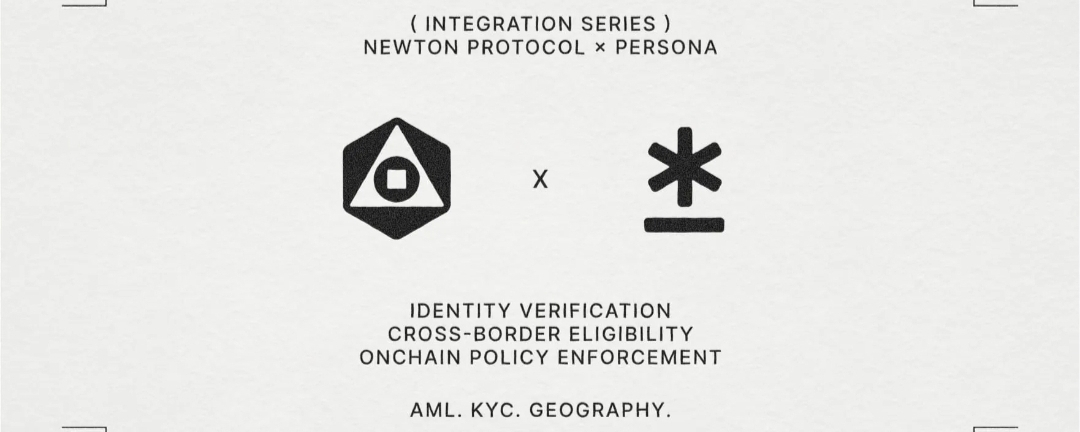
Newton Just Turned Compliance Into a Gate, Not a Filter@NewtonProtocol just made compliance a precondition for transacting, not a check after the fact. That's a bigger shift than the press release makes it sound.
Claim: #Newt Protocol's new Persona Data Oracle enforces identity and jurisdiction rules inside the smart contract itself, before execution, which means the "permissionless" part of onchain finance just picked up a gatekeeper. Not a bad one necessarily. But a real one.
Here's the setup in plain terms. $NEWT sits as an authorization layer between a user and a smart contract. Persona supplies verified identity data age, nationality, residency, state. Newton's operator network checks that data against a policy and issues an attestation (a signed, onchain proof that says "this transaction passed the check"). No valid attestation, no transaction. That's the whole mechanism.
Evidence — why this matters:
Identity fraud hit $43B in losses in 2022, and synthetic identity fraud grew 28% year over year (Javelin Research). That's the backdrop Newton is selling against.
Chainalysis says illicit crypto addresses received at least $154B in 2025 a 162% jump YoY, with a 694% surge tied to sanctioned entities. Big number, but note: "received" isn't "laundered successfully." Worth remembering when a stat this large gets quoted.
The mechanism is pre-execution, not post-hoc monitoring. Most compliance today flags bad transactions after they've settled. Newton's pitch is that the check happens before the funds move at all. That's a structural difference, not a marketing one.
Identity data allegedly never touches the public ledger, it's processed inside a TEE (trusted execution environment, basically a sealed compute environment where even the operator can't see the raw data) and only the pass/fail outcome gets attested onchain.
That last point is the part I keep sitting with. Newton is selling this as privacy-preserving. And technically; yes, your passport number isn't sitting on Etherscan. But the outcome of a government-style eligibility check is now a permanent, queryable, onchain object. You've traded data exposure for behavioral exposure. Every wallet that transacts through a Newton-gated contract now has a public trail of "passed checks" tied to it, even if the underlying identity is hidden. That's not nothing.
What I'd actually verify before treating this as neutral infrastructure:
Who writes the policy? Newton says it's "credibly neutral" because evaluation runs on a decentralized operator network secured via EigenLayer restaking (a system where staked $ETH backs the honesty of the operators). But someone still authors the jurisdiction list. Decentralized execution of a centralized decision isn't the same as a decentralized decision.
Can the policy change retroactively? Newton markets this as "updatable no redeployment needed." Good for compliance teams. Also means the rules a user agreed to on Monday can be different by Friday, with no new signature from the user.
What happens on operator disagreement? A network of operators evaluating identity claims sounds fine until two of them disagree on a borderline case. The doc doesn't say what quorum or dispute mechanism kicks in there.
Does "Newton doesn't control outcomes" hold up under stress? Restaking secures honesty of execution, not fairness of policy. Different guarantee. Worth not conflating the two.
None of this means the product doesn't work as advertised. It probably does, technically. The tension isn't in the engineering. It's in what gets normalized once "authorization before settlement" becomes standard plumbing for RWAs, stablecoins, and DeFi. Once every serious protocol requires a Newton-style attestation to move value, the permissionless pitch of crypto quietly becomes permissioned-by-default, with the permission handled by infrastructure instead of a bank. Cleaner UX. Same gate.
A quick risk checklist, for anyone evaluating this instead of just reading the announcement:
Source of the attestation is it Newton alone, or does it combine feeds (sanctions lists, wallet risk scores)? Combined feeds mean combined failure points.
Who can alter policy after deployment, and is there a timelock or notice period?
Is the "no personal data onchain" claim independently audited, or is it a TEE vendor claim taken at face value?
What's the actual cost/latency added per transaction? Pre-execution checks aren't free, someone pays gas or time for that operator round-trip.
Counterparty risk on the operator set itself: restaking secures against provable misbehavior, not against operators colluding on ambiguous calls.
Smart contract risk on the Newton contracts specifically has this policy engine been through independent audits, and are they published?
One number worth sitting with: the 694% surge in value to sanctioned entities is doing a lot of the persuasive work in this announcement. It's the scariest stat, so it's the one that gets quoted. But "value received by sanctioned entities" and "value Newton would have blocked" are two different populations, and the doc doesn't show overlap data. Fair to be skeptical of how directly this solution maps to that specific number, even if the general problem, jurisdictional evasion is real.
Takeaway: Newton isn't wrong that offchain compliance is leaky. It's just worth noticing that the fix is a permanent, onchain, pre-execution gate and gates, once installed, tend to stay installed even after the emergency that justified them fades.
Still turning over whether "credibly neutral" is doing honest work here or just softening the fact that somebody, somewhere, is still writing the eligibility list —
#NewtonProtocol #NEWTtoken $SPCX #NEWTUSDT
Newton Just Turned Compliance Into a Gate, Not a Filter
@NewtonProtocol just made compliance a precondition for transacting, not a check after the fact. That's a bigger shift than the press release makes it sound.
Claim: #Newt Protocol's new Persona Data Oracle enforces identity and jurisdiction rules inside the smart contract itself, before execution, which means the "permissionless" part of onchain finance just picked up a gatekeeper. Not a bad one necessarily. But a real one.
Here's the setup in plain terms. $NEWT sits as an authorization layer between a user and a smart contract. Persona supplies verified identity data age, nationality, residency, state. Newton's operator network checks that data against a policy and issues an attestation (a signed, onchain proof that says "this transaction passed the check"). No valid attestation, no transaction. That's the whole mechanism.
Evidence — why this matters:
Identity fraud hit $43B in losses in 2022, and synthetic identity fraud grew 28% year over year (Javelin Research). That's the backdrop Newton is selling against.
Chainalysis says illicit crypto addresses received at least $154B in 2025 a 162% jump YoY, with a 694% surge tied to sanctioned entities. Big number, but note: "received" isn't "laundered successfully." Worth remembering when a stat this large gets quoted.
The mechanism is pre-execution, not post-hoc monitoring. Most compliance today flags bad transactions after they've settled. Newton's pitch is that the check happens before the funds move at all. That's a structural difference, not a marketing one.
Identity data allegedly never touches the public ledger, it's processed inside a TEE (trusted execution environment, basically a sealed compute environment where even the operator can't see the raw data) and only the pass/fail outcome gets attested onchain.
That last point is the part I keep sitting with. Newton is selling this as privacy-preserving. And technically; yes, your passport number isn't sitting on Etherscan. But the outcome of a government-style eligibility check is now a permanent, queryable, onchain object. You've traded data exposure for behavioral exposure. Every wallet that transacts through a Newton-gated contract now has a public trail of "passed checks" tied to it, even if the underlying identity is hidden. That's not nothing.
What I'd actually verify before treating this as neutral infrastructure:
Who writes the policy? Newton says it's "credibly neutral" because evaluation runs on a decentralized operator network secured via EigenLayer restaking (a system where staked $ETH backs the honesty of the operators). But someone still authors the jurisdiction list. Decentralized execution of a centralized decision isn't the same as a decentralized decision.
Can the policy change retroactively? Newton markets this as "updatable no redeployment needed." Good for compliance teams. Also means the rules a user agreed to on Monday can be different by Friday, with no new signature from the user.
What happens on operator disagreement? A network of operators evaluating identity claims sounds fine until two of them disagree on a borderline case. The doc doesn't say what quorum or dispute mechanism kicks in there.
Does "Newton doesn't control outcomes" hold up under stress? Restaking secures honesty of execution, not fairness of policy. Different guarantee. Worth not conflating the two.
None of this means the product doesn't work as advertised. It probably does, technically. The tension isn't in the engineering. It's in what gets normalized once "authorization before settlement" becomes standard plumbing for RWAs, stablecoins, and DeFi. Once every serious protocol requires a Newton-style attestation to move value, the permissionless pitch of crypto quietly becomes permissioned-by-default, with the permission handled by infrastructure instead of a bank. Cleaner UX. Same gate.
A quick risk checklist, for anyone evaluating this instead of just reading the announcement:
Source of the attestation is it Newton alone, or does it combine feeds (sanctions lists, wallet risk scores)? Combined feeds mean combined failure points.
Who can alter policy after deployment, and is there a timelock or notice period?
Is the "no personal data onchain" claim independently audited, or is it a TEE vendor claim taken at face value?
What's the actual cost/latency added per transaction? Pre-execution checks aren't free, someone pays gas or time for that operator round-trip.
Counterparty risk on the operator set itself: restaking secures against provable misbehavior, not against operators colluding on ambiguous calls.
Smart contract risk on the Newton contracts specifically has this policy engine been through independent audits, and are they published?
One number worth sitting with: the 694% surge in value to sanctioned entities is doing a lot of the persuasive work in this announcement. It's the scariest stat, so it's the one that gets quoted. But "value received by sanctioned entities" and "value Newton would have blocked" are two different populations, and the doc doesn't show overlap data. Fair to be skeptical of how directly this solution maps to that specific number, even if the general problem, jurisdictional evasion is real.
Takeaway: Newton isn't wrong that offchain compliance is leaky. It's just worth noticing that the fix is a permanent, onchain, pre-execution gate and gates, once installed, tend to stay installed even after the emergency that justified them fades.
Still turning over whether "credibly neutral" is doing honest work here or just softening the fact that somebody, somewhere, is still writing the eligibility list —
#NewtonProtocol #NEWTtoken $SPCX #NEWTUSDT
Claim: #Newt Protocol's new Persona Data Oracle enforces identity and jurisdiction rules inside the smart contract itself, before execution, which means the "permissionless" part of onchain finance just picked up a gatekeeper. Not a bad one necessarily. But a real one.
Here's the setup in plain terms. $NEWT sits as an authorization layer between a user and a smart contract. Persona supplies verified identity data age, nationality, residency, state. Newton's operator network checks that data against a policy and issues an attestation (a signed, onchain proof that says "this transaction passed the check"). No valid attestation, no transaction. That's the whole mechanism.
Evidence — why this matters:
Identity fraud hit $43B in losses in 2022, and synthetic identity fraud grew 28% year over year (Javelin Research). That's the backdrop Newton is selling against.
Chainalysis says illicit crypto addresses received at least $154B in 2025 a 162% jump YoY, with a 694% surge tied to sanctioned entities. Big number, but note: "received" isn't "laundered successfully." Worth remembering when a stat this large gets quoted.
The mechanism is pre-execution, not post-hoc monitoring. Most compliance today flags bad transactions after they've settled. Newton's pitch is that the check happens before the funds move at all. That's a structural difference, not a marketing one.
Identity data allegedly never touches the public ledger, it's processed inside a TEE (trusted execution environment, basically a sealed compute environment where even the operator can't see the raw data) and only the pass/fail outcome gets attested onchain.
That last point is the part I keep sitting with. Newton is selling this as privacy-preserving. And technically; yes, your passport number isn't sitting on Etherscan. But the outcome of a government-style eligibility check is now a permanent, queryable, onchain object. You've traded data exposure for behavioral exposure. Every wallet that transacts through a Newton-gated contract now has a public trail of "passed checks" tied to it, even if the underlying identity is hidden. That's not nothing.
What I'd actually verify before treating this as neutral infrastructure:
Who writes the policy? Newton says it's "credibly neutral" because evaluation runs on a decentralized operator network secured via EigenLayer restaking (a system where staked $ETH backs the honesty of the operators). But someone still authors the jurisdiction list. Decentralized execution of a centralized decision isn't the same as a decentralized decision.
Can the policy change retroactively? Newton markets this as "updatable no redeployment needed." Good for compliance teams. Also means the rules a user agreed to on Monday can be different by Friday, with no new signature from the user.
What happens on operator disagreement? A network of operators evaluating identity claims sounds fine until two of them disagree on a borderline case. The doc doesn't say what quorum or dispute mechanism kicks in there.
Does "Newton doesn't control outcomes" hold up under stress? Restaking secures honesty of execution, not fairness of policy. Different guarantee. Worth not conflating the two.
None of this means the product doesn't work as advertised. It probably does, technically. The tension isn't in the engineering. It's in what gets normalized once "authorization before settlement" becomes standard plumbing for RWAs, stablecoins, and DeFi. Once every serious protocol requires a Newton-style attestation to move value, the permissionless pitch of crypto quietly becomes permissioned-by-default, with the permission handled by infrastructure instead of a bank. Cleaner UX. Same gate.
A quick risk checklist, for anyone evaluating this instead of just reading the announcement:
Source of the attestation is it Newton alone, or does it combine feeds (sanctions lists, wallet risk scores)? Combined feeds mean combined failure points.
Who can alter policy after deployment, and is there a timelock or notice period?
Is the "no personal data onchain" claim independently audited, or is it a TEE vendor claim taken at face value?
What's the actual cost/latency added per transaction? Pre-execution checks aren't free, someone pays gas or time for that operator round-trip.
Counterparty risk on the operator set itself: restaking secures against provable misbehavior, not against operators colluding on ambiguous calls.
Smart contract risk on the Newton contracts specifically has this policy engine been through independent audits, and are they published?
One number worth sitting with: the 694% surge in value to sanctioned entities is doing a lot of the persuasive work in this announcement. It's the scariest stat, so it's the one that gets quoted. But "value received by sanctioned entities" and "value Newton would have blocked" are two different populations, and the doc doesn't show overlap data. Fair to be skeptical of how directly this solution maps to that specific number, even if the general problem, jurisdictional evasion is real.
Takeaway: Newton isn't wrong that offchain compliance is leaky. It's just worth noticing that the fix is a permanent, onchain, pre-execution gate and gates, once installed, tend to stay installed even after the emergency that justified them fades.
Still turning over whether "credibly neutral" is doing honest work here or just softening the fact that somebody, somewhere, is still writing the eligibility list —
#NewtonProtocol #NEWTtoken $SPCX #NEWTUSDT
86
43
714
Article
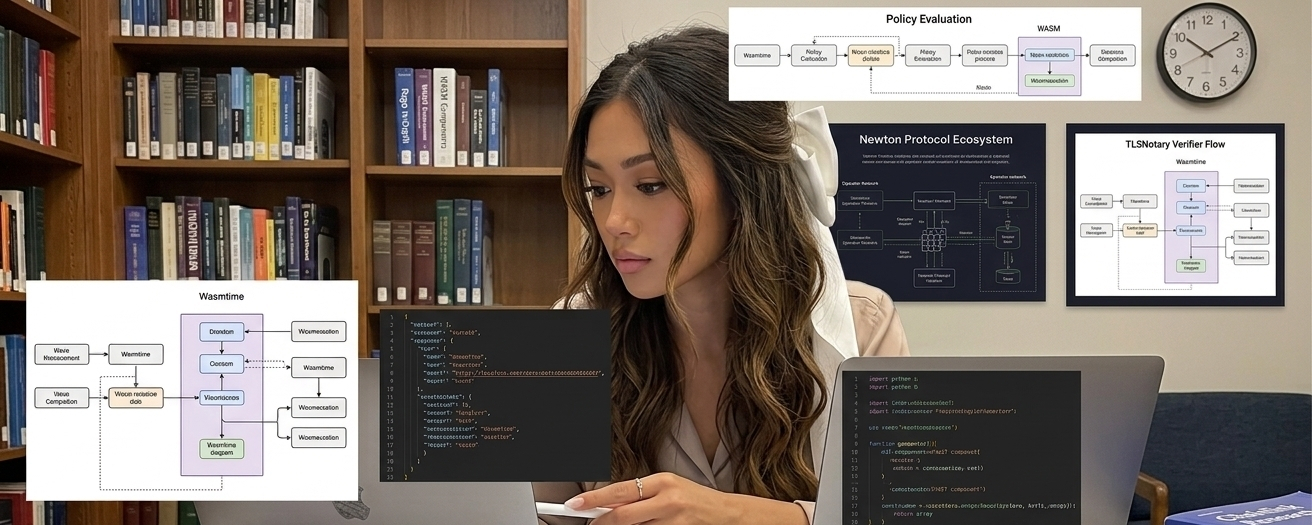
Custom data oracles sound powerful until you actually write one.@NewtonProtocol lets anyone ship WebAssembly code that pulls external data straight into Rego policies. The claim is simple: this makes on-chain decisions as flexible as off-chain APIs without giving up verifiable execution. In practice, it shifts the work and the risks to whoever maintains that WASM component. $NEWT
I spent time with their docs and examples. Here’s what stands out when you try to use it for something real.
How the Oracle Flow Actually Works
You write a small program (mostly JavaScript right now) that implements run. It receives JSON, can call HTTP via the host, optionally reads secrets, and returns JSON that lands in your policy as data.wasm.
The network runs it in sandboxed Wasmtime during policy evaluation. No private IPs, no unlimited compute. TLSNotary support is new and interesting for pulling authenticated web data without the usual 1 MiB WASM limit.
Evidence that this actually ships: $ARX
The WIT interface is explicit: one newton-provider.wit file defines http fetch, secrets, and tlsn verification.
Build step is straightforward with jco: jco componentize turns your JS into a policy.wasm component with the right imports.
Schemas are required: wasm_args_schema.json catches bad inputs before they hit the chain; params_schema.json feeds configurable thresholds into Rego as data.params.*.
Testing is local-first via newton-cli simulate, then RPC for newt_simulatePolicyData.
Numbers from the setup: HTTP responses are capped reasonably, IPFS downloads for TLSNotary proofs up to 5 MiB, and the whole thing runs per-task evaluation. That keeps costs predictable compared to always-on indexers.
One Practical TensionTension $BEAT
The real friction is ownership. You get to decide exactly what data your policy sees price from a specific endpoint, treasury yield, on-chain vault state, whatever. But now you also own the fetch logic, error handling, and update cadence.
If the external API changes its response shape tomorrow, your oracle breaks silently until you recompile and redeploy the WASM. Policies that depend on it either fail closed or fall back. That’s different from trusting a centralized oracle feed that someone else maintains.
What actually works well right now:
Quick prototypes: parse an args object, hit one public endpoint, return structured fields. The JS example in the docs does exactly this for a price feed.
TLSNotary path for higher assurance: verify-from-cid lets the host handle download and verification, then you get server-name, timestamp, transcripts, and notary fingerprint.
Schema validation upfront: malformed wasm_args get rejected before gas is spent.
Risks worth listing:
Smart contract/component risk: the WASM runs in the operator network, but a bug in your run, function can feed bad data to the Rego policy. Audits on the oracle itself are on you.
Sustainability and change risk: external data sources can alter terms, deprecate endpoints, or throttle. Your oracle’s APY-like reliability (how often it succeeds) depends on things you don’t control. Withdrawal or policy update conditions become important when data freshness matters.
Quick Checklist I’d Verify Before Relying on One
Source of yield/data: Is it one API or multiple? Who ultimately pays or hosts it?
Update mechanism: How do you roll a new WASM? Is there on-chain versioning or just IPFS replace?
Can parameters change instantly: policy thresholds vs oracle logic.
Withdrawal / failure mode: what happens to pending tasks if the oracle returns err?
Audits and reproducibility: has the component been reviewed? Can others recompile from source?
Newton gives you the tools WIT contract, host functions, CLI testing but doesn’t remove the maintenance load. That feels honest. Many oracle systems hide this behind “just call our feed.” Here the transparency is built in: you see exactly what code runs because you wrote (or reviewed) the WASM.
Deeper Observation on Policy + Data Separation
Separating the data fetch (WASM) from the decision logic (Rego) is clean on paper. Rego stays pure and auditable; the oracle handles the messy world. In practice it forces clearer thinking: what inputs does my policy actually need? Which fields are optional?
I like that secrets are scoped and fetched inside the oracle, not passed in cleartext. And the new TLSNotary bits address the “how do I trust this web response” question that every custom oracle eventually hits.
Still, there’s an unfinished edge. If your use case needs frequent updates or multiple data sources, you’ll be rebuilding and testing WASM components regularly. The docs point to Rust and Python options too, which might help for performance or library access, but the deployment surface stays the same.
Takeaway: Newton’s data oracles trade central trust for personal responsibility. The power is real if you keep the component small and well-tested.
The tension lingers on how many teams will actually maintain their own oracles long-term versus leaning on shared ones. Worth watching which pattern wins once more projects ship policies.
#Newt #NewtonProtocol #NEWTtoken #NEWTUSD
Custom data oracles sound powerful until you actually write one.
@NewtonProtocol lets anyone ship WebAssembly code that pulls external data straight into Rego policies. The claim is simple: this makes on-chain decisions as flexible as off-chain APIs without giving up verifiable execution. In practice, it shifts the work and the risks to whoever maintains that WASM component. $NEWT
I spent time with their docs and examples. Here’s what stands out when you try to use it for something real.
How the Oracle Flow Actually Works
You write a small program (mostly JavaScript right now) that implements run. It receives JSON, can call HTTP via the host, optionally reads secrets, and returns JSON that lands in your policy as data.wasm.
The network runs it in sandboxed Wasmtime during policy evaluation. No private IPs, no unlimited compute. TLSNotary support is new and interesting for pulling authenticated web data without the usual 1 MiB WASM limit.
Evidence that this actually ships: $ARX
The WIT interface is explicit: one newton-provider.wit file defines http fetch, secrets, and tlsn verification.
Build step is straightforward with jco: jco componentize turns your JS into a policy.wasm component with the right imports.
Schemas are required: wasm_args_schema.json catches bad inputs before they hit the chain; params_schema.json feeds configurable thresholds into Rego as data.params.*.
Testing is local-first via newton-cli simulate, then RPC for newt_simulatePolicyData.
Numbers from the setup: HTTP responses are capped reasonably, IPFS downloads for TLSNotary proofs up to 5 MiB, and the whole thing runs per-task evaluation. That keeps costs predictable compared to always-on indexers.
One Practical TensionTension $BEAT
The real friction is ownership. You get to decide exactly what data your policy sees price from a specific endpoint, treasury yield, on-chain vault state, whatever. But now you also own the fetch logic, error handling, and update cadence.
If the external API changes its response shape tomorrow, your oracle breaks silently until you recompile and redeploy the WASM. Policies that depend on it either fail closed or fall back. That’s different from trusting a centralized oracle feed that someone else maintains.
What actually works well right now:
Quick prototypes: parse an args object, hit one public endpoint, return structured fields. The JS example in the docs does exactly this for a price feed.
TLSNotary path for higher assurance: verify-from-cid lets the host handle download and verification, then you get server-name, timestamp, transcripts, and notary fingerprint.
Schema validation upfront: malformed wasm_args get rejected before gas is spent.
Risks worth listing:
Smart contract/component risk: the WASM runs in the operator network, but a bug in your run, function can feed bad data to the Rego policy. Audits on the oracle itself are on you.
Sustainability and change risk: external data sources can alter terms, deprecate endpoints, or throttle. Your oracle’s APY-like reliability (how often it succeeds) depends on things you don’t control. Withdrawal or policy update conditions become important when data freshness matters.
Quick Checklist I’d Verify Before Relying on One
Source of yield/data: Is it one API or multiple? Who ultimately pays or hosts it?
Update mechanism: How do you roll a new WASM? Is there on-chain versioning or just IPFS replace?
Can parameters change instantly: policy thresholds vs oracle logic.
Withdrawal / failure mode: what happens to pending tasks if the oracle returns err?
Audits and reproducibility: has the component been reviewed? Can others recompile from source?
Newton gives you the tools WIT contract, host functions, CLI testing but doesn’t remove the maintenance load. That feels honest. Many oracle systems hide this behind “just call our feed.” Here the transparency is built in: you see exactly what code runs because you wrote (or reviewed) the WASM.
Deeper Observation on Policy + Data Separation
Separating the data fetch (WASM) from the decision logic (Rego) is clean on paper. Rego stays pure and auditable; the oracle handles the messy world. In practice it forces clearer thinking: what inputs does my policy actually need? Which fields are optional?
I like that secrets are scoped and fetched inside the oracle, not passed in cleartext. And the new TLSNotary bits address the “how do I trust this web response” question that every custom oracle eventually hits.
Still, there’s an unfinished edge. If your use case needs frequent updates or multiple data sources, you’ll be rebuilding and testing WASM components regularly. The docs point to Rust and Python options too, which might help for performance or library access, but the deployment surface stays the same.
Takeaway: Newton’s data oracles trade central trust for personal responsibility. The power is real if you keep the component small and well-tested.
The tension lingers on how many teams will actually maintain their own oracles long-term versus leaning on shared ones. Worth watching which pattern wins once more projects ship policies.
#Newt #NewtonProtocol #NEWTtoken #NEWTUSD
I spent time with their docs and examples. Here’s what stands out when you try to use it for something real.
How the Oracle Flow Actually Works
You write a small program (mostly JavaScript right now) that implements run. It receives JSON, can call HTTP via the host, optionally reads secrets, and returns JSON that lands in your policy as data.wasm.
The network runs it in sandboxed Wasmtime during policy evaluation. No private IPs, no unlimited compute. TLSNotary support is new and interesting for pulling authenticated web data without the usual 1 MiB WASM limit.
Evidence that this actually ships: $ARX
The WIT interface is explicit: one newton-provider.wit file defines http fetch, secrets, and tlsn verification.
Build step is straightforward with jco: jco componentize turns your JS into a policy.wasm component with the right imports.
Schemas are required: wasm_args_schema.json catches bad inputs before they hit the chain; params_schema.json feeds configurable thresholds into Rego as data.params.*.
Testing is local-first via newton-cli simulate, then RPC for newt_simulatePolicyData.
Numbers from the setup: HTTP responses are capped reasonably, IPFS downloads for TLSNotary proofs up to 5 MiB, and the whole thing runs per-task evaluation. That keeps costs predictable compared to always-on indexers.
One Practical TensionTension $BEAT
The real friction is ownership. You get to decide exactly what data your policy sees price from a specific endpoint, treasury yield, on-chain vault state, whatever. But now you also own the fetch logic, error handling, and update cadence.
If the external API changes its response shape tomorrow, your oracle breaks silently until you recompile and redeploy the WASM. Policies that depend on it either fail closed or fall back. That’s different from trusting a centralized oracle feed that someone else maintains.
What actually works well right now:
Quick prototypes: parse an args object, hit one public endpoint, return structured fields. The JS example in the docs does exactly this for a price feed.
TLSNotary path for higher assurance: verify-from-cid lets the host handle download and verification, then you get server-name, timestamp, transcripts, and notary fingerprint.
Schema validation upfront: malformed wasm_args get rejected before gas is spent.
Risks worth listing:
Smart contract/component risk: the WASM runs in the operator network, but a bug in your run, function can feed bad data to the Rego policy. Audits on the oracle itself are on you.
Sustainability and change risk: external data sources can alter terms, deprecate endpoints, or throttle. Your oracle’s APY-like reliability (how often it succeeds) depends on things you don’t control. Withdrawal or policy update conditions become important when data freshness matters.
Quick Checklist I’d Verify Before Relying on One
Source of yield/data: Is it one API or multiple? Who ultimately pays or hosts it?
Update mechanism: How do you roll a new WASM? Is there on-chain versioning or just IPFS replace?
Can parameters change instantly: policy thresholds vs oracle logic.
Withdrawal / failure mode: what happens to pending tasks if the oracle returns err?
Audits and reproducibility: has the component been reviewed? Can others recompile from source?
Newton gives you the tools WIT contract, host functions, CLI testing but doesn’t remove the maintenance load. That feels honest. Many oracle systems hide this behind “just call our feed.” Here the transparency is built in: you see exactly what code runs because you wrote (or reviewed) the WASM.
Deeper Observation on Policy + Data Separation
Separating the data fetch (WASM) from the decision logic (Rego) is clean on paper. Rego stays pure and auditable; the oracle handles the messy world. In practice it forces clearer thinking: what inputs does my policy actually need? Which fields are optional?
I like that secrets are scoped and fetched inside the oracle, not passed in cleartext. And the new TLSNotary bits address the “how do I trust this web response” question that every custom oracle eventually hits.
Still, there’s an unfinished edge. If your use case needs frequent updates or multiple data sources, you’ll be rebuilding and testing WASM components regularly. The docs point to Rust and Python options too, which might help for performance or library access, but the deployment surface stays the same.
Takeaway: Newton’s data oracles trade central trust for personal responsibility. The power is real if you keep the component small and well-tested.
The tension lingers on how many teams will actually maintain their own oracles long-term versus leaning on shared ones. Worth watching which pattern wins once more projects ship policies.
#Newt #NewtonProtocol #NEWTtoken #NEWTUSD
47
1
35
547
·
--
Bearish
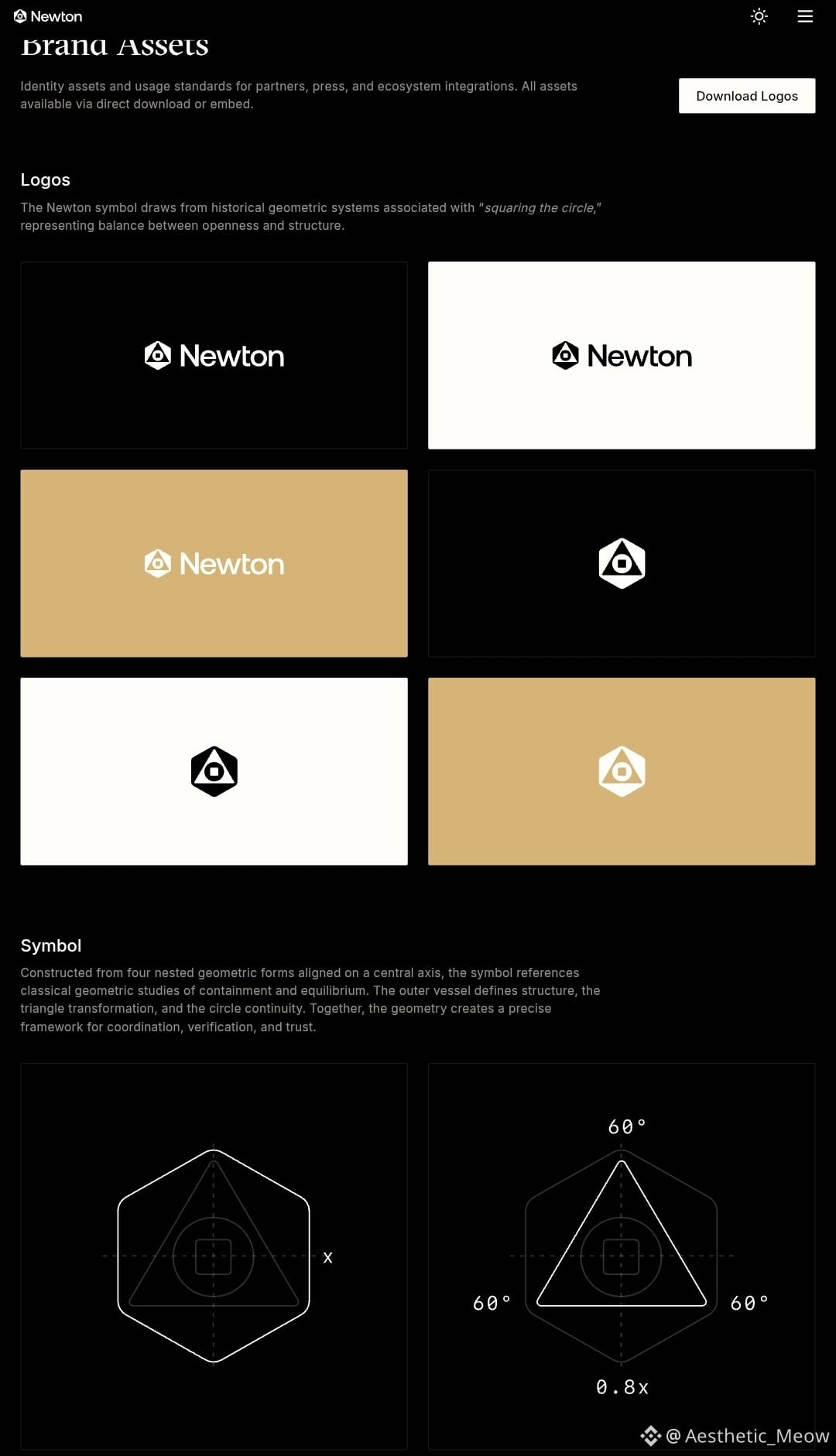
@NewtonProtocol 's logo has a number hiding in it that most brand pages never bother to explain.
0.8x. That's the ratio between the triangle and the hexagon in Newton's mark. Not 0.75, not "roughly proportional." A specific decimal, called out in their own construction diagram, next to three 60° angles.
Most brand kits stop at "here's our logo, don't stretch it." #Newt went further, they published the actual geometry: hexagon (structure) containing a triangle (transformation) containing a circle (continuity) containing a square. Four forms, one axis, one ratio.
Here's the tension: that level of precision only matters if someone's going to reproduce the mark by hand or code, think SVG generation, dynamic app icons, partner co-branding at odd sizes. For 95% of people downloading a logo pack, 0.8x is trivia. $NEWT
So why show it? My guess: it's a trust signal aimed at technical partners, not designers. "We've thought about this down to the decimal" reads differently to an engineering team evaluating an integration than to a marketer picking a header image.
Small thing. But it tells you who Newton's brand page is actually written for. Not press. Not casual users. Whoever's going to embed that hexagon in a codebase and needs it to look right at 16px and 400px both.
Worth checking if your own brand assets do this or if "don't stretch the logo" is as far as anyone got.
#NEWTtoken #NEWTUSDT #NewtonProtocol
@NewtonProtocol 's logo has a number hiding in it that most brand pages never bother to explain.
0.8x. That's the ratio between the triangle and the hexagon in Newton's mark. Not 0.75, not "roughly proportional." A specific decimal, called out in their own construction diagram, next to three 60° angles.
Most brand kits stop at "here's our logo, don't stretch it." #Newt went further, they published the actual geometry: hexagon (structure) containing a triangle (transformation) containing a circle (continuity) containing a square. Four forms, one axis, one ratio.
Here's the tension: that level of precision only matters if someone's going to reproduce the mark by hand or code, think SVG generation, dynamic app icons, partner co-branding at odd sizes. For 95% of people downloading a logo pack, 0.8x is trivia. $NEWT
So why show it? My guess: it's a trust signal aimed at technical partners, not designers. "We've thought about this down to the decimal" reads differently to an engineering team evaluating an integration than to a marketer picking a header image.
Small thing. But it tells you who Newton's brand page is actually written for. Not press. Not casual users. Whoever's going to embed that hexagon in a codebase and needs it to look right at 16px and 400px both.
Worth checking if your own brand assets do this or if "don't stretch the logo" is as far as anyone got.
#NEWTtoken #NEWTUSDT #NewtonProtocol
0.8x. That's the ratio between the triangle and the hexagon in Newton's mark. Not 0.75, not "roughly proportional." A specific decimal, called out in their own construction diagram, next to three 60° angles.
Most brand kits stop at "here's our logo, don't stretch it." #Newt went further, they published the actual geometry: hexagon (structure) containing a triangle (transformation) containing a circle (continuity) containing a square. Four forms, one axis, one ratio.
Here's the tension: that level of precision only matters if someone's going to reproduce the mark by hand or code, think SVG generation, dynamic app icons, partner co-branding at odd sizes. For 95% of people downloading a logo pack, 0.8x is trivia. $NEWT
So why show it? My guess: it's a trust signal aimed at technical partners, not designers. "We've thought about this down to the decimal" reads differently to an engineering team evaluating an integration than to a marketer picking a header image.
Small thing. But it tells you who Newton's brand page is actually written for. Not press. Not casual users. Whoever's going to embed that hexagon in a codebase and needs it to look right at 16px and 400px both.
Worth checking if your own brand assets do this or if "don't stretch the logo" is as far as anyone got.
#NEWTtoken #NEWTUSDT #NewtonProtocol

137
52
433

·
--
#newt $NEWT
#NEWTtoken
$NEWT
@NewtonProtocol
Newton Protocol (NEWT) is an ERC-20 token built on the Ethereum blockchain. It powers an on-chain automation and agent marketplace ecosystem. NEWT tokens are used for transaction fees, staking, agent collateral, and network governance. [1, 2]
Key token details:
Current Price: ~$0.05
Max/Total Supply: 1,000,000,000 NEWT
#newt $NEWT
#NEWTtoken
$NEWT
@NewtonProtocol
Newton Protocol (NEWT) is an ERC-20 token built on the Ethereum blockchain. It powers an on-chain automation and agent marketplace ecosystem. NEWT tokens are used for transaction fees, staking, agent collateral, and network governance. [1, 2]
Key token details:
Current Price: ~$0.05
Max/Total Supply: 1,000,000,000 NEWT
#NEWTtoken
$NEWT
@NewtonProtocol
Newton Protocol (NEWT) is an ERC-20 token built on the Ethereum blockchain. It powers an on-chain automation and agent marketplace ecosystem. NEWT tokens are used for transaction fees, staking, agent collateral, and network governance. [1, 2]
Key token details:
Current Price: ~$0.05
Max/Total Supply: 1,000,000,000 NEWT
90

·
--
#newt $NEWT
@NewtonProtocol
#NEWTtoken
The NEWT token refers to the native utility token of the Newton Protocol—a decentralized computing and on-chain policy layer designed for autonomous AI financial agents.NEWT Tokenomics & Use CasesGas & Transactions: NEWT is used to pay transaction and policy computation fees on the network.Network Security: Holders can stake NEWT as collateral to run nodes, validate transactions, and secure the protocol.Model Registry & Rewards: Agent operators stake NEWT to guarantee the integrity of their automated services and retrieve multi-chain computational data.Governance: Staked tokens give users DAO voting rights on protocol upgrades.
#newt $NEWT
@NewtonProtocol
#NEWTtoken
The NEWT token refers to the native utility token of the Newton Protocol—a decentralized computing and on-chain policy layer designed for autonomous AI financial agents.NEWT Tokenomics & Use CasesGas & Transactions: NEWT is used to pay transaction and policy computation fees on the network.Network Security: Holders can stake NEWT as collateral to run nodes, validate transactions, and secure the protocol.Model Registry & Rewards: Agent operators stake NEWT to guarantee the integrity of their automated services and retrieve multi-chain computational data.Governance: Staked tokens give users DAO voting rights on protocol upgrades.
@NewtonProtocol
#NEWTtoken
The NEWT token refers to the native utility token of the Newton Protocol—a decentralized computing and on-chain policy layer designed for autonomous AI financial agents.NEWT Tokenomics & Use CasesGas & Transactions: NEWT is used to pay transaction and policy computation fees on the network.Network Security: Holders can stake NEWT as collateral to run nodes, validate transactions, and secure the protocol.Model Registry & Rewards: Agent operators stake NEWT to guarantee the integrity of their automated services and retrieve multi-chain computational data.Governance: Staked tokens give users DAO voting rights on protocol upgrades.
127
Article
Newton Says The Market Is Finally Ready For It. I'm Not so Sure The Market Asked.@NewtonProtocol pitches itself as the "authorization layer" onchain finance has been missing, the compliance and policy layer that sits between public liquidity and private execution. That's the claim. Three forces, according to the whitepaper: regulation just got specific, institutional money is already here, and AI agents are about to start transacting on their own. #Newt says it's built for exactly that moment.
Worth noting upfront: this isn't a yield product. No APY, no lock period, no payout schedule to check. This is infrastructure, so the risk questions are different, but they're not lighter.
What $NEWT actually claims (fact, from the whitepaper):
Cites the $GENIUS Act, Hong Kong's Stablecoin Ordinance, MiCA, and FATF guidance as proof regulatory frameworks have "crystallized", meaning institutions now know the rules, they just lack tooling to comply at the transaction level.
States stablecoin supply has crossed $298 billion and tokenized assets have exceeded $19 billion, as evidence institutional onchain demand is real.
Describes a "Public Liquidity, Private Execution" model, liquidity stays on public chains, but compliance checks, identity checks, and risk evaluation happen in a private layer before a transaction settles.
Lists its technical stack: EigenLayer for economic security, OPA/Rego for policy logic, BLS signature aggregation, zero-knowledge VMs for dispute resolution, NATS for messaging, and HPKE-based encryption designed to migrate to post-quantum cryptography later.
That's a lot of pieces. Individually each one is a real, established technology. EigenLayer is a restaking framework, it lets staked crypto be reused to secure other systems, not just one blockchain. OPA/Rego is a widely used enterprise policy language, the kind banks and cloud providers already run. So the ingredients aren't vapor. The question is whether stitching them together actually produces what the paper says it produces.
My opinion, not fact: the "why now" argument is doing a lot of work that the paper itself hasn't earned yet.
Saying regulation crystallized doesn't mean Newton is the thing regulators will accept as proof of compliance. Saying institutional demand exists doesn't mean institutions will route that demand through Newton specifically. The whitepaper is arguing timing, not adoption. Those are different claims, and only one of them is Newton's to prove.
What I'd actually verify before taking any of this seriously:
Who audits Newton's policy evaluation engine, and has that audit happened yet — or is it planned.
Whether any regulator or compliance body has actually recognized Newton's "audit evidence" as satisfying a real framework, or if that's aspirational language.
Who runs the nodes doing policy evaluation, and what stops them from being a single point of failure or censorship.
Whether "Public Liquidity, Private Execution" means anything concrete yet, or if it's still a design thesis with no live implementation.
How Newton makes money, and whether that incentive lines up with strict compliance or with maximizing transaction throughput.
None of that is answered in the two pages I read. Might be answered elsewhere in the paper. But a "why now" section is exactly the kind of writing that should come with proof, and instead it comes with adjacent facts, real stablecoin numbers, real regulatory acronyms, stitched next to a product that hasn't shown its own numbers yet.
Risk framing, since infrastructure has its own version of smart contract risk:
Composability risk, Newton wants to be the layer everything else builds on top of. If it has a flaw or gets forked around, its entire pitch of "no walled gardens" comes with a paradox: something has to gatekeep who can bypass Newton's rules, or it's not actually enforcing anything.
Regulatory risk, inverted; Newton is betting regulation stays "crystallized" in a form its architecture can serve. Rules change. If the next iteration of MiCA or FATF guidance wants something Newton's model can't do, the whole "why now" argument ages badly, fast.
The AI agent argument is the part I keep coming back to. "Machine-speed transactions require machine-speed authorization" sounds right. But machine-speed authorization also means machine-speed mistakes, and the paper doesn't spend much time on what happens when a policy engine approves something it shouldn't at scale, in milliseconds, before any human notices.
Newton isn't claiming to be a blockchain. Isn't claiming to be a wallet. It's claiming to be the layer everyone routes through, which is either a genuinely smart bet on where onchain finance is headed, or the classic infrastructure-of-everything pitch that every cycle produces two or three of, and most quietly disappear.
The technical stack is credible. The timing argument is plausible. What's missing from what I've seen so far is proof that anyone with actual compliance obligations has chosen Newton over building their own stack or using something already in production. Until that shows up, "why now" is a thesis, not a track record.
Newt's whitepaper reads like it was written for regulators and institutions as the target audience, which is a fair strategy if that's genuinely who's evaluating it. But it also means the retail-facing story, why should anyone using Newton, or building on it, trust the authorization layer over the alternative of just... not needing one, isn't really addressed yet.
Takeaway: Newton's pitch is timing plus infrastructure, not traction, worth watching, not worth trusting yet.
Still haven't found anything that tells me who's actually running policy checks through this today, if anyone is.
$ETH #NEWTtoken #NEWTUSDT #Newtcoin
Newton Says The Market Is Finally Ready For It. I'm Not so Sure The Market Asked.
@NewtonProtocol pitches itself as the "authorization layer" onchain finance has been missing, the compliance and policy layer that sits between public liquidity and private execution. That's the claim. Three forces, according to the whitepaper: regulation just got specific, institutional money is already here, and AI agents are about to start transacting on their own. #Newt says it's built for exactly that moment.
Worth noting upfront: this isn't a yield product. No APY, no lock period, no payout schedule to check. This is infrastructure, so the risk questions are different, but they're not lighter.
What $NEWT actually claims (fact, from the whitepaper):
Cites the $GENIUS Act, Hong Kong's Stablecoin Ordinance, MiCA, and FATF guidance as proof regulatory frameworks have "crystallized", meaning institutions now know the rules, they just lack tooling to comply at the transaction level.
States stablecoin supply has crossed $298 billion and tokenized assets have exceeded $19 billion, as evidence institutional onchain demand is real.
Describes a "Public Liquidity, Private Execution" model, liquidity stays on public chains, but compliance checks, identity checks, and risk evaluation happen in a private layer before a transaction settles.
Lists its technical stack: EigenLayer for economic security, OPA/Rego for policy logic, BLS signature aggregation, zero-knowledge VMs for dispute resolution, NATS for messaging, and HPKE-based encryption designed to migrate to post-quantum cryptography later.
That's a lot of pieces. Individually each one is a real, established technology. EigenLayer is a restaking framework, it lets staked crypto be reused to secure other systems, not just one blockchain. OPA/Rego is a widely used enterprise policy language, the kind banks and cloud providers already run. So the ingredients aren't vapor. The question is whether stitching them together actually produces what the paper says it produces.
My opinion, not fact: the "why now" argument is doing a lot of work that the paper itself hasn't earned yet.
Saying regulation crystallized doesn't mean Newton is the thing regulators will accept as proof of compliance. Saying institutional demand exists doesn't mean institutions will route that demand through Newton specifically. The whitepaper is arguing timing, not adoption. Those are different claims, and only one of them is Newton's to prove.
What I'd actually verify before taking any of this seriously:
Who audits Newton's policy evaluation engine, and has that audit happened yet — or is it planned.
Whether any regulator or compliance body has actually recognized Newton's "audit evidence" as satisfying a real framework, or if that's aspirational language.
Who runs the nodes doing policy evaluation, and what stops them from being a single point of failure or censorship.
Whether "Public Liquidity, Private Execution" means anything concrete yet, or if it's still a design thesis with no live implementation.
How Newton makes money, and whether that incentive lines up with strict compliance or with maximizing transaction throughput.
None of that is answered in the two pages I read. Might be answered elsewhere in the paper. But a "why now" section is exactly the kind of writing that should come with proof, and instead it comes with adjacent facts, real stablecoin numbers, real regulatory acronyms, stitched next to a product that hasn't shown its own numbers yet.
Risk framing, since infrastructure has its own version of smart contract risk:
Composability risk, Newton wants to be the layer everything else builds on top of. If it has a flaw or gets forked around, its entire pitch of "no walled gardens" comes with a paradox: something has to gatekeep who can bypass Newton's rules, or it's not actually enforcing anything.
Regulatory risk, inverted; Newton is betting regulation stays "crystallized" in a form its architecture can serve. Rules change. If the next iteration of MiCA or FATF guidance wants something Newton's model can't do, the whole "why now" argument ages badly, fast.
The AI agent argument is the part I keep coming back to. "Machine-speed transactions require machine-speed authorization" sounds right. But machine-speed authorization also means machine-speed mistakes, and the paper doesn't spend much time on what happens when a policy engine approves something it shouldn't at scale, in milliseconds, before any human notices.
Newton isn't claiming to be a blockchain. Isn't claiming to be a wallet. It's claiming to be the layer everyone routes through, which is either a genuinely smart bet on where onchain finance is headed, or the classic infrastructure-of-everything pitch that every cycle produces two or three of, and most quietly disappear.
The technical stack is credible. The timing argument is plausible. What's missing from what I've seen so far is proof that anyone with actual compliance obligations has chosen Newton over building their own stack or using something already in production. Until that shows up, "why now" is a thesis, not a track record.
Newt's whitepaper reads like it was written for regulators and institutions as the target audience, which is a fair strategy if that's genuinely who's evaluating it. But it also means the retail-facing story, why should anyone using Newton, or building on it, trust the authorization layer over the alternative of just... not needing one, isn't really addressed yet.
Takeaway: Newton's pitch is timing plus infrastructure, not traction, worth watching, not worth trusting yet.
Still haven't found anything that tells me who's actually running policy checks through this today, if anyone is.
$ETH #NEWTtoken #NEWTUSDT #Newtcoin
Worth noting upfront: this isn't a yield product. No APY, no lock period, no payout schedule to check. This is infrastructure, so the risk questions are different, but they're not lighter.
What $NEWT actually claims (fact, from the whitepaper):
Cites the $GENIUS Act, Hong Kong's Stablecoin Ordinance, MiCA, and FATF guidance as proof regulatory frameworks have "crystallized", meaning institutions now know the rules, they just lack tooling to comply at the transaction level.
States stablecoin supply has crossed $298 billion and tokenized assets have exceeded $19 billion, as evidence institutional onchain demand is real.
Describes a "Public Liquidity, Private Execution" model, liquidity stays on public chains, but compliance checks, identity checks, and risk evaluation happen in a private layer before a transaction settles.
Lists its technical stack: EigenLayer for economic security, OPA/Rego for policy logic, BLS signature aggregation, zero-knowledge VMs for dispute resolution, NATS for messaging, and HPKE-based encryption designed to migrate to post-quantum cryptography later.
That's a lot of pieces. Individually each one is a real, established technology. EigenLayer is a restaking framework, it lets staked crypto be reused to secure other systems, not just one blockchain. OPA/Rego is a widely used enterprise policy language, the kind banks and cloud providers already run. So the ingredients aren't vapor. The question is whether stitching them together actually produces what the paper says it produces.
My opinion, not fact: the "why now" argument is doing a lot of work that the paper itself hasn't earned yet.
Saying regulation crystallized doesn't mean Newton is the thing regulators will accept as proof of compliance. Saying institutional demand exists doesn't mean institutions will route that demand through Newton specifically. The whitepaper is arguing timing, not adoption. Those are different claims, and only one of them is Newton's to prove.
What I'd actually verify before taking any of this seriously:
Who audits Newton's policy evaluation engine, and has that audit happened yet — or is it planned.
Whether any regulator or compliance body has actually recognized Newton's "audit evidence" as satisfying a real framework, or if that's aspirational language.
Who runs the nodes doing policy evaluation, and what stops them from being a single point of failure or censorship.
Whether "Public Liquidity, Private Execution" means anything concrete yet, or if it's still a design thesis with no live implementation.
How Newton makes money, and whether that incentive lines up with strict compliance or with maximizing transaction throughput.
None of that is answered in the two pages I read. Might be answered elsewhere in the paper. But a "why now" section is exactly the kind of writing that should come with proof, and instead it comes with adjacent facts, real stablecoin numbers, real regulatory acronyms, stitched next to a product that hasn't shown its own numbers yet.
Risk framing, since infrastructure has its own version of smart contract risk:
Composability risk, Newton wants to be the layer everything else builds on top of. If it has a flaw or gets forked around, its entire pitch of "no walled gardens" comes with a paradox: something has to gatekeep who can bypass Newton's rules, or it's not actually enforcing anything.
Regulatory risk, inverted; Newton is betting regulation stays "crystallized" in a form its architecture can serve. Rules change. If the next iteration of MiCA or FATF guidance wants something Newton's model can't do, the whole "why now" argument ages badly, fast.
The AI agent argument is the part I keep coming back to. "Machine-speed transactions require machine-speed authorization" sounds right. But machine-speed authorization also means machine-speed mistakes, and the paper doesn't spend much time on what happens when a policy engine approves something it shouldn't at scale, in milliseconds, before any human notices.
Newton isn't claiming to be a blockchain. Isn't claiming to be a wallet. It's claiming to be the layer everyone routes through, which is either a genuinely smart bet on where onchain finance is headed, or the classic infrastructure-of-everything pitch that every cycle produces two or three of, and most quietly disappear.
The technical stack is credible. The timing argument is plausible. What's missing from what I've seen so far is proof that anyone with actual compliance obligations has chosen Newton over building their own stack or using something already in production. Until that shows up, "why now" is a thesis, not a track record.
Newt's whitepaper reads like it was written for regulators and institutions as the target audience, which is a fair strategy if that's genuinely who's evaluating it. But it also means the retail-facing story, why should anyone using Newton, or building on it, trust the authorization layer over the alternative of just... not needing one, isn't really addressed yet.
Takeaway: Newton's pitch is timing plus infrastructure, not traction, worth watching, not worth trusting yet.
Still haven't found anything that tells me who's actually running policy checks through this today, if anyone is.
$ETH #NEWTtoken #NEWTUSDT #Newtcoin
37
31
497

Article
Visa for Crypto Transactions—but Does Anyone Actually Need That?@NewtonProtocol says it can fix that, by making every transaction pass a live risk check before it settles. Visa does this for cards. #Newt does it for wallets.
What that actually means:
· Real-time, not retrospective. Most protocols check rules after the fact (or not at all). Newton runs authorization in the mempool before state changes.
· Policy packs plug in. Curators write rules: spend caps, jurisdiction blocks, collateral ratios, sanctions screening. No custom smart contract rewrites.
· Signed proof on exit. Each decision produces an on-chain pass/fail attestation. That’s auditable, not just a black box.
· VaultKit is the hook. One SDK integration. They claim mainnet beta is already live.
Numbers I’d want to verify before trusting this:
· Latency: They say sub‑second. I haven’t seen independent benchmarks under load.
· Coverage: Which chains? EVM first, likely. Not all.
· Pricing: Not public yet. That matters because if it’s per‑tx, high‑frequency users get crushed.
Fact vs. my opinion:
· Fact: Mainnet beta is live. VaultKit is released. Partners include RedStone (oracle) and Credora (risk).
· Opinion: This is more valuable for institutional flows than retail. Retail doesn’t care about authorization latency. Treasuries and lenders do.
· Opinion: The real moat isn’t tech—it’s policy curation. Who writes the good rules? That’s the network effect.
Risks I’d flag (not FUD, just real):
· Smart contract risk in the authorization module itself, if that breaks, transactions can get stuck or falsely rejected.
· Centralization of policy authors. If only a few curators dominate, that’s a permissioned feel under a permissionless hood.
· Oracle dependency. Price‑based policies fail if RedStone lags. That’s not Newton’s fault, but it’s their problem.
What I’d check before using it:
· Can APY or fee structure change without notice?
· Who pays for the authorization gas—user or protocol?
· Is there a fallback if the authorization oracle goes down?
· Audits, who did them, and are they public?
· Can you export your policy pack if you leave?
Why I’m watching anyway:
Most “risk” layers are checkboxes. This one actually signs a verdict. That’s different. Not revolutionary but different enough to matter for onchain lending, payroll, or any flow where a bad tx costs more than a delayed one.
The tension I keep coming back to: speed vs. safety. Newton leans hard into safety. But if authorization adds 200ms and 5% failure rate on borderline txs, users will bypass it. Curators will then loosen policies until they’re meaningless. That’s the cycle I’ve seen before.
They’ve built the racecar. Now we watch if anyone drives it aggressively or if it just sits in the garage with perfect specs.
$NEWT $ETH $CL #NEWTUSDT #NEWTtoken #Newtcoin
Visa for Crypto Transactions—but Does Anyone Actually Need That?
@NewtonProtocol says it can fix that, by making every transaction pass a live risk check before it settles. Visa does this for cards. #Newt does it for wallets.
What that actually means:
· Real-time, not retrospective. Most protocols check rules after the fact (or not at all). Newton runs authorization in the mempool before state changes.
· Policy packs plug in. Curators write rules: spend caps, jurisdiction blocks, collateral ratios, sanctions screening. No custom smart contract rewrites.
· Signed proof on exit. Each decision produces an on-chain pass/fail attestation. That’s auditable, not just a black box.
· VaultKit is the hook. One SDK integration. They claim mainnet beta is already live.
Numbers I’d want to verify before trusting this:
· Latency: They say sub‑second. I haven’t seen independent benchmarks under load.
· Coverage: Which chains? EVM first, likely. Not all.
· Pricing: Not public yet. That matters because if it’s per‑tx, high‑frequency users get crushed.
Fact vs. my opinion:
· Fact: Mainnet beta is live. VaultKit is released. Partners include RedStone (oracle) and Credora (risk).
· Opinion: This is more valuable for institutional flows than retail. Retail doesn’t care about authorization latency. Treasuries and lenders do.
· Opinion: The real moat isn’t tech—it’s policy curation. Who writes the good rules? That’s the network effect.
Risks I’d flag (not FUD, just real):
· Smart contract risk in the authorization module itself, if that breaks, transactions can get stuck or falsely rejected.
· Centralization of policy authors. If only a few curators dominate, that’s a permissioned feel under a permissionless hood.
· Oracle dependency. Price‑based policies fail if RedStone lags. That’s not Newton’s fault, but it’s their problem.
What I’d check before using it:
· Can APY or fee structure change without notice?
· Who pays for the authorization gas—user or protocol?
· Is there a fallback if the authorization oracle goes down?
· Audits, who did them, and are they public?
· Can you export your policy pack if you leave?
Why I’m watching anyway:
Most “risk” layers are checkboxes. This one actually signs a verdict. That’s different. Not revolutionary but different enough to matter for onchain lending, payroll, or any flow where a bad tx costs more than a delayed one.
The tension I keep coming back to: speed vs. safety. Newton leans hard into safety. But if authorization adds 200ms and 5% failure rate on borderline txs, users will bypass it. Curators will then loosen policies until they’re meaningless. That’s the cycle I’ve seen before.
They’ve built the racecar. Now we watch if anyone drives it aggressively or if it just sits in the garage with perfect specs.
$NEWT $ETH $CL #NEWTUSDT #NEWTtoken #Newtcoin
What that actually means:
· Real-time, not retrospective. Most protocols check rules after the fact (or not at all). Newton runs authorization in the mempool before state changes.
· Policy packs plug in. Curators write rules: spend caps, jurisdiction blocks, collateral ratios, sanctions screening. No custom smart contract rewrites.
· Signed proof on exit. Each decision produces an on-chain pass/fail attestation. That’s auditable, not just a black box.
· VaultKit is the hook. One SDK integration. They claim mainnet beta is already live.
Numbers I’d want to verify before trusting this:
· Latency: They say sub‑second. I haven’t seen independent benchmarks under load.
· Coverage: Which chains? EVM first, likely. Not all.
· Pricing: Not public yet. That matters because if it’s per‑tx, high‑frequency users get crushed.
Fact vs. my opinion:
· Fact: Mainnet beta is live. VaultKit is released. Partners include RedStone (oracle) and Credora (risk).
· Opinion: This is more valuable for institutional flows than retail. Retail doesn’t care about authorization latency. Treasuries and lenders do.
· Opinion: The real moat isn’t tech—it’s policy curation. Who writes the good rules? That’s the network effect.
Risks I’d flag (not FUD, just real):
· Smart contract risk in the authorization module itself, if that breaks, transactions can get stuck or falsely rejected.
· Centralization of policy authors. If only a few curators dominate, that’s a permissioned feel under a permissionless hood.
· Oracle dependency. Price‑based policies fail if RedStone lags. That’s not Newton’s fault, but it’s their problem.
What I’d check before using it:
· Can APY or fee structure change without notice?
· Who pays for the authorization gas—user or protocol?
· Is there a fallback if the authorization oracle goes down?
· Audits, who did them, and are they public?
· Can you export your policy pack if you leave?
Why I’m watching anyway:
Most “risk” layers are checkboxes. This one actually signs a verdict. That’s different. Not revolutionary but different enough to matter for onchain lending, payroll, or any flow where a bad tx costs more than a delayed one.
The tension I keep coming back to: speed vs. safety. Newton leans hard into safety. But if authorization adds 200ms and 5% failure rate on borderline txs, users will bypass it. Curators will then loosen policies until they’re meaningless. That’s the cycle I’ve seen before.
They’ve built the racecar. Now we watch if anyone drives it aggressively or if it just sits in the garage with perfect specs.
$NEWT $ETH $CL #NEWTUSDT #NEWTtoken #Newtcoin
1
178
What changes when the transition period ends? More than most people think.
@NewtonProtocol #Newt $NEWT
Yesterday, MiCA's transition effectively closed another door. For many crypto firms, the choice is now simple: meet compliance standards or stop operating in regulated markets. That makes Newton feel much more relevant than it did a year ago.
#NEWTUSDT #NewtonProtocol
One thing I keep coming back to: Newton doesn't wait until after settlement. Newton evaluates transactions before they execute.
That changes the conversation.
3 checks that stand out: • Sanctions screening before settlement.
• Identity and policy checks before approval.
• Risk rules evaluated before state changes onchain.
That's a different model from reviewing activity after funds have already moved.
For NEWT, this isn't just about regulation. It's about whether compliance can become infrastructure instead of paperwork. If a transaction can be evaluated, authorized, and cryptographically verified before execution, institutions have something they can actually demonstrate not just document.
My takeaway: watch how Newton performs now that MiCA's transition has ended. The interesting question isn't whether regulation arrived. It's whether Newton and NEWT can prove compliance in real time, before every transaction. That's the part I'm watching.
#NEWTtoken $ETH $BIRB
What's more valuable now?
What changes when the transition period ends? More than most people think.
@NewtonProtocol #Newt $NEWT
Yesterday, MiCA's transition effectively closed another door. For many crypto firms, the choice is now simple: meet compliance standards or stop operating in regulated markets. That makes Newton feel much more relevant than it did a year ago.
#NEWTUSDT #NewtonProtocol
One thing I keep coming back to: Newton doesn't wait until after settlement. Newton evaluates transactions before they execute.
That changes the conversation.
3 checks that stand out: • Sanctions screening before settlement.
• Identity and policy checks before approval.
• Risk rules evaluated before state changes onchain.
That's a different model from reviewing activity after funds have already moved.
For NEWT, this isn't just about regulation. It's about whether compliance can become infrastructure instead of paperwork. If a transaction can be evaluated, authorized, and cryptographically verified before execution, institutions have something they can actually demonstrate not just document.
My takeaway: watch how Newton performs now that MiCA's transition has ended. The interesting question isn't whether regulation arrived. It's whether Newton and NEWT can prove compliance in real time, before every transaction. That's the part I'm watching.
#NEWTtoken $ETH $BIRB
What's more valuable now?
@NewtonProtocol #Newt $NEWT
Yesterday, MiCA's transition effectively closed another door. For many crypto firms, the choice is now simple: meet compliance standards or stop operating in regulated markets. That makes Newton feel much more relevant than it did a year ago.
#NEWTUSDT #NewtonProtocol
One thing I keep coming back to: Newton doesn't wait until after settlement. Newton evaluates transactions before they execute.
That changes the conversation.
3 checks that stand out: • Sanctions screening before settlement.
• Identity and policy checks before approval.
• Risk rules evaluated before state changes onchain.
That's a different model from reviewing activity after funds have already moved.
For NEWT, this isn't just about regulation. It's about whether compliance can become infrastructure instead of paperwork. If a transaction can be evaluated, authorized, and cryptographically verified before execution, institutions have something they can actually demonstrate not just document.
My takeaway: watch how Newton performs now that MiCA's transition has ended. The interesting question isn't whether regulation arrived. It's whether Newton and NEWT can prove compliance in real time, before every transaction. That's the part I'm watching.
#NEWTtoken $ETH $BIRB
What's more valuable now?
🚀 Growth
56%
✅ Trust
31%
💧 Liquidity
13%
16 votes • Voting closed
178
79
1.7k
·
--
Bearish
What if @NewtonProtocol didn't ask you to trust a compliance check at all?
That question changed how I looked at Newton after digging into its attestation flow.
Most systems stop at "verified."
#Newt goes one step further.
Every compliance decision can be backed by a BLS attestation, so the result is cryptographically signed instead of relying on reputation or a centralized validator.
The practical part is what caught my attention.
Only hashes and commitments are written on-chain.
Not user documents.
Not personal data.
That means one decision produces one verifiable proof while exposing 0 pieces of raw private information on-chain.
For developers, Newton also keeps things simple.
The same SDK can connect wallets, dApps, AI agents, and DeFi applications without rebuilding the verification flow every time.
My takeaway from Newton isn't that it's "more secure."
It's that the trust model changes.
Next time you evaluate a protocol, check these 3 things:
• Is the result cryptographically verifiable?
• How much user data reaches the blockchain?
• Can the same proof work across multiple applications?
That's a much harder checklist to satisfy than it sounds... and Newt seems to be aiming directly at it.
$NEWT $ETH $CL #NEWTUSDT #NEWTtoken #NewtonProtocol
What if @NewtonProtocol didn't ask you to trust a compliance check at all?
That question changed how I looked at Newton after digging into its attestation flow.
Most systems stop at "verified."
#Newt goes one step further.
Every compliance decision can be backed by a BLS attestation, so the result is cryptographically signed instead of relying on reputation or a centralized validator.
The practical part is what caught my attention.
Only hashes and commitments are written on-chain.
Not user documents.
Not personal data.
That means one decision produces one verifiable proof while exposing 0 pieces of raw private information on-chain.
For developers, Newton also keeps things simple.
The same SDK can connect wallets, dApps, AI agents, and DeFi applications without rebuilding the verification flow every time.
My takeaway from Newton isn't that it's "more secure."
It's that the trust model changes.
Next time you evaluate a protocol, check these 3 things:
• Is the result cryptographically verifiable?
• How much user data reaches the blockchain?
• Can the same proof work across multiple applications?
That's a much harder checklist to satisfy than it sounds... and Newt seems to be aiming directly at it.
$NEWT $ETH $CL #NEWTUSDT #NEWTtoken #NewtonProtocol
That question changed how I looked at Newton after digging into its attestation flow.
Most systems stop at "verified."
#Newt goes one step further.
Every compliance decision can be backed by a BLS attestation, so the result is cryptographically signed instead of relying on reputation or a centralized validator.
The practical part is what caught my attention.
Only hashes and commitments are written on-chain.
Not user documents.
Not personal data.
That means one decision produces one verifiable proof while exposing 0 pieces of raw private information on-chain.
For developers, Newton also keeps things simple.
The same SDK can connect wallets, dApps, AI agents, and DeFi applications without rebuilding the verification flow every time.
My takeaway from Newton isn't that it's "more secure."
It's that the trust model changes.
Next time you evaluate a protocol, check these 3 things:
• Is the result cryptographically verifiable?
• How much user data reaches the blockchain?
• Can the same proof work across multiple applications?
That's a much harder checklist to satisfy than it sounds... and Newt seems to be aiming directly at it.
$NEWT $ETH $CL #NEWTUSDT #NEWTtoken #NewtonProtocol
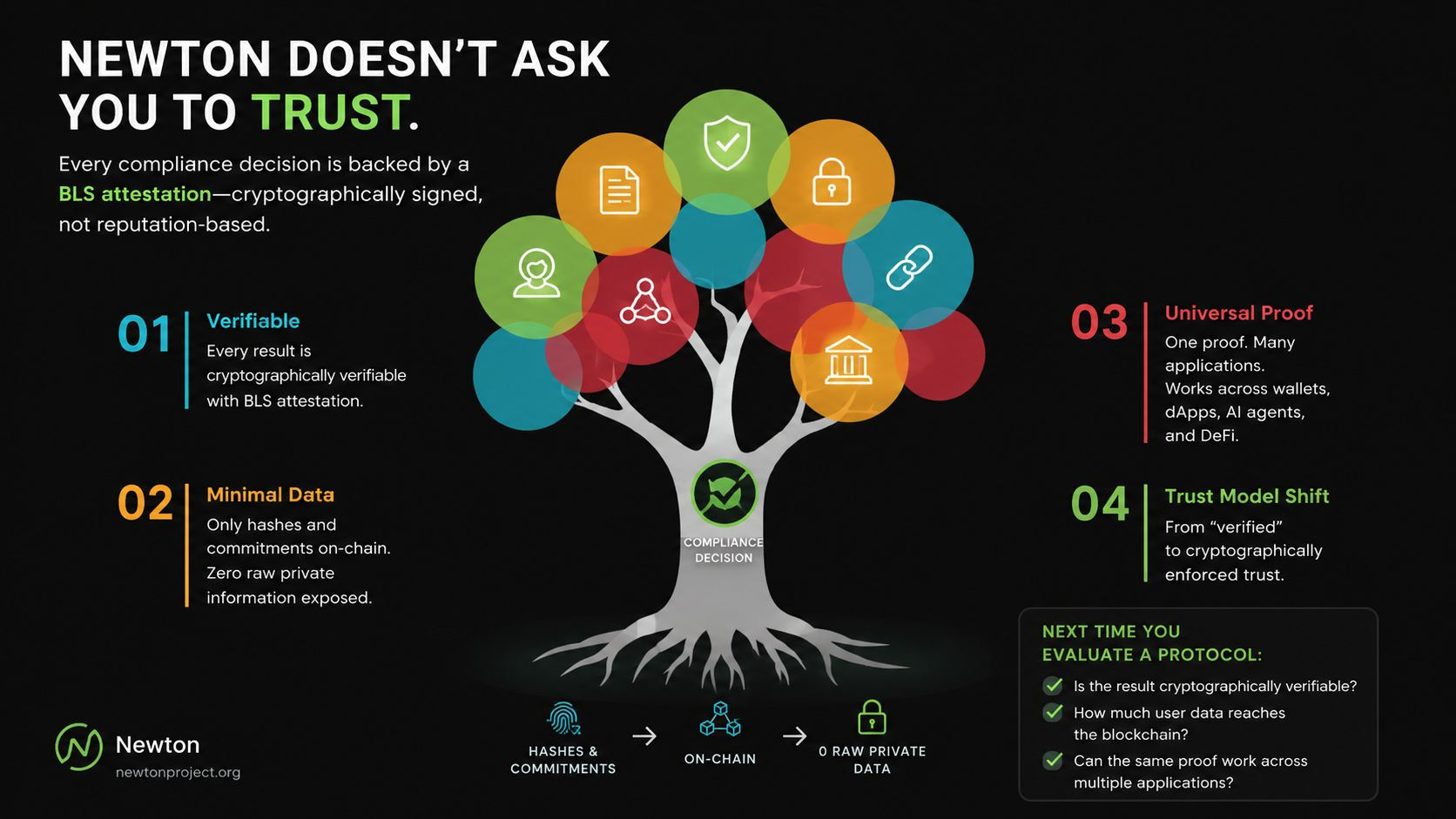
3
174

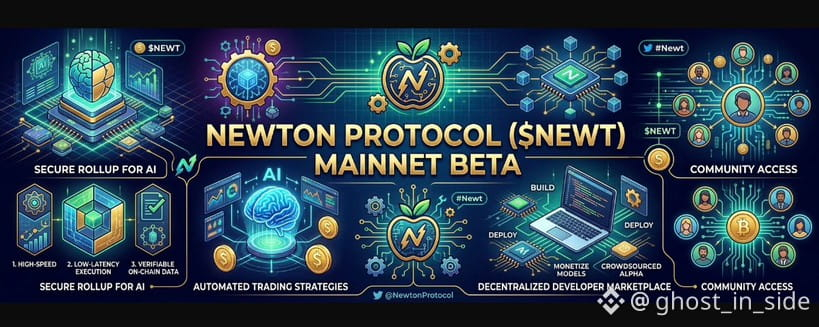
Article
Why Newton Protocol ($NEWT) is the Missing Piece for AI TradingI have been closely watching the recent developments in the crypto space, and there is one major launch that is not getting nearly enough attention. 🚨 We need to talk about the recent rollout of the Newton Mainnet Beta. If you are serious about the future of decentralized finance, this is a massive game changer. 💸
For the longest time, running complex algorithmic trades on-chain was too expensive, slow, and fragmented. 🟥 But @NewtonProtocol is completely fixing this issue. They have built a highly secure rollup that is specifically engineered for AI-based trading strategies and automated execution. ⚙️ By moving this to a dedicated, hyper-optimized layer, the latency and high gas fees that usually kill automated trading are finally eliminated. ⚡
What really caught my eye with the Newton Mainnet Beta is their new decentralized marketplace for AI developers. 🧠💻 Think about it. Smart engineers can now build, test, and directly monetize their algorithmic trading models on a verifiable network. 💵 This means you could potentially get access to institutional-grade, crowdsourced alpha. The smartest models will naturally attract the most liquidity, creating a perfect ecosystem. 🌊
I am extremely bullish on $NEWT because they are solving a real infrastructure problem. 🏗️ We are moving past the phase of just hyping up AI, and entering the phase of actual on-chain utility. 🚀 Trusting automated finance means we need secure, verifiable environments, and that is exactly what this mainnet beta delivers. 🛡️
If you are not paying attention to what is happening with #Newt right now, you might miss the infrastructure that will power the next generation of autonomous trading. 📈
What do you guys think about the mainnet beta? Are you ready to let AI run your portfolio? Let me know in the comments! 👇👀
#NEWTtoken
Why Newton Protocol ($NEWT) is the Missing Piece for AI Trading
I have been closely watching the recent developments in the crypto space, and there is one major launch that is not getting nearly enough attention. 🚨 We need to talk about the recent rollout of the Newton Mainnet Beta. If you are serious about the future of decentralized finance, this is a massive game changer. 💸
For the longest time, running complex algorithmic trades on-chain was too expensive, slow, and fragmented. 🟥 But @NewtonProtocol is completely fixing this issue. They have built a highly secure rollup that is specifically engineered for AI-based trading strategies and automated execution. ⚙️ By moving this to a dedicated, hyper-optimized layer, the latency and high gas fees that usually kill automated trading are finally eliminated. ⚡
What really caught my eye with the Newton Mainnet Beta is their new decentralized marketplace for AI developers. 🧠💻 Think about it. Smart engineers can now build, test, and directly monetize their algorithmic trading models on a verifiable network. 💵 This means you could potentially get access to institutional-grade, crowdsourced alpha. The smartest models will naturally attract the most liquidity, creating a perfect ecosystem. 🌊
I am extremely bullish on $NEWT because they are solving a real infrastructure problem. 🏗️ We are moving past the phase of just hyping up AI, and entering the phase of actual on-chain utility. 🚀 Trusting automated finance means we need secure, verifiable environments, and that is exactly what this mainnet beta delivers. 🛡️
If you are not paying attention to what is happening with #Newt right now, you might miss the infrastructure that will power the next generation of autonomous trading. 📈
What do you guys think about the mainnet beta? Are you ready to let AI run your portfolio? Let me know in the comments! 👇👀
#NEWTtoken
For the longest time, running complex algorithmic trades on-chain was too expensive, slow, and fragmented. 🟥 But @NewtonProtocol is completely fixing this issue. They have built a highly secure rollup that is specifically engineered for AI-based trading strategies and automated execution. ⚙️ By moving this to a dedicated, hyper-optimized layer, the latency and high gas fees that usually kill automated trading are finally eliminated. ⚡
What really caught my eye with the Newton Mainnet Beta is their new decentralized marketplace for AI developers. 🧠💻 Think about it. Smart engineers can now build, test, and directly monetize their algorithmic trading models on a verifiable network. 💵 This means you could potentially get access to institutional-grade, crowdsourced alpha. The smartest models will naturally attract the most liquidity, creating a perfect ecosystem. 🌊
I am extremely bullish on $NEWT because they are solving a real infrastructure problem. 🏗️ We are moving past the phase of just hyping up AI, and entering the phase of actual on-chain utility. 🚀 Trusting automated finance means we need secure, verifiable environments, and that is exactly what this mainnet beta delivers. 🛡️
If you are not paying attention to what is happening with #Newt right now, you might miss the infrastructure that will power the next generation of autonomous trading. 📈
What do you guys think about the mainnet beta? Are you ready to let AI run your portfolio? Let me know in the comments! 👇👀
#NEWTtoken
3
1
83

·
--
Newton Protocol and the Future of Blockchain Innovation@NewtonProtocol is building an interesting ecosystem focused on innovation and blockchain development. I am excited to learn more about the progress of the project and the launch of the mainnet beta. The growth of the community and the continuous updates show strong commitment to long term development and adoption. I believe that $NEWT can play an important role in the ecosystem and provide value to users and developers. It is great to see new technologies and ideas being introduced through this project. I will continue following updates from @NewtonProtocol and look forward to future developments and opportunities within the ecosystem. #newtonprocol #newttoken #newt $NEWT
Newton Protocol and the Future of Blockchain Innovation
@NewtonProtocol is building an interesting ecosystem focused on innovation and blockchain development. I am excited to learn more about the progress of the project and the launch of the mainnet beta. The growth of the community and the continuous updates show strong commitment to long term development and adoption. I believe that $NEWT can play an important role in the ecosystem and provide value to users and developers. It is great to see new technologies and ideas being introduced through this project. I will continue following updates from @NewtonProtocol and look forward to future developments and opportunities within the ecosystem. #newtonprocol #newttoken #newt $NEWT
77
@NewtonProtocol #Newt $NEWT
Can a vault enforce private rules without revealing the rules themselves? That's the question VaultKit from Magic Newton is trying to answer.
Every vault action reallocating funds, changing caps, enabling markets, or updating fees must pass a policy before it reaches the vault. If the policy approves, it executes. If not, nothing happens.
But what if the policy uses confidential data?
Magic Newton solves this with privacy-preserving computation.
Proprietary risk models, compliance checks, and investor eligibility data stay private. Only a cryptographically verifiable approval is recorded onchain.
Why does that matter?
Because institutions often can't publish their internal rulebooks. Magic Newton allows those rules to be enforced without exposing them, making onchain management more practical for regulated participants.
Another detail I found interesting is the fail-closed design. If policy evaluation fails for any reason, the transaction is denied. There is no silent bypass only a public, time-delayed override path.
Does Magic Newton replace existing vaults?
No. Magic Newton's VaultKit sits between the curator and the vault. Managers keep using their current tools while VaultKit verifies every management action.
In my view, the biggest innovation isn't another vault it's making every vault decision verifiable without sacrificing privacy.
Key takeaway: Trust is useful, but Magic Newton shows that enforceable, privacy-preserving policy checks may become the stronger standard for institutional DeFi.
#NewtonProtocol #NEWTtoken #NEWTUSDT $BEE $PALU
Would you trust a vault more if every manager action had to pass an automatic policy check?
@NewtonProtocol #Newt $NEWT
Can a vault enforce private rules without revealing the rules themselves? That's the question VaultKit from Magic Newton is trying to answer.
Every vault action reallocating funds, changing caps, enabling markets, or updating fees must pass a policy before it reaches the vault. If the policy approves, it executes. If not, nothing happens.
But what if the policy uses confidential data?
Magic Newton solves this with privacy-preserving computation.
Proprietary risk models, compliance checks, and investor eligibility data stay private. Only a cryptographically verifiable approval is recorded onchain.
Why does that matter?
Because institutions often can't publish their internal rulebooks. Magic Newton allows those rules to be enforced without exposing them, making onchain management more practical for regulated participants.
Another detail I found interesting is the fail-closed design. If policy evaluation fails for any reason, the transaction is denied. There is no silent bypass only a public, time-delayed override path.
Does Magic Newton replace existing vaults?
No. Magic Newton's VaultKit sits between the curator and the vault. Managers keep using their current tools while VaultKit verifies every management action.
In my view, the biggest innovation isn't another vault it's making every vault decision verifiable without sacrificing privacy.
Key takeaway: Trust is useful, but Magic Newton shows that enforceable, privacy-preserving policy checks may become the stronger standard for institutional DeFi.
#NewtonProtocol #NEWTtoken #NEWTUSDT $BEE $PALU
Would you trust a vault more if every manager action had to pass an automatic policy check?
Can a vault enforce private rules without revealing the rules themselves? That's the question VaultKit from Magic Newton is trying to answer.
Every vault action reallocating funds, changing caps, enabling markets, or updating fees must pass a policy before it reaches the vault. If the policy approves, it executes. If not, nothing happens.
But what if the policy uses confidential data?
Magic Newton solves this with privacy-preserving computation.
Proprietary risk models, compliance checks, and investor eligibility data stay private. Only a cryptographically verifiable approval is recorded onchain.
Why does that matter?
Because institutions often can't publish their internal rulebooks. Magic Newton allows those rules to be enforced without exposing them, making onchain management more practical for regulated participants.
Another detail I found interesting is the fail-closed design. If policy evaluation fails for any reason, the transaction is denied. There is no silent bypass only a public, time-delayed override path.
Does Magic Newton replace existing vaults?
No. Magic Newton's VaultKit sits between the curator and the vault. Managers keep using their current tools while VaultKit verifies every management action.
In my view, the biggest innovation isn't another vault it's making every vault decision verifiable without sacrificing privacy.
Key takeaway: Trust is useful, but Magic Newton shows that enforceable, privacy-preserving policy checks may become the stronger standard for institutional DeFi.
#NewtonProtocol #NEWTtoken #NEWTUSDT $BEE $PALU
Would you trust a vault more if every manager action had to pass an automatic policy check?
✅ Yes
100%
❌ No
0%
🤷 Depends on the policy
0%
📚 Need to learn more
0%
9 votes • Voting closed
49
36
256
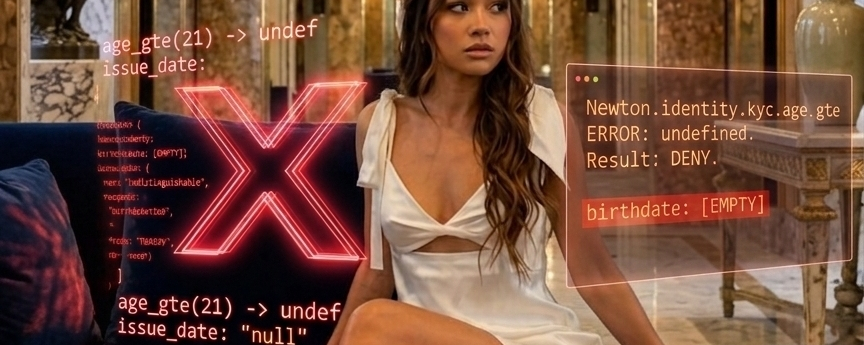
Article
What Happens When a KYC Field Is Just... Empty?I was reading through @NewtonProtocol 's identity policy docs and one line stopped me: any error in a Rego rule means the rule evaluates to undefined. And undefined gets treated as a denial.
That sounds safe. It's actually the whole story here.
The claim
Newton's identity built-ins (newton.identity.kyc.*) are fail-closed by design. If a date can't be parsed, or a country code is malformed, or an array is empty, the policy doesn't error out loudly. It just quietly denies. No exception, no crash, no "please check your data" message. Just: not authorized.
That's a deliberate compliance posture. But it also means bad input data and an actual policy violation look identical from the outside.
What the docs actually show
age_gte(min_age) checks birthdate against a reference_date. If the birthdate string can't be parsed, or the number given is negative, the function errors and the whole rule collapses to undefined.
address_in_countries(), address_in_subdivision(), and address_not_in_subdivision() all fail the same way if you pass full country names instead of ISO codes, or an empty array by mistake.
not_expired() and valid_for(min_days) both depend on expiration_date being present and parseable. Missing that field isn't a "skip this check", it's a hard no.
address_not_in_subdivision() is interesting on its own. It's built for excluding a handful of states (say, US-NY, US-HI) instead of allow-listing 48 others. Efficient. But it means one bad ISO code silently blocks users who technically qualify.
None of this is a bug. Newton is choosing denial-by-default over permissive-by-default. For KYC, that's arguably the correct instinct. Most compliance systems would rather reject a good user than approve a bad one.
The tension
Here's the part that bugs me a little.
If your integration feeds #Newt a slightly malformed issue_date, or your KYC provider hands back an empty address_subdivision, the person gets denied, same as if they were underage or from a blocked region. There's no field-level error surfaced back to the app layer that I can see in this doc. Just a boolean false, indistinguishable from a real policy fail.
For a developer debugging "why did this user get rejected," that's a genuinely annoying place to start. You can't tell, just from the policy result, whether:
the user actually failed the check, or
your data pipeline sent garbage into Newton
Same output. Very different fix.
What I'd verify before relying on this
Not a criticism, just the list I'd actually run through if I were integrating Newton:
Where does the identity data get validated before it hits the policy engine, is there a schema check upstream, or does Newton see raw KYC provider output directly?
Do failed built-in calls get logged anywhere distinguishable from legitimate denials, or does everything just show up as "not authorized" in the audit trail?
Are ISO code formats (country, subdivision) enforced at the point of data ingestion, or only checked lazily when a policy rule runs?
What happens to age_gte if birthdate is present but in a slightly different date format than expected, silent parse failure, or explicit error?
Is there a way to distinguish "denied because underage" from "denied because the date field was malformed" in whatever dashboard or logs Newton exposes?
For address_not_in_subdivision, is there a size limit on the exclusion array, and does an empty array default to allow-all or deny-all?
If the answer to most of these is "no visibility," that's not disqualifying, fail-closed is still the right default for identity. But it does mean the integration work isn't really about writing Rego rules. It's about making sure clean data reaches Newton before the policy ever runs. The policy layer is only as trustworthy as what feeds it.
Risk notes, plainly
Fail-closed masks data-quality bugs. A denial doesn't tell you which failure mode you hit. That's an operational risk, not a security one, but it'll cost you support tickets.
No visible retry or override path in the docs. If a legitimate user gets denied because of a formatting mismatch upstream, there's nothing here describing how that gets corrected without a manual re-submission.
Exclusion lists shift risk downstream. address_not_in_subdivision is convenient, but it means the burden of keeping that exclusion list current sits entirely with whoever wrote the policy not with Newton.
Fact vs opinion, since it matters here
Fact: the docs state that a built-in error makes the containing rule evaluate to undefined, and Newton treats undefined as a denial.
Opinion: that this creates a debugging blind spot for integrators, because the same boolean shows up whether the user failed the check or the data was just bad.
I don't think this is a flaw in Newton's design. Fail-closed is the right call for identity policy. I just think the docs undersell how much of the real integration work is going to be data hygiene before the Rego ever runs, not the Rego itself.
Anyway. Still reading through the SDK reference to see if there's error surfacing I'm missing_
$NEWT #NewtonProtocol #NEWTtoken #NEWTUSDT $BEE $PALU
What Happens When a KYC Field Is Just... Empty?
I was reading through @NewtonProtocol 's identity policy docs and one line stopped me: any error in a Rego rule means the rule evaluates to undefined. And undefined gets treated as a denial.
That sounds safe. It's actually the whole story here.
The claim
Newton's identity built-ins (newton.identity.kyc.*) are fail-closed by design. If a date can't be parsed, or a country code is malformed, or an array is empty, the policy doesn't error out loudly. It just quietly denies. No exception, no crash, no "please check your data" message. Just: not authorized.
That's a deliberate compliance posture. But it also means bad input data and an actual policy violation look identical from the outside.
What the docs actually show
age_gte(min_age) checks birthdate against a reference_date. If the birthdate string can't be parsed, or the number given is negative, the function errors and the whole rule collapses to undefined.
address_in_countries(), address_in_subdivision(), and address_not_in_subdivision() all fail the same way if you pass full country names instead of ISO codes, or an empty array by mistake.
not_expired() and valid_for(min_days) both depend on expiration_date being present and parseable. Missing that field isn't a "skip this check", it's a hard no.
address_not_in_subdivision() is interesting on its own. It's built for excluding a handful of states (say, US-NY, US-HI) instead of allow-listing 48 others. Efficient. But it means one bad ISO code silently blocks users who technically qualify.
None of this is a bug. Newton is choosing denial-by-default over permissive-by-default. For KYC, that's arguably the correct instinct. Most compliance systems would rather reject a good user than approve a bad one.
The tension
Here's the part that bugs me a little.
If your integration feeds #Newt a slightly malformed issue_date, or your KYC provider hands back an empty address_subdivision, the person gets denied, same as if they were underage or from a blocked region. There's no field-level error surfaced back to the app layer that I can see in this doc. Just a boolean false, indistinguishable from a real policy fail.
For a developer debugging "why did this user get rejected," that's a genuinely annoying place to start. You can't tell, just from the policy result, whether:
the user actually failed the check, or
your data pipeline sent garbage into Newton
Same output. Very different fix.
What I'd verify before relying on this
Not a criticism, just the list I'd actually run through if I were integrating Newton:
Where does the identity data get validated before it hits the policy engine, is there a schema check upstream, or does Newton see raw KYC provider output directly?
Do failed built-in calls get logged anywhere distinguishable from legitimate denials, or does everything just show up as "not authorized" in the audit trail?
Are ISO code formats (country, subdivision) enforced at the point of data ingestion, or only checked lazily when a policy rule runs?
What happens to age_gte if birthdate is present but in a slightly different date format than expected, silent parse failure, or explicit error?
Is there a way to distinguish "denied because underage" from "denied because the date field was malformed" in whatever dashboard or logs Newton exposes?
For address_not_in_subdivision, is there a size limit on the exclusion array, and does an empty array default to allow-all or deny-all?
If the answer to most of these is "no visibility," that's not disqualifying, fail-closed is still the right default for identity. But it does mean the integration work isn't really about writing Rego rules. It's about making sure clean data reaches Newton before the policy ever runs. The policy layer is only as trustworthy as what feeds it.
Risk notes, plainly
Fail-closed masks data-quality bugs. A denial doesn't tell you which failure mode you hit. That's an operational risk, not a security one, but it'll cost you support tickets.
No visible retry or override path in the docs. If a legitimate user gets denied because of a formatting mismatch upstream, there's nothing here describing how that gets corrected without a manual re-submission.
Exclusion lists shift risk downstream. address_not_in_subdivision is convenient, but it means the burden of keeping that exclusion list current sits entirely with whoever wrote the policy not with Newton.
Fact vs opinion, since it matters here
Fact: the docs state that a built-in error makes the containing rule evaluate to undefined, and Newton treats undefined as a denial.
Opinion: that this creates a debugging blind spot for integrators, because the same boolean shows up whether the user failed the check or the data was just bad.
I don't think this is a flaw in Newton's design. Fail-closed is the right call for identity policy. I just think the docs undersell how much of the real integration work is going to be data hygiene before the Rego ever runs, not the Rego itself.
Anyway. Still reading through the SDK reference to see if there's error surfacing I'm missing_
$NEWT #NewtonProtocol #NEWTtoken #NEWTUSDT $BEE $PALU
That sounds safe. It's actually the whole story here.
The claim
Newton's identity built-ins (newton.identity.kyc.*) are fail-closed by design. If a date can't be parsed, or a country code is malformed, or an array is empty, the policy doesn't error out loudly. It just quietly denies. No exception, no crash, no "please check your data" message. Just: not authorized.
That's a deliberate compliance posture. But it also means bad input data and an actual policy violation look identical from the outside.
What the docs actually show
age_gte(min_age) checks birthdate against a reference_date. If the birthdate string can't be parsed, or the number given is negative, the function errors and the whole rule collapses to undefined.
address_in_countries(), address_in_subdivision(), and address_not_in_subdivision() all fail the same way if you pass full country names instead of ISO codes, or an empty array by mistake.
not_expired() and valid_for(min_days) both depend on expiration_date being present and parseable. Missing that field isn't a "skip this check", it's a hard no.
address_not_in_subdivision() is interesting on its own. It's built for excluding a handful of states (say, US-NY, US-HI) instead of allow-listing 48 others. Efficient. But it means one bad ISO code silently blocks users who technically qualify.
None of this is a bug. Newton is choosing denial-by-default over permissive-by-default. For KYC, that's arguably the correct instinct. Most compliance systems would rather reject a good user than approve a bad one.
The tension
Here's the part that bugs me a little.
If your integration feeds #Newt a slightly malformed issue_date, or your KYC provider hands back an empty address_subdivision, the person gets denied, same as if they were underage or from a blocked region. There's no field-level error surfaced back to the app layer that I can see in this doc. Just a boolean false, indistinguishable from a real policy fail.
For a developer debugging "why did this user get rejected," that's a genuinely annoying place to start. You can't tell, just from the policy result, whether:
the user actually failed the check, or
your data pipeline sent garbage into Newton
Same output. Very different fix.
What I'd verify before relying on this
Not a criticism, just the list I'd actually run through if I were integrating Newton:
Where does the identity data get validated before it hits the policy engine, is there a schema check upstream, or does Newton see raw KYC provider output directly?
Do failed built-in calls get logged anywhere distinguishable from legitimate denials, or does everything just show up as "not authorized" in the audit trail?
Are ISO code formats (country, subdivision) enforced at the point of data ingestion, or only checked lazily when a policy rule runs?
What happens to age_gte if birthdate is present but in a slightly different date format than expected, silent parse failure, or explicit error?
Is there a way to distinguish "denied because underage" from "denied because the date field was malformed" in whatever dashboard or logs Newton exposes?
For address_not_in_subdivision, is there a size limit on the exclusion array, and does an empty array default to allow-all or deny-all?
If the answer to most of these is "no visibility," that's not disqualifying, fail-closed is still the right default for identity. But it does mean the integration work isn't really about writing Rego rules. It's about making sure clean data reaches Newton before the policy ever runs. The policy layer is only as trustworthy as what feeds it.
Risk notes, plainly
Fail-closed masks data-quality bugs. A denial doesn't tell you which failure mode you hit. That's an operational risk, not a security one, but it'll cost you support tickets.
No visible retry or override path in the docs. If a legitimate user gets denied because of a formatting mismatch upstream, there's nothing here describing how that gets corrected without a manual re-submission.
Exclusion lists shift risk downstream. address_not_in_subdivision is convenient, but it means the burden of keeping that exclusion list current sits entirely with whoever wrote the policy not with Newton.
Fact vs opinion, since it matters here
Fact: the docs state that a built-in error makes the containing rule evaluate to undefined, and Newton treats undefined as a denial.
Opinion: that this creates a debugging blind spot for integrators, because the same boolean shows up whether the user failed the check or the data was just bad.
I don't think this is a flaw in Newton's design. Fail-closed is the right call for identity policy. I just think the docs undersell how much of the real integration work is going to be data hygiene before the Rego ever runs, not the Rego itself.
Anyway. Still reading through the SDK reference to see if there's error surfacing I'm missing_
$NEWT #NewtonProtocol #NEWTtoken #NEWTUSDT $BEE $PALU
38
1
29
351
Verified
Article
What If Newton's Biggest Upgrade Isn't a New Feature, But Who It's Choosing To Trust?Newton Mainnet Beta becomes more interesting because it combines on-chain execution with external price data from RedStone and risk intelligence from Credora. That doesn't guarantee safety. It does suggest Newton is trying to reduce two common weak points before scaling.
The practical observation
Most blockchain launches talk about speed.
@NewtonProtocol is talking about data quality and risk visibility.
That caught my attention more than another TPS number.
If #Newt wants serious DeFi activity, bad price feeds or hidden risk can break user confidence faster than slow transactions ever will.
That's where Newton's latest integrations seem to matter.
What is happening?
$NEWT Mainnet Beta now integrates:
•RedStone for oracle price feeds.
•Credora for institutional-grade risk assessment.
Instead of treating these as optional services, Newton is building with them from the start.
That changes how I look at Newton.
Fact
RedStone supplies market prices that DeFi protocols rely on.
Credora focuses on portfolio transparency and risk monitoring.
Newton is bringing both into its Mainnet Beta.
These are separate infrastructure layers solving different problems.
Why this matters
Most failures don't begin with a broken blockchain.
They begin with incorrect information.
If an oracle reports the wrong price, lending protocols can liquidate healthy positions.
If risk isn't visible, capital often flows where it shouldn't.
Newton appears to be addressing both issues before asking developers to build larger applications.
Evidence
•Newton launched its Mainnet Beta with integrations from RedStone and Credora rather than adding them later.
•RedStone delivers external market prices that DeFi applications depend on for lending, borrowing, and liquidations.
•Credora focuses on transparency through risk assessment and monitoring for institutional participants.
•Together, these integrations strengthen Newton's infrastructure without changing how users interact with applications directly.
My opinion
I don't think this makes Newton automatically safer.
Infrastructure choices rarely become headlines.
But they're often the reason a protocol survives stressful markets.
Choosing reliable data before chasing user growth feels like a practical decision.
That's more interesting than another announcement about transaction speed.
The tension
Newton is still in Mainnet Beta.
Beta networks exist to discover problems.
Real users create situations that test infrastructure in ways simulations cannot.
So the integrations matter.
But they still need to prove themselves under real market volatility.
That's the part worth watching.
Risks worth remembering
•Smart contract risk: Even reliable data cannot eliminate vulnerabilities in application code.
•Oracle dependency: If price feeds experience delays or unexpected failures, DeFi protocols can still face operational issues.
•Platform risk: Mainnet Beta means features and infrastructure may continue changing.
•Risk analytics aren't guarantees: Credora improves visibility, but transparency doesn't prevent losses.
What I'd verify before using Newton
✓ Where does the yield come from?
✓ Who is paying that yield?
✓ Is the APY subsidized by incentives?
✓ Can the APY change instantly?
✓ Are withdrawals immediate or subject to waiting periods?
✓ Has the protocol completed independent security audits?
✓ Which applications rely on RedStone price feeds?
✓ How does Newton respond if oracle data becomes unavailable?
Numbers that matter
There are very few user-facing numbers available today.
That is important by itself.
•APY: Not publicly specified.
•Lock period: Not publicly specified.
•Payout frequency: Not publicly specified.
I'd rather see missing numbers than inflated ones.
When Newton eventually publishes these metrics, they'll deserve as much attention as any roadmap update.
Newton keeps appearing in conversations about infrastructure, and this integration explains why. Newton isn't only adding another service. Newton is connecting execution, pricing, and risk into the same stack before broader adoption. Whether that gives Newton a long-term advantage depends less on the announcement itself and more on how Newton performs when markets become unpredictable. That's the part I'll keep watching.
$AA $VELVET #NewtonProtocol #NEWTtoken #NEWTUSDT
What If Newton's Biggest Upgrade Isn't a New Feature, But Who It's Choosing To Trust?
Newton Mainnet Beta becomes more interesting because it combines on-chain execution with external price data from RedStone and risk intelligence from Credora. That doesn't guarantee safety. It does suggest Newton is trying to reduce two common weak points before scaling.
The practical observation
Most blockchain launches talk about speed.
@NewtonProtocol is talking about data quality and risk visibility.
That caught my attention more than another TPS number.
If #Newt wants serious DeFi activity, bad price feeds or hidden risk can break user confidence faster than slow transactions ever will.
That's where Newton's latest integrations seem to matter.
What is happening?
$NEWT Mainnet Beta now integrates:
•RedStone for oracle price feeds.
•Credora for institutional-grade risk assessment.
Instead of treating these as optional services, Newton is building with them from the start.
That changes how I look at Newton.
Fact
RedStone supplies market prices that DeFi protocols rely on.
Credora focuses on portfolio transparency and risk monitoring.
Newton is bringing both into its Mainnet Beta.
These are separate infrastructure layers solving different problems.
Why this matters
Most failures don't begin with a broken blockchain.
They begin with incorrect information.
If an oracle reports the wrong price, lending protocols can liquidate healthy positions.
If risk isn't visible, capital often flows where it shouldn't.
Newton appears to be addressing both issues before asking developers to build larger applications.
Evidence
•Newton launched its Mainnet Beta with integrations from RedStone and Credora rather than adding them later.
•RedStone delivers external market prices that DeFi applications depend on for lending, borrowing, and liquidations.
•Credora focuses on transparency through risk assessment and monitoring for institutional participants.
•Together, these integrations strengthen Newton's infrastructure without changing how users interact with applications directly.
My opinion
I don't think this makes Newton automatically safer.
Infrastructure choices rarely become headlines.
But they're often the reason a protocol survives stressful markets.
Choosing reliable data before chasing user growth feels like a practical decision.
That's more interesting than another announcement about transaction speed.
The tension
Newton is still in Mainnet Beta.
Beta networks exist to discover problems.
Real users create situations that test infrastructure in ways simulations cannot.
So the integrations matter.
But they still need to prove themselves under real market volatility.
That's the part worth watching.
Risks worth remembering
•Smart contract risk: Even reliable data cannot eliminate vulnerabilities in application code.
•Oracle dependency: If price feeds experience delays or unexpected failures, DeFi protocols can still face operational issues.
•Platform risk: Mainnet Beta means features and infrastructure may continue changing.
•Risk analytics aren't guarantees: Credora improves visibility, but transparency doesn't prevent losses.
What I'd verify before using Newton
✓ Where does the yield come from?
✓ Who is paying that yield?
✓ Is the APY subsidized by incentives?
✓ Can the APY change instantly?
✓ Are withdrawals immediate or subject to waiting periods?
✓ Has the protocol completed independent security audits?
✓ Which applications rely on RedStone price feeds?
✓ How does Newton respond if oracle data becomes unavailable?
Numbers that matter
There are very few user-facing numbers available today.
That is important by itself.
•APY: Not publicly specified.
•Lock period: Not publicly specified.
•Payout frequency: Not publicly specified.
I'd rather see missing numbers than inflated ones.
When Newton eventually publishes these metrics, they'll deserve as much attention as any roadmap update.
Newton keeps appearing in conversations about infrastructure, and this integration explains why. Newton isn't only adding another service. Newton is connecting execution, pricing, and risk into the same stack before broader adoption. Whether that gives Newton a long-term advantage depends less on the announcement itself and more on how Newton performs when markets become unpredictable. That's the part I'll keep watching.
$AA $VELVET #NewtonProtocol #NEWTtoken #NEWTUSDT
The practical observation
Most blockchain launches talk about speed.
@NewtonProtocol is talking about data quality and risk visibility.
That caught my attention more than another TPS number.
If #Newt wants serious DeFi activity, bad price feeds or hidden risk can break user confidence faster than slow transactions ever will.
That's where Newton's latest integrations seem to matter.
What is happening?
$NEWT Mainnet Beta now integrates:
•RedStone for oracle price feeds.
•Credora for institutional-grade risk assessment.
Instead of treating these as optional services, Newton is building with them from the start.
That changes how I look at Newton.
Fact
RedStone supplies market prices that DeFi protocols rely on.
Credora focuses on portfolio transparency and risk monitoring.
Newton is bringing both into its Mainnet Beta.
These are separate infrastructure layers solving different problems.
Why this matters
Most failures don't begin with a broken blockchain.
They begin with incorrect information.
If an oracle reports the wrong price, lending protocols can liquidate healthy positions.
If risk isn't visible, capital often flows where it shouldn't.
Newton appears to be addressing both issues before asking developers to build larger applications.
Evidence
•Newton launched its Mainnet Beta with integrations from RedStone and Credora rather than adding them later.
•RedStone delivers external market prices that DeFi applications depend on for lending, borrowing, and liquidations.
•Credora focuses on transparency through risk assessment and monitoring for institutional participants.
•Together, these integrations strengthen Newton's infrastructure without changing how users interact with applications directly.
My opinion
I don't think this makes Newton automatically safer.
Infrastructure choices rarely become headlines.
But they're often the reason a protocol survives stressful markets.
Choosing reliable data before chasing user growth feels like a practical decision.
That's more interesting than another announcement about transaction speed.
The tension
Newton is still in Mainnet Beta.
Beta networks exist to discover problems.
Real users create situations that test infrastructure in ways simulations cannot.
So the integrations matter.
But they still need to prove themselves under real market volatility.
That's the part worth watching.
Risks worth remembering
•Smart contract risk: Even reliable data cannot eliminate vulnerabilities in application code.
•Oracle dependency: If price feeds experience delays or unexpected failures, DeFi protocols can still face operational issues.
•Platform risk: Mainnet Beta means features and infrastructure may continue changing.
•Risk analytics aren't guarantees: Credora improves visibility, but transparency doesn't prevent losses.
What I'd verify before using Newton
✓ Where does the yield come from?
✓ Who is paying that yield?
✓ Is the APY subsidized by incentives?
✓ Can the APY change instantly?
✓ Are withdrawals immediate or subject to waiting periods?
✓ Has the protocol completed independent security audits?
✓ Which applications rely on RedStone price feeds?
✓ How does Newton respond if oracle data becomes unavailable?
Numbers that matter
There are very few user-facing numbers available today.
That is important by itself.
•APY: Not publicly specified.
•Lock period: Not publicly specified.
•Payout frequency: Not publicly specified.
I'd rather see missing numbers than inflated ones.
When Newton eventually publishes these metrics, they'll deserve as much attention as any roadmap update.
Newton keeps appearing in conversations about infrastructure, and this integration explains why. Newton isn't only adding another service. Newton is connecting execution, pricing, and risk into the same stack before broader adoption. Whether that gives Newton a long-term advantage depends less on the announcement itself and more on how Newton performs when markets become unpredictable. That's the part I'll keep watching.
$AA $VELVET #NewtonProtocol #NEWTtoken #NEWTUSDT
43
27
675
Verified

Article
Why Newton’s “Policy Engine” Is More Interesting Than the Hype Around AgentsI keep seeing @NewtonProtocol described as “verifiable automation” or “intelligent agents,” but honestly? The policy engine piece specifically the Rego integration is what actually makes this project worth paying attention to. #Newt
Here’s the thing: most automation projects either give operators too much control (risky) or lock everything on-chain (too expensive). Newton’s betting on something different: letting you write fine-grained rules in a language that’s been used in traditional finance for years, then enforcing them with EigenLayer security.
The Boring (Important) Part: Rego
Rego is the policy language that powers Open Policy Agent (OPA). It’s been battle-tested at places like Goldman Sachs and Capital One for authorization logic.
Newton just… brought it on-chain. Same language, new rails.
· They’ve forked Regorus (a Rust-based Rego interpreter) and added crypto extensions for on-chain verification
· The policy evaluation happens off-chain, but the proof is verified on-chain via the Newton AVS
· This means your transaction authorization logic can be as complex as you need without paying EVM gas for every condition check
What I actually like: You’re not learning a new language. If you’ve written OPA policies for Kubernetes or API gateways, you can write policies for Newton. That’s more practical than most crypto-native approaches.
How The Policy Flow Works (In Practice)
Here’s what actually happens when you use this :
1. You write a Policy in Rego defining spend limits, allowlists, time windows, whatever
2. The Policy gets stored on IPFS with a CID reference
3. Users submit Intents (standard EVM tx fields: from, to, value, calldata, chain_id)
4. Newton operators evaluate the Intent against your Policy
5. They produce a BLS aggregate signature (Attestation) if the policy passes
6. Your smart contract verifies the proof before executing
Two validation methods:
· _validateAttestation, uses registry lookup, more gas but automatic config resolution
· _validateAttestation, Direct lower gas but you manage policy refs yourself
What This Actually Enables
Not “AI agents” or whatever hype term is floating around. Real, practical things:
· Cross-chain transaction policies, one policy governing activity across multiple chains
· Time-bound permissions, a session key that expires after 24 hours or X transactions
· Conditional spending, approve tx only if token price > some threshold (via PolicyData oracles)
· Compliance guardrails, sanction list checks before any transfer
The separation between data.params (config set by contract owner) and data.wasm (runtime data from oracles) is actually smart lets you update spending limits without changing the core policy logic.
What Gives Me Slight Skepticism
Operator economics. Newton needs enough operators running the AVS to have meaningful quorum. If the operator set is small, the “decentralized” part feels thin. The dPoS staking model with $NEWT is supposed to solve this, but that only works if the token has real utility beyond speculation .
Real-time data dependency. Some policies depend on offchain data via WASM oracles. If those oracles are slow or fail, your transaction evaluation stalls. Newton’s architecture handles this, but it’s a potential failure point that pure on-chain logic doesn’t have.
Rego learning curve. Yes, it’s a standard, but it’s still a specialized language. Most devs will need to ramp up on Rego syntax and the specific Newton extensions.
What I’d Verify Before Using It
· Audit status has the policy evaluation logic and contract verification path been audited?
· Operator count, how many active operators, what’s the quorum threshold?
· Slashing conditions, what happens if operators misbehave? How is that detected?
· Gas costs, how much does the on-chain proof verification actually add to each transaction?
· PolicyData reliability, who runs the oracles, what’s their uptime guarantee?
Bottom Line
Newton isn’t reinventing “automation.” It’s solving a specific problem: how do you authorize complex transactions without trusting a centralized bot or paying EVM-level gas for every condition? The Rego + AVS combo is a sensible answer, even if the execution details still need to play out. The technology is there. The network effects are the open question.
#NEWTtoken #NEWTUSDT #Newtcoin $ETH $DYDX
Why Newton’s “Policy Engine” Is More Interesting Than the Hype Around Agents
I keep seeing @NewtonProtocol described as “verifiable automation” or “intelligent agents,” but honestly? The policy engine piece specifically the Rego integration is what actually makes this project worth paying attention to. #Newt
Here’s the thing: most automation projects either give operators too much control (risky) or lock everything on-chain (too expensive). Newton’s betting on something different: letting you write fine-grained rules in a language that’s been used in traditional finance for years, then enforcing them with EigenLayer security.
The Boring (Important) Part: Rego
Rego is the policy language that powers Open Policy Agent (OPA). It’s been battle-tested at places like Goldman Sachs and Capital One for authorization logic.
Newton just… brought it on-chain. Same language, new rails.
· They’ve forked Regorus (a Rust-based Rego interpreter) and added crypto extensions for on-chain verification
· The policy evaluation happens off-chain, but the proof is verified on-chain via the Newton AVS
· This means your transaction authorization logic can be as complex as you need without paying EVM gas for every condition check
What I actually like: You’re not learning a new language. If you’ve written OPA policies for Kubernetes or API gateways, you can write policies for Newton. That’s more practical than most crypto-native approaches.
How The Policy Flow Works (In Practice)
Here’s what actually happens when you use this :
1. You write a Policy in Rego defining spend limits, allowlists, time windows, whatever
2. The Policy gets stored on IPFS with a CID reference
3. Users submit Intents (standard EVM tx fields: from, to, value, calldata, chain_id)
4. Newton operators evaluate the Intent against your Policy
5. They produce a BLS aggregate signature (Attestation) if the policy passes
6. Your smart contract verifies the proof before executing
Two validation methods:
· _validateAttestation, uses registry lookup, more gas but automatic config resolution
· _validateAttestation, Direct lower gas but you manage policy refs yourself
What This Actually Enables
Not “AI agents” or whatever hype term is floating around. Real, practical things:
· Cross-chain transaction policies, one policy governing activity across multiple chains
· Time-bound permissions, a session key that expires after 24 hours or X transactions
· Conditional spending, approve tx only if token price > some threshold (via PolicyData oracles)
· Compliance guardrails, sanction list checks before any transfer
The separation between data.params (config set by contract owner) and data.wasm (runtime data from oracles) is actually smart lets you update spending limits without changing the core policy logic.
What Gives Me Slight Skepticism
Operator economics. Newton needs enough operators running the AVS to have meaningful quorum. If the operator set is small, the “decentralized” part feels thin. The dPoS staking model with $NEWT is supposed to solve this, but that only works if the token has real utility beyond speculation .
Real-time data dependency. Some policies depend on offchain data via WASM oracles. If those oracles are slow or fail, your transaction evaluation stalls. Newton’s architecture handles this, but it’s a potential failure point that pure on-chain logic doesn’t have.
Rego learning curve. Yes, it’s a standard, but it’s still a specialized language. Most devs will need to ramp up on Rego syntax and the specific Newton extensions.
What I’d Verify Before Using It
· Audit status has the policy evaluation logic and contract verification path been audited?
· Operator count, how many active operators, what’s the quorum threshold?
· Slashing conditions, what happens if operators misbehave? How is that detected?
· Gas costs, how much does the on-chain proof verification actually add to each transaction?
· PolicyData reliability, who runs the oracles, what’s their uptime guarantee?
Bottom Line
Newton isn’t reinventing “automation.” It’s solving a specific problem: how do you authorize complex transactions without trusting a centralized bot or paying EVM-level gas for every condition? The Rego + AVS combo is a sensible answer, even if the execution details still need to play out. The technology is there. The network effects are the open question.
#NEWTtoken #NEWTUSDT #Newtcoin $ETH $DYDX
Here’s the thing: most automation projects either give operators too much control (risky) or lock everything on-chain (too expensive). Newton’s betting on something different: letting you write fine-grained rules in a language that’s been used in traditional finance for years, then enforcing them with EigenLayer security.
The Boring (Important) Part: Rego
Rego is the policy language that powers Open Policy Agent (OPA). It’s been battle-tested at places like Goldman Sachs and Capital One for authorization logic.
Newton just… brought it on-chain. Same language, new rails.
· They’ve forked Regorus (a Rust-based Rego interpreter) and added crypto extensions for on-chain verification
· The policy evaluation happens off-chain, but the proof is verified on-chain via the Newton AVS
· This means your transaction authorization logic can be as complex as you need without paying EVM gas for every condition check
What I actually like: You’re not learning a new language. If you’ve written OPA policies for Kubernetes or API gateways, you can write policies for Newton. That’s more practical than most crypto-native approaches.
How The Policy Flow Works (In Practice)
Here’s what actually happens when you use this :
1. You write a Policy in Rego defining spend limits, allowlists, time windows, whatever
2. The Policy gets stored on IPFS with a CID reference
3. Users submit Intents (standard EVM tx fields: from, to, value, calldata, chain_id)
4. Newton operators evaluate the Intent against your Policy
5. They produce a BLS aggregate signature (Attestation) if the policy passes
6. Your smart contract verifies the proof before executing
Two validation methods:
· _validateAttestation, uses registry lookup, more gas but automatic config resolution
· _validateAttestation, Direct lower gas but you manage policy refs yourself
What This Actually Enables
Not “AI agents” or whatever hype term is floating around. Real, practical things:
· Cross-chain transaction policies, one policy governing activity across multiple chains
· Time-bound permissions, a session key that expires after 24 hours or X transactions
· Conditional spending, approve tx only if token price > some threshold (via PolicyData oracles)
· Compliance guardrails, sanction list checks before any transfer
The separation between data.params (config set by contract owner) and data.wasm (runtime data from oracles) is actually smart lets you update spending limits without changing the core policy logic.
What Gives Me Slight Skepticism
Operator economics. Newton needs enough operators running the AVS to have meaningful quorum. If the operator set is small, the “decentralized” part feels thin. The dPoS staking model with $NEWT is supposed to solve this, but that only works if the token has real utility beyond speculation .
Real-time data dependency. Some policies depend on offchain data via WASM oracles. If those oracles are slow or fail, your transaction evaluation stalls. Newton’s architecture handles this, but it’s a potential failure point that pure on-chain logic doesn’t have.
Rego learning curve. Yes, it’s a standard, but it’s still a specialized language. Most devs will need to ramp up on Rego syntax and the specific Newton extensions.
What I’d Verify Before Using It
· Audit status has the policy evaluation logic and contract verification path been audited?
· Operator count, how many active operators, what’s the quorum threshold?
· Slashing conditions, what happens if operators misbehave? How is that detected?
· Gas costs, how much does the on-chain proof verification actually add to each transaction?
· PolicyData reliability, who runs the oracles, what’s their uptime guarantee?
Bottom Line
Newton isn’t reinventing “automation.” It’s solving a specific problem: how do you authorize complex transactions without trusting a centralized bot or paying EVM-level gas for every condition? The Rego + AVS combo is a sensible answer, even if the execution details still need to play out. The technology is there. The network effects are the open question.
#NEWTtoken #NEWTUSDT #Newtcoin $ETH $DYDX
156
70
1.4k

*Newton Protocol hits Mainnet 🚀*Newton Protocol hits Mainnet 🚀
We know that Newton Protocol is officially live on Mainnet, moving from testnet to real-world execution.
What important to know ?
A decentralized execution layer for AI agents + DeFi. It lets agents verify, settle, and automate on-chain actions without a middleman, using cryptographic attestations and reputation.
Why Mainnet matters: OR important
Some key importance are given below
1.Real liquidity and assets - Agents can now operate with actual value, not test tokens
2. Composability - Plug into DeFi, DAOs, and other protocols live
3. Trust layer - On-chain proof for every agent decision
Mainnet = Newton stops being an idea and starts being infrastructure.
Now newton protocol officially live on mainnet ,move from testnet $NEWT @NewtonProtocol #NEWTtoken Do your own research ✅🚀
*Newton Protocol hits Mainnet 🚀*
Newton Protocol hits Mainnet 🚀
We know that Newton Protocol is officially live on Mainnet, moving from testnet to real-world execution.
What important to know ?
A decentralized execution layer for AI agents + DeFi. It lets agents verify, settle, and automate on-chain actions without a middleman, using cryptographic attestations and reputation.
Why Mainnet matters: OR important
Some key importance are given below
1.Real liquidity and assets - Agents can now operate with actual value, not test tokens
2. Composability - Plug into DeFi, DAOs, and other protocols live
3. Trust layer - On-chain proof for every agent decision
Mainnet = Newton stops being an idea and starts being infrastructure.
Now newton protocol officially live on mainnet ,move from testnet $NEWT @NewtonProtocol #NEWTtoken Do your own research ✅🚀
We know that Newton Protocol is officially live on Mainnet, moving from testnet to real-world execution.
What important to know ?
A decentralized execution layer for AI agents + DeFi. It lets agents verify, settle, and automate on-chain actions without a middleman, using cryptographic attestations and reputation.
Why Mainnet matters: OR important
Some key importance are given below
1.Real liquidity and assets - Agents can now operate with actual value, not test tokens
2. Composability - Plug into DeFi, DAOs, and other protocols live
3. Trust layer - On-chain proof for every agent decision
Mainnet = Newton stops being an idea and starts being infrastructure.
Now newton protocol officially live on mainnet ,move from testnet $NEWT @NewtonProtocol #NEWTtoken Do your own research ✅🚀
2
80
Verified
Can KYC become reusable without exposing personal data? That's the question @NewtonProtocol VC is trying to answer.
Most applications collect KYC separately, forcing users to repeat the same process. Newton introduces another approach: verify once, then let policies check whether a user meets specific requirements without revealing the underlying identity data.
How does that work?
If you're a developer, you can collect KYC through your preferred provider, register it with Newton, and create rules such as allowing access only to users who are 18+ and located in approved regions.
What if another developer already verified the same user?
Newton allows you to use that verified identity in a privacy-preserving way. Your application only learns whether the policy conditions are satisfied, not the user's personal information. That reduces repeated verification while keeping sensitive data private.
What happens behind the scenes?
The flow is straightforward: collect KYC, register it with Newton, let the user link their identity, submit a signed request, and have a policy evaluate whether the requirements are met.
In my view, the most valuable idea isn't replacing KYC it's making verified identity reusable while keeping personal data protected.
The key lesson: better compliance doesn't always require collecting more data. Sometimes it simply requires verifying it more intelligently.
#Newt $NEWT #NewtonProtocol #NEWTtoken #NEWTUSDT $BEAT $ARX
Do you think KYC should be reusable across apps without sharing your personal data?
Can KYC become reusable without exposing personal data? That's the question @NewtonProtocol VC is trying to answer.
Most applications collect KYC separately, forcing users to repeat the same process. Newton introduces another approach: verify once, then let policies check whether a user meets specific requirements without revealing the underlying identity data.
How does that work?
If you're a developer, you can collect KYC through your preferred provider, register it with Newton, and create rules such as allowing access only to users who are 18+ and located in approved regions.
What if another developer already verified the same user?
Newton allows you to use that verified identity in a privacy-preserving way. Your application only learns whether the policy conditions are satisfied, not the user's personal information. That reduces repeated verification while keeping sensitive data private.
What happens behind the scenes?
The flow is straightforward: collect KYC, register it with Newton, let the user link their identity, submit a signed request, and have a policy evaluate whether the requirements are met.
In my view, the most valuable idea isn't replacing KYC it's making verified identity reusable while keeping personal data protected.
The key lesson: better compliance doesn't always require collecting more data. Sometimes it simply requires verifying it more intelligently.
#Newt $NEWT #NewtonProtocol #NEWTtoken #NEWTUSDT $BEAT $ARX
Do you think KYC should be reusable across apps without sharing your personal data?
Most applications collect KYC separately, forcing users to repeat the same process. Newton introduces another approach: verify once, then let policies check whether a user meets specific requirements without revealing the underlying identity data.
How does that work?
If you're a developer, you can collect KYC through your preferred provider, register it with Newton, and create rules such as allowing access only to users who are 18+ and located in approved regions.
What if another developer already verified the same user?
Newton allows you to use that verified identity in a privacy-preserving way. Your application only learns whether the policy conditions are satisfied, not the user's personal information. That reduces repeated verification while keeping sensitive data private.
What happens behind the scenes?
The flow is straightforward: collect KYC, register it with Newton, let the user link their identity, submit a signed request, and have a policy evaluate whether the requirements are met.
In my view, the most valuable idea isn't replacing KYC it's making verified identity reusable while keeping personal data protected.
The key lesson: better compliance doesn't always require collecting more data. Sometimes it simply requires verifying it more intelligently.
#Newt $NEWT #NewtonProtocol #NEWTtoken #NEWTUSDT $BEAT $ARX
Do you think KYC should be reusable across apps without sharing your personal data?
👍 Yes, definitely
50%
🤔 Maybe
13%
🔒 No, separate KYC is better
37%
📚 Need to learn more
0%
8 votes • Voting closed
53
41
1.3k
What happens if one operator gets the answer wrong? @NewtonProtocol doesn't actually need everyone to agree. That's the part I kept coming back to.
In Newton's policy evaluation flow, a single transaction is evaluated by N independent operators, not one. Each operator runs the same policy, signs the result with BLS, and sends it back. The system doesn't wait for every response. It can exit early once the quorum threshold is reached, then compress multiple approvals into one aggregated signature before submitting it on-chain.
That changes the trade-off.
Instead of verifying dozens of signatures on-chain, the contract verifies one. Less data. Fewer verification steps. The decision is still backed by multiple operators rather than a single validator.
A few details worth saving:
• 2 phases: Prepare → Evaluate.
• Operators first build a shared consensus dataset, then evaluate the same policy.
• External data is ECDSA-attested before policy execution.
• Policies are fetched from IPFS.
• The final transaction carries one BLS aggregated attestation, not N separate signatures.
#Newt isn't trying to make authorization faster by skipping checks. Newton reduces the cost after decentralizing the decision. That feels like the more interesting design choice.
I'm curious how $NEWT tunes its quorum over time as the network grows. That's probably where a lot of the real trade-offs start.
$ETH #NEWTUSDT #NEWTtoken #NewtonProtocol
Before a transaction goes through, should it be checked first?
What happens if one operator gets the answer wrong? @NewtonProtocol doesn't actually need everyone to agree. That's the part I kept coming back to.
In Newton's policy evaluation flow, a single transaction is evaluated by N independent operators, not one. Each operator runs the same policy, signs the result with BLS, and sends it back. The system doesn't wait for every response. It can exit early once the quorum threshold is reached, then compress multiple approvals into one aggregated signature before submitting it on-chain.
That changes the trade-off.
Instead of verifying dozens of signatures on-chain, the contract verifies one. Less data. Fewer verification steps. The decision is still backed by multiple operators rather than a single validator.
A few details worth saving:
• 2 phases: Prepare → Evaluate.
• Operators first build a shared consensus dataset, then evaluate the same policy.
• External data is ECDSA-attested before policy execution.
• Policies are fetched from IPFS.
• The final transaction carries one BLS aggregated attestation, not N separate signatures.
#Newt isn't trying to make authorization faster by skipping checks. Newton reduces the cost after decentralizing the decision. That feels like the more interesting design choice.
I'm curious how $NEWT tunes its quorum over time as the network grows. That's probably where a lot of the real trade-offs start.
$ETH #NEWTUSDT #NEWTtoken #NewtonProtocol
Before a transaction goes through, should it be checked first?
In Newton's policy evaluation flow, a single transaction is evaluated by N independent operators, not one. Each operator runs the same policy, signs the result with BLS, and sends it back. The system doesn't wait for every response. It can exit early once the quorum threshold is reached, then compress multiple approvals into one aggregated signature before submitting it on-chain.
That changes the trade-off.
Instead of verifying dozens of signatures on-chain, the contract verifies one. Less data. Fewer verification steps. The decision is still backed by multiple operators rather than a single validator.
A few details worth saving:
• 2 phases: Prepare → Evaluate.
• Operators first build a shared consensus dataset, then evaluate the same policy.
• External data is ECDSA-attested before policy execution.
• Policies are fetched from IPFS.
• The final transaction carries one BLS aggregated attestation, not N separate signatures.
#Newt isn't trying to make authorization faster by skipping checks. Newton reduces the cost after decentralizing the decision. That feels like the more interesting design choice.
I'm curious how $NEWT tunes its quorum over time as the network grows. That's probably where a lot of the real trade-offs start.
$ETH #NEWTUSDT #NEWTtoken #NewtonProtocol
Before a transaction goes through, should it be checked first?
✔️ Yes, always
100%
🤔 Not necessary
0%
3 votes • Voting closed
48
42
428
Log in to explore more content
Join global crypto users on Binance Square
⚡️ Get latest and useful information about crypto.
💬 Trusted by the world’s largest crypto exchange.
👍 Discover real insights from verified creators.
Email / Phone number
Trending Topics
1
#FedMinutesFocusOnOctoberPause
185,999 views
1,345 Discussing
2
#BinanceLaunchesBinanceIntelligence
1.1M views
6,546 Discussing
3
#EvernorthDelaysNasdaqDebutToOct12
15,833 views
310 Discussing
4
#RobinhoodAdds$25MInBitcoinToBalanceSheet
3,580 views
74 Discussing
5
#SP500AndNasdaqHitRecordHighs
22,458 views
482 Discussing
6
#USMortgageRatesRiseTo7.49%
27,671 views
392 Discussing
7
#BTCFallsBelow$84K
131,376 views
236 Discussing
8
#DubaiVARAIssuesReserveAssetAuditCircular
48,189 views
961 Discussing
9
#SECApproves3XBitcoinETF
45,596 views
782 Discussing
10
#WinklevossFilesSpotZcashETFApplication
53,110 views
882 Discussing