

#newtusdt
newtusdt
369,972 views
778 Discussing
Hot
Latest

·
--
Bullish
🔥 #NEWT – Potential 2x Call Loading! 🚀📈
After $NIL ,$NEWT is showing massive potential as it breaks out from a long-term downward trendline on the weekly timeframe! Price has found a bottom around the $0.035 mark and is now pushing upward with renewed strength.
📊 Trade Setup & Targets:
• Current Price: $0.0516
• Strategy: Buy & Hold / Spot Accumulation
• Key Support: $0.0350
• Take-Profit Targets: 5% | 10% | 15% | 20% | 2x++ Potential 🚀
With momentum turning bullish following this trendline breakout, holding for short-to-mid term profit targets could yield major gains if the momentum continues!
💬 Are you adding $NEWT to your spot bag? Let’s discuss your targets in the comments below! 👇
DYOR | NFA
#NEWT #NEWTUSDT #cryptosignals #Altcoins #CryptoTrading #TechnicalAnalysis #Bullish
{spot}(NEWTUSDT)
🔥 #NEWT – Potential 2x Call Loading! 🚀📈
After $NIL ,$NEWT is showing massive potential as it breaks out from a long-term downward trendline on the weekly timeframe! Price has found a bottom around the $0.035 mark and is now pushing upward with renewed strength.
📊 Trade Setup & Targets:
• Current Price: $0.0516
• Strategy: Buy & Hold / Spot Accumulation
• Key Support: $0.0350
• Take-Profit Targets: 5% | 10% | 15% | 20% | 2x++ Potential 🚀
With momentum turning bullish following this trendline breakout, holding for short-to-mid term profit targets could yield major gains if the momentum continues!
💬 Are you adding $NEWT to your spot bag? Let’s discuss your targets in the comments below! 👇
DYOR | NFA
#NEWT #NEWTUSDT #cryptosignals #Altcoins #CryptoTrading #TechnicalAnalysis #Bullish
After $NIL ,$NEWT is showing massive potential as it breaks out from a long-term downward trendline on the weekly timeframe! Price has found a bottom around the $0.035 mark and is now pushing upward with renewed strength.
📊 Trade Setup & Targets:
• Current Price: $0.0516
• Strategy: Buy & Hold / Spot Accumulation
• Key Support: $0.0350
• Take-Profit Targets: 5% | 10% | 15% | 20% | 2x++ Potential 🚀
With momentum turning bullish following this trendline breakout, holding for short-to-mid term profit targets could yield major gains if the momentum continues!
💬 Are you adding $NEWT to your spot bag? Let’s discuss your targets in the comments below! 👇
DYOR | NFA
#NEWT #NEWTUSDT #cryptosignals #Altcoins #CryptoTrading #TechnicalAnalysis #Bullish
1
354

·
--
🚨 Trading Signal - $NEWT | #NEWTUSDT T showing strong buying momentum! 🚨
📈 The price is climbing with a 24-hour gain of 7.9%! 📈
⚡️ A buying dominance of 64% indicates that buyers are actively pushing the price higher!
🟢 **Trend:** Bullish (Long)
📈 **Entry Opportunity:**
Between 0.0525 and 0.0530
❌ **Risk Management:**
Stop Loss: 0.0510 (important to protect your capital)
🎯 **Expected Profit Targets:**
1. 0.0540
2. 0.0550
3. 0.0560
📊 **Why this expectation?**
The recent surge in trading volume (34.5K USDT in 38 seconds) shows strong buyer interest, with a 0.6% increase in just a short time. This momentum could lead to further upward movement if the buying pressure continues.
Stay alert and monitor $NEWT
{future}(NEWTUSDT)
closely! 👀
#TrendingTopic
🚨 Trading Signal - $NEWT | #NEWTUSDT T showing strong buying momentum! 🚨
📈 The price is climbing with a 24-hour gain of 7.9%! 📈
⚡️ A buying dominance of 64% indicates that buyers are actively pushing the price higher!
🟢 **Trend:** Bullish (Long)
📈 **Entry Opportunity:**
Between 0.0525 and 0.0530
❌ **Risk Management:**
Stop Loss: 0.0510 (important to protect your capital)
🎯 **Expected Profit Targets:**
1. 0.0540
2. 0.0550
3. 0.0560
📊 **Why this expectation?**
The recent surge in trading volume (34.5K USDT in 38 seconds) shows strong buyer interest, with a 0.6% increase in just a short time. This momentum could lead to further upward movement if the buying pressure continues.
Stay alert and monitor $NEWT
closely! 👀
#TrendingTopic
📈 The price is climbing with a 24-hour gain of 7.9%! 📈
⚡️ A buying dominance of 64% indicates that buyers are actively pushing the price higher!
🟢 **Trend:** Bullish (Long)
📈 **Entry Opportunity:**
Between 0.0525 and 0.0530
❌ **Risk Management:**
Stop Loss: 0.0510 (important to protect your capital)
🎯 **Expected Profit Targets:**
1. 0.0540
2. 0.0550
3. 0.0560
📊 **Why this expectation?**
The recent surge in trading volume (34.5K USDT in 38 seconds) shows strong buyer interest, with a 0.6% increase in just a short time. This momentum could lead to further upward movement if the buying pressure continues.
Stay alert and monitor $NEWT
closely! 👀
#TrendingTopic
101

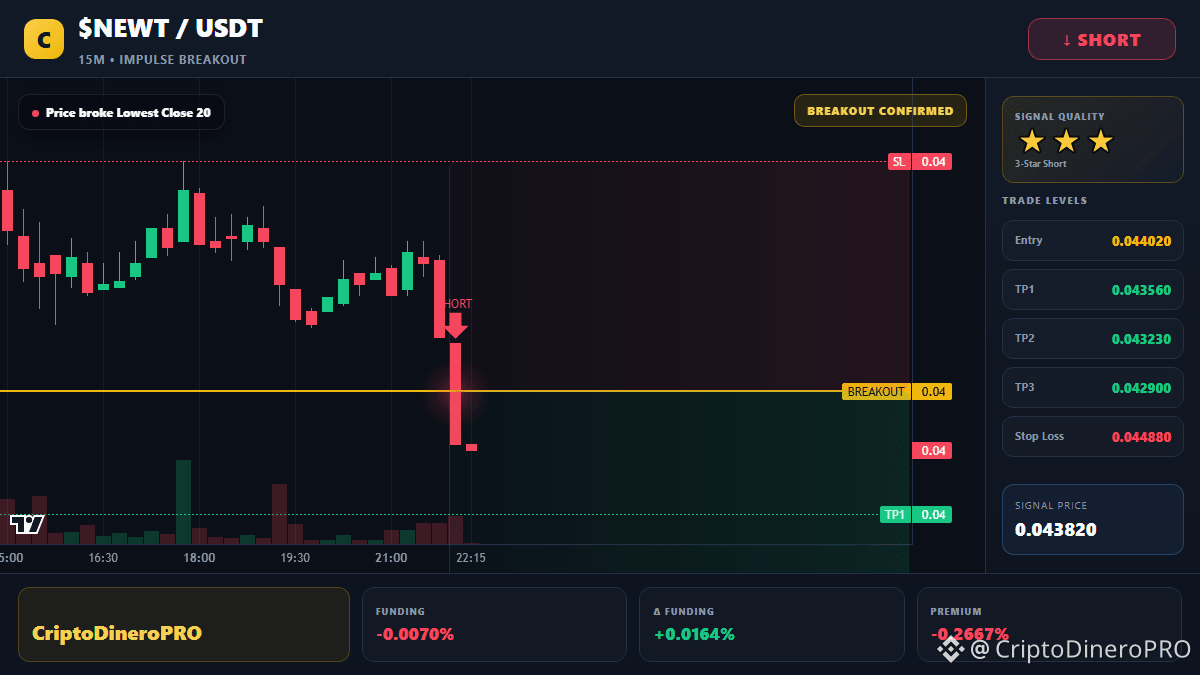
$NEWT - Short Setup Ready 🎯 🔻
{future}(NEWTUSDT)
Entry: 0.043820–0.044220
TP1: 0.043560 | TP2: 0.043230 | TP3: 0.042900
SL: Above 0.044880
On the 15m chart a clean bearish impulse through the 20-bar closing boundary after a relatively compressed 20-bar structure; price finished the candle close to its directional extreme with volume participation around or above its recent average, while open interest is showing only a limited change and funding stays broadly balanced.
#NEWT #NEWTUSDT
$NEWT - Short Setup Ready 🎯 🔻
Entry: 0.043820–0.044220
TP1: 0.043560 | TP2: 0.043230 | TP3: 0.042900
SL: Above 0.044880
On the 15m chart a clean bearish impulse through the 20-bar closing boundary after a relatively compressed 20-bar structure; price finished the candle close to its directional extreme with volume participation around or above its recent average, while open interest is showing only a limited change and funding stays broadly balanced.
#NEWT #NEWTUSDT
Entry: 0.043820–0.044220
TP1: 0.043560 | TP2: 0.043230 | TP3: 0.042900
SL: Above 0.044880
On the 15m chart a clean bearish impulse through the 20-bar closing boundary after a relatively compressed 20-bar structure; price finished the candle close to its directional extreme with volume participation around or above its recent average, while open interest is showing only a limited change and funding stays broadly balanced.
#NEWT #NEWTUSDT
243

📒 The quiet accumulation over many years finally spills away after just a few sessions of collapse.
👑 SHORT $NEWT
Entry: 0.0419
TP: 0.0398 | SL: 0.0461
🪜 Enjoy this journey and learn more every day to improve.
🔍 Price has broken through the final barrier before entering a new ATH zone on the floor.
🎯 The ultimate goal is consistency, not a single big win.
🌈 I hope you’ll always believe in yourself and your ability to conquer the peak.
#NEWTUSDT $NEWTUSDT
📒 The quiet accumulation over many years finally spills away after just a few sessions of collapse.
👑 SHORT $NEWT
Entry: 0.0419
TP: 0.0398 | SL: 0.0461
🪜 Enjoy this journey and learn more every day to improve.
🔍 Price has broken through the final barrier before entering a new ATH zone on the floor.
🎯 The ultimate goal is consistency, not a single big win.
🌈 I hope you’ll always believe in yourself and your ability to conquer the peak.
#NEWTUSDT $NEWTUSDT
👑 SHORT $NEWT
Entry: 0.0419
TP: 0.0398 | SL: 0.0461
🪜 Enjoy this journey and learn more every day to improve.
🔍 Price has broken through the final barrier before entering a new ATH zone on the floor.
🎯 The ultimate goal is consistency, not a single big win.
🌈 I hope you’ll always believe in yourself and your ability to conquer the peak.
#NEWTUSDT $NEWTUSDT
106

·
--
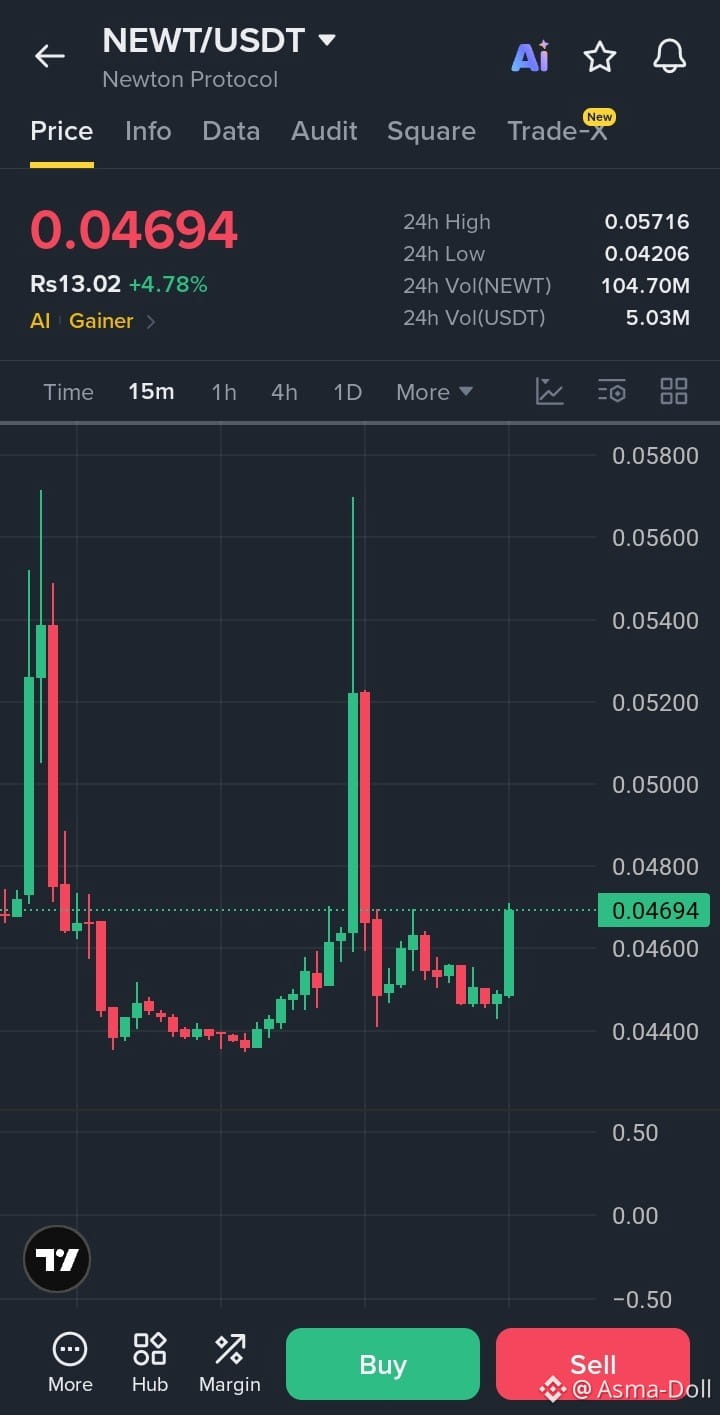
📉 $NEWT /USDT — Short Signal
Entry: 0.0470 – 0.0485
Stop Loss: 0.0515
TP1: 0.0450
TP2: 0.0425
TP3: 0.0395
Trade here $NEWT
{future}(NEWTUSDT)
Analysis:
Strong rejection from 0.0570 area.
Current price is near resistance after a +4.78% bounce.
0.0460 support is key; losing it can accelerate downside.
Prefer short confirmation on a clean break below 0.0460.
⚠️ Use proper risk management; this is a high-volatility gainer.
#NEWT #NEWTUSDT #CryptoSignal #ShortSignal #Binance
📉 $NEWT /USDT — Short Signal
Entry: 0.0470 – 0.0485
Stop Loss: 0.0515
TP1: 0.0450
TP2: 0.0425
TP3: 0.0395
Trade here $NEWT
Analysis:
Strong rejection from 0.0570 area.
Current price is near resistance after a +4.78% bounce.
0.0460 support is key; losing it can accelerate downside.
Prefer short confirmation on a clean break below 0.0460.
⚠️ Use proper risk management; this is a high-volatility gainer.
#NEWT #NEWTUSDT #CryptoSignal #ShortSignal #Binance
Entry: 0.0470 – 0.0485
Stop Loss: 0.0515
TP1: 0.0450
TP2: 0.0425
TP3: 0.0395
Trade here $NEWT
Analysis:
Strong rejection from 0.0570 area.
Current price is near resistance after a +4.78% bounce.
0.0460 support is key; losing it can accelerate downside.
Prefer short confirmation on a clean break below 0.0460.
⚠️ Use proper risk management; this is a high-volatility gainer.
#NEWT #NEWTUSDT #CryptoSignal #ShortSignal #Binance
100
🔋 The world is not short of money; it’s simply moving it from the wallets of the timid to the accounts of the bold.
💹 LONG $NEWT
Entry: 0.0527
TP: 0.0553 | SL: 0.0474
🧼 Following regulations helps crypto get closer to the mainstream.
📊 The Donchian Channel indicator shows the price is forming new highs continuously.
💎 Respect your time, because it’s the most valuable resource on the exchange.
🌞 Wishing you always have happy moments with your family and loved ones.
#NEWTUSDT $NEWTUSDT
🔋 The world is not short of money; it’s simply moving it from the wallets of the timid to the accounts of the bold.
💹 LONG $NEWT
Entry: 0.0527
TP: 0.0553 | SL: 0.0474
🧼 Following regulations helps crypto get closer to the mainstream.
📊 The Donchian Channel indicator shows the price is forming new highs continuously.
💎 Respect your time, because it’s the most valuable resource on the exchange.
🌞 Wishing you always have happy moments with your family and loved ones.
#NEWTUSDT $NEWTUSDT
💹 LONG $NEWT
Entry: 0.0527
TP: 0.0553 | SL: 0.0474
🧼 Following regulations helps crypto get closer to the mainstream.
📊 The Donchian Channel indicator shows the price is forming new highs continuously.
💎 Respect your time, because it’s the most valuable resource on the exchange.
🌞 Wishing you always have happy moments with your family and loved ones.
#NEWTUSDT $NEWTUSDT
60


Verified
What if compliance happened before assets moved instead of after? That's the part of @NewtonProtocol I keep coming back to.
#NewtonProtocol isn't trying to make checks faster. #Newt is changing when they happen. The protocol places programmable policies in front of settlement, so a transaction is evaluated before it becomes final. That small shift changes the entire flow.
Three things stood out while I looked through Newton:
• Policies run before settlement, not after.
• Rules can cover sanctions, investor eligibility, or AI agent spending limits.
• Every operator stakes $NEWT , with a fixed supply of 1 billion tokens, creating economic accountability for policy enforcement.
The practical example is simple. An institution can require a wallet to pass identity and jurisdiction checks before moving tokenized assets. If the policy fails, the transaction never settles. No rollback. No manual review afterward.
That's why I think Newton is worth watching. Most discussions focus on throughput or fees. Newton is focused on authorization instead. Different problem. Different trade-off.
I'm still wondering how this model performs as policy complexity grows and transaction volume increases. That's probably the part that deserves the most attention next.
#NEWTtoken #NEWTUSDT $ETH $LAB
Would you use on-chain policy enforcement?
_Yes, definitely
_Depends on the use case
_Need to learn more
{future}(NEWTUSDT)
What if compliance happened before assets moved instead of after? That's the part of @NewtonProtocol I keep coming back to.
#NewtonProtocol isn't trying to make checks faster. #Newt is changing when they happen. The protocol places programmable policies in front of settlement, so a transaction is evaluated before it becomes final. That small shift changes the entire flow.
Three things stood out while I looked through Newton:
• Policies run before settlement, not after.
• Rules can cover sanctions, investor eligibility, or AI agent spending limits.
• Every operator stakes $NEWT , with a fixed supply of 1 billion tokens, creating economic accountability for policy enforcement.
The practical example is simple. An institution can require a wallet to pass identity and jurisdiction checks before moving tokenized assets. If the policy fails, the transaction never settles. No rollback. No manual review afterward.
That's why I think Newton is worth watching. Most discussions focus on throughput or fees. Newton is focused on authorization instead. Different problem. Different trade-off.
I'm still wondering how this model performs as policy complexity grows and transaction volume increases. That's probably the part that deserves the most attention next.
#NEWTtoken #NEWTUSDT $ETH $LAB
Would you use on-chain policy enforcement?
_Yes, definitely
_Depends on the use case
_Need to learn more
#NewtonProtocol isn't trying to make checks faster. #Newt is changing when they happen. The protocol places programmable policies in front of settlement, so a transaction is evaluated before it becomes final. That small shift changes the entire flow.
Three things stood out while I looked through Newton:
• Policies run before settlement, not after.
• Rules can cover sanctions, investor eligibility, or AI agent spending limits.
• Every operator stakes $NEWT , with a fixed supply of 1 billion tokens, creating economic accountability for policy enforcement.
The practical example is simple. An institution can require a wallet to pass identity and jurisdiction checks before moving tokenized assets. If the policy fails, the transaction never settles. No rollback. No manual review afterward.
That's why I think Newton is worth watching. Most discussions focus on throughput or fees. Newton is focused on authorization instead. Different problem. Different trade-off.
I'm still wondering how this model performs as policy complexity grows and transaction volume increases. That's probably the part that deserves the most attention next.
#NEWTtoken #NEWTUSDT $ETH $LAB
Would you use on-chain policy enforcement?
_Yes, definitely
_Depends on the use case
_Need to learn more


92
43
495

·
--
Bullish
#newt $NEWT NEWT coin (or the Newtone project) is one of the emerging digital currencies that focuses on developing the Web3 environment and operations and decentralized finance (DeFi).
The coin primarily aims to improve the efficiency of digital transactions, and provide innovative solutions for crypto investors by facilitating exchange processes and building a secure and fast network.
The coin is used as a core tool within its own ecosystem to support governance, pay network fees, and incentivize users through reward programs. The coin is drawing growing attention from traders who are looking to explore new projects with small market caps and promising opportunities
NEWT #Newtone #NewtCoin #NEWTUSDT ##Digital_Currencies #crypto #binance #BitcoinFallsOver50%FromOctoberHigh $METAB $SPCXB COMEXGoldSettlesUp1.49%At$4187.3
#newt $NEWT NEWT coin (or the Newtone project) is one of the emerging digital currencies that focuses on developing the Web3 environment and operations and decentralized finance (DeFi).
The coin primarily aims to improve the efficiency of digital transactions, and provide innovative solutions for crypto investors by facilitating exchange processes and building a secure and fast network.
The coin is used as a core tool within its own ecosystem to support governance, pay network fees, and incentivize users through reward programs. The coin is drawing growing attention from traders who are looking to explore new projects with small market caps and promising opportunities
NEWT #Newtone #NewtCoin #NEWTUSDT ##Digital_Currencies #crypto #binance #BitcoinFallsOver50%FromOctoberHigh $METAB $SPCXB COMEXGoldSettlesUp1.49%At$4187.3
The coin primarily aims to improve the efficiency of digital transactions, and provide innovative solutions for crypto investors by facilitating exchange processes and building a secure and fast network.
The coin is used as a core tool within its own ecosystem to support governance, pay network fees, and incentivize users through reward programs. The coin is drawing growing attention from traders who are looking to explore new projects with small market caps and promising opportunities
NEWT #Newtone #NewtCoin #NEWTUSDT ##Digital_Currencies #crypto #binance #BitcoinFallsOver50%FromOctoberHigh $METAB $SPCXB COMEXGoldSettlesUp1.49%At$4187.3
83

·
--
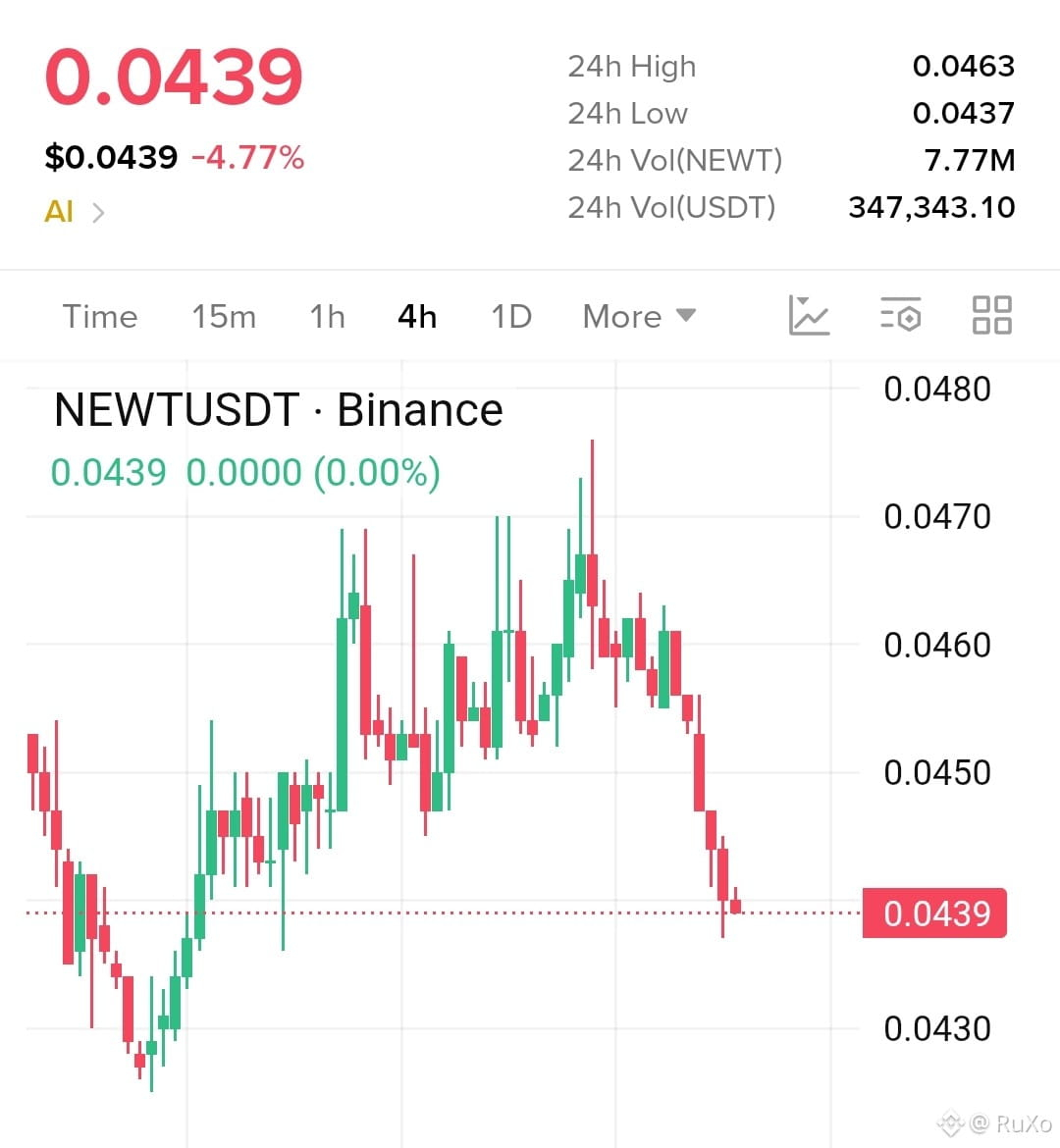
📉 $NEWT down -4.77% but lowkey sitting right on major support at $0.0439! 👀🔥
4H timeframe retesting key floor level! Lock in your parameters:
🟢 LONG: Close ABOVE $0.0452 🎯 TP: $0.0470 | $0.0495+ 🚀 🛑 SL: $0.0430
🔴 SHORT: Close BELOW $0.0435 🎯 TP: $0.0415 | $0.0390- 📉 🛑 SL: $0.0450
Manage your risk & DYOR! 📊⚡
➡️ CLICK $NEWT BELOW TO TRADE ⬅️
#NEWTUSDT #BinanceSquare #CryptoTrading #AI #DYOR
📉 $NEWT down -4.77% but lowkey sitting right on major support at $0.0439! 👀🔥
4H timeframe retesting key floor level! Lock in your parameters:
🟢 LONG: Close ABOVE $0.0452 🎯 TP: $0.0470 | $0.0495+ 🚀 🛑 SL: $0.0430
🔴 SHORT: Close BELOW $0.0435 🎯 TP: $0.0415 | $0.0390- 📉 🛑 SL: $0.0450
Manage your risk & DYOR! 📊⚡
➡️ CLICK $NEWT BELOW TO TRADE ⬅️
#NEWTUSDT #BinanceSquare #CryptoTrading #AI #DYOR
4H timeframe retesting key floor level! Lock in your parameters:
🟢 LONG: Close ABOVE $0.0452 🎯 TP: $0.0470 | $0.0495+ 🚀 🛑 SL: $0.0430
🔴 SHORT: Close BELOW $0.0435 🎯 TP: $0.0415 | $0.0390- 📉 🛑 SL: $0.0450
Manage your risk & DYOR! 📊⚡
➡️ CLICK $NEWT BELOW TO TRADE ⬅️
#NEWTUSDT #BinanceSquare #CryptoTrading #AI #DYOR
218
Verified
Article
Newton Just Turned Compliance Into a Gate, Not a Filter@NewtonProtocol just made compliance a precondition for transacting, not a check after the fact. That's a bigger shift than the press release makes it sound.
Claim: #Newt Protocol's new Persona Data Oracle enforces identity and jurisdiction rules inside the smart contract itself, before execution, which means the "permissionless" part of onchain finance just picked up a gatekeeper. Not a bad one necessarily. But a real one.
Here's the setup in plain terms. $NEWT sits as an authorization layer between a user and a smart contract. Persona supplies verified identity data age, nationality, residency, state. Newton's operator network checks that data against a policy and issues an attestation (a signed, onchain proof that says "this transaction passed the check"). No valid attestation, no transaction. That's the whole mechanism.
Evidence — why this matters:
Identity fraud hit $43B in losses in 2022, and synthetic identity fraud grew 28% year over year (Javelin Research). That's the backdrop Newton is selling against.
Chainalysis says illicit crypto addresses received at least $154B in 2025 a 162% jump YoY, with a 694% surge tied to sanctioned entities. Big number, but note: "received" isn't "laundered successfully." Worth remembering when a stat this large gets quoted.
The mechanism is pre-execution, not post-hoc monitoring. Most compliance today flags bad transactions after they've settled. Newton's pitch is that the check happens before the funds move at all. That's a structural difference, not a marketing one.
Identity data allegedly never touches the public ledger, it's processed inside a TEE (trusted execution environment, basically a sealed compute environment where even the operator can't see the raw data) and only the pass/fail outcome gets attested onchain.
That last point is the part I keep sitting with. Newton is selling this as privacy-preserving. And technically; yes, your passport number isn't sitting on Etherscan. But the outcome of a government-style eligibility check is now a permanent, queryable, onchain object. You've traded data exposure for behavioral exposure. Every wallet that transacts through a Newton-gated contract now has a public trail of "passed checks" tied to it, even if the underlying identity is hidden. That's not nothing.
What I'd actually verify before treating this as neutral infrastructure:
Who writes the policy? Newton says it's "credibly neutral" because evaluation runs on a decentralized operator network secured via EigenLayer restaking (a system where staked $ETH backs the honesty of the operators). But someone still authors the jurisdiction list. Decentralized execution of a centralized decision isn't the same as a decentralized decision.
Can the policy change retroactively? Newton markets this as "updatable no redeployment needed." Good for compliance teams. Also means the rules a user agreed to on Monday can be different by Friday, with no new signature from the user.
What happens on operator disagreement? A network of operators evaluating identity claims sounds fine until two of them disagree on a borderline case. The doc doesn't say what quorum or dispute mechanism kicks in there.
Does "Newton doesn't control outcomes" hold up under stress? Restaking secures honesty of execution, not fairness of policy. Different guarantee. Worth not conflating the two.
None of this means the product doesn't work as advertised. It probably does, technically. The tension isn't in the engineering. It's in what gets normalized once "authorization before settlement" becomes standard plumbing for RWAs, stablecoins, and DeFi. Once every serious protocol requires a Newton-style attestation to move value, the permissionless pitch of crypto quietly becomes permissioned-by-default, with the permission handled by infrastructure instead of a bank. Cleaner UX. Same gate.
A quick risk checklist, for anyone evaluating this instead of just reading the announcement:
Source of the attestation is it Newton alone, or does it combine feeds (sanctions lists, wallet risk scores)? Combined feeds mean combined failure points.
Who can alter policy after deployment, and is there a timelock or notice period?
Is the "no personal data onchain" claim independently audited, or is it a TEE vendor claim taken at face value?
What's the actual cost/latency added per transaction? Pre-execution checks aren't free, someone pays gas or time for that operator round-trip.
Counterparty risk on the operator set itself: restaking secures against provable misbehavior, not against operators colluding on ambiguous calls.
Smart contract risk on the Newton contracts specifically has this policy engine been through independent audits, and are they published?
One number worth sitting with: the 694% surge in value to sanctioned entities is doing a lot of the persuasive work in this announcement. It's the scariest stat, so it's the one that gets quoted. But "value received by sanctioned entities" and "value Newton would have blocked" are two different populations, and the doc doesn't show overlap data. Fair to be skeptical of how directly this solution maps to that specific number, even if the general problem, jurisdictional evasion is real.
Takeaway: Newton isn't wrong that offchain compliance is leaky. It's just worth noticing that the fix is a permanent, onchain, pre-execution gate and gates, once installed, tend to stay installed even after the emergency that justified them fades.
Still turning over whether "credibly neutral" is doing honest work here or just softening the fact that somebody, somewhere, is still writing the eligibility list —
#NewtonProtocol #NEWTtoken $SPCX #NEWTUSDT
Newton Just Turned Compliance Into a Gate, Not a Filter
@NewtonProtocol just made compliance a precondition for transacting, not a check after the fact. That's a bigger shift than the press release makes it sound.
Claim: #Newt Protocol's new Persona Data Oracle enforces identity and jurisdiction rules inside the smart contract itself, before execution, which means the "permissionless" part of onchain finance just picked up a gatekeeper. Not a bad one necessarily. But a real one.
Here's the setup in plain terms. $NEWT sits as an authorization layer between a user and a smart contract. Persona supplies verified identity data age, nationality, residency, state. Newton's operator network checks that data against a policy and issues an attestation (a signed, onchain proof that says "this transaction passed the check"). No valid attestation, no transaction. That's the whole mechanism.
Evidence — why this matters:
Identity fraud hit $43B in losses in 2022, and synthetic identity fraud grew 28% year over year (Javelin Research). That's the backdrop Newton is selling against.
Chainalysis says illicit crypto addresses received at least $154B in 2025 a 162% jump YoY, with a 694% surge tied to sanctioned entities. Big number, but note: "received" isn't "laundered successfully." Worth remembering when a stat this large gets quoted.
The mechanism is pre-execution, not post-hoc monitoring. Most compliance today flags bad transactions after they've settled. Newton's pitch is that the check happens before the funds move at all. That's a structural difference, not a marketing one.
Identity data allegedly never touches the public ledger, it's processed inside a TEE (trusted execution environment, basically a sealed compute environment where even the operator can't see the raw data) and only the pass/fail outcome gets attested onchain.
That last point is the part I keep sitting with. Newton is selling this as privacy-preserving. And technically; yes, your passport number isn't sitting on Etherscan. But the outcome of a government-style eligibility check is now a permanent, queryable, onchain object. You've traded data exposure for behavioral exposure. Every wallet that transacts through a Newton-gated contract now has a public trail of "passed checks" tied to it, even if the underlying identity is hidden. That's not nothing.
What I'd actually verify before treating this as neutral infrastructure:
Who writes the policy? Newton says it's "credibly neutral" because evaluation runs on a decentralized operator network secured via EigenLayer restaking (a system where staked $ETH backs the honesty of the operators). But someone still authors the jurisdiction list. Decentralized execution of a centralized decision isn't the same as a decentralized decision.
Can the policy change retroactively? Newton markets this as "updatable no redeployment needed." Good for compliance teams. Also means the rules a user agreed to on Monday can be different by Friday, with no new signature from the user.
What happens on operator disagreement? A network of operators evaluating identity claims sounds fine until two of them disagree on a borderline case. The doc doesn't say what quorum or dispute mechanism kicks in there.
Does "Newton doesn't control outcomes" hold up under stress? Restaking secures honesty of execution, not fairness of policy. Different guarantee. Worth not conflating the two.
None of this means the product doesn't work as advertised. It probably does, technically. The tension isn't in the engineering. It's in what gets normalized once "authorization before settlement" becomes standard plumbing for RWAs, stablecoins, and DeFi. Once every serious protocol requires a Newton-style attestation to move value, the permissionless pitch of crypto quietly becomes permissioned-by-default, with the permission handled by infrastructure instead of a bank. Cleaner UX. Same gate.
A quick risk checklist, for anyone evaluating this instead of just reading the announcement:
Source of the attestation is it Newton alone, or does it combine feeds (sanctions lists, wallet risk scores)? Combined feeds mean combined failure points.
Who can alter policy after deployment, and is there a timelock or notice period?
Is the "no personal data onchain" claim independently audited, or is it a TEE vendor claim taken at face value?
What's the actual cost/latency added per transaction? Pre-execution checks aren't free, someone pays gas or time for that operator round-trip.
Counterparty risk on the operator set itself: restaking secures against provable misbehavior, not against operators colluding on ambiguous calls.
Smart contract risk on the Newton contracts specifically has this policy engine been through independent audits, and are they published?
One number worth sitting with: the 694% surge in value to sanctioned entities is doing a lot of the persuasive work in this announcement. It's the scariest stat, so it's the one that gets quoted. But "value received by sanctioned entities" and "value Newton would have blocked" are two different populations, and the doc doesn't show overlap data. Fair to be skeptical of how directly this solution maps to that specific number, even if the general problem, jurisdictional evasion is real.
Takeaway: Newton isn't wrong that offchain compliance is leaky. It's just worth noticing that the fix is a permanent, onchain, pre-execution gate and gates, once installed, tend to stay installed even after the emergency that justified them fades.
Still turning over whether "credibly neutral" is doing honest work here or just softening the fact that somebody, somewhere, is still writing the eligibility list —
#NewtonProtocol #NEWTtoken $SPCX #NEWTUSDT
Claim: #Newt Protocol's new Persona Data Oracle enforces identity and jurisdiction rules inside the smart contract itself, before execution, which means the "permissionless" part of onchain finance just picked up a gatekeeper. Not a bad one necessarily. But a real one.
Here's the setup in plain terms. $NEWT sits as an authorization layer between a user and a smart contract. Persona supplies verified identity data age, nationality, residency, state. Newton's operator network checks that data against a policy and issues an attestation (a signed, onchain proof that says "this transaction passed the check"). No valid attestation, no transaction. That's the whole mechanism.
Evidence — why this matters:
Identity fraud hit $43B in losses in 2022, and synthetic identity fraud grew 28% year over year (Javelin Research). That's the backdrop Newton is selling against.
Chainalysis says illicit crypto addresses received at least $154B in 2025 a 162% jump YoY, with a 694% surge tied to sanctioned entities. Big number, but note: "received" isn't "laundered successfully." Worth remembering when a stat this large gets quoted.
The mechanism is pre-execution, not post-hoc monitoring. Most compliance today flags bad transactions after they've settled. Newton's pitch is that the check happens before the funds move at all. That's a structural difference, not a marketing one.
Identity data allegedly never touches the public ledger, it's processed inside a TEE (trusted execution environment, basically a sealed compute environment where even the operator can't see the raw data) and only the pass/fail outcome gets attested onchain.
That last point is the part I keep sitting with. Newton is selling this as privacy-preserving. And technically; yes, your passport number isn't sitting on Etherscan. But the outcome of a government-style eligibility check is now a permanent, queryable, onchain object. You've traded data exposure for behavioral exposure. Every wallet that transacts through a Newton-gated contract now has a public trail of "passed checks" tied to it, even if the underlying identity is hidden. That's not nothing.
What I'd actually verify before treating this as neutral infrastructure:
Who writes the policy? Newton says it's "credibly neutral" because evaluation runs on a decentralized operator network secured via EigenLayer restaking (a system where staked $ETH backs the honesty of the operators). But someone still authors the jurisdiction list. Decentralized execution of a centralized decision isn't the same as a decentralized decision.
Can the policy change retroactively? Newton markets this as "updatable no redeployment needed." Good for compliance teams. Also means the rules a user agreed to on Monday can be different by Friday, with no new signature from the user.
What happens on operator disagreement? A network of operators evaluating identity claims sounds fine until two of them disagree on a borderline case. The doc doesn't say what quorum or dispute mechanism kicks in there.
Does "Newton doesn't control outcomes" hold up under stress? Restaking secures honesty of execution, not fairness of policy. Different guarantee. Worth not conflating the two.
None of this means the product doesn't work as advertised. It probably does, technically. The tension isn't in the engineering. It's in what gets normalized once "authorization before settlement" becomes standard plumbing for RWAs, stablecoins, and DeFi. Once every serious protocol requires a Newton-style attestation to move value, the permissionless pitch of crypto quietly becomes permissioned-by-default, with the permission handled by infrastructure instead of a bank. Cleaner UX. Same gate.
A quick risk checklist, for anyone evaluating this instead of just reading the announcement:
Source of the attestation is it Newton alone, or does it combine feeds (sanctions lists, wallet risk scores)? Combined feeds mean combined failure points.
Who can alter policy after deployment, and is there a timelock or notice period?
Is the "no personal data onchain" claim independently audited, or is it a TEE vendor claim taken at face value?
What's the actual cost/latency added per transaction? Pre-execution checks aren't free, someone pays gas or time for that operator round-trip.
Counterparty risk on the operator set itself: restaking secures against provable misbehavior, not against operators colluding on ambiguous calls.
Smart contract risk on the Newton contracts specifically has this policy engine been through independent audits, and are they published?
One number worth sitting with: the 694% surge in value to sanctioned entities is doing a lot of the persuasive work in this announcement. It's the scariest stat, so it's the one that gets quoted. But "value received by sanctioned entities" and "value Newton would have blocked" are two different populations, and the doc doesn't show overlap data. Fair to be skeptical of how directly this solution maps to that specific number, even if the general problem, jurisdictional evasion is real.
Takeaway: Newton isn't wrong that offchain compliance is leaky. It's just worth noticing that the fix is a permanent, onchain, pre-execution gate and gates, once installed, tend to stay installed even after the emergency that justified them fades.
Still turning over whether "credibly neutral" is doing honest work here or just softening the fact that somebody, somewhere, is still writing the eligibility list —
#NewtonProtocol #NEWTtoken $SPCX #NEWTUSDT
86
43
713
·
--
Bearish
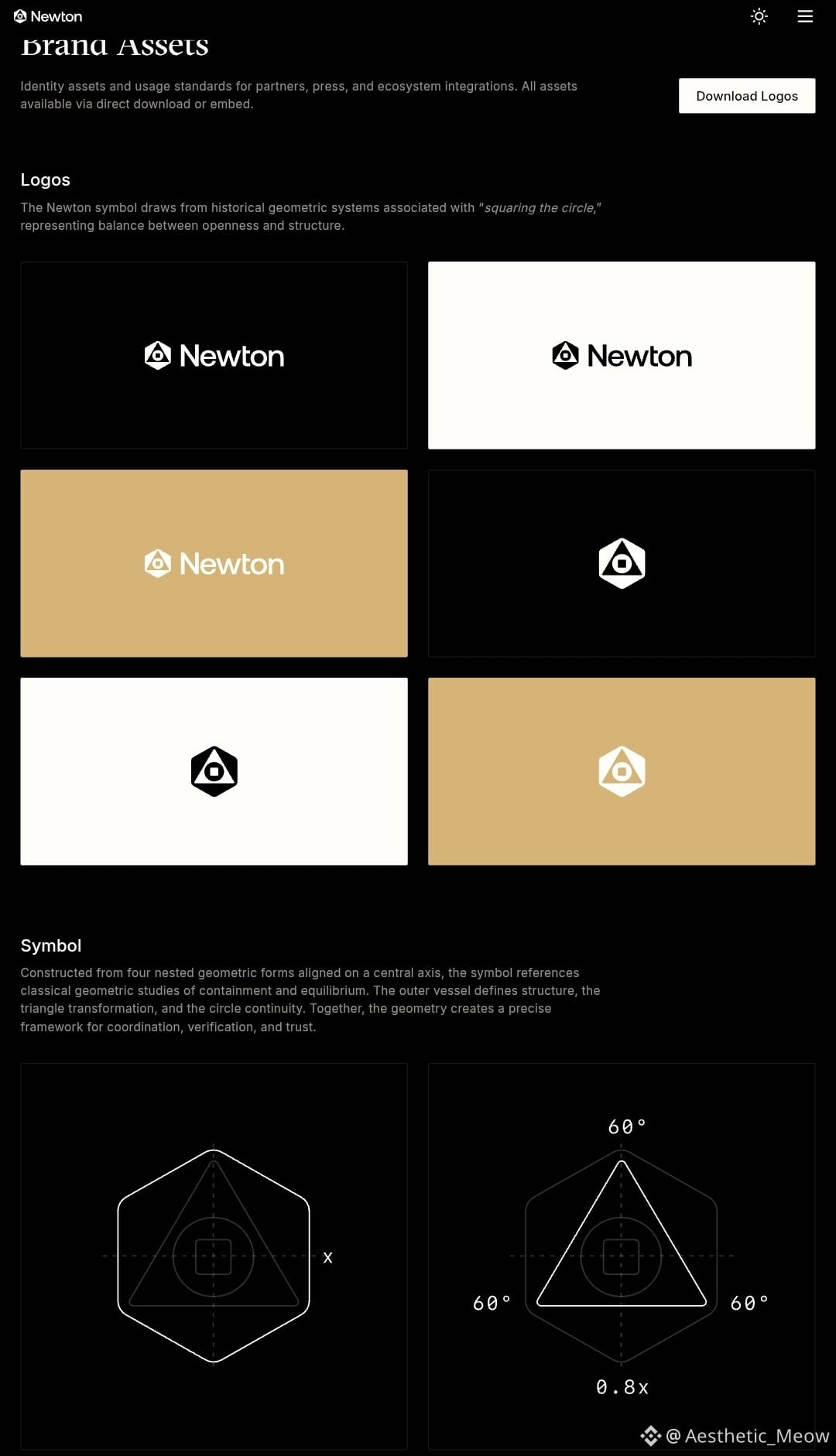
@NewtonProtocol 's logo has a number hiding in it that most brand pages never bother to explain.
0.8x. That's the ratio between the triangle and the hexagon in Newton's mark. Not 0.75, not "roughly proportional." A specific decimal, called out in their own construction diagram, next to three 60° angles.
Most brand kits stop at "here's our logo, don't stretch it." #Newt went further, they published the actual geometry: hexagon (structure) containing a triangle (transformation) containing a circle (continuity) containing a square. Four forms, one axis, one ratio.
Here's the tension: that level of precision only matters if someone's going to reproduce the mark by hand or code, think SVG generation, dynamic app icons, partner co-branding at odd sizes. For 95% of people downloading a logo pack, 0.8x is trivia. $NEWT
So why show it? My guess: it's a trust signal aimed at technical partners, not designers. "We've thought about this down to the decimal" reads differently to an engineering team evaluating an integration than to a marketer picking a header image.
Small thing. But it tells you who Newton's brand page is actually written for. Not press. Not casual users. Whoever's going to embed that hexagon in a codebase and needs it to look right at 16px and 400px both.
Worth checking if your own brand assets do this or if "don't stretch the logo" is as far as anyone got.
#NEWTtoken #NEWTUSDT #NewtonProtocol
@NewtonProtocol 's logo has a number hiding in it that most brand pages never bother to explain.
0.8x. That's the ratio between the triangle and the hexagon in Newton's mark. Not 0.75, not "roughly proportional." A specific decimal, called out in their own construction diagram, next to three 60° angles.
Most brand kits stop at "here's our logo, don't stretch it." #Newt went further, they published the actual geometry: hexagon (structure) containing a triangle (transformation) containing a circle (continuity) containing a square. Four forms, one axis, one ratio.
Here's the tension: that level of precision only matters if someone's going to reproduce the mark by hand or code, think SVG generation, dynamic app icons, partner co-branding at odd sizes. For 95% of people downloading a logo pack, 0.8x is trivia. $NEWT
So why show it? My guess: it's a trust signal aimed at technical partners, not designers. "We've thought about this down to the decimal" reads differently to an engineering team evaluating an integration than to a marketer picking a header image.
Small thing. But it tells you who Newton's brand page is actually written for. Not press. Not casual users. Whoever's going to embed that hexagon in a codebase and needs it to look right at 16px and 400px both.
Worth checking if your own brand assets do this or if "don't stretch the logo" is as far as anyone got.
#NEWTtoken #NEWTUSDT #NewtonProtocol
0.8x. That's the ratio between the triangle and the hexagon in Newton's mark. Not 0.75, not "roughly proportional." A specific decimal, called out in their own construction diagram, next to three 60° angles.
Most brand kits stop at "here's our logo, don't stretch it." #Newt went further, they published the actual geometry: hexagon (structure) containing a triangle (transformation) containing a circle (continuity) containing a square. Four forms, one axis, one ratio.
Here's the tension: that level of precision only matters if someone's going to reproduce the mark by hand or code, think SVG generation, dynamic app icons, partner co-branding at odd sizes. For 95% of people downloading a logo pack, 0.8x is trivia. $NEWT
So why show it? My guess: it's a trust signal aimed at technical partners, not designers. "We've thought about this down to the decimal" reads differently to an engineering team evaluating an integration than to a marketer picking a header image.
Small thing. But it tells you who Newton's brand page is actually written for. Not press. Not casual users. Whoever's going to embed that hexagon in a codebase and needs it to look right at 16px and 400px both.
Worth checking if your own brand assets do this or if "don't stretch the logo" is as far as anyone got.
#NEWTtoken #NEWTUSDT #NewtonProtocol

137
52
431
What changes when the transition period ends? More than most people think.
@NewtonProtocol #Newt $NEWT
Yesterday, MiCA's transition effectively closed another door. For many crypto firms, the choice is now simple: meet compliance standards or stop operating in regulated markets. That makes Newton feel much more relevant than it did a year ago.
#NEWTUSDT #NewtonProtocol
One thing I keep coming back to: Newton doesn't wait until after settlement. Newton evaluates transactions before they execute.
That changes the conversation.
3 checks that stand out: • Sanctions screening before settlement.
• Identity and policy checks before approval.
• Risk rules evaluated before state changes onchain.
That's a different model from reviewing activity after funds have already moved.
For NEWT, this isn't just about regulation. It's about whether compliance can become infrastructure instead of paperwork. If a transaction can be evaluated, authorized, and cryptographically verified before execution, institutions have something they can actually demonstrate not just document.
My takeaway: watch how Newton performs now that MiCA's transition has ended. The interesting question isn't whether regulation arrived. It's whether Newton and NEWT can prove compliance in real time, before every transaction. That's the part I'm watching.
#NEWTtoken $ETH $BIRB
What's more valuable now?
What changes when the transition period ends? More than most people think.
@NewtonProtocol #Newt $NEWT
Yesterday, MiCA's transition effectively closed another door. For many crypto firms, the choice is now simple: meet compliance standards or stop operating in regulated markets. That makes Newton feel much more relevant than it did a year ago.
#NEWTUSDT #NewtonProtocol
One thing I keep coming back to: Newton doesn't wait until after settlement. Newton evaluates transactions before they execute.
That changes the conversation.
3 checks that stand out: • Sanctions screening before settlement.
• Identity and policy checks before approval.
• Risk rules evaluated before state changes onchain.
That's a different model from reviewing activity after funds have already moved.
For NEWT, this isn't just about regulation. It's about whether compliance can become infrastructure instead of paperwork. If a transaction can be evaluated, authorized, and cryptographically verified before execution, institutions have something they can actually demonstrate not just document.
My takeaway: watch how Newton performs now that MiCA's transition has ended. The interesting question isn't whether regulation arrived. It's whether Newton and NEWT can prove compliance in real time, before every transaction. That's the part I'm watching.
#NEWTtoken $ETH $BIRB
What's more valuable now?
@NewtonProtocol #Newt $NEWT
Yesterday, MiCA's transition effectively closed another door. For many crypto firms, the choice is now simple: meet compliance standards or stop operating in regulated markets. That makes Newton feel much more relevant than it did a year ago.
#NEWTUSDT #NewtonProtocol
One thing I keep coming back to: Newton doesn't wait until after settlement. Newton evaluates transactions before they execute.
That changes the conversation.
3 checks that stand out: • Sanctions screening before settlement.
• Identity and policy checks before approval.
• Risk rules evaluated before state changes onchain.
That's a different model from reviewing activity after funds have already moved.
For NEWT, this isn't just about regulation. It's about whether compliance can become infrastructure instead of paperwork. If a transaction can be evaluated, authorized, and cryptographically verified before execution, institutions have something they can actually demonstrate not just document.
My takeaway: watch how Newton performs now that MiCA's transition has ended. The interesting question isn't whether regulation arrived. It's whether Newton and NEWT can prove compliance in real time, before every transaction. That's the part I'm watching.
#NEWTtoken $ETH $BIRB
What's more valuable now?
🚀 Growth
56%
✅ Trust
31%
💧 Liquidity
13%
16 votes • Voting closed
178
79
1.7k

Article
Visa for Crypto Transactions—but Does Anyone Actually Need That?@NewtonProtocol says it can fix that, by making every transaction pass a live risk check before it settles. Visa does this for cards. #Newt does it for wallets.
What that actually means:
· Real-time, not retrospective. Most protocols check rules after the fact (or not at all). Newton runs authorization in the mempool before state changes.
· Policy packs plug in. Curators write rules: spend caps, jurisdiction blocks, collateral ratios, sanctions screening. No custom smart contract rewrites.
· Signed proof on exit. Each decision produces an on-chain pass/fail attestation. That’s auditable, not just a black box.
· VaultKit is the hook. One SDK integration. They claim mainnet beta is already live.
Numbers I’d want to verify before trusting this:
· Latency: They say sub‑second. I haven’t seen independent benchmarks under load.
· Coverage: Which chains? EVM first, likely. Not all.
· Pricing: Not public yet. That matters because if it’s per‑tx, high‑frequency users get crushed.
Fact vs. my opinion:
· Fact: Mainnet beta is live. VaultKit is released. Partners include RedStone (oracle) and Credora (risk).
· Opinion: This is more valuable for institutional flows than retail. Retail doesn’t care about authorization latency. Treasuries and lenders do.
· Opinion: The real moat isn’t tech—it’s policy curation. Who writes the good rules? That’s the network effect.
Risks I’d flag (not FUD, just real):
· Smart contract risk in the authorization module itself, if that breaks, transactions can get stuck or falsely rejected.
· Centralization of policy authors. If only a few curators dominate, that’s a permissioned feel under a permissionless hood.
· Oracle dependency. Price‑based policies fail if RedStone lags. That’s not Newton’s fault, but it’s their problem.
What I’d check before using it:
· Can APY or fee structure change without notice?
· Who pays for the authorization gas—user or protocol?
· Is there a fallback if the authorization oracle goes down?
· Audits, who did them, and are they public?
· Can you export your policy pack if you leave?
Why I’m watching anyway:
Most “risk” layers are checkboxes. This one actually signs a verdict. That’s different. Not revolutionary but different enough to matter for onchain lending, payroll, or any flow where a bad tx costs more than a delayed one.
The tension I keep coming back to: speed vs. safety. Newton leans hard into safety. But if authorization adds 200ms and 5% failure rate on borderline txs, users will bypass it. Curators will then loosen policies until they’re meaningless. That’s the cycle I’ve seen before.
They’ve built the racecar. Now we watch if anyone drives it aggressively or if it just sits in the garage with perfect specs.
$NEWT $ETH $CL #NEWTUSDT #NEWTtoken #Newtcoin
Visa for Crypto Transactions—but Does Anyone Actually Need That?
@NewtonProtocol says it can fix that, by making every transaction pass a live risk check before it settles. Visa does this for cards. #Newt does it for wallets.
What that actually means:
· Real-time, not retrospective. Most protocols check rules after the fact (or not at all). Newton runs authorization in the mempool before state changes.
· Policy packs plug in. Curators write rules: spend caps, jurisdiction blocks, collateral ratios, sanctions screening. No custom smart contract rewrites.
· Signed proof on exit. Each decision produces an on-chain pass/fail attestation. That’s auditable, not just a black box.
· VaultKit is the hook. One SDK integration. They claim mainnet beta is already live.
Numbers I’d want to verify before trusting this:
· Latency: They say sub‑second. I haven’t seen independent benchmarks under load.
· Coverage: Which chains? EVM first, likely. Not all.
· Pricing: Not public yet. That matters because if it’s per‑tx, high‑frequency users get crushed.
Fact vs. my opinion:
· Fact: Mainnet beta is live. VaultKit is released. Partners include RedStone (oracle) and Credora (risk).
· Opinion: This is more valuable for institutional flows than retail. Retail doesn’t care about authorization latency. Treasuries and lenders do.
· Opinion: The real moat isn’t tech—it’s policy curation. Who writes the good rules? That’s the network effect.
Risks I’d flag (not FUD, just real):
· Smart contract risk in the authorization module itself, if that breaks, transactions can get stuck or falsely rejected.
· Centralization of policy authors. If only a few curators dominate, that’s a permissioned feel under a permissionless hood.
· Oracle dependency. Price‑based policies fail if RedStone lags. That’s not Newton’s fault, but it’s their problem.
What I’d check before using it:
· Can APY or fee structure change without notice?
· Who pays for the authorization gas—user or protocol?
· Is there a fallback if the authorization oracle goes down?
· Audits, who did them, and are they public?
· Can you export your policy pack if you leave?
Why I’m watching anyway:
Most “risk” layers are checkboxes. This one actually signs a verdict. That’s different. Not revolutionary but different enough to matter for onchain lending, payroll, or any flow where a bad tx costs more than a delayed one.
The tension I keep coming back to: speed vs. safety. Newton leans hard into safety. But if authorization adds 200ms and 5% failure rate on borderline txs, users will bypass it. Curators will then loosen policies until they’re meaningless. That’s the cycle I’ve seen before.
They’ve built the racecar. Now we watch if anyone drives it aggressively or if it just sits in the garage with perfect specs.
$NEWT $ETH $CL #NEWTUSDT #NEWTtoken #Newtcoin
What that actually means:
· Real-time, not retrospective. Most protocols check rules after the fact (or not at all). Newton runs authorization in the mempool before state changes.
· Policy packs plug in. Curators write rules: spend caps, jurisdiction blocks, collateral ratios, sanctions screening. No custom smart contract rewrites.
· Signed proof on exit. Each decision produces an on-chain pass/fail attestation. That’s auditable, not just a black box.
· VaultKit is the hook. One SDK integration. They claim mainnet beta is already live.
Numbers I’d want to verify before trusting this:
· Latency: They say sub‑second. I haven’t seen independent benchmarks under load.
· Coverage: Which chains? EVM first, likely. Not all.
· Pricing: Not public yet. That matters because if it’s per‑tx, high‑frequency users get crushed.
Fact vs. my opinion:
· Fact: Mainnet beta is live. VaultKit is released. Partners include RedStone (oracle) and Credora (risk).
· Opinion: This is more valuable for institutional flows than retail. Retail doesn’t care about authorization latency. Treasuries and lenders do.
· Opinion: The real moat isn’t tech—it’s policy curation. Who writes the good rules? That’s the network effect.
Risks I’d flag (not FUD, just real):
· Smart contract risk in the authorization module itself, if that breaks, transactions can get stuck or falsely rejected.
· Centralization of policy authors. If only a few curators dominate, that’s a permissioned feel under a permissionless hood.
· Oracle dependency. Price‑based policies fail if RedStone lags. That’s not Newton’s fault, but it’s their problem.
What I’d check before using it:
· Can APY or fee structure change without notice?
· Who pays for the authorization gas—user or protocol?
· Is there a fallback if the authorization oracle goes down?
· Audits, who did them, and are they public?
· Can you export your policy pack if you leave?
Why I’m watching anyway:
Most “risk” layers are checkboxes. This one actually signs a verdict. That’s different. Not revolutionary but different enough to matter for onchain lending, payroll, or any flow where a bad tx costs more than a delayed one.
The tension I keep coming back to: speed vs. safety. Newton leans hard into safety. But if authorization adds 200ms and 5% failure rate on borderline txs, users will bypass it. Curators will then loosen policies until they’re meaningless. That’s the cycle I’ve seen before.
They’ve built the racecar. Now we watch if anyone drives it aggressively or if it just sits in the garage with perfect specs.
$NEWT $ETH $CL #NEWTUSDT #NEWTtoken #Newtcoin
1
175

Article
Newton Says The Market Is Finally Ready For It. I'm Not so Sure The Market Asked.@NewtonProtocol pitches itself as the "authorization layer" onchain finance has been missing, the compliance and policy layer that sits between public liquidity and private execution. That's the claim. Three forces, according to the whitepaper: regulation just got specific, institutional money is already here, and AI agents are about to start transacting on their own. #Newt says it's built for exactly that moment.
Worth noting upfront: this isn't a yield product. No APY, no lock period, no payout schedule to check. This is infrastructure, so the risk questions are different, but they're not lighter.
What $NEWT actually claims (fact, from the whitepaper):
Cites the $GENIUS Act, Hong Kong's Stablecoin Ordinance, MiCA, and FATF guidance as proof regulatory frameworks have "crystallized", meaning institutions now know the rules, they just lack tooling to comply at the transaction level.
States stablecoin supply has crossed $298 billion and tokenized assets have exceeded $19 billion, as evidence institutional onchain demand is real.
Describes a "Public Liquidity, Private Execution" model, liquidity stays on public chains, but compliance checks, identity checks, and risk evaluation happen in a private layer before a transaction settles.
Lists its technical stack: EigenLayer for economic security, OPA/Rego for policy logic, BLS signature aggregation, zero-knowledge VMs for dispute resolution, NATS for messaging, and HPKE-based encryption designed to migrate to post-quantum cryptography later.
That's a lot of pieces. Individually each one is a real, established technology. EigenLayer is a restaking framework, it lets staked crypto be reused to secure other systems, not just one blockchain. OPA/Rego is a widely used enterprise policy language, the kind banks and cloud providers already run. So the ingredients aren't vapor. The question is whether stitching them together actually produces what the paper says it produces.
My opinion, not fact: the "why now" argument is doing a lot of work that the paper itself hasn't earned yet.
Saying regulation crystallized doesn't mean Newton is the thing regulators will accept as proof of compliance. Saying institutional demand exists doesn't mean institutions will route that demand through Newton specifically. The whitepaper is arguing timing, not adoption. Those are different claims, and only one of them is Newton's to prove.
What I'd actually verify before taking any of this seriously:
Who audits Newton's policy evaluation engine, and has that audit happened yet — or is it planned.
Whether any regulator or compliance body has actually recognized Newton's "audit evidence" as satisfying a real framework, or if that's aspirational language.
Who runs the nodes doing policy evaluation, and what stops them from being a single point of failure or censorship.
Whether "Public Liquidity, Private Execution" means anything concrete yet, or if it's still a design thesis with no live implementation.
How Newton makes money, and whether that incentive lines up with strict compliance or with maximizing transaction throughput.
None of that is answered in the two pages I read. Might be answered elsewhere in the paper. But a "why now" section is exactly the kind of writing that should come with proof, and instead it comes with adjacent facts, real stablecoin numbers, real regulatory acronyms, stitched next to a product that hasn't shown its own numbers yet.
Risk framing, since infrastructure has its own version of smart contract risk:
Composability risk, Newton wants to be the layer everything else builds on top of. If it has a flaw or gets forked around, its entire pitch of "no walled gardens" comes with a paradox: something has to gatekeep who can bypass Newton's rules, or it's not actually enforcing anything.
Regulatory risk, inverted; Newton is betting regulation stays "crystallized" in a form its architecture can serve. Rules change. If the next iteration of MiCA or FATF guidance wants something Newton's model can't do, the whole "why now" argument ages badly, fast.
The AI agent argument is the part I keep coming back to. "Machine-speed transactions require machine-speed authorization" sounds right. But machine-speed authorization also means machine-speed mistakes, and the paper doesn't spend much time on what happens when a policy engine approves something it shouldn't at scale, in milliseconds, before any human notices.
Newton isn't claiming to be a blockchain. Isn't claiming to be a wallet. It's claiming to be the layer everyone routes through, which is either a genuinely smart bet on where onchain finance is headed, or the classic infrastructure-of-everything pitch that every cycle produces two or three of, and most quietly disappear.
The technical stack is credible. The timing argument is plausible. What's missing from what I've seen so far is proof that anyone with actual compliance obligations has chosen Newton over building their own stack or using something already in production. Until that shows up, "why now" is a thesis, not a track record.
Newt's whitepaper reads like it was written for regulators and institutions as the target audience, which is a fair strategy if that's genuinely who's evaluating it. But it also means the retail-facing story, why should anyone using Newton, or building on it, trust the authorization layer over the alternative of just... not needing one, isn't really addressed yet.
Takeaway: Newton's pitch is timing plus infrastructure, not traction, worth watching, not worth trusting yet.
Still haven't found anything that tells me who's actually running policy checks through this today, if anyone is.
$ETH #NEWTtoken #NEWTUSDT #Newtcoin
Newton Says The Market Is Finally Ready For It. I'm Not so Sure The Market Asked.
@NewtonProtocol pitches itself as the "authorization layer" onchain finance has been missing, the compliance and policy layer that sits between public liquidity and private execution. That's the claim. Three forces, according to the whitepaper: regulation just got specific, institutional money is already here, and AI agents are about to start transacting on their own. #Newt says it's built for exactly that moment.
Worth noting upfront: this isn't a yield product. No APY, no lock period, no payout schedule to check. This is infrastructure, so the risk questions are different, but they're not lighter.
What $NEWT actually claims (fact, from the whitepaper):
Cites the $GENIUS Act, Hong Kong's Stablecoin Ordinance, MiCA, and FATF guidance as proof regulatory frameworks have "crystallized", meaning institutions now know the rules, they just lack tooling to comply at the transaction level.
States stablecoin supply has crossed $298 billion and tokenized assets have exceeded $19 billion, as evidence institutional onchain demand is real.
Describes a "Public Liquidity, Private Execution" model, liquidity stays on public chains, but compliance checks, identity checks, and risk evaluation happen in a private layer before a transaction settles.
Lists its technical stack: EigenLayer for economic security, OPA/Rego for policy logic, BLS signature aggregation, zero-knowledge VMs for dispute resolution, NATS for messaging, and HPKE-based encryption designed to migrate to post-quantum cryptography later.
That's a lot of pieces. Individually each one is a real, established technology. EigenLayer is a restaking framework, it lets staked crypto be reused to secure other systems, not just one blockchain. OPA/Rego is a widely used enterprise policy language, the kind banks and cloud providers already run. So the ingredients aren't vapor. The question is whether stitching them together actually produces what the paper says it produces.
My opinion, not fact: the "why now" argument is doing a lot of work that the paper itself hasn't earned yet.
Saying regulation crystallized doesn't mean Newton is the thing regulators will accept as proof of compliance. Saying institutional demand exists doesn't mean institutions will route that demand through Newton specifically. The whitepaper is arguing timing, not adoption. Those are different claims, and only one of them is Newton's to prove.
What I'd actually verify before taking any of this seriously:
Who audits Newton's policy evaluation engine, and has that audit happened yet — or is it planned.
Whether any regulator or compliance body has actually recognized Newton's "audit evidence" as satisfying a real framework, or if that's aspirational language.
Who runs the nodes doing policy evaluation, and what stops them from being a single point of failure or censorship.
Whether "Public Liquidity, Private Execution" means anything concrete yet, or if it's still a design thesis with no live implementation.
How Newton makes money, and whether that incentive lines up with strict compliance or with maximizing transaction throughput.
None of that is answered in the two pages I read. Might be answered elsewhere in the paper. But a "why now" section is exactly the kind of writing that should come with proof, and instead it comes with adjacent facts, real stablecoin numbers, real regulatory acronyms, stitched next to a product that hasn't shown its own numbers yet.
Risk framing, since infrastructure has its own version of smart contract risk:
Composability risk, Newton wants to be the layer everything else builds on top of. If it has a flaw or gets forked around, its entire pitch of "no walled gardens" comes with a paradox: something has to gatekeep who can bypass Newton's rules, or it's not actually enforcing anything.
Regulatory risk, inverted; Newton is betting regulation stays "crystallized" in a form its architecture can serve. Rules change. If the next iteration of MiCA or FATF guidance wants something Newton's model can't do, the whole "why now" argument ages badly, fast.
The AI agent argument is the part I keep coming back to. "Machine-speed transactions require machine-speed authorization" sounds right. But machine-speed authorization also means machine-speed mistakes, and the paper doesn't spend much time on what happens when a policy engine approves something it shouldn't at scale, in milliseconds, before any human notices.
Newton isn't claiming to be a blockchain. Isn't claiming to be a wallet. It's claiming to be the layer everyone routes through, which is either a genuinely smart bet on where onchain finance is headed, or the classic infrastructure-of-everything pitch that every cycle produces two or three of, and most quietly disappear.
The technical stack is credible. The timing argument is plausible. What's missing from what I've seen so far is proof that anyone with actual compliance obligations has chosen Newton over building their own stack or using something already in production. Until that shows up, "why now" is a thesis, not a track record.
Newt's whitepaper reads like it was written for regulators and institutions as the target audience, which is a fair strategy if that's genuinely who's evaluating it. But it also means the retail-facing story, why should anyone using Newton, or building on it, trust the authorization layer over the alternative of just... not needing one, isn't really addressed yet.
Takeaway: Newton's pitch is timing plus infrastructure, not traction, worth watching, not worth trusting yet.
Still haven't found anything that tells me who's actually running policy checks through this today, if anyone is.
$ETH #NEWTtoken #NEWTUSDT #Newtcoin
Worth noting upfront: this isn't a yield product. No APY, no lock period, no payout schedule to check. This is infrastructure, so the risk questions are different, but they're not lighter.
What $NEWT actually claims (fact, from the whitepaper):
Cites the $GENIUS Act, Hong Kong's Stablecoin Ordinance, MiCA, and FATF guidance as proof regulatory frameworks have "crystallized", meaning institutions now know the rules, they just lack tooling to comply at the transaction level.
States stablecoin supply has crossed $298 billion and tokenized assets have exceeded $19 billion, as evidence institutional onchain demand is real.
Describes a "Public Liquidity, Private Execution" model, liquidity stays on public chains, but compliance checks, identity checks, and risk evaluation happen in a private layer before a transaction settles.
Lists its technical stack: EigenLayer for economic security, OPA/Rego for policy logic, BLS signature aggregation, zero-knowledge VMs for dispute resolution, NATS for messaging, and HPKE-based encryption designed to migrate to post-quantum cryptography later.
That's a lot of pieces. Individually each one is a real, established technology. EigenLayer is a restaking framework, it lets staked crypto be reused to secure other systems, not just one blockchain. OPA/Rego is a widely used enterprise policy language, the kind banks and cloud providers already run. So the ingredients aren't vapor. The question is whether stitching them together actually produces what the paper says it produces.
My opinion, not fact: the "why now" argument is doing a lot of work that the paper itself hasn't earned yet.
Saying regulation crystallized doesn't mean Newton is the thing regulators will accept as proof of compliance. Saying institutional demand exists doesn't mean institutions will route that demand through Newton specifically. The whitepaper is arguing timing, not adoption. Those are different claims, and only one of them is Newton's to prove.
What I'd actually verify before taking any of this seriously:
Who audits Newton's policy evaluation engine, and has that audit happened yet — or is it planned.
Whether any regulator or compliance body has actually recognized Newton's "audit evidence" as satisfying a real framework, or if that's aspirational language.
Who runs the nodes doing policy evaluation, and what stops them from being a single point of failure or censorship.
Whether "Public Liquidity, Private Execution" means anything concrete yet, or if it's still a design thesis with no live implementation.
How Newton makes money, and whether that incentive lines up with strict compliance or with maximizing transaction throughput.
None of that is answered in the two pages I read. Might be answered elsewhere in the paper. But a "why now" section is exactly the kind of writing that should come with proof, and instead it comes with adjacent facts, real stablecoin numbers, real regulatory acronyms, stitched next to a product that hasn't shown its own numbers yet.
Risk framing, since infrastructure has its own version of smart contract risk:
Composability risk, Newton wants to be the layer everything else builds on top of. If it has a flaw or gets forked around, its entire pitch of "no walled gardens" comes with a paradox: something has to gatekeep who can bypass Newton's rules, or it's not actually enforcing anything.
Regulatory risk, inverted; Newton is betting regulation stays "crystallized" in a form its architecture can serve. Rules change. If the next iteration of MiCA or FATF guidance wants something Newton's model can't do, the whole "why now" argument ages badly, fast.
The AI agent argument is the part I keep coming back to. "Machine-speed transactions require machine-speed authorization" sounds right. But machine-speed authorization also means machine-speed mistakes, and the paper doesn't spend much time on what happens when a policy engine approves something it shouldn't at scale, in milliseconds, before any human notices.
Newton isn't claiming to be a blockchain. Isn't claiming to be a wallet. It's claiming to be the layer everyone routes through, which is either a genuinely smart bet on where onchain finance is headed, or the classic infrastructure-of-everything pitch that every cycle produces two or three of, and most quietly disappear.
The technical stack is credible. The timing argument is plausible. What's missing from what I've seen so far is proof that anyone with actual compliance obligations has chosen Newton over building their own stack or using something already in production. Until that shows up, "why now" is a thesis, not a track record.
Newt's whitepaper reads like it was written for regulators and institutions as the target audience, which is a fair strategy if that's genuinely who's evaluating it. But it also means the retail-facing story, why should anyone using Newton, or building on it, trust the authorization layer over the alternative of just... not needing one, isn't really addressed yet.
Takeaway: Newton's pitch is timing plus infrastructure, not traction, worth watching, not worth trusting yet.
Still haven't found anything that tells me who's actually running policy checks through this today, if anyone is.
$ETH #NEWTtoken #NEWTUSDT #Newtcoin
37
31
491

#Newton Mainnet Beta: Powering the Next Generation of the Decentralized Data Economy#NewtonMainnet Beta: the blockchain system continues to evolve toward real-world utility, and the launch of the Newton Mainnet Beta is established as one of the most significant milestones in this direction. Developed by @NewtonProtocol , this technological advancement does not simply represent a network update, but the fundamental foundation for an infrastructure designed specifically for the massive data economy and decentralized trade at a global scale.
Why does the Newton Protocol make a difference?
#Newton Mainnet Beta: Powering the Next Generation of the Decentralized Data Economy
#NewtonMainnet Beta: the blockchain system continues to evolve toward real-world utility, and the launch of the Newton Mainnet Beta is established as one of the most significant milestones in this direction. Developed by @NewtonProtocol , this technological advancement does not simply represent a network update, but the fundamental foundation for an infrastructure designed specifically for the massive data economy and decentralized trade at a global scale.
Why does the Newton Protocol make a difference?
Why does the Newton Protocol make a difference?
30
·
--
Bearish
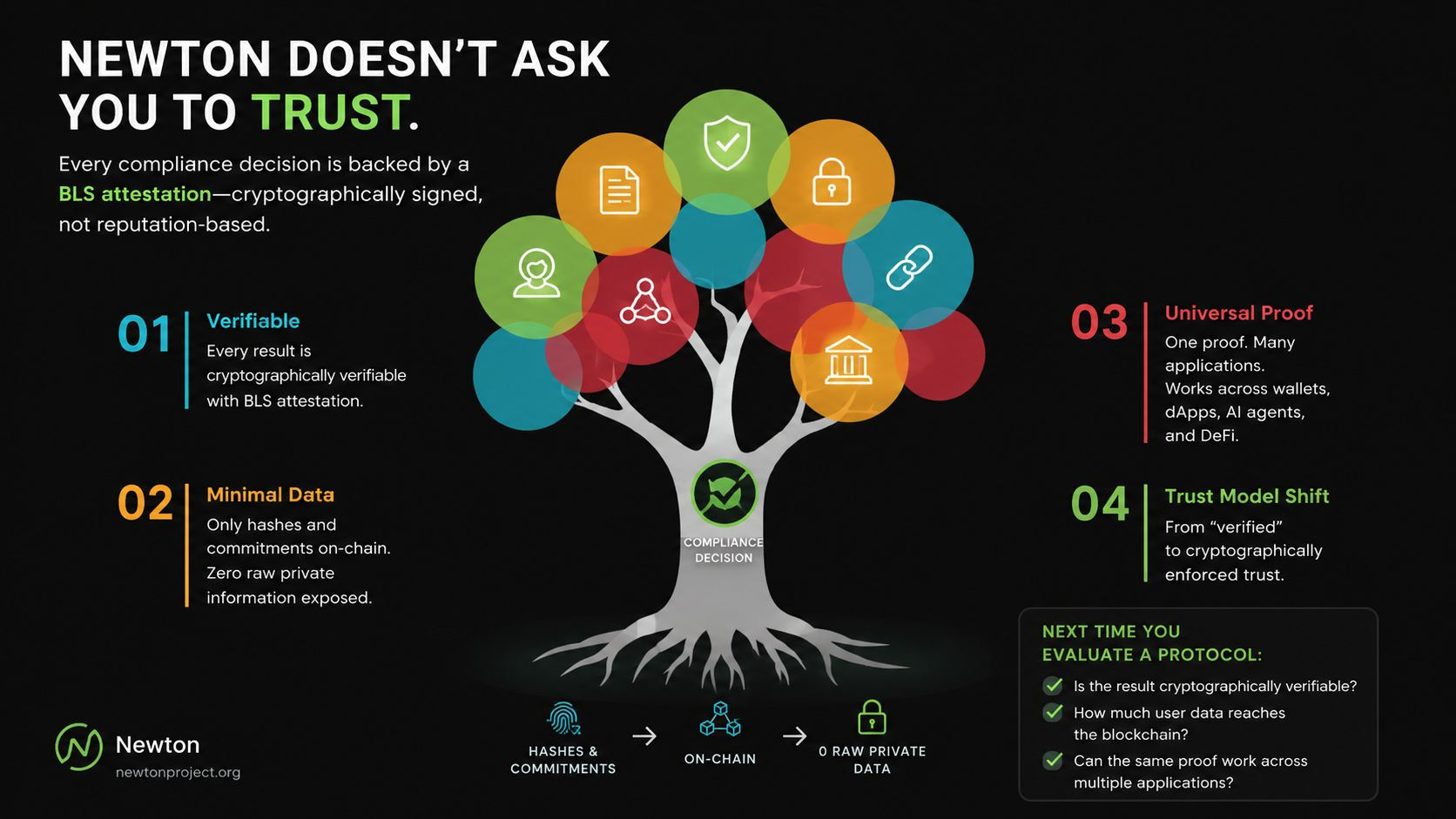
What if @NewtonProtocol didn't ask you to trust a compliance check at all?
That question changed how I looked at Newton after digging into its attestation flow.
Most systems stop at "verified."
#Newt goes one step further.
Every compliance decision can be backed by a BLS attestation, so the result is cryptographically signed instead of relying on reputation or a centralized validator.
The practical part is what caught my attention.
Only hashes and commitments are written on-chain.
Not user documents.
Not personal data.
That means one decision produces one verifiable proof while exposing 0 pieces of raw private information on-chain.
For developers, Newton also keeps things simple.
The same SDK can connect wallets, dApps, AI agents, and DeFi applications without rebuilding the verification flow every time.
My takeaway from Newton isn't that it's "more secure."
It's that the trust model changes.
Next time you evaluate a protocol, check these 3 things:
• Is the result cryptographically verifiable?
• How much user data reaches the blockchain?
• Can the same proof work across multiple applications?
That's a much harder checklist to satisfy than it sounds... and Newt seems to be aiming directly at it.
$NEWT $ETH $CL #NEWTUSDT #NEWTtoken #NewtonProtocol
What if @NewtonProtocol didn't ask you to trust a compliance check at all?
That question changed how I looked at Newton after digging into its attestation flow.
Most systems stop at "verified."
#Newt goes one step further.
Every compliance decision can be backed by a BLS attestation, so the result is cryptographically signed instead of relying on reputation or a centralized validator.
The practical part is what caught my attention.
Only hashes and commitments are written on-chain.
Not user documents.
Not personal data.
That means one decision produces one verifiable proof while exposing 0 pieces of raw private information on-chain.
For developers, Newton also keeps things simple.
The same SDK can connect wallets, dApps, AI agents, and DeFi applications without rebuilding the verification flow every time.
My takeaway from Newton isn't that it's "more secure."
It's that the trust model changes.
Next time you evaluate a protocol, check these 3 things:
• Is the result cryptographically verifiable?
• How much user data reaches the blockchain?
• Can the same proof work across multiple applications?
That's a much harder checklist to satisfy than it sounds... and Newt seems to be aiming directly at it.
$NEWT $ETH $CL #NEWTUSDT #NEWTtoken #NewtonProtocol
That question changed how I looked at Newton after digging into its attestation flow.
Most systems stop at "verified."
#Newt goes one step further.
Every compliance decision can be backed by a BLS attestation, so the result is cryptographically signed instead of relying on reputation or a centralized validator.
The practical part is what caught my attention.
Only hashes and commitments are written on-chain.
Not user documents.
Not personal data.
That means one decision produces one verifiable proof while exposing 0 pieces of raw private information on-chain.
For developers, Newton also keeps things simple.
The same SDK can connect wallets, dApps, AI agents, and DeFi applications without rebuilding the verification flow every time.
My takeaway from Newton isn't that it's "more secure."
It's that the trust model changes.
Next time you evaluate a protocol, check these 3 things:
• Is the result cryptographically verifiable?
• How much user data reaches the blockchain?
• Can the same proof work across multiple applications?
That's a much harder checklist to satisfy than it sounds... and Newt seems to be aiming directly at it.
$NEWT $ETH $CL #NEWTUSDT #NEWTtoken #NewtonProtocol
3
174
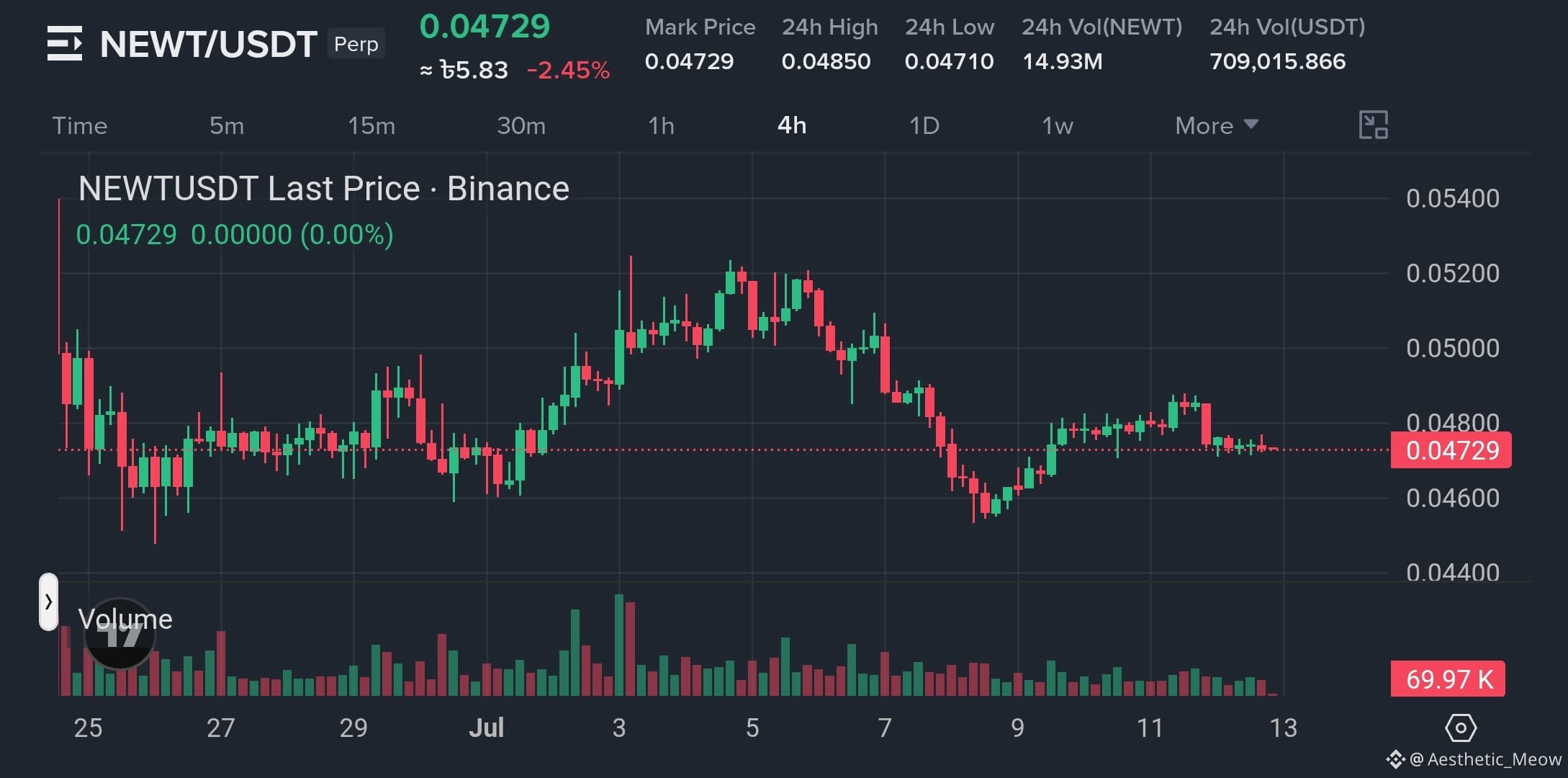
$NEWT Analysis (4H):
Entry: 0.04720
TP: 0.04850
SL: 0.04680
Bias: Long ✅Reasoning: Price consolidating near support, volume steady, risk/reward favorable.🚀
#CryptoTrading #Binance #NEWTUSDT
$NEWT Analysis (4H):
Entry: 0.04720
TP: 0.04850
SL: 0.04680
Bias: Long ✅Reasoning: Price consolidating near support, volume steady, risk/reward favorable.🚀
#CryptoTrading #Binance #NEWTUSDT
Entry: 0.04720
TP: 0.04850
SL: 0.04680
Bias: Long ✅Reasoning: Price consolidating near support, volume steady, risk/reward favorable.🚀
#CryptoTrading #Binance #NEWTUSDT
1
221

Verified
Article
Newton’s Most Important Asset May Not Be Its TokenThe first time I read that Magic Labs was building @NewtonProtocol , I almost treated it as a background detail.
Crypto projects constantly advertise their developers, investors, advisers, and previous achievements. Most of those names tell you very little about whether the new system will survive contact with real users.
Then I thought about what Newton is actually attempting.
It is not trying to build another interface people visit occasionally. It is trying to sit close to the moment when onchain actions are approved, signed, and settled.
That changes the importance of the team behind it.
The uncomfortable problem in crypto is that creating a wallet has become easier, but controlling what that wallet is allowed to do remains messy.
A user can sign a transaction they do not fully understand. An automated strategy can follow its instructions while producing an unacceptable result. A company can discover that its compliance rules existed in documents and dashboards, but not inside the transaction flow itself.
The blockchain may operate correctly throughout the entire failure.
That is what makes these systems difficult to fix.
Most existing solutions are assembled from separate pieces. Identity is checked somewhere. Risk is measured somewhere else. A wallet signs the transaction. A monitoring service reviews it later. Legal teams write policies that engineers then attempt to convert into code.
Every connection adds cost.
Every extra vendor introduces another dependency.
Every manual step creates a reason for users to leave.
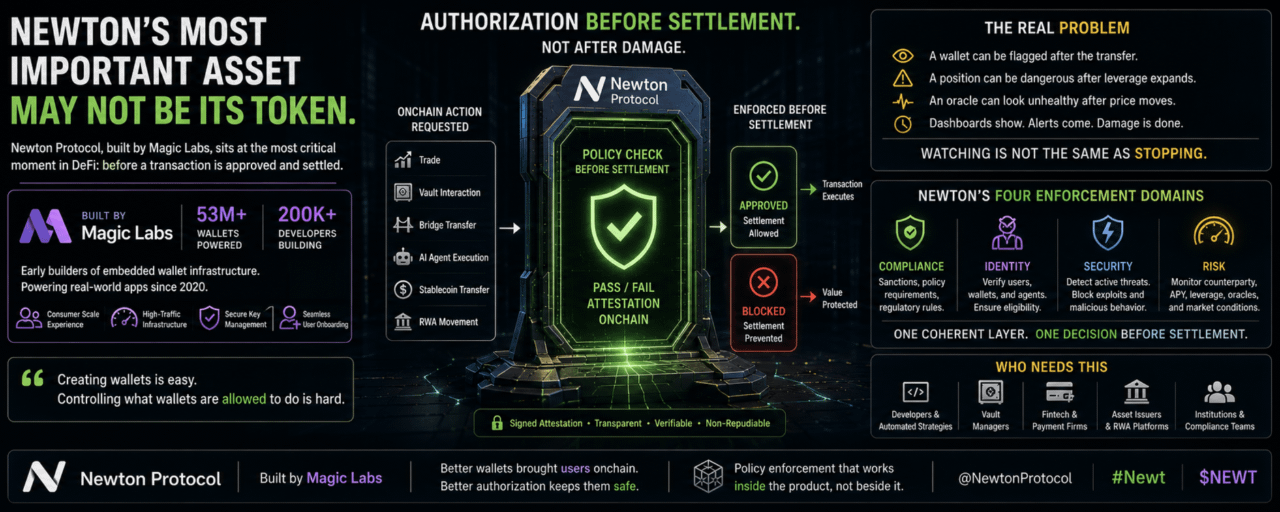
This is why Magic Labs’ history matters more than the usual “experienced team” argument. Newton’s official site identifies Magic as its builder and describes the company as an early developer of embedded-wallet infrastructure. Magic currently says its technology has supported more than 53 million wallets and over 200,000 developers.
Those numbers do not prove #newton will succeed.
They do suggest that its developers have already encountered a part of crypto most infrastructure projects underestimate: ordinary human behaviour.
Most people do not want to manage seed phrases, understand gas mechanics, inspect contract permissions, or study every transaction before approving it. They expect the product to prevent obvious mistakes without making every action feel like a security examination.
Builders face the opposite problem. They need stronger controls, but every additional check can increase latency, integration work, customer-support costs, and legal responsibility.
Institutions are even less forgiving. They do not merely need a transaction to execute. They need to know why it was permitted, which rule was applied, and whether that decision can be audited later.
Magic’s wallet experience gives Newton a potentially useful starting point.
The company has operated wallet infrastructure for large consumer applications, including one that faced significant real-time demand during major global events. Magic says that platform has used its embedded-wallet infrastructure since 2020, giving the team practical exposure to onboarding, signing, withdrawals, authentication, traffic spikes, and high-risk actions.
That experience could matter because authorization cannot be designed only as a compliance feature.
It has to work inside the product.
A rule that protects users but delays every transaction will be resisted. A policy engine that satisfies institutions but requires builders to redesign their applications may remain unused. A system that gives regulators more visibility while quietly creating centralized control could weaken the open structure it claims to protect.
Newton therefore faces a harder test than proving its technology functions.
It must prove that controls can become stronger without becoming unbearable.
$NEWT sits inside that system as the token powering Newton Protocol, but the token alone is not the serious part of the story. The serious question is whether Magic can extend its experience from making wallets easier to enter toward making wallet actions safer to authorize.
The likely users are not people searching for another token narrative.
They are developers operating automated strategies, fintech companies moving payments onchain, vault managers setting risk limits, asset issuers facing eligibility requirements, and institutions that need evidence before capital moves.
Newton might work because its core developer already understands wallet infrastructure at scale.
It could fail if authorization becomes expensive, slow, overly rigid, or dependent on rules nobody trusts.
Experience reduces some execution risk.
It does not remove the need to earn trust again.
$VANRY $LAB #Newt #NEWTUSDT
Newton’s Most Important Asset May Not Be Its Token
The first time I read that Magic Labs was building @NewtonProtocol , I almost treated it as a background detail.
Crypto projects constantly advertise their developers, investors, advisers, and previous achievements. Most of those names tell you very little about whether the new system will survive contact with real users.
Then I thought about what Newton is actually attempting.
It is not trying to build another interface people visit occasionally. It is trying to sit close to the moment when onchain actions are approved, signed, and settled.
That changes the importance of the team behind it.
The uncomfortable problem in crypto is that creating a wallet has become easier, but controlling what that wallet is allowed to do remains messy.
A user can sign a transaction they do not fully understand. An automated strategy can follow its instructions while producing an unacceptable result. A company can discover that its compliance rules existed in documents and dashboards, but not inside the transaction flow itself.
The blockchain may operate correctly throughout the entire failure.
That is what makes these systems difficult to fix.
Most existing solutions are assembled from separate pieces. Identity is checked somewhere. Risk is measured somewhere else. A wallet signs the transaction. A monitoring service reviews it later. Legal teams write policies that engineers then attempt to convert into code.
Every connection adds cost.
Every extra vendor introduces another dependency.
Every manual step creates a reason for users to leave.
This is why Magic Labs’ history matters more than the usual “experienced team” argument. Newton’s official site identifies Magic as its builder and describes the company as an early developer of embedded-wallet infrastructure. Magic currently says its technology has supported more than 53 million wallets and over 200,000 developers.
Those numbers do not prove #newton will succeed.
They do suggest that its developers have already encountered a part of crypto most infrastructure projects underestimate: ordinary human behaviour.
Most people do not want to manage seed phrases, understand gas mechanics, inspect contract permissions, or study every transaction before approving it. They expect the product to prevent obvious mistakes without making every action feel like a security examination.
Builders face the opposite problem. They need stronger controls, but every additional check can increase latency, integration work, customer-support costs, and legal responsibility.
Institutions are even less forgiving. They do not merely need a transaction to execute. They need to know why it was permitted, which rule was applied, and whether that decision can be audited later.
Magic’s wallet experience gives Newton a potentially useful starting point.
The company has operated wallet infrastructure for large consumer applications, including one that faced significant real-time demand during major global events. Magic says that platform has used its embedded-wallet infrastructure since 2020, giving the team practical exposure to onboarding, signing, withdrawals, authentication, traffic spikes, and high-risk actions.
That experience could matter because authorization cannot be designed only as a compliance feature.
It has to work inside the product.
A rule that protects users but delays every transaction will be resisted. A policy engine that satisfies institutions but requires builders to redesign their applications may remain unused. A system that gives regulators more visibility while quietly creating centralized control could weaken the open structure it claims to protect.
Newton therefore faces a harder test than proving its technology functions.
It must prove that controls can become stronger without becoming unbearable.
$NEWT sits inside that system as the token powering Newton Protocol, but the token alone is not the serious part of the story. The serious question is whether Magic can extend its experience from making wallets easier to enter toward making wallet actions safer to authorize.
The likely users are not people searching for another token narrative.
They are developers operating automated strategies, fintech companies moving payments onchain, vault managers setting risk limits, asset issuers facing eligibility requirements, and institutions that need evidence before capital moves.
Newton might work because its core developer already understands wallet infrastructure at scale.
It could fail if authorization becomes expensive, slow, overly rigid, or dependent on rules nobody trusts.
Experience reduces some execution risk.
It does not remove the need to earn trust again.
$VANRY $LAB #Newt #NEWTUSDT
Crypto projects constantly advertise their developers, investors, advisers, and previous achievements. Most of those names tell you very little about whether the new system will survive contact with real users.
Then I thought about what Newton is actually attempting.
It is not trying to build another interface people visit occasionally. It is trying to sit close to the moment when onchain actions are approved, signed, and settled.
That changes the importance of the team behind it.
The uncomfortable problem in crypto is that creating a wallet has become easier, but controlling what that wallet is allowed to do remains messy.
A user can sign a transaction they do not fully understand. An automated strategy can follow its instructions while producing an unacceptable result. A company can discover that its compliance rules existed in documents and dashboards, but not inside the transaction flow itself.
The blockchain may operate correctly throughout the entire failure.
That is what makes these systems difficult to fix.
Most existing solutions are assembled from separate pieces. Identity is checked somewhere. Risk is measured somewhere else. A wallet signs the transaction. A monitoring service reviews it later. Legal teams write policies that engineers then attempt to convert into code.
Every connection adds cost.
Every extra vendor introduces another dependency.
Every manual step creates a reason for users to leave.
This is why Magic Labs’ history matters more than the usual “experienced team” argument. Newton’s official site identifies Magic as its builder and describes the company as an early developer of embedded-wallet infrastructure. Magic currently says its technology has supported more than 53 million wallets and over 200,000 developers.
Those numbers do not prove #newton will succeed.
They do suggest that its developers have already encountered a part of crypto most infrastructure projects underestimate: ordinary human behaviour.
Most people do not want to manage seed phrases, understand gas mechanics, inspect contract permissions, or study every transaction before approving it. They expect the product to prevent obvious mistakes without making every action feel like a security examination.
Builders face the opposite problem. They need stronger controls, but every additional check can increase latency, integration work, customer-support costs, and legal responsibility.
Institutions are even less forgiving. They do not merely need a transaction to execute. They need to know why it was permitted, which rule was applied, and whether that decision can be audited later.
Magic’s wallet experience gives Newton a potentially useful starting point.
The company has operated wallet infrastructure for large consumer applications, including one that faced significant real-time demand during major global events. Magic says that platform has used its embedded-wallet infrastructure since 2020, giving the team practical exposure to onboarding, signing, withdrawals, authentication, traffic spikes, and high-risk actions.
That experience could matter because authorization cannot be designed only as a compliance feature.
It has to work inside the product.
A rule that protects users but delays every transaction will be resisted. A policy engine that satisfies institutions but requires builders to redesign their applications may remain unused. A system that gives regulators more visibility while quietly creating centralized control could weaken the open structure it claims to protect.
Newton therefore faces a harder test than proving its technology functions.
It must prove that controls can become stronger without becoming unbearable.
$NEWT sits inside that system as the token powering Newton Protocol, but the token alone is not the serious part of the story. The serious question is whether Magic can extend its experience from making wallets easier to enter toward making wallet actions safer to authorize.
The likely users are not people searching for another token narrative.
They are developers operating automated strategies, fintech companies moving payments onchain, vault managers setting risk limits, asset issuers facing eligibility requirements, and institutions that need evidence before capital moves.
Newton might work because its core developer already understands wallet infrastructure at scale.
It could fail if authorization becomes expensive, slow, overly rigid, or dependent on rules nobody trusts.
Experience reduces some execution risk.
It does not remove the need to earn trust again.
$VANRY $LAB #Newt #NEWTUSDT
137
54
876

🟢 $NEWT /USDT is trading in a tight accumulation range... buyers have a slight advantage 🔥
📊 Market analysis:
NEWT is holding above the **0.0467–0.0460** support zone after a healthy consolidation. Price remains close to resistance at **0.0485**. A breakout above this level could start a fresh bullish move.
📍 Entry: 0.0473 – 0.0465
🎯 TP1: 0.0520
🎯 TP2: 0.0570
🎯 TP3: 0.0640
⛔ Stop Loss: 0.0455
📊 Long: 64% | Short: 36% ⚠️ Risk: Medium (26%)
💣 KEY MOVE: Holding above **0.0467** favors a breakout toward **0.0520 → 0.0570 → 0.0640**. A close below **0.0455** would invalidate the bullish setup.
$TAC $RE
#NEWTUSDT #OilPriceFalls
🟢 $NEWT /USDT is trading in a tight accumulation range... buyers have a slight advantage 🔥
📊 Market analysis:
NEWT is holding above the **0.0467–0.0460** support zone after a healthy consolidation. Price remains close to resistance at **0.0485**. A breakout above this level could start a fresh bullish move.
📍 Entry: 0.0473 – 0.0465
🎯 TP1: 0.0520
🎯 TP2: 0.0570
🎯 TP3: 0.0640
⛔ Stop Loss: 0.0455
📊 Long: 64% | Short: 36% ⚠️ Risk: Medium (26%)
💣 KEY MOVE: Holding above **0.0467** favors a breakout toward **0.0520 → 0.0570 → 0.0640**. A close below **0.0455** would invalidate the bullish setup.
$TAC $RE
#NEWTUSDT #OilPriceFalls
📊 Market analysis:
NEWT is holding above the **0.0467–0.0460** support zone after a healthy consolidation. Price remains close to resistance at **0.0485**. A breakout above this level could start a fresh bullish move.
📍 Entry: 0.0473 – 0.0465
🎯 TP1: 0.0520
🎯 TP2: 0.0570
🎯 TP3: 0.0640
⛔ Stop Loss: 0.0455
📊 Long: 64% | Short: 36% ⚠️ Risk: Medium (26%)
💣 KEY MOVE: Holding above **0.0467** favors a breakout toward **0.0520 → 0.0570 → 0.0640**. A close below **0.0455** would invalidate the bullish setup.
$TAC $RE
#NEWTUSDT #OilPriceFalls
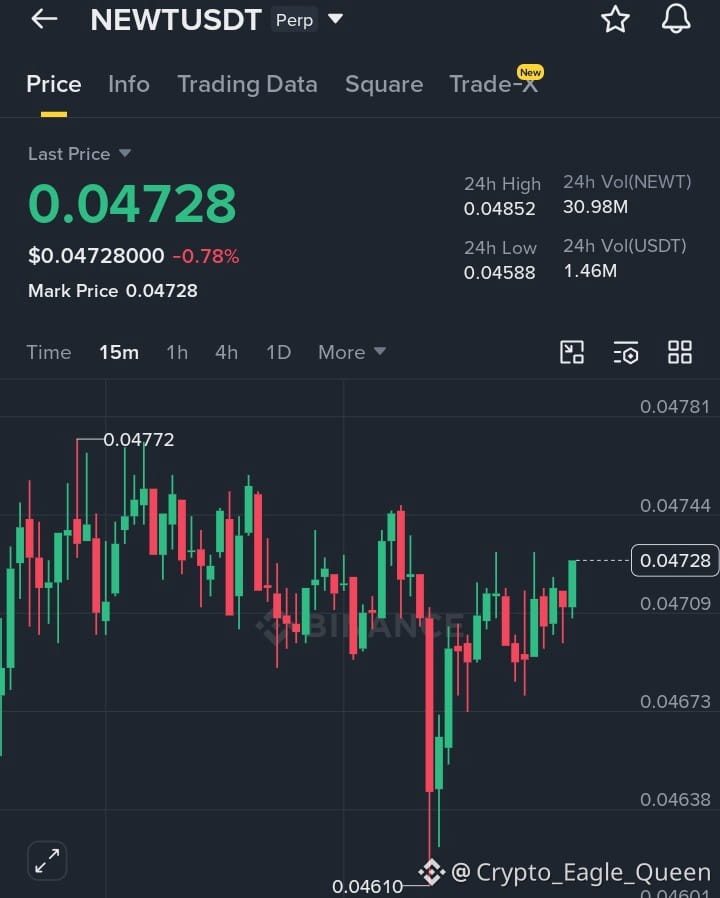
1
2
483

·
--
BUY $NEWT 💸🦸🏻
{spot}(NEWTUSDT)
Targret $NEWT : 0.0750
0.0950 $NEWT 0.1150
#Newt #NEWTUSDT #BinanceExplorers #BinanceSquareFamily #BinanceSquareTalks
BUY $NEWT 💸🦸🏻
Targret $NEWT : 0.0750
0.0950 $NEWT 0.1150
#Newt #NEWTUSDT #BinanceExplorers #BinanceSquareFamily #BinanceSquareTalks
Targret $NEWT : 0.0750
0.0950 $NEWT 0.1150
#Newt #NEWTUSDT #BinanceExplorers #BinanceSquareFamily #BinanceSquareTalks

14
Log in to explore more content
Join global crypto users on Binance Square
⚡️ Get latest and useful information about crypto.
💬 Trusted by the world’s largest crypto exchange.
👍 Discover real insights from verified creators.
Email / Phone number
Trending Topics
1
#ZcashETFPostsFirstWeeklyOutflow$93.6M
18 views
14 Discussing
2
#GreekPoliceBustCryptoScamRingArrest17
29 views
14 Discussing
3
#BitcoinRejectedAt$87K
43,979 views
81 Discussing
4
#FedOctoberRateHikeOddsFallTo17%
25,961 views
419 Discussing
5
#NvidiaHitsRecordHighUp2.4%
9,621 views
272 Discussing
6
#CanaryFilesAmendedS1ForPEPEETF
4,901 views
198 Discussing
7
#USRussiaUkraineTalksReportedlyIncludeLukoilOilDeal
14,409 views
271 Discussing
8
#BitcoinParesGainsAfterRallyTo$86.5K
38,962 views
150 Discussing
9
#CerebrasSinksNearly20%OnReportNvidiaToPowerOpenAI
86,450 views
848 Discussing
10
#SECProposesCryptoCustodyRules
112,066 views
1,054 Discussing