
#multiversx
multiversx
727,115 views
917 Discussing
Hot
Latest

·
--
EGLD is quietly doing the comeback thing — up ~1% in 24h to ~$2.36. Not exactly fireworks, but it printed a fresh all-time low of $2.12 just two days ago (Nov 25), and it's already bounced ~11% off that floor.
24h range $2.31-$2.40, market cap ~$74M, volume ~$2.1M. Still down ~31% this month and ~70% over the year, and about 99.6% below its ~$545 ATH from 2021. So this is a bounce off the bottom, not a victory lap.
Levels I'm watching: $2.31 as support, $2.40 as the one it needs to flip. $BTC is holding ~$61.4k (+~1% 24h, range $59,915-$62,249), still above $60k, so the market's giving it room.
Anyone still holding spot $EGLD from the old days, or is it a watchlist coin now?
#MultiversX #EGLD #Crypto
Not financial advice. DYOR.

EGLD is up 9% today and honestly, the math is the joke.
$EGLD is around $2.36 now, bounced off $2.12 and nearly tagged $2.37 — one of the strongest coins on the board while most of the market just sits there.
But here's the bit nobody wants to say out loud: it's still 99.6% below its $545 all-time high. At this pace it'll need about fifty more days exactly like today.
Still — a bounce is a bounce. Hold $2.12 and $2.37 is the next door to knock on. Lose it, and the party's over pretty fast.
$BTC meanwhile is doing its thing near $60,865, up about 2.4% today after yesterday's dip to $57,300.
Not financial advice. DYOR.
#MultiversX #Crypto #Altcoins
3
Two dollars and twenty cents.
That's where EGLD is sitting tonight — and here's the wild part. It printed its all-time low of $2.15 on Saturday. Not a cycle low. Its ALL-TIME low.
The same coin traded at $545 back in 2021. Down 99.6% from that peak. It's basically starting over from zero.
Right now it's hovering just above that floor — around $2.20, down roughly 4% today while Bitcoin slips under $60K again, near $59,723. If $2.17 holds, the first stops on the way back up are $2.31, then $2.39. Lose $2.17 and there's genuinely nothing underneath — it's uncharted territory below an all-time low.
Nobody's calling this a safe buy. But coins that have lost 99%+ either fade away quietly or turn into the wildest bounce stories of the next cycle. Which one is EGLD?
Not financial advice. DYOR.
$EGLD $BTC
#MultiversX #Crypto #Altcoins
3

With MultiversX’s chain outage, everyone is praising the fact that “no funds were lost.” What I care more about is the timeline.
The postmortem that MvX developer Andrei Marinica shared on X was very straightforward: on the morning of 11/17, an address deployed 23 contracts in a row on shard 0, targeting an unpatched bug in their own fork of Wasmer. The team believed the attacker wanted to run arbitrary code on validators’ machines, potentially reaching their private keys in the worst case, so they asked all validators to shut down—and the chain went down.
Put the dates side by side:
April 30: The fix had already been submitted upstream to Wasmer, but hadn’t made it into a formal release.
May 12: MvX received a report about this stack pointer bug. They couldn’t reproduce it at the time, and the first fix was still wrong, so it was never released.
November 17: Someone actually attacked. It was discovered at 10 a.m. (EEST), the fix was written by 11 a.m., and a new version was ready by 4 p.m.
The same patch took six months to deal with under normal circumstances, but was done in six hours under attack. This wasn’t a question of technical difficulty; it was a question of priority.
The attack surface this time was also different from what people are used to. It wasn’t someone exploiting faulty logic in a DeFi contract. Instead, the contract planted machine code disguised as a numeric constant in memory during compilation, directly attacking the node process. According to the postmortem, the payload was meant to install a hook in memory and impersonate the owner of some contract. The team doesn’t even know which contract was being targeted. Audit reports cover contracts; they can’t tell you how far behind upstream your underlying fork of the compiler is.
I’m not entirely convinced by claims like “decentralization held up.” What held things together was a single word from the core team getting validators to shut down in unison. An X user posted that Bithumb had also paused EGLD withdrawals. It was the right call to shut things down this time, but it shows who holds the switch when an emergency hits.
Also, for now, the claims that “no funds were lost and there’s no need to roll back” are only what I’ve seen the team say about itself. Hexens’ research says the affected component was the Singlepass compiler in Wasmer versions 2.1.0 through 6.x, which is widely used in blockchains. If you hold tokens on chains that use their own Wasm virtual machines, it’s worth checking who maintains their VM and how many versions behind upstream they are.
#EGLD #MultiversX
6
MultiversX $EGLD spot update 📊
$EGLD is trading near $2.87, down ~2.7% today, with a day range of $2.80–$2.99. It's now -21.5% over the past month and -51% year to date.
Support sits at $2.80 (today's low), then $2.70. Resistance at $2.99 (today's high), then $3.03.
The coin is ~99.5% below its $545.64 all-time high from Nov 2021 — one of the deepest drawdowns among large-cap L1s. Market cap is only ~$90M, so spot moves can be sharp both ways.
Bitcoin is holding ~$73,700, with support near $72,800 and resistance at $75,000. Until BTC reclaims $75K, EGLD spot stays a trade, not a trend.
Verdict: watch the $2.80 support — a daily close below it opens lower levels; holding it keeps a bounce toward $3.00 alive.
Not financial advice. DYOR.
#MultiversX #Crypto #Altcoins
110

·
--
LONG $EGLD
Entry: $2.88-2.92
SL: $2.80
TP1: $3.01 | TP2: $3.06
Invalidation: 4H close below $2.80
EGLD is holding the $2.88 swing low after dipping to $2.85 this week, with RSI deeply oversold.
A bounce from support targets the recent $3.01-3.06 resistance zone.
Not financial advice. #EGLD #MultiversX #crypto
Entry: $2.88-2.92
SL: $2.80
TP1: $3.01 | TP2: $3.06
Invalidation: 4H close below $2.80
EGLD is holding the $2.88 swing low after dipping to $2.85 this week, with RSI deeply oversold.
A bounce from support targets the recent $3.01-3.06 resistance zone.
Not financial advice. #EGLD #MultiversX #crypto
97

Today's price action is a lesson for anyone who chased the rally.
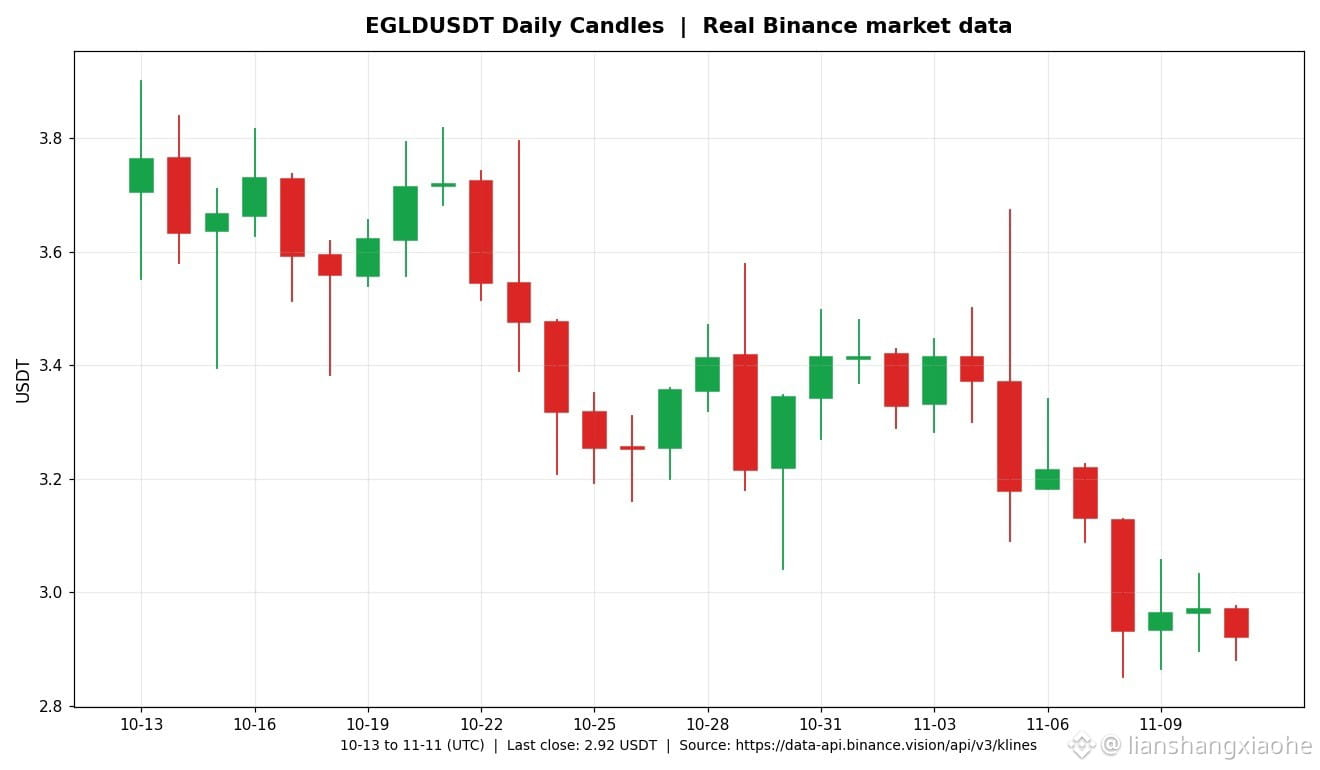
This morning, it climbed all the way from $2.88 to $3.02, briefly topping the daily gainers list. And now? It's at $2.92. Anyone who chased the high at $3.02 is already sitting on an unrealized loss of over 3%. Meanwhile, those who dared to buy at the $2.88 low and decisively sold at $3.02 made just under 500 U on a 10,000 U investment. Same day, same coin, wildly different outcomes.
What makes it sting even more is the backdrop: $EGLD is down about 15% over the past 7 days and about 28% over the past 30 days, with a market cap of only around $497 million. The 30-day candlestick chart has been trending downward all the way, and today's long upper wick says it all.
The market fear index is just 29, while $BTC is clinging to $73,000. These one-day spikes are meat grinders—the rally is there for you to see, but chase it and you'll get buried. Don't ask whether you can still chase it; ask yourself first: Did you make money the last time you chased a spike like this?
#MultiversX #Cryptocurrency
85

·
--
⚡ THREE CRYPTO ECOSYSTEMS WITH UNIQUE TECHNOLOGY!
$EGLD supports the MultiversX ecosystem and its scalable blockchain approach.
$FLOW is designed for applications involving games, collectibles, and digital assets.
$MINA focuses on a lightweight blockchain design using zero-knowledge technology.
Different architectures offer different trade-offs. Which technology will attract more developers?
#MultiversX #Flow #MinaProtocol #BlockchainInnovation #Crypto
1
92

·
--
Bullish
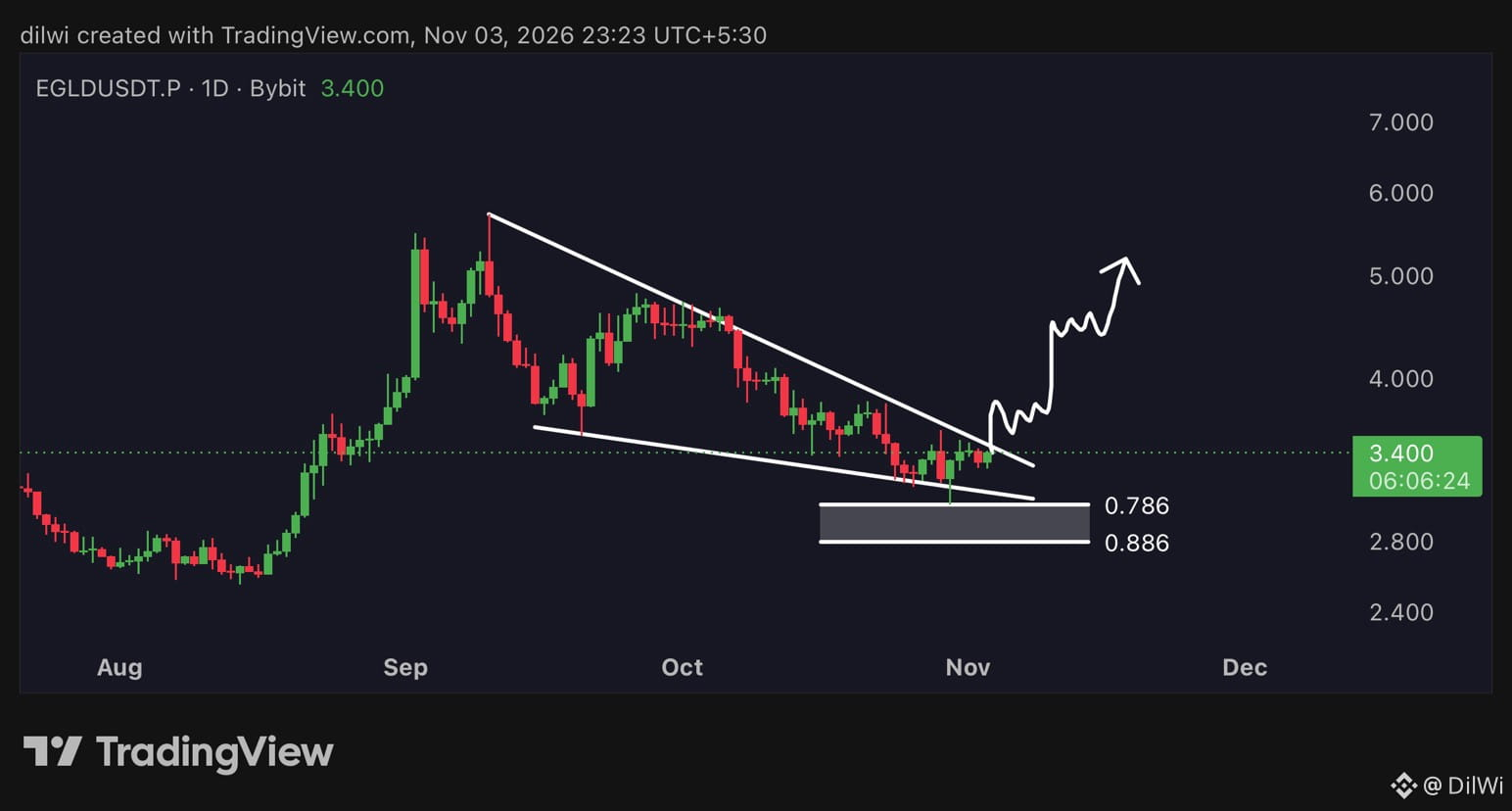
$EGLD bouncing strong from key fib levels and very close to breaking this falling wedge. 🚀
{future}(EGLDUSDT)
#EGLD #MultiversX
$EGLD bouncing strong from key fib levels and very close to breaking this falling wedge. 🚀
#EGLD #MultiversX
#EGLD #MultiversX
1
640

·
--
$EGLD is the quiet name climbing the trending board this afternoon, up about 5% near $3.45 while most of the tape just drifts. Feels like traders circling a name that's suddenly getting attention again rather than chasing the loudest pump. $BTC is the calmer backdrop, up just under 1% near $77,890, so this is its own pocket of interest. I'm watching whether $EGLD holds above $3.40; if it does, the trending-board crowd probably sticks around a bit longer. #MultiversX
$EGLD is the quiet name climbing the trending board this afternoon, up about 5% near $3.45 while most of the tape just drifts. Feels like traders circling a name that's suddenly getting attention again rather than chasing the loudest pump. $BTC is the calmer backdrop, up just under 1% near $77,890, so this is its own pocket of interest. I'm watching whether $EGLD holds above $3.40; if it does, the trending-board crowd probably sticks around a bit longer. #MultiversX
67

Not every part of the market is green today 🔻
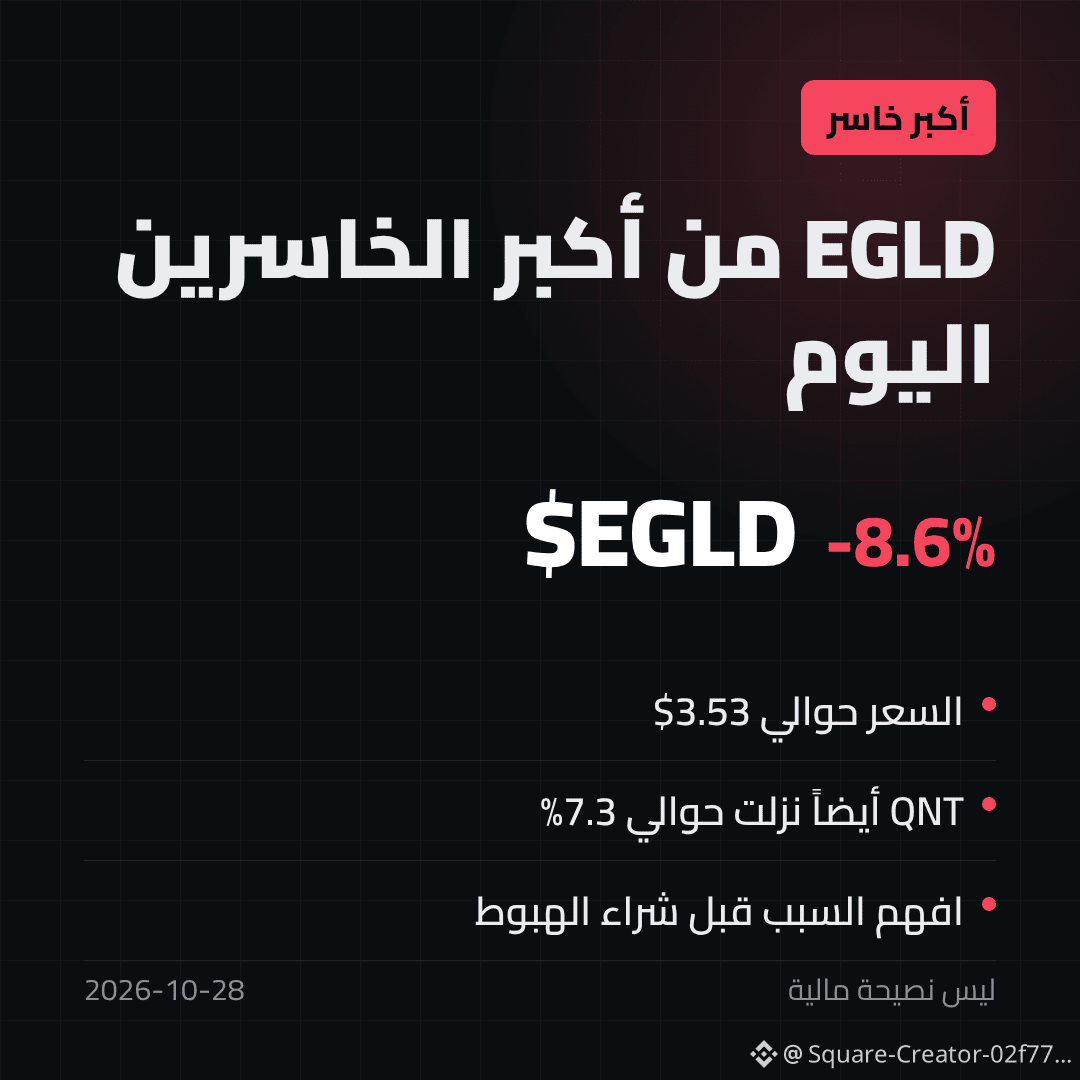
While Bitcoin is up a little, $EGLD (MultiversX) was among the biggest losers over the past 24 hours, down around 8.6%, with a price of about $3.53.
Also on the losers list: $QNT (Quant), down around 7.3%.
This reminds us of something important: Bitcoin going up doesn’t mean all coins will rise. Sometimes, liquidity flows into large-cap coins and out of altcoins.
Before you think, “I’ll buy the dip”:
• Understand why it fell, not just how much it fell.
• A coin that’s down 8% could fall another 8%.
• Scale into your position instead of putting everything in at once.
Not financial advice.
Are you the buy-the-dip type, or do you wait for confirmation?
#BinanceSquare #MultiversX #Altcoins
462

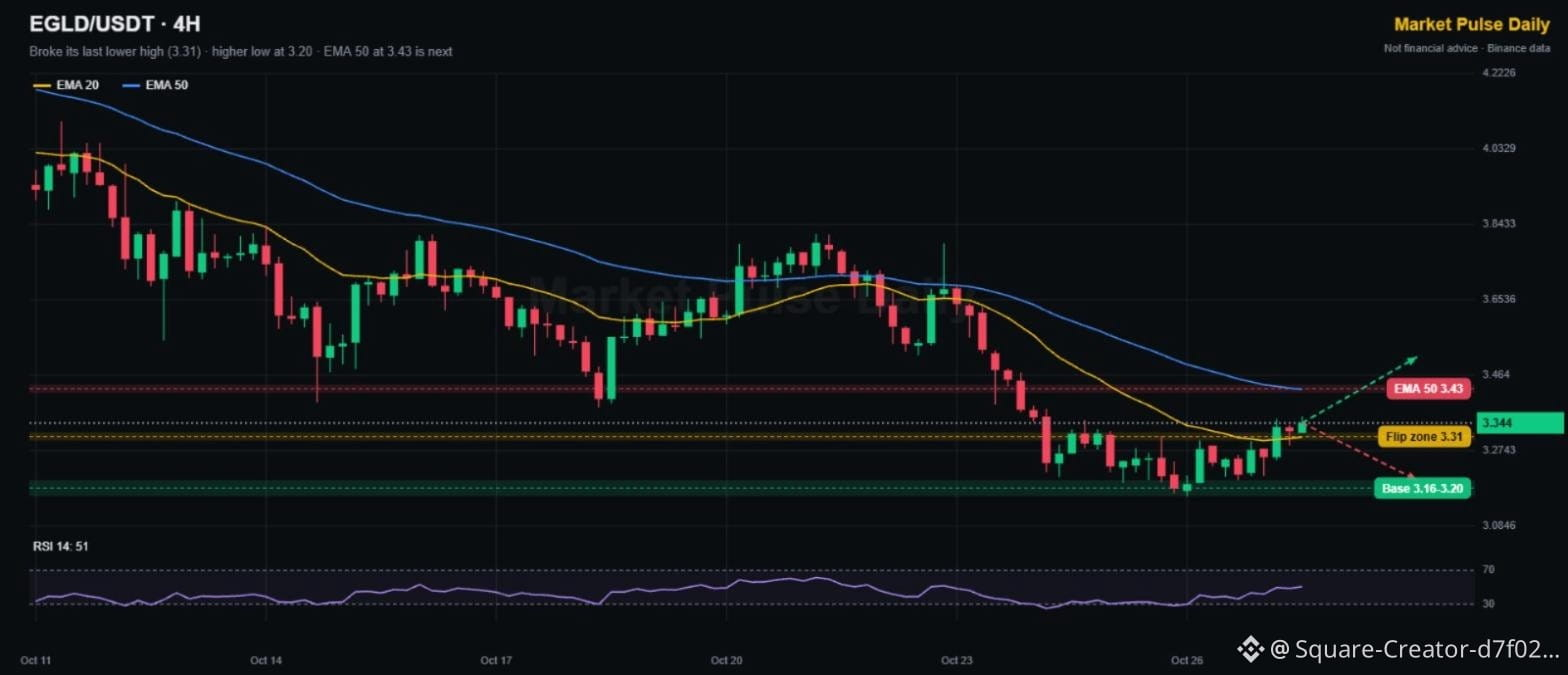
$EGLD just did something it hasn't done all week: it broke a lower high 🟢
Structure (4H):
• Down from 4.10 (Oct 11) to 3.16 (Oct 26). A 23% slide
• Base: 3.16 to 3.20, with a higher low at 3.20 today
• Today's high 3.36 cleared the 3.31 lower high from Oct 26
• Price 3.344, +2.8%, back above EMA 20 (3.31)
• RSI 51, highest reading in over a week
MultiversX was flagged as one of yesterday's worst performers in the top 200 on some trackers. Today it's quietly turning the structure around.
Levels for $EGLD :
🟢 Hold 3.31 → EMA 50 at 3.43, then 3.51
🔴 Back under 3.31 → range again, 3.20 base retest
Early reversal or dead cat bounce for $EGLD ? 👇
NFA
#MultiversX #Altcoins #TechnicalAnalysis
No Binance account yet? Get 20% of your trading fees back 👉 [Sign up on Binance](https://www.binance.com/register?ref=TGCSTKKM)
$EGLD just did something it hasn't done all week: it broke a lower high 🟢
Structure (4H):
• Down from 4.10 (Oct 11) to 3.16 (Oct 26). A 23% slide
• Base: 3.16 to 3.20, with a higher low at 3.20 today
• Today's high 3.36 cleared the 3.31 lower high from Oct 26
• Price 3.344, +2.8%, back above EMA 20 (3.31)
• RSI 51, highest reading in over a week
MultiversX was flagged as one of yesterday's worst performers in the top 200 on some trackers. Today it's quietly turning the structure around.
Levels for $EGLD :
🟢 Hold 3.31 → EMA 50 at 3.43, then 3.51
🔴 Back under 3.31 → range again, 3.20 base retest
Early reversal or dead cat bounce for $EGLD ? 👇
NFA
#MultiversX #Altcoins #TechnicalAnalysis
No Binance account yet? Get 20% of your trading fees back 👉 Sign up on Binance
68
·
--
🔍 THREE NETWORKS WITH DIFFERENT DESIGN CHOICES
🏰 $EGLD — MultiversX's blockchain ecosystem.
⚡ $KAS — Kaspa's blockDAG-based proof-of-work network.
🌐 $HBAR — Hedera's distributed-ledger ecosystem.
Consensus design, decentralization, transaction demand, and token economics all deserve attention.
Which technical design would you like to understand better?
#MultiversX #Kaspa #Hedera
1
26

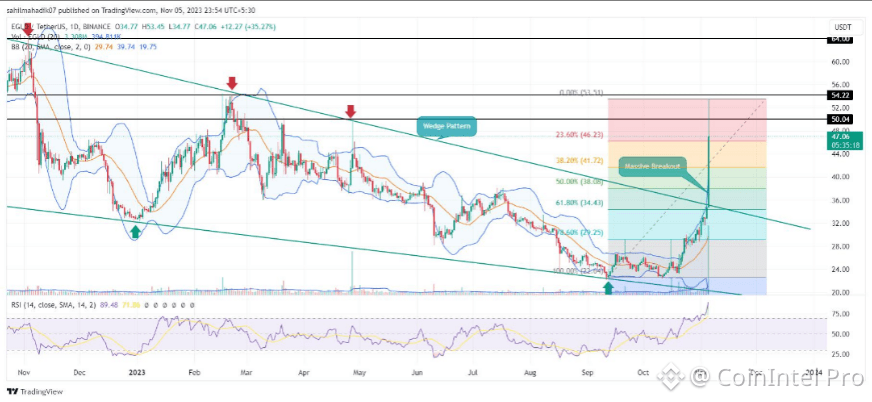
🌐 EGLD LOOKING STRONG
$EGLD bounced from a key demand zone 🔥
📊 Entry: 42
🎯 TP: 50 / 58
🛑 SL: 38
📰 News: Layer-1 ecosystem discussions are increasing again.
👉 Can EGLD make a strong comeback?
#EGLD #MultiversX #CryptoTrading #Layer1
🌐 EGLD LOOKING STRONG
$EGLD bounced from a key demand zone 🔥
📊 Entry: 42
🎯 TP: 50 / 58
🛑 SL: 38
📰 News: Layer-1 ecosystem discussions are increasing again.
👉 Can EGLD make a strong comeback?
#EGLD #MultiversX #CryptoTrading #Layer1
$EGLD bounced from a key demand zone 🔥
📊 Entry: 42
🎯 TP: 50 / 58
🛑 SL: 38
📰 News: Layer-1 ecosystem discussions are increasing again.
👉 Can EGLD make a strong comeback?
#EGLD #MultiversX #CryptoTrading #Layer1
143

·
--
Bullish
Price is droping like Thor's hammer,
Fundamentals unchange
Community still here.
Brighter days will come eventually, many will regret these times, only a few will make it, the one that are now in the trenches.
So #MultiversX FTW! $EGLD
Price is droping like Thor's hammer,
Fundamentals unchange
Community still here.
Brighter days will come eventually, many will regret these times, only a few will make it, the one that are now in the trenches.
So #MultiversX FTW! $EGLD
Fundamentals unchange
Community still here.
Brighter days will come eventually, many will regret these times, only a few will make it, the one that are now in the trenches.
So #MultiversX FTW! $EGLD
3
2
178
·
--
Bullish
✨#Supernova redefines the architecture of the #MultiversX blockchain by decoupling consensus from execution, allowing the network to achieve sub-secondary finality and scalable performance without compromising decentralization or increasing hardware requirements. $EGLD 💎
Fly the flag .. because one day we will be flying high
Fly the flag .. because one day we will be flying high

2
180
·
--
Verified
Sub-second finality is exciting.
What’s equally important is how it got here: proposed publicly, debated openly, and approved on-chain by the community.
Technology matters.
Governance matters too.
$EGLD #MultiversX
Sub-second finality is exciting.
What’s equally important is how it got here: proposed publicly, debated openly, and approved on-chain by the community.
Technology matters.
Governance matters too.
$EGLD #MultiversX
What’s equally important is how it got here: proposed publicly, debated openly, and approved on-chain by the community.
Technology matters.
Governance matters too.
$EGLD #MultiversX
1
7
804

·
--
𝗟𝗼𝗮𝗱𝗶𝗻𝗴 𝘂𝗽 𝗼𝗻 @𝗺𝘂𝗹𝘁𝗶𝘃𝗲𝗿𝘀𝘅 𝗵𝗲𝗿𝗲
$textbook$ breakout reclaiming the prior resistance, higher low holding, and momentum flipping back on the daily 📈
This is the perfect setup for continuation if $EGLD clears the next level cleanly
Classic pattern, clean levels, and the chain keeps stacking real usage late buyers usually become exit liquidity for the crowd that saw it first 🚀 #MultiversX #EGLD
18
·
--
Bullish
You know most haters are just concerned about the price. It's crazy to think that's how they base an active team. I don't read charts. I bought low & high. Yes deep down I'm hoping the price matches the tech someday. Untill then all I can do is give my support for all decisions.#MultiversX $EGLD
You know most haters are just concerned about the price. It's crazy to think that's how they base an active team. I don't read charts. I bought low & high. Yes deep down I'm hoping the price matches the tech someday. Untill then all I can do is give my support for all decisions.#MultiversX $EGLD

5
454

·
--
MultiversX (EGLD) dropped more than 8.9% this week to hit a new low. The main reason is that an exchange suspended deposits and withdrawals before the network upgrade, spreading concerns about liquidity.
The upgrade itself is a positive, but the short-term halt during the execution turned into a catalyst for selling pressure. When market sentiment is fragile, even technical suspensions can be amplified in interpretation.
EGLD is currently trading at $2.65. 24-hour trading volume is $2.42 million, with a market cap of $80.69 million.
After the upgrade is completed, watch for signals of liquidity recovery.
#MultiversX #EGLD
129
Log in to explore more content
Join global crypto users on Binance Square
⚡️ Get latest and useful information about crypto.
💬 Trusted by the world’s largest crypto exchange.
👍 Discover real insights from verified creators.
Email / Phone number
Trending Topics
1
#MoneroFalls13%OnDelistings
20,589 views
281 Discussing
2
#EvolveAtBinanceBlockchainWeek
1.2M views
14,066 Discussing
3
#EthereumGlamsterdamKeepsStorageFeeChange
11,775 views
144 Discussing
4
#XRPLedgerVaultGets29Votes
33,958 views
409 Discussing
5
#CanMarketsReboundAfterThanksgiving?
451,559 views
3,369 Discussing
6
#CouldSpaceX’sOrbitalDataCentersBoostAIChipDemand?
172,829 views
1,734 Discussing
7
#UKFCAProposesDeFiAccessLimitsForExchanges
1,299 views
18 Discussing
8
#ZcashDevelopersUrgeZECMoveToIronwood
101,235 views
491 Discussing
9
#SwitzerlandApproves57JurisdictionsForCryptoDataExchange
10,218 views
35 Discussing
10
#SanDiskJumps11%NvidiaUp4%Premarket
713 views
23 Discussing