

#japaneconomy
japaneconomy
393,681 views
542 Discussing
Hot
Latest

·
--
Bank of Japan Governor Ueda wants to push for neutral interest rates, but the market immediately gave a vote of no confidence with the yen’s collapse! Here are three key takeaways for today’s FX market: 1. A BOJ policy shift—now just a pipe dream? 2. JPY depreciation hits a new yearly low 3. Money is疯狂ly fleeing Japan’s market. How low can $JPY go before it stops? While the Fed watches...
#Forex #JapanEconomy
BOJ's Ueda pushing for neutral rates, but market just voted with yen's collapse! 3 forex watch today: 1. BOJ policy shift in doubt? 2. JPY hits new yearly low 3. Capital fleeing Japan. How low can $JPY go? Fed's just watching the show...
#ForexMarkets #USDJPY
Bank of Japan Governor Ueda wants to push for neutral interest rates, but the market immediately gave a vote of no confidence with the yen’s collapse! Here are three key takeaways for today’s FX market: 1. A BOJ policy shift—now just a pipe dream? 2. JPY depreciation hits a new yearly low 3. Money is疯狂ly fleeing Japan’s market. How low can $JPY go before it stops? While the Fed watches...
#Forex #JapanEconomy
BOJ's Ueda pushing for neutral rates, but market just voted with yen's collapse! 3 forex watch today: 1. BOJ policy shift in doubt? 2. JPY hits new yearly low 3. Capital fleeing Japan. How low can $JPY go? Fed's just watching the show...
#ForexMarkets #USDJPY
#Forex #JapanEconomy
BOJ's Ueda pushing for neutral rates, but market just voted with yen's collapse! 3 forex watch today: 1. BOJ policy shift in doubt? 2. JPY hits new yearly low 3. Capital fleeing Japan. How low can $JPY go? Fed's just watching the show...
#ForexMarkets #USDJPY
4

·
--
Bullish
Verified
#BOJHikesRatesTo31YearHigh
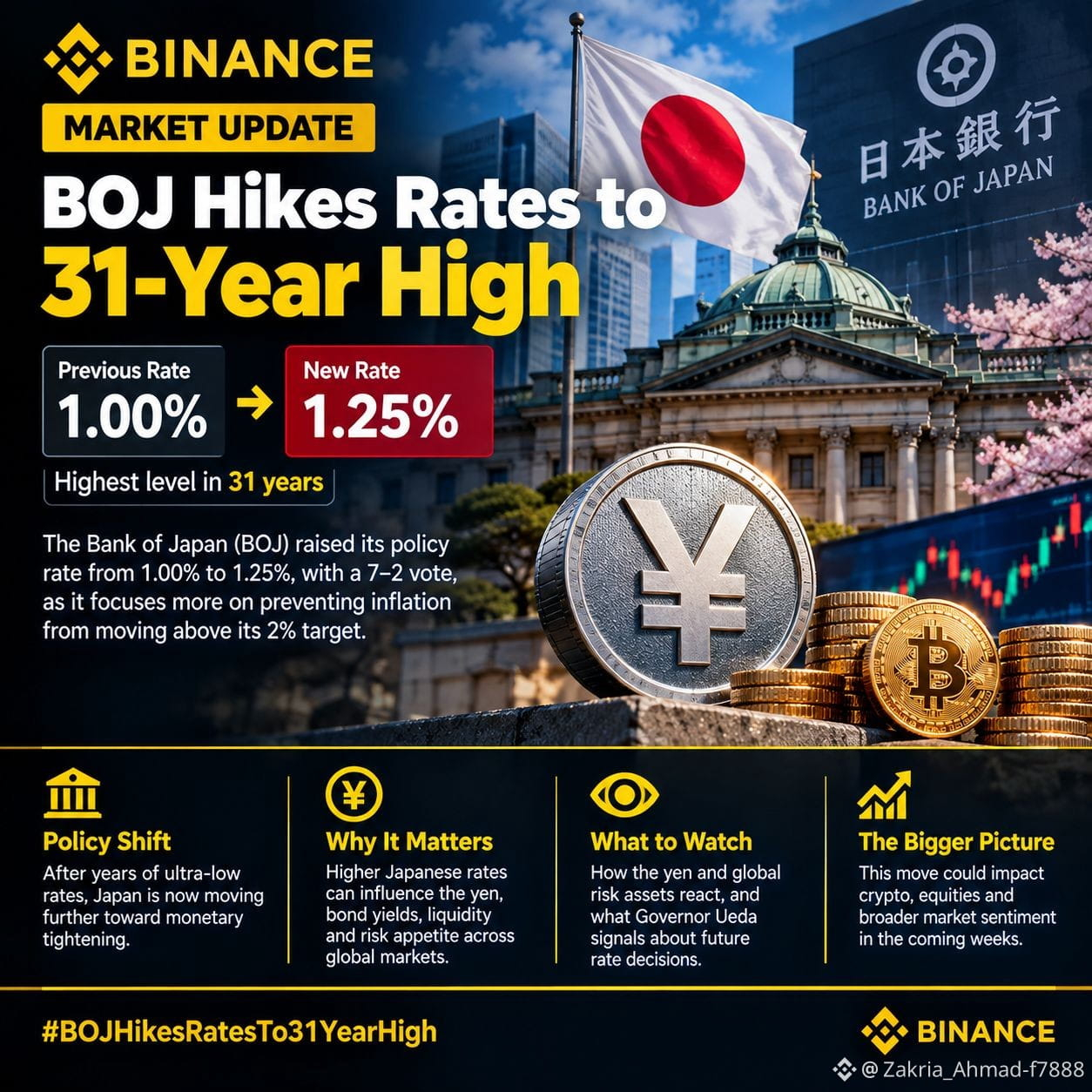
The Bank of Japan has raised its policy rate from 1.00% to 1.25%, taking borrowing costs to their highest level in 31 years. The decision was made by a 7–2 vote as the BOJ focuses more on preventing inflation from moving above its 2% target.
One thing that stands out is the BOJ’s changing policy direction. After years of ultra-low rates, Japan is now moving further toward monetary tightening.
For crypto and global markets, higher Japanese rates matter because they can influence the yen, bond yields, liquidity and risk appetite across markets.
The next thing to watch is how the yen and global risk assets react, and what Governor Ueda signals about future rate decisions.
#BOJ #BankOfJapan #InterestRates #JapanEconomy #CryptoMarket #BinanceSquare
#BOJHikesRatesTo31YearHigh
The Bank of Japan has raised its policy rate from 1.00% to 1.25%, taking borrowing costs to their highest level in 31 years. The decision was made by a 7–2 vote as the BOJ focuses more on preventing inflation from moving above its 2% target.
One thing that stands out is the BOJ’s changing policy direction. After years of ultra-low rates, Japan is now moving further toward monetary tightening.
For crypto and global markets, higher Japanese rates matter because they can influence the yen, bond yields, liquidity and risk appetite across markets.
The next thing to watch is how the yen and global risk assets react, and what Governor Ueda signals about future rate decisions.
#BOJ #BankOfJapan #InterestRates #JapanEconomy #CryptoMarket #BinanceSquare
The Bank of Japan has raised its policy rate from 1.00% to 1.25%, taking borrowing costs to their highest level in 31 years. The decision was made by a 7–2 vote as the BOJ focuses more on preventing inflation from moving above its 2% target.
One thing that stands out is the BOJ’s changing policy direction. After years of ultra-low rates, Japan is now moving further toward monetary tightening.
For crypto and global markets, higher Japanese rates matter because they can influence the yen, bond yields, liquidity and risk appetite across markets.
The next thing to watch is how the yen and global risk assets react, and what Governor Ueda signals about future rate decisions.
#BOJ #BankOfJapan #InterestRates #JapanEconomy #CryptoMarket #BinanceSquare
1
1
43

·
--
Japan’s Ministry of Finance has just released the latest trade statistics for August. The data show that Japan’s exports in August rose 19.3% year-on-year, slowing compared with 23.2% in July; imports increased 28% year-on-year, above the market expectation of 26.3%. As a result, the unadjusted trade deficit widened to 1.1 trillion yen, not only exceeding the previous month’s 638.3 billion yen, but also marking a fourth consecutive month of trade deficits.
This performance report highlights a clear divergence in structure. On one hand, exports of electronic components such as semiconductors surged 52% year-on-year, and automobile exports also remained in growth, suggesting that global demand for high-tech manufacturing remains resilient. On the other hand, with international oil prices staying high and the yen/US dollar exchange rate hovering around 160, the value of crude oil imports jumped by about 59% (while the actual import volume increased only 3.6%). Exchange rate and energy costs have substantially eroded the trade balance.
From the perspective of macro financial markets, the continued widening of the trade deficit reflects import-driven inflation pressure stemming from a weaker yen. The Bank of Japan faces an even more delicate balance between assessing economic recovery and normalizing monetary policy. Market attention to yen volatility and Japanese government bond yields is likely to rise further, and sentiment in the global FX market game will also intensify.
For the crypto market, Japan’s macro data mainly transmit effects through liquidity and exchange-rate expectations. Potential intervention in the yen or its volatility could periodically disrupt cross-market carry trades, but the strength in the tech and semiconductor chain also indicates that risk appetite has not fully faded. At present, overall liquidity conditions are likely to be neutral with respect to $BTC and major alternative coins; everyone may want to pay closer attention to subsequent changes in macro liquidity.✨
#JapanEconomy #GlobalTrade #MacroEconomics
Japan’s Ministry of Finance has just released the latest trade statistics for August. The data show that Japan’s exports in August rose 19.3% year-on-year, slowing compared with 23.2% in July; imports increased 28% year-on-year, above the market expectation of 26.3%. As a result, the unadjusted trade deficit widened to 1.1 trillion yen, not only exceeding the previous month’s 638.3 billion yen, but also marking a fourth consecutive month of trade deficits.
This performance report highlights a clear divergence in structure. On one hand, exports of electronic components such as semiconductors surged 52% year-on-year, and automobile exports also remained in growth, suggesting that global demand for high-tech manufacturing remains resilient. On the other hand, with international oil prices staying high and the yen/US dollar exchange rate hovering around 160, the value of crude oil imports jumped by about 59% (while the actual import volume increased only 3.6%). Exchange rate and energy costs have substantially eroded the trade balance.
From the perspective of macro financial markets, the continued widening of the trade deficit reflects import-driven inflation pressure stemming from a weaker yen. The Bank of Japan faces an even more delicate balance between assessing economic recovery and normalizing monetary policy. Market attention to yen volatility and Japanese government bond yields is likely to rise further, and sentiment in the global FX market game will also intensify.
For the crypto market, Japan’s macro data mainly transmit effects through liquidity and exchange-rate expectations. Potential intervention in the yen or its volatility could periodically disrupt cross-market carry trades, but the strength in the tech and semiconductor chain also indicates that risk appetite has not fully faded. At present, overall liquidity conditions are likely to be neutral with respect to $BTC and major alternative coins; everyone may want to pay closer attention to subsequent changes in macro liquidity.✨
#JapanEconomy #GlobalTrade #MacroEconomics
This performance report highlights a clear divergence in structure. On one hand, exports of electronic components such as semiconductors surged 52% year-on-year, and automobile exports also remained in growth, suggesting that global demand for high-tech manufacturing remains resilient. On the other hand, with international oil prices staying high and the yen/US dollar exchange rate hovering around 160, the value of crude oil imports jumped by about 59% (while the actual import volume increased only 3.6%). Exchange rate and energy costs have substantially eroded the trade balance.
From the perspective of macro financial markets, the continued widening of the trade deficit reflects import-driven inflation pressure stemming from a weaker yen. The Bank of Japan faces an even more delicate balance between assessing economic recovery and normalizing monetary policy. Market attention to yen volatility and Japanese government bond yields is likely to rise further, and sentiment in the global FX market game will also intensify.
For the crypto market, Japan’s macro data mainly transmit effects through liquidity and exchange-rate expectations. Potential intervention in the yen or its volatility could periodically disrupt cross-market carry trades, but the strength in the tech and semiconductor chain also indicates that risk appetite has not fully faded. At present, overall liquidity conditions are likely to be neutral with respect to $BTC and major alternative coins; everyone may want to pay closer attention to subsequent changes in macro liquidity.✨
#JapanEconomy #GlobalTrade #MacroEconomics
110

·
--
Bullish
#japanurgesgpiftoboostdomesticassets
🇯🇵 THE SAMURAI ROTATION IS HERE: JAPAN URGES GPIF TO BOOST DOMESTIC ASSETS! 💴🚀
The landscape of global asset allocation just shifted. The Japanese government is officially making a powerful push urging the Government Pension Investment Fund (GPIF)—the world's largest pension fund managing over $1.5 Trillion—to heavily favor domestic stocks and bonds.
If you are trading macro equities, the Yen, or tracking global sovereign liquidity, pay close attention. This policy shift changes everything.
Here is the quick, professional breakdown of the massive capital rotation:
🚨 The Catalyst: Nationalizing Japan's Wealth
The government wants its financial crown jewel to deploy its gargantuan capital pool to directly fuel the home economy:
The Domestic Multiplier: By shifting allocation away from foreign assets (like US Treasuries and Wall Street tech) and into Japanese equities, the government aims to create an irreversible bullish cycle for local enterprises.The Yen Protection Play: Forcing the world's biggest fund to buy Japanese assets naturally spikes long-term structural demand for the Yen, helping to establish a permanent floor under the currency.Corporate Governance Tailwind: This domestic mandate rewards companies making shareholder-friendly reforms, driving massive institutional buying pressure into undervalued local sectors.
💡 The Big Takeaway for Global Traders
When a $1.5+ Trillion behemoth gets nudged to adjust its portfolio weightings, global liquidity patterns reshape. Wall Street's loss is Tokyo's gain. Capital is going to start quietly but aggressively draining out of overextended Western tech structures and flooding straight into premium Japanese blue-chips.
The Tokyo market isn't just a short-term trade anymore—it is becoming a mandatory sovereign-backed fortress for institutional wealth. 🌊🗻
Will the GPIF’s shift cause a massive rally in Japanese stocks, or will it
#JapanUrgesGPIFToBoostDomesticAssets #GPIF #JapanEconomy
#japanurgesgpiftoboostdomesticassets
🇯🇵 THE SAMURAI ROTATION IS HERE: JAPAN URGES GPIF TO BOOST DOMESTIC ASSETS! 💴🚀
The landscape of global asset allocation just shifted. The Japanese government is officially making a powerful push urging the Government Pension Investment Fund (GPIF)—the world's largest pension fund managing over $1.5 Trillion—to heavily favor domestic stocks and bonds.
If you are trading macro equities, the Yen, or tracking global sovereign liquidity, pay close attention. This policy shift changes everything.
Here is the quick, professional breakdown of the massive capital rotation:
🚨 The Catalyst: Nationalizing Japan's Wealth
The government wants its financial crown jewel to deploy its gargantuan capital pool to directly fuel the home economy:
The Domestic Multiplier: By shifting allocation away from foreign assets (like US Treasuries and Wall Street tech) and into Japanese equities, the government aims to create an irreversible bullish cycle for local enterprises.The Yen Protection Play: Forcing the world's biggest fund to buy Japanese assets naturally spikes long-term structural demand for the Yen, helping to establish a permanent floor under the currency.Corporate Governance Tailwind: This domestic mandate rewards companies making shareholder-friendly reforms, driving massive institutional buying pressure into undervalued local sectors.
💡 The Big Takeaway for Global Traders
When a $1.5+ Trillion behemoth gets nudged to adjust its portfolio weightings, global liquidity patterns reshape. Wall Street's loss is Tokyo's gain. Capital is going to start quietly but aggressively draining out of overextended Western tech structures and flooding straight into premium Japanese blue-chips.
The Tokyo market isn't just a short-term trade anymore—it is becoming a mandatory sovereign-backed fortress for institutional wealth. 🌊🗻
Will the GPIF’s shift cause a massive rally in Japanese stocks, or will it
#JapanUrgesGPIFToBoostDomesticAssets #GPIF #JapanEconomy
🇯🇵 THE SAMURAI ROTATION IS HERE: JAPAN URGES GPIF TO BOOST DOMESTIC ASSETS! 💴🚀
The landscape of global asset allocation just shifted. The Japanese government is officially making a powerful push urging the Government Pension Investment Fund (GPIF)—the world's largest pension fund managing over $1.5 Trillion—to heavily favor domestic stocks and bonds.
If you are trading macro equities, the Yen, or tracking global sovereign liquidity, pay close attention. This policy shift changes everything.
Here is the quick, professional breakdown of the massive capital rotation:
🚨 The Catalyst: Nationalizing Japan's Wealth
The government wants its financial crown jewel to deploy its gargantuan capital pool to directly fuel the home economy:
The Domestic Multiplier: By shifting allocation away from foreign assets (like US Treasuries and Wall Street tech) and into Japanese equities, the government aims to create an irreversible bullish cycle for local enterprises.The Yen Protection Play: Forcing the world's biggest fund to buy Japanese assets naturally spikes long-term structural demand for the Yen, helping to establish a permanent floor under the currency.Corporate Governance Tailwind: This domestic mandate rewards companies making shareholder-friendly reforms, driving massive institutional buying pressure into undervalued local sectors.
💡 The Big Takeaway for Global Traders
When a $1.5+ Trillion behemoth gets nudged to adjust its portfolio weightings, global liquidity patterns reshape. Wall Street's loss is Tokyo's gain. Capital is going to start quietly but aggressively draining out of overextended Western tech structures and flooding straight into premium Japanese blue-chips.
The Tokyo market isn't just a short-term trade anymore—it is becoming a mandatory sovereign-backed fortress for institutional wealth. 🌊🗻
Will the GPIF’s shift cause a massive rally in Japanese stocks, or will it
#JapanUrgesGPIFToBoostDomesticAssets #GPIF #JapanEconomy
1
183

·
--
Bullish
Japan Sees Broader Inflation Pressure as Firms Pass Costs On Faster Than in 2022
📈 Japan’s annual economic report shows that companies are passing higher energy and import costs on to selling prices more quickly than during the 2022 shock, amid a weaker yen and Brent crude holding near $100 per barrel.
🏭 Inflation expectations among businesses and households continue to rise, while corporate investment plans have remained above their historical average for a second consecutive year. This suggests the economy still has some resilience despite increasing cost pressures.
🏦 Many investors still expect the BOJ to keep interest rates unchanged at its late-July meeting, but the likelihood of a more hawkish signal is increasing. Oil prices and yen movements will remain the two key factors shaping Japan’s inflation outlook in the coming weeks.
#JapanEconomy $AKE $DEXE $LINK
Japan Sees Broader Inflation Pressure as Firms Pass Costs On Faster Than in 2022
📈 Japan’s annual economic report shows that companies are passing higher energy and import costs on to selling prices more quickly than during the 2022 shock, amid a weaker yen and Brent crude holding near $100 per barrel.
🏭 Inflation expectations among businesses and households continue to rise, while corporate investment plans have remained above their historical average for a second consecutive year. This suggests the economy still has some resilience despite increasing cost pressures.
🏦 Many investors still expect the BOJ to keep interest rates unchanged at its late-July meeting, but the likelihood of a more hawkish signal is increasing. Oil prices and yen movements will remain the two key factors shaping Japan’s inflation outlook in the coming weeks.
#JapanEconomy $AKE $DEXE $LINK
📈 Japan’s annual economic report shows that companies are passing higher energy and import costs on to selling prices more quickly than during the 2022 shock, amid a weaker yen and Brent crude holding near $100 per barrel.
🏭 Inflation expectations among businesses and households continue to rise, while corporate investment plans have remained above their historical average for a second consecutive year. This suggests the economy still has some resilience despite increasing cost pressures.
🏦 Many investors still expect the BOJ to keep interest rates unchanged at its late-July meeting, but the likelihood of a more hawkish signal is increasing. Oil prices and yen movements will remain the two key factors shaping Japan’s inflation outlook in the coming weeks.
#JapanEconomy $AKE $DEXE $LINK

153

·
--
🚨BREAKING: Japan just dropped a $34 BILLION hammer on forex speculators. 🇯🇵
The Bank of Japan’s latest data reveals a massive 11.4 trillion yen funding gap—completely shattering market expectations of 5.66–6.70 trillion.
The verdict? Japan didn’t just talk... they took action.
Estimates show a staggering ~$34 BILLION intervention on Friday alone. Tokyo and Washington are sending a crystal-clear message to yen short-sellers:
Play with fire, get burned. 📉🔥
Are you holding or shorting the JPY right now?
#YenRisesTo156 #USJapanJointYenInterventionFirstSince2011 #
#JapanEconomy #BinanceSquare
$BTC
{future}(BTCUSDT)
$BLESS
{future}(BLESSUSDT)
$BICO
{future}(BICOUSDT)
🚨BREAKING: Japan just dropped a $34 BILLION hammer on forex speculators. 🇯🇵
The Bank of Japan’s latest data reveals a massive 11.4 trillion yen funding gap—completely shattering market expectations of 5.66–6.70 trillion.
The verdict? Japan didn’t just talk... they took action.
Estimates show a staggering ~$34 BILLION intervention on Friday alone. Tokyo and Washington are sending a crystal-clear message to yen short-sellers:
Play with fire, get burned. 📉🔥
Are you holding or shorting the JPY right now?
#YenRisesTo156 #USJapanJointYenInterventionFirstSince2011 #
#JapanEconomy #BinanceSquare
$BTC
$BLESS
$BICO
The Bank of Japan’s latest data reveals a massive 11.4 trillion yen funding gap—completely shattering market expectations of 5.66–6.70 trillion.
The verdict? Japan didn’t just talk... they took action.
Estimates show a staggering ~$34 BILLION intervention on Friday alone. Tokyo and Washington are sending a crystal-clear message to yen short-sellers:
Play with fire, get burned. 📉🔥
Are you holding or shorting the JPY right now?
#YenRisesTo156 #USJapanJointYenInterventionFirstSince2011 #
#JapanEconomy #BinanceSquare
$BTC
$BLESS
$BICO

152
·
--
Bullish
Japan’s industrial output shows a mild rebound, but factory utilization continues to weaken
🏭 METI’s April 2026 data showed Japan’s industrial production rising 0.5% from the previous month, marking a modest recovery after a weaker stretch. However, the improvement was not strong enough to confirm a clear turnaround in the manufacturing sector.
📉 The more notable signal came from factory utilization, with the Operating Ratio falling 0.8% to 102.9. When output rises but utilization keeps declining, it suggests that real demand may still be insufficient to fully absorb existing production capacity.
⚙️ Weakness was seen in areas such as electronic parts, electrical and information communication machinery, and general-purpose machinery. These segments are closely linked to export chains, so the data still points to a manufacturing recovery that lacks strong momentum.
💴 For the BoJ, this reading may support a more cautious policy stance. With factory utilization falling and industrial momentum still uneven, expectations for faster tightening could remain limited.
🔎 Overall, April’s data is not deeply negative, but it is a warning sign worth monitoring. If capacity utilization continues to decline in the May and June reports, pressure on Q2 growth and sentiment toward Japanese manufacturing stocks could become more visible.
#JapanEconomy $BTC $NVDAB $SPCXB
Japan’s industrial output shows a mild rebound, but factory utilization continues to weaken
🏭 METI’s April 2026 data showed Japan’s industrial production rising 0.5% from the previous month, marking a modest recovery after a weaker stretch. However, the improvement was not strong enough to confirm a clear turnaround in the manufacturing sector.
📉 The more notable signal came from factory utilization, with the Operating Ratio falling 0.8% to 102.9. When output rises but utilization keeps declining, it suggests that real demand may still be insufficient to fully absorb existing production capacity.
⚙️ Weakness was seen in areas such as electronic parts, electrical and information communication machinery, and general-purpose machinery. These segments are closely linked to export chains, so the data still points to a manufacturing recovery that lacks strong momentum.
💴 For the BoJ, this reading may support a more cautious policy stance. With factory utilization falling and industrial momentum still uneven, expectations for faster tightening could remain limited.
🔎 Overall, April’s data is not deeply negative, but it is a warning sign worth monitoring. If capacity utilization continues to decline in the May and June reports, pressure on Q2 growth and sentiment toward Japanese manufacturing stocks could become more visible.
#JapanEconomy $BTC $NVDAB $SPCXB
🏭 METI’s April 2026 data showed Japan’s industrial production rising 0.5% from the previous month, marking a modest recovery after a weaker stretch. However, the improvement was not strong enough to confirm a clear turnaround in the manufacturing sector.
📉 The more notable signal came from factory utilization, with the Operating Ratio falling 0.8% to 102.9. When output rises but utilization keeps declining, it suggests that real demand may still be insufficient to fully absorb existing production capacity.
⚙️ Weakness was seen in areas such as electronic parts, electrical and information communication machinery, and general-purpose machinery. These segments are closely linked to export chains, so the data still points to a manufacturing recovery that lacks strong momentum.
💴 For the BoJ, this reading may support a more cautious policy stance. With factory utilization falling and industrial momentum still uneven, expectations for faster tightening could remain limited.
🔎 Overall, April’s data is not deeply negative, but it is a warning sign worth monitoring. If capacity utilization continues to decline in the May and June reports, pressure on Q2 growth and sentiment toward Japanese manufacturing stocks could become more visible.
#JapanEconomy $BTC $NVDAB $SPCXB

1
3.8k

·
--
Bullish
$龙虾 JUST IN
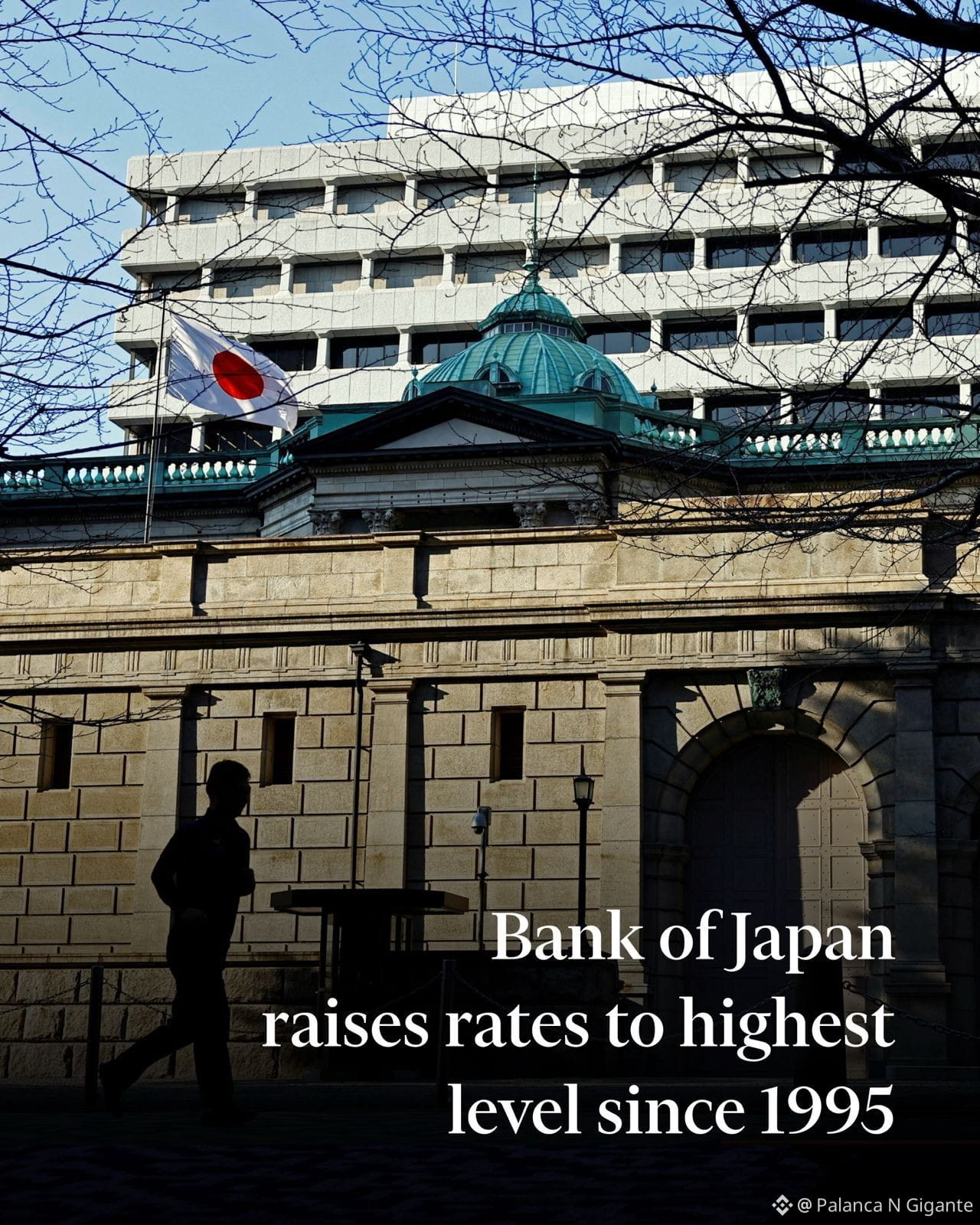
$BSB The Bank of Japan has raised its short-term policy rate to 'around 1 percent', increasing borrowing costs to the highest level in 31 years as the country adjusts to sustained inflation. $BR
{future}(龙虾USDT)
{future}(BSBUSDT)
{future}(BRUSDT)
#news #JapanEconomy #USStockRallyPausesBeforeWarshFed #TradebStocks #Inflation
$龙虾 JUST IN
$BSB The Bank of Japan has raised its short-term policy rate to 'around 1 percent', increasing borrowing costs to the highest level in 31 years as the country adjusts to sustained inflation. $BR
#news #JapanEconomy #USStockRallyPausesBeforeWarshFed #TradebStocks #Inflation
$BSB The Bank of Japan has raised its short-term policy rate to 'around 1 percent', increasing borrowing costs to the highest level in 31 years as the country adjusts to sustained inflation. $BR
#news #JapanEconomy #USStockRallyPausesBeforeWarshFed #TradebStocks #Inflation
621

·
--
The Bank of Japan (BOJ) has raised its benchmark interest rate to 1.0%, up from 0.1%, matching market expectations. The central bank also warned that core inflation is expected to remain above its 2% target starting in September, signaling persistent price pressures.
Market Impact:
🇯🇵 Higher interest rates could strengthen the Japanese Yen (JPY).
📉 Equities and other risk assets may face short-term pressure due to tighter monetary policy.
🪙 Crypto and global markets could see increased volatility as investors react to changes in Japan's monetary stance.
👀 Traders will closely monitor upcoming BOJ statements and inflation data for clues on further rate hikes.
#BankOfJapan #BOJ #InterestRates #JapanEconomy
The Bank of Japan (BOJ) has raised its benchmark interest rate to 1.0%, up from 0.1%, matching market expectations. The central bank also warned that core inflation is expected to remain above its 2% target starting in September, signaling persistent price pressures.
Market Impact:
🇯🇵 Higher interest rates could strengthen the Japanese Yen (JPY).
📉 Equities and other risk assets may face short-term pressure due to tighter monetary policy.
🪙 Crypto and global markets could see increased volatility as investors react to changes in Japan's monetary stance.
👀 Traders will closely monitor upcoming BOJ statements and inflation data for clues on further rate hikes.
#BankOfJapan #BOJ #InterestRates #JapanEconomy
Market Impact:
🇯🇵 Higher interest rates could strengthen the Japanese Yen (JPY).
📉 Equities and other risk assets may face short-term pressure due to tighter monetary policy.
🪙 Crypto and global markets could see increased volatility as investors react to changes in Japan's monetary stance.
👀 Traders will closely monitor upcoming BOJ statements and inflation data for clues on further rate hikes.
#BankOfJapan #BOJ #InterestRates #JapanEconomy
84
·
--
Bullish
Japan is doing everything it can to save its bond market from a crisis. $ONG
The Japanese Ministry of Finance is planning tax exemptions for citizens who buy government bonds, according to a new proposal for the 2027 fiscal year.
The Bank of Japan used to buy most of Japan’s debt. Since 2024, it has been sharply reducing those purchases, and a real gap is now forming. Households currently hold only 2% of Japanese government bonds.
The Bank of Japan holds about 50%.
Banks and other institutions hold about 40%. $TAC
The plan would add government bonds to the country’s tax-exempt investment program, the New NISA, and would be included in tax reform proposals for the 2027 fiscal year, scheduled for late August.
Some lawmakers even argue for exempting these bonds from inheritance tax, but there is resistance to granting them special treatment that other investments do not receive.
Yields on long-term Japanese bonds are already at levels not seen in decades. If ordinary citizens do not step in to fill this gap, Japan may have difficulty continuing to finance its own public debt. $AMP
{spot}(AMPUSDT)
{spot}(ONGUSDT)
{future}(TACUSDT)
#JapanNoAdditionalOilReserveReleaseInSepOct #crashmarket #OilHoldsLosses #ZECBreaksKeyResistanceUp75.5% #JapanEconomy
Japan is doing everything it can to save its bond market from a crisis. $ONG
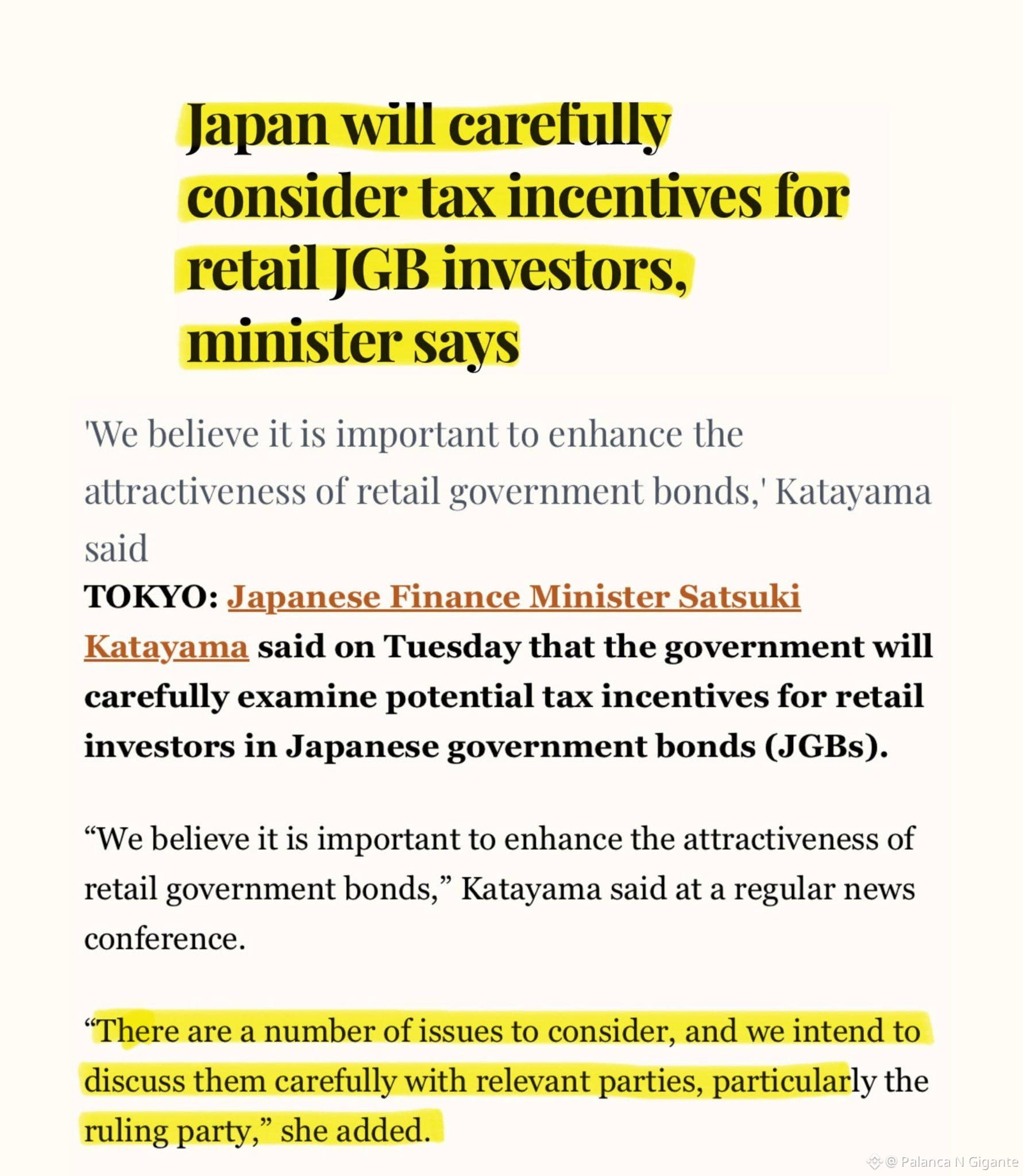
The Japanese Ministry of Finance is planning tax exemptions for citizens who buy government bonds, according to a new proposal for the 2027 fiscal year.
The Bank of Japan used to buy most of Japan’s debt. Since 2024, it has been sharply reducing those purchases, and a real gap is now forming. Households currently hold only 2% of Japanese government bonds.
The Bank of Japan holds about 50%.
Banks and other institutions hold about 40%. $TAC
The plan would add government bonds to the country’s tax-exempt investment program, the New NISA, and would be included in tax reform proposals for the 2027 fiscal year, scheduled for late August.
Some lawmakers even argue for exempting these bonds from inheritance tax, but there is resistance to granting them special treatment that other investments do not receive.
Yields on long-term Japanese bonds are already at levels not seen in decades. If ordinary citizens do not step in to fill this gap, Japan may have difficulty continuing to finance its own public debt. $AMP
#JapanNoAdditionalOilReserveReleaseInSepOct #crashmarket #OilHoldsLosses #ZECBreaksKeyResistanceUp75.5% #JapanEconomy
The Japanese Ministry of Finance is planning tax exemptions for citizens who buy government bonds, according to a new proposal for the 2027 fiscal year.
The Bank of Japan used to buy most of Japan’s debt. Since 2024, it has been sharply reducing those purchases, and a real gap is now forming. Households currently hold only 2% of Japanese government bonds.
The Bank of Japan holds about 50%.
Banks and other institutions hold about 40%. $TAC
The plan would add government bonds to the country’s tax-exempt investment program, the New NISA, and would be included in tax reform proposals for the 2027 fiscal year, scheduled for late August.
Some lawmakers even argue for exempting these bonds from inheritance tax, but there is resistance to granting them special treatment that other investments do not receive.
Yields on long-term Japanese bonds are already at levels not seen in decades. If ordinary citizens do not step in to fill this gap, Japan may have difficulty continuing to finance its own public debt. $AMP
#JapanNoAdditionalOilReserveReleaseInSepOct #crashmarket #OilHoldsLosses #ZECBreaksKeyResistanceUp75.5% #JapanEconomy
1
1.3k

·
--
Bullish
Partly True
Ene Gains Strength as the US and Japan Say They Are Jointly Intervening for the First Time in Nearly 30 Years
$BNB
$XRP
$ETH
#Bloomberg #BloombergReport #JapanEconomy #JapanCrypto #Japanese
{spot}(ETHUSDT)
{spot}(XRPUSDT)
{spot}(BNBUSDT)
Ene Gains Strength as the US and Japan Say They Are Jointly Intervening for the First Time in Nearly 30 Years
$BNB
$XRP
$ETH
#Bloomberg #BloombergReport #JapanEconomy #JapanCrypto #Japanese
$BNB
$XRP
$ETH
#Bloomberg #BloombergReport #JapanEconomy #JapanCrypto #Japanese


Binance News
·
--
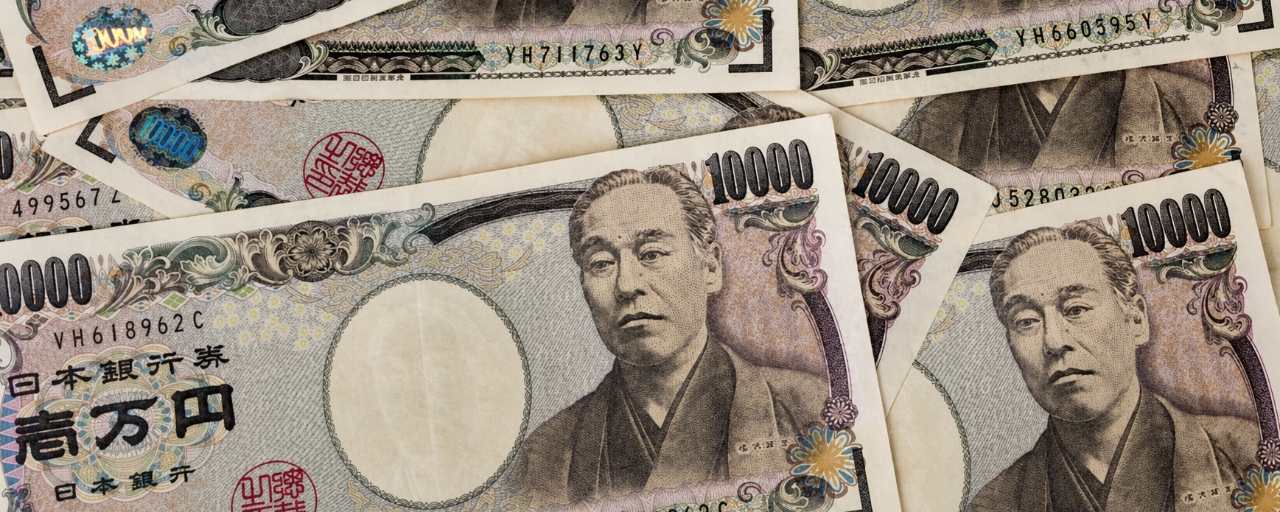
Yen Gains as US and Japan Reportedly Intervene Jointly for First Time in Nearly 30 Years
US and Japanese authorities extended efforts to shore up the yen on Friday, with the currency strengthening more than 1% against both the dollar and the euro, Bloomberg reported. Japanese authorities bought yen and sold dollars during New York trading, while the Financial Times said the Federal Reserve Bank of New York sold euros to buy yen on behalf of the US Treasury — a move the FT called the first joint intervention by Washington and Tokyo to prop up the currency in nearly 30 years. The yen gained about 1.3% versus the greenback, closing near the day's high of 157.28.The coordinated push follows Thursday's estimated ¥8.45 trillion ($52.8 billion) intervention, likely Tokyo's largest ever single-day operation, which drove yen trading volumes to their highest in nearly 12 years, according to Bloomberg. The currency last week touched its weakest level since 1986, pressured by rising oil prices, Japan's budget deficits and a wide US-Japan rate gap. Doubts persist over the effort's durability: Evercore ISI strategists said interventions without support from rate differentials tend to be short-lived, while the BOJ held rates on Friday and Governor Kazuo Ueda gave the currency little fresh support. Rabobank's Jane Foley said the crucial question is whether dollar-yen can hold at 160 without pushing higher again.
1
1.7k


·
--
#JapanEconomy
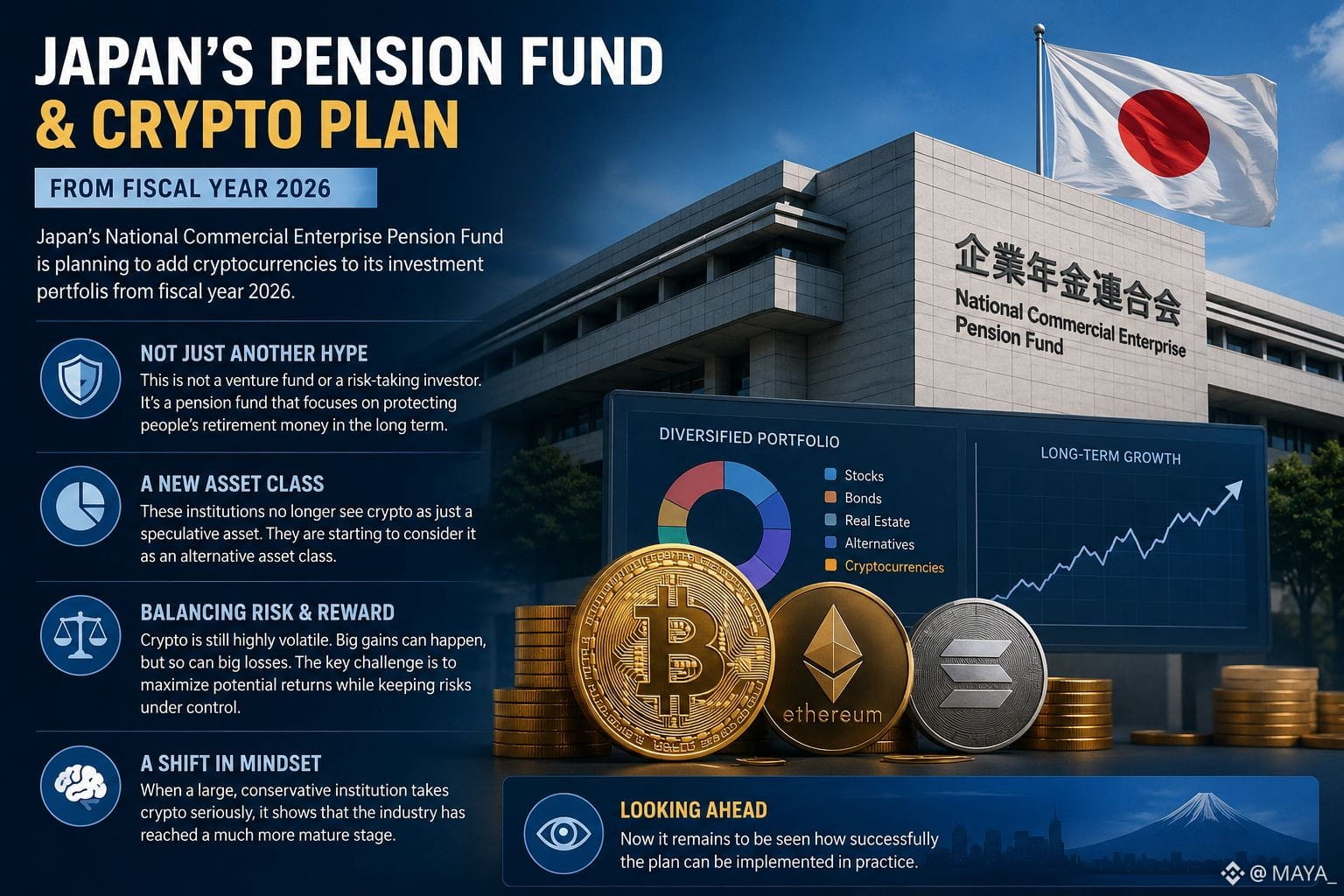
Japan’s National Commercial Enterprise Pension Fund is planning to add cryptocurrencies to its investment portfolio from fiscal year 2026 - the news may sound like “another crypto hype news.” But it’s actually a bit different.
Because there are no venture capital funds or risk-averse investors here. This is a pension fund whose main job is to protect people’s retirement money in the long term. That means they naturally make very calculated decisions. The most important thing for me is that such institutions are no longer viewing crypto as just a speculative asset. They are starting to consider it as an alternative asset class. This doesn’t mean that they will suddenly pour huge amounts of money into Bitcoin or any other digital asset. Rather, it indicates that crypto is slowly taking a permanent place in the mainstream financial system. But there is another side to it. Crypto prices are still very volatile. Big rises are possible in a few months, but big falls are also possible. For institutions like pension funds, this risk is not a small matter. So the biggest challenge for them will be... how to take advantage of the potentially high returns, while at the same time keeping the risks under control.
I think the importance of this decision is not only in terms of investment, but also in terms of psychology. When such a large and conservative institution starts thinking seriously about crypto, it means that the industry has reached a much more mature stage than before.
Now it remains to be seen how successfully the plan can be implemented in practice.
@Binance_Academy @Binance_Square_Official
#JapanEconomy
Japan’s National Commercial Enterprise Pension Fund is planning to add cryptocurrencies to its investment portfolio from fiscal year 2026 - the news may sound like “another crypto hype news.” But it’s actually a bit different.
Because there are no venture capital funds or risk-averse investors here. This is a pension fund whose main job is to protect people’s retirement money in the long term. That means they naturally make very calculated decisions. The most important thing for me is that such institutions are no longer viewing crypto as just a speculative asset. They are starting to consider it as an alternative asset class. This doesn’t mean that they will suddenly pour huge amounts of money into Bitcoin or any other digital asset. Rather, it indicates that crypto is slowly taking a permanent place in the mainstream financial system. But there is another side to it. Crypto prices are still very volatile. Big rises are possible in a few months, but big falls are also possible. For institutions like pension funds, this risk is not a small matter. So the biggest challenge for them will be... how to take advantage of the potentially high returns, while at the same time keeping the risks under control.
I think the importance of this decision is not only in terms of investment, but also in terms of psychology. When such a large and conservative institution starts thinking seriously about crypto, it means that the industry has reached a much more mature stage than before.
Now it remains to be seen how successfully the plan can be implemented in practice.
@Binance Academy @Binance Square Official
Japan’s National Commercial Enterprise Pension Fund is planning to add cryptocurrencies to its investment portfolio from fiscal year 2026 - the news may sound like “another crypto hype news.” But it’s actually a bit different.
Because there are no venture capital funds or risk-averse investors here. This is a pension fund whose main job is to protect people’s retirement money in the long term. That means they naturally make very calculated decisions. The most important thing for me is that such institutions are no longer viewing crypto as just a speculative asset. They are starting to consider it as an alternative asset class. This doesn’t mean that they will suddenly pour huge amounts of money into Bitcoin or any other digital asset. Rather, it indicates that crypto is slowly taking a permanent place in the mainstream financial system. But there is another side to it. Crypto prices are still very volatile. Big rises are possible in a few months, but big falls are also possible. For institutions like pension funds, this risk is not a small matter. So the biggest challenge for them will be... how to take advantage of the potentially high returns, while at the same time keeping the risks under control.
I think the importance of this decision is not only in terms of investment, but also in terms of psychology. When such a large and conservative institution starts thinking seriously about crypto, it means that the industry has reached a much more mature stage than before.
Now it remains to be seen how successfully the plan can be implemented in practice.
@Binance Academy @Binance Square Official
6
146

·
--
Article
Will Japanese Interest Rates Hit a 30-Year High?Inflation, Energy Prices, and Middle East Risks in Focus
Introduction: Japan’s Monetary Policy Enters a New Era
The Bank of Japan (BOJ) is facing a major policy decision as markets increasingly expect another interest rate hike. After years of ultra-loose monetary policy, Japan is moving toward normalization as inflation pressures become more persistent.
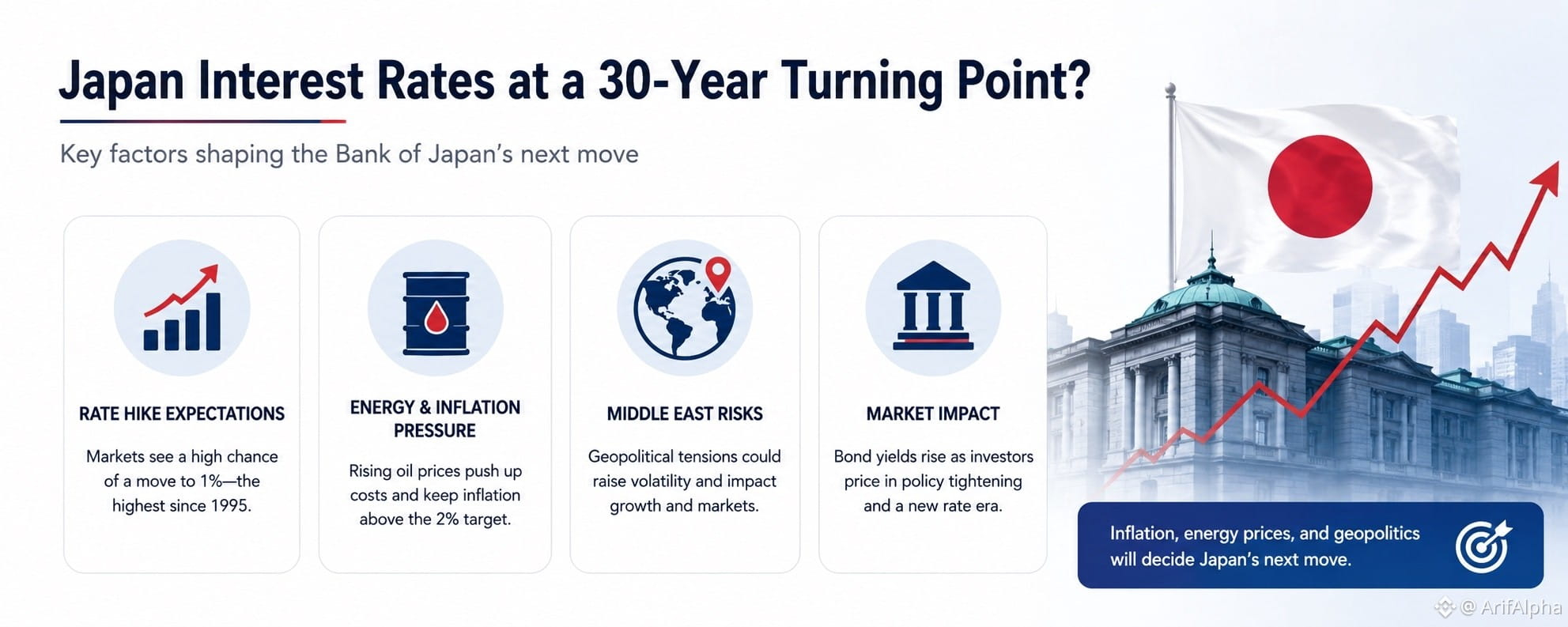
The key question for investors is whether the BOJ will raise its short-term policy rate from 0.75% to 1%, pushing borrowing costs to their highest level since the mid-1990s. However, the final decision depends on three major factors: inflation trends, energy prices, and geopolitical risks from the Middle East.
1. BOJ Rate Hike Expectations Are Rising
Market participants are assigning a high probability that the BOJ will continue tightening policy. Recent statements from central bank officials suggest that policymakers are becoming more concerned about inflation staying above the 2% target for an extended period.
The BOJ’s challenge is different from previous decades. For many years, Japan struggled with weak inflation and slow economic growth. Now, policymakers are trying to prevent price increases from becoming too deeply embedded in the economy.
A potential move toward a 1% interest rate would represent a historic shift, signaling that Japan is moving further away from the negative-rate and stimulus era.
2. Energy Prices Create New Inflation Pressure
One of the biggest drivers behind the BOJ’s concerns is the global energy market.
Japan depends heavily on imported energy, meaning increases in oil and gas prices quickly affect:
• Business operating costs
• Transportation expenses
• Consumer prices
• Household spending power
The Middle East situation has increased uncertainty around global energy supplies. If oil prices remain elevated, Japanese companies may continue passing higher costs onto consumers, creating stronger inflation pressure.
This makes the BOJ’s decision more complicated: higher rates can control inflation, but they can also slow economic activity.
3. The Middle East Conflict: A Double-Edged Risk
Geopolitical tensions create two opposite effects for Japan.
Inflation Impact:
Higher energy prices can push inflation upward, strengthening the argument for a rate hike.
Growth Impact:
A prolonged conflict could damage global demand, increase market volatility, and weaken economic growth.
For the BOJ, the biggest risk is that an aggressive tightening decision could come at the wrong time if global uncertainty suddenly increases.
4. Bond Markets Are Already Pricing a New Reality
Japanese government bond yields have moved significantly higher as investors prepare for further monetary tightening.
Rising yields indicate that markets believe Japan’s long period of extremely low interest rates is ending.
A sustained move toward higher rates could impact:
• Japanese banks
• Currency markets
• Global bond flows
• Equity valuations
• Carry trades involving the Japanese yen
The yen could also react strongly because higher Japanese rates may make the currency more attractive compared with low-rate periods.
5. What This Means for Global Markets and Crypto
Japan’s monetary policy can influence global liquidity.
For years, cheap Japanese borrowing supported risk-taking through the yen carry trade. If rates rise faster than expected:
• Global liquidity conditions may tighten
• Investors may reduce leveraged positions
• Risk assets could experience volatility
Cryptocurrency markets, especially Bitcoin and high-beta altcoins, could react to changes in global liquidity conditions.
However, if rate hikes happen gradually and inflation remains controlled, markets may view it as a sign of economic confidence rather than a negative shock.
Conclusion: Japan’s Biggest Policy Test
The BOJ is approaching a critical moment. A move toward a 1% policy rate would mark one of the most significant changes in Japanese monetary policy in decades.
The decision will depend on whether inflation remains persistent, whether energy prices stay elevated, and whether Middle East tensions create additional economic risks.
Japan’s next move is not only about domestic inflation — it could influence global markets, currencies, bonds, and investor risk appetite worldwide.
#JapanEconomy #GlobalMarkets #InflationWatch #CryptoMacro #ArifAlpha
Will Japanese Interest Rates Hit a 30-Year High?
Inflation, Energy Prices, and Middle East Risks in Focus
Introduction: Japan’s Monetary Policy Enters a New Era
The Bank of Japan (BOJ) is facing a major policy decision as markets increasingly expect another interest rate hike. After years of ultra-loose monetary policy, Japan is moving toward normalization as inflation pressures become more persistent.
The key question for investors is whether the BOJ will raise its short-term policy rate from 0.75% to 1%, pushing borrowing costs to their highest level since the mid-1990s. However, the final decision depends on three major factors: inflation trends, energy prices, and geopolitical risks from the Middle East.
1. BOJ Rate Hike Expectations Are Rising
Market participants are assigning a high probability that the BOJ will continue tightening policy. Recent statements from central bank officials suggest that policymakers are becoming more concerned about inflation staying above the 2% target for an extended period.
The BOJ’s challenge is different from previous decades. For many years, Japan struggled with weak inflation and slow economic growth. Now, policymakers are trying to prevent price increases from becoming too deeply embedded in the economy.
A potential move toward a 1% interest rate would represent a historic shift, signaling that Japan is moving further away from the negative-rate and stimulus era.
2. Energy Prices Create New Inflation Pressure
One of the biggest drivers behind the BOJ’s concerns is the global energy market.
Japan depends heavily on imported energy, meaning increases in oil and gas prices quickly affect:
• Business operating costs
• Transportation expenses
• Consumer prices
• Household spending power
The Middle East situation has increased uncertainty around global energy supplies. If oil prices remain elevated, Japanese companies may continue passing higher costs onto consumers, creating stronger inflation pressure.
This makes the BOJ’s decision more complicated: higher rates can control inflation, but they can also slow economic activity.
3. The Middle East Conflict: A Double-Edged Risk
Geopolitical tensions create two opposite effects for Japan.
Inflation Impact:
Higher energy prices can push inflation upward, strengthening the argument for a rate hike.
Growth Impact:
A prolonged conflict could damage global demand, increase market volatility, and weaken economic growth.
For the BOJ, the biggest risk is that an aggressive tightening decision could come at the wrong time if global uncertainty suddenly increases.
4. Bond Markets Are Already Pricing a New Reality
Japanese government bond yields have moved significantly higher as investors prepare for further monetary tightening.
Rising yields indicate that markets believe Japan’s long period of extremely low interest rates is ending.
A sustained move toward higher rates could impact:
• Japanese banks
• Currency markets
• Global bond flows
• Equity valuations
• Carry trades involving the Japanese yen
The yen could also react strongly because higher Japanese rates may make the currency more attractive compared with low-rate periods.
5. What This Means for Global Markets and Crypto
Japan’s monetary policy can influence global liquidity.
For years, cheap Japanese borrowing supported risk-taking through the yen carry trade. If rates rise faster than expected:
• Global liquidity conditions may tighten
• Investors may reduce leveraged positions
• Risk assets could experience volatility
Cryptocurrency markets, especially Bitcoin and high-beta altcoins, could react to changes in global liquidity conditions.
However, if rate hikes happen gradually and inflation remains controlled, markets may view it as a sign of economic confidence rather than a negative shock.
Conclusion: Japan’s Biggest Policy Test
The BOJ is approaching a critical moment. A move toward a 1% policy rate would mark one of the most significant changes in Japanese monetary policy in decades.
The decision will depend on whether inflation remains persistent, whether energy prices stay elevated, and whether Middle East tensions create additional economic risks.
Japan’s next move is not only about domestic inflation — it could influence global markets, currencies, bonds, and investor risk appetite worldwide.
#JapanEconomy #GlobalMarkets #InflationWatch #CryptoMacro #ArifAlpha
Introduction: Japan’s Monetary Policy Enters a New Era
The Bank of Japan (BOJ) is facing a major policy decision as markets increasingly expect another interest rate hike. After years of ultra-loose monetary policy, Japan is moving toward normalization as inflation pressures become more persistent.
The key question for investors is whether the BOJ will raise its short-term policy rate from 0.75% to 1%, pushing borrowing costs to their highest level since the mid-1990s. However, the final decision depends on three major factors: inflation trends, energy prices, and geopolitical risks from the Middle East.
1. BOJ Rate Hike Expectations Are Rising
Market participants are assigning a high probability that the BOJ will continue tightening policy. Recent statements from central bank officials suggest that policymakers are becoming more concerned about inflation staying above the 2% target for an extended period.
The BOJ’s challenge is different from previous decades. For many years, Japan struggled with weak inflation and slow economic growth. Now, policymakers are trying to prevent price increases from becoming too deeply embedded in the economy.
A potential move toward a 1% interest rate would represent a historic shift, signaling that Japan is moving further away from the negative-rate and stimulus era.
2. Energy Prices Create New Inflation Pressure
One of the biggest drivers behind the BOJ’s concerns is the global energy market.
Japan depends heavily on imported energy, meaning increases in oil and gas prices quickly affect:
• Business operating costs
• Transportation expenses
• Consumer prices
• Household spending power
The Middle East situation has increased uncertainty around global energy supplies. If oil prices remain elevated, Japanese companies may continue passing higher costs onto consumers, creating stronger inflation pressure.
This makes the BOJ’s decision more complicated: higher rates can control inflation, but they can also slow economic activity.
3. The Middle East Conflict: A Double-Edged Risk
Geopolitical tensions create two opposite effects for Japan.
Inflation Impact:
Higher energy prices can push inflation upward, strengthening the argument for a rate hike.
Growth Impact:
A prolonged conflict could damage global demand, increase market volatility, and weaken economic growth.
For the BOJ, the biggest risk is that an aggressive tightening decision could come at the wrong time if global uncertainty suddenly increases.
4. Bond Markets Are Already Pricing a New Reality
Japanese government bond yields have moved significantly higher as investors prepare for further monetary tightening.
Rising yields indicate that markets believe Japan’s long period of extremely low interest rates is ending.
A sustained move toward higher rates could impact:
• Japanese banks
• Currency markets
• Global bond flows
• Equity valuations
• Carry trades involving the Japanese yen
The yen could also react strongly because higher Japanese rates may make the currency more attractive compared with low-rate periods.
5. What This Means for Global Markets and Crypto
Japan’s monetary policy can influence global liquidity.
For years, cheap Japanese borrowing supported risk-taking through the yen carry trade. If rates rise faster than expected:
• Global liquidity conditions may tighten
• Investors may reduce leveraged positions
• Risk assets could experience volatility
Cryptocurrency markets, especially Bitcoin and high-beta altcoins, could react to changes in global liquidity conditions.
However, if rate hikes happen gradually and inflation remains controlled, markets may view it as a sign of economic confidence rather than a negative shock.
Conclusion: Japan’s Biggest Policy Test
The BOJ is approaching a critical moment. A move toward a 1% policy rate would mark one of the most significant changes in Japanese monetary policy in decades.
The decision will depend on whether inflation remains persistent, whether energy prices stay elevated, and whether Middle East tensions create additional economic risks.
Japan’s next move is not only about domestic inflation — it could influence global markets, currencies, bonds, and investor risk appetite worldwide.
#JapanEconomy #GlobalMarkets #InflationWatch #CryptoMacro #ArifAlpha
93
·
--
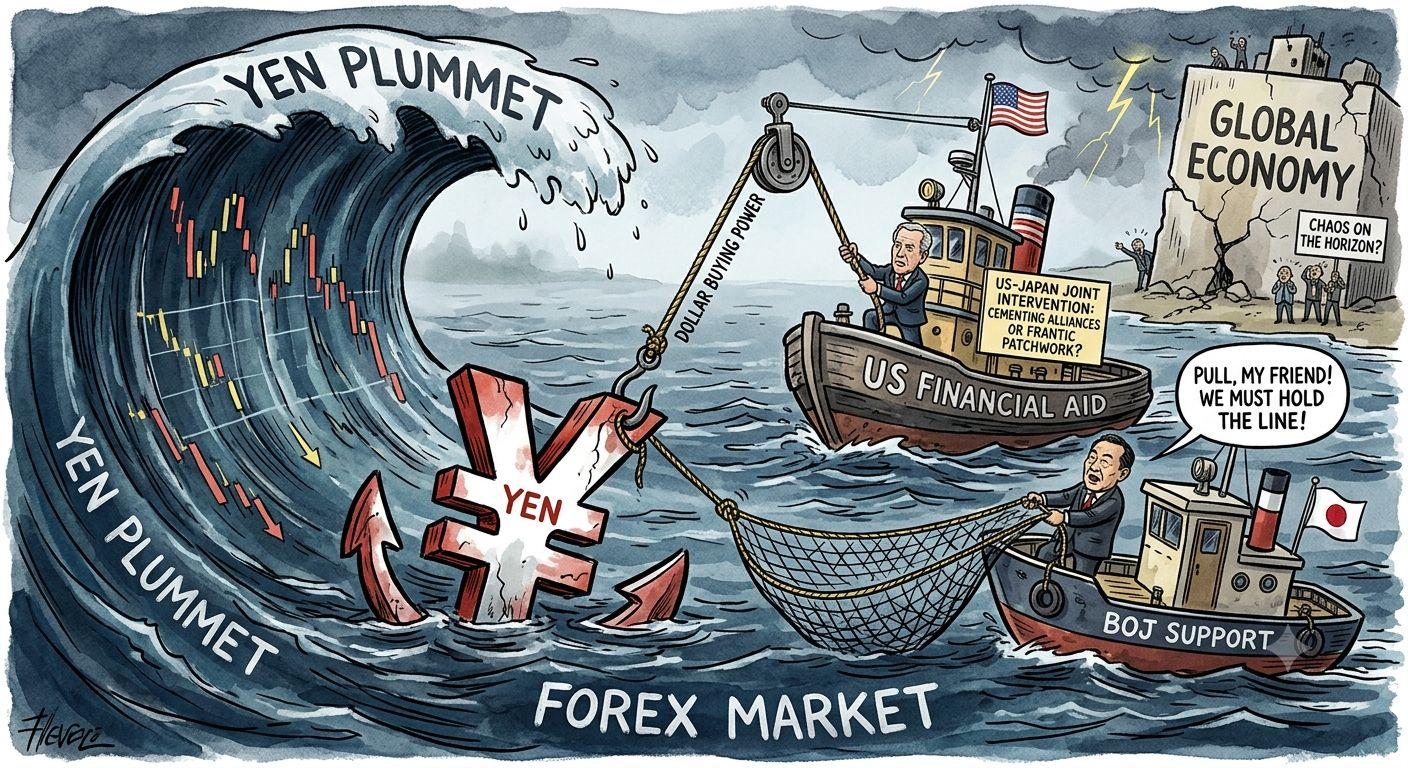
#USAndJapanJointlyInterveneToBuyYen
Not since 1998... The US and Japan just did something the markets will never forget. 📉
Talk about a long-distance bromance that stands the test of time... 🤝🇯🇵🇺🇸
For the first time since 1998, the US and Japan have launched a joint intervention to buy the Yen. That’s nearly 30 years of partnership coming through right when the market needed it most!
But here’s what every trader actually needs to know right now... 👇
💥 The Domino Effect: Enter the "Yen Carry Trade"
With the Yen surging, the infamous Yen Carry Trade Unwind is officially triggered.
When the Yen rockets up:
Cheap borrowing in JPY gets crushed.
Global liquidity gets squeezed.
Volatility spikes across all major asset classes.
In short? The markets are about to get wild. 🌊
🛡️ How to Survive (and Thrive) in This Market
If you're navigating these waters, here is your game plan:
🎢 Buckle up: Volatility is non-negotiable right now. Expect big swings.
⚖️ Manage your leverage: Unwinding events wipe out over-leveraged accounts in seconds. Respect your risk.
👀 Eyes on USD/JPY: This pair is ground zero. Watch price action closely before making a move.
⚠️ Reminder: Volatility brings massive opportunities, but capital preservation always comes first.
Safe trading out there, everyone!
(NFA / Not Financial Advice)
#JapanEconomy #Trading #BinanceSquare
$1000RATS
{future}(1000RATSUSDT)
$GIGGLE
{future}(GIGGLEUSDT)
$IDOL
{future}(IDOLUSDT)
#USAndJapanJointlyInterveneToBuyYen
Not since 1998... The US and Japan just did something the markets will never forget. 📉
Talk about a long-distance bromance that stands the test of time... 🤝🇯🇵🇺🇸
For the first time since 1998, the US and Japan have launched a joint intervention to buy the Yen. That’s nearly 30 years of partnership coming through right when the market needed it most!
But here’s what every trader actually needs to know right now... 👇
💥 The Domino Effect: Enter the "Yen Carry Trade"
With the Yen surging, the infamous Yen Carry Trade Unwind is officially triggered.
When the Yen rockets up:
Cheap borrowing in JPY gets crushed.
Global liquidity gets squeezed.
Volatility spikes across all major asset classes.
In short? The markets are about to get wild. 🌊
🛡️ How to Survive (and Thrive) in This Market
If you're navigating these waters, here is your game plan:
🎢 Buckle up: Volatility is non-negotiable right now. Expect big swings.
⚖️ Manage your leverage: Unwinding events wipe out over-leveraged accounts in seconds. Respect your risk.
👀 Eyes on USD/JPY: This pair is ground zero. Watch price action closely before making a move.
⚠️ Reminder: Volatility brings massive opportunities, but capital preservation always comes first.
Safe trading out there, everyone!
(NFA / Not Financial Advice)
#JapanEconomy #Trading #BinanceSquare
$1000RATS
$GIGGLE
$IDOL
Not since 1998... The US and Japan just did something the markets will never forget. 📉
Talk about a long-distance bromance that stands the test of time... 🤝🇯🇵🇺🇸
For the first time since 1998, the US and Japan have launched a joint intervention to buy the Yen. That’s nearly 30 years of partnership coming through right when the market needed it most!
But here’s what every trader actually needs to know right now... 👇
💥 The Domino Effect: Enter the "Yen Carry Trade"
With the Yen surging, the infamous Yen Carry Trade Unwind is officially triggered.
When the Yen rockets up:
Cheap borrowing in JPY gets crushed.
Global liquidity gets squeezed.
Volatility spikes across all major asset classes.
In short? The markets are about to get wild. 🌊
🛡️ How to Survive (and Thrive) in This Market
If you're navigating these waters, here is your game plan:
🎢 Buckle up: Volatility is non-negotiable right now. Expect big swings.
⚖️ Manage your leverage: Unwinding events wipe out over-leveraged accounts in seconds. Respect your risk.
👀 Eyes on USD/JPY: This pair is ground zero. Watch price action closely before making a move.
⚠️ Reminder: Volatility brings massive opportunities, but capital preservation always comes first.
Safe trading out there, everyone!
(NFA / Not Financial Advice)
#JapanEconomy #Trading #BinanceSquare
$1000RATS
$GIGGLE
$IDOL
2
371

·
--
SoftBank Overtakes Toyota as Japan's Most Valuable Company 🚀
SoftBank has surpassed Toyota to become Japan's most valuable company, with its market capitalization exceeding $300 billion. This shift in rankings marks a significant milestone, highlighting the growing influence of technology and investment firms in the Japanese economy. The market impact is expected to be substantial, as investors and analysts reassess the country's corporate landscape. As the global economy continues to evolve, this development may have far-reaching implications for traditional industries and emerging players alike. #Crypto #Markets #JapanEconomy #InvestmentTrends
SoftBank Overtakes Toyota as Japan's Most Valuable Company 🚀
SoftBank has surpassed Toyota to become Japan's most valuable company, with its market capitalization exceeding $300 billion. This shift in rankings marks a significant milestone, highlighting the growing influence of technology and investment firms in the Japanese economy. The market impact is expected to be substantial, as investors and analysts reassess the country's corporate landscape. As the global economy continues to evolve, this development may have far-reaching implications for traditional industries and emerging players alike. #Crypto #Markets #JapanEconomy #InvestmentTrends
SoftBank has surpassed Toyota to become Japan's most valuable company, with its market capitalization exceeding $300 billion. This shift in rankings marks a significant milestone, highlighting the growing influence of technology and investment firms in the Japanese economy. The market impact is expected to be substantial, as investors and analysts reassess the country's corporate landscape. As the global economy continues to evolve, this development may have far-reaching implications for traditional industries and emerging players alike. #Crypto #Markets #JapanEconomy #InvestmentTrends
20
·
--
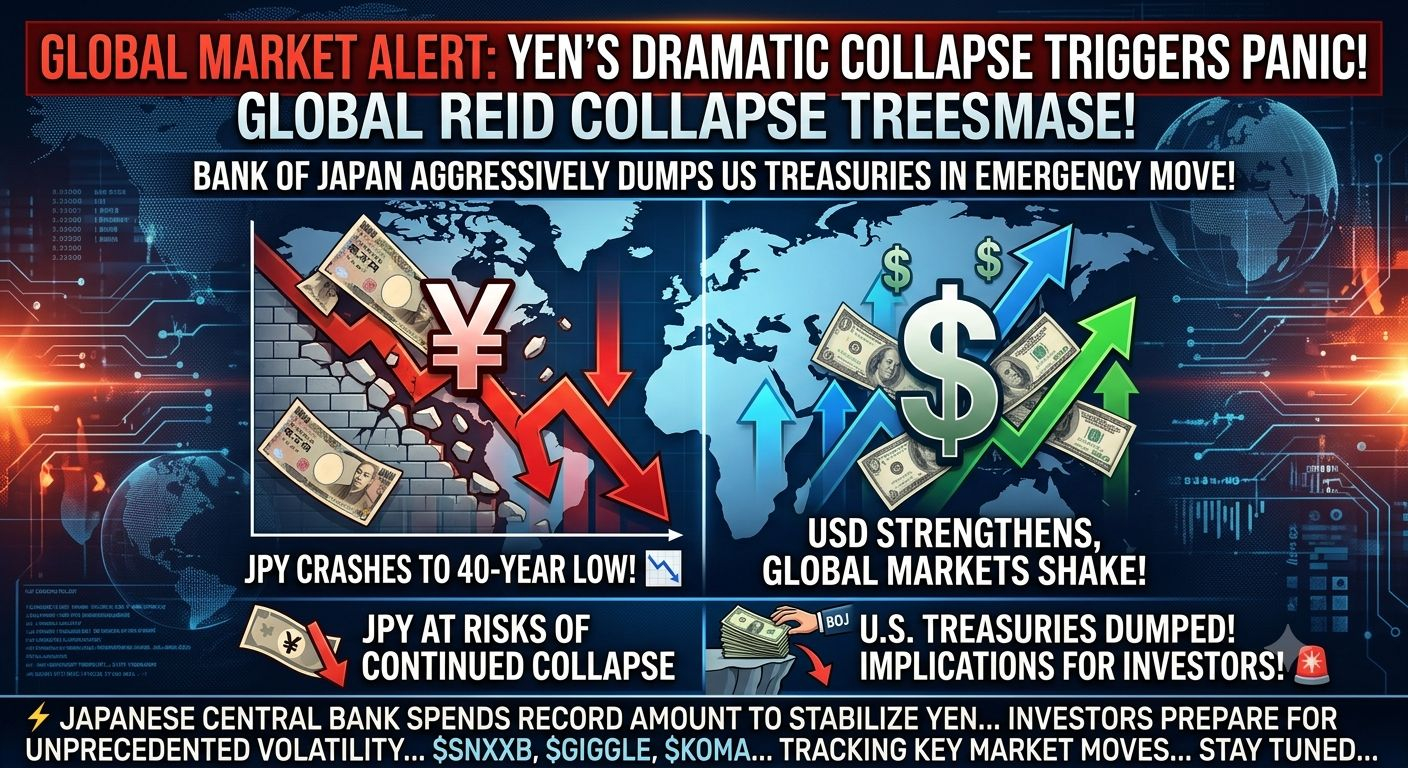
🚨 BREAKING: JAPAN’S YEN IN FREEFALL—AND THE DOMINOES ARE STARTING TO FALL 💥
The Japanese Yen just crashed to a 40-year low, sending shockwaves across global markets. 📉
In a desperate attempt to stop the bleed, the Bank of Japan just dropped a RECORD $73.4 BILLION to buy back its own currency and inject emergency CPR into the Yen. 💰💸
Here’s where it gets crazy for every investor on the planet:
To fund this massive intervention, Japan is aggressively dumping US Treasury bonds. That’s right—one of the world's largest holders of US debt is liquidating fast, and the ripple effects could rock global markets, yields, and crypto. 💣
🔥 Why this matters for your portfolio:
A collapsing Yen puts massive pressure on global carry trades.
Mass US bond sell-offs usually mean volatile interest rates and shifting capital.
Liquidity is moving FAST into alternative assets.
Keep your eyes on the charts. This macro shift is just getting started.
👇 Are you holding cash, stocks, or crypto through this storm? Drop your take below!
not financial advice dyor
#JapanEconomy #KospiJumpsRecord15% #KospiUp15.13%InMorningTrade #USGDPGrows1.5%InQ2 #BinanceSquare
$KOMA
{future}(KOMAUSDT)
$GIGGLE
{future}(GIGGLEUSDT)
$MUU
{future}(MUUUSDT)
🚨 BREAKING: JAPAN’S YEN IN FREEFALL—AND THE DOMINOES ARE STARTING TO FALL 💥
The Japanese Yen just crashed to a 40-year low, sending shockwaves across global markets. 📉
In a desperate attempt to stop the bleed, the Bank of Japan just dropped a RECORD $73.4 BILLION to buy back its own currency and inject emergency CPR into the Yen. 💰💸
Here’s where it gets crazy for every investor on the planet:
To fund this massive intervention, Japan is aggressively dumping US Treasury bonds. That’s right—one of the world's largest holders of US debt is liquidating fast, and the ripple effects could rock global markets, yields, and crypto. 💣
🔥 Why this matters for your portfolio:
A collapsing Yen puts massive pressure on global carry trades.
Mass US bond sell-offs usually mean volatile interest rates and shifting capital.
Liquidity is moving FAST into alternative assets.
Keep your eyes on the charts. This macro shift is just getting started.
👇 Are you holding cash, stocks, or crypto through this storm? Drop your take below!
not financial advice dyor
#JapanEconomy #KospiJumpsRecord15% #KospiUp15.13%InMorningTrade #USGDPGrows1.5%InQ2 #BinanceSquare
$KOMA
$GIGGLE
$MUU
The Japanese Yen just crashed to a 40-year low, sending shockwaves across global markets. 📉
In a desperate attempt to stop the bleed, the Bank of Japan just dropped a RECORD $73.4 BILLION to buy back its own currency and inject emergency CPR into the Yen. 💰💸
Here’s where it gets crazy for every investor on the planet:
To fund this massive intervention, Japan is aggressively dumping US Treasury bonds. That’s right—one of the world's largest holders of US debt is liquidating fast, and the ripple effects could rock global markets, yields, and crypto. 💣
🔥 Why this matters for your portfolio:
A collapsing Yen puts massive pressure on global carry trades.
Mass US bond sell-offs usually mean volatile interest rates and shifting capital.
Liquidity is moving FAST into alternative assets.
Keep your eyes on the charts. This macro shift is just getting started.
👇 Are you holding cash, stocks, or crypto through this storm? Drop your take below!
not financial advice dyor
#JapanEconomy #KospiJumpsRecord15% #KospiUp15.13%InMorningTrade #USGDPGrows1.5%InQ2 #BinanceSquare
$KOMA
$GIGGLE
$MUU
1
284

·
--
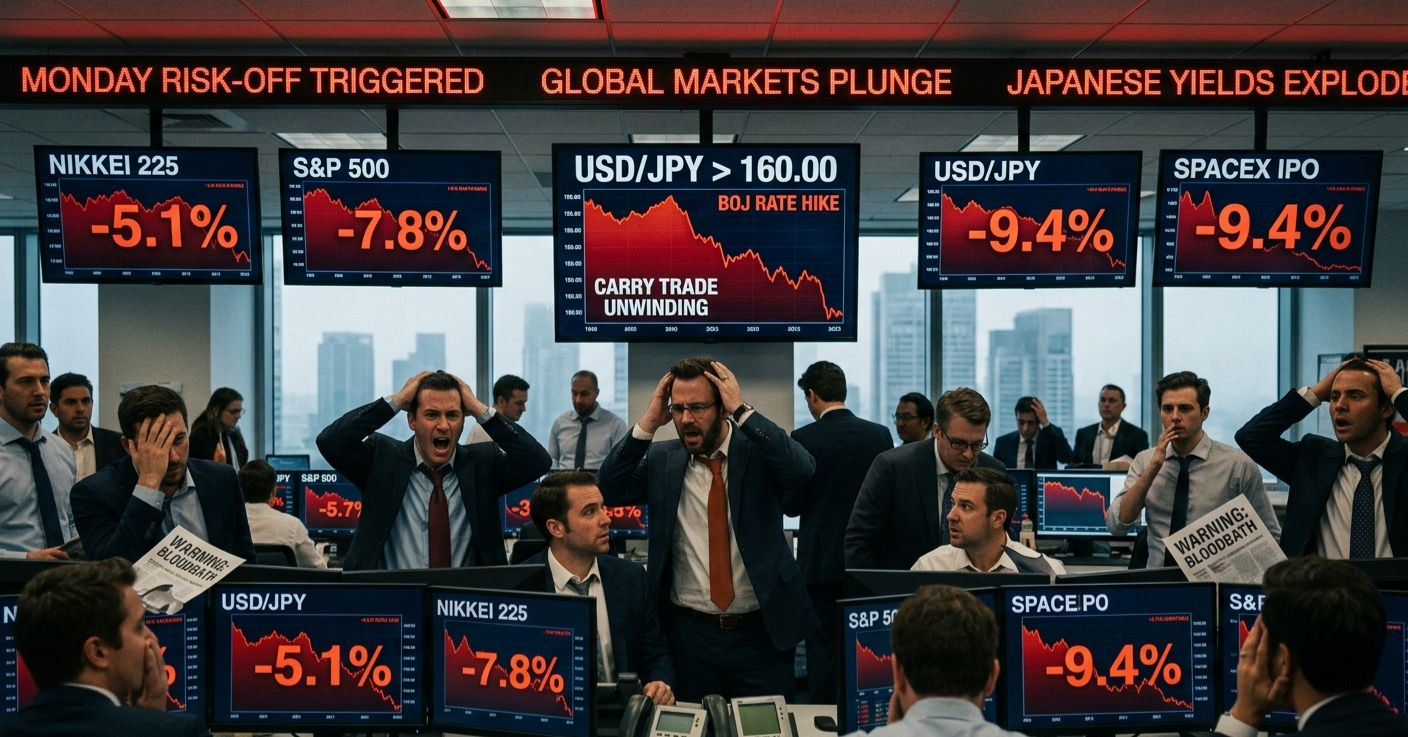
🚨 MONDAY COULD BE "BLOODY" FOR THE MARKETS
History repeats itself. The last time USD/JPY broke 160, and Japan started hiking rates, global markets faced a harsh crash.
What's happening right now:
The Bank of Japan (BOJ) is hiking rates again, and Japanese bond yields are skyrocketing.
The USD/JPY pair has once again settled above 160.
Investors are panicking: there's a massive unwinding of carry trades happening.
The SpaceX Factor: the recent massive IPO of SpaceX has pulled a gigantic amount of liquidity out of the market. If the company's shares start to correct, a sell-off avalanche will hit all sectors simultaneously.
⚠️ Summary: We are facing a classic trigger for a large and aggressive decline in global markets (risk-off). Brace for the storm.
#SaylorHintsStrategyBitcoinBuy
#JapanEconomy
#JPMorganCEOFightsCLARITYAct
$BTC
{future}(BTCUSDT)
$SPCXB
{spot}(SPCXBUSDT)
$ETH
{future}(ETHUSDT)
🚨 MONDAY COULD BE "BLOODY" FOR THE MARKETS
History repeats itself. The last time USD/JPY broke 160, and Japan started hiking rates, global markets faced a harsh crash.
What's happening right now:
The Bank of Japan (BOJ) is hiking rates again, and Japanese bond yields are skyrocketing.
The USD/JPY pair has once again settled above 160.
Investors are panicking: there's a massive unwinding of carry trades happening.
The SpaceX Factor: the recent massive IPO of SpaceX has pulled a gigantic amount of liquidity out of the market. If the company's shares start to correct, a sell-off avalanche will hit all sectors simultaneously.
⚠️ Summary: We are facing a classic trigger for a large and aggressive decline in global markets (risk-off). Brace for the storm.
#SaylorHintsStrategyBitcoinBuy
#JapanEconomy
#JPMorganCEOFightsCLARITYAct
$BTC
$SPCXB
$ETH
History repeats itself. The last time USD/JPY broke 160, and Japan started hiking rates, global markets faced a harsh crash.
What's happening right now:
The Bank of Japan (BOJ) is hiking rates again, and Japanese bond yields are skyrocketing.
The USD/JPY pair has once again settled above 160.
Investors are panicking: there's a massive unwinding of carry trades happening.
The SpaceX Factor: the recent massive IPO of SpaceX has pulled a gigantic amount of liquidity out of the market. If the company's shares start to correct, a sell-off avalanche will hit all sectors simultaneously.
⚠️ Summary: We are facing a classic trigger for a large and aggressive decline in global markets (risk-off). Brace for the storm.
#SaylorHintsStrategyBitcoinBuy
#JapanEconomy
#JPMorganCEOFightsCLARITYAct
$BTC
$SPCXB
$ETH
14
71

·
--
Verified
⚡ JUST IN !!!
BANK OF JAPAN DOUBLES DOWN ON RATE HIKES - YEN POLICY SHIFT ACCELERATES 🇯🇵📈
Governor Ueda signals BoJ is ready to hike regardless of Middle East uncertainty - inflation risks are front and center.
• 🏦 BoJ confirms: Rate hike path remains core policy - real rates still deeply negative, plenty of room to tighten
• ⚠️ Ueda warning: Upside inflation risks are growing and may materialize sooner than forecast
• 🛢️ Oil risk: Rising crude prices could trigger broad-based inflation across multiple goods categories
• 💴 Wage growth: ~5% increases across both large and small firms (Rengo negotiations) - deflation psychology officially dead
• 📊 Economy outlook: Moderate growth supported by strong corporate profits, personal consumption, and chip/electronics exports
Japan just broke 30 years of deflation and BoJ is not blinking. With oil at $98 and wages rising 5%, Ueda has all the cover he needs to keep hiking. Higher JPY rates = stronger yen = unwinding of carry trades = potential liquidity squeeze across global risk assets including crypto. This is a macro risk that doesn't get enough attention. #JapanEconomy
$EWJ $HYPE $XRP
{future}(XRPUSDT)
{future}(HYPEUSDT)
{future}(EWJUSDT)
⚡ JUST IN !!!
BANK OF JAPAN DOUBLES DOWN ON RATE HIKES - YEN POLICY SHIFT ACCELERATES 🇯🇵📈
Governor Ueda signals BoJ is ready to hike regardless of Middle East uncertainty - inflation risks are front and center.
• 🏦 BoJ confirms: Rate hike path remains core policy - real rates still deeply negative, plenty of room to tighten
• ⚠️ Ueda warning: Upside inflation risks are growing and may materialize sooner than forecast
• 🛢️ Oil risk: Rising crude prices could trigger broad-based inflation across multiple goods categories
• 💴 Wage growth: ~5% increases across both large and small firms (Rengo negotiations) - deflation psychology officially dead
• 📊 Economy outlook: Moderate growth supported by strong corporate profits, personal consumption, and chip/electronics exports
Japan just broke 30 years of deflation and BoJ is not blinking. With oil at $98 and wages rising 5%, Ueda has all the cover he needs to keep hiking. Higher JPY rates = stronger yen = unwinding of carry trades = potential liquidity squeeze across global risk assets including crypto. This is a macro risk that doesn't get enough attention. #JapanEconomy
$EWJ $HYPE $XRP
BANK OF JAPAN DOUBLES DOWN ON RATE HIKES - YEN POLICY SHIFT ACCELERATES 🇯🇵📈
Governor Ueda signals BoJ is ready to hike regardless of Middle East uncertainty - inflation risks are front and center.
• 🏦 BoJ confirms: Rate hike path remains core policy - real rates still deeply negative, plenty of room to tighten
• ⚠️ Ueda warning: Upside inflation risks are growing and may materialize sooner than forecast
• 🛢️ Oil risk: Rising crude prices could trigger broad-based inflation across multiple goods categories
• 💴 Wage growth: ~5% increases across both large and small firms (Rengo negotiations) - deflation psychology officially dead
• 📊 Economy outlook: Moderate growth supported by strong corporate profits, personal consumption, and chip/electronics exports
Japan just broke 30 years of deflation and BoJ is not blinking. With oil at $98 and wages rising 5%, Ueda has all the cover he needs to keep hiking. Higher JPY rates = stronger yen = unwinding of carry trades = potential liquidity squeeze across global risk assets including crypto. This is a macro risk that doesn't get enough attention. #JapanEconomy
$EWJ $HYPE $XRP


1
2k

·
--
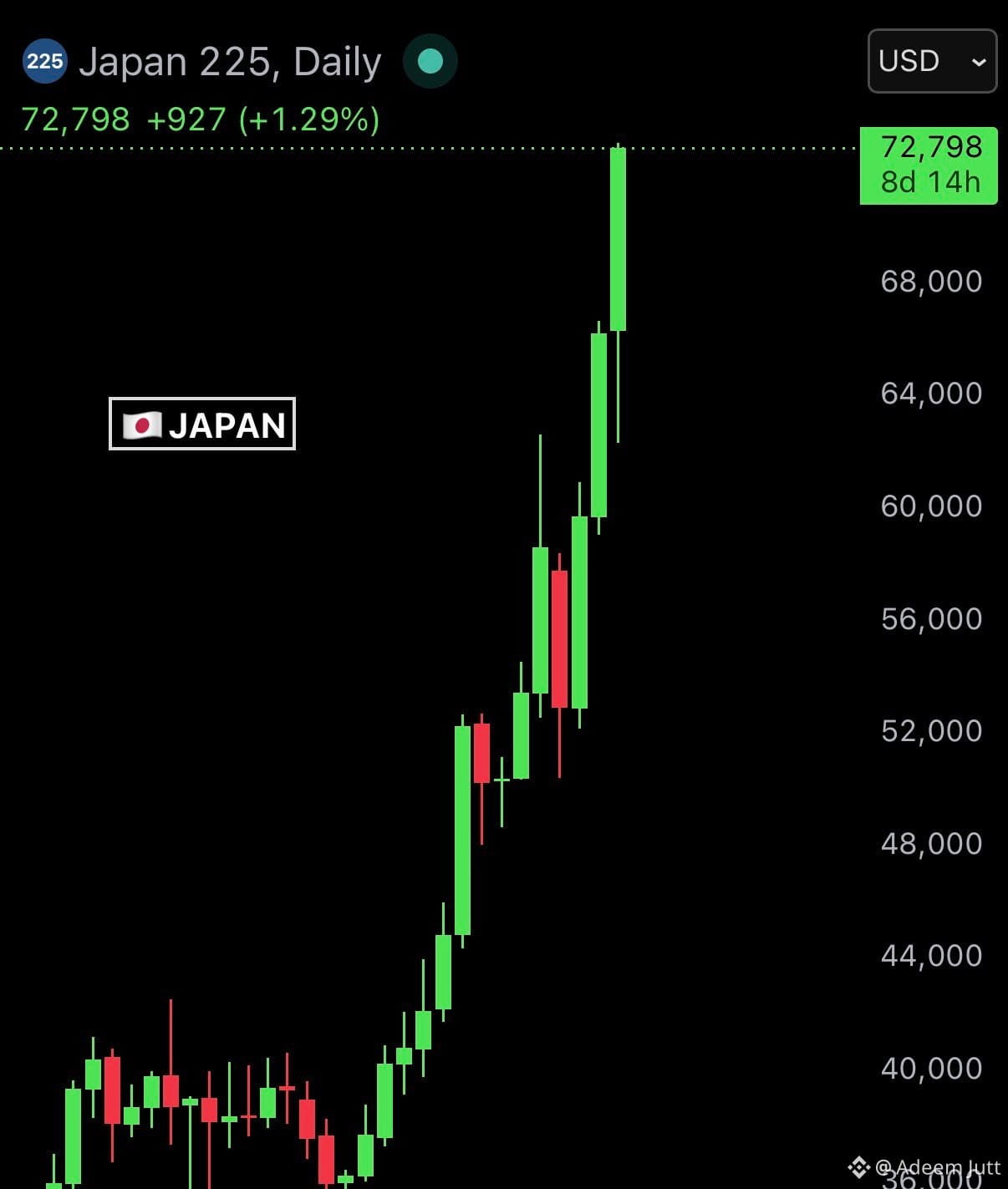
🚨 JAPAN JUST MADE HISTORY! 🇯🇵📈 Nikkei Smashes 72,500 as Trillions Flood Into the Market
🇯🇵 The Nikkei has surged past 72,500 for the very first time ever, marking a major milestone for global markets.
💰 Even more astonishing? A staggering ¥25.74 trillion in market value was added in just one trading day.
This isn't just another green candle—it’s a powerful signal of growing investor confidence and accelerating capital inflows into risk assets.
As traditional markets continue setting new records, crypto traders should pay close attention. Major liquidity shifts often create ripple effects across the entire financial ecosystem. 👀
The question now is simple:
Are we witnessing the beginning of an even bigger global risk-on rally? 🚀
$BEL $TAIKO $BULLA
{future}(BULLAUSDT)
{spot}(BELUSDT)
{future}(TAIKOUSDT)
#Nikkei #Japan #JapanEconomy
🚨 JAPAN JUST MADE HISTORY! 🇯🇵📈 Nikkei Smashes 72,500 as Trillions Flood Into the Market
🇯🇵 The Nikkei has surged past 72,500 for the very first time ever, marking a major milestone for global markets.
💰 Even more astonishing? A staggering ¥25.74 trillion in market value was added in just one trading day.
This isn't just another green candle—it’s a powerful signal of growing investor confidence and accelerating capital inflows into risk assets.
As traditional markets continue setting new records, crypto traders should pay close attention. Major liquidity shifts often create ripple effects across the entire financial ecosystem. 👀
The question now is simple:
Are we witnessing the beginning of an even bigger global risk-on rally? 🚀
$BEL $TAIKO $BULLA
#Nikkei #Japan #JapanEconomy
🇯🇵 The Nikkei has surged past 72,500 for the very first time ever, marking a major milestone for global markets.
💰 Even more astonishing? A staggering ¥25.74 trillion in market value was added in just one trading day.
This isn't just another green candle—it’s a powerful signal of growing investor confidence and accelerating capital inflows into risk assets.
As traditional markets continue setting new records, crypto traders should pay close attention. Major liquidity shifts often create ripple effects across the entire financial ecosystem. 👀
The question now is simple:
Are we witnessing the beginning of an even bigger global risk-on rally? 🚀
$BEL $TAIKO $BULLA
#Nikkei #Japan #JapanEconomy
3
2
142

🇯🇵🏦 Bank of America expects the Bank of Japan to continue gradual interest rate hikes through 2027.
The outlook suggests Japan may slowly move away from its ultra-loose monetary policy as inflation and wage growth remain in focus.
📈 Higher rates could:
• Support the Japanese Yen (JPY)
• Impact global bond markets
• Influence capital flows across Asia
• Affect risk assets, including cryptocurrencies
Markets are expected to closely monitor upcoming BOJ meetings for clues on the pace of future tightening.
⚠️ Risk Warning: Financial markets can react quickly to changes in central bank policy. Always conduct your own research and consider market risks before making investment decisions.
#BankOfJapan #BOJ #JapanEconomy #Forex #Markets #Investing #Economy
🇯🇵🏦 Bank of America expects the Bank of Japan to continue gradual interest rate hikes through 2027.
The outlook suggests Japan may slowly move away from its ultra-loose monetary policy as inflation and wage growth remain in focus.
📈 Higher rates could:
• Support the Japanese Yen (JPY)
• Impact global bond markets
• Influence capital flows across Asia
• Affect risk assets, including cryptocurrencies
Markets are expected to closely monitor upcoming BOJ meetings for clues on the pace of future tightening.
⚠️ Risk Warning: Financial markets can react quickly to changes in central bank policy. Always conduct your own research and consider market risks before making investment decisions.
#BankOfJapan #BOJ #JapanEconomy #Forex #Markets #Investing #Economy
The outlook suggests Japan may slowly move away from its ultra-loose monetary policy as inflation and wage growth remain in focus.
📈 Higher rates could:
• Support the Japanese Yen (JPY)
• Impact global bond markets
• Influence capital flows across Asia
• Affect risk assets, including cryptocurrencies
Markets are expected to closely monitor upcoming BOJ meetings for clues on the pace of future tightening.
⚠️ Risk Warning: Financial markets can react quickly to changes in central bank policy. Always conduct your own research and consider market risks before making investment decisions.
#BankOfJapan #BOJ #JapanEconomy #Forex #Markets #Investing #Economy
61
Log in to explore more content
Join global crypto users on Binance Square
⚡️ Get latest and useful information about crypto.
💬 Trusted by the world’s largest crypto exchange.
👍 Discover real insights from verified creators.
Email / Phone number
Trending Topics
1
#BitwiseFilesFinalNEARSpotETFProspectus
67,298 views
1,249 Discussing
2
#BitgetHackerMoves$83MStolenXRP
28,600 views
155 Discussing
3
#SOLSpotETFWeeklyInflow$188M
17,826 views
124 Discussing
4
#DogecoinETFsPostBiggestWeekSinceLaunch
44,734 views
886 Discussing
5
#StrategyStriveAdd2305BitcoinThisWeek
124,558 views
2,052 Discussing
6
#TrumpRejectsIranHormuzReopening
111,162 views
1,558 Discussing
7
#TokenizedStockDEXVolumeHits$20.9B
147 views
6 Discussing
8
#CircleTetherFreezeBitgetHackerWallet
100,877 views
1,455 Discussing
9
#SECSaysTokenBuybacksNotAutoSecurities
66,071 views
851 Discussing
10
#ChinaUSAgreeOn$30BTariffCut
5,232 views
45 Discussing