
#solanacutstargetslottimeto250ms
solanacutstargetslottimeto250ms
79,790 views
907 Discussing
Hot
Latest

·
--
Bullish
Verified
#solanacutstargetslottimeto250ms ⚡ $SOL JUST CUT SLOT TIME TO 250MS! 👀🚀
Solana has officially activated its 250-millisecond target slot time on mainnet-beta, marking another step toward its planned 200ms milestone.
📅 Activation: September 18, 2026
🔹 Epoch: 1037
🔹 Upgrade: SIMD-0525
🔹 Previous Target: 300ms
🔹 New Target: 250ms
🔹 Future Goal: 200ms
This upgrade means Solana is targeting approximately 4 slots per second, compared with around 3.3 slots per second at 300ms.
But the real story isn't simply about speed. ⚙️
🔍 WHAT DOES THIS CHANGE?
Shorter slot times mean block production operates on a tighter schedule. Validators have less time within each slot to coordinate and propagate data.
To maintain a similar overall execution budget, the upgrade also adjusts per-slot resource limits. Faster slots don't automatically mean a proportional increase in TPS.
The 250ms milestone is part of a phased rollout under SIMD-0525, which moves Solana from its original 400ms target toward 200ms.
📉 400ms → 350ms → 300ms → 250ms → 200ms
🧠 MY TAKE
The most important question isn't just how fast Solana can produce blocks.
It's whether the network can maintain reliable validator coordination, data propagation, and stable performance as timing becomes tighter.
The final 200ms target remains ahead, and its mainnet activation date has not been announced.
⚡ Speed matters. But speed with stability matters even more.
❓Do you think Solana's 200ms target could become its next major performance milestone?
👇 Share your thoughts in the comments!
Disclaimer: This content is for informational purposes only and is not financial advice.
#Solana #SOL #CryptoNews #Blockchain #Web3 #CryptoUpdates #SIMD0525 #GrowWithSAC
#solanacutstargetslottimeto250ms ⚡ $SOL JUST CUT SLOT TIME TO 250MS! 👀🚀
Solana has officially activated its 250-millisecond target slot time on mainnet-beta, marking another step toward its planned 200ms milestone.
📅 Activation: September 18, 2026
🔹 Epoch: 1037
🔹 Upgrade: SIMD-0525
🔹 Previous Target: 300ms
🔹 New Target: 250ms
🔹 Future Goal: 200ms
This upgrade means Solana is targeting approximately 4 slots per second, compared with around 3.3 slots per second at 300ms.
But the real story isn't simply about speed. ⚙️
🔍 WHAT DOES THIS CHANGE?
Shorter slot times mean block production operates on a tighter schedule. Validators have less time within each slot to coordinate and propagate data.
To maintain a similar overall execution budget, the upgrade also adjusts per-slot resource limits. Faster slots don't automatically mean a proportional increase in TPS.
The 250ms milestone is part of a phased rollout under SIMD-0525, which moves Solana from its original 400ms target toward 200ms.
📉 400ms → 350ms → 300ms → 250ms → 200ms
🧠 MY TAKE
The most important question isn't just how fast Solana can produce blocks.
It's whether the network can maintain reliable validator coordination, data propagation, and stable performance as timing becomes tighter.
The final 200ms target remains ahead, and its mainnet activation date has not been announced.
⚡ Speed matters. But speed with stability matters even more.
❓Do you think Solana's 200ms target could become its next major performance milestone?
👇 Share your thoughts in the comments!
Disclaimer: This content is for informational purposes only and is not financial advice.
#Solana #SOL #CryptoNews #Blockchain #Web3 #CryptoUpdates #SIMD0525 #GrowWithSAC
Solana has officially activated its 250-millisecond target slot time on mainnet-beta, marking another step toward its planned 200ms milestone.
📅 Activation: September 18, 2026
🔹 Epoch: 1037
🔹 Upgrade: SIMD-0525
🔹 Previous Target: 300ms
🔹 New Target: 250ms
🔹 Future Goal: 200ms
This upgrade means Solana is targeting approximately 4 slots per second, compared with around 3.3 slots per second at 300ms.
But the real story isn't simply about speed. ⚙️
🔍 WHAT DOES THIS CHANGE?
Shorter slot times mean block production operates on a tighter schedule. Validators have less time within each slot to coordinate and propagate data.
To maintain a similar overall execution budget, the upgrade also adjusts per-slot resource limits. Faster slots don't automatically mean a proportional increase in TPS.
The 250ms milestone is part of a phased rollout under SIMD-0525, which moves Solana from its original 400ms target toward 200ms.
📉 400ms → 350ms → 300ms → 250ms → 200ms
🧠 MY TAKE
The most important question isn't just how fast Solana can produce blocks.
It's whether the network can maintain reliable validator coordination, data propagation, and stable performance as timing becomes tighter.
The final 200ms target remains ahead, and its mainnet activation date has not been announced.
⚡ Speed matters. But speed with stability matters even more.
❓Do you think Solana's 200ms target could become its next major performance milestone?
👇 Share your thoughts in the comments!
Disclaimer: This content is for informational purposes only and is not financial advice.
#Solana #SOL #CryptoNews #Blockchain #Web3 #CryptoUpdates #SIMD0525 #GrowWithSAC

2
3.8k


Verified
#solanacutstargetslottimeto250ms
⚡ $SOL JUST CUT THE CLOCK TO 250MS 👀 ⚡
When speed becomes the battlefield,
even milliseconds start writing the future.
Solana has now activated a 250ms target slot time on mainnet, down from 300ms. The change went live at epoch 1037 on September 18 under SIMD-0525.
That means the network is targeting roughly four slots per second, moving another step toward its longer-term 200ms goal. This is not simply a headline about “faster Solana.” It changes how quickly the network cycles through block production.
The deeper story is coordination. Shorter slots leave validators, transaction forwarding and network repair with less time to react, making reliability increasingly important as Solana pushes toward 200ms.
My Take: The real value of this upgrade is not a marketing number. Solana is testing how far it can compress network timing while maintaining stable validator coordination and real-world performance.
If that balance holds, faster execution could strengthen Solana’s infrastructure story. But every millisecond saved also raises the engineering bar.
The race is no longer just to move faster. It is to move faster without losing stability.
❓Do you think 200ms could become Solana’s next major performance milestone?
Disclaimer: Informational content only, not financial advice.
#Solana #CryptoNews #GrowWithSAC $SAGA $FTT
#SolanaCutsTargetSlotTimeTo250ms
#solanacutstargetslottimeto250ms
⚡ $SOL JUST CUT THE CLOCK TO 250MS 👀 ⚡
When speed becomes the battlefield,
even milliseconds start writing the future.
Solana has now activated a 250ms target slot time on mainnet, down from 300ms. The change went live at epoch 1037 on September 18 under SIMD-0525.
That means the network is targeting roughly four slots per second, moving another step toward its longer-term 200ms goal. This is not simply a headline about “faster Solana.” It changes how quickly the network cycles through block production.
The deeper story is coordination. Shorter slots leave validators, transaction forwarding and network repair with less time to react, making reliability increasingly important as Solana pushes toward 200ms.
My Take: The real value of this upgrade is not a marketing number. Solana is testing how far it can compress network timing while maintaining stable validator coordination and real-world performance.
If that balance holds, faster execution could strengthen Solana’s infrastructure story. But every millisecond saved also raises the engineering bar.
The race is no longer just to move faster. It is to move faster without losing stability.
❓Do you think 200ms could become Solana’s next major performance milestone?
Disclaimer: Informational content only, not financial advice.
#Solana #CryptoNews #GrowWithSAC $SAGA $FTT
#SolanaCutsTargetSlotTimeTo250ms
⚡ $SOL JUST CUT THE CLOCK TO 250MS 👀 ⚡
When speed becomes the battlefield,
even milliseconds start writing the future.
Solana has now activated a 250ms target slot time on mainnet, down from 300ms. The change went live at epoch 1037 on September 18 under SIMD-0525.
That means the network is targeting roughly four slots per second, moving another step toward its longer-term 200ms goal. This is not simply a headline about “faster Solana.” It changes how quickly the network cycles through block production.
The deeper story is coordination. Shorter slots leave validators, transaction forwarding and network repair with less time to react, making reliability increasingly important as Solana pushes toward 200ms.
My Take: The real value of this upgrade is not a marketing number. Solana is testing how far it can compress network timing while maintaining stable validator coordination and real-world performance.
If that balance holds, faster execution could strengthen Solana’s infrastructure story. But every millisecond saved also raises the engineering bar.
The race is no longer just to move faster. It is to move faster without losing stability.
❓Do you think 200ms could become Solana’s next major performance milestone?
Disclaimer: Informational content only, not financial advice.
#Solana #CryptoNews #GrowWithSAC $SAGA $FTT
#SolanaCutsTargetSlotTimeTo250ms

Hooram bhatti:
Sol
1
4
4.4k

·
--
Bullish
Verified
#solanacutstargetslottimeto250ms
Solana Just Got 2x Faster: Why 250ms Slots Change the Game for HFT Traders ⚡
Solana has officially pushed its target slot time down from 300ms to 250ms as part of its SIMD-0525 upgrade roadmap. The network is now targeting 4 blocks per second—a major leap forward for speed, low latency, and real-time execution.
While the total processing capacity remains capped via proportional compute adjustments, the faster block cadence provides fresher price updates across DeFi applications and speeds up validator leader rotation.
Key Takeaways:
Tech Upgrade: Target slot timing drops to 250ms, shrinking Solana's epoch duration from 36 hours down to roughly 30 hours.
Trader Lens: Reduced latency gives DEX traders, automated market makers (AMMs), and high-frequency trading (HFT) bots faster confirmation cycles—significantly reducing slippage and trade failure rates during volatile market spikes.
Roadmap Ahead: Developers are observing network stability at 250ms before evaluating the final planned milestone target of 200ms.
How do you think this speed upgrade impacts Solana's edge over other Layer-1 networks? Share your thoughts below! 👇
$SOL
{future}(SOLUSDT)
#solana #sol #CryptoNews
#solanacutstargetslottimeto250ms
Solana Just Got 2x Faster: Why 250ms Slots Change the Game for HFT Traders ⚡
Solana has officially pushed its target slot time down from 300ms to 250ms as part of its SIMD-0525 upgrade roadmap. The network is now targeting 4 blocks per second—a major leap forward for speed, low latency, and real-time execution.
While the total processing capacity remains capped via proportional compute adjustments, the faster block cadence provides fresher price updates across DeFi applications and speeds up validator leader rotation.
Key Takeaways:
Tech Upgrade: Target slot timing drops to 250ms, shrinking Solana's epoch duration from 36 hours down to roughly 30 hours.
Trader Lens: Reduced latency gives DEX traders, automated market makers (AMMs), and high-frequency trading (HFT) bots faster confirmation cycles—significantly reducing slippage and trade failure rates during volatile market spikes.
Roadmap Ahead: Developers are observing network stability at 250ms before evaluating the final planned milestone target of 200ms.
How do you think this speed upgrade impacts Solana's edge over other Layer-1 networks? Share your thoughts below! 👇
$SOL
#solana #sol #CryptoNews
Solana Just Got 2x Faster: Why 250ms Slots Change the Game for HFT Traders ⚡
Solana has officially pushed its target slot time down from 300ms to 250ms as part of its SIMD-0525 upgrade roadmap. The network is now targeting 4 blocks per second—a major leap forward for speed, low latency, and real-time execution.
While the total processing capacity remains capped via proportional compute adjustments, the faster block cadence provides fresher price updates across DeFi applications and speeds up validator leader rotation.
Key Takeaways:
Tech Upgrade: Target slot timing drops to 250ms, shrinking Solana's epoch duration from 36 hours down to roughly 30 hours.
Trader Lens: Reduced latency gives DEX traders, automated market makers (AMMs), and high-frequency trading (HFT) bots faster confirmation cycles—significantly reducing slippage and trade failure rates during volatile market spikes.
Roadmap Ahead: Developers are observing network stability at 250ms before evaluating the final planned milestone target of 200ms.
How do you think this speed upgrade impacts Solana's edge over other Layer-1 networks? Share your thoughts below! 👇
$SOL
#solana #sol #CryptoNews

REDsCASTLE :
hay que invertir en SOL
1
1
7
2.8k

·
--
Bullish
Verified
🚨 $SOL just got faster — Solana has cut its target slot time to 250ms.
The network reduced its target slot time from 300ms to 250ms, making block updates nearly 17% faster. That means wallets, exchanges, and trading apps can receive fresher onchain data with lower latency.
This is the third stage of Solana’s SIMD-0525 speed-up plan:
400ms → 350ms → 300ms → 250ms
The next target is 200ms, although there’s no confirmed mainnet activation date yet.
One important detail: this upgrade doesn’t increase total throughput, because compute and data capacity per slot are reduced proportionally. The real benefit is faster state updates, lower latency, and shorter validator control windows.
For $SOL, the narrative is simple:
Faster execution + lower latency + stronger trading UX = more competitive infrastructure.
If Solana eventually reaches 200ms slots while keeping validator performance stable, the chain gets even closer to real-time financial infrastructure.
$SOL isn’t just chasing higher TPS anymore — it’s chasing speed. 👀
{future}(SOLUSDT)
{future}(ZECUSDT)
$ZEC
#solanacutstargetslottimeto250ms #EthereumSurpasses$2700 #CanaryFilesSecondAmendmentForStakedSEIETF #SaylorHintsStrategyBitcoinBuy #BOJRaisesRatesTo31YearHigh
🚨 $SOL just got faster — Solana has cut its target slot time to 250ms.
The network reduced its target slot time from 300ms to 250ms, making block updates nearly 17% faster. That means wallets, exchanges, and trading apps can receive fresher onchain data with lower latency.
This is the third stage of Solana’s SIMD-0525 speed-up plan:
400ms → 350ms → 300ms → 250ms
The next target is 200ms, although there’s no confirmed mainnet activation date yet.
One important detail: this upgrade doesn’t increase total throughput, because compute and data capacity per slot are reduced proportionally. The real benefit is faster state updates, lower latency, and shorter validator control windows.
For $SOL , the narrative is simple:
Faster execution + lower latency + stronger trading UX = more competitive infrastructure.
If Solana eventually reaches 200ms slots while keeping validator performance stable, the chain gets even closer to real-time financial infrastructure.
$SOL isn’t just chasing higher TPS anymore — it’s chasing speed. 👀
$ZEC
#solanacutstargetslottimeto250ms #EthereumSurpasses$2700 #CanaryFilesSecondAmendmentForStakedSEIETF #SaylorHintsStrategyBitcoinBuy #BOJRaisesRatesTo31YearHigh
The network reduced its target slot time from 300ms to 250ms, making block updates nearly 17% faster. That means wallets, exchanges, and trading apps can receive fresher onchain data with lower latency.
This is the third stage of Solana’s SIMD-0525 speed-up plan:
400ms → 350ms → 300ms → 250ms
The next target is 200ms, although there’s no confirmed mainnet activation date yet.
One important detail: this upgrade doesn’t increase total throughput, because compute and data capacity per slot are reduced proportionally. The real benefit is faster state updates, lower latency, and shorter validator control windows.
For $SOL , the narrative is simple:
Faster execution + lower latency + stronger trading UX = more competitive infrastructure.
If Solana eventually reaches 200ms slots while keeping validator performance stable, the chain gets even closer to real-time financial infrastructure.
$SOL isn’t just chasing higher TPS anymore — it’s chasing speed. 👀
$ZEC
#solanacutstargetslottimeto250ms #EthereumSurpasses$2700 #CanaryFilesSecondAmendmentForStakedSEIETF #SaylorHintsStrategyBitcoinBuy #BOJRaisesRatesTo31YearHigh
1
858

Verified
#solanacutstargetslottimeto250ms
⚡ Solana $SOL Cuts Target Slot Time To 250ms ⚡
Picture a network clock ticking so fast that one small adjustment changes how quickly the entire system moves. On Solana, that moment has now arrived.
Solana activated a 250ms target slot time on September 18, down from 300ms. The change is the third stage of SIMD-0525, a proposal designed to reduce slot times progressively toward 200ms.
At 250ms, Solana targets four slots every second instead of roughly 3.3. That compresses a four-slot validator leadership window from 1.2 seconds to about 1 second, while epochs shorten from roughly 36 hours to 30.
But here is the detail many headlines can miss: faster slots do not automatically mean a proportional increase in total processing capacity. The proposal reduces per-slot work limits alongside the timing change, keeping the approximate wall-clock processing ceiling similar.
That makes this more of an efficiency and responsiveness upgrade than a simple “Solana is now X% faster” story. Validators also face tighter timing around block production and infrastructure performance.
For SOL, the upgrade strengthens the network-performance narrative while the broader market remains positive. Current Binance Square market data shows SOL in the green alongside a strong altcoin rotation.
The bigger question is what happens next: can Solana keep compressing its timing without sacrificing reliability?
A faster clock matters only when the network can keep every beat.
❓Would you rather see Solana prioritize even faster slots, or maximum stability at 250ms?
Disclaimer: This is educational content, not financial advice.
#Solana #CryptoNews #GrowWithSAC $SAGA $FTT
#SolanaCutsTargetSlotTimeTo250ms
#solanacutstargetslottimeto250ms
⚡ Solana $SOL Cuts Target Slot Time To 250ms ⚡
Picture a network clock ticking so fast that one small adjustment changes how quickly the entire system moves. On Solana, that moment has now arrived.
Solana activated a 250ms target slot time on September 18, down from 300ms. The change is the third stage of SIMD-0525, a proposal designed to reduce slot times progressively toward 200ms.
At 250ms, Solana targets four slots every second instead of roughly 3.3. That compresses a four-slot validator leadership window from 1.2 seconds to about 1 second, while epochs shorten from roughly 36 hours to 30.
But here is the detail many headlines can miss: faster slots do not automatically mean a proportional increase in total processing capacity. The proposal reduces per-slot work limits alongside the timing change, keeping the approximate wall-clock processing ceiling similar.
That makes this more of an efficiency and responsiveness upgrade than a simple “Solana is now X% faster” story. Validators also face tighter timing around block production and infrastructure performance.
For SOL, the upgrade strengthens the network-performance narrative while the broader market remains positive. Current Binance Square market data shows SOL in the green alongside a strong altcoin rotation.
The bigger question is what happens next: can Solana keep compressing its timing without sacrificing reliability?
A faster clock matters only when the network can keep every beat.
❓Would you rather see Solana prioritize even faster slots, or maximum stability at 250ms?
Disclaimer: This is educational content, not financial advice.
#Solana #CryptoNews #GrowWithSAC $SAGA $FTT
#SolanaCutsTargetSlotTimeTo250ms
⚡ Solana $SOL Cuts Target Slot Time To 250ms ⚡
Picture a network clock ticking so fast that one small adjustment changes how quickly the entire system moves. On Solana, that moment has now arrived.
Solana activated a 250ms target slot time on September 18, down from 300ms. The change is the third stage of SIMD-0525, a proposal designed to reduce slot times progressively toward 200ms.
At 250ms, Solana targets four slots every second instead of roughly 3.3. That compresses a four-slot validator leadership window from 1.2 seconds to about 1 second, while epochs shorten from roughly 36 hours to 30.
But here is the detail many headlines can miss: faster slots do not automatically mean a proportional increase in total processing capacity. The proposal reduces per-slot work limits alongside the timing change, keeping the approximate wall-clock processing ceiling similar.
That makes this more of an efficiency and responsiveness upgrade than a simple “Solana is now X% faster” story. Validators also face tighter timing around block production and infrastructure performance.
For SOL, the upgrade strengthens the network-performance narrative while the broader market remains positive. Current Binance Square market data shows SOL in the green alongside a strong altcoin rotation.
The bigger question is what happens next: can Solana keep compressing its timing without sacrificing reliability?
A faster clock matters only when the network can keep every beat.
❓Would you rather see Solana prioritize even faster slots, or maximum stability at 250ms?
Disclaimer: This is educational content, not financial advice.
#Solana #CryptoNews #GrowWithSAC $SAGA $FTT
#SolanaCutsTargetSlotTimeTo250ms

4
8.3k
·
--
Bullish
Verified
#solanacutstargetslottimeto250ms ⚡ Solana Targets 250ms Slots — Speed Upgrade Could Reshape Trading! 🚀
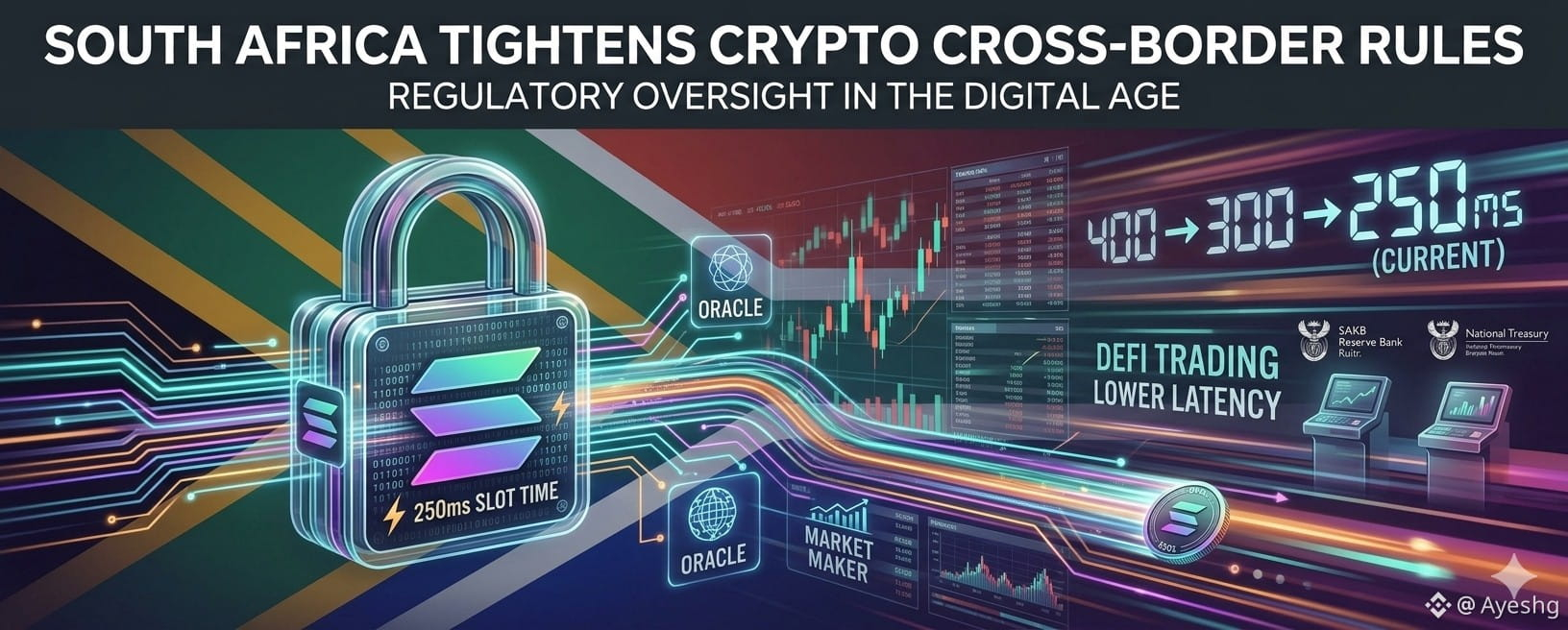
Solana is moving toward 250ms slot times under SIMD-0525, part of a staged plan to reduce slot time from 400ms toward 200ms.
📌 Current status: Mainnet is currently at 300ms, while the 250ms upgrade is live on Devnet and Testnet. Mainnet activation is still TBD.
⚡ Faster slots could mean:
• More frequent on-chain updates
• Lower latency for trading applications
• Faster leader rotation
• Finer timing for oracles and market makers
The official proposal says the 250ms stage would shorten an epoch from roughly 36 hours to 30 hours, while per-slot work limits are adjusted proportionally.
🔥 $SOL remains one of the key assets to watch as Solana pushes toward lower latency.
#Solana #SOL #CryptoNews #Blockchain #DeFi
#solanacutstargetslottimeto250ms ⚡ Solana Targets 250ms Slots — Speed Upgrade Could Reshape Trading! 🚀
Solana is moving toward 250ms slot times under SIMD-0525, part of a staged plan to reduce slot time from 400ms toward 200ms.
📌 Current status: Mainnet is currently at 300ms, while the 250ms upgrade is live on Devnet and Testnet. Mainnet activation is still TBD.
⚡ Faster slots could mean:
• More frequent on-chain updates
• Lower latency for trading applications
• Faster leader rotation
• Finer timing for oracles and market makers
The official proposal says the 250ms stage would shorten an epoch from roughly 36 hours to 30 hours, while per-slot work limits are adjusted proportionally.
🔥 $SOL remains one of the key assets to watch as Solana pushes toward lower latency.
#Solana #SOL #CryptoNews #Blockchain #DeFi
Solana is moving toward 250ms slot times under SIMD-0525, part of a staged plan to reduce slot time from 400ms toward 200ms.
📌 Current status: Mainnet is currently at 300ms, while the 250ms upgrade is live on Devnet and Testnet. Mainnet activation is still TBD.
⚡ Faster slots could mean:
• More frequent on-chain updates
• Lower latency for trading applications
• Faster leader rotation
• Finer timing for oracles and market makers
The official proposal says the 250ms stage would shorten an epoch from roughly 36 hours to 30 hours, while per-slot work limits are adjusted proportionally.
🔥 $SOL remains one of the key assets to watch as Solana pushes toward lower latency.
#Solana #SOL #CryptoNews #Blockchain #DeFi
2.6k

·
--
Bullish
Verified
#solanacutstargetslottimeto250ms
250ms Is Live. Now Solana Faces the 200ms Question
Solana has reached 250ms—but the real engineering story may be what happens next.
The September 18 activation represents another milestone in Solana’s SIMD-0525 rollout. The network has moved through 350ms and 300ms before reaching the current 250ms target, with 200ms remaining as the final proposed stage.
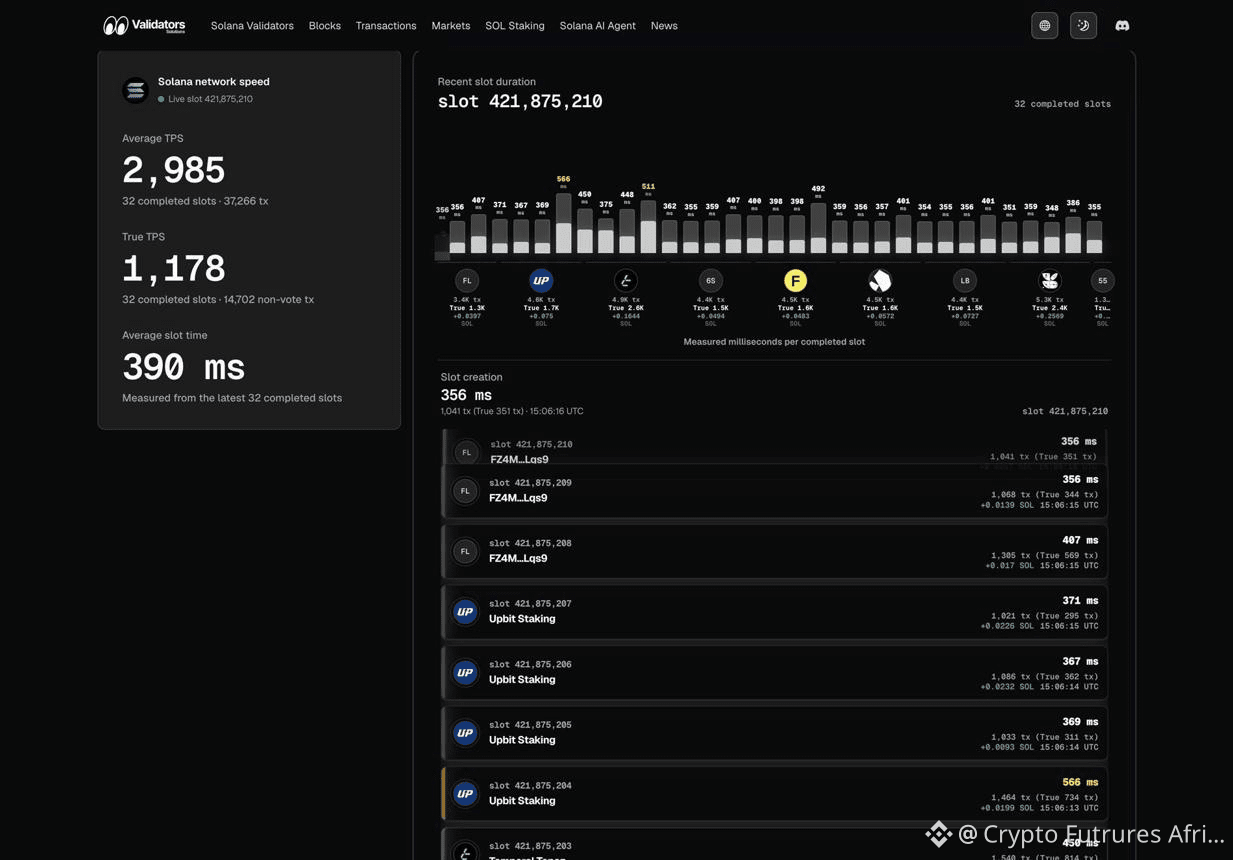
At 250ms, Solana’s design calls for approximately four target slots per second and an expected epoch duration of about 30 hours, assuming the 432,000-slot epoch structure remains unchanged. At 200ms, the proposal projects roughly 24-hour epochs.
But pushing the clock faster also leaves validators less wall-clock time for block production, voting, networking and handoffs.
That is why the 200ms step is not simply a matter of flipping another switch. The proposal is explicitly designed as a staged rollout so implementation and operational issues can be observed at each stage.
250ms is the latest milestone. 200ms is the next question.
$ZETA
{future}(ZETAUSDT)
$DRIFT
{future}(DRIFTUSDT)
$arc
{future}(ARCUSDT)
#solanacutstargetslottimeto250ms
250ms Is Live. Now Solana Faces the 200ms Question
Solana has reached 250ms—but the real engineering story may be what happens next.
The September 18 activation represents another milestone in Solana’s SIMD-0525 rollout. The network has moved through 350ms and 300ms before reaching the current 250ms target, with 200ms remaining as the final proposed stage.
At 250ms, Solana’s design calls for approximately four target slots per second and an expected epoch duration of about 30 hours, assuming the 432,000-slot epoch structure remains unchanged. At 200ms, the proposal projects roughly 24-hour epochs.
But pushing the clock faster also leaves validators less wall-clock time for block production, voting, networking and handoffs.
That is why the 200ms step is not simply a matter of flipping another switch. The proposal is explicitly designed as a staged rollout so implementation and operational issues can be observed at each stage.
250ms is the latest milestone. 200ms is the next question.
$ZETA
$DRIFT
$arc
250ms Is Live. Now Solana Faces the 200ms Question
Solana has reached 250ms—but the real engineering story may be what happens next.
The September 18 activation represents another milestone in Solana’s SIMD-0525 rollout. The network has moved through 350ms and 300ms before reaching the current 250ms target, with 200ms remaining as the final proposed stage.
At 250ms, Solana’s design calls for approximately four target slots per second and an expected epoch duration of about 30 hours, assuming the 432,000-slot epoch structure remains unchanged. At 200ms, the proposal projects roughly 24-hour epochs.
But pushing the clock faster also leaves validators less wall-clock time for block production, voting, networking and handoffs.
That is why the 200ms step is not simply a matter of flipping another switch. The proposal is explicitly designed as a staged rollout so implementation and operational issues can be observed at each stage.
250ms is the latest milestone. 200ms is the next question.
$ZETA
$DRIFT
$arc
2
3.1k

Verified
$SOL Solana Just Got FasterAnother upgrade for the Solana network — and this one is worth watching. 👀
On September 18, $SOL reduced its target slot time from 300ms to 250ms, marking the third speed increase since August.
This is part of the SIMD-0525 upgrade plan, which has already taken Solana from:
400ms → 350ms → 300ms → 250ms ⚡
The next target is 200ms, although Binance reports that there is currently no confirmed mainnet activation date for that final step. It will depend on validator performance and stable block-skip rates.
One important detail: this upgrade doesn't automatically mean higher overall throughput. Compute and data capacity per slot were adjusted proportionally, so total transaction-processing capacity remains broadly unchanged.
For me, the bigger story is the continued focus on Solana's network efficiency and performance.
👀 $SOL
⚡ Faster slot production
🔧 SIMD-0525 upgrade
🚀 200ms is the next target
If Solana keeps improving its infrastructure while adoption grows, the $SOL ecosystem could become even more interesting to watch.
Technology first. Price comes later. 📈
#solanacutstargetslottimeto250ms #Solana #SOL #SIMD0525 #Blockchain #Layer1 #Crypto #BinanceSquare
{spot}(SOLUSDT)
$SOL Solana Just Got Faster
Another upgrade for the Solana network — and this one is worth watching. 👀
On September 18, $SOL reduced its target slot time from 300ms to 250ms, marking the third speed increase since August.
This is part of the SIMD-0525 upgrade plan, which has already taken Solana from:
400ms → 350ms → 300ms → 250ms ⚡
The next target is 200ms, although Binance reports that there is currently no confirmed mainnet activation date for that final step. It will depend on validator performance and stable block-skip rates.
One important detail: this upgrade doesn't automatically mean higher overall throughput. Compute and data capacity per slot were adjusted proportionally, so total transaction-processing capacity remains broadly unchanged.
For me, the bigger story is the continued focus on Solana's network efficiency and performance.
👀 $SOL
⚡ Faster slot production
🔧 SIMD-0525 upgrade
🚀 200ms is the next target
If Solana keeps improving its infrastructure while adoption grows, the $SOL ecosystem could become even more interesting to watch.
Technology first. Price comes later. 📈
#solanacutstargetslottimeto250ms #Solana #SOL #SIMD0525 #Blockchain #Layer1 #Crypto #BinanceSquare
On September 18, $SOL reduced its target slot time from 300ms to 250ms, marking the third speed increase since August.
This is part of the SIMD-0525 upgrade plan, which has already taken Solana from:
400ms → 350ms → 300ms → 250ms ⚡
The next target is 200ms, although Binance reports that there is currently no confirmed mainnet activation date for that final step. It will depend on validator performance and stable block-skip rates.
One important detail: this upgrade doesn't automatically mean higher overall throughput. Compute and data capacity per slot were adjusted proportionally, so total transaction-processing capacity remains broadly unchanged.
For me, the bigger story is the continued focus on Solana's network efficiency and performance.
👀 $SOL
⚡ Faster slot production
🔧 SIMD-0525 upgrade
🚀 200ms is the next target
If Solana keeps improving its infrastructure while adoption grows, the $SOL ecosystem could become even more interesting to watch.
Technology first. Price comes later. 📈
#solanacutstargetslottimeto250ms #Solana #SOL #SIMD0525 #Blockchain #Layer1 #Crypto #BinanceSquare
897

Solana has successfully reduced its target slot time to 250 milliseconds. This significant technical achievement demonstrates the network's ongoing commitment to enhancing performance and efficiency. Faster block production times can lead to improved transaction speeds and a more responsive user experience, potentially attracting more developers and users to the ecosystem. This upgrade is a positive signal for the network's scalability and its ability to handle increased demand in the future.
Disclaimer: This is not investment advice.
#SolanaCutsTargetSlotTimeTo250ms $SOL
Solana has successfully reduced its target slot time to 250 milliseconds. This significant technical achievement demonstrates the network's ongoing commitment to enhancing performance and efficiency. Faster block production times can lead to improved transaction speeds and a more responsive user experience, potentially attracting more developers and users to the ecosystem. This upgrade is a positive signal for the network's scalability and its ability to handle increased demand in the future.
Disclaimer: This is not investment advice.
#SolanaCutsTargetSlotTimeTo250ms $SOL
Disclaimer: This is not investment advice.
#SolanaCutsTargetSlotTimeTo250ms $SOL
111

·
--
#SolanaCutsTargetSlotTimeTo250ms SOLANA SHORTENS SLOT TIME TO 250MS: BOOSTS NETWORK SPEED BY AN ADDITIONAL 17%!
Solana has just officially activated a major upgrade, reducing the target slot time from 300ms to 250ms!
👉Key highlights of the upgrade:
=> Blazing clock speed: The network hits the threshold of creating ~4 blocks/second (a ~17% increase in block production speed).
=> Transaction capacity: Short-term basic transaction processing capacity remains largely unchanged, with a focus on optimizing latency.
👉 Next goal: A solid step forward toward the ambitious 200ms/slot milestone on Mainnet.
Solana's edge in ultra-fast response times continues to widen, solidifying its leading position in the High-Performance L1 space!
👉What do you guys think— is the current Solana experience smooth enough, or should we overclock it all the way down to 200ms?$SOL
#SolanaCutsTargetSlotTimeTo250ms SOLANA SHORTENS SLOT TIME TO 250MS: BOOSTS NETWORK SPEED BY AN ADDITIONAL 17%!
Solana has just officially activated a major upgrade, reducing the target slot time from 300ms to 250ms!
👉Key highlights of the upgrade:
=> Blazing clock speed: The network hits the threshold of creating ~4 blocks/second (a ~17% increase in block production speed).
=> Transaction capacity: Short-term basic transaction processing capacity remains largely unchanged, with a focus on optimizing latency.
👉 Next goal: A solid step forward toward the ambitious 200ms/slot milestone on Mainnet.
Solana's edge in ultra-fast response times continues to widen, solidifying its leading position in the High-Performance L1 space!
👉What do you guys think— is the current Solana experience smooth enough, or should we overclock it all the way down to 200ms?$SOL
Solana has just officially activated a major upgrade, reducing the target slot time from 300ms to 250ms!
👉Key highlights of the upgrade:
=> Blazing clock speed: The network hits the threshold of creating ~4 blocks/second (a ~17% increase in block production speed).
=> Transaction capacity: Short-term basic transaction processing capacity remains largely unchanged, with a focus on optimizing latency.
👉 Next goal: A solid step forward toward the ambitious 200ms/slot milestone on Mainnet.
Solana's edge in ultra-fast response times continues to widen, solidifying its leading position in the High-Performance L1 space!
👉What do you guys think— is the current Solana experience smooth enough, or should we overclock it all the way down to 200ms?$SOL

146

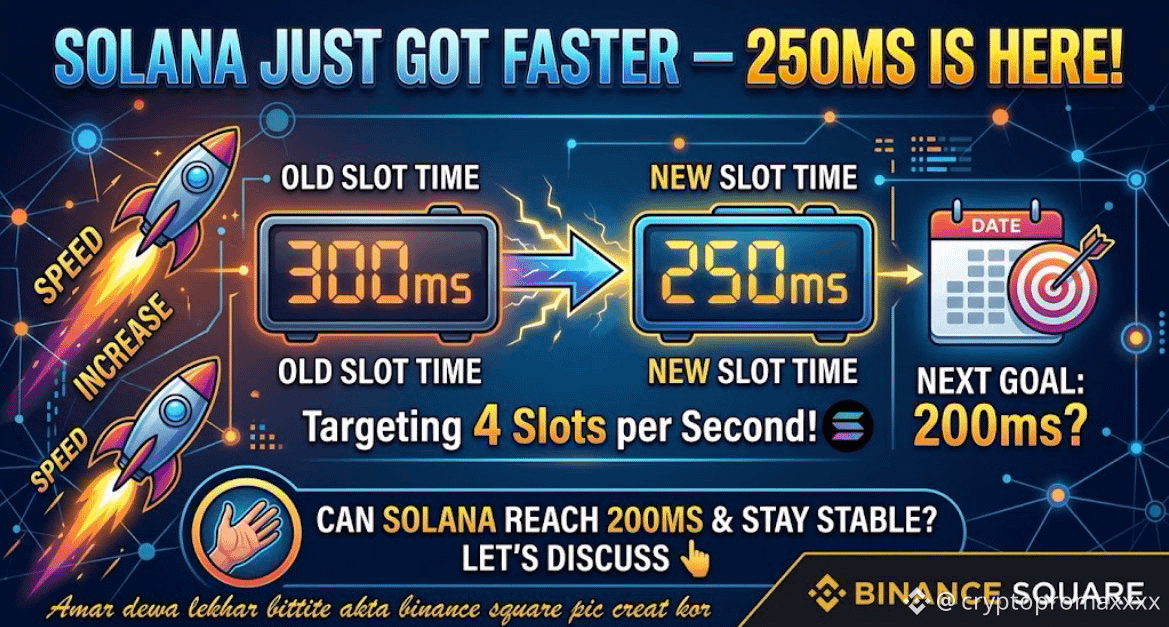
⚡ SOLANA JUST GOT FASTER — 250MS IS HERE! 🚀
Solana has reached another important infrastructure milestone. On September 18, 2026, its mainnet-beta target slot time moved from 300ms → 250ms under SIMD-0525.
That means Solana is now targeting roughly 4 slots per second. 👀
🔹 Previous target: 300ms
🔹 New target: 250ms
🔹 Next long-term goal: 200ms
But here’s the interesting part 🧠👇
A shorter slot time doesn’t automatically mean Solana will process proportionally more transactions. The upgrade also adjusts per-slot resource limits to keep the overall execution budget broadly balanced.
So the real test isn’t simply “How fast can Solana go?”
It’s whether validators, transaction propagation and network coordination can remain reliable as the timing gets tighter.
⚡ 250ms is the milestone.
200ms could be the next big test.
Do you think Solana can successfully reach 200ms while maintaining stable network performance? 👇
Bullish on $SOL? 🟢 or watching from the sidelines?
#SolanaCutsTargetSlotTimeTo250ms #SOL #CryptoNews #Blockchain #Web3 #Crypto #BinanceSquare
{spot}(SOLUSDT)
⚡ SOLANA JUST GOT FASTER — 250MS IS HERE! 🚀
Solana has reached another important infrastructure milestone. On September 18, 2026, its mainnet-beta target slot time moved from 300ms → 250ms under SIMD-0525.
That means Solana is now targeting roughly 4 slots per second. 👀
🔹 Previous target: 300ms
🔹 New target: 250ms
🔹 Next long-term goal: 200ms
But here’s the interesting part 🧠👇
A shorter slot time doesn’t automatically mean Solana will process proportionally more transactions. The upgrade also adjusts per-slot resource limits to keep the overall execution budget broadly balanced.
So the real test isn’t simply “How fast can Solana go?”
It’s whether validators, transaction propagation and network coordination can remain reliable as the timing gets tighter.
⚡ 250ms is the milestone.
200ms could be the next big test.
Do you think Solana can successfully reach 200ms while maintaining stable network performance? 👇
Bullish on $SOL? 🟢 or watching from the sidelines?
#SolanaCutsTargetSlotTimeTo250ms #SOL #CryptoNews #Blockchain #Web3 #Crypto #BinanceSquare
Solana has reached another important infrastructure milestone. On September 18, 2026, its mainnet-beta target slot time moved from 300ms → 250ms under SIMD-0525.
That means Solana is now targeting roughly 4 slots per second. 👀
🔹 Previous target: 300ms
🔹 New target: 250ms
🔹 Next long-term goal: 200ms
But here’s the interesting part 🧠👇
A shorter slot time doesn’t automatically mean Solana will process proportionally more transactions. The upgrade also adjusts per-slot resource limits to keep the overall execution budget broadly balanced.
So the real test isn’t simply “How fast can Solana go?”
It’s whether validators, transaction propagation and network coordination can remain reliable as the timing gets tighter.
⚡ 250ms is the milestone.
200ms could be the next big test.
Do you think Solana can successfully reach 200ms while maintaining stable network performance? 👇
Bullish on $SOL? 🟢 or watching from the sidelines?
#SolanaCutsTargetSlotTimeTo250ms #SOL #CryptoNews #Blockchain #Web3 #Crypto #BinanceSquare
253

#SolanaCutsTargetSlotTimeTo250ms
Solana has cut its target slot time from 300ms to 250ms under proposal SIMD-0525, boosting block production cadence by nearly 17%.
Key highlights of the update:
* Faster Cadence: The network now targets four slots per second instead of ~3.3, delivering quicker block production and fresher data.
* Capacity Preserved: Per-slot compute limits are proportionally reduced, preserving overall throughput while increasing block frequency.
* Shorter Epochs: An epoch (432,000 slots) now completes in roughly 30 hours instead of 36.
* Roadmap: This marks the third phase down from 400ms, with a final target of 200ms.
$SOL
{spot}(SOLUSDT)
#SolanaCutsTargetSlotTimeTo250ms
Solana has cut its target slot time from 300ms to 250ms under proposal SIMD-0525, boosting block production cadence by nearly 17%.
Key highlights of the update:
* Faster Cadence: The network now targets four slots per second instead of ~3.3, delivering quicker block production and fresher data.
* Capacity Preserved: Per-slot compute limits are proportionally reduced, preserving overall throughput while increasing block frequency.
* Shorter Epochs: An epoch (432,000 slots) now completes in roughly 30 hours instead of 36.
* Roadmap: This marks the third phase down from 400ms, with a final target of 200ms.
$SOL
Solana has cut its target slot time from 300ms to 250ms under proposal SIMD-0525, boosting block production cadence by nearly 17%.
Key highlights of the update:
* Faster Cadence: The network now targets four slots per second instead of ~3.3, delivering quicker block production and fresher data.
* Capacity Preserved: Per-slot compute limits are proportionally reduced, preserving overall throughput while increasing block frequency.
* Shorter Epochs: An epoch (432,000 slots) now completes in roughly 30 hours instead of 36.
* Roadmap: This marks the third phase down from 400ms, with a final target of 200ms.
$SOL
138
·
--
Bullish
Verified
#solanacutstargetslottimeto250ms
From 400ms to 250ms: Solana’s Multi-Stage Speed Strategy
Solana didn’t jump from 400ms to 250ms overnight. It built a staged path to get there.
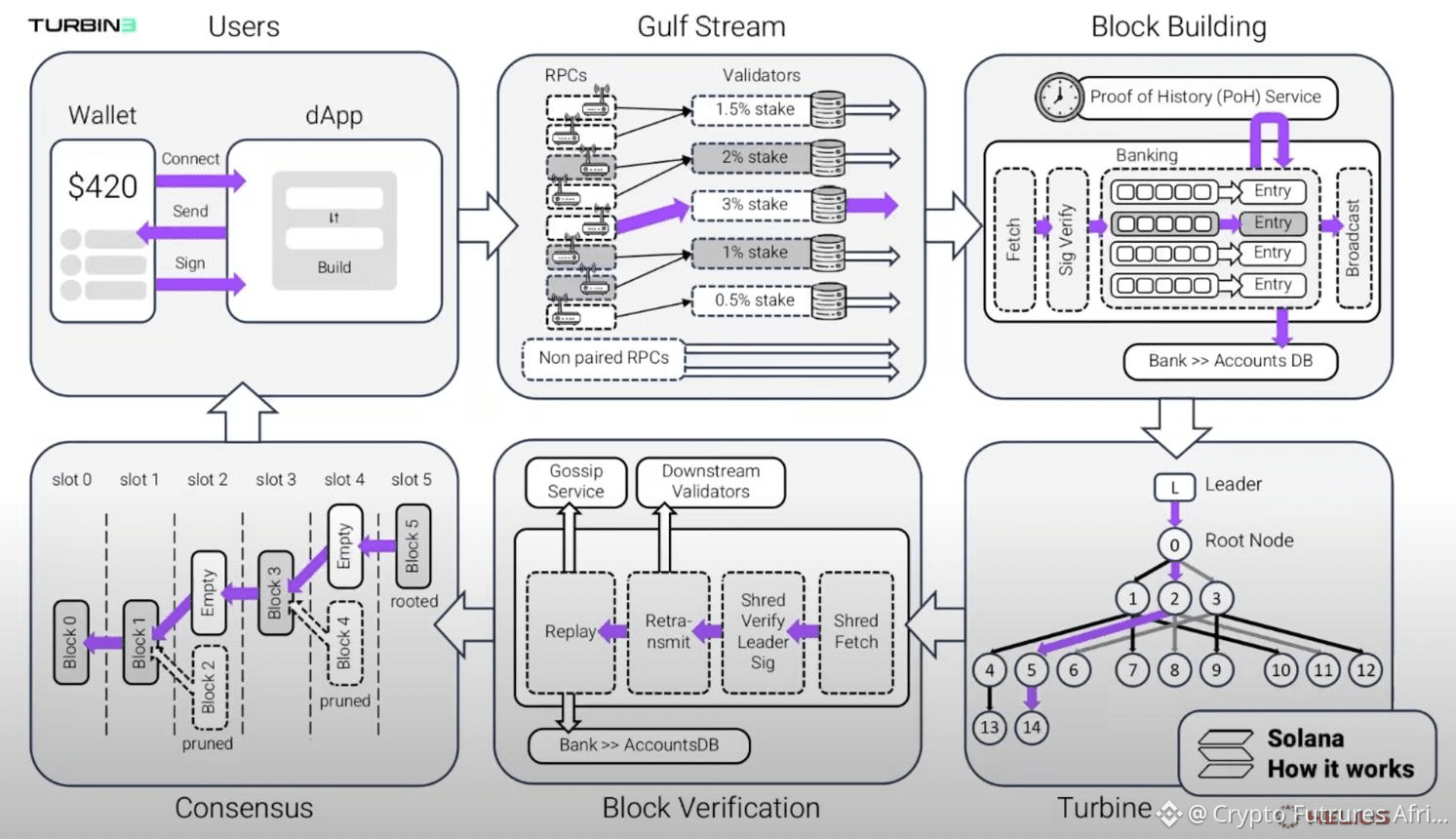
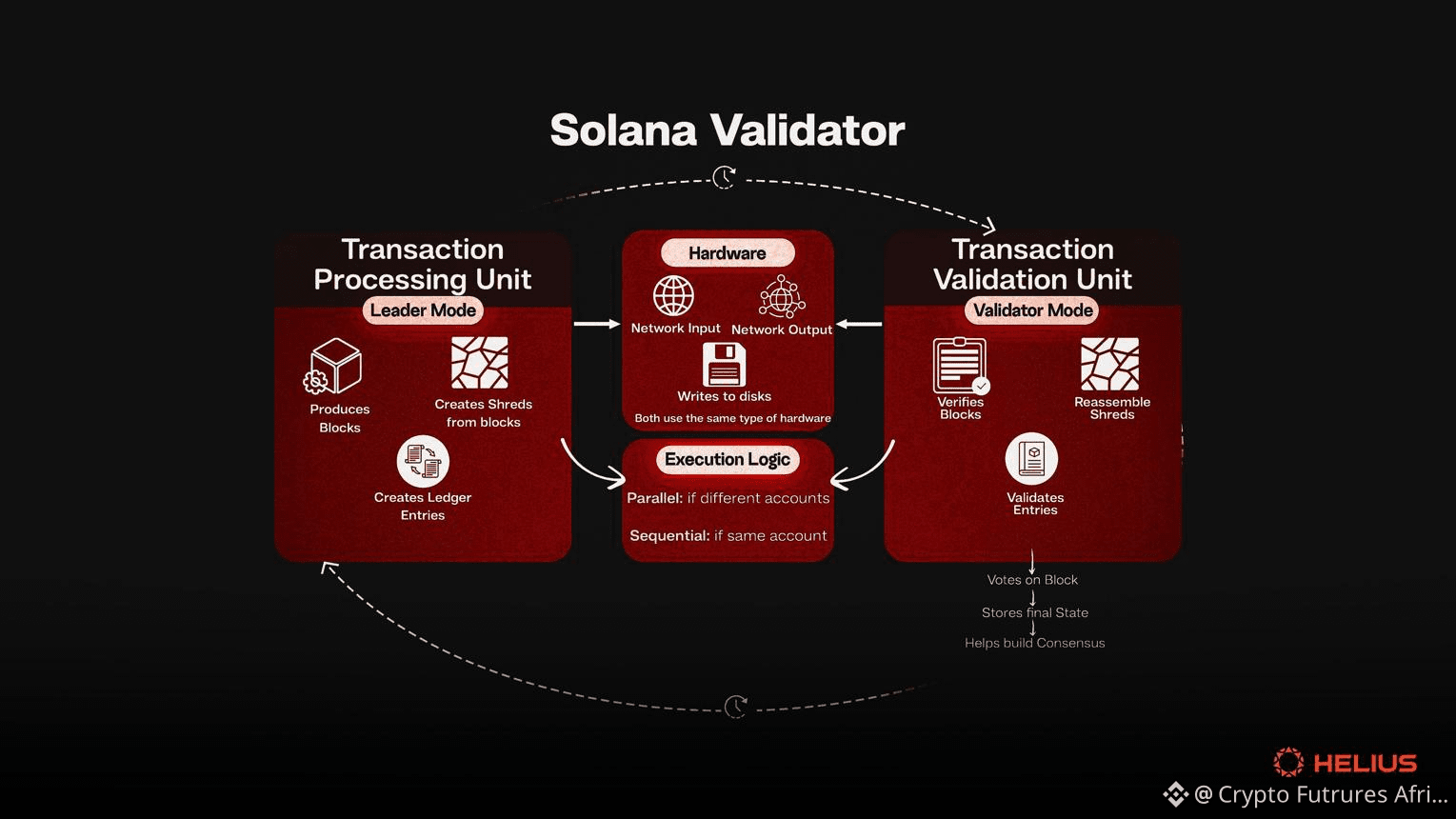
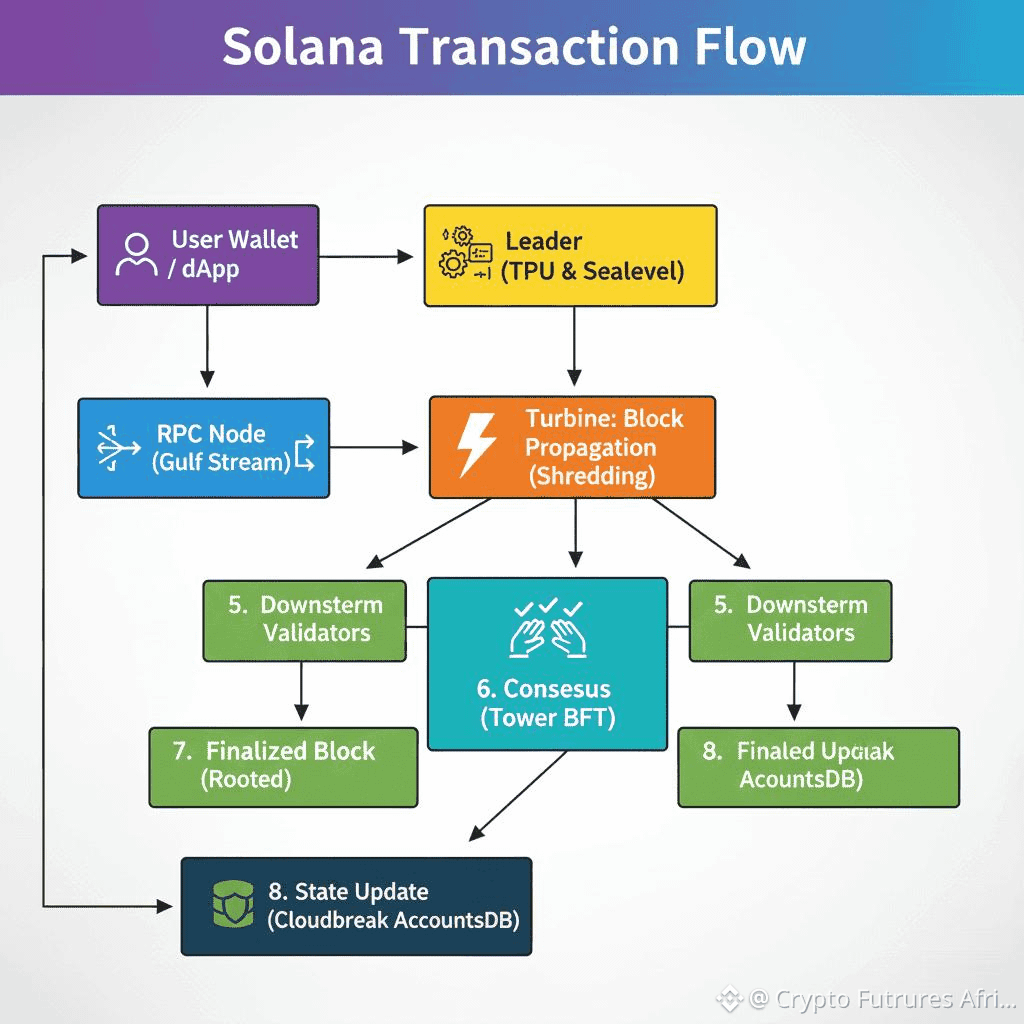
SIMD-0525 defines four reductions: 350ms, 300ms, 250ms and eventually 200ms. Each stage is feature-gated, allowing the network and its validators to adapt before the next reduction.
The 250ms stage is now active on Solana mainnet, while the final 200ms stage does not yet have a confirmed mainnet activation date. Binance News reported that the final step will depend on network performance, including validator stability.
The staged approach also changes other technical parameters. At 250ms, the proposal specifies a nominal one-second four-slot leader window, compared with 1.6 seconds at 400ms.
That makes the upgrade less about one headline number and more about gradually changing Solana’s timing architecture without making a single massive leap.
The next milestone is simple: whether the network can sustain the tighter timing at scale.
$ZETA
{future}(ZETAUSDT)
$SAGA
{future}(SAGAUSDT)
$KMNO
{future}(KMNOUSDT)
#solanacutstargetslottimeto250ms
From 400ms to 250ms: Solana’s Multi-Stage Speed Strategy
Solana didn’t jump from 400ms to 250ms overnight. It built a staged path to get there.
SIMD-0525 defines four reductions: 350ms, 300ms, 250ms and eventually 200ms. Each stage is feature-gated, allowing the network and its validators to adapt before the next reduction.
The 250ms stage is now active on Solana mainnet, while the final 200ms stage does not yet have a confirmed mainnet activation date. Binance News reported that the final step will depend on network performance, including validator stability.
The staged approach also changes other technical parameters. At 250ms, the proposal specifies a nominal one-second four-slot leader window, compared with 1.6 seconds at 400ms.
That makes the upgrade less about one headline number and more about gradually changing Solana’s timing architecture without making a single massive leap.
The next milestone is simple: whether the network can sustain the tighter timing at scale.
$ZETA
$SAGA
$KMNO
From 400ms to 250ms: Solana’s Multi-Stage Speed Strategy
Solana didn’t jump from 400ms to 250ms overnight. It built a staged path to get there.
SIMD-0525 defines four reductions: 350ms, 300ms, 250ms and eventually 200ms. Each stage is feature-gated, allowing the network and its validators to adapt before the next reduction.
The 250ms stage is now active on Solana mainnet, while the final 200ms stage does not yet have a confirmed mainnet activation date. Binance News reported that the final step will depend on network performance, including validator stability.
The staged approach also changes other technical parameters. At 250ms, the proposal specifies a nominal one-second four-slot leader window, compared with 1.6 seconds at 400ms.
That makes the upgrade less about one headline number and more about gradually changing Solana’s timing architecture without making a single massive leap.
The next milestone is simple: whether the network can sustain the tighter timing at scale.
$ZETA
$SAGA
$KMNO
1
2.1k

Everyone thinks faster block times automatically mean easier trading profits, but actually it creates a dangerous trap for retail execution.
Most traders lose money chasing high-speed volatility, getting front-run or trapped by failed transactions before their wallet even updates. When latency drops this drastically, clicking buy on market orders becomes a costly gamble.
Think of it like upgrading a highway speed limit from sixty to two hundred miles per hour. While Solana cutting target slot time down to 250ms makes the network remarkably fast, it also widens the gap between high-frequency trading bots and everyday users. If you are actively trading $SOL or rotating capital across high-throughput networks like $SUI, your default slippage settings need immediate attention to prevent poor fills.
First, your order routing requires tighter slippage tolerances because liquidity pools rebalance before standard confirmations finish processing. Second, chasing sudden green candles with market orders will simply feed latency arbitrage bots. Third, priority fee spikes will happen in fractions of a second, meaning underpaid transfers can get dropped while the price moves away from your entry.
Chains like $NEAR and Solana are built for peak performance, but speed without disciplined order management will drain your balance faster than network fees ever could.
How are you adjusting your execution strategy as block times continue to drop?
#SolanaCutsTargetSlotTimeTo250ms #EthereumSurpasses
Everyone thinks faster block times automatically mean easier trading profits, but actually it creates a dangerous trap for retail execution.
Most traders lose money chasing high-speed volatility, getting front-run or trapped by failed transactions before their wallet even updates. When latency drops this drastically, clicking buy on market orders becomes a costly gamble.
Think of it like upgrading a highway speed limit from sixty to two hundred miles per hour. While Solana cutting target slot time down to 250ms makes the network remarkably fast, it also widens the gap between high-frequency trading bots and everyday users. If you are actively trading $SOL or rotating capital across high-throughput networks like $SUI , your default slippage settings need immediate attention to prevent poor fills.
First, your order routing requires tighter slippage tolerances because liquidity pools rebalance before standard confirmations finish processing. Second, chasing sudden green candles with market orders will simply feed latency arbitrage bots. Third, priority fee spikes will happen in fractions of a second, meaning underpaid transfers can get dropped while the price moves away from your entry.
Chains like $NEAR and Solana are built for peak performance, but speed without disciplined order management will drain your balance faster than network fees ever could.
How are you adjusting your execution strategy as block times continue to drop?
#SolanaCutsTargetSlotTimeTo250ms #EthereumSurpasses
Most traders lose money chasing high-speed volatility, getting front-run or trapped by failed transactions before their wallet even updates. When latency drops this drastically, clicking buy on market orders becomes a costly gamble.
Think of it like upgrading a highway speed limit from sixty to two hundred miles per hour. While Solana cutting target slot time down to 250ms makes the network remarkably fast, it also widens the gap between high-frequency trading bots and everyday users. If you are actively trading $SOL or rotating capital across high-throughput networks like $SUI , your default slippage settings need immediate attention to prevent poor fills.
First, your order routing requires tighter slippage tolerances because liquidity pools rebalance before standard confirmations finish processing. Second, chasing sudden green candles with market orders will simply feed latency arbitrage bots. Third, priority fee spikes will happen in fractions of a second, meaning underpaid transfers can get dropped while the price moves away from your entry.
Chains like $NEAR and Solana are built for peak performance, but speed without disciplined order management will drain your balance faster than network fees ever could.
How are you adjusting your execution strategy as block times continue to drop?
#SolanaCutsTargetSlotTimeTo250ms #EthereumSurpasses

2
119

·
--
Picture this: you click swap on a DEX right before a breakout candle closes, only to watch your order fail because the network slot was already congested.
Every on-chain trader knows that brutal sinking feeling when slippage eats your profit margin or a delayed block leaves you trapped in a crashing trade. Execution speed is not just a vanity metric in high-frequency DeFi; it is the difference between catching liquidity and losing capital to arbitrage bots.
Solana is now testing a reduction in target slot times from 400 milliseconds down to 250 milliseconds. When we look back at how previous throughput optimizations shaped DeFi volume, slashing network latency this drastically is a direct shot across the bow of fast monolithic competitors like $SUI and $NEAR. By compressing block production intervals, $SOL aims to narrow the performance gap with centralized exchanges, giving decentralized order books the responsiveness needed for institutional liquidity.
Of course, faster block generation comes with serious trade-offs in validator synchronization and hardware overhead. When Ethereum rollups push sub-second finality, they rely on centralized sequencers, whereas cutting slot times across a globally distributed validator set tests the absolute physical limits of internet propagation. If the network maintains stability under this pace, it could redefine standard user expectations for on-chain execution.
Do you think cutting slot times will eliminate failed transactions during peak volatility, or will it just put heavier strain on smaller node operators?
#SolanaCutsTargetSlotTimeTo250ms #EthereumSurpasses
Picture this: you click swap on a DEX right before a breakout candle closes, only to watch your order fail because the network slot was already congested.
Every on-chain trader knows that brutal sinking feeling when slippage eats your profit margin or a delayed block leaves you trapped in a crashing trade. Execution speed is not just a vanity metric in high-frequency DeFi; it is the difference between catching liquidity and losing capital to arbitrage bots.
Solana is now testing a reduction in target slot times from 400 milliseconds down to 250 milliseconds. When we look back at how previous throughput optimizations shaped DeFi volume, slashing network latency this drastically is a direct shot across the bow of fast monolithic competitors like $SUI and $NEAR . By compressing block production intervals, $SOL aims to narrow the performance gap with centralized exchanges, giving decentralized order books the responsiveness needed for institutional liquidity.
Of course, faster block generation comes with serious trade-offs in validator synchronization and hardware overhead. When Ethereum rollups push sub-second finality, they rely on centralized sequencers, whereas cutting slot times across a globally distributed validator set tests the absolute physical limits of internet propagation. If the network maintains stability under this pace, it could redefine standard user expectations for on-chain execution.
Do you think cutting slot times will eliminate failed transactions during peak volatility, or will it just put heavier strain on smaller node operators?
#SolanaCutsTargetSlotTimeTo250ms #EthereumSurpasses
Every on-chain trader knows that brutal sinking feeling when slippage eats your profit margin or a delayed block leaves you trapped in a crashing trade. Execution speed is not just a vanity metric in high-frequency DeFi; it is the difference between catching liquidity and losing capital to arbitrage bots.
Solana is now testing a reduction in target slot times from 400 milliseconds down to 250 milliseconds. When we look back at how previous throughput optimizations shaped DeFi volume, slashing network latency this drastically is a direct shot across the bow of fast monolithic competitors like $SUI and $NEAR . By compressing block production intervals, $SOL aims to narrow the performance gap with centralized exchanges, giving decentralized order books the responsiveness needed for institutional liquidity.
Of course, faster block generation comes with serious trade-offs in validator synchronization and hardware overhead. When Ethereum rollups push sub-second finality, they rely on centralized sequencers, whereas cutting slot times across a globally distributed validator set tests the absolute physical limits of internet propagation. If the network maintains stability under this pace, it could redefine standard user expectations for on-chain execution.
Do you think cutting slot times will eliminate failed transactions during peak volatility, or will it just put heavier strain on smaller node operators?
#SolanaCutsTargetSlotTimeTo250ms #EthereumSurpasses

118

·
--
If you are still evaluating Layer 1 speed based on theoretical whitepapers rather than live execution latency, stop now.
Most traders lose money on fast-moving momentum plays simply because their transactions get stuck in mempool congestion while MEV bots frontrun the exact exit they needed. Watching a green candle evaporate into slippage because the network lagged is a pain every on-chain trader knows too well.
Solana pushing target slot times down to 250ms is fundamentally changing how execution wars play out across high-throughput networks. We watched $SUI and $NEAR force the speed narrative with sub-second finality, but seeing $SOL double down on raw block propagation changes the competitive math. Faster slots do not just mean snappier swaps for retail; they squeeze the arbitrage window for liquidators and drastically reduce stale state errors during violent volatility.
The trade-off, as always in distributed systems, lands squarely on validator hardware requirements and bandwidth overhead. Cutting slot times in half creates intense synchronization demands, reminding everyone of the historic trade-offs between pure decentralization and peak execution efficiency.
Do you think pushing sub-second slot times is the right path to win the throughput race, or does it risk pushing validator decentralization too far?
#SolanaCutsTargetSlotTimeTo250ms #EthereumSurpasses
If you are still evaluating Layer 1 speed based on theoretical whitepapers rather than live execution latency, stop now.
Most traders lose money on fast-moving momentum plays simply because their transactions get stuck in mempool congestion while MEV bots frontrun the exact exit they needed. Watching a green candle evaporate into slippage because the network lagged is a pain every on-chain trader knows too well.
Solana pushing target slot times down to 250ms is fundamentally changing how execution wars play out across high-throughput networks. We watched $SUI and $NEAR force the speed narrative with sub-second finality, but seeing $SOL double down on raw block propagation changes the competitive math. Faster slots do not just mean snappier swaps for retail; they squeeze the arbitrage window for liquidators and drastically reduce stale state errors during violent volatility.
The trade-off, as always in distributed systems, lands squarely on validator hardware requirements and bandwidth overhead. Cutting slot times in half creates intense synchronization demands, reminding everyone of the historic trade-offs between pure decentralization and peak execution efficiency.
Do you think pushing sub-second slot times is the right path to win the throughput race, or does it risk pushing validator decentralization too far?
#SolanaCutsTargetSlotTimeTo250ms #EthereumSurpasses
Most traders lose money on fast-moving momentum plays simply because their transactions get stuck in mempool congestion while MEV bots frontrun the exact exit they needed. Watching a green candle evaporate into slippage because the network lagged is a pain every on-chain trader knows too well.
Solana pushing target slot times down to 250ms is fundamentally changing how execution wars play out across high-throughput networks. We watched $SUI and $NEAR force the speed narrative with sub-second finality, but seeing $SOL double down on raw block propagation changes the competitive math. Faster slots do not just mean snappier swaps for retail; they squeeze the arbitrage window for liquidators and drastically reduce stale state errors during violent volatility.
The trade-off, as always in distributed systems, lands squarely on validator hardware requirements and bandwidth overhead. Cutting slot times in half creates intense synchronization demands, reminding everyone of the historic trade-offs between pure decentralization and peak execution efficiency.
Do you think pushing sub-second slot times is the right path to win the throughput race, or does it risk pushing validator decentralization too far?
#SolanaCutsTargetSlotTimeTo250ms #EthereumSurpasses

109

·
--
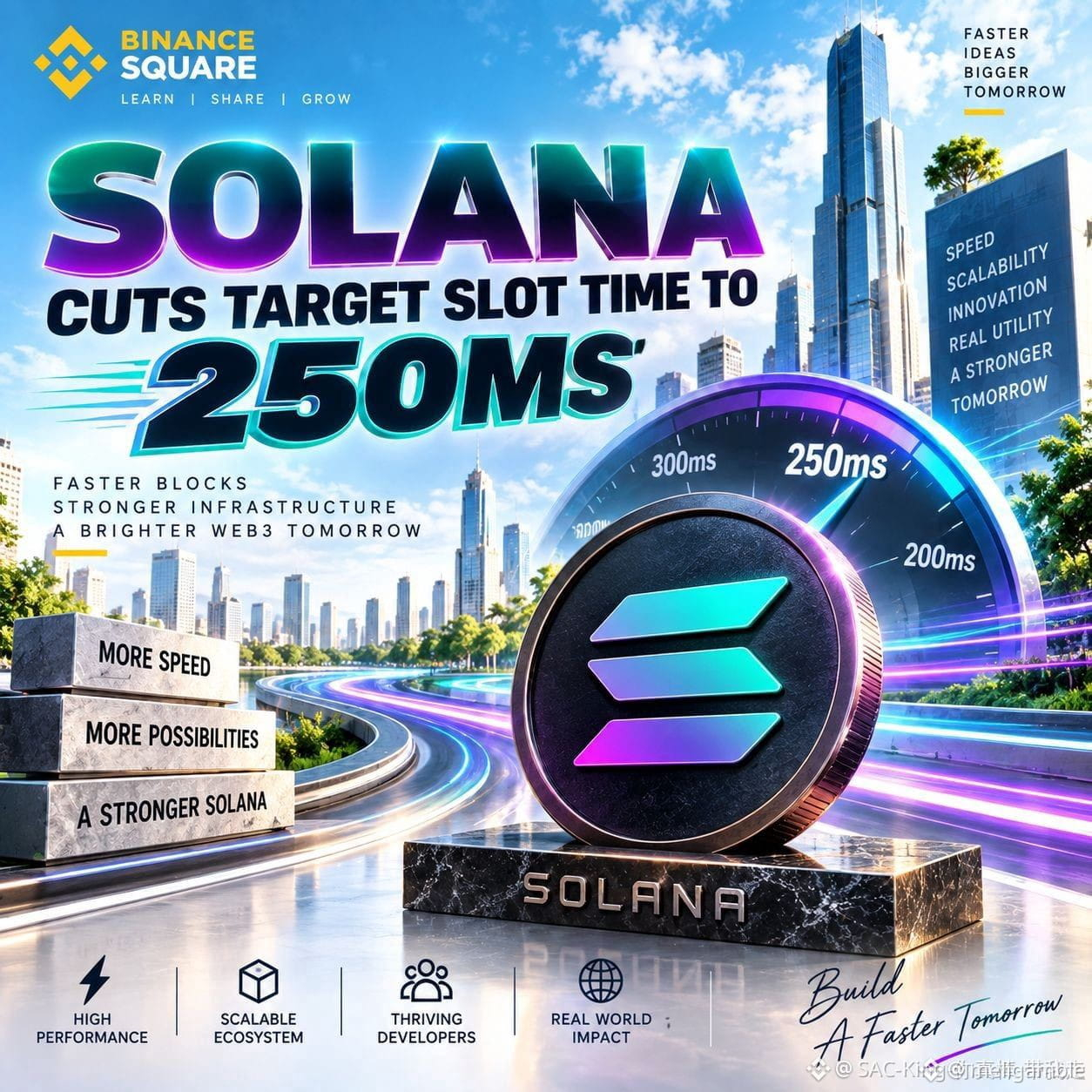
Most traders still treat confirmation speed like a footnote, yet Solana just set a 250ms target slot time , forty times quicker than Ethereum’s typical block and two thousand times faster than Bitcoin.
That gap used to cost real money. I watched entire positions evaporate in 2021 because a $SOL sell sat unconfirmed while the market reversed, the same fear that still hits when greed sits at 76 and everyone is piling in without checking the plumbing.
Slot time is simply the window a validator gets to produce the next block. Cutting the target to 250 milliseconds is Solana’s attempt to shrink latency so that liquidations, oracle updates, and even a basic swap actually land when you need them. We saw the same pattern after Ethereum’s gas wars and after $NEAR and $SUI marketed themselves as the chains that would not freeze. Those upgrades never arrived overnight; they arrived after traders had already paid tuition in missed entries and forced holds.
This time the narrative is cleaner, but the lesson from prior cycles still applies: speed upgrades pull capital first and deliver reliability later. In a greed tape, that delay is exactly where most people get chopped.
Where do you think this actually leaves $SOL versus the other L1s from here?
#SolanaCutsTargetSlotTimeTo250ms #EthereumSurpasses #BitcoinHits
Most traders still treat confirmation speed like a footnote, yet Solana just set a 250ms target slot time , forty times quicker than Ethereum’s typical block and two thousand times faster than Bitcoin.
That gap used to cost real money. I watched entire positions evaporate in 2021 because a $SOL sell sat unconfirmed while the market reversed, the same fear that still hits when greed sits at 76 and everyone is piling in without checking the plumbing.
Slot time is simply the window a validator gets to produce the next block. Cutting the target to 250 milliseconds is Solana’s attempt to shrink latency so that liquidations, oracle updates, and even a basic swap actually land when you need them. We saw the same pattern after Ethereum’s gas wars and after $NEAR and $SUI marketed themselves as the chains that would not freeze. Those upgrades never arrived overnight; they arrived after traders had already paid tuition in missed entries and forced holds.
This time the narrative is cleaner, but the lesson from prior cycles still applies: speed upgrades pull capital first and deliver reliability later. In a greed tape, that delay is exactly where most people get chopped.
Where do you think this actually leaves $SOL versus the other L1s from here?
#SolanaCutsTargetSlotTimeTo250ms #EthereumSurpasses #BitcoinHits
That gap used to cost real money. I watched entire positions evaporate in 2021 because a $SOL sell sat unconfirmed while the market reversed, the same fear that still hits when greed sits at 76 and everyone is piling in without checking the plumbing.
Slot time is simply the window a validator gets to produce the next block. Cutting the target to 250 milliseconds is Solana’s attempt to shrink latency so that liquidations, oracle updates, and even a basic swap actually land when you need them. We saw the same pattern after Ethereum’s gas wars and after $NEAR and $SUI marketed themselves as the chains that would not freeze. Those upgrades never arrived overnight; they arrived after traders had already paid tuition in missed entries and forced holds.
This time the narrative is cleaner, but the lesson from prior cycles still applies: speed upgrades pull capital first and deliver reliability later. In a greed tape, that delay is exactly where most people get chopped.
Where do you think this actually leaves $SOL versus the other L1s from here?
#SolanaCutsTargetSlotTimeTo250ms #EthereumSurpasses #BitcoinHits
64

#SolanaCutsTargetSlotTimeTo250ms
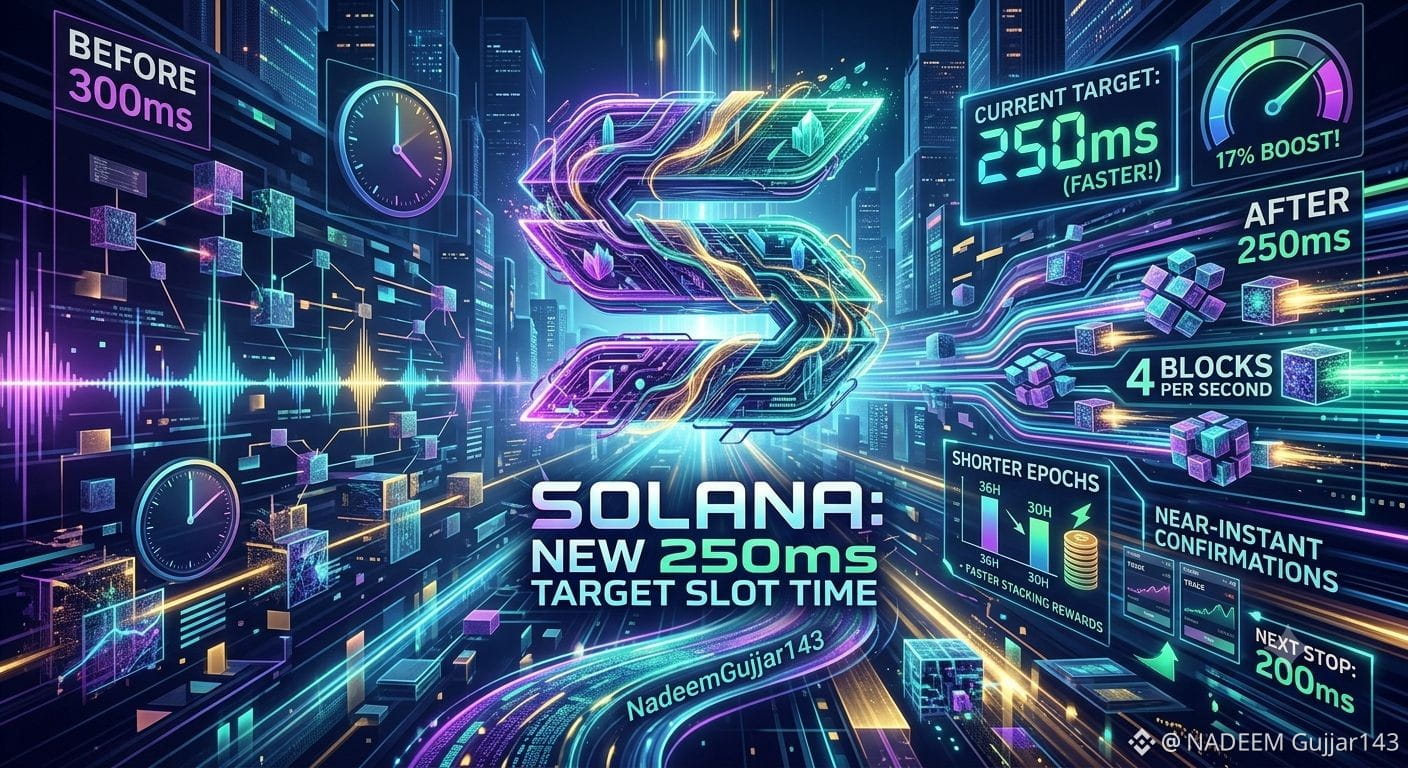
Solana Just Got 17% Faster! ⚡️
Solana has official cut its target slot time from 300ms down to 250ms! The clock is ticking faster on mainnet, and the ecosystem is feeling the speed boost.
Here is what you need to know 🧵👇
⚡ 4 Blocks Per Second: The network now targets 4 slots every single second.
📉 Shorter Epochs: Epochs dropped from ~36 hours down to ~30 hours. Staking rewards arrive faster!
🎯 Near-Instant Confirmations: Reduced price drift and latency for traders, DeFi, and oracles.
🏁 Next Stop: 200ms is the final target on the SIMD-0525 roadmap!
Solana keeps setting the standard for high-performance Web3. Are you holding $SOL? 🚀#Solana #DeFiDominance #BinanceSquareFamily
#Nadeemgujjar143
@Square-Creator-f3ffb6967ae3 @Square-Creator-82298398aad82
@1O69852872 @Square-Creator-4b9004503
$SOL
{spot}(SOLUSDT)
$SOLV
{spot}(SOLVUSDT)
$SOMI
{future}(SOMIUSDT)
#SolanaCutsTargetSlotTimeTo250ms
Solana Just Got 17% Faster! ⚡️
Solana has official cut its target slot time from 300ms down to 250ms! The clock is ticking faster on mainnet, and the ecosystem is feeling the speed boost.
Here is what you need to know 🧵👇
⚡ 4 Blocks Per Second: The network now targets 4 slots every single second.
📉 Shorter Epochs: Epochs dropped from ~36 hours down to ~30 hours. Staking rewards arrive faster!
🎯 Near-Instant Confirmations: Reduced price drift and latency for traders, DeFi, and oracles.
🏁 Next Stop: 200ms is the final target on the SIMD-0525 roadmap!
Solana keeps setting the standard for high-performance Web3. Are you holding $SOL ? 🚀#Solana #DeFiDominance #BinanceSquareFamily
#Nadeemgujjar143
@aasho @AYESHA ABID 阿伊莎 阿比德
@Fatima_Tariq @FATIMA
$SOL
$SOLV
$SOMI
Solana Just Got 17% Faster! ⚡️
Solana has official cut its target slot time from 300ms down to 250ms! The clock is ticking faster on mainnet, and the ecosystem is feeling the speed boost.
Here is what you need to know 🧵👇
⚡ 4 Blocks Per Second: The network now targets 4 slots every single second.
📉 Shorter Epochs: Epochs dropped from ~36 hours down to ~30 hours. Staking rewards arrive faster!
🎯 Near-Instant Confirmations: Reduced price drift and latency for traders, DeFi, and oracles.
🏁 Next Stop: 200ms is the final target on the SIMD-0525 roadmap!
Solana keeps setting the standard for high-performance Web3. Are you holding $SOL ? 🚀#Solana #DeFiDominance #BinanceSquareFamily
#Nadeemgujjar143
@aasho @AYESHA ABID 阿伊莎 阿比德
@Fatima_Tariq @FATIMA
$SOL
$SOLV
$SOMI
aasho:
Solana has official cut its target slot time from 300ms down to 250ms! The clock is ticking faster on mainnet, and the ecosystem is feeling the speed boost.
$SOL
1
1
50

Why is everyone celebrating faster block times when most retail traders are about to get front-run harder than ever?
Every cycle, traders watch their orders slip or get eaten alive by MEV bots during high-volatility spikes, only to blame network congestion. Cutting target slot times down to 250ms might look like a massive throughput victory on paper, but in reality, it widens the execution gap between everyday participants and high-frequency trading infrastructure.
When block production accelerates to sub-second speeds, validator co-location and custom RPC pipelines become the only game that matters. While high-speed chains like $SUI and $NEAR have forced this race toward ultra-low latency, pushing $SOL to 250ms slots turns decentralized trading into a pure latency arbitrage arena. Retail market orders will inevitably absorb worse execution prices during major liquidations while specialized desks capture the spread.
We often confuse raw network speed with actual market fairness. Faster execution is great for infrastructure benchmarks, but it fundamentally shifts the battlefield toward whoever sits closest to the validator.
Do you think sub-second block times actually help regular on-chain users, or are we just optimizing the network for trading bots?
#SolanaCutsTargetSlotTimeTo250ms #EthereumSurpasses
Why is everyone celebrating faster block times when most retail traders are about to get front-run harder than ever?
Every cycle, traders watch their orders slip or get eaten alive by MEV bots during high-volatility spikes, only to blame network congestion. Cutting target slot times down to 250ms might look like a massive throughput victory on paper, but in reality, it widens the execution gap between everyday participants and high-frequency trading infrastructure.
When block production accelerates to sub-second speeds, validator co-location and custom RPC pipelines become the only game that matters. While high-speed chains like $SUI and $NEAR have forced this race toward ultra-low latency, pushing $SOL to 250ms slots turns decentralized trading into a pure latency arbitrage arena. Retail market orders will inevitably absorb worse execution prices during major liquidations while specialized desks capture the spread.
We often confuse raw network speed with actual market fairness. Faster execution is great for infrastructure benchmarks, but it fundamentally shifts the battlefield toward whoever sits closest to the validator.
Do you think sub-second block times actually help regular on-chain users, or are we just optimizing the network for trading bots?
#SolanaCutsTargetSlotTimeTo250ms #EthereumSurpasses
Every cycle, traders watch their orders slip or get eaten alive by MEV bots during high-volatility spikes, only to blame network congestion. Cutting target slot times down to 250ms might look like a massive throughput victory on paper, but in reality, it widens the execution gap between everyday participants and high-frequency trading infrastructure.
When block production accelerates to sub-second speeds, validator co-location and custom RPC pipelines become the only game that matters. While high-speed chains like $SUI and $NEAR have forced this race toward ultra-low latency, pushing $SOL to 250ms slots turns decentralized trading into a pure latency arbitrage arena. Retail market orders will inevitably absorb worse execution prices during major liquidations while specialized desks capture the spread.
We often confuse raw network speed with actual market fairness. Faster execution is great for infrastructure benchmarks, but it fundamentally shifts the battlefield toward whoever sits closest to the validator.
Do you think sub-second block times actually help regular on-chain users, or are we just optimizing the network for trading bots?
#SolanaCutsTargetSlotTimeTo250ms #EthereumSurpasses
103

·
--
#SolanaCutsTargetSlotTimeTo250ms
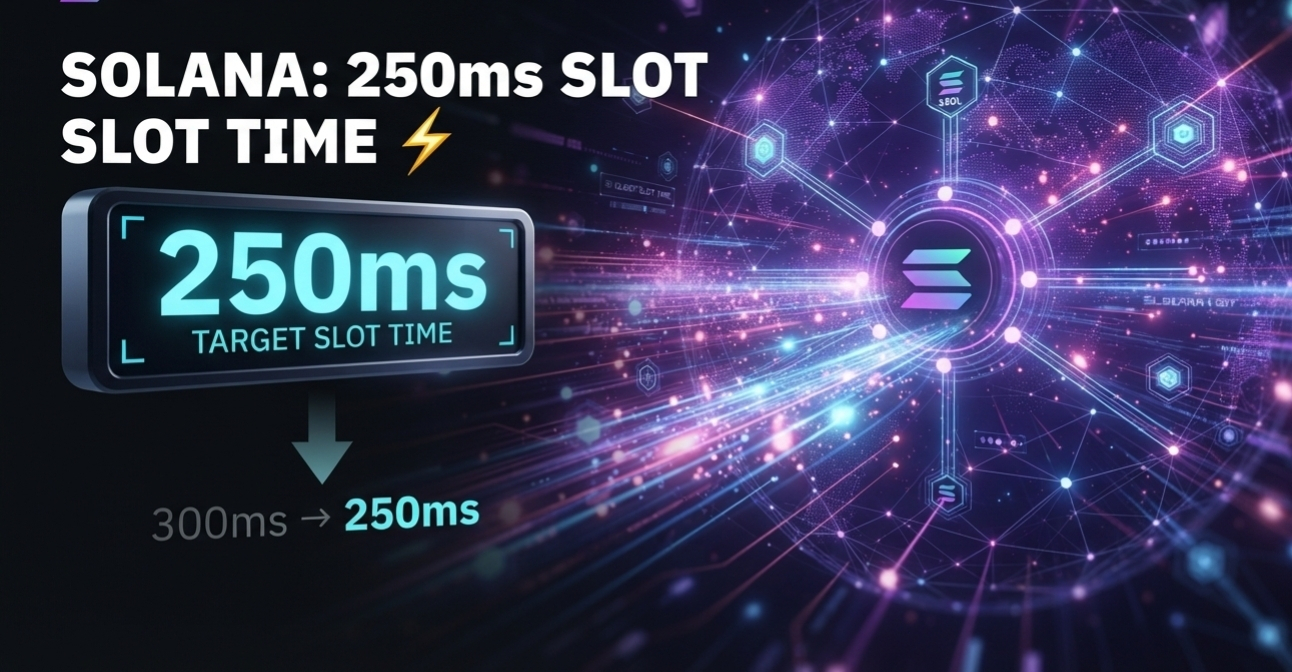
⚡ Solana $SOL Just Got Faster: 250ms Target Slot Time Goes Live
Solana has activated a major network timing upgrade, reducing its target slot time from 300ms to 250ms on September 18, 2026.
The change is part of SIMD-0525, a phased roadmap designed to progressively reduce Solana’s slot time toward a 200ms target.
🚀 What Does 250ms Mean?
At 250ms:
• ⏱️ 4 target slots per second, compared with ~3.3 previously
• 🔄 A 4-slot leader window is about 1 second, down from 1.2 seconds
• 🌐 A 432,000-slot epoch targets roughly 30 hours, compared with ~36 hours at 300ms
• ⚡ The network gets more frequent state updates and shorter leader-control intervals
Importantly, faster slots do not automatically mean higher overall transaction capacity. SIMD-0525 also adjusts per-slot compute and data limits to keep the approximate wall-clock processing rate broadly aligned.
🔥 The Bigger Picture
The 250ms upgrade is another step in Solana’s push toward lower latency and faster network coordination.
And there is still another milestone ahead:
250ms → 200ms
The 200ms target remains the next stage of the roadmap, with its mainnet activation still ahead.
For $SOL, the key question is not simply “How fast can Solana go?” — but how developers, traders, validators, and applications use these lower-latency capabilities as the network evolves.
⚠️ Disclaimer: This post is for informational purposes only and does not constitute financial or investment advice. Always conduct your own research before making any investment decision.
#Solana #SOL #Crypto #Blockchain #Web3 #DeFi #Altcoins #CryptoNews #SolanaNews
#SolanaCutsTargetSlotTimeTo250ms
⚡ Solana $SOL Just Got Faster: 250ms Target Slot Time Goes Live
Solana has activated a major network timing upgrade, reducing its target slot time from 300ms to 250ms on September 18, 2026.
The change is part of SIMD-0525, a phased roadmap designed to progressively reduce Solana’s slot time toward a 200ms target.
🚀 What Does 250ms Mean?
At 250ms:
• ⏱️ 4 target slots per second, compared with ~3.3 previously
• 🔄 A 4-slot leader window is about 1 second, down from 1.2 seconds
• 🌐 A 432,000-slot epoch targets roughly 30 hours, compared with ~36 hours at 300ms
• ⚡ The network gets more frequent state updates and shorter leader-control intervals
Importantly, faster slots do not automatically mean higher overall transaction capacity. SIMD-0525 also adjusts per-slot compute and data limits to keep the approximate wall-clock processing rate broadly aligned.
🔥 The Bigger Picture
The 250ms upgrade is another step in Solana’s push toward lower latency and faster network coordination.
And there is still another milestone ahead:
250ms → 200ms
The 200ms target remains the next stage of the roadmap, with its mainnet activation still ahead.
For $SOL, the key question is not simply “How fast can Solana go?” — but how developers, traders, validators, and applications use these lower-latency capabilities as the network evolves.
⚠️ Disclaimer: This post is for informational purposes only and does not constitute financial or investment advice. Always conduct your own research before making any investment decision.
#Solana #SOL #Crypto #Blockchain #Web3 #DeFi #Altcoins #CryptoNews #SolanaNews
⚡ Solana $SOL Just Got Faster: 250ms Target Slot Time Goes Live
Solana has activated a major network timing upgrade, reducing its target slot time from 300ms to 250ms on September 18, 2026.
The change is part of SIMD-0525, a phased roadmap designed to progressively reduce Solana’s slot time toward a 200ms target.
🚀 What Does 250ms Mean?
At 250ms:
• ⏱️ 4 target slots per second, compared with ~3.3 previously
• 🔄 A 4-slot leader window is about 1 second, down from 1.2 seconds
• 🌐 A 432,000-slot epoch targets roughly 30 hours, compared with ~36 hours at 300ms
• ⚡ The network gets more frequent state updates and shorter leader-control intervals
Importantly, faster slots do not automatically mean higher overall transaction capacity. SIMD-0525 also adjusts per-slot compute and data limits to keep the approximate wall-clock processing rate broadly aligned.
🔥 The Bigger Picture
The 250ms upgrade is another step in Solana’s push toward lower latency and faster network coordination.
And there is still another milestone ahead:
250ms → 200ms
The 200ms target remains the next stage of the roadmap, with its mainnet activation still ahead.
For $SOL, the key question is not simply “How fast can Solana go?” — but how developers, traders, validators, and applications use these lower-latency capabilities as the network evolves.
⚠️ Disclaimer: This post is for informational purposes only and does not constitute financial or investment advice. Always conduct your own research before making any investment decision.
#Solana #SOL #Crypto #Blockchain #Web3 #DeFi #Altcoins #CryptoNews #SolanaNews
54
Log in to explore more content
Join global crypto users on Binance Square
⚡️ Get latest and useful information about crypto.
💬 Trusted by the world’s largest crypto exchange.
👍 Discover real insights from verified creators.
Email / Phone number
Trending Topics
1
#XRPRises8%
4,570 views
308 Discussing
2
#AMDHits$1TrillionMarketCap
3 views
2 Discussing
3
#BitcoinSpotETFs$999MNetInflow
4 views
6 Discussing
4
#AppleGoogleSeekStablecoinTokenizedDepositTalent
3,288 views
244 Discussing
5
#NvidiaToBuyAnother$1.5BSBEnergySharesPreIPO
917 views
25 Discussing
6
#AgoraGetsPreliminaryOCCApprovalForTrustBank
1,936 views
103 Discussing
7
#NEARRisesNearly80%InAWeek
64,533 views
1,222 Discussing
8
#MultiversXPlansHardForkRecovery
51,315 views
918 Discussing
9
#CircleLaunchesInstitutionalBTCBackedBorrowing
45,684 views
915 Discussing
10
#BitcoinHits$85K
65,596 views
333 Discussing