Binance Square
#newt

newt

4.3M views
36,843 Discussing
David_John
·
--
I keep thinking about Newton Protocol because the market is treating it like another clean DeFi infrastructure story, but I don’t think that’s the real point. Risk policies sound good on paper. Everyone can say they have standards. What matters is whether those standards can be checked by anyone, across different apps, without just trusting the team behind them. That’s where Newton gets interesting. Still, I’m not getting carried away. There are always unlocks, hype cycles, weak demand, and token math hiding in the background. If Newton makes verification something people actually use, it could have real weight. If not, it’s just another polished narrative trying to look stronger than it is. #Newt @NewtonProtocol $NEWT
I keep thinking about Newton Protocol because the market is treating it like another clean DeFi infrastructure story, but I don’t think that’s the real point.

Risk policies sound good on paper. Everyone can say they have standards. What matters is whether those standards can be checked by anyone, across different apps, without just trusting the team behind them.

That’s where Newton gets interesting. Still, I’m not getting carried away.

There are always unlocks, hype cycles, weak demand, and token math hiding in the background. If Newton makes verification something people actually use, it could have real weight.

If not, it’s just another polished narrative trying to look stronger than it is.

#Newt @NewtonProtocol $NEWT
Bit Gurl:
The project becomes much more interesting if wallets, protocols, and agents keep using it because the rules layer genuinely reduces risk before assuming adoption is truly sticky.
·
--
Bullish
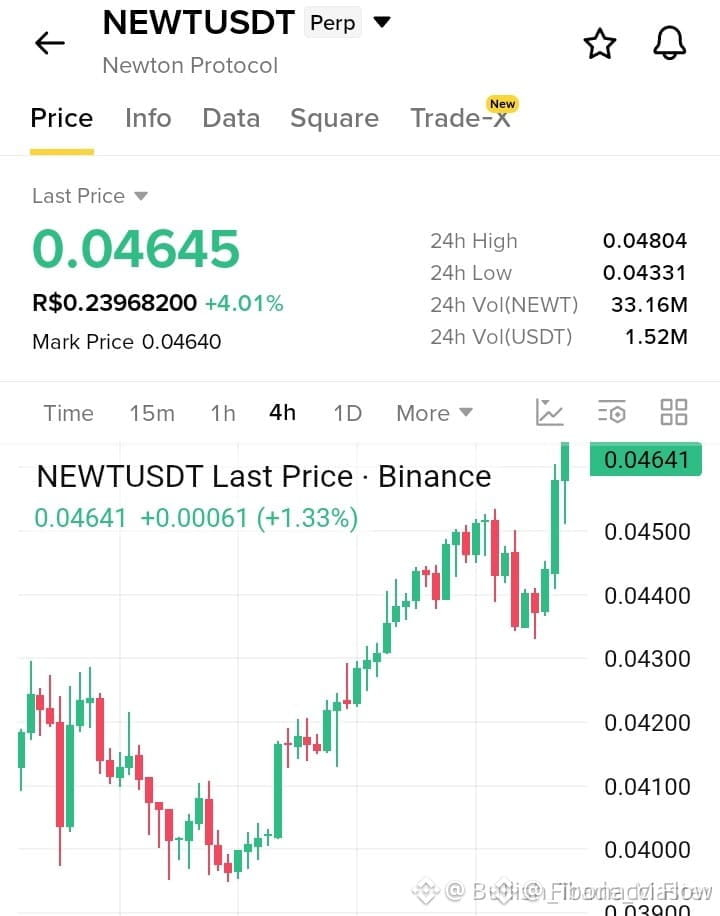
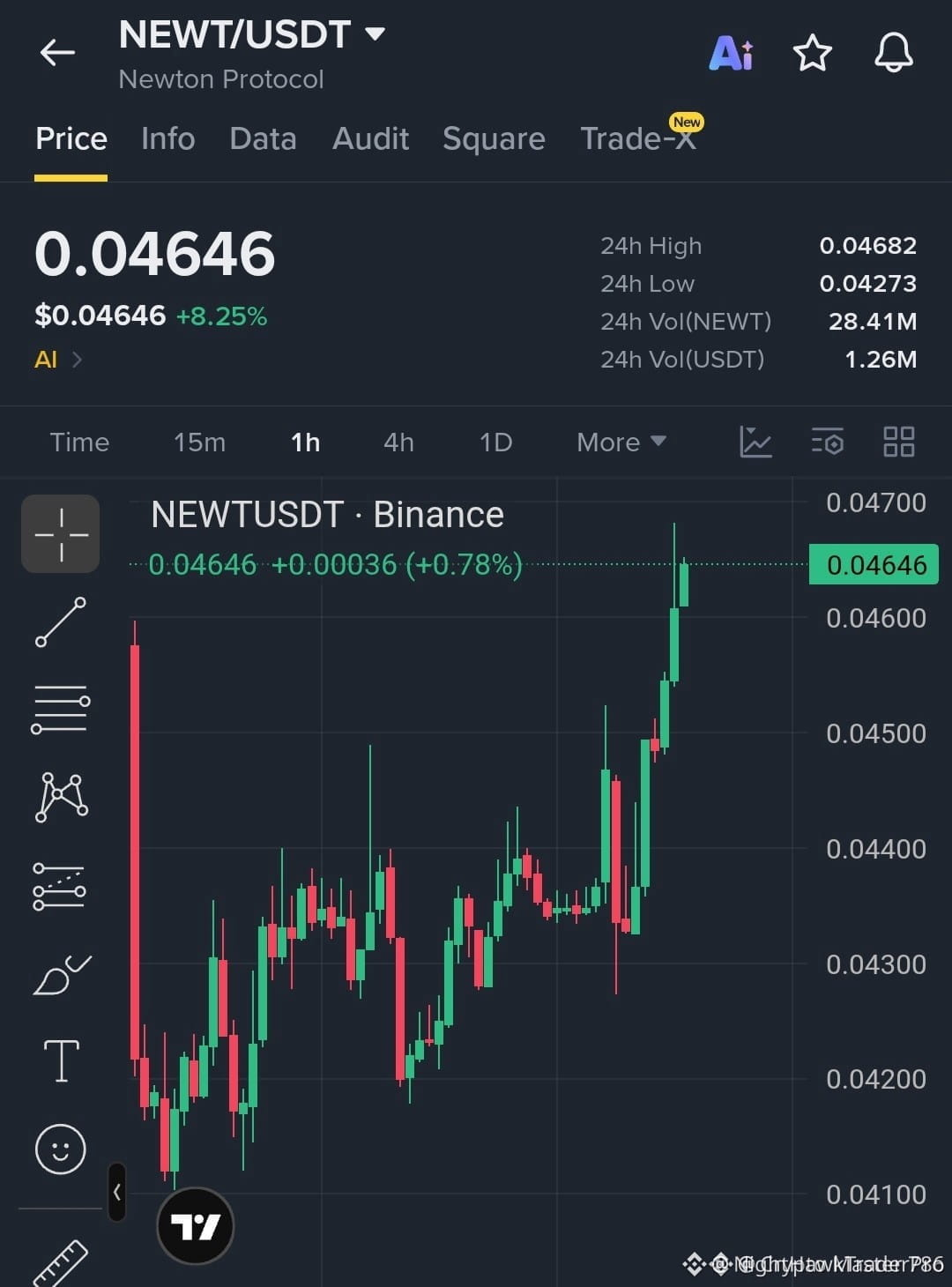
I keep thinking about Newton how easy it is to reduce NEWT to a chart. That is usually the first thing everyone sees. A price moving. A ticker getting attention. Another project sitting inside the AI and crypto overlap. But I do not think that is the most useful way to look at Newton. The part that keeps pulling me back is much quieter: permission. Not speed. Not automation. Not the usual story about agents doing more things onchain. Just permission. Because if AI agents and vaults are going to move capital, someone has to decide where the lines are before the money moves. That sounds obvious at first. Then it gets uncomfortable. Crypto loves removing friction, but some friction exists for a reason. A bot that can move instantly can also break things instantly. A vault that can rebalance without delay can also make one bad action travel faster than anyone can react. Newton seems to be working inside that tension. It is not asking whether automation should exist. That answer already feels decided. More capital will be managed by systems, agents, strategies, and rules that run without someone manually approving every move. The harder question is whether those systems can be trusted with limits. That is where the onchain authorization layer starts to feel less like a feature and more like a missing piece. Before a transaction goes through, the system checks whether it is allowed. Whether it fits the policy. Whether the actor has the right permission. Whether this action should happen at all. I like that because it feels boring in the right way. The best infrastructure usually does. It does not need to look dramatic from the outside. It just needs to stop the wrong thing before anyone has to explain why it happened. I still think there are questions. How much adoption will it get? How cleanly can this fit into real DeFi workflows? Will builders care enough about authorization before something goes wrong? I do not know yet. #Newt @NewtonProtocol $NEWT {future}(NEWTUSDT)
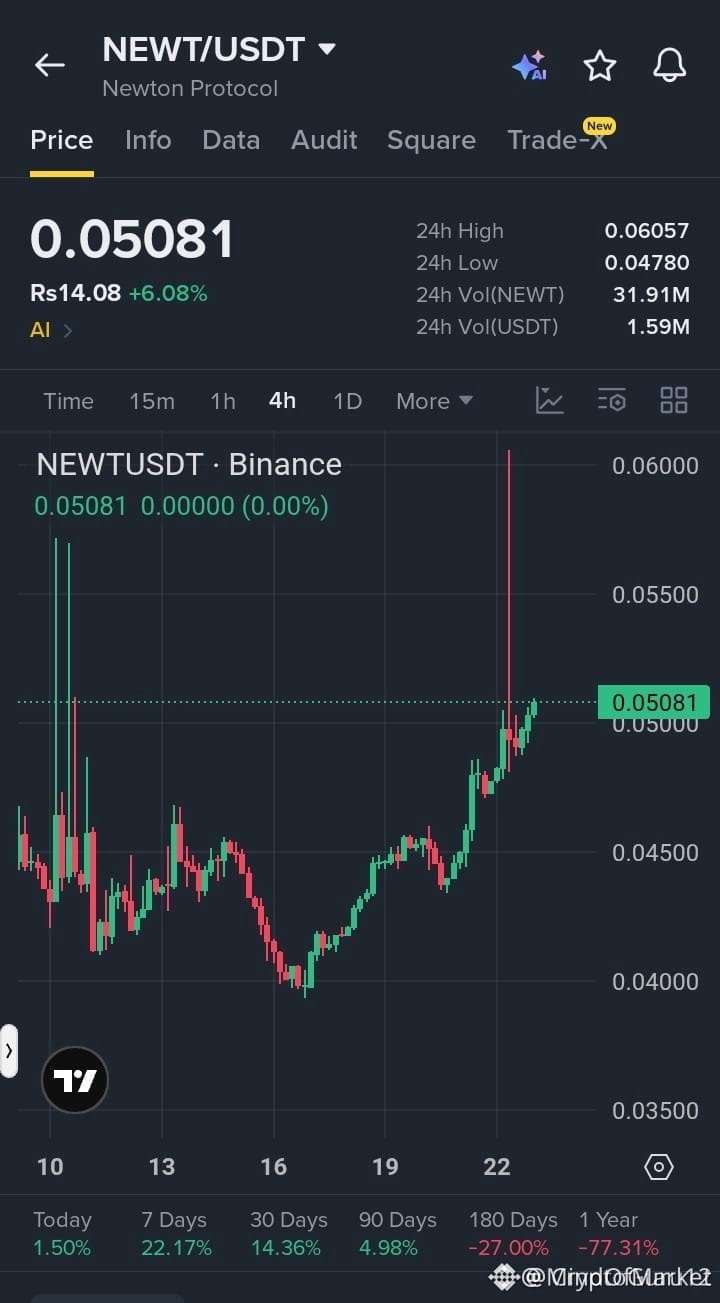
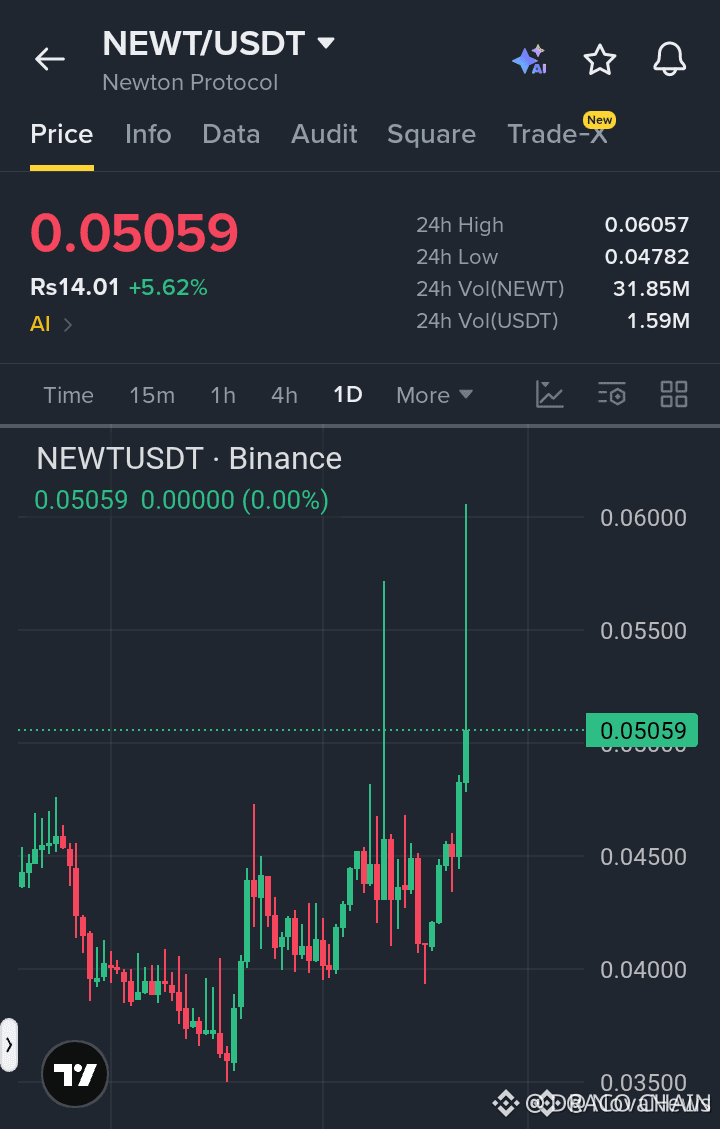
I keep thinking about Newton how easy it is to reduce NEWT to a chart.

That is usually the first thing everyone sees.

A price moving. A ticker getting attention. Another project sitting inside the AI and crypto overlap.

But I do not think that is the most useful way to look at Newton.

The part that keeps pulling me back is much quieter: permission.

Not speed. Not automation. Not the usual story about agents doing more things onchain.

Just permission.

Because if AI agents and vaults are going to move capital, someone has to decide where the lines are before the money moves.

That sounds obvious at first.

Then it gets uncomfortable.

Crypto loves removing friction, but some friction exists for a reason. A bot that can move instantly can also break things instantly. A vault that can rebalance without delay can also make one bad action travel faster than anyone can react.

Newton seems to be working inside that tension.

It is not asking whether automation should exist. That answer already feels decided. More capital will be managed by systems, agents, strategies, and rules that run without someone manually approving every move.

The harder question is whether those systems can be trusted with limits.

That is where the onchain authorization layer starts to feel less like a feature and more like a missing piece.

Before a transaction goes through, the system checks whether it is allowed. Whether it fits the policy. Whether the actor has the right permission. Whether this action should happen at all.

I like that because it feels boring in the right way.

The best infrastructure usually does.

It does not need to look dramatic from the outside. It just needs to stop the wrong thing before anyone has to explain why it happened.

I still think there are questions.

How much adoption will it get? How cleanly can this fit into real DeFi workflows? Will builders care enough about authorization before something goes wrong?

I do not know yet.

#Newt @NewtonProtocol $NEWT
Anaya Khan ㅤㅤㅤㅤㅤ:
Can $NEWT drive wider adoption though
·
--
Bullish
I keep staring at Newton because it looks boring on the surface. Mainnet beta. VaultKit. Policy enforcement. The kind of language DeFi has learned to package until every launch sounds more serious than it is. But the obvious read feels too easy. This is not just another project claiming to make vaults safer. Everyone says that. Most of them mean dashboards, alerts, committees, or pretty interfaces wrapped around the same old execution risk. The deeper question is whether Newton can make rules matter before money moves. That is where things get uncomfortable. DeFi has always liked the idea of being trustless, but vaults still depend on a lot of trust. Trust the curator. Trust the strategy. Trust the policy document. Trust the person watching the risk panel at the right time. VaultKit is interesting because it attacks that gap directly. A vault action should not just be reviewed later. It should be tested at the point of execution. Counterparties, limits, health, price feeds, permissions — these are not decoration if they can actually block a bad move. Still, the hard part is not writing rules. The hard part is proving those rules survive real markets, messy integrations, edge cases, and managers who always find the grey area between allowed and reckless. That is why I do not see $NEWT as a simple infrastructure story yet. It could become a serious control layer for onchain finance. Or it could become another elegant system that sounds better in architecture diagrams than it performs under pressure. Both are possible. But the direction is worth watching because DeFi’s next failure may not come from a lack of yield, liquidity, or speed. It may come from discovering that most “rules” were never rules at all. #Newt @NewtonProtocol $NEWT {future}(NEWTUSDT)
I keep staring at Newton because it looks boring on the surface.

Mainnet beta. VaultKit. Policy enforcement. The kind of language DeFi has learned to package until every launch sounds more serious than it is.

But the obvious read feels too easy.

This is not just another project claiming to make vaults safer. Everyone says that. Most of them mean dashboards, alerts, committees, or pretty interfaces wrapped around the same old execution risk.

The deeper question is whether Newton can make rules matter before money moves.

That is where things get uncomfortable.

DeFi has always liked the idea of being trustless, but vaults still depend on a lot of trust. Trust the curator. Trust the strategy. Trust the policy document. Trust the person watching the risk panel at the right time.

VaultKit is interesting because it attacks that gap directly.

A vault action should not just be reviewed later. It should be tested at the point of execution. Counterparties, limits, health, price feeds, permissions — these are not decoration if they can actually block a bad move.

Still, the hard part is not writing rules.

The hard part is proving those rules survive real markets, messy integrations, edge cases, and managers who always find the grey area between allowed and reckless.

That is why I do not see $NEWT as a simple infrastructure story yet.

It could become a serious control layer for onchain finance.

Or it could become another elegant system that sounds better in architecture diagrams than it performs under pressure.

Both are possible.

But the direction is worth watching because DeFi’s next failure may not come from a lack of yield, liquidity, or speed.

It may come from discovering that most “rules” were never rules at all.

#Newt @NewtonProtocol $NEWT
Anaya Khan ㅤㅤㅤㅤㅤ:
Can $NEWT enforce every policy reliably
#newt $NEWT Headline: Why Pre-Transaction Authorization is the Ultimate Shield for Web3 Ecosystems 🛡️⚡ ​One of the biggest systemic risks in cryptocurrency today is the reliance on reactive security. Traditional protocols are forced to react after an exploit has already hit the blockchain, leading to millions in lost capital. The deployment of the Newton Mainnet Beta introduces a completely proactive architectural standard to solve this critical vulnerability. ​Developed by the infrastructure team at Magic Labs, @NewtonProtocol operates as a composable, pre-transaction authorization layer rather than an isolated application chain. This allows developers to integrate "compliance-as-code" directly into the transaction lifecycle across multiple networks. ​Here is how the infrastructure transforms security: ​Hardware-Enforced Logic: Using VaultKit, Newton processes custom policy rules inside Trusted Execution Environments (TEEs) and verifies them with zero-knowledge proofs (ZKPs) off-chain before assets ever settle on the destination chain. ​Dynamic Risk Interception: Core data integrations with RedStone (providing manipulation-resistant oracle price feeds) and Credora (delivering real-time credit risk intelligence) allow Newton Vaults to instantly identify and block malicious activities at the exact transaction level. ​The $NEWT Economic Model: The native utility token, $NEWT, powers the entire ecosystem by acting as gas for verifiable policy computing, enabling delegated staking to secure the network, and serving as the governance asset for future upgrades. ​By mathematically verifying policy parameters before final execution, Newton establishes the secure, neutral framework necessary for decentralized applications, real-world assets (RWAs), and autonomous AI agents to operate safely. ​Tagging: $NEWT Account: @NewtonProtocol Hashtag: #Newt
#newt $NEWT Headline: Why Pre-Transaction Authorization is the Ultimate Shield for Web3 Ecosystems 🛡️⚡

​One of the biggest systemic risks in cryptocurrency today is the reliance on reactive security. Traditional protocols are forced to react after an exploit has already hit the blockchain, leading to millions in lost capital. The deployment of the Newton Mainnet Beta introduces a completely proactive architectural standard to solve this critical vulnerability.

​Developed by the infrastructure team at Magic Labs, @NewtonProtocol operates as a composable, pre-transaction authorization layer rather than an isolated application chain. This allows developers to integrate "compliance-as-code" directly into the transaction lifecycle across multiple networks.

​Here is how the infrastructure transforms security:

​Hardware-Enforced Logic: Using VaultKit, Newton processes custom policy rules inside Trusted Execution Environments (TEEs) and verifies them with zero-knowledge proofs (ZKPs) off-chain before assets ever settle on the destination chain.

​Dynamic Risk Interception: Core data integrations with RedStone (providing manipulation-resistant oracle price feeds) and Credora (delivering real-time credit risk intelligence) allow Newton Vaults to instantly identify and block malicious activities at the exact transaction level.

​The $NEWT Economic Model: The native utility token, $NEWT , powers the entire ecosystem by acting as gas for verifiable policy computing, enabling delegated staking to secure the network, and serving as the governance asset for future upgrades.

​By mathematically verifying policy parameters before final execution, Newton establishes the secure, neutral framework necessary for decentralized applications, real-world assets (RWAs), and autonomous AI agents to operate safely.

​Tagging: $NEWT

Account: @NewtonProtocol

Hashtag: #Newt
FINNEAS:
The project looks promising, but healthy skepticism always helps avoid emotional decisions during rapidly changing market conditions
I spent some time thinking about why a policy would begin with default allow := false. At first, that sounded like the safest possible approach to authorization. It isn't. That statement only decides what happens when no rule produces an approval. It says nothing about the quality of the rules that can change the final decision. Newton's Rego examples start from a deny-by-default posture, then introduce focused allow if { ... } rules for specific situations. Another example separates blocking conditions with deny if { ... } before evaluating not deny. The default remains unchanged throughout, yet the final outcome depends entirely on which rules are capable of overriding it. That was the part I didn't expect. default allow := false creates a conservative foundation, but it doesn't guarantee a conservative policy. A single broad approval rule or an exception that grows over time can weaken the protection without ever changing the default itself. The fallback stays strict while the authorization logic gradually becomes more permissive. What stayed with me wasn't the deny-by-default pattern. It was the realization that policy security is measured less by how a policy begins and more by every path that can eventually produce an approval. Does a default-deny policy meaningfully improve security, or do carefully designed approval rules ultimately matter more? @NewtonProtocol $NEWT #NEWT $TLM {future}(TLMUSDT) $BAS {alpha}(560x0f0df6cb17ee5e883eddfef9153fc6036bdb4e37) #Newt #NHHB639ProtectsDigitalAssetSelfCustody #GillibrandCallsForDigitalAssetEthicsBan #JunePayrolls57KHikeOddsFallTo50%
I spent some time thinking about why a policy would begin with default allow := false. At first, that sounded like the safest possible approach to authorization. It isn't. That statement only decides what happens when no rule produces an approval. It says nothing about the quality of the rules that can change the final decision.
Newton's Rego examples start from a deny-by-default posture, then introduce focused allow if { ... } rules for specific situations. Another example separates blocking conditions with deny if { ... } before evaluating not deny. The default remains unchanged throughout, yet the final outcome depends entirely on which rules are capable of overriding it.
That was the part I didn't expect. default allow := false creates a conservative foundation, but it doesn't guarantee a conservative policy. A single broad approval rule or an exception that grows over time can weaken the protection without ever changing the default itself. The fallback stays strict while the authorization logic gradually becomes more permissive.
What stayed with me wasn't the deny-by-default pattern. It was the realization that policy security is measured less by how a policy begins and more by every path that can eventually produce an approval.
Does a default-deny policy meaningfully improve security, or do carefully designed approval rules ultimately matter more?
@NewtonProtocol $NEWT #NEWT $TLM
$BAS
#Newt
#NHHB639ProtectsDigitalAssetSelfCustody #GillibrandCallsForDigitalAssetEthicsBan #JunePayrolls57KHikeOddsFallTo50%
Default deny is strongest
Approval rules matter more
Both matter equally
Still exploring
22 hr(s) left
On the bus from my hometown back to Hanoi, I was sitting by the window with my younger sister, watching the streetlights slide across the road. The two people sitting next to us were talking quietly about @NewtonProtocol just loud enough for a few fragments to reach me, but enough to pull my attention in. They were talking about something called “transaction gating,” not in the sense of blocking bad transactions after they appear, but preventing them from ever becoming an option that shows up in the first place. That line stuck with me, because it doesn’t sound like a typical filtering mechanism. In Newton Protocol’s architecture, transaction gating operates before the UI and even before the list of possible transactions is formed. Instead of rejecting transactions in real time, it prevents them from ever becoming visible or selectable options. The system isn’t judging “good or bad” at execution it determines whether something is allowed to exist in the option space at all. My sister leaned over and asked quietly: “So we only see part of what the system could actually do?” I didn’t answer immediately. Because the deeper point isn’t obvious at first glance. It’s not about reducing risk after users see the world it’s about defining the boundary of what the world is allowed to look like in the first place. The question is no longer about choosing correctly or incorrectly, but about which possibilities are even permitted to enter the space where choice becomes possible. If you look closer, transaction gating effectively separates “possibility” from “option.” Some things may still exist technically within the system, but they are never allowed to cross into the layer where humans can interact with them. They don’t disappear they are simply held back before becoming visible choices. I was left with a simple thought: Newton Protocol doesn’t help you make better decisions. It operates a step earlier deciding what is even allowed to exist as a decision in the first place. @NewtonProtocol $NEWT #Newt $MPLX $NEX
On the bus from my hometown back to Hanoi, I was sitting by the window with my younger sister, watching the streetlights slide across the road. The two people sitting next to us were talking quietly about @NewtonProtocol just loud enough for a few fragments to reach me, but enough to pull my attention in.

They were talking about something called “transaction gating,” not in the sense of blocking bad transactions after they appear, but preventing them from ever becoming an option that shows up in the first place. That line stuck with me, because it doesn’t sound like a typical filtering mechanism.

In Newton Protocol’s architecture, transaction gating operates before the UI and even before the list of possible transactions is formed. Instead of rejecting transactions in real time, it prevents them from ever becoming visible or selectable options. The system isn’t judging “good or bad” at execution it determines whether something is allowed to exist in the option space at all.

My sister leaned over and asked quietly: “So we only see part of what the system could actually do?” I didn’t answer immediately. Because the deeper point isn’t obvious at first glance.

It’s not about reducing risk after users see the world it’s about defining the boundary of what the world is allowed to look like in the first place. The question is no longer about choosing correctly or incorrectly, but about which possibilities are even permitted to enter the space where choice becomes possible.

If you look closer, transaction gating effectively separates “possibility” from “option.” Some things may still exist technically within the system, but they are never allowed to cross into the layer where humans can interact with them. They don’t disappear they are simply held back before becoming visible choices.

I was left with a simple thought: Newton Protocol doesn’t help you make better decisions. It operates a step earlier deciding what is even allowed to exist as a decision in the first place.
@NewtonProtocol $NEWT #Newt $MPLX $NEX
Hoàng Tử Bit:
Wow, this is such a clean way to frame it. Transaction gating in Newton Protocol isn’t just another filter layer — it’s architectural philosophy. It doesn’t wait for bad transactions to appear and then say “no.” It makes the bad ones never exist in the user’s reality in the first place.
Article
The Question That Stayed With Me After Reading Newton Protocol's ArchitectureI thought I was opening the documentation to understand how a payment moves through the system. Instead, I ended up asking a different question. When does the protocol decide that a payment is allowed to happen? That question kept me on the architecture page longer than I expected. Following the workflow from the beginning, I noticed the transfer isn't the first thing the diagram is trying to explain. Before it reaches that point, there's a policy evaluation and an attestation becomes part of the process. I actually went back through the diagram because I wanted to understand why those steps appeared where they did. After reading the notes beside the workflow, the sequence started to make more sense. I missed that detail the first time. When I read that the payment contract uses NewtonPolicyClient, I scrolled back to the diagram to see where it fit into the flow. That second look answered more questions than the first one did. I also paused when I read that there isn't an off-chain server sitting in the critical path. It's only a short sentence, but I found myself looking back at the diagram again after reading it. Sometimes one sentence changes the way you look at an entire page. That's probably why I like reading technical documentation slowly. The first time through, I'm usually just trying to understand the names of different components. The second time, I start noticing why they're arranged the way they are. For me, that was the interesting part of Newton Protocol's payment architecture. Not the payment itself. The thinking behind the workflow. By the time I finished reading, I wasn't remembering individual boxes in the diagram anymore. I was remembering the order they appeared in, and I think that says a lot about how clearly the workflow was presented. #newt @NewtonProtocol $NEWT {spot}(NEWTUSDT)

The Question That Stayed With Me After Reading Newton Protocol's Architecture

I thought I was opening the documentation to understand how a payment moves through the system.
Instead, I ended up asking a different question.
When does the protocol decide that a payment is allowed to happen?
That question kept me on the architecture page longer than I expected.
Following the workflow from the beginning, I noticed the transfer isn't the first thing the diagram is trying to explain. Before it reaches that point, there's a policy evaluation and an attestation becomes part of the process. I actually went back through the diagram because I wanted to understand why those steps appeared where they did.
After reading the notes beside the workflow, the sequence started to make more sense.
I missed that detail the first time. When I read that the payment contract uses NewtonPolicyClient, I scrolled back to the diagram to see where it fit into the flow. That second look answered more questions than the first one did.
I also paused when I read that there isn't an off-chain server sitting in the critical path.
It's only a short sentence, but I found myself looking back at the diagram again after reading it. Sometimes one sentence changes the way you look at an entire page.
That's probably why I like reading technical documentation slowly.
The first time through, I'm usually just trying to understand the names of different components.
The second time, I start noticing why they're arranged the way they are.
For me, that was the interesting part of Newton Protocol's payment architecture.
Not the payment itself.
The thinking behind the workflow.
By the time I finished reading, I wasn't remembering individual boxes in the diagram anymore. I was remembering the order they appeared in, and I think that says a lot about how clearly the workflow was presented.
#newt @NewtonProtocol $NEWT
BTC-KISWA:
Newton is solving a real infrastructure problem.
·
--
Bullish
I keep thinking about Newton Protocol how easily we hand over control in crypto. We call it automation because that sounds harmless. Convenient. Efficient. Just a smarter way to remove friction from the process. But the more I look at it, the less simple it feels. The thing that worries me is not the trade itself. It is the permission behind it. That quiet approval we give to systems we barely understand. We connect a wallet, approve access, and assume the machine will stay inside the lines. Until it does not. And when that happens, the problem is not usually loud at first. It is buried inside a permission we forgot existed. That is why Newton approach stands out to me. It is not built around the idea that AI agents or bots should simply be trusted because they are fast, useful, or well-designed. It starts from a more serious question: Before this system moves anything, can it prove it is allowed to? That changes the conversation. In most setups, users are asked to trust the operator, the developer, the interface, or the reputation behind the product. Newton pushes the trust model closer to policy. Rules are defined first. Actions are checked against those rules. Execution only happens if the system can prove it stayed within the boundary. That is a very different kind of automation. It is not just about whether an agent can trade, rebalance, or react faster than a human. It is about whether that agent can show its authority before it touches funds. Speed is easy to admire. Accountability is harder to build. And as crypto automation moves deeper into AI-driven systems, that may become the real dividing line. Not which agent acts the fastest, but which one can justify its power before it moves a single cent. #Newt @NewtonProtocol $NEWT {future}(NEWTUSDT)
I keep thinking about Newton Protocol how easily we hand over control in crypto.

We call it automation because that sounds harmless. Convenient. Efficient. Just a smarter way to remove friction from the process.

But the more I look at it, the less simple it feels.

The thing that worries me is not the trade itself. It is the permission behind it. That quiet approval we give to systems we barely understand. We connect a wallet, approve access, and assume the machine will stay inside the lines.

Until it does not.

And when that happens, the problem is not usually loud at first. It is buried inside a permission we forgot existed.

That is why Newton approach stands out to me.

It is not built around the idea that AI agents or bots should simply be trusted because they are fast, useful, or well-designed. It starts from a more serious question:

Before this system moves anything, can it prove it is allowed to?

That changes the conversation.

In most setups, users are asked to trust the operator, the developer, the interface, or the reputation behind the product. Newton pushes the trust model closer to policy. Rules are defined first. Actions are checked against those rules. Execution only happens if the system can prove it stayed within the boundary.

That is a very different kind of automation.

It is not just about whether an agent can trade, rebalance, or react faster than a human. It is about whether that agent can show its authority before it touches funds.

Speed is easy to admire.

Accountability is harder to build.

And as crypto automation moves deeper into AI-driven systems, that may become the real dividing line. Not which agent acts the fastest, but which one can justify its power before it moves a single cent.

#Newt @NewtonProtocol $NEWT
Anaya Khan ㅤㅤㅤㅤㅤ:
Why $NEWT over faster bots though
·
--
Bullish
I've reached a point where new crypto narratives rarely excite me. I've watched DeFi, NFTs, the metaverse, RWAs, and now AI follow a familiar pattern: bold ideas, massive expectations, and a slow confrontation with reality. That doesn't mean innovation has stopped—it just means I've become more interested in problems than promises. That's why Newton Protocol caught my attention. It isn't simply another project combining AI with blockchain. Instead, it asks a more practical question: how can autonomous AI agents interact with on-chain assets without requiring users to blindly trust them? The idea of limiting AI through programmable permissions and verifiable execution feels more grounded than chasing the latest automation trend. Still, good ideas don't automatically become widely used products. Trust remains difficult, user experience is often overlooked, and marketplaces only work when developers, operators, and users all show up together. Those are hard challenges that technology alone can't solve. Then there's the NEWT token. It has defined roles within the ecosystem, but like every infrastructure token, the real test is whether people use it because the network genuinely needs it—not because every blockchain project is expected to have one. I don't know if Newton Protocol will become an important piece of crypto infrastructure. What I do know is that it's asking a more interesting question than most AI projects. After enough market cycles, that quiet curiosity feels far more valuable than hype. @NewtonProtocol #newt $NEWT {spot}(NEWTUSDT)
I've reached a point where new crypto narratives rarely excite me. I've watched DeFi, NFTs, the metaverse, RWAs, and now AI follow a familiar pattern: bold ideas, massive expectations, and a slow confrontation with reality. That doesn't mean innovation has stopped—it just means I've become more interested in problems than promises.

That's why Newton Protocol caught my attention.

It isn't simply another project combining AI with blockchain. Instead, it asks a more practical question: how can autonomous AI agents interact with on-chain assets without requiring users to blindly trust them? The idea of limiting AI through programmable permissions and verifiable execution feels more grounded than chasing the latest automation trend.

Still, good ideas don't automatically become widely used products. Trust remains difficult, user experience is often overlooked, and marketplaces only work when developers, operators, and users all show up together. Those are hard challenges that technology alone can't solve.

Then there's the NEWT token. It has defined roles within the ecosystem, but like every infrastructure token, the real test is whether people use it because the network genuinely needs it—not because every blockchain project is expected to have one.

I don't know if Newton Protocol will become an important piece of crypto infrastructure. What I do know is that it's asking a more interesting question than most AI projects. After enough market cycles, that quiet curiosity feels far more valuable than hype.

@NewtonProtocol

#newt $NEWT
Hanam_22:
If sub-vaults need fresh authorization every time, it adds security but also more friction. That tradeoff will matter
Article
Newton Protocol: Unlocking Institutional DeFi AdoptionWhen people talk about DeFi, the conversation usually revolves around higher yields, faster transactions, or new financial products. But I think one question matters even more 👉 What will it take for institutions to actually participate? Many financial firms are interested in blockchain technology, but they can't simply ignore compliance, security, and internal approval processes. Those requirements are part of how they operate. Without solving them, large-scale institutional adoption will always face obstacles. That's one reason Newton Protocol stands out to me. Instead of treating compliance as something added later @NewtonProtocol is exploring how it can become part of the transaction process itself. If identity verification, permissions, and authorization can happen before execution, it could create a smoother path for organizations that need both transparency and regulatory confidence. I also like that the project isn't trying to replace traditional finance. It seems more focused on building a bridge between TradFi and DeFi, allowing both systems to benefit from programmable infrastructure without sacrificing security or flexibility. Of course, real adoption won't happen overnight. Institutional trust takes time, and every new technology has to prove itself through consistent execution. But I believe projects that focus on solving practical problems have a better chance of creating long-term value than those relying only on market hype. Newton Protocol is still in its early stages, yet its approach feels aligned with what the industry needs if DeFi is going to expand beyond retail users. I'll be watching closely to see how the ecosystem grows and whether this vision translates into real-world adoption. $NEWT #newt

Newton Protocol: Unlocking Institutional DeFi Adoption

When people talk about DeFi, the conversation usually revolves around higher yields, faster transactions, or new financial products. But I think one question matters even more 👉 What will it take for institutions to actually participate?
Many financial firms are interested in blockchain technology, but they can't simply ignore compliance, security, and internal approval processes. Those requirements are part of how they operate. Without solving them, large-scale institutional adoption will always face obstacles.
That's one reason Newton Protocol stands out to me.
Instead of treating compliance as something added later @NewtonProtocol is exploring how it can become part of the transaction process itself. If identity verification, permissions, and authorization can happen before execution, it could create a smoother path for organizations that need both transparency and regulatory confidence.
I also like that the project isn't trying to replace traditional finance. It seems more focused on building a bridge between TradFi and DeFi, allowing both systems to benefit from programmable infrastructure without sacrificing security or flexibility.
Of course, real adoption won't happen overnight. Institutional trust takes time, and every new technology has to prove itself through consistent execution. But I believe projects that focus on solving practical problems have a better chance of creating long-term value than those relying only on market hype.
Newton Protocol is still in its early stages, yet its approach feels aligned with what the industry needs if DeFi is going to expand beyond retail users. I'll be watching closely to see how the ecosystem grows and whether this vision translates into real-world adoption.
$NEWT #newt
Rais_Crypto9047:
TradFi and DeFi, allowing both systems to benefit from programmable infrastructure without sacrificing security or flexibility.
Verified
ALPHA空投日历 昨天有一个ALPHA盲盒我没有选择吃,想着等一等,听说后面还有PRE-TGE,今天早上惊奇的发现昨天让兄弟们做的ALLOX,第4个和第五个任务已经满了,现在抓紧把前三个任务赶快弄完,看到这条就立马去做,不然又错过了 今天继续聊聊#newt 我原来看到“合规”两个字会直接划走,觉得那是机构和交易所操心的事。今天翻@NewtonProtocol 文档,才发现它讲的东西其实离普通人挺近。 比如稳定币转账,不只是把钱从 A 发到 B。真正跑起来后,会碰到黑名单、地区限制、单笔额度、一天能转多少这些问题。以前可能是某个后台服务器说了算,但 Newton Protocol 想把这些判断写成规则,再让 operator 网络去验证。 所以我现在看 Newton Mainnet Beta,不会只理解成“项目上线测试”。它更像是在试一套新的链上通行规则:能不能转、为什么能转、谁验证过,都要留下依据。 $NEWT 我还在慢慢看,但这个角度挺适合新人继续追,因为它不是单纯讲热度,而是在回答一个很现实的问题:以后稳定币和 DeFi 真大规模用了,链上交易到底靠什么把关?这个问题不搞明白,大概率不会大资金体量放到里面
ALPHA空投日历
昨天有一个ALPHA盲盒我没有选择吃,想着等一等,听说后面还有PRE-TGE,今天早上惊奇的发现昨天让兄弟们做的ALLOX,第4个和第五个任务已经满了,现在抓紧把前三个任务赶快弄完,看到这条就立马去做,不然又错过了
今天继续聊聊#newt
我原来看到“合规”两个字会直接划走,觉得那是机构和交易所操心的事。今天翻@NewtonProtocol 文档,才发现它讲的东西其实离普通人挺近。
比如稳定币转账,不只是把钱从 A 发到 B。真正跑起来后,会碰到黑名单、地区限制、单笔额度、一天能转多少这些问题。以前可能是某个后台服务器说了算,但 Newton Protocol 想把这些判断写成规则,再让 operator 网络去验证。
所以我现在看 Newton Mainnet Beta,不会只理解成“项目上线测试”。它更像是在试一套新的链上通行规则:能不能转、为什么能转、谁验证过,都要留下依据。
$NEWT 我还在慢慢看,但这个角度挺适合新人继续追,因为它不是单纯讲热度,而是在回答一个很现实的问题:以后稳定币和 DeFi 真大规模用了,链上交易到底靠什么把关?这个问题不搞明白,大概率不会大资金体量放到里面
hjh617:
不搞了
·
--
Bullish
Newton Protocol (NEWT): Why I Think Secure AI Automation Could Become a Bigger Crypto Narrative One thing that stood out to me about Newton Protocol (NEWT) is that it isn't just another project adding AI to its branding. What caught my attention is its focus on authorization and policy enforcement before transactions happen. I think that's an area many people overlook. As AI agents become capable of managing wallets, executing trades, or running automated strategies, security isn't only about protecting private keys anymore. It's also about defining exactly what those agents are allowed to do. From what I've read in the official documentation, Newton Protocol is building a secure rollup that allows developers to create programmable authorization policies for on-chain activity. Instead of giving an AI agent unlimited control, users can set conditions, permissions, and limits that must be satisfied before a transaction is executed. I like this approach because it adds an extra layer of accountability without changing how existing blockchain networks work. The project also aims to provide infrastructure for AI developers through a marketplace where secure automation can be deployed more efficiently. I'm still watching one important thing though: adoption. Good infrastructure only becomes valuable if developers actually build on it and applications decide these security features are worth integrating. That's the part I'd keep an eye on over the coming months. For anyone researching NEWT, I'd spend more time reading the official documentation, technical architecture, and developer resources than watching short-term price movements. If secure AI automation becomes a major blockchain trend, projects solving the trust and authorization problem could end up playing a much bigger role than many people expect. @NewtonProtocol #Newt $NEWT
Newton Protocol (NEWT): Why I Think Secure AI Automation Could Become a Bigger Crypto Narrative

One thing that stood out to me about Newton Protocol (NEWT) is that it isn't just another project adding AI to its branding. What caught my attention is its focus on authorization and policy enforcement before transactions happen. I think that's an area many people overlook. As AI agents become capable of managing wallets, executing trades, or running automated strategies, security isn't only about protecting private keys anymore. It's also about defining exactly what those agents are allowed to do.

From what I've read in the official documentation, Newton Protocol is building a secure rollup that allows developers to create programmable authorization policies for on-chain activity. Instead of giving an AI agent unlimited control, users can set conditions, permissions, and limits that must be satisfied before a transaction is executed. I like this approach because it adds an extra layer of accountability without changing how existing blockchain networks work. The project also aims to provide infrastructure for AI developers through a marketplace where secure automation can be deployed more efficiently.

I'm still watching one important thing though: adoption. Good infrastructure only becomes valuable if developers actually build on it and applications decide these security features are worth integrating. That's the part I'd keep an eye on over the coming months.

For anyone researching NEWT, I'd spend more time reading the official documentation, technical architecture, and developer resources than watching short-term price movements. If secure AI automation becomes a major blockchain trend, projects solving the trust and authorization problem could end up playing a much bigger role than many people expect. @NewtonProtocol
#Newt
$NEWT
Awais web33:
Newton Protocol is building the future of verifiable AI. Smarter automation, transparent trust, limitless potential. 🚀 #NewtonProtocol
Newton starting with vaults instead of RWAs, stablecoins, or AI agents gets framed as discipline, prove the model on a contained use case before scaling into bigger ones. I mostly buy that framing. But there is a fuzzy question sitting underneath it that I do not think gets asked enough: does proving the enforcement architecture works on vaults actually prove it generalizes, or does it only prove it works on the easiest case Newton could have picked. Vaults are, relatively speaking, a controlled environment. Deposits and withdrawals, defined curators, bounded strategies, risk signals that RedStone and Credora already track well. Compliance, identity, security, and risk checks all have a fairly narrow surface to evaluate against. RWAs bring investor eligibility rules that vary wildly by jurisdiction and asset type. Stablecoins bring travel rule data and velocity limits that have to hold up against genuinely high-frequency, high-volume flows. AI agents bring an entirely different failure mode, a system that can be manipulated upstream before a transaction ever reaches Newton's checkpoint at all. None of those are just "vaults but bigger." Each one stresses a different part of the four-domain architecture in ways vaults simply do not. So when Newton points to a clean vault launch as proof the model works, I think that claim is true and incomplete at the same time. It proves the plumbing functions under real transaction volume, real curators, real money. It does not yet prove the same architecture holds up against jurisdictional complexity, velocity-based fraud patterns, or an adversary that never touches the blockchain layer at all until the very last step. I am not betting against Newton generalizing, the architecture is genuinely thoughtful. I just think the honest read on "starting narrow" is that it proves the foundation, not the whole roadmap, and the harder tests are all still ahead. @NewtonProtocol $NEWT #Newt $TLM $HMSTR
Newton starting with vaults instead of RWAs, stablecoins, or AI agents gets framed as discipline, prove the model on a contained use case before scaling into bigger ones. I mostly buy that framing. But there is a fuzzy question sitting underneath it that I do not think gets asked enough: does proving the enforcement architecture works on vaults actually prove it generalizes, or does it only prove it works on the easiest case Newton could have picked.

Vaults are, relatively speaking, a controlled environment. Deposits and withdrawals, defined curators, bounded strategies, risk signals that RedStone and Credora already track well. Compliance, identity, security, and risk checks all have a fairly narrow surface to evaluate against. RWAs bring investor eligibility rules that vary wildly by jurisdiction and asset type. Stablecoins bring travel rule data and velocity limits that have to hold up against genuinely high-frequency, high-volume flows. AI agents bring an entirely different failure mode, a system that can be manipulated upstream before a transaction ever reaches Newton's checkpoint at all.

None of those are just "vaults but bigger." Each one stresses a different part of the four-domain architecture in ways vaults simply do not. So when Newton points to a clean vault launch as proof the model works, I think that claim is true and incomplete at the same time. It proves the plumbing functions under real transaction volume, real curators, real money. It does not yet prove the same architecture holds up against jurisdictional complexity, velocity-based fraud patterns, or an adversary that never touches the blockchain layer at all until the very last step.

I am not betting against Newton generalizing, the architecture is genuinely thoughtful. I just think the honest read on "starting narrow" is that it proves the foundation, not the whole roadmap, and the harder tests are all still ahead.

@NewtonProtocol $NEWT #Newt $TLM $HMSTR
BlueTokenCapital:
🧩 A successful vault launch proves the foundation—not the entire architecture. The real challenge begins when Newton expands into RWAs, stablecoins, and AI agents. Different use cases will expose completely different failure modes. 👇 Which expansion do you think will be Newton's toughest test?
Article
How Newton Turns Messy Market Data Into Execution DecisionsNewton becomes much more interesting when you stop imagining policy checks as simple yes or no rules. A simple rule is easy. Do not spend above this limit. Do not send to this address. Do not call this contract. But real DeFi is not always that clean. The harder problem starts when Newton has to make a policy decision using live data. A vault wants to rebalance. An agent wants to buy. A stablecoin flow wants to move. A strategy wants to enter a position. The policy may depend on price, oracle health, APY, collateral value, depeg risk, liquidity, market movement, or counterparty exposure. Now the question is no longer just: “Does this transaction match the rule?” The deeper question becomes: “Which data did the rule see when it made the decision?” That is where Newton’s median consensus problem matters. If different operators evaluate the same policy using slightly different data, the result can become messy. One operator may see ETH at one price. Another may see a newer update. Another may read a delayed feed. Another may pull data after a fast market move. All of them may be honest. All of them may be evaluating the same rule. But if the data snapshot is not aligned, the policy result can split. This is why time-sensitive data creates a real architectural problem for Newton. And it is also why prepare-commit style evaluation matters. Newton is not only trying to check rules. It is trying to make sure a group of operators can check the same rule against a shared, defensible view of data before the result becomes an attestation. That sounds technical, but the idea is simple. Before operators can say pass or fail, the network needs a stable reference point. Otherwise, the policy layer becomes too dependent on timing luck. This is very important for vaults. Imagine a vault policy says the vault can rebalance only if the collateral ratio stays above a certain threshold. That threshold depends on price data. If the price is stable, the check is simple. But if the market is moving fast, different operators may read slightly different prices. One operator may say the rebalance is safe. Another may say it is too close to the risk line. A third may say the oracle update is stale. A fourth may see price variance between feeds. This is not a small issue. The whole point of Newton is to create reliable authorization before execution. If the data behind the decision is unstable, the authorization result becomes harder to trust. This is where median consensus becomes useful. Instead of trusting one data point from one operator, the system can use a consensus approach where multiple operators submit or commit to observed values, and the network forms a shared result, often by using a median or similar method that reduces the impact of outliers. The median matters because one strange value should not control the decision. If five operators see prices like: 2,998 3,001 3,000 3,500 2,999 The 3,500 value looks suspicious or delayed or wrong compared with the rest. A simple average would be pulled upward. A median is more resistant because it looks at the middle value after sorting. The median would stay close to the real cluster. That is why median-based thinking matters in oracle-heavy systems. It does not pretend every data source is perfect. It accepts that live data can disagree and then tries to produce a safer reference value. For Newton, this is important because a policy check is not only a calculation. It becomes part of execution control. If the policy passes, capital may move. If the policy fails, execution may stop. So the data used in the policy result has to be handled carefully. This is where prepare-commit style evaluation gives the process more discipline. In a basic explanation, prepare-commit means operators do not just casually announce answers after seeing everyone else’s answer. The system first prepares the data view or evaluation context, then commits to the result in a way that reduces manipulation, timing games, or inconsistent evaluation. The first phase is about gathering or fixing the data context. The second phase is about committing to the policy result based on that context. This matters because live markets are noisy. If operators can evaluate at random moments, one operator may sign a result based on data from one block, while another signs based on a later condition. That can create disagreement even without bad behavior. Prepare-commit style design helps narrow that window. It gives the operator network a more consistent basis for evaluation. That consistency is what makes the final attestation more meaningful. A signed pass or fail result should not feel like a lucky snapshot. It should represent a policy decision made from an agreed data view. This is the fresh angle I think people miss with Newton. Most people understand the basic story: Newton checks transactions before settlement. That is true, but the deeper challenge is that many transactions need rules based on moving data. Price feeds move. Liquidity moves. APY moves. Collateral values move. Risk scores can change. Oracle updates can arrive at different times. Newton has to handle that moving world without turning authorization into confusion. That is why data consensus is not a side detail. It is part of the core trust model. A policy layer is only as strong as the data it uses. If the policy sees bad data, it can approve the wrong action. If the policy sees inconsistent data, operators may disagree. If the policy uses stale data, the smart contract may execute under old conditions. If the policy cannot explain which data view it used, depositors and builders have less confidence in the result. Newton’s job is not only to say yes or no. Newton has to make the yes or no defensible. That is the difference between basic automation and serious authorization infrastructure. A simple bot can act on whatever price it sees. A serious policy network has to ask whether the data was fresh, consistent, resistant to outliers, and evaluated within the right time window. This matters especially for vault mandates. A vault may have a rule like: Only allocate if oracle divergence is below a defined level. Only rebalance if asset exposure stays under a threshold. Only enter a market if collateral health remains above a safe zone. Only move funds if APY is not coming from an abnormal risk spike. Only execute if price feed conditions are valid. These rules depend on real data. And real data does not always arrive neatly. Oracle A may update faster than Oracle B. A decentralized exchange price may move before an oracle feed updates. A volatile token may print different prices across venues. A temporary wick may distort one source. A slow update may make a feed look safe even when the market already moved. If Newton is going to enforce vault rules before execution, it must deal with these situations. This is why median consensus becomes practical rather than academic. It gives the operator network a way to reduce single-source weakness. Instead of letting one data provider or one operator define the policy state, the system can work toward a shared value that reflects the middle of the operator observations. The result is not perfect. No data system is perfect. But it is stronger than blind trust in one reading. And when the result is tied to an attestation, the decision becomes more useful for smart contracts. The contract does not need to understand every price source directly. It needs to verify that Newton’s policy process produced a valid result for that exact intent. That is the point. Newton can take complicated data disagreement and compress it into a clear execution answer: pass or fail. But behind that simple answer, the operator network still needs a serious method to reach agreement. This is what makes the project deeper than a normal risk dashboard. A dashboard can show multiple prices and let humans decide. Newton has to produce an execution-ready decision. That is much harder. A human can look at five prices and say, “This one looks wrong.” A smart contract needs proof and rules. Newton sits between those worlds. It has to convert messy market information into a policy result that the execution layer can trust. That is why prepare-commit style evaluation is useful. It gives the process structure before the final decision is signed. Without that structure, the network could face three problems. First, timing drift. Operators evaluate at slightly different moments and get different data. Second, outlier risk. One bad or manipulated value influences the policy result too strongly. Third, result ambiguity. The final pass/fail result becomes harder to explain because it is unclear which data view operators used. Prepare-commit style flow helps answer these problems by making the evaluation more ordered. The system prepares the shared context. Operators commit to what they evaluated. The policy result is formed from that agreed process. Then the attestation can represent a stronger answer. This matters for any system where capital movement depends on live data. Let’s use a simple example. A vault wants to move funds into a lending market. The policy says the action is allowed only if the asset price is above a certain level and the oracle divergence is below 1%. At the moment of evaluation, one source says the asset is $1.00, another says $0.995, another says $0.997, another says $0.91 because of a bad update or thin liquidity event. If the policy blindly uses the bad value, it may block a valid action. If the policy ignores variance completely, it may approve a risky action. A median-style consensus can help identify the central value, while a divergence rule can still detect whether data disagreement is too high. This is important. Median consensus is not only about choosing the middle number. It can also help reveal when disagreement itself is the risk. Sometimes the right result is not “use the median and continue.” Sometimes the right result is “data is too inconsistent, so fail closed.” That is a powerful design idea for Newton. In fast markets, the safest policy outcome may be rejection. If the data is unstable, the transaction should not be forced through just because one number looks acceptable. That is what mature authorization looks like. Not every unclear situation deserves execution. Sometimes the policy should say: wait, the data is not clean enough. This is where Newton can create better vault behavior. A vault curator may want to move quickly. That can be good when markets are normal. But when price data disagrees, fast action can become dangerous. Newton’s policy layer can create a rule where the vault action only passes if the market data is within acceptable variance. That protects depositors from execution based on weak information. It also protects good curators because the rules become visible and enforceable. The curator does not have to rely only on personal judgment during messy market conditions. The policy can define the boundary. This is the kind of infrastructure DeFi needs as vaults become more professional. The same concept applies to agents. An AI agent or automated strategy may act quickly, but it should not act on unstable price data. If an agent sees one feed showing a discount and another feed showing normal price, it may try to trade. Without policy checks, it may chase a false signal. Newton can make the agent’s action pass through data-quality rules before execution. If the data is aligned, the action can continue. If the data disagrees beyond the policy threshold, the action can fail. That is much safer than letting automation act on noise. Stablecoins also need this. A stablecoin policy may depend on depeg signals, redemption conditions, liquidity, or price stability. If one feed shows a depeg and another does not, the system needs a careful way to handle disagreement. Blind execution can be dangerous. Panic blocking can also be dangerous. A structured policy check can define how much variance is acceptable and when the system should stop or require stronger proof. RWAs need it too. An RWA platform may rely on market valuations, NAV updates, interest rates, collateral data, or external risk signals. These values may not update every second like crypto prices, but disagreement still matters. A policy that uses old or inconsistent data can allow actions under wrong assumptions. Newton’s approach is valuable because it does not treat external data as decoration. It treats external data as part of authorization. That raises the standard. If data is part of authorization, then data quality becomes part of security. That is the main idea. This is why I like the “When Data Disagrees” angle. It shows Newton’s complexity in a more real way. Easy policy checks are not the hard part. The hard part is checking policies when the world is moving. Markets do not wait. Oracles update on their own rhythm. Operators may observe different states. Contracts need clear answers. Users need safety. Newton has to bring all of that together. That is why the operator layer matters. The operators are not just there to make the system sound decentralized. They help evaluate policy tasks. When multiple operators evaluate the same data-dependent policy, the network can form a more robust result than a single source would provide. But operator evaluation only works if the process is disciplined. That is where prepare-commit comes back. It helps avoid a loose situation where every operator is effectively answering a slightly different question. The goal is for operators to answer the same question: Given this intent, this policy, this time window, and this prepared data context, does the transaction pass? That is much stronger. A policy result should not be random based on who evaluated first or last. It should be tied to a defined context. For me, this is one of the areas where Newton looks like real infrastructure instead of campaign language. Because the project is not only saying “we use policies.” It is dealing with the hard part of policy execution: how to make external, time-sensitive, sometimes inconsistent data usable before settlement. That is not a small problem. If Newton can solve this well, it improves trust in the whole authorization layer. A builder can define rules with more confidence. A vault can enforce mandates with better data discipline. An agent can act under cleaner boundaries. A stablecoin flow can respond to conditions without becoming chaotic. An RWA platform can use external context without forcing every detail directly onchain. This is where $NEWT’s project narrative gets stronger. The token story is not just about attention or speculation. The serious story is whether Newton becomes a network used for real policy evaluations. Time-sensitive data checks can create real demand because they are not optional for serious finance. Every vault that needs oracle health checks. Every agent that needs market-condition rules. Every stablecoin flow that needs depeg monitoring. Every RWA product that needs external valuation or eligibility context. Every treasury that needs risk-aware transfer controls. These are possible areas where Newton’s policy network can become useful. The more important the transaction, the more important the data discipline. That is the demand side. A cheap transaction may not need this depth. A high-value vault move probably does. A serious RWA transfer probably does. An autonomous agent controlling funds probably does. A stablecoin movement during volatile conditions probably does. That is how Newton moves from idea to infrastructure. It gives the system a way to say: this transaction does not only pass a static rule; it passes the rule under an agreed data context. That is much more powerful. My personal take is that the future of onchain finance will not only depend on better oracles. It will also depend on better ways to agree on how oracle data is used at the moment of execution. That is a subtle difference. An oracle gives data. Newton’s policy layer can decide whether that data is good enough for action. A price feed gives a number. Newton can help decide whether the number should authorize capital movement. That is where the project becomes deeper. Because the final goal is not data. The final goal is safer execution. And safer execution needs more than one raw feed. It needs policies that can handle variance, timing, and disagreement. This is the real meaning of Newton’s median consensus problem. It is the problem of turning noisy live data into a fair, verifiable policy result before a transaction settles. When the data agrees, execution can be clean. When the data disagrees, the system needs discipline. Sometimes that means using the median. Sometimes it means checking variance. Sometimes it means failing closed. Sometimes it means waiting for a cleaner update. The key is that the policy should not blindly accept the easiest number. Newton’s value is in making that discipline part of the transaction path. That is why this topic matters. A weak policy layer asks: what does one data source say? A stronger policy layer asks: do enough operators agree on a data view that makes this action safe to authorize? That is the level of infrastructure serious DeFi needs. Not just faster transactions. Not just prettier dashboards. Not just more alerts. A structured way to decide whether live data is trustworthy enough to let capital move. That is where Newton’s prepare-commit style evaluation becomes important. It makes the policy result less like a guess and more like a network decision. And for $NEWT, that is the deeper story. Newton is not only checking rules. It is building the machinery for rules to survive real market noise. #Newt $NEWT @NewtonProtocol {future}(NEWTUSDT)

How Newton Turns Messy Market Data Into Execution Decisions

Newton becomes much more interesting when you stop imagining policy checks as simple yes or no rules.
A simple rule is easy.
Do not spend above this limit.
Do not send to this address.
Do not call this contract.
But real DeFi is not always that clean.
The harder problem starts when Newton has to make a policy decision using live data.
A vault wants to rebalance.
An agent wants to buy.
A stablecoin flow wants to move.
A strategy wants to enter a position.
The policy may depend on price, oracle health, APY, collateral value, depeg risk, liquidity, market movement, or counterparty exposure.
Now the question is no longer just:
“Does this transaction match the rule?”
The deeper question becomes:
“Which data did the rule see when it made the decision?”
That is where Newton’s median consensus problem matters.
If different operators evaluate the same policy using slightly different data, the result can become messy. One operator may see ETH at one price. Another may see a newer update. Another may read a delayed feed. Another may pull data after a fast market move.
All of them may be honest.
All of them may be evaluating the same rule.
But if the data snapshot is not aligned, the policy result can split.
This is why time-sensitive data creates a real architectural problem for Newton.
And it is also why prepare-commit style evaluation matters.
Newton is not only trying to check rules. It is trying to make sure a group of operators can check the same rule against a shared, defensible view of data before the result becomes an attestation.
That sounds technical, but the idea is simple.
Before operators can say pass or fail, the network needs a stable reference point.
Otherwise, the policy layer becomes too dependent on timing luck.
This is very important for vaults.
Imagine a vault policy says the vault can rebalance only if the collateral ratio stays above a certain threshold. That threshold depends on price data. If the price is stable, the check is simple. But if the market is moving fast, different operators may read slightly different prices.
One operator may say the rebalance is safe.
Another may say it is too close to the risk line.
A third may say the oracle update is stale.
A fourth may see price variance between feeds.
This is not a small issue. The whole point of Newton is to create reliable authorization before execution. If the data behind the decision is unstable, the authorization result becomes harder to trust.
This is where median consensus becomes useful.
Instead of trusting one data point from one operator, the system can use a consensus approach where multiple operators submit or commit to observed values, and the network forms a shared result, often by using a median or similar method that reduces the impact of outliers.
The median matters because one strange value should not control the decision.
If five operators see prices like:
2,998
3,001
3,000
3,500
2,999
The 3,500 value looks suspicious or delayed or wrong compared with the rest. A simple average would be pulled upward. A median is more resistant because it looks at the middle value after sorting.
The median would stay close to the real cluster.
That is why median-based thinking matters in oracle-heavy systems.
It does not pretend every data source is perfect.
It accepts that live data can disagree and then tries to produce a safer reference value.
For Newton, this is important because a policy check is not only a calculation. It becomes part of execution control. If the policy passes, capital may move. If the policy fails, execution may stop.
So the data used in the policy result has to be handled carefully.
This is where prepare-commit style evaluation gives the process more discipline.
In a basic explanation, prepare-commit means operators do not just casually announce answers after seeing everyone else’s answer. The system first prepares the data view or evaluation context, then commits to the result in a way that reduces manipulation, timing games, or inconsistent evaluation.
The first phase is about gathering or fixing the data context.
The second phase is about committing to the policy result based on that context.
This matters because live markets are noisy.
If operators can evaluate at random moments, one operator may sign a result based on data from one block, while another signs based on a later condition. That can create disagreement even without bad behavior.
Prepare-commit style design helps narrow that window.
It gives the operator network a more consistent basis for evaluation.
That consistency is what makes the final attestation more meaningful.
A signed pass or fail result should not feel like a lucky snapshot. It should represent a policy decision made from an agreed data view.
This is the fresh angle I think people miss with Newton.
Most people understand the basic story: Newton checks transactions before settlement.
That is true, but the deeper challenge is that many transactions need rules based on moving data.
Price feeds move.
Liquidity moves.
APY moves.
Collateral values move.
Risk scores can change.
Oracle updates can arrive at different times.
Newton has to handle that moving world without turning authorization into confusion.
That is why data consensus is not a side detail. It is part of the core trust model.
A policy layer is only as strong as the data it uses.
If the policy sees bad data, it can approve the wrong action.
If the policy sees inconsistent data, operators may disagree.
If the policy uses stale data, the smart contract may execute under old conditions.
If the policy cannot explain which data view it used, depositors and builders have less confidence in the result.
Newton’s job is not only to say yes or no.
Newton has to make the yes or no defensible.
That is the difference between basic automation and serious authorization infrastructure.
A simple bot can act on whatever price it sees.
A serious policy network has to ask whether the data was fresh, consistent, resistant to outliers, and evaluated within the right time window.
This matters especially for vault mandates.
A vault may have a rule like:
Only allocate if oracle divergence is below a defined level.
Only rebalance if asset exposure stays under a threshold.
Only enter a market if collateral health remains above a safe zone.
Only move funds if APY is not coming from an abnormal risk spike.
Only execute if price feed conditions are valid.
These rules depend on real data.
And real data does not always arrive neatly.
Oracle A may update faster than Oracle B. A decentralized exchange price may move before an oracle feed updates. A volatile token may print different prices across venues. A temporary wick may distort one source. A slow update may make a feed look safe even when the market already moved.
If Newton is going to enforce vault rules before execution, it must deal with these situations.
This is why median consensus becomes practical rather than academic.
It gives the operator network a way to reduce single-source weakness.
Instead of letting one data provider or one operator define the policy state, the system can work toward a shared value that reflects the middle of the operator observations.
The result is not perfect. No data system is perfect. But it is stronger than blind trust in one reading.
And when the result is tied to an attestation, the decision becomes more useful for smart contracts.
The contract does not need to understand every price source directly.
It needs to verify that Newton’s policy process produced a valid result for that exact intent.
That is the point.
Newton can take complicated data disagreement and compress it into a clear execution answer:
pass or fail.
But behind that simple answer, the operator network still needs a serious method to reach agreement.
This is what makes the project deeper than a normal risk dashboard.
A dashboard can show multiple prices and let humans decide.
Newton has to produce an execution-ready decision.
That is much harder.
A human can look at five prices and say, “This one looks wrong.”
A smart contract needs proof and rules.
Newton sits between those worlds.
It has to convert messy market information into a policy result that the execution layer can trust.
That is why prepare-commit style evaluation is useful. It gives the process structure before the final decision is signed.
Without that structure, the network could face three problems.
First, timing drift.
Operators evaluate at slightly different moments and get different data.
Second, outlier risk.
One bad or manipulated value influences the policy result too strongly.
Third, result ambiguity.
The final pass/fail result becomes harder to explain because it is unclear which data view operators used.
Prepare-commit style flow helps answer these problems by making the evaluation more ordered.
The system prepares the shared context.
Operators commit to what they evaluated.
The policy result is formed from that agreed process.
Then the attestation can represent a stronger answer.
This matters for any system where capital movement depends on live data.
Let’s use a simple example.
A vault wants to move funds into a lending market.
The policy says the action is allowed only if the asset price is above a certain level and the oracle divergence is below 1%.
At the moment of evaluation, one source says the asset is $1.00, another says $0.995, another says $0.997, another says $0.91 because of a bad update or thin liquidity event.
If the policy blindly uses the bad value, it may block a valid action.
If the policy ignores variance completely, it may approve a risky action.
A median-style consensus can help identify the central value, while a divergence rule can still detect whether data disagreement is too high.
This is important.
Median consensus is not only about choosing the middle number.
It can also help reveal when disagreement itself is the risk.
Sometimes the right result is not “use the median and continue.”
Sometimes the right result is “data is too inconsistent, so fail closed.”
That is a powerful design idea for Newton.
In fast markets, the safest policy outcome may be rejection.
If the data is unstable, the transaction should not be forced through just because one number looks acceptable.
That is what mature authorization looks like.
Not every unclear situation deserves execution.
Sometimes the policy should say: wait, the data is not clean enough.
This is where Newton can create better vault behavior.
A vault curator may want to move quickly. That can be good when markets are normal. But when price data disagrees, fast action can become dangerous. Newton’s policy layer can create a rule where the vault action only passes if the market data is within acceptable variance.
That protects depositors from execution based on weak information.
It also protects good curators because the rules become visible and enforceable. The curator does not have to rely only on personal judgment during messy market conditions. The policy can define the boundary.
This is the kind of infrastructure DeFi needs as vaults become more professional.
The same concept applies to agents.
An AI agent or automated strategy may act quickly, but it should not act on unstable price data. If an agent sees one feed showing a discount and another feed showing normal price, it may try to trade. Without policy checks, it may chase a false signal.
Newton can make the agent’s action pass through data-quality rules before execution.
If the data is aligned, the action can continue.
If the data disagrees beyond the policy threshold, the action can fail.
That is much safer than letting automation act on noise.
Stablecoins also need this.
A stablecoin policy may depend on depeg signals, redemption conditions, liquidity, or price stability. If one feed shows a depeg and another does not, the system needs a careful way to handle disagreement.
Blind execution can be dangerous.
Panic blocking can also be dangerous.
A structured policy check can define how much variance is acceptable and when the system should stop or require stronger proof.
RWAs need it too.
An RWA platform may rely on market valuations, NAV updates, interest rates, collateral data, or external risk signals. These values may not update every second like crypto prices, but disagreement still matters. A policy that uses old or inconsistent data can allow actions under wrong assumptions.
Newton’s approach is valuable because it does not treat external data as decoration.
It treats external data as part of authorization.
That raises the standard.
If data is part of authorization, then data quality becomes part of security.
That is the main idea.
This is why I like the “When Data Disagrees” angle. It shows Newton’s complexity in a more real way.
Easy policy checks are not the hard part.
The hard part is checking policies when the world is moving.
Markets do not wait.
Oracles update on their own rhythm.
Operators may observe different states.
Contracts need clear answers.
Users need safety.
Newton has to bring all of that together.
That is why the operator layer matters.
The operators are not just there to make the system sound decentralized. They help evaluate policy tasks. When multiple operators evaluate the same data-dependent policy, the network can form a more robust result than a single source would provide.
But operator evaluation only works if the process is disciplined.
That is where prepare-commit comes back.
It helps avoid a loose situation where every operator is effectively answering a slightly different question.
The goal is for operators to answer the same question:
Given this intent, this policy, this time window, and this prepared data context, does the transaction pass?
That is much stronger.
A policy result should not be random based on who evaluated first or last.
It should be tied to a defined context.
For me, this is one of the areas where Newton looks like real infrastructure instead of campaign language.
Because the project is not only saying “we use policies.”
It is dealing with the hard part of policy execution: how to make external, time-sensitive, sometimes inconsistent data usable before settlement.
That is not a small problem.
If Newton can solve this well, it improves trust in the whole authorization layer.
A builder can define rules with more confidence.
A vault can enforce mandates with better data discipline.
An agent can act under cleaner boundaries.
A stablecoin flow can respond to conditions without becoming chaotic.
An RWA platform can use external context without forcing every detail directly onchain.
This is where $NEWT ’s project narrative gets stronger.
The token story is not just about attention or speculation. The serious story is whether Newton becomes a network used for real policy evaluations. Time-sensitive data checks can create real demand because they are not optional for serious finance.
Every vault that needs oracle health checks.
Every agent that needs market-condition rules.
Every stablecoin flow that needs depeg monitoring.
Every RWA product that needs external valuation or eligibility context.
Every treasury that needs risk-aware transfer controls.
These are possible areas where Newton’s policy network can become useful.
The more important the transaction, the more important the data discipline.
That is the demand side.
A cheap transaction may not need this depth.
A high-value vault move probably does.
A serious RWA transfer probably does.
An autonomous agent controlling funds probably does.
A stablecoin movement during volatile conditions probably does.
That is how Newton moves from idea to infrastructure.
It gives the system a way to say: this transaction does not only pass a static rule; it passes the rule under an agreed data context.
That is much more powerful.
My personal take is that the future of onchain finance will not only depend on better oracles. It will also depend on better ways to agree on how oracle data is used at the moment of execution.
That is a subtle difference.
An oracle gives data.
Newton’s policy layer can decide whether that data is good enough for action.
A price feed gives a number.
Newton can help decide whether the number should authorize capital movement.
That is where the project becomes deeper.
Because the final goal is not data.
The final goal is safer execution.
And safer execution needs more than one raw feed. It needs policies that can handle variance, timing, and disagreement.
This is the real meaning of Newton’s median consensus problem.
It is the problem of turning noisy live data into a fair, verifiable policy result before a transaction settles.
When the data agrees, execution can be clean.
When the data disagrees, the system needs discipline.
Sometimes that means using the median.
Sometimes it means checking variance.
Sometimes it means failing closed.
Sometimes it means waiting for a cleaner update.
The key is that the policy should not blindly accept the easiest number.
Newton’s value is in making that discipline part of the transaction path.
That is why this topic matters.
A weak policy layer asks: what does one data source say?
A stronger policy layer asks: do enough operators agree on a data view that makes this action safe to authorize?
That is the level of infrastructure serious DeFi needs.
Not just faster transactions.
Not just prettier dashboards.
Not just more alerts.
A structured way to decide whether live data is trustworthy enough to let capital move.
That is where Newton’s prepare-commit style evaluation becomes important.
It makes the policy result less like a guess and more like a network decision.
And for $NEWT , that is the deeper story.
Newton is not only checking rules.
It is building the machinery for rules to survive real market noise.
#Newt $NEWT @NewtonProtocol
Crypto_Empires:
I am watching how @NewtonProtocol turns technical design into real ecosystem adoption.
@NewtonProtocol What stands out to me about Newton Protocol is that it seems to approach security from a wider angle. Instead of focusing on just one point of risk, the idea feels more centered around protecting multiple areas at once. That matters because in crypto, threats rarely come from a single direction. Risk can build across different layers, often where people are paying the least attention. I think of it like protecting a large property. Locking only the front gate does not mean the whole place is secure. You still need to think about side entrances, back doors, windows and every possible entry point. Real security comes from understanding the full perimeter, not just one visible area. That is why the idea of four operational domains feels important. If protection exists across multiple layers, the chances of catching issues early become much stronger. Capital usually feels safer in systems where risk is being monitored more completely. Users may chase opportunities, but they also pay attention to how well their downside is protected. Of course, broader security also creates bigger expectations. Covering more areas that sounds strong in the theory, but execution matters far more than the design. A system is only as effective as its weakest point. What I keep thinking about, is whether crypto is moving toward a future where layered security becomes standard rather than optional. As more value moves onchain, will complete protection eventually become something every serious protocol needs? #Newt $NEWT #Ethcryptohub $TLM $HMSTR
@NewtonProtocol

What stands out to me about Newton Protocol is that it seems to approach security from a wider angle. Instead of focusing on just one point of risk, the idea feels more centered around protecting multiple areas at once. That matters because in crypto, threats rarely come from a single direction. Risk can build across different layers, often where people are paying the least attention.

I think of it like protecting a large property. Locking only the front gate does not mean the whole place is secure. You still need to think about side entrances, back doors, windows and every possible entry point. Real security comes from understanding the full perimeter, not just one visible area.

That is why the idea of four operational domains feels important. If protection exists across multiple layers, the chances of catching issues early become much stronger. Capital usually feels safer in systems where risk is being monitored more completely. Users may chase opportunities, but they also pay attention to how well their downside is protected.

Of course, broader security also creates bigger expectations. Covering more areas that sounds strong in the theory, but execution matters far more than the design. A system is only as effective as its weakest point.

What I keep thinking about, is whether crypto is moving toward a future where layered security becomes standard rather than optional. As more value moves onchain, will complete protection eventually become something every serious protocol needs?

#Newt $NEWT
#Ethcryptohub $TLM $HMSTR
awhks:
Keamanan berlapis Newton Protocol menutup celah yang sering diabaikan protokol lain. Seiring nilai on-chain naik, perlindungan menyeluruh akan jadi kebutuhan dasar protokol serius. Menurut Anda, apa tantangan terbesar saat menerapkan keamanan berlapis: biaya, kompleksitas, atau edukasi pengguna?
Article
Newton Protocol and why crypto needs better brakes before faster machinesNewton Protocol feels like one of those crypto projects I don’t want to overreact to, because I’ve seen this space turn every useful idea into a circus. Especially when AI is involved. The second people hear AI, agents, automated trading, or onchain strategies, the noise starts. Threads. Claims. Big words. People acting like the future has already arrived because a token exists. Look, I’m tired of that. But I also don’t think Newton is pointing at a fake problem. The thing is, crypto has already trained most of us to be paranoid. We have seen vaults go wrong. We have seen bots behave badly. We have signed approvals we barely understood. We have watched “secure” systems fail in public, then read the same boring post-mortem afterward. Funds lost. Lessons learned. Same story again. So when Newton Protocol talks about putting rules around AI-driven strategies, automated trading, and DeFi vaults before actions actually settle, I get why that matters. Not in a hyped-up way. More in a tired, practical way. Like, yes, maybe this is the kind of plumbing crypto should have cared about earlier. Because right now, a lot of onchain finance still feels like people are building fast cars and forgetting the brakes. AI agents make that even worse. Everyone wants to talk about smart automation, but honestly, an AI agent moving money does not automatically make me comfortable. It can still follow bad data. It can still make a dumb move quickly. It can still act inside a strategy that looked fine in theory and terrible in real market conditions. Fast mistakes are still mistakes. That is where Newton Mainnet Beta starts to make sense to me. It is live on Base and Ethereum, and the focus seems to be around enforcing policies before transactions go through. That sounds dry because it is dry. But dry does not mean useless. It is infrastructure. It is under the hood. It is the stuff nobody wants to talk about until something breaks and suddenly everyone becomes an expert on risk controls. I think that is the part Newton is trying to fix. If a DeFi vault has rules, those rules should not just sit in a document somewhere. If a curator has limits, those limits should actually matter. If an AI agent is only supposed to do certain things, then there should be something stopping it before it crosses the line. Not after. Before. That difference matters. Crypto has this bad habit of reacting after the damage is already done. A dashboard warns you. A monitoring tool detects something. A tweet explains the exploit. Great. But by then, the money is usually gone, the chat is melting down, and everyone is pretending they always saw the risk. Newton’s approach feels more like trying to build the guardrails into the road itself. That does not make it perfect. Nothing in crypto is perfect. Especially not infrastructure that has to deal with real money, automated systems, and different chains. This stuff is hard to build. It might take time. It might be annoying for developers to integrate. Vault managers may not care until they are forced to care. Users may not even understand why it matters. That is the ugly part. Good infrastructure does not always get attention. It does not always get adopted quickly. Sometimes the market ignores the boring useful thing and runs toward the loud useless thing. We have all seen that happen. With Newton, the question is not just whether the idea is good. The question is whether people will actually use it when there is no disaster forcing them to. VaultKit is interesting for that reason. It gives the project a more specific place to prove itself. DeFi vaults are messy. Curators make decisions. Strategies change. Risk moves around quietly until it suddenly becomes very loud. If Newton can help enforce what a vault is allowed to do, then that is at least a real use case, not just abstract AI talk. And I like that this is not only about making AI agents sound cool. Honestly, most AI-in-crypto pitches feel like someone glued two narratives together and hoped retail would not ask questions. Newton is at least dealing with the boring question underneath: if automated systems are going to touch funds, how do we control what they are allowed to do? That is not sexy. It is necessary. Still, I would not pretend this removes trust issues completely. It just moves them around. Who writes the policies? Who updates them? Can users understand them? Are the rules transparent enough? Does this become real protection, or does it become another layer that only teams and institutions understand while regular users just click and hope? That part worries me. Crypto loves saying “trustless,” but most users still end up trusting someone. A front end. A vault manager. A bridge. A signer. An oracle. A Telegram admin, sometimes, which is embarrassing but true. Newton is trying to reduce some of that mess by making rules enforceable before actions settle. I can respect that. But I also know that new infrastructure can create new complexity. And complexity has burned crypto users before. Then there is $NEWT. Look, whenever a token is involved, I slow down. I have to. We all should. The project can be useful and the token can still be confusing. That is not an attack. That is crypto history talking. Too many times, the token becomes the loudest part of the project while the actual infrastructure sits quietly in the background doing the hard work. So with $NEWT, I would want to see the real purpose over time. Does it matter to the protocol? Does it support usage? Does it help coordinate anything important? Or does it just become the part everyone trades while barely understanding Newton itself? Maybe it proves its role. Maybe it does not. Too early to talk like we know. What I do think is fair to say is that Newton Protocol is working on a problem that feels real because the trauma is real. We have lived through broken bridges, bad vault behavior, fake security promises, rushed automation, and systems that only looked safe until the market got violent. So when a project says, “Maybe we should enforce rules before money moves,” I can’t just dismiss it. That is basic. Almost painfully basic. And maybe that is why it matters. The Newton Mainnet Beta does not prove everything. It does not mean AI finance is suddenly safe. It does not mean automated trading becomes trustworthy overnight. It does not mean DeFi vaults stop being risky. It just means Newton is trying to build some of the plumbing that this space keeps pretending it does not need. Honestly, I prefer that over another shiny narrative. Maybe Newton works. Maybe adoption is slow. Maybe the market understands it late. Maybe it stays niche until some future failure reminds everyone why guardrails matter. I don’t know. But I would rather watch a project trying to clean up the mess under the hood than another one promising the moon while ignoring the pipes. @NewtonProtocol #Newt $NEWT {spot}(NEWTUSDT)

Newton Protocol and why crypto needs better brakes before faster machines

Newton Protocol feels like one of those crypto projects I don’t want to overreact to, because I’ve seen this space turn every useful idea into a circus. Especially when AI is involved. The second people hear AI, agents, automated trading, or onchain strategies, the noise starts. Threads. Claims. Big words. People acting like the future has already arrived because a token exists.
Look, I’m tired of that.
But I also don’t think Newton is pointing at a fake problem.
The thing is, crypto has already trained most of us to be paranoid. We have seen vaults go wrong. We have seen bots behave badly. We have signed approvals we barely understood. We have watched “secure” systems fail in public, then read the same boring post-mortem afterward.
Funds lost.
Lessons learned.
Same story again.
So when Newton Protocol talks about putting rules around AI-driven strategies, automated trading, and DeFi vaults before actions actually settle, I get why that matters. Not in a hyped-up way. More in a tired, practical way. Like, yes, maybe this is the kind of plumbing crypto should have cared about earlier.
Because right now, a lot of onchain finance still feels like people are building fast cars and forgetting the brakes.
AI agents make that even worse. Everyone wants to talk about smart automation, but honestly, an AI agent moving money does not automatically make me comfortable. It can still follow bad data. It can still make a dumb move quickly. It can still act inside a strategy that looked fine in theory and terrible in real market conditions.
Fast mistakes are still mistakes.
That is where Newton Mainnet Beta starts to make sense to me. It is live on Base and Ethereum, and the focus seems to be around enforcing policies before transactions go through. That sounds dry because it is dry. But dry does not mean useless.
It is infrastructure.
It is under the hood.
It is the stuff nobody wants to talk about until something breaks and suddenly everyone becomes an expert on risk controls.
I think that is the part Newton is trying to fix. If a DeFi vault has rules, those rules should not just sit in a document somewhere. If a curator has limits, those limits should actually matter. If an AI agent is only supposed to do certain things, then there should be something stopping it before it crosses the line.
Not after.
Before.
That difference matters.
Crypto has this bad habit of reacting after the damage is already done. A dashboard warns you. A monitoring tool detects something. A tweet explains the exploit. Great. But by then, the money is usually gone, the chat is melting down, and everyone is pretending they always saw the risk.
Newton’s approach feels more like trying to build the guardrails into the road itself.
That does not make it perfect.
Nothing in crypto is perfect. Especially not infrastructure that has to deal with real money, automated systems, and different chains. This stuff is hard to build. It might take time. It might be annoying for developers to integrate. Vault managers may not care until they are forced to care. Users may not even understand why it matters.
That is the ugly part.
Good infrastructure does not always get attention. It does not always get adopted quickly. Sometimes the market ignores the boring useful thing and runs toward the loud useless thing. We have all seen that happen.
With Newton, the question is not just whether the idea is good. The question is whether people will actually use it when there is no disaster forcing them to.
VaultKit is interesting for that reason. It gives the project a more specific place to prove itself. DeFi vaults are messy. Curators make decisions. Strategies change. Risk moves around quietly until it suddenly becomes very loud. If Newton can help enforce what a vault is allowed to do, then that is at least a real use case, not just abstract AI talk.
And I like that this is not only about making AI agents sound cool.
Honestly, most AI-in-crypto pitches feel like someone glued two narratives together and hoped retail would not ask questions. Newton is at least dealing with the boring question underneath: if automated systems are going to touch funds, how do we control what they are allowed to do?
That is not sexy.
It is necessary.
Still, I would not pretend this removes trust issues completely. It just moves them around. Who writes the policies? Who updates them? Can users understand them? Are the rules transparent enough? Does this become real protection, or does it become another layer that only teams and institutions understand while regular users just click and hope?
That part worries me.
Crypto loves saying “trustless,” but most users still end up trusting someone. A front end. A vault manager. A bridge. A signer. An oracle. A Telegram admin, sometimes, which is embarrassing but true.
Newton is trying to reduce some of that mess by making rules enforceable before actions settle. I can respect that. But I also know that new infrastructure can create new complexity. And complexity has burned crypto users before.
Then there is $NEWT .
Look, whenever a token is involved, I slow down. I have to. We all should.
The project can be useful and the token can still be confusing. That is not an attack. That is crypto history talking. Too many times, the token becomes the loudest part of the project while the actual infrastructure sits quietly in the background doing the hard work.
So with $NEWT , I would want to see the real purpose over time. Does it matter to the protocol? Does it support usage? Does it help coordinate anything important? Or does it just become the part everyone trades while barely understanding Newton itself?
Maybe it proves its role.
Maybe it does not.
Too early to talk like we know.
What I do think is fair to say is that Newton Protocol is working on a problem that feels real because the trauma is real. We have lived through broken bridges, bad vault behavior, fake security promises, rushed automation, and systems that only looked safe until the market got violent.
So when a project says, “Maybe we should enforce rules before money moves,” I can’t just dismiss it.
That is basic.
Almost painfully basic.
And maybe that is why it matters.
The Newton Mainnet Beta does not prove everything. It does not mean AI finance is suddenly safe. It does not mean automated trading becomes trustworthy overnight. It does not mean DeFi vaults stop being risky.
It just means Newton is trying to build some of the plumbing that this space keeps pretending it does not need.
Honestly, I prefer that over another shiny narrative.
Maybe Newton works. Maybe adoption is slow. Maybe the market understands it late. Maybe it stays niche until some future failure reminds everyone why guardrails matter.
I don’t know.
But I would rather watch a project trying to clean up the mess under the hood than another one promising the moon while ignoring the pipes.
@NewtonProtocol #Newt $NEWT
FINNEAS:
The project looks promising, but healthy skepticism always helps avoid emotional decisions during rapidly changing market conditions
Article
Authorization Before Execution: The Missing Layer in DeFiI've started wondering whether DeFi has been solving the same trust problem in the least efficient way possible. Every new protocol spends time defining its own authorization rules, integrating separate security checks, and maintaining independent compliance logic before transactions can move. That approach may work for individual applications, but it doesn't naturally create reusable trust across an ecosystem. The more protocols that emerge, the more duplicated authorization infrastructure we end up maintaining instead of sharing. Newton Mainnet Beta made me look at authorization differently. Instead of leaving every protocol to build its own approval system, Newton introduces an onchain authorization layer where transactions are evaluated against active policies before settlement. The result isn't a public disclosure of sensitive data or internal policy logic. It's a cryptographically signed pass/fail attestation that proves the required policy was enforced. That distinction changes the role of blockchain infrastructure in a subtle way. For years, execution has been the network's primary responsibility. Once the required signatures exist, the transaction settles. Newton moves part of that responsibility to the authorization stage. Active policies for compliance, identity, security, and risk are evaluated before value moves, and the network records a signed pass or fail attestation instead of exposing the policy itself. I think that's a more scalable trust model because applications no longer need every participant to inspect complex authorization logic. They only need confidence that the required policy was enforced before execution. If authorization becomes standardized infrastructure instead of application specific logic, developers can spend less time rebuilding the same trust assumptions and more time creating better financial applications. The real advantage isn't reducing development effort. It's making trust itself easier to reuse. As more protocols rely on the same verifiable authorization framework, consistency becomes easier to achieve without requiring every application to expose sensitive policy details or recreate identical security models. What I find most interesting is what this could mean for the next generation of onchain applications. If developers eventually stop asking how to build authorization and start asking which policies to adopt, Newton won't simply introduce another infrastructure layer. It could change where trust is created in DeFi. Execution will always matter, but the protocols that define which actions are permitted before execution may end up shaping the ecosystem even more. #Newt @NewtonProtocol $NEWT {future}(NEWTUSDT)

Authorization Before Execution: The Missing Layer in DeFi

I've started wondering whether DeFi has been solving the same trust problem in the least efficient way possible. Every new protocol spends time defining its own authorization rules, integrating separate security checks, and maintaining independent compliance logic before transactions can move.
That approach may work for individual applications, but it doesn't naturally create reusable trust across an ecosystem. The more protocols that emerge, the more duplicated authorization infrastructure we end up maintaining instead of sharing.
Newton Mainnet Beta made me look at authorization differently.
Instead of leaving every protocol to build its own approval system, Newton introduces an onchain authorization layer where transactions are evaluated against active policies before settlement. The result isn't a public disclosure of sensitive data or internal policy logic. It's a cryptographically signed pass/fail attestation that proves the required policy was enforced.
That distinction changes the role of blockchain infrastructure in a subtle way. For years, execution has been the network's primary responsibility. Once the required signatures exist, the transaction settles. Newton moves part of that responsibility to the authorization stage. Active policies for compliance, identity, security, and risk are evaluated before value moves, and the network records a signed pass or fail attestation instead of exposing the policy itself. I think that's a more scalable trust model because applications no longer need every participant to inspect complex authorization logic. They only need confidence that the required policy was enforced before execution.
If authorization becomes standardized infrastructure instead of application specific logic, developers can spend less time rebuilding the same trust assumptions and more time creating better financial applications. The real advantage isn't reducing development effort. It's making trust itself easier to reuse. As more protocols rely on the same verifiable authorization framework, consistency becomes easier to achieve without requiring every application to expose sensitive policy details or recreate identical security models.
What I find most interesting is what this could mean for the next generation of onchain applications. If developers eventually stop asking how to build authorization and start asking which policies to adopt, Newton won't simply introduce another infrastructure layer. It could change where trust is created in DeFi. Execution will always matter, but the protocols that define which actions are permitted before execution may end up shaping the ecosystem even more.
#Newt
@NewtonProtocol
$NEWT
Crypto NexusX:
They only need confidence that the required policy was enforced before execution. If authorization becomes standardized
·
--
Bearish
🚨 WHO WRITES THE RULES? "Not me." That might be the most honest answer an AI could ever give. Everyone is racing to build smarter AI. Very few are asking a much harder question: Who writes the rules that AI must follow? ⚖️ AI doesn't create policies. It doesn't define limits. It doesn't decide what's acceptable. It simply executes the instructions it's given. As AI begins managing wallets, executing trades, optimizing portfolios, and moving capital autonomously, the biggest risk won't be intelligence. It will be authority without boundaries. The future of AI-native finance won't be determined by the smartest model. It will be determined by the people who write the rules. 🛡️ That's exactly why @NewtonProtocol caught my attention. Instead of trusting AI by default, Newton is building an authorization layer for AI-native finance—one that introduces Authorization Before Execution, allowing every AI action to be checked against programmable policies before execution ever happens. Rather than giving AI unlimited authority through a private key, Newton enables developers, institutions, and users to define what an AI agent can do, how much capital it can access, which protocols it can interact with, and under what conditions it's allowed to execute. That's a fundamental shift. Because a private key proves ownership. It doesn't grant permission. As autonomous trading, AI agents, and on-chain capital continue to grow, programmable permissions, policy-based execution, and verifiable authorization may become just as important as the AI models themselves. Newton isn't trying to build AI that can do everything. It's building the infrastructure that ensures AI only does what it's authorized to do. Because in the AI era... The most valuable layer won't be intelligence. It will be the rules behind it. 🤔 Imagine your AI delivers 10× better returns than any human trader. Would you give it unlimited access to your wallet, or require every action to pass programmable authorization first? You can only choose ONE. Which one—and why? #Newt $NEWT
🚨 WHO WRITES THE RULES?

"Not me."

That might be the most honest answer an AI could ever give.

Everyone is racing to build smarter AI.
Very few are asking a much harder question:
Who writes the rules that AI must follow?

⚖️ AI doesn't create policies.

It doesn't define limits.
It doesn't decide what's acceptable.
It simply executes the instructions it's given.

As AI begins managing wallets, executing trades, optimizing portfolios, and moving capital autonomously, the biggest risk won't be intelligence.

It will be authority without boundaries.
The future of AI-native finance won't be determined by the smartest model.
It will be determined by the people who write the rules.

🛡️ That's exactly why @NewtonProtocol caught my attention.

Instead of trusting AI by default, Newton is building an authorization layer for AI-native finance—one that introduces Authorization Before Execution, allowing every AI action to be checked against programmable policies before execution ever happens.

Rather than giving AI unlimited authority through a private key, Newton enables developers, institutions, and users to define what an AI agent can do, how much capital it can access, which protocols it can interact with, and under what conditions it's allowed to execute.

That's a fundamental shift.
Because a private key proves ownership.
It doesn't grant permission.

As autonomous trading, AI agents, and on-chain capital continue to grow, programmable permissions, policy-based execution, and verifiable authorization may become just as important as the AI models themselves.

Newton isn't trying to build AI that can do everything.

It's building the infrastructure that ensures AI only does what it's authorized to do.

Because in the AI era...
The most valuable layer won't be intelligence.
It will be the rules behind it.

🤔 Imagine your AI delivers 10× better returns than any human trader. Would you give it unlimited access to your wallet, or require every action to pass programmable authorization first?

You can only choose ONE. Which one—and why?
#Newt $NEWT
MIND_TRUST:
🤔 Imagine your AI delivers 10× better returns than any human trader. Would you give it unlimited access to your wallet, or require every action to pass programmable authorization first?
·
--
Something shifted for me while reading through @NewtonProtocol documentation last week, and I'm still not sure I've fully worked out what to do with it. I'd been thinking about Newton's authorization layer as a restriction mechanism. A policy engine that sits between a transaction and the chain, deciding what gets through and what doesn't. A sophisticated gate. Then I started reading the actual use cases more carefully. Tokenized real-world assets. Institutional DeFi. Onchain credit underwriting. AI agents managing treasury positions. Every single one of them isn't blocked by what blockchains can't do technically. They're blocked by the absence of infrastructure that proves — verifiably, cryptographically — that the right checks happened before execution. A smart contract can settle a tokenized bond transfer just fine. What it can't do on its own is prove to a regulator that the buyer was an accredited investor, without pasting that investor's identity data onto a public ledger for the world to inspect permanently. That's not a restriction Newton is adding. That's the foundation that makes the transaction possible in the first place. I'm still working out whether that reframing actually matters for how you think about Newton's trajectory, or whether it's just a cleaner way to describe the same infrastructure. But there's something in it. The most important rails in any financial system are usually invisible until the moment they're obviously missing. Maybe the question worth sitting with isn't whether the Newton Protocol policy engine is too strict. Maybe it's whether the things that require this kind of infrastructure to exist will arrive before the window closes. That's a much harder question. And I genuinely don't know the answer yet. #Newt $NEWT #NEWT
Something shifted for me while reading through @NewtonProtocol documentation last week, and I'm still not sure I've fully worked out what to do with it.
I'd been thinking about Newton's authorization layer as a restriction mechanism. A policy engine that sits between a transaction and the chain, deciding what gets through and what doesn't. A sophisticated gate.
Then I started reading the actual use cases more carefully.
Tokenized real-world assets. Institutional DeFi. Onchain credit underwriting. AI agents managing treasury positions. Every single one of them isn't blocked by what blockchains can't do technically. They're blocked by the absence of infrastructure that proves — verifiably, cryptographically — that the right checks happened before execution.
A smart contract can settle a tokenized bond transfer just fine. What it can't do on its own is prove to a regulator that the buyer was an accredited investor, without pasting that investor's identity data onto a public ledger for the world to inspect permanently.
That's not a restriction Newton is adding.
That's the foundation that makes the transaction possible in the first place.
I'm still working out whether that reframing actually matters for how you think about Newton's trajectory, or whether it's just a cleaner way to describe the same infrastructure. But there's something in it.
The most important rails in any financial system are usually invisible until the moment they're obviously missing.
Maybe the question worth sitting with isn't whether the Newton Protocol policy engine is too strict. Maybe it's whether the things that require this kind of infrastructure to exist will arrive before the window closes.
That's a much harder question. And I genuinely don't know the answer yet.
#Newt $NEWT #NEWT
Missing foundation
Just another gate
18 hr(s) left
Article
NEWTON PROTOCOL: THE CONTROL LAYER NOBODY ASKED FOR?Look, I've spent the better part of twenty years covering technology companies that claimed they had discovered the missing piece of the internet. Every cycle sounds different. The words change. The presentations become slicker. The logos improve. But the script rarely does. A new technology arrives. Someone announces that everything built before it was incomplete. Investors rush in. Developers begin experimenting. Token prices jump. Then reality shows up carrying invoices, regulators, security audits, and users who simply want something that works. Newton Protocol arrives with a familiar promise. Artificial intelligence is supposedly about to manage money, execute trades, interact with decentralized finance, and make financial decisions on behalf of people. According to the project, today's blockchain infrastructure wasn't built for that future because wallets only verify ownership, not intent. Their answer is an authorization layer sitting between AI agents and the blockchain itself. It sounds tidy. On paper, at least. But when you peel back the marketing, the glue starts to melt. The core problem Newton claims to solve is real enough. Give an AI agent unrestricted access to a crypto wallet and eventually something will go wrong. Maybe it misreads market conditions. Maybe it interacts with a malicious smart contract. Maybe a bug pushes it outside its intended strategy. Once a blockchain transaction is signed and confirmed, there is no customer support desk waiting to reverse the mistake. Digital assets move. They're gone. That's simply how blockchains work. Newton's argument is that AI needs supervision before transactions happen rather than after. Instead of allowing software to act freely, every action passes through programmable policies. Spending limits. Risk controls. Approved protocols. Compliance checks. Only after satisfying those rules does the transaction continue toward settlement. Reasonable enough. Until you ask the next question. Why does this require an entirely new protocol? I've seen this movie before. Every few years the crypto industry discovers another missing layer. First it was Layer 1 blockchains. Then Layer 2 scaling. Then interoperability. Then decentralized identity. Then modular chains. Then restaking. Now it's authorization. Every missing piece somehow arrives with its own token. That pattern deserves more attention than it usually gets. The uncomfortable truth is that Newton doesn't remove complexity. It relocates it. Before Newton, you trusted your wallet, your blockchain, and the smart contract you interacted with. After Newton, you still trust all of those things. You simply add another network sitting in the middle making decisions about whether transactions are allowed. More software. More validators. More governance. More economic incentives. More opportunities for something unexpected to fail. Supporters argue this reduces risk. Perhaps it does in certain situations. But every additional layer also introduces new assumptions. Authorization policies can contain bugs. Operators can disagree. Governance can become political. Infrastructure can experience outages. The protocol itself becomes another critical dependency. Complexity has a habit of disguising itself as security. Let's be honest. Financial infrastructure doesn't become safer simply because another blockchain starts watching other blockchains. Then there's the token. This is where my skepticism usually begins. Projects explain that the native token aligns incentives, secures the network, funds governance, rewards operators, and creates accountability. Those are familiar arguments. Sometimes they're true. Sometimes they're convenient explanations for introducing an asset that captures value as speculation grows. Ask yourself a simple question. If Newton removed the token entirely, could the authorization system still function using conventional payment mechanisms? If the answer is yes, then the token becomes less about technical necessity and more about economic design. That doesn't automatically make it bad. It simply changes the conversation. Marketing material rarely asks that question. Neither do enthusiastic investors. The decentralization story deserves equal scrutiny. Protocols frequently describe themselves as decentralized because many computers participate in consensus. That definition ignores where meaningful power actually sits. Who writes the authorization standards? Who updates the software? Who decides which policies become defaults? Who responds during emergencies? Who controls treasury funds? Who owns enough tokens to influence governance? Those questions matter far more than the number of validator nodes displayed on a dashboard. Real decentralization isn't measured by server count. It's measured by how difficult it is for one group to steer the system. Crypto has promised decentralized governance for well over a decade. Yet most major protocols eventually discover that somebody still needs to make decisions when things break. And things always break. That brings us to the human reality. Imagine an institutional investor allows AI to manage part of its portfolio through Newton's authorization framework. Every policy passes inspection. Every validator behaves honestly. Every cryptographic signature verifies correctly. The AI still makes terrible decisions. Now what? Who explains the losses? The software developer? The policy author? The validator operators? The institution deploying the system? The governance community? The blockchain itself certainly won't care. Technology distributes computation remarkably well. Responsibility is much harder to decentralize. Regulators have little patience for blurred accountability. Banks certainly don't enjoy explaining to auditors that an autonomous agent behaved exactly as authorized while still creating catastrophic outcomes. That legal uncertainty isn't discussed nearly as often as transaction throughput or staking rewards. There's another catch hiding beneath the technical architecture. Adoption. Developers already possess mature identity systems, cloud security frameworks, permission management software, enterprise access controls, and compliance infrastructure. Most organizations solve authorization problems every single day without introducing another blockchain. Newton therefore isn't competing only against crypto projects. It's competing against existing enterprise software that already works. That's an entirely different challenge. History suggests developers rarely migrate because architecture diagrams look elegant. They migrate because the new solution dramatically lowers cost, reduces operational burden, or enables something impossible before. Being technically interesting isn't enough. It never has been. Perhaps the biggest assumption behind Newton is that autonomous AI agents will soon control meaningful financial activity across decentralized markets. Maybe that happens. Maybe software eventually negotiates contracts, reallocates investment portfolios, manages treasuries, and coordinates digital businesses without constant human supervision. Or maybe adoption unfolds much more slowly than optimistic forecasts suggest. Infrastructure built for tomorrow's economy often arrives years before tomorrow itself. Sometimes that's visionary. Sometimes it's simply early. I've watched enough technology cycles to know which outcome is more common. Newton isn't selling faster transactions or cheaper block space. It's selling confidence that autonomous software can be trusted with money if another network stands between intelligence and execution. Maybe that becomes indispensable. Or maybe it's another carefully engineered layer added to an industry already famous for solving yesterday's complexity by inventing tomorrow's complexity. That's the part I can't ignore. @NewtonProtocol #Newt $NEWT $TLM $NOM {future}(NEWTUSDT)

NEWTON PROTOCOL: THE CONTROL LAYER NOBODY ASKED FOR?

Look, I've spent the better part of twenty years covering technology companies that claimed they had discovered the missing piece of the internet. Every cycle sounds different. The words change. The presentations become slicker. The logos improve. But the script rarely does.
A new technology arrives. Someone announces that everything built before it was incomplete. Investors rush in. Developers begin experimenting. Token prices jump. Then reality shows up carrying invoices, regulators, security audits, and users who simply want something that works.
Newton Protocol arrives with a familiar promise. Artificial intelligence is supposedly about to manage money, execute trades, interact with decentralized finance, and make financial decisions on behalf of people. According to the project, today's blockchain infrastructure wasn't built for that future because wallets only verify ownership, not intent. Their answer is an authorization layer sitting between AI agents and the blockchain itself.
It sounds tidy.
On paper, at least.
But when you peel back the marketing, the glue starts to melt.
The core problem Newton claims to solve is real enough. Give an AI agent unrestricted access to a crypto wallet and eventually something will go wrong. Maybe it misreads market conditions. Maybe it interacts with a malicious smart contract. Maybe a bug pushes it outside its intended strategy. Once a blockchain transaction is signed and confirmed, there is no customer support desk waiting to reverse the mistake. Digital assets move. They're gone. That's simply how blockchains work.
Newton's argument is that AI needs supervision before transactions happen rather than after. Instead of allowing software to act freely, every action passes through programmable policies. Spending limits. Risk controls. Approved protocols. Compliance checks. Only after satisfying those rules does the transaction continue toward settlement.
Reasonable enough.
Until you ask the next question.
Why does this require an entirely new protocol?
I've seen this movie before. Every few years the crypto industry discovers another missing layer. First it was Layer 1 blockchains. Then Layer 2 scaling. Then interoperability. Then decentralized identity. Then modular chains. Then restaking. Now it's authorization.
Every missing piece somehow arrives with its own token.
That pattern deserves more attention than it usually gets.
The uncomfortable truth is that Newton doesn't remove complexity. It relocates it.
Before Newton, you trusted your wallet, your blockchain, and the smart contract you interacted with. After Newton, you still trust all of those things. You simply add another network sitting in the middle making decisions about whether transactions are allowed.
More software.
More validators.
More governance.
More economic incentives.
More opportunities for something unexpected to fail.
Supporters argue this reduces risk. Perhaps it does in certain situations. But every additional layer also introduces new assumptions. Authorization policies can contain bugs. Operators can disagree. Governance can become political. Infrastructure can experience outages. The protocol itself becomes another critical dependency.
Complexity has a habit of disguising itself as security.
Let's be honest. Financial infrastructure doesn't become safer simply because another blockchain starts watching other blockchains.
Then there's the token.
This is where my skepticism usually begins.
Projects explain that the native token aligns incentives, secures the network, funds governance, rewards operators, and creates accountability. Those are familiar arguments. Sometimes they're true. Sometimes they're convenient explanations for introducing an asset that captures value as speculation grows.
Ask yourself a simple question.
If Newton removed the token entirely, could the authorization system still function using conventional payment mechanisms?
If the answer is yes, then the token becomes less about technical necessity and more about economic design.
That doesn't automatically make it bad.
It simply changes the conversation.
Marketing material rarely asks that question.
Neither do enthusiastic investors.
The decentralization story deserves equal scrutiny.
Protocols frequently describe themselves as decentralized because many computers participate in consensus. That definition ignores where meaningful power actually sits.
Who writes the authorization standards?
Who updates the software?
Who decides which policies become defaults?
Who responds during emergencies?
Who controls treasury funds?
Who owns enough tokens to influence governance?
Those questions matter far more than the number of validator nodes displayed on a dashboard.
Real decentralization isn't measured by server count.
It's measured by how difficult it is for one group to steer the system.
Crypto has promised decentralized governance for well over a decade. Yet most major protocols eventually discover that somebody still needs to make decisions when things break.
And things always break.
That brings us to the human reality.
Imagine an institutional investor allows AI to manage part of its portfolio through Newton's authorization framework. Every policy passes inspection. Every validator behaves honestly. Every cryptographic signature verifies correctly.
The AI still makes terrible decisions.
Now what?
Who explains the losses?
The software developer?
The policy author?
The validator operators?
The institution deploying the system?
The governance community?
The blockchain itself certainly won't care.
Technology distributes computation remarkably well.
Responsibility is much harder to decentralize.
Regulators have little patience for blurred accountability. Banks certainly don't enjoy explaining to auditors that an autonomous agent behaved exactly as authorized while still creating catastrophic outcomes.
That legal uncertainty isn't discussed nearly as often as transaction throughput or staking rewards.
There's another catch hiding beneath the technical architecture.
Adoption.
Developers already possess mature identity systems, cloud security frameworks, permission management software, enterprise access controls, and compliance infrastructure. Most organizations solve authorization problems every single day without introducing another blockchain.
Newton therefore isn't competing only against crypto projects.
It's competing against existing enterprise software that already works.
That's an entirely different challenge.
History suggests developers rarely migrate because architecture diagrams look elegant. They migrate because the new solution dramatically lowers cost, reduces operational burden, or enables something impossible before.
Being technically interesting isn't enough.
It never has been.
Perhaps the biggest assumption behind Newton is that autonomous AI agents will soon control meaningful financial activity across decentralized markets. Maybe that happens. Maybe software eventually negotiates contracts, reallocates investment portfolios, manages treasuries, and coordinates digital businesses without constant human supervision.
Or maybe adoption unfolds much more slowly than optimistic forecasts suggest.
Infrastructure built for tomorrow's economy often arrives years before tomorrow itself.
Sometimes that's visionary.
Sometimes it's simply early.
I've watched enough technology cycles to know which outcome is more common.
Newton isn't selling faster transactions or cheaper block space. It's selling confidence that autonomous software can be trusted with money if another network stands between intelligence and execution.
Maybe that becomes indispensable.
Or maybe it's another carefully engineered layer added to an industry already famous for solving yesterday's complexity by inventing tomorrow's complexity.
That's the part I can't ignore.
@NewtonProtocol #Newt $NEWT
$TLM $NOM
Yuuki Trading:
After years of watching crypto add "missing layers," I’ve learned to ask who carries the risk when the diagram becomes reality. An authorization layer can reduce obvious mistakes, but it also adds trust, governance and incentives... If losses happen even after every rule is followed, who stands in front of users?
Log in to explore more content
Join global crypto users on Binance Square
⚡️ Get latest and useful information about crypto.
💬 Trusted by the world’s largest crypto exchange.
👍 Discover real insights from verified creators.
Email / Phone number