
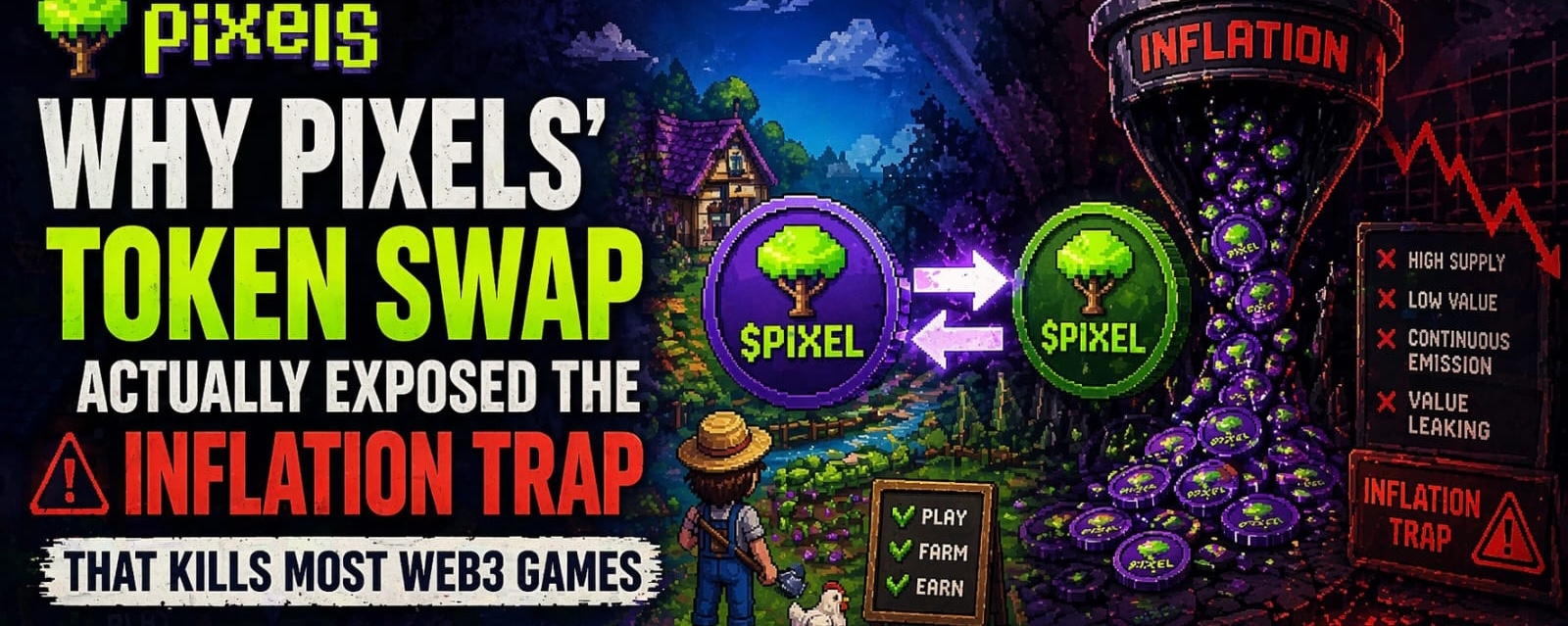
I’ve been watching Pixels closely for a while now, not just as a player or observer, but as someone trying to understand where Web3 gaming actually works—and where it quietly breaks. And the more I looked into it, the more I realized something uncomfortable: the token swap didn’t just upgrade the system… it exposed the core weakness most people try to ignore.
At first glance, everything about Pixels looked like success. Millions of users, massive engagement, constant activity, and one of the strongest launches in Web3 gaming. You log in, the world feels alive, players are farming, trading, grinding—it gives the impression of a functioning digital economy. But once the token swap happened and the system matured, the illusion started to thin out.
Because activity is not the same as value.
And that’s where the inflation trap begins.
Pixels runs on a dual-token model—$BERRY for in-game earnings and $PIXEL as the premium layer. On paper, this structure is supposed to separate gameplay from value. In reality, it creates a constant loop where players generate resources endlessly while only a fraction of that activity translates into actual demand for the main token.
I started noticing something subtle but important: the more people played, the more the system produced—but not necessarily more value. That’s the paradox. Growth didn’t tighten the economy, it expanded its pressure points.
When the token swap and broader token rollout happened, it gave the market a clearer view of supply dynamics. Suddenly, you weren’t just looking at a game—you were looking at an economy with unlock schedules, circulating supply increases, and continuous emission pressure. And the numbers tell the story. With a max supply of 5 billion $PIXEL and hundreds of millions already circulating, even small unlock percentages translate into real, consistent sell pressure.
Now combine that with player behavior.
Most players aren’t holding—they’re extracting. They farm, earn, and convert. That’s not a flaw in user behavior; that’s exactly how the system incentivizes them to act. But when a large portion of your user base is effectively “earning to sell,” the economy starts leaning in one direction.
Outflows.
And this is where things get interesting. Pixels didn’t collapse because of lack of users. It didn’t fail because the game isn’t fun. In fact, that’s what makes it such a strong case study. It succeeded in everything most Web3 games fail at—onboarding, engagement, accessibility. But even with all that, the token still struggled to retain value over time.
That’s not a coincidence.
It’s structure.
The token swap didn’t create the inflation problem—it revealed it. It made it measurable. It turned a hidden design flaw into something visible on charts, in liquidity, and in player behavior.
And once you see it, you can’t unsee it.
The system continuously produces rewards, but the sinks—the places where value is actually absorbed—aren’t strong enough to counterbalance that flow. Yes, there are uses for $PIXEL: upgrades, land, VIP features. But the question isn’t whether utility exists. The question is whether that utility creates sustained demand that matches the rate of emission.
So far, the answer has been inconsistent.
What makes this even more complex is how convincing the surface-level metrics look. Daily active users can grow. Transactions can increase. Social engagement can explode. But none of that automatically means the economy underneath is healthy. In fact, in some cases, more activity can accelerate the imbalance if the incentives aren’t aligned.
That’s the uncomfortable truth most people don’t want to talk about.
More players doesn’t always fix the problem—it can amplify it.
I’ve seen people assume that if Pixels just keeps growing, everything else will eventually stabilize. But growth without economic balance is like pouring water into a bucket with a hole. The faster you pour, the faster it leaks.
And Pixels isn’t alone in this. It’s just one of the clearest examples.
This is the inflation trap that quietly kills most Web3 games. Not instantly, not dramatically—but slowly, through pressure that builds over time. A system where rewards outpace demand, where tokens circulate faster than they’re absorbed, and where value depends more on new activity than sustainable design.
But here’s the part that makes Pixels different—and still worth paying attention to.
It’s early enough to adjust.
The game has real users, real engagement, and a real economy. That’s more than most projects ever achieve. The question now isn’t whether Pixels can grow—it already has. The question is whether it can evolve its economic model into something that doesn’t rely on constant expansion to survive.
Because if it can solve that, it doesn’t just fix Pixels.
It sets a blueprint for the entire Web3 gaming space.
And if it doesn’t, then Pixels becomes something else entirely—not a failure, but a lesson. A very important one.
That even the most active, most engaging, most hyped Web3 game can’t escape the fundamentals.
And in the end, no matter how fun the game is…
The economy always tells the truth.