
The Cryptonomist
17.8k Beiträge

The Cryptonomist
 Square Verified+
Melden
Nutzer blockieren
0 Following
37.9K+ Follower
22.5K+ Like gegeben
1 Abzeichen
Beiträge
Artikel
Übersetzung ansehen
World Liberty’s USD1 stablecoin launch on Canton hits $4.05 billionWorld Liberty Financial has taken its dollar-pegged stablecoin fully onchain inside one of the fastest-growing institutional blockchain networks in finance. On August 25, the company confirmed that World Liberty Financial’s USD1 stablecoin, now valued at $4.05 billion, is issued natively on the Canton Network, giving banks, asset managers and other institutions a way to settle tokenized securities and cash payments inside a single, synchronized transaction.
Key takeaways
World Liberty Financial’s USD1 stablecoin, worth $4.05 billion, is now issued directly on the Canton Network rather than bridged from another chain.
Native issuance lets institutions settle a tokenized asset and its USD1 payment in the same synchronized transaction, cutting settlement risk.
USD1 is fully reserved, redeemable one-to-one for U.S. dollars, and ranks as the sixth-largest dollar-pegged stablecoin, according to DeFiLlama.
World Liberty Trust Company has conditional OCC charter approval but still needs final authorization before it can take over USD1 issuance from BitGo Bank & Trust.
Canton processes more than $9 trillion in tokenized assets monthly and $350 billion in onchain U.S. Treasurys daily, and is piloting a benefits payment program with the American Idea Foundation.
World Liberty Launches USD1 Stablecoin on Canton Network
Native issuance means USD1 no longer has to travel through a bridge from another blockchain to reach Canton. Instead, the token is minted and settled directly on the network, which lets an institution swap USD1 for a tokenized asset in one move rather than two separate, sequential transfers.
Synchronized settlement cuts a familiar risk
Canton’s system synchronizes both sides of a trade so the cash and the asset settle together, according to World Liberty’s announcement. That structure addresses a problem long familiar to trading desks: the risk that one leg of a transaction completes while the other stays outstanding, tying up capital or exposing a counterparty. Canton applies privacy and permissioning controls on top of that settlement layer, letting participating firms decide who can view transaction details while still meeting the compliance standards regulated markets expect.
Institutions can now put USD1 to work well beyond simple payments. World Liberty said the stablecoin can serve as collateral for derivatives and institutional loans, fund new Around the clock, it enables the issuance of assets, handles redemption processes, facilitates financing arrangements, and executes cross-border payment settlements. Tokenized government debt, repurchase agreements and treasury-management trades typically require a matching cash leg, and World Liberty is positioning USD1 as that dollar-denominated counterpart without routing the payment through a separate network.
USD1’s Backing and Market Position
USD1 is fully reserved and redeemable for U.S. dollars on a one-to-one basis, backed by U.S. government money market funds, dollar deposits, and other cash equivalents, alongside monthly published reserve documentation, according to World Liberty. That structure mirrors the model most large dollar stablecoins now use to reassure institutional counterparties that a token can always be converted back to cash at par.
Sixth-largest stablecoin by market cap
DeFiLlama data puts USD1’s market value at roughly $4.05 billion, making it the sixth-largest dollar-pegged stablecoin by capitalization. That is a sharp jump from December 2025, when World Liberty and Canton first disclosed plans for the deployment and USD1’s market cap stood at just over $2 billion. Much of the token’s early volume traces back to a single transaction: in May 2025, Abu Dhabi-backed investment firm MGX used USD1 to settle its investment in Binance, a $2 billion deal that had originally been announced without naming the settlement asset.
Regulatory Status and the Road to Full OCC Authorization
World Liberty’s stablecoin ambitions still depend on a regulatory green light that hasn’t fully arrived. The Office of the Comptroller of the Currency granted World Liberty Trust Company conditional charter approval on August 14, letting the firm move forward with organizing a national trust bank — but that approval does not let the proposed institution start operating.
Before receiving final authorization, World Liberty Trust is required to hold a minimum of $20 million in eligible capital, hire a qualified internal audit manager, and fulfill additional preopening obligations set by the OCC, which retains the ability to change, suspend or withdraw its preliminary approval before the bank opens. Once — and if — that final sign-off comes through, The trust company intends to assume responsibility for USD1 issuance, redemption, and reserve management previously handled by BitGo Bank & Trust, which currently handles those functions. The proposed bank would also offer digital-asset custody and stablecoin conversion services to institutional clients, though unlike a conventional bank it would not accept ordinary deposits or issue standard loans.
Political scrutiny follows the Trump family connection
The OCC’s decision has not gone unnoticed in Washington. An entity affiliated with President Donald Trump and members of his family holds an interest in World Liberty’s parent company, and the OCC itself is led by a political appointee of the president — a combination Democrats have called a stark example of potential conflict of interest, since there has been no prior case of a sitting president holding an interest in a bank his own administration would approve and regulate.
A World Liberty spokesperson pushed back on conflict-of-interest concerns, telling media outlets: “Critics are missing the point: World Liberty Financial is running towards regulation and continuous oversight, not away from it,” and arguing the national charter “will ensure robust and permanent regulatory supervision from the OCC … that will outlast the Trump administration.” The OCC has said its review of the application was handled by career staff rather than the Trump-appointed agency head.
World Liberty CEO Zach Witkoff addressed the criticism directly on CNBC’s “Squawk Box” the same day the Canton integration went live. Pointing to trading data he said he checked before going on air, Witkoff noted that USD1 saw $1.7 billion in volume over the trailing 24 hours. “There’s over $4 billion of USD1 in circulation [and] over a billion dollars trades every single day in volume in USD1 … that speaks to the use case of USD1, it speaks to customers actually using it,” he said, adding that he has “never talked to” the president about business and doesn’t dwell on the conflict-of-interest allegations. Trump’s own financial disclosure showed roughly $515 million in income from World Liberty token sales and $65 million from equity sales in the company’s holding structure during 2025, according to CNBC.
Canton Network’s Scale and Next Institutional Bets
The USD1 deployment lands inside a network already handling enormous volumes of institutional activity. Canton says more than $9 trillion in tokenized assets are issued or processed across the network every month, alongside more than $350 billion in onchain U.S. Treasurys moving daily — figures that reflect trading activity rather than total value locked on the chain. Canton’s synchronized settlement design isn’t new to the network: Tradeweb disclosed in July, Franklin Templeton executed a transfer of tokenized U.S. Treasury securities to Virtu Financial in return for USDCx, involving Canton matching both sides of the trade in real time.
A benefits payment pilot moves toward 2027
Digital Asset, the firm behind Canton, is also testing the network’s reach beyond capital markets. In August, Digital Asset and former House Speaker Paul Ryan’s American Idea Foundation unveiled a pilot program called Resources for Independence, Stability, and Employment, designed to combine separate government benefits into monthly or twice-monthly payments. The pilot is scheduled to begin in three U.S. states during the first quarter of 2027, subject to federal approval. Canton would apply rules covering approved spending categories, restrict access to recipients’ sensitive information, and let administrators automatically adjust payments when a recipient’s reported income changes. Digital Asset and the foundation have not disclosed which states or which benefit programs will take part.
FAQ
What is the significance of USD1 stablecoin native issuance on Canton Network?
Native issuance on Canton allows synchronized settlement of tokenized assets and USD1 payments in one transaction, reducing settlement risk.
How is USD1 backed and redeemable?
USD1 is fully reserved and redeemable one-to-one for U.S. dollars, with reserves including dollar deposits and money market funds and monthly reserve disclosure.
What regulatory approval does World Liberty Trust Company currently hold for USD1 operations?
World Liberty Trust Company holds a conditional OCC charter approval but must meet additional requirements, including a $20 million eligible capital threshold, before final authorization.
What institutional use cases does USD1 support?
USD1 is used for collateral, lending, issuance, redemptions, and 24/7 cross-border payments by institutions operating on Canton.
Article produced with the assistance of artificial intelligence and reviewed by the editorial team.
World Liberty’s USD1 stablecoin launch on Canton hits $4.05 billion
World Liberty Financial has taken its dollar-pegged stablecoin fully onchain inside one of the fastest-growing institutional blockchain networks in finance. On August 25, the company confirmed that World Liberty Financial’s USD1 stablecoin, now valued at $4.05 billion, is issued natively on the Canton Network, giving banks, asset managers and other institutions a way to settle tokenized securities and cash payments inside a single, synchronized transaction.
Key takeaways
World Liberty Financial’s USD1 stablecoin, worth $4.05 billion, is now issued directly on the Canton Network rather than bridged from another chain.
Native issuance lets institutions settle a tokenized asset and its USD1 payment in the same synchronized transaction, cutting settlement risk.
USD1 is fully reserved, redeemable one-to-one for U.S. dollars, and ranks as the sixth-largest dollar-pegged stablecoin, according to DeFiLlama.
World Liberty Trust Company has conditional OCC charter approval but still needs final authorization before it can take over USD1 issuance from BitGo Bank & Trust.
Canton processes more than $9 trillion in tokenized assets monthly and $350 billion in onchain U.S. Treasurys daily, and is piloting a benefits payment program with the American Idea Foundation.
World Liberty Launches USD1 Stablecoin on Canton Network
Native issuance means USD1 no longer has to travel through a bridge from another blockchain to reach Canton. Instead, the token is minted and settled directly on the network, which lets an institution swap USD1 for a tokenized asset in one move rather than two separate, sequential transfers.
Synchronized settlement cuts a familiar risk
Canton’s system synchronizes both sides of a trade so the cash and the asset settle together, according to World Liberty’s announcement. That structure addresses a problem long familiar to trading desks: the risk that one leg of a transaction completes while the other stays outstanding, tying up capital or exposing a counterparty. Canton applies privacy and permissioning controls on top of that settlement layer, letting participating firms decide who can view transaction details while still meeting the compliance standards regulated markets expect.
Institutions can now put USD1 to work well beyond simple payments. World Liberty said the stablecoin can serve as collateral for derivatives and institutional loans, fund new Around the clock, it enables the issuance of assets, handles redemption processes, facilitates financing arrangements, and executes cross-border payment settlements. Tokenized government debt, repurchase agreements and treasury-management trades typically require a matching cash leg, and World Liberty is positioning USD1 as that dollar-denominated counterpart without routing the payment through a separate network.
USD1’s Backing and Market Position
USD1 is fully reserved and redeemable for U.S. dollars on a one-to-one basis, backed by U.S. government money market funds, dollar deposits, and other cash equivalents, alongside monthly published reserve documentation, according to World Liberty. That structure mirrors the model most large dollar stablecoins now use to reassure institutional counterparties that a token can always be converted back to cash at par.
Sixth-largest stablecoin by market cap
DeFiLlama data puts USD1’s market value at roughly $4.05 billion, making it the sixth-largest dollar-pegged stablecoin by capitalization. That is a sharp jump from December 2025, when World Liberty and Canton first disclosed plans for the deployment and USD1’s market cap stood at just over $2 billion. Much of the token’s early volume traces back to a single transaction: in May 2025, Abu Dhabi-backed investment firm MGX used USD1 to settle its investment in Binance, a $2 billion deal that had originally been announced without naming the settlement asset.
Regulatory Status and the Road to Full OCC Authorization
World Liberty’s stablecoin ambitions still depend on a regulatory green light that hasn’t fully arrived. The Office of the Comptroller of the Currency granted World Liberty Trust Company conditional charter approval on August 14, letting the firm move forward with organizing a national trust bank — but that approval does not let the proposed institution start operating.
Before receiving final authorization, World Liberty Trust is required to hold a minimum of $20 million in eligible capital, hire a qualified internal audit manager, and fulfill additional preopening obligations set by the OCC, which retains the ability to change, suspend or withdraw its preliminary approval before the bank opens. Once — and if — that final sign-off comes through, The trust company intends to assume responsibility for USD1 issuance, redemption, and reserve management previously handled by BitGo Bank & Trust, which currently handles those functions. The proposed bank would also offer digital-asset custody and stablecoin conversion services to institutional clients, though unlike a conventional bank it would not accept ordinary deposits or issue standard loans.
Political scrutiny follows the Trump family connection
The OCC’s decision has not gone unnoticed in Washington. An entity affiliated with President Donald Trump and members of his family holds an interest in World Liberty’s parent company, and the OCC itself is led by a political appointee of the president — a combination Democrats have called a stark example of potential conflict of interest, since there has been no prior case of a sitting president holding an interest in a bank his own administration would approve and regulate.
A World Liberty spokesperson pushed back on conflict-of-interest concerns, telling media outlets: “Critics are missing the point: World Liberty Financial is running towards regulation and continuous oversight, not away from it,” and arguing the national charter “will ensure robust and permanent regulatory supervision from the OCC … that will outlast the Trump administration.” The OCC has said its review of the application was handled by career staff rather than the Trump-appointed agency head.
World Liberty CEO Zach Witkoff addressed the criticism directly on CNBC’s “Squawk Box” the same day the Canton integration went live. Pointing to trading data he said he checked before going on air, Witkoff noted that USD1 saw $1.7 billion in volume over the trailing 24 hours. “There’s over $4 billion of USD1 in circulation [and] over a billion dollars trades every single day in volume in USD1 … that speaks to the use case of USD1, it speaks to customers actually using it,” he said, adding that he has “never talked to” the president about business and doesn’t dwell on the conflict-of-interest allegations. Trump’s own financial disclosure showed roughly $515 million in income from World Liberty token sales and $65 million from equity sales in the company’s holding structure during 2025, according to CNBC.
Canton Network’s Scale and Next Institutional Bets
The USD1 deployment lands inside a network already handling enormous volumes of institutional activity. Canton says more than $9 trillion in tokenized assets are issued or processed across the network every month, alongside more than $350 billion in onchain U.S. Treasurys moving daily — figures that reflect trading activity rather than total value locked on the chain. Canton’s synchronized settlement design isn’t new to the network: Tradeweb disclosed in July, Franklin Templeton executed a transfer of tokenized U.S. Treasury securities to Virtu Financial in return for USDCx, involving Canton matching both sides of the trade in real time.
A benefits payment pilot moves toward 2027
Digital Asset, the firm behind Canton, is also testing the network’s reach beyond capital markets. In August, Digital Asset and former House Speaker Paul Ryan’s American Idea Foundation unveiled a pilot program called Resources for Independence, Stability, and Employment, designed to combine separate government benefits into monthly or twice-monthly payments. The pilot is scheduled to begin in three U.S. states during the first quarter of 2027, subject to federal approval. Canton would apply rules covering approved spending categories, restrict access to recipients’ sensitive information, and let administrators automatically adjust payments when a recipient’s reported income changes. Digital Asset and the foundation have not disclosed which states or which benefit programs will take part.
FAQ
What is the significance of USD1 stablecoin native issuance on Canton Network?
Native issuance on Canton allows synchronized settlement of tokenized assets and USD1 payments in one transaction, reducing settlement risk.
How is USD1 backed and redeemable?
USD1 is fully reserved and redeemable one-to-one for U.S. dollars, with reserves including dollar deposits and money market funds and monthly reserve disclosure.
What regulatory approval does World Liberty Trust Company currently hold for USD1 operations?
World Liberty Trust Company holds a conditional OCC charter approval but must meet additional requirements, including a $20 million eligible capital threshold, before final authorization.
What institutional use cases does USD1 support?
USD1 is used for collateral, lending, issuance, redemptions, and 24/7 cross-border payments by institutions operating on Canton.
Article produced with the assistance of artificial intelligence and reviewed by the editorial team.
Key takeaways
World Liberty Financial’s USD1 stablecoin, worth $4.05 billion, is now issued directly on the Canton Network rather than bridged from another chain.
Native issuance lets institutions settle a tokenized asset and its USD1 payment in the same synchronized transaction, cutting settlement risk.
USD1 is fully reserved, redeemable one-to-one for U.S. dollars, and ranks as the sixth-largest dollar-pegged stablecoin, according to DeFiLlama.
World Liberty Trust Company has conditional OCC charter approval but still needs final authorization before it can take over USD1 issuance from BitGo Bank & Trust.
Canton processes more than $9 trillion in tokenized assets monthly and $350 billion in onchain U.S. Treasurys daily, and is piloting a benefits payment program with the American Idea Foundation.
World Liberty Launches USD1 Stablecoin on Canton Network
Native issuance means USD1 no longer has to travel through a bridge from another blockchain to reach Canton. Instead, the token is minted and settled directly on the network, which lets an institution swap USD1 for a tokenized asset in one move rather than two separate, sequential transfers.
Synchronized settlement cuts a familiar risk
Canton’s system synchronizes both sides of a trade so the cash and the asset settle together, according to World Liberty’s announcement. That structure addresses a problem long familiar to trading desks: the risk that one leg of a transaction completes while the other stays outstanding, tying up capital or exposing a counterparty. Canton applies privacy and permissioning controls on top of that settlement layer, letting participating firms decide who can view transaction details while still meeting the compliance standards regulated markets expect.
Institutions can now put USD1 to work well beyond simple payments. World Liberty said the stablecoin can serve as collateral for derivatives and institutional loans, fund new Around the clock, it enables the issuance of assets, handles redemption processes, facilitates financing arrangements, and executes cross-border payment settlements. Tokenized government debt, repurchase agreements and treasury-management trades typically require a matching cash leg, and World Liberty is positioning USD1 as that dollar-denominated counterpart without routing the payment through a separate network.
USD1’s Backing and Market Position
USD1 is fully reserved and redeemable for U.S. dollars on a one-to-one basis, backed by U.S. government money market funds, dollar deposits, and other cash equivalents, alongside monthly published reserve documentation, according to World Liberty. That structure mirrors the model most large dollar stablecoins now use to reassure institutional counterparties that a token can always be converted back to cash at par.
Sixth-largest stablecoin by market cap
DeFiLlama data puts USD1’s market value at roughly $4.05 billion, making it the sixth-largest dollar-pegged stablecoin by capitalization. That is a sharp jump from December 2025, when World Liberty and Canton first disclosed plans for the deployment and USD1’s market cap stood at just over $2 billion. Much of the token’s early volume traces back to a single transaction: in May 2025, Abu Dhabi-backed investment firm MGX used USD1 to settle its investment in Binance, a $2 billion deal that had originally been announced without naming the settlement asset.
Regulatory Status and the Road to Full OCC Authorization
World Liberty’s stablecoin ambitions still depend on a regulatory green light that hasn’t fully arrived. The Office of the Comptroller of the Currency granted World Liberty Trust Company conditional charter approval on August 14, letting the firm move forward with organizing a national trust bank — but that approval does not let the proposed institution start operating.
Before receiving final authorization, World Liberty Trust is required to hold a minimum of $20 million in eligible capital, hire a qualified internal audit manager, and fulfill additional preopening obligations set by the OCC, which retains the ability to change, suspend or withdraw its preliminary approval before the bank opens. Once — and if — that final sign-off comes through, The trust company intends to assume responsibility for USD1 issuance, redemption, and reserve management previously handled by BitGo Bank & Trust, which currently handles those functions. The proposed bank would also offer digital-asset custody and stablecoin conversion services to institutional clients, though unlike a conventional bank it would not accept ordinary deposits or issue standard loans.
Political scrutiny follows the Trump family connection
The OCC’s decision has not gone unnoticed in Washington. An entity affiliated with President Donald Trump and members of his family holds an interest in World Liberty’s parent company, and the OCC itself is led by a political appointee of the president — a combination Democrats have called a stark example of potential conflict of interest, since there has been no prior case of a sitting president holding an interest in a bank his own administration would approve and regulate.
A World Liberty spokesperson pushed back on conflict-of-interest concerns, telling media outlets: “Critics are missing the point: World Liberty Financial is running towards regulation and continuous oversight, not away from it,” and arguing the national charter “will ensure robust and permanent regulatory supervision from the OCC … that will outlast the Trump administration.” The OCC has said its review of the application was handled by career staff rather than the Trump-appointed agency head.
World Liberty CEO Zach Witkoff addressed the criticism directly on CNBC’s “Squawk Box” the same day the Canton integration went live. Pointing to trading data he said he checked before going on air, Witkoff noted that USD1 saw $1.7 billion in volume over the trailing 24 hours. “There’s over $4 billion of USD1 in circulation [and] over a billion dollars trades every single day in volume in USD1 … that speaks to the use case of USD1, it speaks to customers actually using it,” he said, adding that he has “never talked to” the president about business and doesn’t dwell on the conflict-of-interest allegations. Trump’s own financial disclosure showed roughly $515 million in income from World Liberty token sales and $65 million from equity sales in the company’s holding structure during 2025, according to CNBC.
Canton Network’s Scale and Next Institutional Bets
The USD1 deployment lands inside a network already handling enormous volumes of institutional activity. Canton says more than $9 trillion in tokenized assets are issued or processed across the network every month, alongside more than $350 billion in onchain U.S. Treasurys moving daily — figures that reflect trading activity rather than total value locked on the chain. Canton’s synchronized settlement design isn’t new to the network: Tradeweb disclosed in July, Franklin Templeton executed a transfer of tokenized U.S. Treasury securities to Virtu Financial in return for USDCx, involving Canton matching both sides of the trade in real time.
A benefits payment pilot moves toward 2027
Digital Asset, the firm behind Canton, is also testing the network’s reach beyond capital markets. In August, Digital Asset and former House Speaker Paul Ryan’s American Idea Foundation unveiled a pilot program called Resources for Independence, Stability, and Employment, designed to combine separate government benefits into monthly or twice-monthly payments. The pilot is scheduled to begin in three U.S. states during the first quarter of 2027, subject to federal approval. Canton would apply rules covering approved spending categories, restrict access to recipients’ sensitive information, and let administrators automatically adjust payments when a recipient’s reported income changes. Digital Asset and the foundation have not disclosed which states or which benefit programs will take part.
FAQ
What is the significance of USD1 stablecoin native issuance on Canton Network?
Native issuance on Canton allows synchronized settlement of tokenized assets and USD1 payments in one transaction, reducing settlement risk.
How is USD1 backed and redeemable?
USD1 is fully reserved and redeemable one-to-one for U.S. dollars, with reserves including dollar deposits and money market funds and monthly reserve disclosure.
What regulatory approval does World Liberty Trust Company currently hold for USD1 operations?
World Liberty Trust Company holds a conditional OCC charter approval but must meet additional requirements, including a $20 million eligible capital threshold, before final authorization.
What institutional use cases does USD1 support?
USD1 is used for collateral, lending, issuance, redemptions, and 24/7 cross-border payments by institutions operating on Canton.
Article produced with the assistance of artificial intelligence and reviewed by the editorial team.
57
Artikel
Übersetzung ansehen
Chainlink Powers $19 Billion in Tokenized Housing Assets via NUVAA chain-agnostic vault marketplace called NUVA has struck a partnership with Chainlink to shepherd roughly $19 billion in tokenized housing assets onto the blockchain, marking one of the more ambitious attempts yet to fuse residential real estate credit with decentralized finance. The move, confirmed in late August 2026, positions Chainlink as the exclusive data backbone behind NUVA’s push to let everyday crypto holders tap into yield streams once reserved for institutional investors.
Key takeaways
NUVA, a chain-agnostic vault marketplace backed by Animoca Brands and Nuva Labs, launched on Ethereum in May 2026.
NUVA has adopted Chainlink as its exclusive data infrastructure for bringing institutional tokenized real-world assets into DeFi.
Its flagship tokens, nvYLDS and nvPRIME, represent an asset base valued around $19 billion.
nvYLDS passes short-term U.S. Treasury returns to holders, while nvPRIME offers onchain exposure to institutional-grade U.S. home equity lines of credit.
Chainlink has already enabled over $33 trillion in transaction value across DeFi and works with institutions such as Swift and UBS.
NUVA Launches Chain-Agnostic Vault Marketplace on Ethereum
NUVA is a decentralized marketplace built to give retail crypto users direct access to yield-bearing instruments tied to residential real estate, and it went live on Ethereum in May 2026. The platform is backed by Animoca Brands and Nuva Labs, two names that carry weight in the tokenization space and lend credibility to a project trying to bridge traditional mortgage-style credit markets with onchain finance.
Rather than building its own siloed chain, NUVA was designed to be chain-agnostic from the start, a structural choice that lets its vaults plug into multiple blockchain ecosystems instead of locking liquidity into a single network. According to reporting from Crypto Briefing, the platform is meant to make institutional-grade assets — including Treasury-linked products and home equity credit — reachable outside the confines of traditional financial networks. The underlying real-world assets originate from Figure Technologies’ Provenance Blockchain, giving NUVA a direct pipeline into an established institutional credit market rather than starting from scratch.
Flagship Tokens Represent $19 Billion in Tokenized Housing Assets
NUVA’s two flagship products, nvYLDS and nvPRIME, together reflect an asset base valued around $19 billion, according to CoinGape and Chainlink Today reporting on the deal. That figure puts NUVA among the larger tokenized real-world asset marketplaces currently operating in DeFi, and it signals that the platform is not merely experimenting at the margins but attempting to move real institutional volume onchain.
nvYLDS Token Passes U.S. Treasury Returns
nvYLDS functions as a yield-bearing vault token that passes short-term U.S. Treasury returns directly through to crypto holders. It gives retail participants a way to capture government-backed yield without leaving the crypto ecosystem, effectively translating a traditional fixed-income instrument into a token that behaves like any other DeFi asset.
nvPRIME Token Offers Exposure to Institutional HELOCs
nvPRIME takes a different route. It is a tokenized private credit vault that provides onchain exposure to institutional-grade U.S. home equity lines of credit, or HELOCs. In practical terms, that means the token tracks the performance of a pool of real estate-backed credit instruments that would normally sit exclusively inside institutional balance sheets. By tokenizing that exposure, NUVA opens a door that has historically been closed to smaller investors.
Chainlink Powers Secure Onchain Valuation and Lending Mechanisms
Chainlink now serves as NUVA’s exclusive data infrastructure, and that role centers on solving one of the thorniest problems in real-world asset tokenization: how to price an off-chain asset reliably enough for a DeFi protocol to trust it. NUVA is leaning on Chainlink to deliver tamper-resistant valuation data for its assets, starting with nvPRIME, so that the numbers feeding smart contracts can’t be easily manipulated or spoofed.
That data feed does more than display a price. It lets DeFi protocols price collateral accurately, set lending parameters, and calculate liquidation thresholds — the mechanical guardrails that keep a lending market solvent when asset values shift. Without dependable oracle infrastructure, a tokenized housing asset is just a claim with no verifiable anchor to reality; with it, the same token can be collateralized, borrowed against, and traded with a measure of confidence that DeFi lenders require.
This is where Chainlink’s scale matters. The oracle network has enabled over $33 trillion in transaction value and secures the majority of DeFi activity, positioning it as the leading infrastructure link between traditional finance and blockchain markets. Chainlink already connects global institutions such as Swift and UBS to onchain systems, and its data standard has become something close to a default layer for bringing tokenized RWAs — whether securities or real estate — into a state where they gain real utility and composability across DeFi.
NUVA Broadens DeFi Yield Access to Retail Investors
The strategic logic behind NUVA is straightforward: connect institutional-grade real estate credit with retail crypto investors who otherwise have no way into that market. That matters for a simple reason — yield-bearing real estate instruments have long been walled off by minimum investment thresholds, accreditation rules, and opaque servicing arrangements that keep smaller investors out entirely.
By tokenizing that access, NUVA and Chainlink are effectively testing whether tokenized housing assets can become a mainstream DeFi yield category rather than a niche experiment. If nvYLDS and nvPRIME perform as designed, the $19 billion asset base behind them could serve as a template for other institutions looking to move real estate credit onto public blockchains, with Chainlink’s oracle layer as the trust mechanism that makes the whole structure workable at scale.
The bigger question now is whether liquidity follows. A tokenized asset only matters to a retail investor if it trades, settles, and pays out reliably — and that test plays out not in press releases, but in how nvYLDS and nvPRIME behave once real capital starts flowing through NUVA’s vaults.
FAQ
What is NUVA and when was it launched?
NUVA is a chain-agnostic vault marketplace launched on Ethereum in May 2026, backed by Animoca Brands and Nuva Labs.
What are nvYLDS and nvPRIME tokens?
nvYLDS is a vault token that passes short-term U.S. Treasury returns to holders, while nvPRIME provides onchain exposure to institutional-grade U.S. home equity lines of credit.
How does Chainlink support NUVA’s marketplace?
Chainlink acts as NUVA’s exclusive data infrastructure, supplying reliable, tamper-resistant valuation data that enables collateral pricing, lending management, and liquidation thresholds.
What scale does NUVA’s tokenized asset market represent?
NUVA’s flagship products, nvYLDS and nvPRIME, represent an asset base valued around $19 billion, one of the larger figures reported so far in the tokenized housing assets segment of DeFi.
Article produced with the assistance of artificial intelligence and reviewed by the editorial team.
Chainlink Powers $19 Billion in Tokenized Housing Assets via NUVA
A chain-agnostic vault marketplace called NUVA has struck a partnership with Chainlink to shepherd roughly $19 billion in tokenized housing assets onto the blockchain, marking one of the more ambitious attempts yet to fuse residential real estate credit with decentralized finance. The move, confirmed in late August 2026, positions Chainlink as the exclusive data backbone behind NUVA’s push to let everyday crypto holders tap into yield streams once reserved for institutional investors.
Key takeaways
NUVA, a chain-agnostic vault marketplace backed by Animoca Brands and Nuva Labs, launched on Ethereum in May 2026.
NUVA has adopted Chainlink as its exclusive data infrastructure for bringing institutional tokenized real-world assets into DeFi.
Its flagship tokens, nvYLDS and nvPRIME, represent an asset base valued around $19 billion.
nvYLDS passes short-term U.S. Treasury returns to holders, while nvPRIME offers onchain exposure to institutional-grade U.S. home equity lines of credit.
Chainlink has already enabled over $33 trillion in transaction value across DeFi and works with institutions such as Swift and UBS.
NUVA Launches Chain-Agnostic Vault Marketplace on Ethereum
NUVA is a decentralized marketplace built to give retail crypto users direct access to yield-bearing instruments tied to residential real estate, and it went live on Ethereum in May 2026. The platform is backed by Animoca Brands and Nuva Labs, two names that carry weight in the tokenization space and lend credibility to a project trying to bridge traditional mortgage-style credit markets with onchain finance.
Rather than building its own siloed chain, NUVA was designed to be chain-agnostic from the start, a structural choice that lets its vaults plug into multiple blockchain ecosystems instead of locking liquidity into a single network. According to reporting from Crypto Briefing, the platform is meant to make institutional-grade assets — including Treasury-linked products and home equity credit — reachable outside the confines of traditional financial networks. The underlying real-world assets originate from Figure Technologies’ Provenance Blockchain, giving NUVA a direct pipeline into an established institutional credit market rather than starting from scratch.
Flagship Tokens Represent $19 Billion in Tokenized Housing Assets
NUVA’s two flagship products, nvYLDS and nvPRIME, together reflect an asset base valued around $19 billion, according to CoinGape and Chainlink Today reporting on the deal. That figure puts NUVA among the larger tokenized real-world asset marketplaces currently operating in DeFi, and it signals that the platform is not merely experimenting at the margins but attempting to move real institutional volume onchain.
nvYLDS Token Passes U.S. Treasury Returns
nvYLDS functions as a yield-bearing vault token that passes short-term U.S. Treasury returns directly through to crypto holders. It gives retail participants a way to capture government-backed yield without leaving the crypto ecosystem, effectively translating a traditional fixed-income instrument into a token that behaves like any other DeFi asset.
nvPRIME Token Offers Exposure to Institutional HELOCs
nvPRIME takes a different route. It is a tokenized private credit vault that provides onchain exposure to institutional-grade U.S. home equity lines of credit, or HELOCs. In practical terms, that means the token tracks the performance of a pool of real estate-backed credit instruments that would normally sit exclusively inside institutional balance sheets. By tokenizing that exposure, NUVA opens a door that has historically been closed to smaller investors.
Chainlink Powers Secure Onchain Valuation and Lending Mechanisms
Chainlink now serves as NUVA’s exclusive data infrastructure, and that role centers on solving one of the thorniest problems in real-world asset tokenization: how to price an off-chain asset reliably enough for a DeFi protocol to trust it. NUVA is leaning on Chainlink to deliver tamper-resistant valuation data for its assets, starting with nvPRIME, so that the numbers feeding smart contracts can’t be easily manipulated or spoofed.
That data feed does more than display a price. It lets DeFi protocols price collateral accurately, set lending parameters, and calculate liquidation thresholds — the mechanical guardrails that keep a lending market solvent when asset values shift. Without dependable oracle infrastructure, a tokenized housing asset is just a claim with no verifiable anchor to reality; with it, the same token can be collateralized, borrowed against, and traded with a measure of confidence that DeFi lenders require.
This is where Chainlink’s scale matters. The oracle network has enabled over $33 trillion in transaction value and secures the majority of DeFi activity, positioning it as the leading infrastructure link between traditional finance and blockchain markets. Chainlink already connects global institutions such as Swift and UBS to onchain systems, and its data standard has become something close to a default layer for bringing tokenized RWAs — whether securities or real estate — into a state where they gain real utility and composability across DeFi.
NUVA Broadens DeFi Yield Access to Retail Investors
The strategic logic behind NUVA is straightforward: connect institutional-grade real estate credit with retail crypto investors who otherwise have no way into that market. That matters for a simple reason — yield-bearing real estate instruments have long been walled off by minimum investment thresholds, accreditation rules, and opaque servicing arrangements that keep smaller investors out entirely.
By tokenizing that access, NUVA and Chainlink are effectively testing whether tokenized housing assets can become a mainstream DeFi yield category rather than a niche experiment. If nvYLDS and nvPRIME perform as designed, the $19 billion asset base behind them could serve as a template for other institutions looking to move real estate credit onto public blockchains, with Chainlink’s oracle layer as the trust mechanism that makes the whole structure workable at scale.
The bigger question now is whether liquidity follows. A tokenized asset only matters to a retail investor if it trades, settles, and pays out reliably — and that test plays out not in press releases, but in how nvYLDS and nvPRIME behave once real capital starts flowing through NUVA’s vaults.
FAQ
What is NUVA and when was it launched?
NUVA is a chain-agnostic vault marketplace launched on Ethereum in May 2026, backed by Animoca Brands and Nuva Labs.
What are nvYLDS and nvPRIME tokens?
nvYLDS is a vault token that passes short-term U.S. Treasury returns to holders, while nvPRIME provides onchain exposure to institutional-grade U.S. home equity lines of credit.
How does Chainlink support NUVA’s marketplace?
Chainlink acts as NUVA’s exclusive data infrastructure, supplying reliable, tamper-resistant valuation data that enables collateral pricing, lending management, and liquidation thresholds.
What scale does NUVA’s tokenized asset market represent?
NUVA’s flagship products, nvYLDS and nvPRIME, represent an asset base valued around $19 billion, one of the larger figures reported so far in the tokenized housing assets segment of DeFi.
Article produced with the assistance of artificial intelligence and reviewed by the editorial team.
Key takeaways
NUVA, a chain-agnostic vault marketplace backed by Animoca Brands and Nuva Labs, launched on Ethereum in May 2026.
NUVA has adopted Chainlink as its exclusive data infrastructure for bringing institutional tokenized real-world assets into DeFi.
Its flagship tokens, nvYLDS and nvPRIME, represent an asset base valued around $19 billion.
nvYLDS passes short-term U.S. Treasury returns to holders, while nvPRIME offers onchain exposure to institutional-grade U.S. home equity lines of credit.
Chainlink has already enabled over $33 trillion in transaction value across DeFi and works with institutions such as Swift and UBS.
NUVA Launches Chain-Agnostic Vault Marketplace on Ethereum
NUVA is a decentralized marketplace built to give retail crypto users direct access to yield-bearing instruments tied to residential real estate, and it went live on Ethereum in May 2026. The platform is backed by Animoca Brands and Nuva Labs, two names that carry weight in the tokenization space and lend credibility to a project trying to bridge traditional mortgage-style credit markets with onchain finance.
Rather than building its own siloed chain, NUVA was designed to be chain-agnostic from the start, a structural choice that lets its vaults plug into multiple blockchain ecosystems instead of locking liquidity into a single network. According to reporting from Crypto Briefing, the platform is meant to make institutional-grade assets — including Treasury-linked products and home equity credit — reachable outside the confines of traditional financial networks. The underlying real-world assets originate from Figure Technologies’ Provenance Blockchain, giving NUVA a direct pipeline into an established institutional credit market rather than starting from scratch.
Flagship Tokens Represent $19 Billion in Tokenized Housing Assets
NUVA’s two flagship products, nvYLDS and nvPRIME, together reflect an asset base valued around $19 billion, according to CoinGape and Chainlink Today reporting on the deal. That figure puts NUVA among the larger tokenized real-world asset marketplaces currently operating in DeFi, and it signals that the platform is not merely experimenting at the margins but attempting to move real institutional volume onchain.
nvYLDS Token Passes U.S. Treasury Returns
nvYLDS functions as a yield-bearing vault token that passes short-term U.S. Treasury returns directly through to crypto holders. It gives retail participants a way to capture government-backed yield without leaving the crypto ecosystem, effectively translating a traditional fixed-income instrument into a token that behaves like any other DeFi asset.
nvPRIME Token Offers Exposure to Institutional HELOCs
nvPRIME takes a different route. It is a tokenized private credit vault that provides onchain exposure to institutional-grade U.S. home equity lines of credit, or HELOCs. In practical terms, that means the token tracks the performance of a pool of real estate-backed credit instruments that would normally sit exclusively inside institutional balance sheets. By tokenizing that exposure, NUVA opens a door that has historically been closed to smaller investors.
Chainlink Powers Secure Onchain Valuation and Lending Mechanisms
Chainlink now serves as NUVA’s exclusive data infrastructure, and that role centers on solving one of the thorniest problems in real-world asset tokenization: how to price an off-chain asset reliably enough for a DeFi protocol to trust it. NUVA is leaning on Chainlink to deliver tamper-resistant valuation data for its assets, starting with nvPRIME, so that the numbers feeding smart contracts can’t be easily manipulated or spoofed.
That data feed does more than display a price. It lets DeFi protocols price collateral accurately, set lending parameters, and calculate liquidation thresholds — the mechanical guardrails that keep a lending market solvent when asset values shift. Without dependable oracle infrastructure, a tokenized housing asset is just a claim with no verifiable anchor to reality; with it, the same token can be collateralized, borrowed against, and traded with a measure of confidence that DeFi lenders require.
This is where Chainlink’s scale matters. The oracle network has enabled over $33 trillion in transaction value and secures the majority of DeFi activity, positioning it as the leading infrastructure link between traditional finance and blockchain markets. Chainlink already connects global institutions such as Swift and UBS to onchain systems, and its data standard has become something close to a default layer for bringing tokenized RWAs — whether securities or real estate — into a state where they gain real utility and composability across DeFi.
NUVA Broadens DeFi Yield Access to Retail Investors
The strategic logic behind NUVA is straightforward: connect institutional-grade real estate credit with retail crypto investors who otherwise have no way into that market. That matters for a simple reason — yield-bearing real estate instruments have long been walled off by minimum investment thresholds, accreditation rules, and opaque servicing arrangements that keep smaller investors out entirely.
By tokenizing that access, NUVA and Chainlink are effectively testing whether tokenized housing assets can become a mainstream DeFi yield category rather than a niche experiment. If nvYLDS and nvPRIME perform as designed, the $19 billion asset base behind them could serve as a template for other institutions looking to move real estate credit onto public blockchains, with Chainlink’s oracle layer as the trust mechanism that makes the whole structure workable at scale.
The bigger question now is whether liquidity follows. A tokenized asset only matters to a retail investor if it trades, settles, and pays out reliably — and that test plays out not in press releases, but in how nvYLDS and nvPRIME behave once real capital starts flowing through NUVA’s vaults.
FAQ
What is NUVA and when was it launched?
NUVA is a chain-agnostic vault marketplace launched on Ethereum in May 2026, backed by Animoca Brands and Nuva Labs.
What are nvYLDS and nvPRIME tokens?
nvYLDS is a vault token that passes short-term U.S. Treasury returns to holders, while nvPRIME provides onchain exposure to institutional-grade U.S. home equity lines of credit.
How does Chainlink support NUVA’s marketplace?
Chainlink acts as NUVA’s exclusive data infrastructure, supplying reliable, tamper-resistant valuation data that enables collateral pricing, lending management, and liquidation thresholds.
What scale does NUVA’s tokenized asset market represent?
NUVA’s flagship products, nvYLDS and nvPRIME, represent an asset base valued around $19 billion, one of the larger figures reported so far in the tokenized housing assets segment of DeFi.
Article produced with the assistance of artificial intelligence and reviewed by the editorial team.
83

Artikel
Übersetzung ansehen
X crypto trading feature adds buy button after Cashtags’ $1B debutX is preparing to let users buy and sell cryptocurrency without ever leaving their timeline, a move that would turn the social platform into something closer to a trading terminal. The X crypto trading feature was teased by former X head of product Nikita Bier, who said on the 25th, local time, that a buy button is coming to follow up on the platform’s existing “Cashtags” tool. If it launches as described, users could go from spotting a token in a post to owning it in a single tap.
Key takeaways
Nikita Bier announced that X will add a buy button for direct crypto trading on the timeline, building on the Cashtags feature he created.
Cashtags already displays real-time Solana (SOL) and Ethereum (ETH) price charts inside posts, and generated roughly $1 billion in trading volume within 48 hours after its April debut for iPhone users in the US and Canada.
Contract address verification is designed to help traders confirm they are buying the real token rather than a scam copy.
No official launch date has been set, and Bier’s recent exit from his product-chief role leaves the rollout in the hands of his successor.
Bitcoin was trading near $80,643, con un incremento del 4.25% nella giornata e del 24.5% nell’ultimo mese, a rally Bier attributed to US Treasury bond purchases rather than to X’s own features.
X Introduces Buy Button for Direct Crypto Trading
The plan is simple on paper: put a trading button directly inside the timeline so users can act on a token the moment they see it discussed. Bier revealed the plan while responding to a user who joked that a bull market might be starting simply because he had stopped shadowbanning “Crypto Twitter,” the informal term for X’s crypto-focused community. Shadowbanning refers to quietly limiting a post’s visibility without telling the account holder.
Bier pushed back on that framing, but confirmed the bigger news himself. “Before I joined, X had zero features for crypto traders,” he said, noting that he built Cashtags from scratch and that a trading button was next in line. He also pointed to a lesser-known tool already live on the platform: pasting a newly issued token’s contract address into a post pulls up relevant information about that asset automatically.
One-Tap Token Orders
Once the button goes live, the workflow changes noticeably. Right now, spotting a token on X still means opening a separate wallet or exchange app to actually buy it. With the new feature, that extra step disappears — users would be able to place an order without leaving the post they were reading. It’s a small technical shift with a big behavioral implication: it collapses the gap between discovering an asset and trading it, which is exactly the kind of friction reduction that tends to drive short-term volume spikes in crypto markets.
Cashtags and the $1 Billion Debut
Cashtags didn’t appear out of nowhere — it already has a track record that helps explain why X is doubling down. The feature shows live price charts for tokens like Solana and Ethereum directly inside tweets, letting users track price action without switching apps.
Cashtags’ $1 Billion Trading Debut
X first rolled out Cashtags in April, limited to iPhone users in the US and Canada. Despite that narrow rollout, the pilot is estimated to have driven about $1 billion in trading volume within just 48 hours, a figure that suggests real demand for crypto tools embedded in the timeline rather than bolted onto a separate app. X later expanded the concept in May, adding real-time stock charts to the same feature — a sign the company sees Cashtags as a template for financial data broadly, not just crypto.
Security Measures and Contract Address Verification
Contract address verification is the safety layer meant to keep the whole system from becoming a magnet for fraud. Scam tokens routinely copy the names and branding of legitimate projects, so confirming the correct on-chain address before sending funds is one of the few reliable defenses traders have.
Guarding Against Scam Tokens
By letting users paste a contract address into a post and instantly pull up verified information about that token, X is trying to close a gap that has cost crypto traders money for years. This matters more, not less, once a one-tap buy button exists: faster trading also means faster mistakes if a user buys the wrong token by accident. Pairing the trading button with address verification is arguably what makes the whole feature usable rather than just fast.
Market Context and Leadership Transition
Bier was careful to separate his product from the broader market mood. He dismissed the idea that X itself sparked the current crypto rally, pointing instead to the US Treasury Department’s bond purchases and a weakening dollar as the real drivers. Il Segretario del Tesoro Scott Bessent ha ampliato almeno del doppio il programma di acquisto di titoli a lungo termine il 20, a move that has drawn criticism over its roughly $950 billion price tag and how it’s being funded.
Leadership Handover and Uncertain Timeline
The market has reacted regardless of the debate over causes. Bitcoin was trading around $80,643, up 4.25% on the day and 24.5% over the past month, while gold logged its best monthly performance since 1999. Bier himself stepped down from his product-chief role this month and now serves only as an advisor, meaning the trading button’s actual launch will be steered by whoever succeeds him. That handover adds a layer of uncertainty: X has already rolled out charts, volume data, and address lookup tools in sequence, but the buy button — the step that would effectively turn the timeline into a live order book — remains unscheduled. Neither Bier nor X has announced a launch date, and Cashtags still covers only limited markets, meaning broader availability may need to arrive before the trading button can follow.
FAQ
What new crypto trading feature is X introducing?
X is adding a buy button to its timeline that would let users trade digital assets directly from their feed, without switching to a separate wallet or exchange.
What are Cashtags and what do they display?
Cashtags is a feature that shows live Solana (SOL) and Ethereum (ETH) price charts directly inside posts, and it later expanded to include real-time stock charts as well.
How does contract address verification improve trade safety on X?
It lets users paste a token’s contract address into a post to pull up verified information, helping them avoid scam tokens that copy the names of legitimate projects before they send any funds.
Has X announced the official launch date for the trading button?
No. Neither Nikita Bier nor X has confirmed a launch date, and the rollout now depends on Bier’s successor as head of product following his move to an advisory role.
Article produced with the assistance of artificial intelligence and reviewed by the editorial team.
X crypto trading feature adds buy button after Cashtags’ $1B debut
X is preparing to let users buy and sell cryptocurrency without ever leaving their timeline, a move that would turn the social platform into something closer to a trading terminal. The X crypto trading feature was teased by former X head of product Nikita Bier, who said on the 25th, local time, that a buy button is coming to follow up on the platform’s existing “Cashtags” tool. If it launches as described, users could go from spotting a token in a post to owning it in a single tap.
Key takeaways
Nikita Bier announced that X will add a buy button for direct crypto trading on the timeline, building on the Cashtags feature he created.
Cashtags already displays real-time Solana (SOL) and Ethereum (ETH) price charts inside posts, and generated roughly $1 billion in trading volume within 48 hours after its April debut for iPhone users in the US and Canada.
Contract address verification is designed to help traders confirm they are buying the real token rather than a scam copy.
No official launch date has been set, and Bier’s recent exit from his product-chief role leaves the rollout in the hands of his successor.
Bitcoin was trading near $80,643, con un incremento del 4.25% nella giornata e del 24.5% nell’ultimo mese, a rally Bier attributed to US Treasury bond purchases rather than to X’s own features.
X Introduces Buy Button for Direct Crypto Trading
The plan is simple on paper: put a trading button directly inside the timeline so users can act on a token the moment they see it discussed. Bier revealed the plan while responding to a user who joked that a bull market might be starting simply because he had stopped shadowbanning “Crypto Twitter,” the informal term for X’s crypto-focused community. Shadowbanning refers to quietly limiting a post’s visibility without telling the account holder.
Bier pushed back on that framing, but confirmed the bigger news himself. “Before I joined, X had zero features for crypto traders,” he said, noting that he built Cashtags from scratch and that a trading button was next in line. He also pointed to a lesser-known tool already live on the platform: pasting a newly issued token’s contract address into a post pulls up relevant information about that asset automatically.
One-Tap Token Orders
Once the button goes live, the workflow changes noticeably. Right now, spotting a token on X still means opening a separate wallet or exchange app to actually buy it. With the new feature, that extra step disappears — users would be able to place an order without leaving the post they were reading. It’s a small technical shift with a big behavioral implication: it collapses the gap between discovering an asset and trading it, which is exactly the kind of friction reduction that tends to drive short-term volume spikes in crypto markets.
Cashtags and the $1 Billion Debut
Cashtags didn’t appear out of nowhere — it already has a track record that helps explain why X is doubling down. The feature shows live price charts for tokens like Solana and Ethereum directly inside tweets, letting users track price action without switching apps.
Cashtags’ $1 Billion Trading Debut
X first rolled out Cashtags in April, limited to iPhone users in the US and Canada. Despite that narrow rollout, the pilot is estimated to have driven about $1 billion in trading volume within just 48 hours, a figure that suggests real demand for crypto tools embedded in the timeline rather than bolted onto a separate app. X later expanded the concept in May, adding real-time stock charts to the same feature — a sign the company sees Cashtags as a template for financial data broadly, not just crypto.
Security Measures and Contract Address Verification
Contract address verification is the safety layer meant to keep the whole system from becoming a magnet for fraud. Scam tokens routinely copy the names and branding of legitimate projects, so confirming the correct on-chain address before sending funds is one of the few reliable defenses traders have.
Guarding Against Scam Tokens
By letting users paste a contract address into a post and instantly pull up verified information about that token, X is trying to close a gap that has cost crypto traders money for years. This matters more, not less, once a one-tap buy button exists: faster trading also means faster mistakes if a user buys the wrong token by accident. Pairing the trading button with address verification is arguably what makes the whole feature usable rather than just fast.
Market Context and Leadership Transition
Bier was careful to separate his product from the broader market mood. He dismissed the idea that X itself sparked the current crypto rally, pointing instead to the US Treasury Department’s bond purchases and a weakening dollar as the real drivers. Il Segretario del Tesoro Scott Bessent ha ampliato almeno del doppio il programma di acquisto di titoli a lungo termine il 20, a move that has drawn criticism over its roughly $950 billion price tag and how it’s being funded.
Leadership Handover and Uncertain Timeline
The market has reacted regardless of the debate over causes. Bitcoin was trading around $80,643, up 4.25% on the day and 24.5% over the past month, while gold logged its best monthly performance since 1999. Bier himself stepped down from his product-chief role this month and now serves only as an advisor, meaning the trading button’s actual launch will be steered by whoever succeeds him. That handover adds a layer of uncertainty: X has already rolled out charts, volume data, and address lookup tools in sequence, but the buy button — the step that would effectively turn the timeline into a live order book — remains unscheduled. Neither Bier nor X has announced a launch date, and Cashtags still covers only limited markets, meaning broader availability may need to arrive before the trading button can follow.
FAQ
What new crypto trading feature is X introducing?
X is adding a buy button to its timeline that would let users trade digital assets directly from their feed, without switching to a separate wallet or exchange.
What are Cashtags and what do they display?
Cashtags is a feature that shows live Solana (SOL) and Ethereum (ETH) price charts directly inside posts, and it later expanded to include real-time stock charts as well.
How does contract address verification improve trade safety on X?
It lets users paste a token’s contract address into a post to pull up verified information, helping them avoid scam tokens that copy the names of legitimate projects before they send any funds.
Has X announced the official launch date for the trading button?
No. Neither Nikita Bier nor X has confirmed a launch date, and the rollout now depends on Bier’s successor as head of product following his move to an advisory role.
Article produced with the assistance of artificial intelligence and reviewed by the editorial team.
Key takeaways
Nikita Bier announced that X will add a buy button for direct crypto trading on the timeline, building on the Cashtags feature he created.
Cashtags already displays real-time Solana (SOL) and Ethereum (ETH) price charts inside posts, and generated roughly $1 billion in trading volume within 48 hours after its April debut for iPhone users in the US and Canada.
Contract address verification is designed to help traders confirm they are buying the real token rather than a scam copy.
No official launch date has been set, and Bier’s recent exit from his product-chief role leaves the rollout in the hands of his successor.
Bitcoin was trading near $80,643, con un incremento del 4.25% nella giornata e del 24.5% nell’ultimo mese, a rally Bier attributed to US Treasury bond purchases rather than to X’s own features.
X Introduces Buy Button for Direct Crypto Trading
The plan is simple on paper: put a trading button directly inside the timeline so users can act on a token the moment they see it discussed. Bier revealed the plan while responding to a user who joked that a bull market might be starting simply because he had stopped shadowbanning “Crypto Twitter,” the informal term for X’s crypto-focused community. Shadowbanning refers to quietly limiting a post’s visibility without telling the account holder.
Bier pushed back on that framing, but confirmed the bigger news himself. “Before I joined, X had zero features for crypto traders,” he said, noting that he built Cashtags from scratch and that a trading button was next in line. He also pointed to a lesser-known tool already live on the platform: pasting a newly issued token’s contract address into a post pulls up relevant information about that asset automatically.
One-Tap Token Orders
Once the button goes live, the workflow changes noticeably. Right now, spotting a token on X still means opening a separate wallet or exchange app to actually buy it. With the new feature, that extra step disappears — users would be able to place an order without leaving the post they were reading. It’s a small technical shift with a big behavioral implication: it collapses the gap between discovering an asset and trading it, which is exactly the kind of friction reduction that tends to drive short-term volume spikes in crypto markets.
Cashtags and the $1 Billion Debut
Cashtags didn’t appear out of nowhere — it already has a track record that helps explain why X is doubling down. The feature shows live price charts for tokens like Solana and Ethereum directly inside tweets, letting users track price action without switching apps.
Cashtags’ $1 Billion Trading Debut
X first rolled out Cashtags in April, limited to iPhone users in the US and Canada. Despite that narrow rollout, the pilot is estimated to have driven about $1 billion in trading volume within just 48 hours, a figure that suggests real demand for crypto tools embedded in the timeline rather than bolted onto a separate app. X later expanded the concept in May, adding real-time stock charts to the same feature — a sign the company sees Cashtags as a template for financial data broadly, not just crypto.
Security Measures and Contract Address Verification
Contract address verification is the safety layer meant to keep the whole system from becoming a magnet for fraud. Scam tokens routinely copy the names and branding of legitimate projects, so confirming the correct on-chain address before sending funds is one of the few reliable defenses traders have.
Guarding Against Scam Tokens
By letting users paste a contract address into a post and instantly pull up verified information about that token, X is trying to close a gap that has cost crypto traders money for years. This matters more, not less, once a one-tap buy button exists: faster trading also means faster mistakes if a user buys the wrong token by accident. Pairing the trading button with address verification is arguably what makes the whole feature usable rather than just fast.
Market Context and Leadership Transition
Bier was careful to separate his product from the broader market mood. He dismissed the idea that X itself sparked the current crypto rally, pointing instead to the US Treasury Department’s bond purchases and a weakening dollar as the real drivers. Il Segretario del Tesoro Scott Bessent ha ampliato almeno del doppio il programma di acquisto di titoli a lungo termine il 20, a move that has drawn criticism over its roughly $950 billion price tag and how it’s being funded.
Leadership Handover and Uncertain Timeline
The market has reacted regardless of the debate over causes. Bitcoin was trading around $80,643, up 4.25% on the day and 24.5% over the past month, while gold logged its best monthly performance since 1999. Bier himself stepped down from his product-chief role this month and now serves only as an advisor, meaning the trading button’s actual launch will be steered by whoever succeeds him. That handover adds a layer of uncertainty: X has already rolled out charts, volume data, and address lookup tools in sequence, but the buy button — the step that would effectively turn the timeline into a live order book — remains unscheduled. Neither Bier nor X has announced a launch date, and Cashtags still covers only limited markets, meaning broader availability may need to arrive before the trading button can follow.
FAQ
What new crypto trading feature is X introducing?
X is adding a buy button to its timeline that would let users trade digital assets directly from their feed, without switching to a separate wallet or exchange.
What are Cashtags and what do they display?
Cashtags is a feature that shows live Solana (SOL) and Ethereum (ETH) price charts directly inside posts, and it later expanded to include real-time stock charts as well.
How does contract address verification improve trade safety on X?
It lets users paste a token’s contract address into a post to pull up verified information, helping them avoid scam tokens that copy the names of legitimate projects before they send any funds.
Has X announced the official launch date for the trading button?
No. Neither Nikita Bier nor X has confirmed a launch date, and the rollout now depends on Bier’s successor as head of product following his move to an advisory role.
Article produced with the assistance of artificial intelligence and reviewed by the editorial team.
26
Artikel
Übersetzung ansehen
Mantle Stablecoin Vault Goes Non-Custodial After $200M MilestoneMantle is opening up its stablecoin yield business to anyone with a wallet, moving a product that once lived exclusively inside a centralized exchange onto the open blockchain. The new Mantle stablecoin vault lets users deposit USDC or USDT0 directly into a non-custodial strategy, a shift that trades the convenience of a centralized exchange for full control over private keys. It arrives just months after the exchange-based version of the same product crossed $200 million in assets under management, giving Mantle a track record to lean on as it tests whether DeFi users will follow where CeFi customers already went.
Key takeaways
Mantle expanded its real-world asset yield business from a Bybit-based centralized product into a non-custodial DeFi vault accessible through Fluxion.
The earlier Bybit version of Mantle Vault had already surpassed $200 million in assets under management before the DeFi expansion.
Depositors use USDC or USDT0 to gain exposure to yield tied to sUSDS, the savings version of Sky’s USDS stablecoin, with a target APY of up to 6.5% plus Fluxion Points and GROVE token incentives.
The strategy was built by CIAN, sourced through Grove’s connection to the Sky Savings Rate, and accessed through Fluxion, with no leverage involved.
U.S. availability depends on Fluxion’s compliance terms, and pending legislation could restrict passive stablecoin yield going forward.
Mantle launches non-custodial stablecoin vault in DeFi
Mantle’s latest move takes a proven product and strips out the middleman. The new vault, announced through Mantle’s Aug. 25 update and detailed in a PRNewswire release, extends Mantle Vault beyond its original home on Bybit into an open, self-custodial format built with Grove infrastructure, CIAN’s strategy design, and Fluxion’s access layer.
Transition from centralized Bybit vault to DeFi
The original Mantle Vault launched on Bybit in December 2025, letting customers deposit USDC or USDT through Bybit Earn while their funds moved into Mantle-based yield strategies behind the scenes. That centralized version has since surpassed $200 million in assets under management, a figure Mantle points to as evidence that demand for the strategy already existed before any self-custody option appeared.
The DeFi version changes who holds the keys. Rather than trusting an exchange account to hold and deploy stablecoins, users now interact with smart contracts through Fluxion. Mantle summed up the shift by noting that CIAN used a similar construction for the new product, “except now, you keep your keys.” Emily Bao, Key Advisor at Mantle and Spot Executive at Bybit, framed the expansion as proof of what an open financial network is meant to do: connect participants to institutional-grade assets wherever they are.
Supported assets and yield methodology
Deposits into the Mantle stablecoin vault are currently limited to USDC and USDT0, an omnichain version of Tether’s dollar token built to move across supported networks. That distinguishes it from depositing standard USDT directly. Once inside the vault, stablecoins gain exposure to yield generated by sUSDS, the yield-bearing counterpart to Sky’s USDS. This is where the product’s real innovation lies: instead of a custodian managing the strategy on a user’s behalf, the entire flow — from deposit to yield generation — happens on public infrastructure that anyone can inspect.
Technical design and yield components of the vault
Behind the interface sits a deliberately conservative structure. CIAN designed the underlying strategy without leverage, Grove supplies the connection to yield, and Fluxion handles the liquidity layer users actually touch.
Non-leveraged onchain strategy by CIAN
CIAN, the protocol that built the original Bybit-based product, packages the new vault’s positions and transactions so they remain visible onchain. Mantle said the strategy avoids leverage entirely, which limits one common source of liquidation risk. Luffy, Founder of CIAN, described the approach as translating “institutional-grade portfolio construction into transparent, non-custodial yield infrastructure.”
Yield sources through Grove and Sky governance
Grove provides the capital foundation through Grove Savings, described as the onchain interface to the Sky Savings Rate. That rate is set by Sky governance and delivered through what Grove calls the Sky Agent Network — an independent group of capital allocators competing across diversified, governance-approved strategies. Kevin Chan, Co-Founder of Grove, said the partnership with Mantle, CIAN, and Fluxion helps make “institutional-grade on-chain strategies accessible to more users.”
This governance link matters for anyone weighing the promised returns. An Aug. 6 report on real-world asset deposits found sUSDS supply at 4.61 billion with a savings rate of 3.52% at the time. Because Sky governance can adjust that rate, the underlying sUSDS stablecoin yield feeding the vault is not fixed for the life of a deposit — it moves with governance decisions, market conditions, and the performance of the strategies Sky approves.
Incentives with Fluxion Points and GROVE tokens
On top of the base yield, Mantle’s launch materials advertise a target APY of up to 6.5%, layered with a dedicated incentive program of 5.14 million GROVE tokens plus Fluxion Points. Mantle has been explicit that program terms, duration, and rates may vary based on market conditions, and that incentives are not guaranteed. Fluxion CMO Sham called the partnership a strong start for the platform’s Earn product, positioning Mantle as a hub for real-world assets.
Growth of Mantle’s DeFi ecosystem and real-world asset activity
The vault expansion lands at a moment when Mantle’s broader real-world asset footprint has been climbing fast. According to a Nansen Q2 2026 report, Mantle’s During the first half of the year, DeFi total value locked surpassed the $1 billion threshold, driven by a 230% expansion the year, while RWA-focused DeFi TVL passed $90 million and the earlier Mantle Vault product on Bybit had already topped $200 million in deposits.
Mantle’s own launch materials cite slightly different figures, placing RWA TVL at $257 million — up from $22 million over the prior year — with total DeFi TVL exceeding $755 million. Those gaps likely reflect differences in measurement dates and the categories each data provider counts, but the broader trend line points the same direction: Mantle’s real-world asset business has scaled meaningfully in less than a year.
Stablecoin liquidity on the network has followed a similar path. Nansen put Mantle’s stablecoin market capitalization at $955 million, a 120% year-over-year increase. Tokenized equities have expanded too, growing from 10 products in April to 155 by the end of June, including instruments tied to SpaceX and Franklin Templeton’s U.S. Equity Index ETF. It’s worth noting that these tokenized products don’t automatically carry direct ownership, voting rights, or the investor protections attached to the underlying securities — eligibility still depends on the issuer, distributor, and jurisdiction involved.
Regulatory challenges and U.S. availability considerations
Whether American users can fully access the new vault is a separate question from whether the product exists. Access for U.S. residents depends on Fluxion’s own terms, wallet restrictions, and applicable federal and state rules — Mantle’s description of borderless access doesn’t guarantee every feature or incentive is legally available to every U.S. resident.
Fluxion’s compliance and access restrictions
Fluxion operates as Mantle’s native decentralized exchange and RWA distribution hub, combining an AMM/RFQ trading model with access to tokenized equity trading through xStocks’ xChange. That role now extends to gatekeeping who can use the vault’s Earn features, since compliance obligations sit with the platform users interact with directly rather than with the underlying protocols.
U.S. legislation impact including the GENIUS Act
This is where the regulatory picture gets genuinely complicated. The GENIUS Act already bars payment stablecoin issuers from paying interest or yield directly to holders, but reward structures offered by exchanges, brokers, and DeFi platforms remain an open congressional debate.
That distinction is exactly why Mantle and its partners have framed the vault’s return as strategy-generated yield sourced from sUSDS, with Fluxion Points and GROVE tokens presented as separate promotional incentives rather than direct interest payments. Banking groups have pushed Congress to close what they call loopholes in stablecoin yield provisions. Crypto firms, for their part, argue that returns generated by an external DeFi strategy are fundamentally different from interest paid by a stablecoin issuer itself — a legal line that lawmakers still haven’t fully drawn.
For now, the vault’s design — non-custodial, non-leveraged, and built around a governance-set rate rather than a fixed issuer payment — puts it closer to the kind of DeFi real-world asset yield product regulators have signaled they might tolerate. But with stablecoin regulation still evolving in Congress, that positioning could shift depending on how lawmakers ultimately define passive yield versus activity-based rewards.
FAQ
What stablecoins can be deposited into Mantle’s new DeFi vault?
Users can deposit USDC or USDT0 stablecoins to earn yield based on sUSDS, the savings version of Sky’s USDS stablecoin.
How does the new Mantle vault differ from the previous product on Bybit?
The new vault is non-custodial, allowing users to retain self-custody of their funds and interact directly with smart contracts, unlike the centralized Bybit model.
What is the role of Sky governance in Mantle’s stablecoin vault?
Sky governance sets the savings rate for sUSDS, which can vary over time and impacts the underlying yield returned to depositors.
Is Mantle’s stablecoin vault available to users in the United States?
Availability depends on Fluxion’s terms and adherence to U.S. federal and state regulations; some incentives or features may not be offered to all U.S. residents.
Article produced with the assistance of artificial intelligence and reviewed by the editorial team.
Mantle Stablecoin Vault Goes Non-Custodial After $200M Milestone
Mantle is opening up its stablecoin yield business to anyone with a wallet, moving a product that once lived exclusively inside a centralized exchange onto the open blockchain. The new Mantle stablecoin vault lets users deposit USDC or USDT0 directly into a non-custodial strategy, a shift that trades the convenience of a centralized exchange for full control over private keys. It arrives just months after the exchange-based version of the same product crossed $200 million in assets under management, giving Mantle a track record to lean on as it tests whether DeFi users will follow where CeFi customers already went.
Key takeaways
Mantle expanded its real-world asset yield business from a Bybit-based centralized product into a non-custodial DeFi vault accessible through Fluxion.
The earlier Bybit version of Mantle Vault had already surpassed $200 million in assets under management before the DeFi expansion.
Depositors use USDC or USDT0 to gain exposure to yield tied to sUSDS, the savings version of Sky’s USDS stablecoin, with a target APY of up to 6.5% plus Fluxion Points and GROVE token incentives.
The strategy was built by CIAN, sourced through Grove’s connection to the Sky Savings Rate, and accessed through Fluxion, with no leverage involved.
U.S. availability depends on Fluxion’s compliance terms, and pending legislation could restrict passive stablecoin yield going forward.
Mantle launches non-custodial stablecoin vault in DeFi
Mantle’s latest move takes a proven product and strips out the middleman. The new vault, announced through Mantle’s Aug. 25 update and detailed in a PRNewswire release, extends Mantle Vault beyond its original home on Bybit into an open, self-custodial format built with Grove infrastructure, CIAN’s strategy design, and Fluxion’s access layer.
Transition from centralized Bybit vault to DeFi
The original Mantle Vault launched on Bybit in December 2025, letting customers deposit USDC or USDT through Bybit Earn while their funds moved into Mantle-based yield strategies behind the scenes. That centralized version has since surpassed $200 million in assets under management, a figure Mantle points to as evidence that demand for the strategy already existed before any self-custody option appeared.
The DeFi version changes who holds the keys. Rather than trusting an exchange account to hold and deploy stablecoins, users now interact with smart contracts through Fluxion. Mantle summed up the shift by noting that CIAN used a similar construction for the new product, “except now, you keep your keys.” Emily Bao, Key Advisor at Mantle and Spot Executive at Bybit, framed the expansion as proof of what an open financial network is meant to do: connect participants to institutional-grade assets wherever they are.
Supported assets and yield methodology
Deposits into the Mantle stablecoin vault are currently limited to USDC and USDT0, an omnichain version of Tether’s dollar token built to move across supported networks. That distinguishes it from depositing standard USDT directly. Once inside the vault, stablecoins gain exposure to yield generated by sUSDS, the yield-bearing counterpart to Sky’s USDS. This is where the product’s real innovation lies: instead of a custodian managing the strategy on a user’s behalf, the entire flow — from deposit to yield generation — happens on public infrastructure that anyone can inspect.
Technical design and yield components of the vault
Behind the interface sits a deliberately conservative structure. CIAN designed the underlying strategy without leverage, Grove supplies the connection to yield, and Fluxion handles the liquidity layer users actually touch.
Non-leveraged onchain strategy by CIAN
CIAN, the protocol that built the original Bybit-based product, packages the new vault’s positions and transactions so they remain visible onchain. Mantle said the strategy avoids leverage entirely, which limits one common source of liquidation risk. Luffy, Founder of CIAN, described the approach as translating “institutional-grade portfolio construction into transparent, non-custodial yield infrastructure.”
Yield sources through Grove and Sky governance
Grove provides the capital foundation through Grove Savings, described as the onchain interface to the Sky Savings Rate. That rate is set by Sky governance and delivered through what Grove calls the Sky Agent Network — an independent group of capital allocators competing across diversified, governance-approved strategies. Kevin Chan, Co-Founder of Grove, said the partnership with Mantle, CIAN, and Fluxion helps make “institutional-grade on-chain strategies accessible to more users.”
This governance link matters for anyone weighing the promised returns. An Aug. 6 report on real-world asset deposits found sUSDS supply at 4.61 billion with a savings rate of 3.52% at the time. Because Sky governance can adjust that rate, the underlying sUSDS stablecoin yield feeding the vault is not fixed for the life of a deposit — it moves with governance decisions, market conditions, and the performance of the strategies Sky approves.
Incentives with Fluxion Points and GROVE tokens
On top of the base yield, Mantle’s launch materials advertise a target APY of up to 6.5%, layered with a dedicated incentive program of 5.14 million GROVE tokens plus Fluxion Points. Mantle has been explicit that program terms, duration, and rates may vary based on market conditions, and that incentives are not guaranteed. Fluxion CMO Sham called the partnership a strong start for the platform’s Earn product, positioning Mantle as a hub for real-world assets.
Growth of Mantle’s DeFi ecosystem and real-world asset activity
The vault expansion lands at a moment when Mantle’s broader real-world asset footprint has been climbing fast. According to a Nansen Q2 2026 report, Mantle’s During the first half of the year, DeFi total value locked surpassed the $1 billion threshold, driven by a 230% expansion the year, while RWA-focused DeFi TVL passed $90 million and the earlier Mantle Vault product on Bybit had already topped $200 million in deposits.
Mantle’s own launch materials cite slightly different figures, placing RWA TVL at $257 million — up from $22 million over the prior year — with total DeFi TVL exceeding $755 million. Those gaps likely reflect differences in measurement dates and the categories each data provider counts, but the broader trend line points the same direction: Mantle’s real-world asset business has scaled meaningfully in less than a year.
Stablecoin liquidity on the network has followed a similar path. Nansen put Mantle’s stablecoin market capitalization at $955 million, a 120% year-over-year increase. Tokenized equities have expanded too, growing from 10 products in April to 155 by the end of June, including instruments tied to SpaceX and Franklin Templeton’s U.S. Equity Index ETF. It’s worth noting that these tokenized products don’t automatically carry direct ownership, voting rights, or the investor protections attached to the underlying securities — eligibility still depends on the issuer, distributor, and jurisdiction involved.
Regulatory challenges and U.S. availability considerations
Whether American users can fully access the new vault is a separate question from whether the product exists. Access for U.S. residents depends on Fluxion’s own terms, wallet restrictions, and applicable federal and state rules — Mantle’s description of borderless access doesn’t guarantee every feature or incentive is legally available to every U.S. resident.
Fluxion’s compliance and access restrictions
Fluxion operates as Mantle’s native decentralized exchange and RWA distribution hub, combining an AMM/RFQ trading model with access to tokenized equity trading through xStocks’ xChange. That role now extends to gatekeeping who can use the vault’s Earn features, since compliance obligations sit with the platform users interact with directly rather than with the underlying protocols.
U.S. legislation impact including the GENIUS Act
This is where the regulatory picture gets genuinely complicated. The GENIUS Act already bars payment stablecoin issuers from paying interest or yield directly to holders, but reward structures offered by exchanges, brokers, and DeFi platforms remain an open congressional debate.
That distinction is exactly why Mantle and its partners have framed the vault’s return as strategy-generated yield sourced from sUSDS, with Fluxion Points and GROVE tokens presented as separate promotional incentives rather than direct interest payments. Banking groups have pushed Congress to close what they call loopholes in stablecoin yield provisions. Crypto firms, for their part, argue that returns generated by an external DeFi strategy are fundamentally different from interest paid by a stablecoin issuer itself — a legal line that lawmakers still haven’t fully drawn.
For now, the vault’s design — non-custodial, non-leveraged, and built around a governance-set rate rather than a fixed issuer payment — puts it closer to the kind of DeFi real-world asset yield product regulators have signaled they might tolerate. But with stablecoin regulation still evolving in Congress, that positioning could shift depending on how lawmakers ultimately define passive yield versus activity-based rewards.
FAQ
What stablecoins can be deposited into Mantle’s new DeFi vault?
Users can deposit USDC or USDT0 stablecoins to earn yield based on sUSDS, the savings version of Sky’s USDS stablecoin.
How does the new Mantle vault differ from the previous product on Bybit?
The new vault is non-custodial, allowing users to retain self-custody of their funds and interact directly with smart contracts, unlike the centralized Bybit model.
What is the role of Sky governance in Mantle’s stablecoin vault?
Sky governance sets the savings rate for sUSDS, which can vary over time and impacts the underlying yield returned to depositors.
Is Mantle’s stablecoin vault available to users in the United States?
Availability depends on Fluxion’s terms and adherence to U.S. federal and state regulations; some incentives or features may not be offered to all U.S. residents.
Article produced with the assistance of artificial intelligence and reviewed by the editorial team.
Key takeaways
Mantle expanded its real-world asset yield business from a Bybit-based centralized product into a non-custodial DeFi vault accessible through Fluxion.
The earlier Bybit version of Mantle Vault had already surpassed $200 million in assets under management before the DeFi expansion.
Depositors use USDC or USDT0 to gain exposure to yield tied to sUSDS, the savings version of Sky’s USDS stablecoin, with a target APY of up to 6.5% plus Fluxion Points and GROVE token incentives.
The strategy was built by CIAN, sourced through Grove’s connection to the Sky Savings Rate, and accessed through Fluxion, with no leverage involved.
U.S. availability depends on Fluxion’s compliance terms, and pending legislation could restrict passive stablecoin yield going forward.
Mantle launches non-custodial stablecoin vault in DeFi
Mantle’s latest move takes a proven product and strips out the middleman. The new vault, announced through Mantle’s Aug. 25 update and detailed in a PRNewswire release, extends Mantle Vault beyond its original home on Bybit into an open, self-custodial format built with Grove infrastructure, CIAN’s strategy design, and Fluxion’s access layer.
Transition from centralized Bybit vault to DeFi
The original Mantle Vault launched on Bybit in December 2025, letting customers deposit USDC or USDT through Bybit Earn while their funds moved into Mantle-based yield strategies behind the scenes. That centralized version has since surpassed $200 million in assets under management, a figure Mantle points to as evidence that demand for the strategy already existed before any self-custody option appeared.
The DeFi version changes who holds the keys. Rather than trusting an exchange account to hold and deploy stablecoins, users now interact with smart contracts through Fluxion. Mantle summed up the shift by noting that CIAN used a similar construction for the new product, “except now, you keep your keys.” Emily Bao, Key Advisor at Mantle and Spot Executive at Bybit, framed the expansion as proof of what an open financial network is meant to do: connect participants to institutional-grade assets wherever they are.
Supported assets and yield methodology
Deposits into the Mantle stablecoin vault are currently limited to USDC and USDT0, an omnichain version of Tether’s dollar token built to move across supported networks. That distinguishes it from depositing standard USDT directly. Once inside the vault, stablecoins gain exposure to yield generated by sUSDS, the yield-bearing counterpart to Sky’s USDS. This is where the product’s real innovation lies: instead of a custodian managing the strategy on a user’s behalf, the entire flow — from deposit to yield generation — happens on public infrastructure that anyone can inspect.
Technical design and yield components of the vault
Behind the interface sits a deliberately conservative structure. CIAN designed the underlying strategy without leverage, Grove supplies the connection to yield, and Fluxion handles the liquidity layer users actually touch.
Non-leveraged onchain strategy by CIAN
CIAN, the protocol that built the original Bybit-based product, packages the new vault’s positions and transactions so they remain visible onchain. Mantle said the strategy avoids leverage entirely, which limits one common source of liquidation risk. Luffy, Founder of CIAN, described the approach as translating “institutional-grade portfolio construction into transparent, non-custodial yield infrastructure.”
Yield sources through Grove and Sky governance
Grove provides the capital foundation through Grove Savings, described as the onchain interface to the Sky Savings Rate. That rate is set by Sky governance and delivered through what Grove calls the Sky Agent Network — an independent group of capital allocators competing across diversified, governance-approved strategies. Kevin Chan, Co-Founder of Grove, said the partnership with Mantle, CIAN, and Fluxion helps make “institutional-grade on-chain strategies accessible to more users.”
This governance link matters for anyone weighing the promised returns. An Aug. 6 report on real-world asset deposits found sUSDS supply at 4.61 billion with a savings rate of 3.52% at the time. Because Sky governance can adjust that rate, the underlying sUSDS stablecoin yield feeding the vault is not fixed for the life of a deposit — it moves with governance decisions, market conditions, and the performance of the strategies Sky approves.
Incentives with Fluxion Points and GROVE tokens
On top of the base yield, Mantle’s launch materials advertise a target APY of up to 6.5%, layered with a dedicated incentive program of 5.14 million GROVE tokens plus Fluxion Points. Mantle has been explicit that program terms, duration, and rates may vary based on market conditions, and that incentives are not guaranteed. Fluxion CMO Sham called the partnership a strong start for the platform’s Earn product, positioning Mantle as a hub for real-world assets.
Growth of Mantle’s DeFi ecosystem and real-world asset activity
The vault expansion lands at a moment when Mantle’s broader real-world asset footprint has been climbing fast. According to a Nansen Q2 2026 report, Mantle’s During the first half of the year, DeFi total value locked surpassed the $1 billion threshold, driven by a 230% expansion the year, while RWA-focused DeFi TVL passed $90 million and the earlier Mantle Vault product on Bybit had already topped $200 million in deposits.
Mantle’s own launch materials cite slightly different figures, placing RWA TVL at $257 million — up from $22 million over the prior year — with total DeFi TVL exceeding $755 million. Those gaps likely reflect differences in measurement dates and the categories each data provider counts, but the broader trend line points the same direction: Mantle’s real-world asset business has scaled meaningfully in less than a year.
Stablecoin liquidity on the network has followed a similar path. Nansen put Mantle’s stablecoin market capitalization at $955 million, a 120% year-over-year increase. Tokenized equities have expanded too, growing from 10 products in April to 155 by the end of June, including instruments tied to SpaceX and Franklin Templeton’s U.S. Equity Index ETF. It’s worth noting that these tokenized products don’t automatically carry direct ownership, voting rights, or the investor protections attached to the underlying securities — eligibility still depends on the issuer, distributor, and jurisdiction involved.
Regulatory challenges and U.S. availability considerations
Whether American users can fully access the new vault is a separate question from whether the product exists. Access for U.S. residents depends on Fluxion’s own terms, wallet restrictions, and applicable federal and state rules — Mantle’s description of borderless access doesn’t guarantee every feature or incentive is legally available to every U.S. resident.
Fluxion’s compliance and access restrictions
Fluxion operates as Mantle’s native decentralized exchange and RWA distribution hub, combining an AMM/RFQ trading model with access to tokenized equity trading through xStocks’ xChange. That role now extends to gatekeeping who can use the vault’s Earn features, since compliance obligations sit with the platform users interact with directly rather than with the underlying protocols.
U.S. legislation impact including the GENIUS Act
This is where the regulatory picture gets genuinely complicated. The GENIUS Act already bars payment stablecoin issuers from paying interest or yield directly to holders, but reward structures offered by exchanges, brokers, and DeFi platforms remain an open congressional debate.
That distinction is exactly why Mantle and its partners have framed the vault’s return as strategy-generated yield sourced from sUSDS, with Fluxion Points and GROVE tokens presented as separate promotional incentives rather than direct interest payments. Banking groups have pushed Congress to close what they call loopholes in stablecoin yield provisions. Crypto firms, for their part, argue that returns generated by an external DeFi strategy are fundamentally different from interest paid by a stablecoin issuer itself — a legal line that lawmakers still haven’t fully drawn.
For now, the vault’s design — non-custodial, non-leveraged, and built around a governance-set rate rather than a fixed issuer payment — puts it closer to the kind of DeFi real-world asset yield product regulators have signaled they might tolerate. But with stablecoin regulation still evolving in Congress, that positioning could shift depending on how lawmakers ultimately define passive yield versus activity-based rewards.
FAQ
What stablecoins can be deposited into Mantle’s new DeFi vault?
Users can deposit USDC or USDT0 stablecoins to earn yield based on sUSDS, the savings version of Sky’s USDS stablecoin.
How does the new Mantle vault differ from the previous product on Bybit?
The new vault is non-custodial, allowing users to retain self-custody of their funds and interact directly with smart contracts, unlike the centralized Bybit model.
What is the role of Sky governance in Mantle’s stablecoin vault?
Sky governance sets the savings rate for sUSDS, which can vary over time and impacts the underlying yield returned to depositors.
Is Mantle’s stablecoin vault available to users in the United States?
Availability depends on Fluxion’s terms and adherence to U.S. federal and state regulations; some incentives or features may not be offered to all U.S. residents.
Article produced with the assistance of artificial intelligence and reviewed by the editorial team.
43
Artikel
Übersetzung ansehen
UAE trading surge tied to Trump posts outpaces Fed reactionsWhen Donald Trump posts a political statement, traders across Dubai and Abu Dhabi don’t wait for confirmation before acting. According to Capital.com, the recent UAE trading surge tied to these announcements has grown large enough that it now outpaces the market reaction to Federal Reserve decisions and major U.S. economic data releases, according to the platform’s Middle East leadership.
Key takeaways
Capital.com says Trump’s political announcements trigger near-instant price swings and a measurable jump in UAE retail trading activity.
Volume increases tied to Trump statements outpace reactions to Federal Reserve decisions and major U.S. economic data.
Capital.com posted record MENA trading volumes in Q1 2025, driven by local retail demand and global market volatility.
Capital Vault, an affiliate of Capital.com, secured a UAE license to offer spot virtual asset dealing and custody services.
Separately, Oman and Iran have floated a temporary shipping corridor and mine-clearance plan for the Strait of Hormuz, with prediction markets pricing rising odds of a formal deal.
Political announcements spur a surge in UAE retail trading
Trump’s social media posts and policy announcements have become one of the fastest-moving triggers in the region’s retail trading world, according to Capital.com’s Middle East CEO, Tarik Chebib. Speaking to Fortune, Chebib described a pattern that’s become familiar to the platform’s trading desks: a political headline drops, and within moments, order books start moving.
Trump’s announcements trigger near-instant price swings
“We see the price fluctuation immediately, and that will lead to trades,” Chebib said. “We see that there’s more activity around those kinds of announcements.” Chebib has run Capital.com’s MENA operations since 2022 and previously served as Head of Middle East at Pepperstone, another major retail brokerage — a background that gives him a front-row seat to just how competitive, and reactive, the region’s trading landscape has become.
Trading volume surpasses responses to Fed decisions and US economic data
What stands out in Capital.com’s internal data isn’t just that traders react to Trump — it’s how strongly they react compared with traditional market catalysts. The trading volume increases linked to his statements have outpaced the activity typically generated by Federal Reserve rate decisions and headline U.S. economic releases, the kind of events that normally dominate short-term trading strategy. Political news, in other words, is no longer background noise for UAE retail traders. It functions as a direct trade trigger, sitting placed alongside comparable events like earnings announcements or meetings held by central banks, though far less warning attached.
That shift matters because it changes how quickly retail money moves in response to headlines that have nothing to do with corporate fundamentals or monetary policy. For a platform like Capital.com, it also means volatility itself has become a recurring, almost predictable source of trading activity.
Capital.com records historic trading volumes and expands crypto services in MENA
Capital.com’s own numbers back up the trend. The broker reported record trading volumes across the MENA region in the first quarter of 2025, a milestone the company attributes to two overlapping forces: rising local appetite for retail trading and a broader wave of global market volatility that has kept traders active across asset classes.
Record Q1 2025 trading volumes reflect rising local retail appetite and global volatility
The record volumes suggest the region’s retail trading base isn’t just growing steadily — it’s becoming more responsive to global events in real time. That combination of local demand and international volatility is precisely the environment where political headlines, including Trump’s, tend to generate outsized trading reactions.
Capital Vault obtains UAE license for spot virtual asset services
Alongside the trading surge, Capital.com has been building out its crypto footprint in the region. Capital Vault, an affiliate of Capital.com, obtained a UAE regulatory license to offer spot virtual asset services, according to the company. Per reporting from Cointelegraph, the license was granted by the UAE’s Capital Market Authority and allows Capital Vault to deal in virtual assets as an agent or matching principal, while also providing custody on behalf of clients.
That’s a meaningful distinction from Capital.com’s existing contracts-for-difference products, which give traders price exposure to crypto without actual ownership of the underlying asset. Once the spot service goes live, UAE clients will reportedly be able to buy and hold real crypto through the Capital.com app, with Capital Vault handling execution, custody and settlement. Capital Vault operates as a separately regulated entity, with its own governance and risk arrangements kept apart from Capital.com’s other business lines, and has opened an office in Abu Dhabi to build out a local virtual-asset team, Cointelegraph reported.
The approval follows the Capital Market Authority’s introduction of a broader virtual-asset regulatory framework in April, which expanded the number of regulated crypto activities in the UAE from three to eight and introduced new standards covering business conduct, alternative trading systems, anti-money laundering controls and prudential requirements, according to Cointelegraph.
Why this matters: combining traditional CFD trading with regulated spot crypto access under one roof positions Capital.com to capture both sides of a volatile trading environment — the fast political reaction trades and the longer-term crypto exposure — at a moment when regional demand for both appears to be climbing simultaneously.
Oman and Iran propose temporary shipping route in the Strait of Hormuz
Away from the trading floor, a separate but geopolitically consequential development is unfolding in one of the world’s most sensitive maritime corridors. Oman and Iran have proposed establishing a temporary shipping route along with a plan for mine clearance in the Strait of Hormuz, according to a statement from Oman’s foreign ministry.
Proposal aims to improve regional stability and reduce navigational risks
The proposal comes amid lingering tensions in the strait following the recent Iran-U.S. conflict, which left the waterway partially restricted due to mines and ongoing security concerns. The Strait of Hormuz remains one of the most strategically important chokepoints for global energy shipments, and any credible move toward reopening it more safely carries weight well beyond the region. The initiative reflects an effort to stabilize the area and restore safer commercial transit through a corridor that has been a persistent flashpoint for maritime security.
Market pricing signals increased probability of a formal agreement
Prediction markets are already pricing in the odds of a finalized deal. Market pricing for an Iran-Oman Hormuz agreement by August 31 rose to a 34.5% probability, up sharply from 16% the previous day, while the September 30 sub-market showed an even higher probability of 57%. That gap suggests traders view a longer resolution timeline as more likely than a quick formal sign-off.
Whether that probability turns into an actual signed agreement will depend on formal statements from both governments and how regional and global actors, including the United States and other Gulf states, respond to the proposal. Any confirmed joint announcement or signed arrangement would carry real weight for shipping routes, energy markets and the broader security picture around one of the world’s busiest oil transit corridors.
FAQ
What caused the surge in retail trading activity in the UAE?
The surge was triggered by political announcements from Donald Trump, which led to near-instant price fluctuations and increased trades across Capital.com’s platform.
How does trading volume from Trump announcements compare to other market events?
Trading volume increases after Trump’s announcements outpace those following Federal Reserve decisions and major U.S. economic data releases, according to Capital.com.
What is the significance of the shipping route proposal by Oman and Iran?
The proposal aims to create a temporary shipping corridor and clear mines in the Strait of Hormuz to reduce navigation risks and enhance regional stability.
What regulatory milestone did Capital Vault achieve in the UAE?
Capital Vault obtained a regulatory license from the UAE’s Capital Market Authority to offer spot virtual asset services, enabling crypto dealing and custody alongside Capital.com’s existing trading products.
Article produced with the assistance of artificial intelligence and reviewed by the editorial team.
UAE trading surge tied to Trump posts outpaces Fed reactions
When Donald Trump posts a political statement, traders across Dubai and Abu Dhabi don’t wait for confirmation before acting. According to Capital.com, the recent UAE trading surge tied to these announcements has grown large enough that it now outpaces the market reaction to Federal Reserve decisions and major U.S. economic data releases, according to the platform’s Middle East leadership.
Key takeaways
Capital.com says Trump’s political announcements trigger near-instant price swings and a measurable jump in UAE retail trading activity.
Volume increases tied to Trump statements outpace reactions to Federal Reserve decisions and major U.S. economic data.
Capital.com posted record MENA trading volumes in Q1 2025, driven by local retail demand and global market volatility.
Capital Vault, an affiliate of Capital.com, secured a UAE license to offer spot virtual asset dealing and custody services.
Separately, Oman and Iran have floated a temporary shipping corridor and mine-clearance plan for the Strait of Hormuz, with prediction markets pricing rising odds of a formal deal.
Political announcements spur a surge in UAE retail trading
Trump’s social media posts and policy announcements have become one of the fastest-moving triggers in the region’s retail trading world, according to Capital.com’s Middle East CEO, Tarik Chebib. Speaking to Fortune, Chebib described a pattern that’s become familiar to the platform’s trading desks: a political headline drops, and within moments, order books start moving.
Trump’s announcements trigger near-instant price swings
“We see the price fluctuation immediately, and that will lead to trades,” Chebib said. “We see that there’s more activity around those kinds of announcements.” Chebib has run Capital.com’s MENA operations since 2022 and previously served as Head of Middle East at Pepperstone, another major retail brokerage — a background that gives him a front-row seat to just how competitive, and reactive, the region’s trading landscape has become.
Trading volume surpasses responses to Fed decisions and US economic data
What stands out in Capital.com’s internal data isn’t just that traders react to Trump — it’s how strongly they react compared with traditional market catalysts. The trading volume increases linked to his statements have outpaced the activity typically generated by Federal Reserve rate decisions and headline U.S. economic releases, the kind of events that normally dominate short-term trading strategy. Political news, in other words, is no longer background noise for UAE retail traders. It functions as a direct trade trigger, sitting placed alongside comparable events like earnings announcements or meetings held by central banks, though far less warning attached.
That shift matters because it changes how quickly retail money moves in response to headlines that have nothing to do with corporate fundamentals or monetary policy. For a platform like Capital.com, it also means volatility itself has become a recurring, almost predictable source of trading activity.
Capital.com records historic trading volumes and expands crypto services in MENA
Capital.com’s own numbers back up the trend. The broker reported record trading volumes across the MENA region in the first quarter of 2025, a milestone the company attributes to two overlapping forces: rising local appetite for retail trading and a broader wave of global market volatility that has kept traders active across asset classes.
Record Q1 2025 trading volumes reflect rising local retail appetite and global volatility
The record volumes suggest the region’s retail trading base isn’t just growing steadily — it’s becoming more responsive to global events in real time. That combination of local demand and international volatility is precisely the environment where political headlines, including Trump’s, tend to generate outsized trading reactions.
Capital Vault obtains UAE license for spot virtual asset services
Alongside the trading surge, Capital.com has been building out its crypto footprint in the region. Capital Vault, an affiliate of Capital.com, obtained a UAE regulatory license to offer spot virtual asset services, according to the company. Per reporting from Cointelegraph, the license was granted by the UAE’s Capital Market Authority and allows Capital Vault to deal in virtual assets as an agent or matching principal, while also providing custody on behalf of clients.
That’s a meaningful distinction from Capital.com’s existing contracts-for-difference products, which give traders price exposure to crypto without actual ownership of the underlying asset. Once the spot service goes live, UAE clients will reportedly be able to buy and hold real crypto through the Capital.com app, with Capital Vault handling execution, custody and settlement. Capital Vault operates as a separately regulated entity, with its own governance and risk arrangements kept apart from Capital.com’s other business lines, and has opened an office in Abu Dhabi to build out a local virtual-asset team, Cointelegraph reported.
The approval follows the Capital Market Authority’s introduction of a broader virtual-asset regulatory framework in April, which expanded the number of regulated crypto activities in the UAE from three to eight and introduced new standards covering business conduct, alternative trading systems, anti-money laundering controls and prudential requirements, according to Cointelegraph.
Why this matters: combining traditional CFD trading with regulated spot crypto access under one roof positions Capital.com to capture both sides of a volatile trading environment — the fast political reaction trades and the longer-term crypto exposure — at a moment when regional demand for both appears to be climbing simultaneously.
Oman and Iran propose temporary shipping route in the Strait of Hormuz
Away from the trading floor, a separate but geopolitically consequential development is unfolding in one of the world’s most sensitive maritime corridors. Oman and Iran have proposed establishing a temporary shipping route along with a plan for mine clearance in the Strait of Hormuz, according to a statement from Oman’s foreign ministry.
Proposal aims to improve regional stability and reduce navigational risks
The proposal comes amid lingering tensions in the strait following the recent Iran-U.S. conflict, which left the waterway partially restricted due to mines and ongoing security concerns. The Strait of Hormuz remains one of the most strategically important chokepoints for global energy shipments, and any credible move toward reopening it more safely carries weight well beyond the region. The initiative reflects an effort to stabilize the area and restore safer commercial transit through a corridor that has been a persistent flashpoint for maritime security.
Market pricing signals increased probability of a formal agreement
Prediction markets are already pricing in the odds of a finalized deal. Market pricing for an Iran-Oman Hormuz agreement by August 31 rose to a 34.5% probability, up sharply from 16% the previous day, while the September 30 sub-market showed an even higher probability of 57%. That gap suggests traders view a longer resolution timeline as more likely than a quick formal sign-off.
Whether that probability turns into an actual signed agreement will depend on formal statements from both governments and how regional and global actors, including the United States and other Gulf states, respond to the proposal. Any confirmed joint announcement or signed arrangement would carry real weight for shipping routes, energy markets and the broader security picture around one of the world’s busiest oil transit corridors.
FAQ
What caused the surge in retail trading activity in the UAE?
The surge was triggered by political announcements from Donald Trump, which led to near-instant price fluctuations and increased trades across Capital.com’s platform.
How does trading volume from Trump announcements compare to other market events?
Trading volume increases after Trump’s announcements outpace those following Federal Reserve decisions and major U.S. economic data releases, according to Capital.com.
What is the significance of the shipping route proposal by Oman and Iran?
The proposal aims to create a temporary shipping corridor and clear mines in the Strait of Hormuz to reduce navigation risks and enhance regional stability.
What regulatory milestone did Capital Vault achieve in the UAE?
Capital Vault obtained a regulatory license from the UAE’s Capital Market Authority to offer spot virtual asset services, enabling crypto dealing and custody alongside Capital.com’s existing trading products.
Article produced with the assistance of artificial intelligence and reviewed by the editorial team.
Key takeaways
Capital.com says Trump’s political announcements trigger near-instant price swings and a measurable jump in UAE retail trading activity.
Volume increases tied to Trump statements outpace reactions to Federal Reserve decisions and major U.S. economic data.
Capital.com posted record MENA trading volumes in Q1 2025, driven by local retail demand and global market volatility.
Capital Vault, an affiliate of Capital.com, secured a UAE license to offer spot virtual asset dealing and custody services.
Separately, Oman and Iran have floated a temporary shipping corridor and mine-clearance plan for the Strait of Hormuz, with prediction markets pricing rising odds of a formal deal.
Political announcements spur a surge in UAE retail trading
Trump’s social media posts and policy announcements have become one of the fastest-moving triggers in the region’s retail trading world, according to Capital.com’s Middle East CEO, Tarik Chebib. Speaking to Fortune, Chebib described a pattern that’s become familiar to the platform’s trading desks: a political headline drops, and within moments, order books start moving.
Trump’s announcements trigger near-instant price swings
“We see the price fluctuation immediately, and that will lead to trades,” Chebib said. “We see that there’s more activity around those kinds of announcements.” Chebib has run Capital.com’s MENA operations since 2022 and previously served as Head of Middle East at Pepperstone, another major retail brokerage — a background that gives him a front-row seat to just how competitive, and reactive, the region’s trading landscape has become.
Trading volume surpasses responses to Fed decisions and US economic data
What stands out in Capital.com’s internal data isn’t just that traders react to Trump — it’s how strongly they react compared with traditional market catalysts. The trading volume increases linked to his statements have outpaced the activity typically generated by Federal Reserve rate decisions and headline U.S. economic releases, the kind of events that normally dominate short-term trading strategy. Political news, in other words, is no longer background noise for UAE retail traders. It functions as a direct trade trigger, sitting placed alongside comparable events like earnings announcements or meetings held by central banks, though far less warning attached.
That shift matters because it changes how quickly retail money moves in response to headlines that have nothing to do with corporate fundamentals or monetary policy. For a platform like Capital.com, it also means volatility itself has become a recurring, almost predictable source of trading activity.
Capital.com records historic trading volumes and expands crypto services in MENA
Capital.com’s own numbers back up the trend. The broker reported record trading volumes across the MENA region in the first quarter of 2025, a milestone the company attributes to two overlapping forces: rising local appetite for retail trading and a broader wave of global market volatility that has kept traders active across asset classes.
Record Q1 2025 trading volumes reflect rising local retail appetite and global volatility
The record volumes suggest the region’s retail trading base isn’t just growing steadily — it’s becoming more responsive to global events in real time. That combination of local demand and international volatility is precisely the environment where political headlines, including Trump’s, tend to generate outsized trading reactions.
Capital Vault obtains UAE license for spot virtual asset services
Alongside the trading surge, Capital.com has been building out its crypto footprint in the region. Capital Vault, an affiliate of Capital.com, obtained a UAE regulatory license to offer spot virtual asset services, according to the company. Per reporting from Cointelegraph, the license was granted by the UAE’s Capital Market Authority and allows Capital Vault to deal in virtual assets as an agent or matching principal, while also providing custody on behalf of clients.
That’s a meaningful distinction from Capital.com’s existing contracts-for-difference products, which give traders price exposure to crypto without actual ownership of the underlying asset. Once the spot service goes live, UAE clients will reportedly be able to buy and hold real crypto through the Capital.com app, with Capital Vault handling execution, custody and settlement. Capital Vault operates as a separately regulated entity, with its own governance and risk arrangements kept apart from Capital.com’s other business lines, and has opened an office in Abu Dhabi to build out a local virtual-asset team, Cointelegraph reported.
The approval follows the Capital Market Authority’s introduction of a broader virtual-asset regulatory framework in April, which expanded the number of regulated crypto activities in the UAE from three to eight and introduced new standards covering business conduct, alternative trading systems, anti-money laundering controls and prudential requirements, according to Cointelegraph.
Why this matters: combining traditional CFD trading with regulated spot crypto access under one roof positions Capital.com to capture both sides of a volatile trading environment — the fast political reaction trades and the longer-term crypto exposure — at a moment when regional demand for both appears to be climbing simultaneously.
Oman and Iran propose temporary shipping route in the Strait of Hormuz
Away from the trading floor, a separate but geopolitically consequential development is unfolding in one of the world’s most sensitive maritime corridors. Oman and Iran have proposed establishing a temporary shipping route along with a plan for mine clearance in the Strait of Hormuz, according to a statement from Oman’s foreign ministry.
Proposal aims to improve regional stability and reduce navigational risks
The proposal comes amid lingering tensions in the strait following the recent Iran-U.S. conflict, which left the waterway partially restricted due to mines and ongoing security concerns. The Strait of Hormuz remains one of the most strategically important chokepoints for global energy shipments, and any credible move toward reopening it more safely carries weight well beyond the region. The initiative reflects an effort to stabilize the area and restore safer commercial transit through a corridor that has been a persistent flashpoint for maritime security.
Market pricing signals increased probability of a formal agreement
Prediction markets are already pricing in the odds of a finalized deal. Market pricing for an Iran-Oman Hormuz agreement by August 31 rose to a 34.5% probability, up sharply from 16% the previous day, while the September 30 sub-market showed an even higher probability of 57%. That gap suggests traders view a longer resolution timeline as more likely than a quick formal sign-off.
Whether that probability turns into an actual signed agreement will depend on formal statements from both governments and how regional and global actors, including the United States and other Gulf states, respond to the proposal. Any confirmed joint announcement or signed arrangement would carry real weight for shipping routes, energy markets and the broader security picture around one of the world’s busiest oil transit corridors.
FAQ
What caused the surge in retail trading activity in the UAE?
The surge was triggered by political announcements from Donald Trump, which led to near-instant price fluctuations and increased trades across Capital.com’s platform.
How does trading volume from Trump announcements compare to other market events?
Trading volume increases after Trump’s announcements outpace those following Federal Reserve decisions and major U.S. economic data releases, according to Capital.com.
What is the significance of the shipping route proposal by Oman and Iran?
The proposal aims to create a temporary shipping corridor and clear mines in the Strait of Hormuz to reduce navigation risks and enhance regional stability.
What regulatory milestone did Capital Vault achieve in the UAE?
Capital Vault obtained a regulatory license from the UAE’s Capital Market Authority to offer spot virtual asset services, enabling crypto dealing and custody alongside Capital.com’s existing trading products.
Article produced with the assistance of artificial intelligence and reviewed by the editorial team.
18
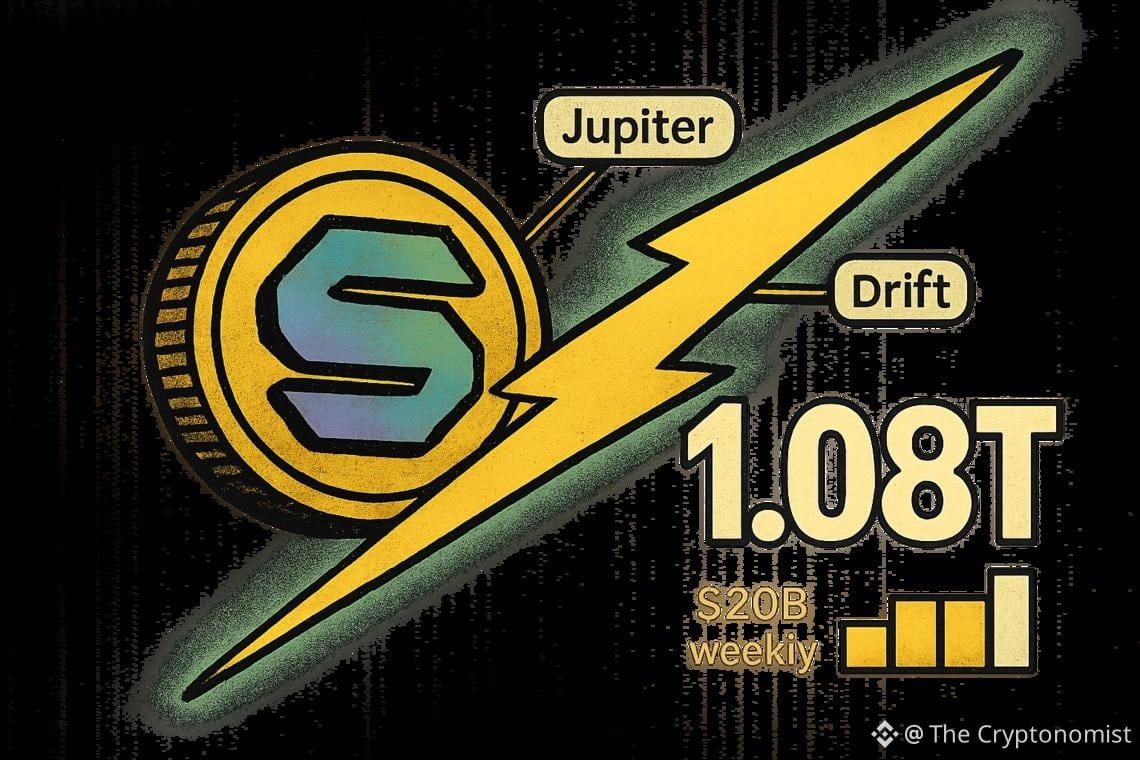
Artikel
Übersetzung ansehen
Solana Perpetual Futures Volume Tops $1.08 Trillion, Trails Only HyperliquidSolana perpetual futures trading has quietly become one of the biggest stories in crypto derivatives this year. Platforms built on the Solana blockchain have collectively processed more than $1.08 trillion in cumulative notional volume, a figure that puts the network firmly among the top venues for onchain leveraged trading anywhere in the industry.
Key takeaways
Solana-based perpetual futures platforms have surpassed $1.08 trillion in cumulative trading volume.
Jupiter Perps and Drift Protocol are the two main platforms driving that volume.
Solana is now the second-largest onchain perpetuals ecosystem, trailing only Hyperliquid.
By May 2026, weekly Solana perp volumes had pushed past $20 billion.
Jupiter Perps alone accounts for roughly 80% of that activity.
Solana Surpasses $1 Trillion in Perpetual Futures Volume
Solana’s derivatives platforms have collectively cleared the $1 trillion mark, confirming that leveraged crypto trading on the network has moved well beyond a niche experiment. That $1.08 trillion figure was built cumulatively across multiple protocols rather than in one single event, but it reflects a sustained climb rather than a one-off spike.
Major Milestones in Trading Volume
The broader category of perpetual futures decentralized exchanges first broke through $1 trillion in monthly volume back in September 2025, when the sector hit $1.05 trillion for that single month, a 48% jump from August. Solana captured an outsized share of that surge, and its platforms have kept expanding since.
Daily and Weekly Volume Trends
During peak months like October 2025, daily trading volumes on Solana perp platforms averaged approximately $1.8 billion. That pace kept building: By May 2026, the aggregate volume of weekly perpetual contracts on Solana had surpassed $20 billion, with each platform processing tens of billions in transactions of dollars in monthly flow on their own.
Key Platforms Driving Solana’s Perpetual Futures Market
Two protocols do most of the heavy lifting behind Solana derivatives volume: Jupiter Perps and Drift Protocol. Together they account for the bulk of the network’s leveraged trading activity, though their approaches to execution differ significantly.
Jupiter Perps’ Market Dominance
Jupiter Perps accounts for roughly 80% of Solana’s perpetual futures volume. That dominance largely comes from Jupiter’s integration with its own aggregator, which already functions as the primary swap router across the Solana ecosystem. That built-in user base gives Jupiter Perps trading a distribution advantage that smaller, standalone platforms struggle to match.
Drift Protocol’s Hybrid Execution and Leverage
Drift Protocol operates differently, running a hybrid venue that blends order book and automated market maker execution. It supports leverage of up to 101x, giving traders access to highly amplified positions directly onchain. That combination of execution styles has carved out a distinct niche for Drift within Solana’s derivatives landscape, even as Jupiter Perps captures the larger share of overall volume.
Technical Advantages Supporting Solana’s Derivatives Growth
Solana’s underlying infrastructure is a big part of why traders keep coming back for leveraged positions. High throughput and low transaction latency mean orders execute quickly and cheaply, which matters enormously for anyone holding a leveraged position that can be liquidated within seconds if the market moves against them.
Low Latency and High Throughput
Speed and cost are not minor details in leveraged trading. Fast execution reduces slippage and shortens the window in which a losing position can spiral before it gets closed out, a critical factor for any exchange handling billions of dollars in daily flow.
Economic Impact on SOL Holders and Validators
The rise in onchain derivatives activity also feeds directly back into Solana’s economy. Every The fees generated through trading are distributed among validators, token holders, and protocol treasuries, thereby sustaining ongoing demand for SOL, since the token is required to pay for transactions on the network. That mechanism ties the growth of Solana perpetual futures trading directly to the economic health of the broader ecosystem — more volume means more fees, and more fees mean more reasons to hold and use SOL.
Solana’s Position in the Broader Onchain Perpetual Futures Ecosystem
Thanks to these technical attributes, Solana has emerged as crypto’s second-largest perpetual trading ecosystem, trailing only Hyperliquid, which has built its reputation as the dominant decentralized venue for perps trading globally.
The gap between Solana and the market leader remains wide, but the ranking itself matters. It signals that onchain derivatives volume is no longer concentrated in a single platform or chain — it is spreading across ecosystems that can offer the speed and cost structure leveraged traders demand.
What began as a tool used mostly by DeFi-native traders has increasingly become a mainstream alternative to centralized exchange derivatives. The distance between decentralized and centralized derivatives volume is narrowing, even as centralized platforms continue growing their own trading activity. For Solana, that shift has translated into a derivatives market that now rivals some of the largest trading venues in crypto — and one that keeps generating fee revenue for the network’s validators and token holders with every trade that clears.
FAQ
What is the total trading volume achieved by Solana-based perpetual futures platforms?
Solana-based perpetual futures platforms have surpassed $1.08 trillion in cumulative trading volume.
Which platforms are the main contributors to Solana’s perpetual futures trading volume?
Jupiter Perps and Drift Protocol are the main platforms contributing to Solana’s derivatives volume.
Why is Solana an attractive platform for leveraged trading?
Solana’s low latency and high throughput facilitate fast and cheap leveraged trading, which is critical for managing fast liquidations.
How does increased perpetual futures volume economically benefit Solana network participants?
Increased onchain derivatives volume generates transaction fees benefiting SOL holders, network validators, and protocol treasuries.
Article produced with the assistance of artificial intelligence and reviewed by the editorial team.
Solana Perpetual Futures Volume Tops $1.08 Trillion, Trails Only Hyperliquid
Solana perpetual futures trading has quietly become one of the biggest stories in crypto derivatives this year. Platforms built on the Solana blockchain have collectively processed more than $1.08 trillion in cumulative notional volume, a figure that puts the network firmly among the top venues for onchain leveraged trading anywhere in the industry.
Key takeaways
Solana-based perpetual futures platforms have surpassed $1.08 trillion in cumulative trading volume.
Jupiter Perps and Drift Protocol are the two main platforms driving that volume.
Solana is now the second-largest onchain perpetuals ecosystem, trailing only Hyperliquid.
By May 2026, weekly Solana perp volumes had pushed past $20 billion.
Jupiter Perps alone accounts for roughly 80% of that activity.
Solana Surpasses $1 Trillion in Perpetual Futures Volume
Solana’s derivatives platforms have collectively cleared the $1 trillion mark, confirming that leveraged crypto trading on the network has moved well beyond a niche experiment. That $1.08 trillion figure was built cumulatively across multiple protocols rather than in one single event, but it reflects a sustained climb rather than a one-off spike.
Major Milestones in Trading Volume
The broader category of perpetual futures decentralized exchanges first broke through $1 trillion in monthly volume back in September 2025, when the sector hit $1.05 trillion for that single month, a 48% jump from August. Solana captured an outsized share of that surge, and its platforms have kept expanding since.
Daily and Weekly Volume Trends
During peak months like October 2025, daily trading volumes on Solana perp platforms averaged approximately $1.8 billion. That pace kept building: By May 2026, the aggregate volume of weekly perpetual contracts on Solana had surpassed $20 billion, with each platform processing tens of billions in transactions of dollars in monthly flow on their own.
Key Platforms Driving Solana’s Perpetual Futures Market
Two protocols do most of the heavy lifting behind Solana derivatives volume: Jupiter Perps and Drift Protocol. Together they account for the bulk of the network’s leveraged trading activity, though their approaches to execution differ significantly.
Jupiter Perps’ Market Dominance
Jupiter Perps accounts for roughly 80% of Solana’s perpetual futures volume. That dominance largely comes from Jupiter’s integration with its own aggregator, which already functions as the primary swap router across the Solana ecosystem. That built-in user base gives Jupiter Perps trading a distribution advantage that smaller, standalone platforms struggle to match.
Drift Protocol’s Hybrid Execution and Leverage
Drift Protocol operates differently, running a hybrid venue that blends order book and automated market maker execution. It supports leverage of up to 101x, giving traders access to highly amplified positions directly onchain. That combination of execution styles has carved out a distinct niche for Drift within Solana’s derivatives landscape, even as Jupiter Perps captures the larger share of overall volume.
Technical Advantages Supporting Solana’s Derivatives Growth
Solana’s underlying infrastructure is a big part of why traders keep coming back for leveraged positions. High throughput and low transaction latency mean orders execute quickly and cheaply, which matters enormously for anyone holding a leveraged position that can be liquidated within seconds if the market moves against them.
Low Latency and High Throughput
Speed and cost are not minor details in leveraged trading. Fast execution reduces slippage and shortens the window in which a losing position can spiral before it gets closed out, a critical factor for any exchange handling billions of dollars in daily flow.
Economic Impact on SOL Holders and Validators
The rise in onchain derivatives activity also feeds directly back into Solana’s economy. Every The fees generated through trading are distributed among validators, token holders, and protocol treasuries, thereby sustaining ongoing demand for SOL, since the token is required to pay for transactions on the network. That mechanism ties the growth of Solana perpetual futures trading directly to the economic health of the broader ecosystem — more volume means more fees, and more fees mean more reasons to hold and use SOL.
Solana’s Position in the Broader Onchain Perpetual Futures Ecosystem
Thanks to these technical attributes, Solana has emerged as crypto’s second-largest perpetual trading ecosystem, trailing only Hyperliquid, which has built its reputation as the dominant decentralized venue for perps trading globally.
The gap between Solana and the market leader remains wide, but the ranking itself matters. It signals that onchain derivatives volume is no longer concentrated in a single platform or chain — it is spreading across ecosystems that can offer the speed and cost structure leveraged traders demand.
What began as a tool used mostly by DeFi-native traders has increasingly become a mainstream alternative to centralized exchange derivatives. The distance between decentralized and centralized derivatives volume is narrowing, even as centralized platforms continue growing their own trading activity. For Solana, that shift has translated into a derivatives market that now rivals some of the largest trading venues in crypto — and one that keeps generating fee revenue for the network’s validators and token holders with every trade that clears.
FAQ
What is the total trading volume achieved by Solana-based perpetual futures platforms?
Solana-based perpetual futures platforms have surpassed $1.08 trillion in cumulative trading volume.
Which platforms are the main contributors to Solana’s perpetual futures trading volume?
Jupiter Perps and Drift Protocol are the main platforms contributing to Solana’s derivatives volume.
Why is Solana an attractive platform for leveraged trading?
Solana’s low latency and high throughput facilitate fast and cheap leveraged trading, which is critical for managing fast liquidations.
How does increased perpetual futures volume economically benefit Solana network participants?
Increased onchain derivatives volume generates transaction fees benefiting SOL holders, network validators, and protocol treasuries.
Article produced with the assistance of artificial intelligence and reviewed by the editorial team.
Key takeaways
Solana-based perpetual futures platforms have surpassed $1.08 trillion in cumulative trading volume.
Jupiter Perps and Drift Protocol are the two main platforms driving that volume.
Solana is now the second-largest onchain perpetuals ecosystem, trailing only Hyperliquid.
By May 2026, weekly Solana perp volumes had pushed past $20 billion.
Jupiter Perps alone accounts for roughly 80% of that activity.
Solana Surpasses $1 Trillion in Perpetual Futures Volume
Solana’s derivatives platforms have collectively cleared the $1 trillion mark, confirming that leveraged crypto trading on the network has moved well beyond a niche experiment. That $1.08 trillion figure was built cumulatively across multiple protocols rather than in one single event, but it reflects a sustained climb rather than a one-off spike.
Major Milestones in Trading Volume
The broader category of perpetual futures decentralized exchanges first broke through $1 trillion in monthly volume back in September 2025, when the sector hit $1.05 trillion for that single month, a 48% jump from August. Solana captured an outsized share of that surge, and its platforms have kept expanding since.
Daily and Weekly Volume Trends
During peak months like October 2025, daily trading volumes on Solana perp platforms averaged approximately $1.8 billion. That pace kept building: By May 2026, the aggregate volume of weekly perpetual contracts on Solana had surpassed $20 billion, with each platform processing tens of billions in transactions of dollars in monthly flow on their own.
Key Platforms Driving Solana’s Perpetual Futures Market
Two protocols do most of the heavy lifting behind Solana derivatives volume: Jupiter Perps and Drift Protocol. Together they account for the bulk of the network’s leveraged trading activity, though their approaches to execution differ significantly.
Jupiter Perps’ Market Dominance
Jupiter Perps accounts for roughly 80% of Solana’s perpetual futures volume. That dominance largely comes from Jupiter’s integration with its own aggregator, which already functions as the primary swap router across the Solana ecosystem. That built-in user base gives Jupiter Perps trading a distribution advantage that smaller, standalone platforms struggle to match.
Drift Protocol’s Hybrid Execution and Leverage
Drift Protocol operates differently, running a hybrid venue that blends order book and automated market maker execution. It supports leverage of up to 101x, giving traders access to highly amplified positions directly onchain. That combination of execution styles has carved out a distinct niche for Drift within Solana’s derivatives landscape, even as Jupiter Perps captures the larger share of overall volume.
Technical Advantages Supporting Solana’s Derivatives Growth
Solana’s underlying infrastructure is a big part of why traders keep coming back for leveraged positions. High throughput and low transaction latency mean orders execute quickly and cheaply, which matters enormously for anyone holding a leveraged position that can be liquidated within seconds if the market moves against them.
Low Latency and High Throughput
Speed and cost are not minor details in leveraged trading. Fast execution reduces slippage and shortens the window in which a losing position can spiral before it gets closed out, a critical factor for any exchange handling billions of dollars in daily flow.
Economic Impact on SOL Holders and Validators
The rise in onchain derivatives activity also feeds directly back into Solana’s economy. Every The fees generated through trading are distributed among validators, token holders, and protocol treasuries, thereby sustaining ongoing demand for SOL, since the token is required to pay for transactions on the network. That mechanism ties the growth of Solana perpetual futures trading directly to the economic health of the broader ecosystem — more volume means more fees, and more fees mean more reasons to hold and use SOL.
Solana’s Position in the Broader Onchain Perpetual Futures Ecosystem
Thanks to these technical attributes, Solana has emerged as crypto’s second-largest perpetual trading ecosystem, trailing only Hyperliquid, which has built its reputation as the dominant decentralized venue for perps trading globally.
The gap between Solana and the market leader remains wide, but the ranking itself matters. It signals that onchain derivatives volume is no longer concentrated in a single platform or chain — it is spreading across ecosystems that can offer the speed and cost structure leveraged traders demand.
What began as a tool used mostly by DeFi-native traders has increasingly become a mainstream alternative to centralized exchange derivatives. The distance between decentralized and centralized derivatives volume is narrowing, even as centralized platforms continue growing their own trading activity. For Solana, that shift has translated into a derivatives market that now rivals some of the largest trading venues in crypto — and one that keeps generating fee revenue for the network’s validators and token holders with every trade that clears.
FAQ
What is the total trading volume achieved by Solana-based perpetual futures platforms?
Solana-based perpetual futures platforms have surpassed $1.08 trillion in cumulative trading volume.
Which platforms are the main contributors to Solana’s perpetual futures trading volume?
Jupiter Perps and Drift Protocol are the main platforms contributing to Solana’s derivatives volume.
Why is Solana an attractive platform for leveraged trading?
Solana’s low latency and high throughput facilitate fast and cheap leveraged trading, which is critical for managing fast liquidations.
How does increased perpetual futures volume economically benefit Solana network participants?
Increased onchain derivatives volume generates transaction fees benefiting SOL holders, network validators, and protocol treasuries.
Article produced with the assistance of artificial intelligence and reviewed by the editorial team.
169

Artikel
Übersetzung ansehen
Crypto fund fraud conviction: Dillman faces 20 years over fake Autotrader botA federal jury in San Francisco has delivered a crypto fund fraud conviction against Japheth Dillman, the 48-year-old founder of Block Bits Capital, after prosecutors showed he sold investors on trading software he knew never actually worked. The verdict, announced by the Justice Department, closes out a case that stretched back nearly a decade to when Dillman first began pitching an automated cryptocurrency trading tool that turned out to be little more than a pitch deck.
Key takeaways
Japheth Dillman was convicted of wire fraud and conspiracy by a federal jury in San Francisco after a 10-day trial.
He raised nearly $1 million from more than 20 investors for his fund, Block Bits Capital, between June 2017 and August 2018.
Dillman claimed the fund used a working automated trading tool called the Autotrader, which prosecutors say never functioned.
Investor money was instead used for personal payments and risky crypto bets that lost heavily, while Dillman falsely reported profits.
He faces up to 20 years in prison and a $250,000 fine per count, with sentencing set for December 8.
Federal Jury Convicts Japheth Dillman of Crypto Fund Fraud
A jury in the Northern District of California found Dillman guilty of wire fraud and conspiracy to commit wire fraud following a 10-day trial before U.S. District Judge Richard Seeborg. The Justice Department confirmed the verdict on Monday, capping a prosecution that examined years of misleading statements Dillman made to people who trusted him with their savings.
Dillman remains free on bond while he awaits sentencing, scheduled for December 8 at 9:30 a.m. before Judge Seeborg. The maximum statutory penalty is steep: up to 20 years in federal prison and a $250,000 fine for each count of conviction. Those figures represent ceilings under law rather than a guaranteed outcome — the judge will weigh federal sentencing guidelines and other factors before setting an actual term.
Why does this crypto fund fraud conviction matter beyond one courtroom? It shows federal prosecutors are willing to pursue multi-year investigations into crypto trading funds long after the money has vanished, sending a signal to anyone still running unregistered trading vehicles that markets cooling off does not mean scrutiny cools off too.
Fraudulent Claims Involving Block Bits Capital and Autotrader Software
At the center of the case was a piece of software that, according to prosecutors, simply did not do what Dillman told investors it did. Block Bits Capital was marketed as a fund that would generate returns through automated cryptocurrency trading, and that promise was the hook used to bring money in the door.
False Promises of a Working Trading Bot
Between June 2017 and August 2018, Dillman told investors that Block Bits ran on a proprietary tool called the Autotrader, describing it as complete and operational. Prosecutors demonstrated at trial that the algorithm did not work as represented — and that Dillman knew it. That meant investor money could never have been deployed the way he had promised, because the automated strategy behind the pitch simply did not exist in a usable form.
Misuse of Investor Funds and False Profit Reporting
With the Autotrader nonfunctional, Dillman and an unnamed co-conspirator diverted money elsewhere. Some of it went to personal payments; the rest was funneled into speculative positions in other crypto ventures, all while investors were told their funds sat somewhere safer. Those bets lost heavily. Rather than disclose the losses, Dillman told investors that Block Bits’ trading had produced significant profits — a claim prosecutors say was false from start to finish.
This pattern of concealed losses paired with fabricated profit reports is a recurring feature in crypto fraud prosecutions, and it’s precisely the kind of gap between marketing and reality that regulators are now built to chase down. For investors, the lesson is blunt: a trading fund’s claimed technology is only as credible as the evidence backing it, and “proprietary” software promises deserve the same skepticism as any other unverifiable pitch.
Investigation and Prosecution by US Federal Agencies
The case was built jointly by the FBI and IRS Criminal Investigation, with assistance from the SEC’s San Francisco Regional Office. Assistant U.S. Attorneys Christiaan Highsmith and Charles Bisesto prosecuted the matter for the Justice Department.
The criminal case did not emerge out of nowhere. Block Bits Capital and its associated entities had already drawn regulatory attention years earlier: the SEC brought a civil complaint in April 2022 against Block Bits Capital, an affiliated entity, Dillman, and co-founder David Mata over an alleged unregistered and fraudulent securities offering. That earlier action, which described the same core allegations — a trading bot that was never finished while investor funds were reportedly traded manually behind the scenes — laid groundwork that fed into the criminal case now resulting in conviction.
Funding Raised from Investors for Block Bits Capital
Court evidence showed Dillman raised close to $1 million from more than 20 investors in Block Bits Capital, money collected on the strength of promises about automated trading returns that never materialized. That figure, modest by the standards of some crypto collapses, still represents real losses for more than two dozen individual investors who believed they were buying into a working trading system rather than a fund whose central technology never left the drawing board.
FAQ
What was Japheth Dillman convicted of?
He was convicted of wire fraud and conspiracy related to defrauding investors in a crypto fund.
How did Dillman deceive investors?
He falsely claimed that the fund used a working automated trading software called Autotrader, which was actually non-functional.
What happened to the investor funds?
The funds were misused for personal payments and speculative cryptocurrency bets that resulted in heavy losses.
What penalties does Dillman face?
He faces up to 20 years in prison and $250,000 fines per count, with sentencing scheduled for December 8.
Article produced with the assistance of artificial intelligence and reviewed by the editorial team.
Crypto fund fraud conviction: Dillman faces 20 years over fake Autotrader bot
A federal jury in San Francisco has delivered a crypto fund fraud conviction against Japheth Dillman, the 48-year-old founder of Block Bits Capital, after prosecutors showed he sold investors on trading software he knew never actually worked. The verdict, announced by the Justice Department, closes out a case that stretched back nearly a decade to when Dillman first began pitching an automated cryptocurrency trading tool that turned out to be little more than a pitch deck.
Key takeaways
Japheth Dillman was convicted of wire fraud and conspiracy by a federal jury in San Francisco after a 10-day trial.
He raised nearly $1 million from more than 20 investors for his fund, Block Bits Capital, between June 2017 and August 2018.
Dillman claimed the fund used a working automated trading tool called the Autotrader, which prosecutors say never functioned.
Investor money was instead used for personal payments and risky crypto bets that lost heavily, while Dillman falsely reported profits.
He faces up to 20 years in prison and a $250,000 fine per count, with sentencing set for December 8.
Federal Jury Convicts Japheth Dillman of Crypto Fund Fraud
A jury in the Northern District of California found Dillman guilty of wire fraud and conspiracy to commit wire fraud following a 10-day trial before U.S. District Judge Richard Seeborg. The Justice Department confirmed the verdict on Monday, capping a prosecution that examined years of misleading statements Dillman made to people who trusted him with their savings.
Dillman remains free on bond while he awaits sentencing, scheduled for December 8 at 9:30 a.m. before Judge Seeborg. The maximum statutory penalty is steep: up to 20 years in federal prison and a $250,000 fine for each count of conviction. Those figures represent ceilings under law rather than a guaranteed outcome — the judge will weigh federal sentencing guidelines and other factors before setting an actual term.
Why does this crypto fund fraud conviction matter beyond one courtroom? It shows federal prosecutors are willing to pursue multi-year investigations into crypto trading funds long after the money has vanished, sending a signal to anyone still running unregistered trading vehicles that markets cooling off does not mean scrutiny cools off too.
Fraudulent Claims Involving Block Bits Capital and Autotrader Software
At the center of the case was a piece of software that, according to prosecutors, simply did not do what Dillman told investors it did. Block Bits Capital was marketed as a fund that would generate returns through automated cryptocurrency trading, and that promise was the hook used to bring money in the door.
False Promises of a Working Trading Bot
Between June 2017 and August 2018, Dillman told investors that Block Bits ran on a proprietary tool called the Autotrader, describing it as complete and operational. Prosecutors demonstrated at trial that the algorithm did not work as represented — and that Dillman knew it. That meant investor money could never have been deployed the way he had promised, because the automated strategy behind the pitch simply did not exist in a usable form.
Misuse of Investor Funds and False Profit Reporting
With the Autotrader nonfunctional, Dillman and an unnamed co-conspirator diverted money elsewhere. Some of it went to personal payments; the rest was funneled into speculative positions in other crypto ventures, all while investors were told their funds sat somewhere safer. Those bets lost heavily. Rather than disclose the losses, Dillman told investors that Block Bits’ trading had produced significant profits — a claim prosecutors say was false from start to finish.
This pattern of concealed losses paired with fabricated profit reports is a recurring feature in crypto fraud prosecutions, and it’s precisely the kind of gap between marketing and reality that regulators are now built to chase down. For investors, the lesson is blunt: a trading fund’s claimed technology is only as credible as the evidence backing it, and “proprietary” software promises deserve the same skepticism as any other unverifiable pitch.
Investigation and Prosecution by US Federal Agencies
The case was built jointly by the FBI and IRS Criminal Investigation, with assistance from the SEC’s San Francisco Regional Office. Assistant U.S. Attorneys Christiaan Highsmith and Charles Bisesto prosecuted the matter for the Justice Department.
The criminal case did not emerge out of nowhere. Block Bits Capital and its associated entities had already drawn regulatory attention years earlier: the SEC brought a civil complaint in April 2022 against Block Bits Capital, an affiliated entity, Dillman, and co-founder David Mata over an alleged unregistered and fraudulent securities offering. That earlier action, which described the same core allegations — a trading bot that was never finished while investor funds were reportedly traded manually behind the scenes — laid groundwork that fed into the criminal case now resulting in conviction.
Funding Raised from Investors for Block Bits Capital
Court evidence showed Dillman raised close to $1 million from more than 20 investors in Block Bits Capital, money collected on the strength of promises about automated trading returns that never materialized. That figure, modest by the standards of some crypto collapses, still represents real losses for more than two dozen individual investors who believed they were buying into a working trading system rather than a fund whose central technology never left the drawing board.
FAQ
What was Japheth Dillman convicted of?
He was convicted of wire fraud and conspiracy related to defrauding investors in a crypto fund.
How did Dillman deceive investors?
He falsely claimed that the fund used a working automated trading software called Autotrader, which was actually non-functional.
What happened to the investor funds?
The funds were misused for personal payments and speculative cryptocurrency bets that resulted in heavy losses.
What penalties does Dillman face?
He faces up to 20 years in prison and $250,000 fines per count, with sentencing scheduled for December 8.
Article produced with the assistance of artificial intelligence and reviewed by the editorial team.
Key takeaways
Japheth Dillman was convicted of wire fraud and conspiracy by a federal jury in San Francisco after a 10-day trial.
He raised nearly $1 million from more than 20 investors for his fund, Block Bits Capital, between June 2017 and August 2018.
Dillman claimed the fund used a working automated trading tool called the Autotrader, which prosecutors say never functioned.
Investor money was instead used for personal payments and risky crypto bets that lost heavily, while Dillman falsely reported profits.
He faces up to 20 years in prison and a $250,000 fine per count, with sentencing set for December 8.
Federal Jury Convicts Japheth Dillman of Crypto Fund Fraud
A jury in the Northern District of California found Dillman guilty of wire fraud and conspiracy to commit wire fraud following a 10-day trial before U.S. District Judge Richard Seeborg. The Justice Department confirmed the verdict on Monday, capping a prosecution that examined years of misleading statements Dillman made to people who trusted him with their savings.
Dillman remains free on bond while he awaits sentencing, scheduled for December 8 at 9:30 a.m. before Judge Seeborg. The maximum statutory penalty is steep: up to 20 years in federal prison and a $250,000 fine for each count of conviction. Those figures represent ceilings under law rather than a guaranteed outcome — the judge will weigh federal sentencing guidelines and other factors before setting an actual term.
Why does this crypto fund fraud conviction matter beyond one courtroom? It shows federal prosecutors are willing to pursue multi-year investigations into crypto trading funds long after the money has vanished, sending a signal to anyone still running unregistered trading vehicles that markets cooling off does not mean scrutiny cools off too.
Fraudulent Claims Involving Block Bits Capital and Autotrader Software
At the center of the case was a piece of software that, according to prosecutors, simply did not do what Dillman told investors it did. Block Bits Capital was marketed as a fund that would generate returns through automated cryptocurrency trading, and that promise was the hook used to bring money in the door.
False Promises of a Working Trading Bot
Between June 2017 and August 2018, Dillman told investors that Block Bits ran on a proprietary tool called the Autotrader, describing it as complete and operational. Prosecutors demonstrated at trial that the algorithm did not work as represented — and that Dillman knew it. That meant investor money could never have been deployed the way he had promised, because the automated strategy behind the pitch simply did not exist in a usable form.
Misuse of Investor Funds and False Profit Reporting
With the Autotrader nonfunctional, Dillman and an unnamed co-conspirator diverted money elsewhere. Some of it went to personal payments; the rest was funneled into speculative positions in other crypto ventures, all while investors were told their funds sat somewhere safer. Those bets lost heavily. Rather than disclose the losses, Dillman told investors that Block Bits’ trading had produced significant profits — a claim prosecutors say was false from start to finish.
This pattern of concealed losses paired with fabricated profit reports is a recurring feature in crypto fraud prosecutions, and it’s precisely the kind of gap between marketing and reality that regulators are now built to chase down. For investors, the lesson is blunt: a trading fund’s claimed technology is only as credible as the evidence backing it, and “proprietary” software promises deserve the same skepticism as any other unverifiable pitch.
Investigation and Prosecution by US Federal Agencies
The case was built jointly by the FBI and IRS Criminal Investigation, with assistance from the SEC’s San Francisco Regional Office. Assistant U.S. Attorneys Christiaan Highsmith and Charles Bisesto prosecuted the matter for the Justice Department.
The criminal case did not emerge out of nowhere. Block Bits Capital and its associated entities had already drawn regulatory attention years earlier: the SEC brought a civil complaint in April 2022 against Block Bits Capital, an affiliated entity, Dillman, and co-founder David Mata over an alleged unregistered and fraudulent securities offering. That earlier action, which described the same core allegations — a trading bot that was never finished while investor funds were reportedly traded manually behind the scenes — laid groundwork that fed into the criminal case now resulting in conviction.
Funding Raised from Investors for Block Bits Capital
Court evidence showed Dillman raised close to $1 million from more than 20 investors in Block Bits Capital, money collected on the strength of promises about automated trading returns that never materialized. That figure, modest by the standards of some crypto collapses, still represents real losses for more than two dozen individual investors who believed they were buying into a working trading system rather than a fund whose central technology never left the drawing board.
FAQ
What was Japheth Dillman convicted of?
He was convicted of wire fraud and conspiracy related to defrauding investors in a crypto fund.
How did Dillman deceive investors?
He falsely claimed that the fund used a working automated trading software called Autotrader, which was actually non-functional.
What happened to the investor funds?
The funds were misused for personal payments and speculative cryptocurrency bets that resulted in heavy losses.
What penalties does Dillman face?
He faces up to 20 years in prison and $250,000 fines per count, with sentencing scheduled for December 8.
Article produced with the assistance of artificial intelligence and reviewed by the editorial team.
18
Artikel
Übersetzung ansehen
Chainalysis Operation Lighthouse flags 7,700 suspects across 125 countriesChainalysis says a sweeping, multi-day operation it led alongside law enforcement and private-sector partners has flagged more than 7,700 suspect accounts tied to crypto-enabled child sexual abuse material networks, in one of the most extensive coordinated crackdowns the blockchain analytics firm has run to date. The initiative, called Chainalysis Operation Lighthouse, generated 14,300 investigative leads and surfaced suspects spread across 125 countries, according to a press release the company shared and reporting from Cointelegraph.
Key takeaways
Chainalysis launched Operation Lighthouse to disrupt crypto-enabled CSAM networks worldwide.
The operation generated 14,300 investigative leads and flagged over 7,700 suspect accounts across 125 countries.
Investigators examined 29,120 crypto addresses and digital identifiers linked to more than 100 CSAM platforms, forums and distribution networks.
Partners included Europol, the UK National Crime Agency, Binance, Coinbase, Block and the Internet Watch Foundation.
Sixteen registered sex offenders were among the suspects identified, alongside military personnel, law enforcement officers, medical professionals and educators.
Chainalysis Launches Operation Lighthouse Against Crypto-Enabled CSAM
Operation Lighthouse was built to trace how criminal networks use digital assets to fund and distribute CSAM, and it did so by mapping tens of thousands of onchain identifiers back to real platforms and, ultimately, real people. Investigators reviewed Over 100 CSAM platforms, forums and distribution networks were linked to 29,120 crypto addresses and digital identifiers operating across both the surface web and the dark web, Cointelegraph reported. That scope alone sets Lighthouse apart from smaller, single-agency probes that typically target one platform or one payment rail at a time.
Global Collaboration Between Law Enforcement and Private Sector
Why this matters: no single company or agency has the reach to track illicit crypto flows across 125 countries alone, which is exactly why Lighthouse was structured as a joint effort rather than a Chainalysis-only initiative. New York’s National Cyber-Forensics and Training Alliance served as the venue for this multi-day intensive sprint following months of data enrichment work, and it pulled together government agencies, exchanges and nonprofits under one roof. Participants named in connection with the operation included Europol, the UK National Crime Agency, Binance, Coinbase, Block and the Internet Watch Foundation, each contributing intelligence or platform-level data that fed into the shared investigative pool.
Operational Scope and Metrics
The numbers tell their own story. Operation Lighthouse produced 14,300 investigative leads across 11 crypto exchanges and payment services, and it flagged over 7,700 suspect accounts spanning 125 countries. Among those identified were 16 registered sex offenders, and Chainalysis said the wider suspect pool also included military personnel, law enforcement officers, medical professionals and educators — several with direct access to children, according to Tom McLouth, senior intelligence analyst at Chainalysis. “Behind every lead is a real child at risk,” McLouth told Cointelegraph, underscoring the human stakes behind the aggregated data.
Chainalysis said the leads generated during the sprint are expected to feed follow-on legal processes, with outcomes potentially including arrests, prosecutions and account-level disruption on the exchanges and payment platforms involved.
Impact on Crypto Security and Future Regulatory Landscape
Operation Lighthouse arrives as crypto firms face growing pressure to prove they can police illicit financial activity without waiting for regulators to force their hand. The scale of this particular effort, spanning 125 countries and 11 exchanges, signals that the industry’s biggest platforms are increasingly willing to share intelligence directly with law enforcement rather than treat compliance as a purely internal matter.
Enhancing Crypto Accountability
Beyond the raw statistics, Lighthouse reinforces a broader shift toward proactive intervention rather than reactive investigation. This is not the first time onchain tracing has cracked open a CSAM network: in 2019, the US Justice Department announced the takedown of Welcome to Video, at the time described as the largest darknet child exploitation market by volume of content. Authorities traced Bitcoin payments to locate the site’s server in South Korea and identify its administrator, leading to 337 arrests, the rescue of at least 23 victims and the seizure of roughly eight terabytes of material. Chainalysis said its software was used to analyze those transactions and map the site’s users and contributors, a precedent that helps explain why blockchain forensics firms are now positioned as central players in child-safety investigations rather than peripheral tech vendors.
Potential Influence on Compliance Standards and Investor Confidence
The operation also lands against a backdrop of expanding industry-wide efforts against exploitation. Binance, one of the exchanges participating in Lighthouse, separately announced a partnership in July with the nonprofit Stop The Traffik, aimed at improving its detection and investigation of crypto activity linked to human trafficking and child exploitation. Europol has said joint action of this kind is essential precisely because perpetrators exploit financial services, payment systems and internet platforms interchangeably, making single-institution enforcement far less effective.
For traders and platforms alike, the practical implication is straightforward: exchanges that can demonstrate active participation in operations like this one may find it easier to build trust with regulators and users, while those that lag on compliance infrastructure could face growing scrutiny as intelligence-sharing networks like Lighthouse mature.
FAQ
What is Operation Lighthouse?
Operation Lighthouse is a global initiative led by Chainalysis to disrupt crypto-enabled Child Sexual Abuse Material (CSAM) networks through a partnership between law enforcement agencies and private-sector entities, including major crypto exchanges.
How many suspect accounts did Operation Lighthouse identify?
The operation identified more than 7,700 suspect accounts globally, spread across 125 countries, including 16 registered sex offenders.
What was the scale of the investigative leads generated by the operation?
Operation Lighthouse generated 14,300 investigative leads across 11 crypto exchanges and payment services during a multi-day sprint hosted at the National Cyber-Forensics and Training Alliance in New York.
Which parties collaborated in Operation Lighthouse?
The initiative brought together Chainalysis, law enforcement agencies including Europol and the UK National Crime Agency, exchanges such as Binance, Coinbase and Block, and the nonprofit Internet Watch Foundation.
Article produced with the assistance of artificial intelligence and reviewed by the editorial team.
Chainalysis Operation Lighthouse flags 7,700 suspects across 125 countries
Chainalysis says a sweeping, multi-day operation it led alongside law enforcement and private-sector partners has flagged more than 7,700 suspect accounts tied to crypto-enabled child sexual abuse material networks, in one of the most extensive coordinated crackdowns the blockchain analytics firm has run to date. The initiative, called Chainalysis Operation Lighthouse, generated 14,300 investigative leads and surfaced suspects spread across 125 countries, according to a press release the company shared and reporting from Cointelegraph.
Key takeaways
Chainalysis launched Operation Lighthouse to disrupt crypto-enabled CSAM networks worldwide.
The operation generated 14,300 investigative leads and flagged over 7,700 suspect accounts across 125 countries.
Investigators examined 29,120 crypto addresses and digital identifiers linked to more than 100 CSAM platforms, forums and distribution networks.
Partners included Europol, the UK National Crime Agency, Binance, Coinbase, Block and the Internet Watch Foundation.
Sixteen registered sex offenders were among the suspects identified, alongside military personnel, law enforcement officers, medical professionals and educators.
Chainalysis Launches Operation Lighthouse Against Crypto-Enabled CSAM
Operation Lighthouse was built to trace how criminal networks use digital assets to fund and distribute CSAM, and it did so by mapping tens of thousands of onchain identifiers back to real platforms and, ultimately, real people. Investigators reviewed Over 100 CSAM platforms, forums and distribution networks were linked to 29,120 crypto addresses and digital identifiers operating across both the surface web and the dark web, Cointelegraph reported. That scope alone sets Lighthouse apart from smaller, single-agency probes that typically target one platform or one payment rail at a time.
Global Collaboration Between Law Enforcement and Private Sector
Why this matters: no single company or agency has the reach to track illicit crypto flows across 125 countries alone, which is exactly why Lighthouse was structured as a joint effort rather than a Chainalysis-only initiative. New York’s National Cyber-Forensics and Training Alliance served as the venue for this multi-day intensive sprint following months of data enrichment work, and it pulled together government agencies, exchanges and nonprofits under one roof. Participants named in connection with the operation included Europol, the UK National Crime Agency, Binance, Coinbase, Block and the Internet Watch Foundation, each contributing intelligence or platform-level data that fed into the shared investigative pool.
Operational Scope and Metrics
The numbers tell their own story. Operation Lighthouse produced 14,300 investigative leads across 11 crypto exchanges and payment services, and it flagged over 7,700 suspect accounts spanning 125 countries. Among those identified were 16 registered sex offenders, and Chainalysis said the wider suspect pool also included military personnel, law enforcement officers, medical professionals and educators — several with direct access to children, according to Tom McLouth, senior intelligence analyst at Chainalysis. “Behind every lead is a real child at risk,” McLouth told Cointelegraph, underscoring the human stakes behind the aggregated data.
Chainalysis said the leads generated during the sprint are expected to feed follow-on legal processes, with outcomes potentially including arrests, prosecutions and account-level disruption on the exchanges and payment platforms involved.
Impact on Crypto Security and Future Regulatory Landscape
Operation Lighthouse arrives as crypto firms face growing pressure to prove they can police illicit financial activity without waiting for regulators to force their hand. The scale of this particular effort, spanning 125 countries and 11 exchanges, signals that the industry’s biggest platforms are increasingly willing to share intelligence directly with law enforcement rather than treat compliance as a purely internal matter.
Enhancing Crypto Accountability
Beyond the raw statistics, Lighthouse reinforces a broader shift toward proactive intervention rather than reactive investigation. This is not the first time onchain tracing has cracked open a CSAM network: in 2019, the US Justice Department announced the takedown of Welcome to Video, at the time described as the largest darknet child exploitation market by volume of content. Authorities traced Bitcoin payments to locate the site’s server in South Korea and identify its administrator, leading to 337 arrests, the rescue of at least 23 victims and the seizure of roughly eight terabytes of material. Chainalysis said its software was used to analyze those transactions and map the site’s users and contributors, a precedent that helps explain why blockchain forensics firms are now positioned as central players in child-safety investigations rather than peripheral tech vendors.
Potential Influence on Compliance Standards and Investor Confidence
The operation also lands against a backdrop of expanding industry-wide efforts against exploitation. Binance, one of the exchanges participating in Lighthouse, separately announced a partnership in July with the nonprofit Stop The Traffik, aimed at improving its detection and investigation of crypto activity linked to human trafficking and child exploitation. Europol has said joint action of this kind is essential precisely because perpetrators exploit financial services, payment systems and internet platforms interchangeably, making single-institution enforcement far less effective.
For traders and platforms alike, the practical implication is straightforward: exchanges that can demonstrate active participation in operations like this one may find it easier to build trust with regulators and users, while those that lag on compliance infrastructure could face growing scrutiny as intelligence-sharing networks like Lighthouse mature.
FAQ
What is Operation Lighthouse?
Operation Lighthouse is a global initiative led by Chainalysis to disrupt crypto-enabled Child Sexual Abuse Material (CSAM) networks through a partnership between law enforcement agencies and private-sector entities, including major crypto exchanges.
How many suspect accounts did Operation Lighthouse identify?
The operation identified more than 7,700 suspect accounts globally, spread across 125 countries, including 16 registered sex offenders.
What was the scale of the investigative leads generated by the operation?
Operation Lighthouse generated 14,300 investigative leads across 11 crypto exchanges and payment services during a multi-day sprint hosted at the National Cyber-Forensics and Training Alliance in New York.
Which parties collaborated in Operation Lighthouse?
The initiative brought together Chainalysis, law enforcement agencies including Europol and the UK National Crime Agency, exchanges such as Binance, Coinbase and Block, and the nonprofit Internet Watch Foundation.
Article produced with the assistance of artificial intelligence and reviewed by the editorial team.
Key takeaways
Chainalysis launched Operation Lighthouse to disrupt crypto-enabled CSAM networks worldwide.
The operation generated 14,300 investigative leads and flagged over 7,700 suspect accounts across 125 countries.
Investigators examined 29,120 crypto addresses and digital identifiers linked to more than 100 CSAM platforms, forums and distribution networks.
Partners included Europol, the UK National Crime Agency, Binance, Coinbase, Block and the Internet Watch Foundation.
Sixteen registered sex offenders were among the suspects identified, alongside military personnel, law enforcement officers, medical professionals and educators.
Chainalysis Launches Operation Lighthouse Against Crypto-Enabled CSAM
Operation Lighthouse was built to trace how criminal networks use digital assets to fund and distribute CSAM, and it did so by mapping tens of thousands of onchain identifiers back to real platforms and, ultimately, real people. Investigators reviewed Over 100 CSAM platforms, forums and distribution networks were linked to 29,120 crypto addresses and digital identifiers operating across both the surface web and the dark web, Cointelegraph reported. That scope alone sets Lighthouse apart from smaller, single-agency probes that typically target one platform or one payment rail at a time.
Global Collaboration Between Law Enforcement and Private Sector
Why this matters: no single company or agency has the reach to track illicit crypto flows across 125 countries alone, which is exactly why Lighthouse was structured as a joint effort rather than a Chainalysis-only initiative. New York’s National Cyber-Forensics and Training Alliance served as the venue for this multi-day intensive sprint following months of data enrichment work, and it pulled together government agencies, exchanges and nonprofits under one roof. Participants named in connection with the operation included Europol, the UK National Crime Agency, Binance, Coinbase, Block and the Internet Watch Foundation, each contributing intelligence or platform-level data that fed into the shared investigative pool.
Operational Scope and Metrics
The numbers tell their own story. Operation Lighthouse produced 14,300 investigative leads across 11 crypto exchanges and payment services, and it flagged over 7,700 suspect accounts spanning 125 countries. Among those identified were 16 registered sex offenders, and Chainalysis said the wider suspect pool also included military personnel, law enforcement officers, medical professionals and educators — several with direct access to children, according to Tom McLouth, senior intelligence analyst at Chainalysis. “Behind every lead is a real child at risk,” McLouth told Cointelegraph, underscoring the human stakes behind the aggregated data.
Chainalysis said the leads generated during the sprint are expected to feed follow-on legal processes, with outcomes potentially including arrests, prosecutions and account-level disruption on the exchanges and payment platforms involved.
Impact on Crypto Security and Future Regulatory Landscape
Operation Lighthouse arrives as crypto firms face growing pressure to prove they can police illicit financial activity without waiting for regulators to force their hand. The scale of this particular effort, spanning 125 countries and 11 exchanges, signals that the industry’s biggest platforms are increasingly willing to share intelligence directly with law enforcement rather than treat compliance as a purely internal matter.
Enhancing Crypto Accountability
Beyond the raw statistics, Lighthouse reinforces a broader shift toward proactive intervention rather than reactive investigation. This is not the first time onchain tracing has cracked open a CSAM network: in 2019, the US Justice Department announced the takedown of Welcome to Video, at the time described as the largest darknet child exploitation market by volume of content. Authorities traced Bitcoin payments to locate the site’s server in South Korea and identify its administrator, leading to 337 arrests, the rescue of at least 23 victims and the seizure of roughly eight terabytes of material. Chainalysis said its software was used to analyze those transactions and map the site’s users and contributors, a precedent that helps explain why blockchain forensics firms are now positioned as central players in child-safety investigations rather than peripheral tech vendors.
Potential Influence on Compliance Standards and Investor Confidence
The operation also lands against a backdrop of expanding industry-wide efforts against exploitation. Binance, one of the exchanges participating in Lighthouse, separately announced a partnership in July with the nonprofit Stop The Traffik, aimed at improving its detection and investigation of crypto activity linked to human trafficking and child exploitation. Europol has said joint action of this kind is essential precisely because perpetrators exploit financial services, payment systems and internet platforms interchangeably, making single-institution enforcement far less effective.
For traders and platforms alike, the practical implication is straightforward: exchanges that can demonstrate active participation in operations like this one may find it easier to build trust with regulators and users, while those that lag on compliance infrastructure could face growing scrutiny as intelligence-sharing networks like Lighthouse mature.
FAQ
What is Operation Lighthouse?
Operation Lighthouse is a global initiative led by Chainalysis to disrupt crypto-enabled Child Sexual Abuse Material (CSAM) networks through a partnership between law enforcement agencies and private-sector entities, including major crypto exchanges.
How many suspect accounts did Operation Lighthouse identify?
The operation identified more than 7,700 suspect accounts globally, spread across 125 countries, including 16 registered sex offenders.
What was the scale of the investigative leads generated by the operation?
Operation Lighthouse generated 14,300 investigative leads across 11 crypto exchanges and payment services during a multi-day sprint hosted at the National Cyber-Forensics and Training Alliance in New York.
Which parties collaborated in Operation Lighthouse?
The initiative brought together Chainalysis, law enforcement agencies including Europol and the UK National Crime Agency, exchanges such as Binance, Coinbase and Block, and the nonprofit Internet Watch Foundation.
Article produced with the assistance of artificial intelligence and reviewed by the editorial team.
8

Artikel
Übersetzung ansehen
Venmo PYUSD support gives 67 million users stablecoin accessVenmo is rolling out Venmo PYUSD support for its user base, giving more than 67 million account holders the ability to buy, sell, and send the PayPal-backed stablecoin directly inside the app. The update, reported by Coinfomania, arrives at a moment when the broader crypto market is sending mixed signals, and it marks one of the largest single expansions of stablecoin access inside a mainstream U.S. payments app to date.
Key takeaways
Venmo now supports PYUSD, letting eligible users buy, sell, and send the stablecoin from within the app.
More than 67 million Venmo users have access to the feature, according to Coinfomania.
No official trading volume data for Venmo’s PYUSD activity has been reported so far.
PYUSD’s broader market cap has been climbing alongside sibling stablecoin USDG, both issued through Paxos infrastructure, per Crypto Briefing.
The move could push other fintech companies to add similar stablecoin features to their own apps.
Venmo Launches PYUSD Stablecoin Support
Venmo has switched on native support for PYUSD, meaning eligible users can buy, sell, and send the token without leaving the app they already use for everyday payments. That single design choice is what makes this rollout notable: it turns a crypto asset into something as accessible as splitting a dinner bill or paying a roommate.
The scale is what stands out most. Coinfomania reports that more than 67 million users now have access to PYUSD through Venmo, a number that dwarfs the user base of most standalone crypto exchanges. Venmo, long known as a simple peer-to-peer money app, is now positioning itself inside the digital asset space by making stablecoin transactions feel like just another wallet feature rather than a separate financial product.
Implications for Cryptocurrency Adoption
Bringing a regulated stablecoin into a household-name payments app is exactly the kind of move that tends to nudge everyday consumers toward crypto without them necessarily thinking of it that way. For a platform built around convenience, adding PYUSD lowers the barrier to entry for people who would never open a separate crypto exchange account.
Mainstream Shift in Digital Currency Usage
This rollout signals a broader shift toward folding cryptocurrency directly into apps people already use for daily finances. Coinfomania frames the integration as evidence that stablecoin transactions are moving from niche crypto circles into ordinary fintech behavior, where buying or sending PYUSD becomes no different from sending cash to a friend.
That shift matters because adoption driven by convenience tends to stick. When a stablecoin lives inside a digital wallet millions of people already trust for rent splits and coffee runs, the friction that usually keeps casual users away from crypto largely disappears.
Potential Impact on Crypto Market Dynamics
Wider stablecoin access on a platform of Venmo’s size has the potential to influence trading behavior and exchange order books, even if that effect hasn’t shown up in hard numbers yet. Coinfomania notes that a surge in stablecoin transactions across mainstream apps could add volatility and open new trading opportunities, particularly if usage builds momentum over time.
There’s also a wider market backdrop worth noting. According to Crypto Briefing, Paxos-issued stablecoins USDG and PYUSD together added roughly $313.6 million in combined market capitalization over a 30-day window ending in mid-August 2026, with USDG driving most of that growth at around $305 million and PYUSD contributing a smaller but still meaningful share. That momentum suggests PYUSD was already gaining ground in the market before Venmo’s rollout, which could make the newly opened access point for 67 million users an accelerant rather than a standalone catalyst.
Current Trading Data and Future Outlook
No official figures on Venmo’s PYUSD trading volume have been released yet, so the real-world scale of this rollout is still an open question. Coinfomania explicitly notes that transaction volume from the feature remains unreported, which limits how confidently anyone can measure its early market impact.
What happens next largely depends on whether rival fintech platforms respond in kind. If Venmo’s approach drives measurable engagement, competitors could feel pressure to add their own stablecoin options rather than cede ground in a market where cryptocurrency adoption is increasingly tied to everyday payment apps rather than dedicated exchanges. For now, the industry will be watching user behavior on Venmo’s digital wallet closely for the first real signal of how mainstream stablecoin usage plays out at scale.
This article is for informational purposes only and does not constitute financial advice.
FAQ
What new feature has Venmo introduced related to cryptocurrency?
Venmo has introduced support for the PYUSD stablecoin, allowing users to buy, sell, and send PYUSD directly within the app.
How many Venmo users can access PYUSD transactions?
More than 67 million Venmo users now have access to buy, sell, and send PYUSD, according to Coinfomania.
Has Venmo reported any trading volume data for PYUSD transactions?
No, current data on Venmo’s PYUSD trading volume has not been reported.
Does the article provide financial advice regarding PYUSD or cryptocurrency?
No, this coverage is for informational purposes only and does not constitute financial advice.
Article produced with the assistance of artificial intelligence and reviewed by the editorial team.
Venmo PYUSD support gives 67 million users stablecoin access
Venmo is rolling out Venmo PYUSD support for its user base, giving more than 67 million account holders the ability to buy, sell, and send the PayPal-backed stablecoin directly inside the app. The update, reported by Coinfomania, arrives at a moment when the broader crypto market is sending mixed signals, and it marks one of the largest single expansions of stablecoin access inside a mainstream U.S. payments app to date.
Key takeaways
Venmo now supports PYUSD, letting eligible users buy, sell, and send the stablecoin from within the app.
More than 67 million Venmo users have access to the feature, according to Coinfomania.
No official trading volume data for Venmo’s PYUSD activity has been reported so far.
PYUSD’s broader market cap has been climbing alongside sibling stablecoin USDG, both issued through Paxos infrastructure, per Crypto Briefing.
The move could push other fintech companies to add similar stablecoin features to their own apps.
Venmo Launches PYUSD Stablecoin Support
Venmo has switched on native support for PYUSD, meaning eligible users can buy, sell, and send the token without leaving the app they already use for everyday payments. That single design choice is what makes this rollout notable: it turns a crypto asset into something as accessible as splitting a dinner bill or paying a roommate.
The scale is what stands out most. Coinfomania reports that more than 67 million users now have access to PYUSD through Venmo, a number that dwarfs the user base of most standalone crypto exchanges. Venmo, long known as a simple peer-to-peer money app, is now positioning itself inside the digital asset space by making stablecoin transactions feel like just another wallet feature rather than a separate financial product.
Implications for Cryptocurrency Adoption
Bringing a regulated stablecoin into a household-name payments app is exactly the kind of move that tends to nudge everyday consumers toward crypto without them necessarily thinking of it that way. For a platform built around convenience, adding PYUSD lowers the barrier to entry for people who would never open a separate crypto exchange account.
Mainstream Shift in Digital Currency Usage
This rollout signals a broader shift toward folding cryptocurrency directly into apps people already use for daily finances. Coinfomania frames the integration as evidence that stablecoin transactions are moving from niche crypto circles into ordinary fintech behavior, where buying or sending PYUSD becomes no different from sending cash to a friend.
That shift matters because adoption driven by convenience tends to stick. When a stablecoin lives inside a digital wallet millions of people already trust for rent splits and coffee runs, the friction that usually keeps casual users away from crypto largely disappears.
Potential Impact on Crypto Market Dynamics
Wider stablecoin access on a platform of Venmo’s size has the potential to influence trading behavior and exchange order books, even if that effect hasn’t shown up in hard numbers yet. Coinfomania notes that a surge in stablecoin transactions across mainstream apps could add volatility and open new trading opportunities, particularly if usage builds momentum over time.
There’s also a wider market backdrop worth noting. According to Crypto Briefing, Paxos-issued stablecoins USDG and PYUSD together added roughly $313.6 million in combined market capitalization over a 30-day window ending in mid-August 2026, with USDG driving most of that growth at around $305 million and PYUSD contributing a smaller but still meaningful share. That momentum suggests PYUSD was already gaining ground in the market before Venmo’s rollout, which could make the newly opened access point for 67 million users an accelerant rather than a standalone catalyst.
Current Trading Data and Future Outlook
No official figures on Venmo’s PYUSD trading volume have been released yet, so the real-world scale of this rollout is still an open question. Coinfomania explicitly notes that transaction volume from the feature remains unreported, which limits how confidently anyone can measure its early market impact.
What happens next largely depends on whether rival fintech platforms respond in kind. If Venmo’s approach drives measurable engagement, competitors could feel pressure to add their own stablecoin options rather than cede ground in a market where cryptocurrency adoption is increasingly tied to everyday payment apps rather than dedicated exchanges. For now, the industry will be watching user behavior on Venmo’s digital wallet closely for the first real signal of how mainstream stablecoin usage plays out at scale.
This article is for informational purposes only and does not constitute financial advice.
FAQ
What new feature has Venmo introduced related to cryptocurrency?
Venmo has introduced support for the PYUSD stablecoin, allowing users to buy, sell, and send PYUSD directly within the app.
How many Venmo users can access PYUSD transactions?
More than 67 million Venmo users now have access to buy, sell, and send PYUSD, according to Coinfomania.
Has Venmo reported any trading volume data for PYUSD transactions?
No, current data on Venmo’s PYUSD trading volume has not been reported.
Does the article provide financial advice regarding PYUSD or cryptocurrency?
No, this coverage is for informational purposes only and does not constitute financial advice.
Article produced with the assistance of artificial intelligence and reviewed by the editorial team.
Key takeaways
Venmo now supports PYUSD, letting eligible users buy, sell, and send the stablecoin from within the app.
More than 67 million Venmo users have access to the feature, according to Coinfomania.
No official trading volume data for Venmo’s PYUSD activity has been reported so far.
PYUSD’s broader market cap has been climbing alongside sibling stablecoin USDG, both issued through Paxos infrastructure, per Crypto Briefing.
The move could push other fintech companies to add similar stablecoin features to their own apps.
Venmo Launches PYUSD Stablecoin Support
Venmo has switched on native support for PYUSD, meaning eligible users can buy, sell, and send the token without leaving the app they already use for everyday payments. That single design choice is what makes this rollout notable: it turns a crypto asset into something as accessible as splitting a dinner bill or paying a roommate.
The scale is what stands out most. Coinfomania reports that more than 67 million users now have access to PYUSD through Venmo, a number that dwarfs the user base of most standalone crypto exchanges. Venmo, long known as a simple peer-to-peer money app, is now positioning itself inside the digital asset space by making stablecoin transactions feel like just another wallet feature rather than a separate financial product.
Implications for Cryptocurrency Adoption
Bringing a regulated stablecoin into a household-name payments app is exactly the kind of move that tends to nudge everyday consumers toward crypto without them necessarily thinking of it that way. For a platform built around convenience, adding PYUSD lowers the barrier to entry for people who would never open a separate crypto exchange account.
Mainstream Shift in Digital Currency Usage
This rollout signals a broader shift toward folding cryptocurrency directly into apps people already use for daily finances. Coinfomania frames the integration as evidence that stablecoin transactions are moving from niche crypto circles into ordinary fintech behavior, where buying or sending PYUSD becomes no different from sending cash to a friend.
That shift matters because adoption driven by convenience tends to stick. When a stablecoin lives inside a digital wallet millions of people already trust for rent splits and coffee runs, the friction that usually keeps casual users away from crypto largely disappears.
Potential Impact on Crypto Market Dynamics
Wider stablecoin access on a platform of Venmo’s size has the potential to influence trading behavior and exchange order books, even if that effect hasn’t shown up in hard numbers yet. Coinfomania notes that a surge in stablecoin transactions across mainstream apps could add volatility and open new trading opportunities, particularly if usage builds momentum over time.
There’s also a wider market backdrop worth noting. According to Crypto Briefing, Paxos-issued stablecoins USDG and PYUSD together added roughly $313.6 million in combined market capitalization over a 30-day window ending in mid-August 2026, with USDG driving most of that growth at around $305 million and PYUSD contributing a smaller but still meaningful share. That momentum suggests PYUSD was already gaining ground in the market before Venmo’s rollout, which could make the newly opened access point for 67 million users an accelerant rather than a standalone catalyst.
Current Trading Data and Future Outlook
No official figures on Venmo’s PYUSD trading volume have been released yet, so the real-world scale of this rollout is still an open question. Coinfomania explicitly notes that transaction volume from the feature remains unreported, which limits how confidently anyone can measure its early market impact.
What happens next largely depends on whether rival fintech platforms respond in kind. If Venmo’s approach drives measurable engagement, competitors could feel pressure to add their own stablecoin options rather than cede ground in a market where cryptocurrency adoption is increasingly tied to everyday payment apps rather than dedicated exchanges. For now, the industry will be watching user behavior on Venmo’s digital wallet closely for the first real signal of how mainstream stablecoin usage plays out at scale.
This article is for informational purposes only and does not constitute financial advice.
FAQ
What new feature has Venmo introduced related to cryptocurrency?
Venmo has introduced support for the PYUSD stablecoin, allowing users to buy, sell, and send PYUSD directly within the app.
How many Venmo users can access PYUSD transactions?
More than 67 million Venmo users now have access to buy, sell, and send PYUSD, according to Coinfomania.
Has Venmo reported any trading volume data for PYUSD transactions?
No, current data on Venmo’s PYUSD trading volume has not been reported.
Does the article provide financial advice regarding PYUSD or cryptocurrency?
No, this coverage is for informational purposes only and does not constitute financial advice.
Article produced with the assistance of artificial intelligence and reviewed by the editorial team.
18
Artikel
Übersetzung ansehen
SQD’s Blockchain Analytics Partnership Brings 225+ Networks to Google CloudEnterprise interest in blockchain data just got a major boost from one of the world’s biggest cloud providers. SQD, the Zug-based Web3 infrastructure company formerly known as Subsquid, has struck a blockchain analytics partnership with Google Cloud, positioning its validated data pipelines as the backbone behind Google’s new Blockchain Analytics offering inside BigQuery. The deal, announced by Subsquid Labs GmbH, signals that enterprise-grade on-chain data has moved from a niche developer tool to something big cloud platforms are willing to build products around.
Key takeaways
SQD, through its enterprise arm SQD 360, supplies the indexing and data pipelines powering Google Cloud’s Blockchain Analytics.
Every block is checked with six cryptographic verification steps, including multi-source checks, transaction roots and state roots, before it reaches users.
Google Cloud’s BigQuery platform now integrates SQD’s validated blockchain data, combining it with BigQuery’s machine learning and business intelligence tools.
SQD already streams real-time data from more than 225 blockchain networks through a single API, serving clients such as Morpho, GMX, PancakeSwap, RAILGUN, zkVerify and Deutsche Telekom.
SQD CEO Wanja Oberhof calls the deal “a meaningful step toward making blockchain analytics usable at enterprise scale.”
SQD Powers Google Cloud’s Blockchain Analytics
SQD’s role in this collaboration comes down to infrastructure: it feeds Google Cloud the raw material analysts and enterprises actually need to trust. Through SQD 360, the company’s enterprise division, SQD supplies the indexing and data pipelines that sit behind Google Cloud’s Blockchain Analytics product. That infrastructure is designed to keep on-chain data accurate, complete and fresh, delivered directly into the environments where analysts, developers and enterprise teams already operate.
Enterprise-grade data pipelines by SQD 360
SQD 360 isn’t a separate product line so much as a hardened version of the indexing technology SQD has run since it launched. Rather than asking enterprises to bolt on extra tooling, SQD 360 is built to plug straight into workflows that companies already use, which is precisely why Google Cloud picked it as the foundation for a new analytics layer rather than building that layer from scratch.
That same validated foundation now underpins blockchain analytics inside BigQuery, Google Cloud’s fully managed, serverless data platform that comes with built-in machine learning and business intelligence features. In practice, this means enterprise teams already running queries in BigQuery can pull in on-chain data without switching platforms or standing up separate blockchain infrastructure.
Robust Data Validation Ensuring Accuracy
Data accuracy is the whole selling point here, and SQD backs it with a specific verification process rather than a vague promise. According to the company, every block is validated with six cryptographic checks before it’s served to a user, a step designed to catch errors before they ever reach an analyst’s dashboard.
Six cryptographic checks per block
Those checks include multi-source verification, transaction root comparisons and state root confirmations, among others. It’s the kind of layered validation typically associated with institutional-grade financial systems rather than typical blockchain indexers, and SQD frames it as the same standard that’s made the company a go-to backend for production applications. The idea is straightforward: if enterprise clients are going to build analytics and reporting on top of blockchain data, that data has to be provably correct, not just fast to retrieve.
Enterprise-scale Blockchain Data Accessibility
Scale is where this blockchain analytics partnership starts to matter beyond a single product integration. SQD delivers validated, real-time blockchain data across more than 225 networks through one streaming API, giving applications, institutions and even AI agents a single point of access to verifiable on-chain activity instead of stitching together dozens of separate data feeds.
Real-time data from over 225 networks
That breadth matters for enterprise clients who work across multiple chains and don’t want to manage a patchwork of custom integrations for each one. Pairing that reach with BigQuery’s analytics tools effectively turns a sprawling, fragmented blockchain data landscape into something queryable from a single, familiar environment. That’s a meaningful shift for companies that have historically treated multichain analytics as a technical headache rather than something they could plug into existing business intelligence workflows.
SQD frames the broader ambition around openness as much as accuracy. The partnership, the company says, supports open access to public Web3 data as a foundation the wider ecosystem can build on, rather than locking validated blockchain data behind a single walled garden.
Leadership Vision and Future Developments
SQD CEO Wanja Oberhof tied the announcement to a broader philosophy about how blockchain data should work. “For us at Subsquid, this is a natural extension of a simple belief: blockchain data should be complete, accurate, and provable and most importantly of all, openly accessible,” Oberhof said. “Bringing that standard to a platform like Google Cloud Web3 Blockchain Analytics is a meaningful step toward making blockchain analytics usable at enterprise scale.”
Oberhof went further in describing what the deal signals for the industry: “Partnering with Google Cloud Web3 to bring our validated data standard to BigQuery is a defining step for SQD, and a strong signal that enterprise-grade blockchain data has arrived. This partnership builds toward a shared goal with Google Cloud Web3: open access to public Web3 data as a foundation the whole ecosystem can build on.”
Why this matters now: cloud providers integrating validated on-chain data directly into mainstream analytics tools lowers the barrier for traditional enterprises to work with blockchain information without hiring specialized crypto data teams. For SQD, landing inside a platform as widely used as BigQuery also puts its validation methodology in front of an audience far larger than the typical Web3 developer base.
SQD describes this stage as a foundation rather than a finished product, with expanded capabilities, additional blockchain networks and what it calls “agentic enhancement” listed on its roadmap. Founded in 2021 in Zug, Switzerland, SQD already powers production infrastructure for clients including Morpho, GMX, PancakeSwap, RAILGUN, zkVerify and Deutsche Telekom — a client list that suggests this Google Cloud integration is less a one-off experiment than an extension of infrastructure SQD has already proven at scale.
FAQ
What role does SQD play in the partnership with Google Cloud?
SQD, through its enterprise arm SQD 360, provides the indexing and data pipelines that power Google Cloud’s Blockchain Analytics.
How does SQD ensure the accuracy of blockchain data?
SQD validates every blockchain block with six cryptographic checks before delivering the data, ensuring high correctness.
Which Google Cloud platform integrates with SQD’s blockchain data?
Google Cloud’s BigQuery platform integrates with SQD’s validated blockchain data to provide blockchain analytics.
What is the strategic goal of the SQD and Google Cloud partnership?
The partnership aims to make blockchain analytics usable at enterprise scale by providing complete, accurate, provable, and openly accessible blockchain data.
Article produced with the assistance of artificial intelligence and reviewed by the editorial team.
SQD’s Blockchain Analytics Partnership Brings 225+ Networks to Google Cloud
Enterprise interest in blockchain data just got a major boost from one of the world’s biggest cloud providers. SQD, the Zug-based Web3 infrastructure company formerly known as Subsquid, has struck a blockchain analytics partnership with Google Cloud, positioning its validated data pipelines as the backbone behind Google’s new Blockchain Analytics offering inside BigQuery. The deal, announced by Subsquid Labs GmbH, signals that enterprise-grade on-chain data has moved from a niche developer tool to something big cloud platforms are willing to build products around.
Key takeaways
SQD, through its enterprise arm SQD 360, supplies the indexing and data pipelines powering Google Cloud’s Blockchain Analytics.
Every block is checked with six cryptographic verification steps, including multi-source checks, transaction roots and state roots, before it reaches users.
Google Cloud’s BigQuery platform now integrates SQD’s validated blockchain data, combining it with BigQuery’s machine learning and business intelligence tools.
SQD already streams real-time data from more than 225 blockchain networks through a single API, serving clients such as Morpho, GMX, PancakeSwap, RAILGUN, zkVerify and Deutsche Telekom.
SQD CEO Wanja Oberhof calls the deal “a meaningful step toward making blockchain analytics usable at enterprise scale.”
SQD Powers Google Cloud’s Blockchain Analytics
SQD’s role in this collaboration comes down to infrastructure: it feeds Google Cloud the raw material analysts and enterprises actually need to trust. Through SQD 360, the company’s enterprise division, SQD supplies the indexing and data pipelines that sit behind Google Cloud’s Blockchain Analytics product. That infrastructure is designed to keep on-chain data accurate, complete and fresh, delivered directly into the environments where analysts, developers and enterprise teams already operate.
Enterprise-grade data pipelines by SQD 360
SQD 360 isn’t a separate product line so much as a hardened version of the indexing technology SQD has run since it launched. Rather than asking enterprises to bolt on extra tooling, SQD 360 is built to plug straight into workflows that companies already use, which is precisely why Google Cloud picked it as the foundation for a new analytics layer rather than building that layer from scratch.
That same validated foundation now underpins blockchain analytics inside BigQuery, Google Cloud’s fully managed, serverless data platform that comes with built-in machine learning and business intelligence features. In practice, this means enterprise teams already running queries in BigQuery can pull in on-chain data without switching platforms or standing up separate blockchain infrastructure.
Robust Data Validation Ensuring Accuracy
Data accuracy is the whole selling point here, and SQD backs it with a specific verification process rather than a vague promise. According to the company, every block is validated with six cryptographic checks before it’s served to a user, a step designed to catch errors before they ever reach an analyst’s dashboard.
Six cryptographic checks per block
Those checks include multi-source verification, transaction root comparisons and state root confirmations, among others. It’s the kind of layered validation typically associated with institutional-grade financial systems rather than typical blockchain indexers, and SQD frames it as the same standard that’s made the company a go-to backend for production applications. The idea is straightforward: if enterprise clients are going to build analytics and reporting on top of blockchain data, that data has to be provably correct, not just fast to retrieve.
Enterprise-scale Blockchain Data Accessibility
Scale is where this blockchain analytics partnership starts to matter beyond a single product integration. SQD delivers validated, real-time blockchain data across more than 225 networks through one streaming API, giving applications, institutions and even AI agents a single point of access to verifiable on-chain activity instead of stitching together dozens of separate data feeds.
Real-time data from over 225 networks
That breadth matters for enterprise clients who work across multiple chains and don’t want to manage a patchwork of custom integrations for each one. Pairing that reach with BigQuery’s analytics tools effectively turns a sprawling, fragmented blockchain data landscape into something queryable from a single, familiar environment. That’s a meaningful shift for companies that have historically treated multichain analytics as a technical headache rather than something they could plug into existing business intelligence workflows.
SQD frames the broader ambition around openness as much as accuracy. The partnership, the company says, supports open access to public Web3 data as a foundation the wider ecosystem can build on, rather than locking validated blockchain data behind a single walled garden.
Leadership Vision and Future Developments
SQD CEO Wanja Oberhof tied the announcement to a broader philosophy about how blockchain data should work. “For us at Subsquid, this is a natural extension of a simple belief: blockchain data should be complete, accurate, and provable and most importantly of all, openly accessible,” Oberhof said. “Bringing that standard to a platform like Google Cloud Web3 Blockchain Analytics is a meaningful step toward making blockchain analytics usable at enterprise scale.”
Oberhof went further in describing what the deal signals for the industry: “Partnering with Google Cloud Web3 to bring our validated data standard to BigQuery is a defining step for SQD, and a strong signal that enterprise-grade blockchain data has arrived. This partnership builds toward a shared goal with Google Cloud Web3: open access to public Web3 data as a foundation the whole ecosystem can build on.”
Why this matters now: cloud providers integrating validated on-chain data directly into mainstream analytics tools lowers the barrier for traditional enterprises to work with blockchain information without hiring specialized crypto data teams. For SQD, landing inside a platform as widely used as BigQuery also puts its validation methodology in front of an audience far larger than the typical Web3 developer base.
SQD describes this stage as a foundation rather than a finished product, with expanded capabilities, additional blockchain networks and what it calls “agentic enhancement” listed on its roadmap. Founded in 2021 in Zug, Switzerland, SQD already powers production infrastructure for clients including Morpho, GMX, PancakeSwap, RAILGUN, zkVerify and Deutsche Telekom — a client list that suggests this Google Cloud integration is less a one-off experiment than an extension of infrastructure SQD has already proven at scale.
FAQ
What role does SQD play in the partnership with Google Cloud?
SQD, through its enterprise arm SQD 360, provides the indexing and data pipelines that power Google Cloud’s Blockchain Analytics.
How does SQD ensure the accuracy of blockchain data?
SQD validates every blockchain block with six cryptographic checks before delivering the data, ensuring high correctness.
Which Google Cloud platform integrates with SQD’s blockchain data?
Google Cloud’s BigQuery platform integrates with SQD’s validated blockchain data to provide blockchain analytics.
What is the strategic goal of the SQD and Google Cloud partnership?
The partnership aims to make blockchain analytics usable at enterprise scale by providing complete, accurate, provable, and openly accessible blockchain data.
Article produced with the assistance of artificial intelligence and reviewed by the editorial team.
Key takeaways
SQD, through its enterprise arm SQD 360, supplies the indexing and data pipelines powering Google Cloud’s Blockchain Analytics.
Every block is checked with six cryptographic verification steps, including multi-source checks, transaction roots and state roots, before it reaches users.
Google Cloud’s BigQuery platform now integrates SQD’s validated blockchain data, combining it with BigQuery’s machine learning and business intelligence tools.
SQD already streams real-time data from more than 225 blockchain networks through a single API, serving clients such as Morpho, GMX, PancakeSwap, RAILGUN, zkVerify and Deutsche Telekom.
SQD CEO Wanja Oberhof calls the deal “a meaningful step toward making blockchain analytics usable at enterprise scale.”
SQD Powers Google Cloud’s Blockchain Analytics
SQD’s role in this collaboration comes down to infrastructure: it feeds Google Cloud the raw material analysts and enterprises actually need to trust. Through SQD 360, the company’s enterprise division, SQD supplies the indexing and data pipelines that sit behind Google Cloud’s Blockchain Analytics product. That infrastructure is designed to keep on-chain data accurate, complete and fresh, delivered directly into the environments where analysts, developers and enterprise teams already operate.
Enterprise-grade data pipelines by SQD 360
SQD 360 isn’t a separate product line so much as a hardened version of the indexing technology SQD has run since it launched. Rather than asking enterprises to bolt on extra tooling, SQD 360 is built to plug straight into workflows that companies already use, which is precisely why Google Cloud picked it as the foundation for a new analytics layer rather than building that layer from scratch.
That same validated foundation now underpins blockchain analytics inside BigQuery, Google Cloud’s fully managed, serverless data platform that comes with built-in machine learning and business intelligence features. In practice, this means enterprise teams already running queries in BigQuery can pull in on-chain data without switching platforms or standing up separate blockchain infrastructure.
Robust Data Validation Ensuring Accuracy
Data accuracy is the whole selling point here, and SQD backs it with a specific verification process rather than a vague promise. According to the company, every block is validated with six cryptographic checks before it’s served to a user, a step designed to catch errors before they ever reach an analyst’s dashboard.
Six cryptographic checks per block
Those checks include multi-source verification, transaction root comparisons and state root confirmations, among others. It’s the kind of layered validation typically associated with institutional-grade financial systems rather than typical blockchain indexers, and SQD frames it as the same standard that’s made the company a go-to backend for production applications. The idea is straightforward: if enterprise clients are going to build analytics and reporting on top of blockchain data, that data has to be provably correct, not just fast to retrieve.
Enterprise-scale Blockchain Data Accessibility
Scale is where this blockchain analytics partnership starts to matter beyond a single product integration. SQD delivers validated, real-time blockchain data across more than 225 networks through one streaming API, giving applications, institutions and even AI agents a single point of access to verifiable on-chain activity instead of stitching together dozens of separate data feeds.
Real-time data from over 225 networks
That breadth matters for enterprise clients who work across multiple chains and don’t want to manage a patchwork of custom integrations for each one. Pairing that reach with BigQuery’s analytics tools effectively turns a sprawling, fragmented blockchain data landscape into something queryable from a single, familiar environment. That’s a meaningful shift for companies that have historically treated multichain analytics as a technical headache rather than something they could plug into existing business intelligence workflows.
SQD frames the broader ambition around openness as much as accuracy. The partnership, the company says, supports open access to public Web3 data as a foundation the wider ecosystem can build on, rather than locking validated blockchain data behind a single walled garden.
Leadership Vision and Future Developments
SQD CEO Wanja Oberhof tied the announcement to a broader philosophy about how blockchain data should work. “For us at Subsquid, this is a natural extension of a simple belief: blockchain data should be complete, accurate, and provable and most importantly of all, openly accessible,” Oberhof said. “Bringing that standard to a platform like Google Cloud Web3 Blockchain Analytics is a meaningful step toward making blockchain analytics usable at enterprise scale.”
Oberhof went further in describing what the deal signals for the industry: “Partnering with Google Cloud Web3 to bring our validated data standard to BigQuery is a defining step for SQD, and a strong signal that enterprise-grade blockchain data has arrived. This partnership builds toward a shared goal with Google Cloud Web3: open access to public Web3 data as a foundation the whole ecosystem can build on.”
Why this matters now: cloud providers integrating validated on-chain data directly into mainstream analytics tools lowers the barrier for traditional enterprises to work with blockchain information without hiring specialized crypto data teams. For SQD, landing inside a platform as widely used as BigQuery also puts its validation methodology in front of an audience far larger than the typical Web3 developer base.
SQD describes this stage as a foundation rather than a finished product, with expanded capabilities, additional blockchain networks and what it calls “agentic enhancement” listed on its roadmap. Founded in 2021 in Zug, Switzerland, SQD already powers production infrastructure for clients including Morpho, GMX, PancakeSwap, RAILGUN, zkVerify and Deutsche Telekom — a client list that suggests this Google Cloud integration is less a one-off experiment than an extension of infrastructure SQD has already proven at scale.
FAQ
What role does SQD play in the partnership with Google Cloud?
SQD, through its enterprise arm SQD 360, provides the indexing and data pipelines that power Google Cloud’s Blockchain Analytics.
How does SQD ensure the accuracy of blockchain data?
SQD validates every blockchain block with six cryptographic checks before delivering the data, ensuring high correctness.
Which Google Cloud platform integrates with SQD’s blockchain data?
Google Cloud’s BigQuery platform integrates with SQD’s validated blockchain data to provide blockchain analytics.
What is the strategic goal of the SQD and Google Cloud partnership?
The partnership aims to make blockchain analytics usable at enterprise scale by providing complete, accurate, provable, and openly accessible blockchain data.
Article produced with the assistance of artificial intelligence and reviewed by the editorial team.
158
Artikel
Übersetzung ansehen
Alibaba Stock Drops 10% After $10.2 Billion AI Funding BetAlibaba stock closed at $118.47 on Monday, down roughly 10% after the company confirmed a $10.2 billion equity placement to fund its AI build-out. Price now trades below all three key moving averages on the daily chart. The broader trend structure has turned unmistakably heavy.
BABA — daily chart with candlesticks, EMA20/EMA50 and volume.
Key takeaways
Alibaba stock fell roughly 10% after a $10.2 billion equity placement for AI investment
Price trades below the EMA20 ($123.16), EMA50 ($120.73), and EMA200 ($129.67)
Insiders, including the CEO, purchased more than 1 million shares following the selloff
Daily support sits at $116.42, with resistance at $120.49
RSI14 at 44.99 remains neutral, meaning the selloff has not yet reached exhaustion
Alibaba Stock Daily Chart: A Trend Under Pressure
The daily chart shows Alibaba stock has lost its bullish footing decisively. Price trades below all three key moving averages in a textbook bearish alignment.
In terms of momentum, the MACD line sits at 2.0 versus a signal line of 3.1. This produces a negative histogram of -1.1. Momentum is clearly fading. The MACD line remains in modestly positive territory, but recent bounce attempts have lacked real conviction. Meanwhile, RSI14 at 44.99 is not yet oversold. It sits in neutral ground, which suggests sellers have pushed price lower without exhausting the move.
On the volatility front, the daily Bollinger Bands show price hugging the lower half of the range. The mid-band stands at $124.51 and the lower band at $114.28. A close near that lower boundary after a violent single-day drop typically signals stress rather than calm consolidation.
AI Funding Shock Triggers the Selloff
Notably, the news backdrop explains much of this technical damage. Alibaba’s decision to sell 710 million shares to raise $10.2 billion for AI investment put it alongside Alphabet and Intel. Both raised capital earlier this year for similar reasons. However, investors reacted with clear discomfort. Dilution concerns collided with a weak June quarter, and shares were dumped aggressively.
Insider Buying Offers a Counter-Signal
At the same time, a notable counter-signal emerged. Alibaba’s CEO and other insiders purchased more than 1 million shares following the selloff. Markets often read such gestures as confidence from those closest to the business. Seeking Alpha‘s coverage went further, arguing the market got this one wrong. That divergence between headline reaction and insider behavior is worth watching closely as Alibaba stock searches for a base.
Elevated Volatility and Pivot Structure
In volatility terms, daily ATR14 stands at 4.36, confirming just how much turbulence has entered the picture. The daily pivot structure places the pivot point at $118.45, essentially where price closed. Resistance sits at $120.49 and support at $116.42. This tight clustering around the pivot suggests the market is still deciding direction rather than committing firmly to either side.
1H Timeframe Confirms the Bearish Bias
The 1-hour chart reinforces the bearish tone across Alibaba stock without offering relief. Price remains below all three key moving averages, mirroring the daily structure exactly.
On the 1H chart, price sits below the EMA20 ($121.41), EMA50 ($123.69), and EMA200 ($120.84). However, RSI14 on the 1H has dropped to 34.11. That is meaningfully closer to oversold territory than the daily reading. This gap between timeframes matters. It implies the recent decline has been steep and fast on an intraday basis. The daily RSI has not yet reached extreme levels, but the 1H reading tells a more urgent story. The 1H MACD reinforces the negative tilt. The line at -2.18 sits below a signal of -1.89, with a histogram of -0.29. Both are firmly negative.
Therefore, the 1H timeframe does not contradict the daily bias. It sharpens it. The tight 1H pivot range shows price compressed into a narrow band just above the pivot. Pivot stands at $118.68, resistance at $118.97, and support at $118.19. This kind of compression after a large move often precedes a directional decision. Traders should treat the current zone as a decision point rather than a stable equilibrium.
15-Minute Execution Context
On the 15-minute chart, Alibaba stock remains in a bearish regime. A subtle stabilization hint has appeared within the broader downtrend, but it is far from a reversal signal.
Currently, price trades right at its EMA20 ($118.99) while remaining well below the EMA50 ($120.42) and EMA200 ($123.98). Notably, the 15m MACD histogram has ticked slightly positive at 0.08. Yet the MACD line (-0.41) stays below its signal (-0.49). This hints at short-term stabilization within a broader downtrend. RSI14 at 41.64 remains below the midpoint. That is consistent with sellers still holding the upper hand intraday. The 15m Bollinger Bands are notably narrow, with bounds at $119.98 and $118.04. This reflects the sharp drop in short-term ATR to 0.48 as the market consolidates after Monday’s volatility spike.
Bullish Scenario for Alibaba Stock
A bullish recovery in Alibaba stock hinges on reclaiming key pivot and moving average levels. Insider buying provides a credible argument that the selloff may be overdone.
A constructive case would need price to reclaim the daily pivot at $118.45 and push through resistance near $120.49. Ideally, it would also recover the EMA50 on the daily chart at $120.73. Insider buying of more than 1 million shares by the CEO and other executives adds weight to the bullish argument. Those with the deepest knowledge of the business appear to see the selloff as overdone. If the AI investment thesis gains traction with investors over time, sentiment could shift from dilution fear toward growth optimism. Comparisons to Alphabet and Intel’s own capital raises support this view. A close back above the daily EMA20 near $123 would be an early signal that buyers are regaining control.
Bearish Scenario and Invalidation Levels
The bearish case for Alibaba stock remains intact as long as price stays below the daily EMA200 and fails to reclaim the pivot zone. A break of key support would extend the current downtrend.
Price remains below the daily EMA200 at $129.67. A break below daily support at $116.42 would open the door toward the lower Bollinger Band at $114.28. Continued concern over AI spending weighing on profits could keep pressure on shares. The weak June quarter cited in recent coverage adds to this risk, even if insiders are buying. A failure of the 1H RSI to recover from its current 34.11 reading would confirm sellers remain dominant. Persistently negative MACD histograms across both daily and 1H timeframes reinforce this outlook.
Alibaba Stock: Key Levels and Market Outlook
Alibaba stock sits at a genuine inflection point between dilution fears and insider confidence. The $116.42 to $120.49 range on the daily chart is the key battleground to watch.
Overall, the daily and 1H timeframes align on near-term weakness. However, insider buying and contrarian analyst views introduce real uncertainty into the longer-term picture. Volatility remains elevated, as shown by the daily ATR of 4.36. The narrow pivot ranges across timeframes suggest the market has not yet settled on a clear direction. This is a market defined by conflicting forces. Dilution concerns compete against insider confidence. AI spending risk vies against long-term strategic bets. Positioning here calls for discipline given the volatility. Traders should watch the $116.42 to $120.49 range on the daily chart as the key battleground for the next directional move.
FAQ
Why did Alibaba stock drop recently?
Alibaba stock fell roughly 10% after the company announced a $10.2 billion equity placement, issuing 710 million shares to fund its AI infrastructure build-out. Investors reacted negatively to the dilution, compounded by a weak June quarter.
What are the key support and resistance levels for Alibaba stock?
Daily support sits at $116.42, with the lower Bollinger Band at $114.28 providing additional support. Resistance stands at $120.49, with the EMA50 at $120.73 and EMA20 near $123 acting as overhead barriers.
Are Alibaba insiders buying the stock?
Yes. Alibaba’s CEO and other executives purchased more than 1 million shares following the selloff, signaling confidence from those closest to the business.
Disclaimer: This article is for informational purposes only and does not constitute financial advice, an investment recommendation, or a solicitation to buy or sell any financial instrument or cryptocurrency. The analysis provided is not indicative of future results. Investing in crypto assets and financial markets carries a high risk of capital loss. Always do your own research (DYOR) and consult a qualified financial advisor before making any decision.
Article produced with the assistance of artificial intelligence and reviewed by the editorial team.
Alibaba Stock Drops 10% After $10.2 Billion AI Funding Bet
Alibaba stock closed at $118.47 on Monday, down roughly 10% after the company confirmed a $10.2 billion equity placement to fund its AI build-out. Price now trades below all three key moving averages on the daily chart. The broader trend structure has turned unmistakably heavy.
BABA — daily chart with candlesticks, EMA20/EMA50 and volume.
Key takeaways
Alibaba stock fell roughly 10% after a $10.2 billion equity placement for AI investment
Price trades below the EMA20 ($123.16), EMA50 ($120.73), and EMA200 ($129.67)
Insiders, including the CEO, purchased more than 1 million shares following the selloff
Daily support sits at $116.42, with resistance at $120.49
RSI14 at 44.99 remains neutral, meaning the selloff has not yet reached exhaustion
Alibaba Stock Daily Chart: A Trend Under Pressure
The daily chart shows Alibaba stock has lost its bullish footing decisively. Price trades below all three key moving averages in a textbook bearish alignment.
In terms of momentum, the MACD line sits at 2.0 versus a signal line of 3.1. This produces a negative histogram of -1.1. Momentum is clearly fading. The MACD line remains in modestly positive territory, but recent bounce attempts have lacked real conviction. Meanwhile, RSI14 at 44.99 is not yet oversold. It sits in neutral ground, which suggests sellers have pushed price lower without exhausting the move.
On the volatility front, the daily Bollinger Bands show price hugging the lower half of the range. The mid-band stands at $124.51 and the lower band at $114.28. A close near that lower boundary after a violent single-day drop typically signals stress rather than calm consolidation.
AI Funding Shock Triggers the Selloff
Notably, the news backdrop explains much of this technical damage. Alibaba’s decision to sell 710 million shares to raise $10.2 billion for AI investment put it alongside Alphabet and Intel. Both raised capital earlier this year for similar reasons. However, investors reacted with clear discomfort. Dilution concerns collided with a weak June quarter, and shares were dumped aggressively.
Insider Buying Offers a Counter-Signal
At the same time, a notable counter-signal emerged. Alibaba’s CEO and other insiders purchased more than 1 million shares following the selloff. Markets often read such gestures as confidence from those closest to the business. Seeking Alpha‘s coverage went further, arguing the market got this one wrong. That divergence between headline reaction and insider behavior is worth watching closely as Alibaba stock searches for a base.
Elevated Volatility and Pivot Structure
In volatility terms, daily ATR14 stands at 4.36, confirming just how much turbulence has entered the picture. The daily pivot structure places the pivot point at $118.45, essentially where price closed. Resistance sits at $120.49 and support at $116.42. This tight clustering around the pivot suggests the market is still deciding direction rather than committing firmly to either side.
1H Timeframe Confirms the Bearish Bias
The 1-hour chart reinforces the bearish tone across Alibaba stock without offering relief. Price remains below all three key moving averages, mirroring the daily structure exactly.
On the 1H chart, price sits below the EMA20 ($121.41), EMA50 ($123.69), and EMA200 ($120.84). However, RSI14 on the 1H has dropped to 34.11. That is meaningfully closer to oversold territory than the daily reading. This gap between timeframes matters. It implies the recent decline has been steep and fast on an intraday basis. The daily RSI has not yet reached extreme levels, but the 1H reading tells a more urgent story. The 1H MACD reinforces the negative tilt. The line at -2.18 sits below a signal of -1.89, with a histogram of -0.29. Both are firmly negative.
Therefore, the 1H timeframe does not contradict the daily bias. It sharpens it. The tight 1H pivot range shows price compressed into a narrow band just above the pivot. Pivot stands at $118.68, resistance at $118.97, and support at $118.19. This kind of compression after a large move often precedes a directional decision. Traders should treat the current zone as a decision point rather than a stable equilibrium.
15-Minute Execution Context
On the 15-minute chart, Alibaba stock remains in a bearish regime. A subtle stabilization hint has appeared within the broader downtrend, but it is far from a reversal signal.
Currently, price trades right at its EMA20 ($118.99) while remaining well below the EMA50 ($120.42) and EMA200 ($123.98). Notably, the 15m MACD histogram has ticked slightly positive at 0.08. Yet the MACD line (-0.41) stays below its signal (-0.49). This hints at short-term stabilization within a broader downtrend. RSI14 at 41.64 remains below the midpoint. That is consistent with sellers still holding the upper hand intraday. The 15m Bollinger Bands are notably narrow, with bounds at $119.98 and $118.04. This reflects the sharp drop in short-term ATR to 0.48 as the market consolidates after Monday’s volatility spike.
Bullish Scenario for Alibaba Stock
A bullish recovery in Alibaba stock hinges on reclaiming key pivot and moving average levels. Insider buying provides a credible argument that the selloff may be overdone.
A constructive case would need price to reclaim the daily pivot at $118.45 and push through resistance near $120.49. Ideally, it would also recover the EMA50 on the daily chart at $120.73. Insider buying of more than 1 million shares by the CEO and other executives adds weight to the bullish argument. Those with the deepest knowledge of the business appear to see the selloff as overdone. If the AI investment thesis gains traction with investors over time, sentiment could shift from dilution fear toward growth optimism. Comparisons to Alphabet and Intel’s own capital raises support this view. A close back above the daily EMA20 near $123 would be an early signal that buyers are regaining control.
Bearish Scenario and Invalidation Levels
The bearish case for Alibaba stock remains intact as long as price stays below the daily EMA200 and fails to reclaim the pivot zone. A break of key support would extend the current downtrend.
Price remains below the daily EMA200 at $129.67. A break below daily support at $116.42 would open the door toward the lower Bollinger Band at $114.28. Continued concern over AI spending weighing on profits could keep pressure on shares. The weak June quarter cited in recent coverage adds to this risk, even if insiders are buying. A failure of the 1H RSI to recover from its current 34.11 reading would confirm sellers remain dominant. Persistently negative MACD histograms across both daily and 1H timeframes reinforce this outlook.
Alibaba Stock: Key Levels and Market Outlook
Alibaba stock sits at a genuine inflection point between dilution fears and insider confidence. The $116.42 to $120.49 range on the daily chart is the key battleground to watch.
Overall, the daily and 1H timeframes align on near-term weakness. However, insider buying and contrarian analyst views introduce real uncertainty into the longer-term picture. Volatility remains elevated, as shown by the daily ATR of 4.36. The narrow pivot ranges across timeframes suggest the market has not yet settled on a clear direction. This is a market defined by conflicting forces. Dilution concerns compete against insider confidence. AI spending risk vies against long-term strategic bets. Positioning here calls for discipline given the volatility. Traders should watch the $116.42 to $120.49 range on the daily chart as the key battleground for the next directional move.
FAQ
Why did Alibaba stock drop recently?
Alibaba stock fell roughly 10% after the company announced a $10.2 billion equity placement, issuing 710 million shares to fund its AI infrastructure build-out. Investors reacted negatively to the dilution, compounded by a weak June quarter.
What are the key support and resistance levels for Alibaba stock?
Daily support sits at $116.42, with the lower Bollinger Band at $114.28 providing additional support. Resistance stands at $120.49, with the EMA50 at $120.73 and EMA20 near $123 acting as overhead barriers.
Are Alibaba insiders buying the stock?
Yes. Alibaba’s CEO and other executives purchased more than 1 million shares following the selloff, signaling confidence from those closest to the business.
Disclaimer: This article is for informational purposes only and does not constitute financial advice, an investment recommendation, or a solicitation to buy or sell any financial instrument or cryptocurrency. The analysis provided is not indicative of future results. Investing in crypto assets and financial markets carries a high risk of capital loss. Always do your own research (DYOR) and consult a qualified financial advisor before making any decision.
Article produced with the assistance of artificial intelligence and reviewed by the editorial team.
BABA — daily chart with candlesticks, EMA20/EMA50 and volume.
Key takeaways
Alibaba stock fell roughly 10% after a $10.2 billion equity placement for AI investment
Price trades below the EMA20 ($123.16), EMA50 ($120.73), and EMA200 ($129.67)
Insiders, including the CEO, purchased more than 1 million shares following the selloff
Daily support sits at $116.42, with resistance at $120.49
RSI14 at 44.99 remains neutral, meaning the selloff has not yet reached exhaustion
Alibaba Stock Daily Chart: A Trend Under Pressure
The daily chart shows Alibaba stock has lost its bullish footing decisively. Price trades below all three key moving averages in a textbook bearish alignment.
In terms of momentum, the MACD line sits at 2.0 versus a signal line of 3.1. This produces a negative histogram of -1.1. Momentum is clearly fading. The MACD line remains in modestly positive territory, but recent bounce attempts have lacked real conviction. Meanwhile, RSI14 at 44.99 is not yet oversold. It sits in neutral ground, which suggests sellers have pushed price lower without exhausting the move.
On the volatility front, the daily Bollinger Bands show price hugging the lower half of the range. The mid-band stands at $124.51 and the lower band at $114.28. A close near that lower boundary after a violent single-day drop typically signals stress rather than calm consolidation.
AI Funding Shock Triggers the Selloff
Notably, the news backdrop explains much of this technical damage. Alibaba’s decision to sell 710 million shares to raise $10.2 billion for AI investment put it alongside Alphabet and Intel. Both raised capital earlier this year for similar reasons. However, investors reacted with clear discomfort. Dilution concerns collided with a weak June quarter, and shares were dumped aggressively.
Insider Buying Offers a Counter-Signal
At the same time, a notable counter-signal emerged. Alibaba’s CEO and other insiders purchased more than 1 million shares following the selloff. Markets often read such gestures as confidence from those closest to the business. Seeking Alpha‘s coverage went further, arguing the market got this one wrong. That divergence between headline reaction and insider behavior is worth watching closely as Alibaba stock searches for a base.
Elevated Volatility and Pivot Structure
In volatility terms, daily ATR14 stands at 4.36, confirming just how much turbulence has entered the picture. The daily pivot structure places the pivot point at $118.45, essentially where price closed. Resistance sits at $120.49 and support at $116.42. This tight clustering around the pivot suggests the market is still deciding direction rather than committing firmly to either side.
1H Timeframe Confirms the Bearish Bias
The 1-hour chart reinforces the bearish tone across Alibaba stock without offering relief. Price remains below all three key moving averages, mirroring the daily structure exactly.
On the 1H chart, price sits below the EMA20 ($121.41), EMA50 ($123.69), and EMA200 ($120.84). However, RSI14 on the 1H has dropped to 34.11. That is meaningfully closer to oversold territory than the daily reading. This gap between timeframes matters. It implies the recent decline has been steep and fast on an intraday basis. The daily RSI has not yet reached extreme levels, but the 1H reading tells a more urgent story. The 1H MACD reinforces the negative tilt. The line at -2.18 sits below a signal of -1.89, with a histogram of -0.29. Both are firmly negative.
Therefore, the 1H timeframe does not contradict the daily bias. It sharpens it. The tight 1H pivot range shows price compressed into a narrow band just above the pivot. Pivot stands at $118.68, resistance at $118.97, and support at $118.19. This kind of compression after a large move often precedes a directional decision. Traders should treat the current zone as a decision point rather than a stable equilibrium.
15-Minute Execution Context
On the 15-minute chart, Alibaba stock remains in a bearish regime. A subtle stabilization hint has appeared within the broader downtrend, but it is far from a reversal signal.
Currently, price trades right at its EMA20 ($118.99) while remaining well below the EMA50 ($120.42) and EMA200 ($123.98). Notably, the 15m MACD histogram has ticked slightly positive at 0.08. Yet the MACD line (-0.41) stays below its signal (-0.49). This hints at short-term stabilization within a broader downtrend. RSI14 at 41.64 remains below the midpoint. That is consistent with sellers still holding the upper hand intraday. The 15m Bollinger Bands are notably narrow, with bounds at $119.98 and $118.04. This reflects the sharp drop in short-term ATR to 0.48 as the market consolidates after Monday’s volatility spike.
Bullish Scenario for Alibaba Stock
A bullish recovery in Alibaba stock hinges on reclaiming key pivot and moving average levels. Insider buying provides a credible argument that the selloff may be overdone.
A constructive case would need price to reclaim the daily pivot at $118.45 and push through resistance near $120.49. Ideally, it would also recover the EMA50 on the daily chart at $120.73. Insider buying of more than 1 million shares by the CEO and other executives adds weight to the bullish argument. Those with the deepest knowledge of the business appear to see the selloff as overdone. If the AI investment thesis gains traction with investors over time, sentiment could shift from dilution fear toward growth optimism. Comparisons to Alphabet and Intel’s own capital raises support this view. A close back above the daily EMA20 near $123 would be an early signal that buyers are regaining control.
Bearish Scenario and Invalidation Levels
The bearish case for Alibaba stock remains intact as long as price stays below the daily EMA200 and fails to reclaim the pivot zone. A break of key support would extend the current downtrend.
Price remains below the daily EMA200 at $129.67. A break below daily support at $116.42 would open the door toward the lower Bollinger Band at $114.28. Continued concern over AI spending weighing on profits could keep pressure on shares. The weak June quarter cited in recent coverage adds to this risk, even if insiders are buying. A failure of the 1H RSI to recover from its current 34.11 reading would confirm sellers remain dominant. Persistently negative MACD histograms across both daily and 1H timeframes reinforce this outlook.
Alibaba Stock: Key Levels and Market Outlook
Alibaba stock sits at a genuine inflection point between dilution fears and insider confidence. The $116.42 to $120.49 range on the daily chart is the key battleground to watch.
Overall, the daily and 1H timeframes align on near-term weakness. However, insider buying and contrarian analyst views introduce real uncertainty into the longer-term picture. Volatility remains elevated, as shown by the daily ATR of 4.36. The narrow pivot ranges across timeframes suggest the market has not yet settled on a clear direction. This is a market defined by conflicting forces. Dilution concerns compete against insider confidence. AI spending risk vies against long-term strategic bets. Positioning here calls for discipline given the volatility. Traders should watch the $116.42 to $120.49 range on the daily chart as the key battleground for the next directional move.
FAQ
Why did Alibaba stock drop recently?
Alibaba stock fell roughly 10% after the company announced a $10.2 billion equity placement, issuing 710 million shares to fund its AI infrastructure build-out. Investors reacted negatively to the dilution, compounded by a weak June quarter.
What are the key support and resistance levels for Alibaba stock?
Daily support sits at $116.42, with the lower Bollinger Band at $114.28 providing additional support. Resistance stands at $120.49, with the EMA50 at $120.73 and EMA20 near $123 acting as overhead barriers.
Are Alibaba insiders buying the stock?
Yes. Alibaba’s CEO and other executives purchased more than 1 million shares following the selloff, signaling confidence from those closest to the business.
Disclaimer: This article is for informational purposes only and does not constitute financial advice, an investment recommendation, or a solicitation to buy or sell any financial instrument or cryptocurrency. The analysis provided is not indicative of future results. Investing in crypto assets and financial markets carries a high risk of capital loss. Always do your own research (DYOR) and consult a qualified financial advisor before making any decision.
Article produced with the assistance of artificial intelligence and reviewed by the editorial team.
22

Artikel
Übersetzung ansehen
Ex-Lunar founders raise €8.2M to crack the €80B AI audit marketA trio of former executives from Danish digital bank Lunar has decided that spreadsheets and human-only bookkeeping have run their course. Together with a professional auditor, they’ve raised €8.2 million to build Repodo, a startup betting that artificial intelligence can finally break into the notoriously conservative audit market, starting with small businesses in Denmark rather than the multinational giants that dominate the industry today.
Key takeaways
Repodo raised €8.2 million to launch an AI-powered audit firm, with the round led by Hedosophia and Seed Capital.
The company was founded by three former Lunar executives alongside professional auditor Anders Houmann.
The global audit market is worth roughly €80 billion, with Europe accounting for about €74 billion of that total.
Repodo is targeting small and medium-sized enterprises in Denmark first, with plans to expand across Europe.
The Big Four firms have poured billions into AI tools but remain focused on large corporate clients, leaving SMEs largely underserved.
Launch of Repodo and Its Founders
Repodo’s arrival answers a simple question: what happens when people who scaled a challenger bank turn their attention to auditing? The company launches with fresh capital and a founding team that blends fintech experience with formal audit credentials, an unusual pairing in a profession built on regulatory caution.
Funding and Investors
The €8.2 million funding round was led by Hedosophia and Seed Capital, two firms that also backed Lunar during its earlier fundraising rounds. That continuity matters. Investors who watched Lunar grow from a Danish challenger bank into a company that has raised more than €500 million since 2015, with over one million customers, are now placing a similar wager on the audit sector. It’s a signal that backers see repeatable playbooks between digital banking disruption and reshaping how audits get done.
Founding Team Composition
Three of Repodo’s founders previously held executive roles at Lunar. Joining them is Anders Houmann, a professional auditor whose presence addresses a structural reality of the industry: audit is heavily regulated, and no software, however advanced, can substitute for the legal requirement that a qualified human sign off on the final result. Repodo’s pitch rests on dividing labor sensibly, letting machines handle volume while licensed professionals retain accountability.
Repodo’s AI Approach to Auditing
Repodo describes itself as “AI-native,” a label meant to draw a sharp line between its technology and the bolt-on chatbots that legacy audit firms have added to existing workflows. The distinction is strategic as much as technical: it positions Repodo as built for automation from day one, rather than retrofitted for it.
AI Capabilities and Auditor Roles
The company’s AI is designed to handle the repetitive, time-consuming parts of an audit, data collection, transaction analysis, and pattern matching, tasks that traditionally eat up junior staff hours. Licensed auditors then step in for the parts of the job that genuinely require professional judgment, keeping the human sign-off intact while freeing up time that would otherwise go toward manual review.
Distinct AI-Native Strategy
This division of labor is central to why Repodo believes it can compete. Rather than promising to replace auditors outright, an approach that would run headlong into regulatory reality, the company frames AI as a way to compress the grunt work so human expertise can be applied more efficiently. That framing matters for a heavily regulated profession where trust and compliance carry as much weight as speed.
Market Context and Strategic Focus
Why does any of this matter beyond one startup’s funding round? Because the numbers behind the global audit market suggest a sizable gap between where big accounting firms have pointed their technology investment and where the actual demand for faster, cheaper audits sits.
Global and European Audit Market Size
The global audit market is valued at approximately €80 billion, and Europe alone accounts for around €74 billion of that figure. Those numbers put the European opportunity for SME audit Europe services in sharp relief: it’s a market nearly as large as the global total, concentrated on a continent with dense populations of small and mid-sized businesses that need audit services but often lack the budget or attention of top-tier firms.
Targeting SMEs and Expansion Plans
Small and medium-sized enterprises in Denmark represent Repodo’s initial focus, with expansion throughout Europe planned for later phases. That sequencing isn’t accidental. Building for smaller businesses first, then scaling into other markets, mirrors the approach Lunar’s founders used when they started as a Danish challenger bank before pushing into other Nordic markets. It’s the same playbook, applied to a different balance sheet problem.
Comparison with Big Four Firms’ Market Focus
The Big Four accounting firms, Deloitte, PwC, EY, and KPMG, have collectively invested billions in AI and automation tools over recent years. Yet their attention tends to skew toward large enterprise clients, the companies with the budgets and complexity that justify heavy technology spending. That focus leaves the SME segment relatively underserved by cutting-edge tools, even though small and mid-sized businesses make up the bulk of Europe’s economic activity.
This is where Repodo’s bet becomes strategically interesting rather than merely opportunistic. If the Big Four are optimizing for scale and complexity, a startup built around Lunar founders AI expertise and lean automation could carve out a segment that larger competitors have effectively priced themselves out of. Whether that gap stays open long enough for Repodo to establish itself, especially once larger firms notice the opening, is the question that will determine whether this funding round becomes a footnote or the start of a genuine shift in how SMEs get audited.
FAQ
Who founded Repodo and what is their background?
Repodo was founded by three former Lunar executives and professional auditor Anders Houmann.
What is Repodo’s approach to auditing with AI?
Repodo’s AI handles data collection, transaction analysis, and pattern matching while licensed auditors perform the expert judgment required for sign-off.
Which market segment does Repodo initially target?
Repodo initially targets small and medium-sized enterprises in Denmark, with plans to expand across Europe.
How does Repodo’s market focus differ from Big Four firms?
While the Big Four firms focus their AI investment on large enterprise clients, Repodo aims to serve SMEs with AI-driven audits, a segment it argues has been left behind by the industry’s biggest players.
Article produced with the assistance of artificial intelligence and reviewed by the editorial team.
Ex-Lunar founders raise €8.2M to crack the €80B AI audit market
A trio of former executives from Danish digital bank Lunar has decided that spreadsheets and human-only bookkeeping have run their course. Together with a professional auditor, they’ve raised €8.2 million to build Repodo, a startup betting that artificial intelligence can finally break into the notoriously conservative audit market, starting with small businesses in Denmark rather than the multinational giants that dominate the industry today.
Key takeaways
Repodo raised €8.2 million to launch an AI-powered audit firm, with the round led by Hedosophia and Seed Capital.
The company was founded by three former Lunar executives alongside professional auditor Anders Houmann.
The global audit market is worth roughly €80 billion, with Europe accounting for about €74 billion of that total.
Repodo is targeting small and medium-sized enterprises in Denmark first, with plans to expand across Europe.
The Big Four firms have poured billions into AI tools but remain focused on large corporate clients, leaving SMEs largely underserved.
Launch of Repodo and Its Founders
Repodo’s arrival answers a simple question: what happens when people who scaled a challenger bank turn their attention to auditing? The company launches with fresh capital and a founding team that blends fintech experience with formal audit credentials, an unusual pairing in a profession built on regulatory caution.
Funding and Investors
The €8.2 million funding round was led by Hedosophia and Seed Capital, two firms that also backed Lunar during its earlier fundraising rounds. That continuity matters. Investors who watched Lunar grow from a Danish challenger bank into a company that has raised more than €500 million since 2015, with over one million customers, are now placing a similar wager on the audit sector. It’s a signal that backers see repeatable playbooks between digital banking disruption and reshaping how audits get done.
Founding Team Composition
Three of Repodo’s founders previously held executive roles at Lunar. Joining them is Anders Houmann, a professional auditor whose presence addresses a structural reality of the industry: audit is heavily regulated, and no software, however advanced, can substitute for the legal requirement that a qualified human sign off on the final result. Repodo’s pitch rests on dividing labor sensibly, letting machines handle volume while licensed professionals retain accountability.
Repodo’s AI Approach to Auditing
Repodo describes itself as “AI-native,” a label meant to draw a sharp line between its technology and the bolt-on chatbots that legacy audit firms have added to existing workflows. The distinction is strategic as much as technical: it positions Repodo as built for automation from day one, rather than retrofitted for it.
AI Capabilities and Auditor Roles
The company’s AI is designed to handle the repetitive, time-consuming parts of an audit, data collection, transaction analysis, and pattern matching, tasks that traditionally eat up junior staff hours. Licensed auditors then step in for the parts of the job that genuinely require professional judgment, keeping the human sign-off intact while freeing up time that would otherwise go toward manual review.
Distinct AI-Native Strategy
This division of labor is central to why Repodo believes it can compete. Rather than promising to replace auditors outright, an approach that would run headlong into regulatory reality, the company frames AI as a way to compress the grunt work so human expertise can be applied more efficiently. That framing matters for a heavily regulated profession where trust and compliance carry as much weight as speed.
Market Context and Strategic Focus
Why does any of this matter beyond one startup’s funding round? Because the numbers behind the global audit market suggest a sizable gap between where big accounting firms have pointed their technology investment and where the actual demand for faster, cheaper audits sits.
Global and European Audit Market Size
The global audit market is valued at approximately €80 billion, and Europe alone accounts for around €74 billion of that figure. Those numbers put the European opportunity for SME audit Europe services in sharp relief: it’s a market nearly as large as the global total, concentrated on a continent with dense populations of small and mid-sized businesses that need audit services but often lack the budget or attention of top-tier firms.
Targeting SMEs and Expansion Plans
Small and medium-sized enterprises in Denmark represent Repodo’s initial focus, with expansion throughout Europe planned for later phases. That sequencing isn’t accidental. Building for smaller businesses first, then scaling into other markets, mirrors the approach Lunar’s founders used when they started as a Danish challenger bank before pushing into other Nordic markets. It’s the same playbook, applied to a different balance sheet problem.
Comparison with Big Four Firms’ Market Focus
The Big Four accounting firms, Deloitte, PwC, EY, and KPMG, have collectively invested billions in AI and automation tools over recent years. Yet their attention tends to skew toward large enterprise clients, the companies with the budgets and complexity that justify heavy technology spending. That focus leaves the SME segment relatively underserved by cutting-edge tools, even though small and mid-sized businesses make up the bulk of Europe’s economic activity.
This is where Repodo’s bet becomes strategically interesting rather than merely opportunistic. If the Big Four are optimizing for scale and complexity, a startup built around Lunar founders AI expertise and lean automation could carve out a segment that larger competitors have effectively priced themselves out of. Whether that gap stays open long enough for Repodo to establish itself, especially once larger firms notice the opening, is the question that will determine whether this funding round becomes a footnote or the start of a genuine shift in how SMEs get audited.
FAQ
Who founded Repodo and what is their background?
Repodo was founded by three former Lunar executives and professional auditor Anders Houmann.
What is Repodo’s approach to auditing with AI?
Repodo’s AI handles data collection, transaction analysis, and pattern matching while licensed auditors perform the expert judgment required for sign-off.
Which market segment does Repodo initially target?
Repodo initially targets small and medium-sized enterprises in Denmark, with plans to expand across Europe.
How does Repodo’s market focus differ from Big Four firms?
While the Big Four firms focus their AI investment on large enterprise clients, Repodo aims to serve SMEs with AI-driven audits, a segment it argues has been left behind by the industry’s biggest players.
Article produced with the assistance of artificial intelligence and reviewed by the editorial team.
Key takeaways
Repodo raised €8.2 million to launch an AI-powered audit firm, with the round led by Hedosophia and Seed Capital.
The company was founded by three former Lunar executives alongside professional auditor Anders Houmann.
The global audit market is worth roughly €80 billion, with Europe accounting for about €74 billion of that total.
Repodo is targeting small and medium-sized enterprises in Denmark first, with plans to expand across Europe.
The Big Four firms have poured billions into AI tools but remain focused on large corporate clients, leaving SMEs largely underserved.
Launch of Repodo and Its Founders
Repodo’s arrival answers a simple question: what happens when people who scaled a challenger bank turn their attention to auditing? The company launches with fresh capital and a founding team that blends fintech experience with formal audit credentials, an unusual pairing in a profession built on regulatory caution.
Funding and Investors
The €8.2 million funding round was led by Hedosophia and Seed Capital, two firms that also backed Lunar during its earlier fundraising rounds. That continuity matters. Investors who watched Lunar grow from a Danish challenger bank into a company that has raised more than €500 million since 2015, with over one million customers, are now placing a similar wager on the audit sector. It’s a signal that backers see repeatable playbooks between digital banking disruption and reshaping how audits get done.
Founding Team Composition
Three of Repodo’s founders previously held executive roles at Lunar. Joining them is Anders Houmann, a professional auditor whose presence addresses a structural reality of the industry: audit is heavily regulated, and no software, however advanced, can substitute for the legal requirement that a qualified human sign off on the final result. Repodo’s pitch rests on dividing labor sensibly, letting machines handle volume while licensed professionals retain accountability.
Repodo’s AI Approach to Auditing
Repodo describes itself as “AI-native,” a label meant to draw a sharp line between its technology and the bolt-on chatbots that legacy audit firms have added to existing workflows. The distinction is strategic as much as technical: it positions Repodo as built for automation from day one, rather than retrofitted for it.
AI Capabilities and Auditor Roles
The company’s AI is designed to handle the repetitive, time-consuming parts of an audit, data collection, transaction analysis, and pattern matching, tasks that traditionally eat up junior staff hours. Licensed auditors then step in for the parts of the job that genuinely require professional judgment, keeping the human sign-off intact while freeing up time that would otherwise go toward manual review.
Distinct AI-Native Strategy
This division of labor is central to why Repodo believes it can compete. Rather than promising to replace auditors outright, an approach that would run headlong into regulatory reality, the company frames AI as a way to compress the grunt work so human expertise can be applied more efficiently. That framing matters for a heavily regulated profession where trust and compliance carry as much weight as speed.
Market Context and Strategic Focus
Why does any of this matter beyond one startup’s funding round? Because the numbers behind the global audit market suggest a sizable gap between where big accounting firms have pointed their technology investment and where the actual demand for faster, cheaper audits sits.
Global and European Audit Market Size
The global audit market is valued at approximately €80 billion, and Europe alone accounts for around €74 billion of that figure. Those numbers put the European opportunity for SME audit Europe services in sharp relief: it’s a market nearly as large as the global total, concentrated on a continent with dense populations of small and mid-sized businesses that need audit services but often lack the budget or attention of top-tier firms.
Targeting SMEs and Expansion Plans
Small and medium-sized enterprises in Denmark represent Repodo’s initial focus, with expansion throughout Europe planned for later phases. That sequencing isn’t accidental. Building for smaller businesses first, then scaling into other markets, mirrors the approach Lunar’s founders used when they started as a Danish challenger bank before pushing into other Nordic markets. It’s the same playbook, applied to a different balance sheet problem.
Comparison with Big Four Firms’ Market Focus
The Big Four accounting firms, Deloitte, PwC, EY, and KPMG, have collectively invested billions in AI and automation tools over recent years. Yet their attention tends to skew toward large enterprise clients, the companies with the budgets and complexity that justify heavy technology spending. That focus leaves the SME segment relatively underserved by cutting-edge tools, even though small and mid-sized businesses make up the bulk of Europe’s economic activity.
This is where Repodo’s bet becomes strategically interesting rather than merely opportunistic. If the Big Four are optimizing for scale and complexity, a startup built around Lunar founders AI expertise and lean automation could carve out a segment that larger competitors have effectively priced themselves out of. Whether that gap stays open long enough for Repodo to establish itself, especially once larger firms notice the opening, is the question that will determine whether this funding round becomes a footnote or the start of a genuine shift in how SMEs get audited.
FAQ
Who founded Repodo and what is their background?
Repodo was founded by three former Lunar executives and professional auditor Anders Houmann.
What is Repodo’s approach to auditing with AI?
Repodo’s AI handles data collection, transaction analysis, and pattern matching while licensed auditors perform the expert judgment required for sign-off.
Which market segment does Repodo initially target?
Repodo initially targets small and medium-sized enterprises in Denmark, with plans to expand across Europe.
How does Repodo’s market focus differ from Big Four firms?
While the Big Four firms focus their AI investment on large enterprise clients, Repodo aims to serve SMEs with AI-driven audits, a segment it argues has been left behind by the industry’s biggest players.
Article produced with the assistance of artificial intelligence and reviewed by the editorial team.
1
9
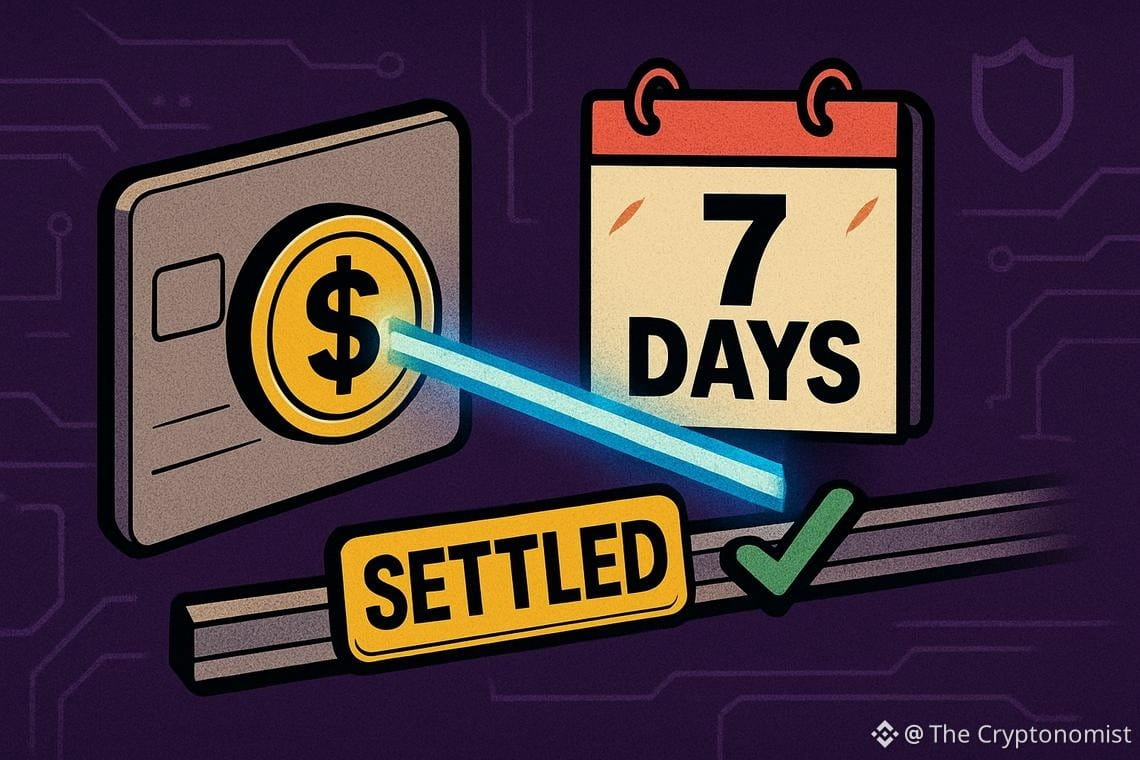
Artikel
Der Stablecoin-Abwicklungs-Pilot von Visa zielt auf grenzüberschreitende Zahlungen an 7 Tagen der WocheVisa testet, ob Stablecoins Zahlungen an jedem einzelnen Tag der Woche abwickeln können – einschließlich Wochenenden und Feiertagen – in einem Pilotprojekt, das möglicherweise verändert, wie Banken Geld über Grenzen hinweg bewegen. Das Karten-Netzwerk hat sich für einen Test im Rahmen der BLOOM-Initiative in Singapur mit dem grenzüberschreitenden Zahlungsanbieter Nium zusammengetan, um nachzuweisen, dass regulierte Stablecoins die Lücken schließen können, die durch die Öffnungszeiten des traditionellen Bankwesens entstehen. Der Visa-Stablecoin-Abwicklungs-Pilot ist das erste Projekt des Unternehmens innerhalb des Rahmens, der von der Monetary Authority of Singapore betrieben wird, und signalisiert einen stärkeren Vorstoß großer Zahlungsnetzwerke, Abwicklungswege aufzubauen, die sich nie wirklich schließen.
Der Stablecoin-Abwicklungs-Pilot von Visa zielt auf grenzüberschreitende Zahlungen an 7 Tagen der Woche
Visa testet, ob Stablecoins Zahlungen an jedem einzelnen Tag der Woche abwickeln können – einschließlich Wochenenden und Feiertagen – in einem Pilotprojekt, das möglicherweise verändert, wie Banken Geld über Grenzen hinweg bewegen. Das Karten-Netzwerk hat sich für einen Test im Rahmen der BLOOM-Initiative in Singapur mit dem grenzüberschreitenden Zahlungsanbieter Nium zusammengetan, um nachzuweisen, dass regulierte Stablecoins die Lücken schließen können, die durch die Öffnungszeiten des traditionellen Bankwesens entstehen. Der Visa-Stablecoin-Abwicklungs-Pilot ist das erste Projekt des Unternehmens innerhalb des Rahmens, der von der Monetary Authority of Singapore betrieben wird, und signalisiert einen stärkeren Vorstoß großer Zahlungsnetzwerke, Abwicklungswege aufzubauen, die sich nie wirklich schließen.
1
102
Artikel
Die Erholung des Altcoin-Markts bringt in 3 Tagen 215 Mrd. US-Dollar und übertrifft 1 Billion US-DollarEtwas hat sich im Kryptomarkt in der dritten Augustwoche verändert. Nachdem Altmünzen seit Monaten weit hinter Bitcoin zurücklagen, hat ein kräftiger Kaufimpuls den kombinierten Wert der Münzen außerhalb von Bitcoin und Ethereum in nur drei Tagen um rund 215 Milliarden US-Dollar nach oben getrieben. Diese eine Bewegung, bestätigt von mehreren Marktdaten-Trackern, hat die Diskussionen über eine Erholung des Altcoin-Markts neu entfacht und die Frage aufgeworfen, die Analysten die ganze Zeit über beschäftigt hat: Ist das der echte Beginn einer Altcoin-Saison – oder nur ein weiterer Fehlalarm?
Kernaussagen
Die Erholung des Altcoin-Markts bringt in 3 Tagen 215 Mrd. US-Dollar und übertrifft 1 Billion US-Dollar
Etwas hat sich im Kryptomarkt in der dritten Augustwoche verändert. Nachdem Altmünzen seit Monaten weit hinter Bitcoin zurücklagen, hat ein kräftiger Kaufimpuls den kombinierten Wert der Münzen außerhalb von Bitcoin und Ethereum in nur drei Tagen um rund 215 Milliarden US-Dollar nach oben getrieben. Diese eine Bewegung, bestätigt von mehreren Marktdaten-Trackern, hat die Diskussionen über eine Erholung des Altcoin-Markts neu entfacht und die Frage aufgeworfen, die Analysten die ganze Zeit über beschäftigt hat: Ist das der echte Beginn einer Altcoin-Saison – oder nur ein weiterer Fehlalarm?
Kernaussagen
Kernaussagen
148
Artikel
Übersetzung ansehen
AM Intelligence Nvidia order: 9,000 systems to power India’s AI factoryAn Indian AI infrastructure company just placed a hardware order large enough to make Nvidia’s supply chain take notice. AM Intelligence, the AI computing arm of India’s AM Group, has confirmed the AM Intelligence Nvidia order for 9,000 Vera Rubin NVL72 rack-scale systems, positioning the company as one of the first movers in Asia to deploy Nvidia’s newest AI computing platform at scale. The systems are destined for an AI factory in Hyderabad, and the order marks AMI’s first major hardware commitment inside a broader plan to spend more than $8 billion on AI compute infrastructure worldwide.
Key takeaways
AM Intelligence ordered 9,000 Nvidia Vera Rubin NVL72 rack-scale systems for an AI factory in Hyderabad, India.
Delivery is scheduled by Q1 2027, powering the facility’s initial 30 MW phase.
The order sits inside a wider plan to invest over $8 billion on AI compute infrastructure globally.
AM Group separately plans a $25 billion, 1 GW green-powered AI and HPC hub in Greater Noida, targeting 350 MW by 2028.
Customers for the Hyderabad facility include cloud providers, AI labs, and groups building homegrown Indian AI models, according to Bloomberg.
AM Intelligence’s record bet on Nvidia’s Vera Rubin platform
The scale of this deal is what sets it apart. Nine thousand Vera Rubin NVL72 systems represents one of the largest known commitments to Nvidia’s newest hardware anywhere in the world, and it comes just months after the platform entered full production in May 2026. For AM Intelligence, the order functions as a statement of intent: the company wants to be counted among the earliest adopters of Nvidia’s most advanced AI computing architecture, not a follower waiting for supply to loosen up.
Order details and delivery timeline
The systems are scheduled for delivery by Q1 2027, according to details shared by AM Intelligence, with servers expected to come online in southern India shortly after. Bloomberg reported that customers lined up for the Hyderabad facility include major cloud-service providers, AI labs, and organizations working to build homegrown Indian AI models — a mix that suggests the facility is being designed as shared infrastructure rather than a single-tenant buildout.
What makes Vera Rubin different
Nvidia built the Vera Rubin platform for what the industry calls agentic AI — systems capable of reasoning, planning, and taking actions on their own rather than simply responding to prompts. The NVL72 label refers to a rack-scale configuration, meaning each unit is a fully integrated computing rack engineered for massive AI workloads, not a chip dropped into an existing server. That distinction matters for buyers like AM Intelligence, since rack-scale systems require different power, cooling, and facility planning than traditional server deployments.
Hyderabad’s AI factory and its place in AMI’s $8 billion plan
The Hyderabad site will open with a 30 MW initial phase, a modest starting point relative to the company’s ambitions but a deliberate one. Rather than building out massive capacity immediately, AM Intelligence appears to be sequencing its rollout, using the first phase to validate performance of the Vera Rubin systems before committing further capital. That approach fits with the company’s stated plan to deploy over $8 billion across AI compute infrastructure globally, a figure that positions the Hyderabad facility as one node in a much larger network rather than a standalone project.
AM Group’s parallel bet: a $25 billion hub in Greater Noida
Hyderabad isn’t the only site on AM Group’s map. The company has also outlined a $25 billion, 1 GW green-powered AI and high-performance computing hub planned for Greater Noida, aiming to reach 350 MW of capacity by 2028. That project leans on the founders’ background running Greenko, India’s clean-energy leader, and signals an attempt to pair large-scale AI compute with renewable power rather than treating the two as separate problems. Together, the Hyderabad and Greater Noida projects represent the two pillars of AM Group’s AI strategy: one focused on rapid, near-term hardware deployment, the other on longer-term green infrastructure at gigawatt scale.
Why this matters for India’s sovereign AI push
Behind the hardware numbers sits a bigger strategic question. India has been pushing to build sovereign AI capabilities so that its companies and researchers aren’t entirely dependent on cloud providers headquartered elsewhere — a dependence that carries both cost implications and data sovereignty concerns. A domestic buildout of Nvidia Vera Rubin AI infrastructure, backed by billions in committed capital, gives Indian AI labs and enterprises a local alternative to running workloads through foreign-owned clouds.
That’s also why the delivery timeline carries weight beyond AM Intelligence’s own balance sheet. If the company brings its first 30 MW of Vera Rubin capacity online on schedule by Q1 2027, it would count among the fastest deployments of this hardware anywhere at scale, reinforcing confidence in the rest of AMI’s buildout and in the Greater Noida hub’s own 2028 targets. Any slippage, on the other hand, would ripple through both projects and test how much patience investors and government partners have for India’s sovereign AI compute ambitions.
FAQ
What is the scale of AM Intelligence’s Nvidia hardware order?
AM Intelligence ordered 9,000 Nvidia Vera Rubin NVL72 rack-scale systems for its Hyderabad AI factory, one of the largest known commitments to Nvidia’s newest platform.
When will the Nvidia Vera Rubin systems be delivered and operational?
By Q1 2027, the Hyderabad facility’s initial 30 MW phase is expected to receive these systems for operation.
What distinguishes Nvidia’s Vera Rubin platform?
It is purpose-built for agentic AI workloads, enabling AI systems to reason, plan, and act autonomously rather than simply respond to prompts.
What other major AI infrastructure projects does AM Group have planned?
AM Group plans a separate $25 billion, 1 GW green-powered AI and HPC hub in Greater Noida, targeting 350 MW of capacity by 2028.
Article produced with the assistance of artificial intelligence and reviewed by the editorial team.
AM Intelligence Nvidia order: 9,000 systems to power India’s AI factory
An Indian AI infrastructure company just placed a hardware order large enough to make Nvidia’s supply chain take notice. AM Intelligence, the AI computing arm of India’s AM Group, has confirmed the AM Intelligence Nvidia order for 9,000 Vera Rubin NVL72 rack-scale systems, positioning the company as one of the first movers in Asia to deploy Nvidia’s newest AI computing platform at scale. The systems are destined for an AI factory in Hyderabad, and the order marks AMI’s first major hardware commitment inside a broader plan to spend more than $8 billion on AI compute infrastructure worldwide.
Key takeaways
AM Intelligence ordered 9,000 Nvidia Vera Rubin NVL72 rack-scale systems for an AI factory in Hyderabad, India.
Delivery is scheduled by Q1 2027, powering the facility’s initial 30 MW phase.
The order sits inside a wider plan to invest over $8 billion on AI compute infrastructure globally.
AM Group separately plans a $25 billion, 1 GW green-powered AI and HPC hub in Greater Noida, targeting 350 MW by 2028.
Customers for the Hyderabad facility include cloud providers, AI labs, and groups building homegrown Indian AI models, according to Bloomberg.
AM Intelligence’s record bet on Nvidia’s Vera Rubin platform
The scale of this deal is what sets it apart. Nine thousand Vera Rubin NVL72 systems represents one of the largest known commitments to Nvidia’s newest hardware anywhere in the world, and it comes just months after the platform entered full production in May 2026. For AM Intelligence, the order functions as a statement of intent: the company wants to be counted among the earliest adopters of Nvidia’s most advanced AI computing architecture, not a follower waiting for supply to loosen up.
Order details and delivery timeline
The systems are scheduled for delivery by Q1 2027, according to details shared by AM Intelligence, with servers expected to come online in southern India shortly after. Bloomberg reported that customers lined up for the Hyderabad facility include major cloud-service providers, AI labs, and organizations working to build homegrown Indian AI models — a mix that suggests the facility is being designed as shared infrastructure rather than a single-tenant buildout.
What makes Vera Rubin different
Nvidia built the Vera Rubin platform for what the industry calls agentic AI — systems capable of reasoning, planning, and taking actions on their own rather than simply responding to prompts. The NVL72 label refers to a rack-scale configuration, meaning each unit is a fully integrated computing rack engineered for massive AI workloads, not a chip dropped into an existing server. That distinction matters for buyers like AM Intelligence, since rack-scale systems require different power, cooling, and facility planning than traditional server deployments.
Hyderabad’s AI factory and its place in AMI’s $8 billion plan
The Hyderabad site will open with a 30 MW initial phase, a modest starting point relative to the company’s ambitions but a deliberate one. Rather than building out massive capacity immediately, AM Intelligence appears to be sequencing its rollout, using the first phase to validate performance of the Vera Rubin systems before committing further capital. That approach fits with the company’s stated plan to deploy over $8 billion across AI compute infrastructure globally, a figure that positions the Hyderabad facility as one node in a much larger network rather than a standalone project.
AM Group’s parallel bet: a $25 billion hub in Greater Noida
Hyderabad isn’t the only site on AM Group’s map. The company has also outlined a $25 billion, 1 GW green-powered AI and high-performance computing hub planned for Greater Noida, aiming to reach 350 MW of capacity by 2028. That project leans on the founders’ background running Greenko, India’s clean-energy leader, and signals an attempt to pair large-scale AI compute with renewable power rather than treating the two as separate problems. Together, the Hyderabad and Greater Noida projects represent the two pillars of AM Group’s AI strategy: one focused on rapid, near-term hardware deployment, the other on longer-term green infrastructure at gigawatt scale.
Why this matters for India’s sovereign AI push
Behind the hardware numbers sits a bigger strategic question. India has been pushing to build sovereign AI capabilities so that its companies and researchers aren’t entirely dependent on cloud providers headquartered elsewhere — a dependence that carries both cost implications and data sovereignty concerns. A domestic buildout of Nvidia Vera Rubin AI infrastructure, backed by billions in committed capital, gives Indian AI labs and enterprises a local alternative to running workloads through foreign-owned clouds.
That’s also why the delivery timeline carries weight beyond AM Intelligence’s own balance sheet. If the company brings its first 30 MW of Vera Rubin capacity online on schedule by Q1 2027, it would count among the fastest deployments of this hardware anywhere at scale, reinforcing confidence in the rest of AMI’s buildout and in the Greater Noida hub’s own 2028 targets. Any slippage, on the other hand, would ripple through both projects and test how much patience investors and government partners have for India’s sovereign AI compute ambitions.
FAQ
What is the scale of AM Intelligence’s Nvidia hardware order?
AM Intelligence ordered 9,000 Nvidia Vera Rubin NVL72 rack-scale systems for its Hyderabad AI factory, one of the largest known commitments to Nvidia’s newest platform.
When will the Nvidia Vera Rubin systems be delivered and operational?
By Q1 2027, the Hyderabad facility’s initial 30 MW phase is expected to receive these systems for operation.
What distinguishes Nvidia’s Vera Rubin platform?
It is purpose-built for agentic AI workloads, enabling AI systems to reason, plan, and act autonomously rather than simply respond to prompts.
What other major AI infrastructure projects does AM Group have planned?
AM Group plans a separate $25 billion, 1 GW green-powered AI and HPC hub in Greater Noida, targeting 350 MW of capacity by 2028.
Article produced with the assistance of artificial intelligence and reviewed by the editorial team.
Key takeaways
AM Intelligence ordered 9,000 Nvidia Vera Rubin NVL72 rack-scale systems for an AI factory in Hyderabad, India.
Delivery is scheduled by Q1 2027, powering the facility’s initial 30 MW phase.
The order sits inside a wider plan to invest over $8 billion on AI compute infrastructure globally.
AM Group separately plans a $25 billion, 1 GW green-powered AI and HPC hub in Greater Noida, targeting 350 MW by 2028.
Customers for the Hyderabad facility include cloud providers, AI labs, and groups building homegrown Indian AI models, according to Bloomberg.
AM Intelligence’s record bet on Nvidia’s Vera Rubin platform
The scale of this deal is what sets it apart. Nine thousand Vera Rubin NVL72 systems represents one of the largest known commitments to Nvidia’s newest hardware anywhere in the world, and it comes just months after the platform entered full production in May 2026. For AM Intelligence, the order functions as a statement of intent: the company wants to be counted among the earliest adopters of Nvidia’s most advanced AI computing architecture, not a follower waiting for supply to loosen up.
Order details and delivery timeline
The systems are scheduled for delivery by Q1 2027, according to details shared by AM Intelligence, with servers expected to come online in southern India shortly after. Bloomberg reported that customers lined up for the Hyderabad facility include major cloud-service providers, AI labs, and organizations working to build homegrown Indian AI models — a mix that suggests the facility is being designed as shared infrastructure rather than a single-tenant buildout.
What makes Vera Rubin different
Nvidia built the Vera Rubin platform for what the industry calls agentic AI — systems capable of reasoning, planning, and taking actions on their own rather than simply responding to prompts. The NVL72 label refers to a rack-scale configuration, meaning each unit is a fully integrated computing rack engineered for massive AI workloads, not a chip dropped into an existing server. That distinction matters for buyers like AM Intelligence, since rack-scale systems require different power, cooling, and facility planning than traditional server deployments.
Hyderabad’s AI factory and its place in AMI’s $8 billion plan
The Hyderabad site will open with a 30 MW initial phase, a modest starting point relative to the company’s ambitions but a deliberate one. Rather than building out massive capacity immediately, AM Intelligence appears to be sequencing its rollout, using the first phase to validate performance of the Vera Rubin systems before committing further capital. That approach fits with the company’s stated plan to deploy over $8 billion across AI compute infrastructure globally, a figure that positions the Hyderabad facility as one node in a much larger network rather than a standalone project.
AM Group’s parallel bet: a $25 billion hub in Greater Noida
Hyderabad isn’t the only site on AM Group’s map. The company has also outlined a $25 billion, 1 GW green-powered AI and high-performance computing hub planned for Greater Noida, aiming to reach 350 MW of capacity by 2028. That project leans on the founders’ background running Greenko, India’s clean-energy leader, and signals an attempt to pair large-scale AI compute with renewable power rather than treating the two as separate problems. Together, the Hyderabad and Greater Noida projects represent the two pillars of AM Group’s AI strategy: one focused on rapid, near-term hardware deployment, the other on longer-term green infrastructure at gigawatt scale.
Why this matters for India’s sovereign AI push
Behind the hardware numbers sits a bigger strategic question. India has been pushing to build sovereign AI capabilities so that its companies and researchers aren’t entirely dependent on cloud providers headquartered elsewhere — a dependence that carries both cost implications and data sovereignty concerns. A domestic buildout of Nvidia Vera Rubin AI infrastructure, backed by billions in committed capital, gives Indian AI labs and enterprises a local alternative to running workloads through foreign-owned clouds.
That’s also why the delivery timeline carries weight beyond AM Intelligence’s own balance sheet. If the company brings its first 30 MW of Vera Rubin capacity online on schedule by Q1 2027, it would count among the fastest deployments of this hardware anywhere at scale, reinforcing confidence in the rest of AMI’s buildout and in the Greater Noida hub’s own 2028 targets. Any slippage, on the other hand, would ripple through both projects and test how much patience investors and government partners have for India’s sovereign AI compute ambitions.
FAQ
What is the scale of AM Intelligence’s Nvidia hardware order?
AM Intelligence ordered 9,000 Nvidia Vera Rubin NVL72 rack-scale systems for its Hyderabad AI factory, one of the largest known commitments to Nvidia’s newest platform.
When will the Nvidia Vera Rubin systems be delivered and operational?
By Q1 2027, the Hyderabad facility’s initial 30 MW phase is expected to receive these systems for operation.
What distinguishes Nvidia’s Vera Rubin platform?
It is purpose-built for agentic AI workloads, enabling AI systems to reason, plan, and act autonomously rather than simply respond to prompts.
What other major AI infrastructure projects does AM Group have planned?
AM Group plans a separate $25 billion, 1 GW green-powered AI and HPC hub in Greater Noida, targeting 350 MW of capacity by 2028.
Article produced with the assistance of artificial intelligence and reviewed by the editorial team.
16
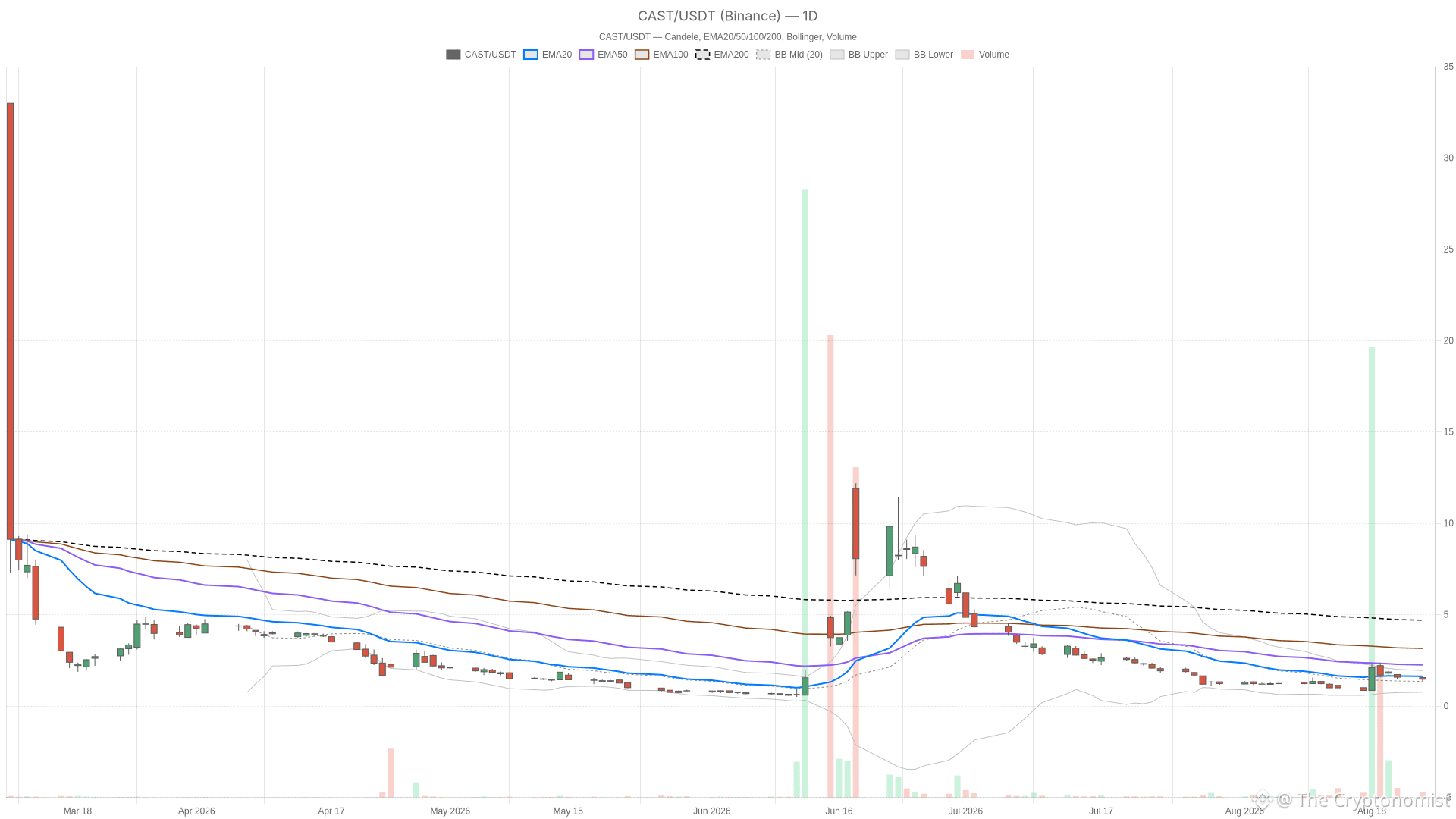
Artikel
Übersetzung ansehen
FreeCast Stock Sinks to $1.47 as Bearish Trend Deepens Below Key EMAsFreeCast stock (CAST) remains under firm selling pressure, closing at $1.47 on August 24 after touching a session low of $1.38. Sellers stayed active into the close, and the daily structure tells a difficult story for anyone tracking CAST right now.
CAST — daily chart with candlesticks, EMA20/EMA50 and volume.
Key takeaways
CAST closed at $1.47 on August 24, down from an open of $1.56 and well off the session high of $1.58.
Daily EMA20 ($1.63), EMA50 ($2.26), and EMA200 ($4.70) all sit above price, confirming a bearish regime.
Daily RSI14 at 45.21 signals neutral momentum — not yet oversold despite the extended decline.
Daily ATR14 of $0.34 reflects elevated volatility relative to the $1.47 share price.
The hourly chart shows a neutral consolidation pattern, suggesting sellers are pausing rather than pressing further.
Daily Trend Confirms Bearish Bias for FreeCast Stock
FreeCast stock’s daily trend remains firmly bearish. Price trades below every major moving average, and momentum indicators confirm that sellers still control the broader structure. The daily indicators leave little room for ambiguity. Price sits below the EMA20 at $1.63, below the EMA50 at $2.26, and well below the EMA200 at $4.70. That stacked EMA alignment points to steady medium-term losses. The system’s bearish regime tag reinforces this read. Notably, the gap between price and the EMA200 tells the real story. This is not a minor pullback — it is a deep, extended decline.
Momentum Signals: Slowing but Still Negative
RSI14 on the daily reads 45.21, which is neutral rather than oversold. That matters. It means momentum has not reached exhaustion levels, so there is no strong statistical case yet for a mean-reversion bounce. Meanwhile, the daily MACD shows the line at -0.27 against a signal of -0.41, with a histogram of +0.14. The positive histogram suggests the decline is slowing. However, with both line and signal still negative, momentum remains technically bearish. In other words, sellers are less aggressive than they were, without yet losing control.
Volatility and Pivot Context
The daily Bollinger Bands frame the volatility backdrop: mid at $1.35, upper at $1.95, lower at $0.76. Price at $1.47 sits above the midline but nowhere near the upper band. That keeps the broader read cautious rather than constructive. ATR14 stands at $0.34, a large figure relative to a $1.47 share price. That is a volatility footprint traders need to respect. Daily ranges of this magnitude can produce sharp moves in either direction. Daily pivot levels sit at pp $1.48, r1 $1.57, and s1 $1.37, with Monday’s close landing almost exactly on the pivot itself.
Hourly Chart Shows Signs of Consolidation
The hourly chart for CAST shows a neutral consolidation pattern rather than a continued selloff, though sellers still hold the structural advantage. Price closed at $1.46, still below the EMA20 ($1.56), EMA50 ($1.50), and EMA200 ($2.10). That EMA stack technically still favors sellers. However, the system classifies the H1 regime as neutral, not bearish, and that distinction is worth noting. RSI14 on H1 reads 43.65, broadly in line with the daily reading. MACD is essentially flat: line at -0.02 versus signal at +0.01, with a small negative histogram of -0.03. This is not a strong directional signal in either direction.
The H1 Bollinger setup (mid $1.62, upper $1.90, lower $1.34) has price sitting closer to the lower half of the range. That keeps pressure tilted toward sellers without confirming a breakdown. Meanwhile, the H1 pivot at $1.47 lines up almost precisely with the current price. Such alignment often signals indecision rather than conviction. Therefore, the hourly chart is best read as a pause inside the larger downtrend rather than a genuine reversal signal.
Short-Term Execution: 15-Minute Range
The 15-minute timeframe for FreeCast stock reflects a tight, choppy range. It is useful for timing entries and exits but offers no standalone directional signal. Price closed at $1.46, wedged between the EMA20 ($1.48) and EMA200 ($1.47), and below the EMA50 ($1.53). RSI14 at 43.85 mirrors the higher timeframes almost exactly. MACD shows a marginal positive histogram of +0.01. This small tick hints at short-term stabilization but carries little weight on its own. The 15m Bollinger Bands sit at mid $1.48, upper $1.55, and lower $1.40. Together with the pivot cluster around $1.47–$1.50, they confirm the stock is trading in a narrow, choppy range right now.
Bullish Scenario: What Would Change the Picture
For FreeCast stock to build a constructive case, price would need to reclaim the daily pivot at $1.48. It would then need to push through resistance near $1.57 — the daily r1. That would be the first meaningful sign that sellers are losing their grip. On top of that, the daily MACD histogram would need to keep expanding on the positive side. This would confirm that the deceleration in downside momentum is turning into genuine reversal. A daily RSI move back above 50, paired with price reclaiming the EMA20 at $1.63, would further support a shift in structure. On the fundamental side, FreeCast announced plans to relaunch the Investor News Channel on August 18. The initiative aims to create a next-generation global business and financial FAST network. If this development gains traction with investors, it could positively feed into sentiment.
Bearish Scenario: Downside Risks Remain
The bearish scenario for CAST remains the path of least resistance given the current daily regime. A rejection near the pivot zone, followed by a break below the daily s1 at $1.37, would open the door toward the lower Bollinger band. That band sits at $0.76. The wide gap between these levels reflects just how stretched this downtrend has become. On the hourly chart, a decisive break below the $1.43 support (H1 s1) would be significant. It would confirm that the current consolidation is resolving lower rather than building a base. The EMA200 readings across both daily and hourly timeframes remain far above current price. The broader trend context therefore continues to favor sellers until proven otherwise.
Closing Thoughts on FreeCast Stock Positioning
Overall, FreeCast stock is caught between a clearly bearish daily trend and a short-term consolidation on the lower timeframes. The daily EMA structure and regime tag argue for caution. At the same time, the flattening MACD histogram and neutral H1 regime suggest sellers may be pausing rather than pressing further. The elevated ATR14 reading on the daily chart is a reminder that volatility remains high. Moves in either direction could be sharp once the current range resolves. Given the mixed signals across timeframes, positioning around CAST calls for discipline. Focus should remain on the key pivot and support levels rather than conviction in either direction.
FAQ
What is the current trend for FreeCast stock?
FreeCast stock is in a firmly bearish daily trend. Price trades below the EMA20 ($1.63), EMA50 ($2.26), and EMA200 ($4.70). The system classifies the daily regime as bearish. The hourly chart shows a neutral consolidation, but this is best read as a pause within the larger downtrend — not a reversal.
What are the key support and resistance levels for CAST?
Key support sits at the daily s1 of $1.37, with the lower Bollinger band at $0.76 representing a deeper downside target. On the hourly chart, $1.43 (H1 s1) is a critical near-term level. Resistance is clustered around the daily pivot at $1.48 and the daily r1 at $1.57. The EMA20 at $1.63 represents a more significant structural resistance.
Is FreeCast stock showing any signs of a reversal?
Not yet. The daily MACD histogram has turned positive, suggesting the pace of decline is slowing. However, both the MACD line and signal remain negative. RSI14 at 45.21 is neutral — not oversold. For a genuine reversal signal, CAST would need to reclaim the EMA20 at $1.63 with RSI moving above 50 and the MACD histogram continuing to expand positively.
What recent corporate news could affect FreeCast stock?
On August 18, FreeCast announced plans to relaunch the Investor News Channel as a next-generation global business and financial FAST network. If this initiative gains traction with investors, it could positively influence sentiment around the stock.
Disclaimer: This article is for informational purposes only and does not constitute financial advice, an investment recommendation, or a solicitation to buy or sell any financial instrument or cryptocurrency. The analysis provided is not indicative of future results. Investing in crypto assets and financial markets carries a high risk of capital loss. Always do your own research (DYOR) and consult a qualified financial advisor before making any decision.
Article produced with the assistance of artificial intelligence and reviewed by the editorial team.
FreeCast Stock Sinks to $1.47 as Bearish Trend Deepens Below Key EMAs
FreeCast stock (CAST) remains under firm selling pressure, closing at $1.47 on August 24 after touching a session low of $1.38. Sellers stayed active into the close, and the daily structure tells a difficult story for anyone tracking CAST right now.
CAST — daily chart with candlesticks, EMA20/EMA50 and volume.
Key takeaways
CAST closed at $1.47 on August 24, down from an open of $1.56 and well off the session high of $1.58.
Daily EMA20 ($1.63), EMA50 ($2.26), and EMA200 ($4.70) all sit above price, confirming a bearish regime.
Daily RSI14 at 45.21 signals neutral momentum — not yet oversold despite the extended decline.
Daily ATR14 of $0.34 reflects elevated volatility relative to the $1.47 share price.
The hourly chart shows a neutral consolidation pattern, suggesting sellers are pausing rather than pressing further.
Daily Trend Confirms Bearish Bias for FreeCast Stock
FreeCast stock’s daily trend remains firmly bearish. Price trades below every major moving average, and momentum indicators confirm that sellers still control the broader structure. The daily indicators leave little room for ambiguity. Price sits below the EMA20 at $1.63, below the EMA50 at $2.26, and well below the EMA200 at $4.70. That stacked EMA alignment points to steady medium-term losses. The system’s bearish regime tag reinforces this read. Notably, the gap between price and the EMA200 tells the real story. This is not a minor pullback — it is a deep, extended decline.
Momentum Signals: Slowing but Still Negative
RSI14 on the daily reads 45.21, which is neutral rather than oversold. That matters. It means momentum has not reached exhaustion levels, so there is no strong statistical case yet for a mean-reversion bounce. Meanwhile, the daily MACD shows the line at -0.27 against a signal of -0.41, with a histogram of +0.14. The positive histogram suggests the decline is slowing. However, with both line and signal still negative, momentum remains technically bearish. In other words, sellers are less aggressive than they were, without yet losing control.
Volatility and Pivot Context
The daily Bollinger Bands frame the volatility backdrop: mid at $1.35, upper at $1.95, lower at $0.76. Price at $1.47 sits above the midline but nowhere near the upper band. That keeps the broader read cautious rather than constructive. ATR14 stands at $0.34, a large figure relative to a $1.47 share price. That is a volatility footprint traders need to respect. Daily ranges of this magnitude can produce sharp moves in either direction. Daily pivot levels sit at pp $1.48, r1 $1.57, and s1 $1.37, with Monday’s close landing almost exactly on the pivot itself.
Hourly Chart Shows Signs of Consolidation
The hourly chart for CAST shows a neutral consolidation pattern rather than a continued selloff, though sellers still hold the structural advantage. Price closed at $1.46, still below the EMA20 ($1.56), EMA50 ($1.50), and EMA200 ($2.10). That EMA stack technically still favors sellers. However, the system classifies the H1 regime as neutral, not bearish, and that distinction is worth noting. RSI14 on H1 reads 43.65, broadly in line with the daily reading. MACD is essentially flat: line at -0.02 versus signal at +0.01, with a small negative histogram of -0.03. This is not a strong directional signal in either direction.
The H1 Bollinger setup (mid $1.62, upper $1.90, lower $1.34) has price sitting closer to the lower half of the range. That keeps pressure tilted toward sellers without confirming a breakdown. Meanwhile, the H1 pivot at $1.47 lines up almost precisely with the current price. Such alignment often signals indecision rather than conviction. Therefore, the hourly chart is best read as a pause inside the larger downtrend rather than a genuine reversal signal.
Short-Term Execution: 15-Minute Range
The 15-minute timeframe for FreeCast stock reflects a tight, choppy range. It is useful for timing entries and exits but offers no standalone directional signal. Price closed at $1.46, wedged between the EMA20 ($1.48) and EMA200 ($1.47), and below the EMA50 ($1.53). RSI14 at 43.85 mirrors the higher timeframes almost exactly. MACD shows a marginal positive histogram of +0.01. This small tick hints at short-term stabilization but carries little weight on its own. The 15m Bollinger Bands sit at mid $1.48, upper $1.55, and lower $1.40. Together with the pivot cluster around $1.47–$1.50, they confirm the stock is trading in a narrow, choppy range right now.
Bullish Scenario: What Would Change the Picture
For FreeCast stock to build a constructive case, price would need to reclaim the daily pivot at $1.48. It would then need to push through resistance near $1.57 — the daily r1. That would be the first meaningful sign that sellers are losing their grip. On top of that, the daily MACD histogram would need to keep expanding on the positive side. This would confirm that the deceleration in downside momentum is turning into genuine reversal. A daily RSI move back above 50, paired with price reclaiming the EMA20 at $1.63, would further support a shift in structure. On the fundamental side, FreeCast announced plans to relaunch the Investor News Channel on August 18. The initiative aims to create a next-generation global business and financial FAST network. If this development gains traction with investors, it could positively feed into sentiment.
Bearish Scenario: Downside Risks Remain
The bearish scenario for CAST remains the path of least resistance given the current daily regime. A rejection near the pivot zone, followed by a break below the daily s1 at $1.37, would open the door toward the lower Bollinger band. That band sits at $0.76. The wide gap between these levels reflects just how stretched this downtrend has become. On the hourly chart, a decisive break below the $1.43 support (H1 s1) would be significant. It would confirm that the current consolidation is resolving lower rather than building a base. The EMA200 readings across both daily and hourly timeframes remain far above current price. The broader trend context therefore continues to favor sellers until proven otherwise.
Closing Thoughts on FreeCast Stock Positioning
Overall, FreeCast stock is caught between a clearly bearish daily trend and a short-term consolidation on the lower timeframes. The daily EMA structure and regime tag argue for caution. At the same time, the flattening MACD histogram and neutral H1 regime suggest sellers may be pausing rather than pressing further. The elevated ATR14 reading on the daily chart is a reminder that volatility remains high. Moves in either direction could be sharp once the current range resolves. Given the mixed signals across timeframes, positioning around CAST calls for discipline. Focus should remain on the key pivot and support levels rather than conviction in either direction.
FAQ
What is the current trend for FreeCast stock?
FreeCast stock is in a firmly bearish daily trend. Price trades below the EMA20 ($1.63), EMA50 ($2.26), and EMA200 ($4.70). The system classifies the daily regime as bearish. The hourly chart shows a neutral consolidation, but this is best read as a pause within the larger downtrend — not a reversal.
What are the key support and resistance levels for CAST?
Key support sits at the daily s1 of $1.37, with the lower Bollinger band at $0.76 representing a deeper downside target. On the hourly chart, $1.43 (H1 s1) is a critical near-term level. Resistance is clustered around the daily pivot at $1.48 and the daily r1 at $1.57. The EMA20 at $1.63 represents a more significant structural resistance.
Is FreeCast stock showing any signs of a reversal?
Not yet. The daily MACD histogram has turned positive, suggesting the pace of decline is slowing. However, both the MACD line and signal remain negative. RSI14 at 45.21 is neutral — not oversold. For a genuine reversal signal, CAST would need to reclaim the EMA20 at $1.63 with RSI moving above 50 and the MACD histogram continuing to expand positively.
What recent corporate news could affect FreeCast stock?
On August 18, FreeCast announced plans to relaunch the Investor News Channel as a next-generation global business and financial FAST network. If this initiative gains traction with investors, it could positively influence sentiment around the stock.
Disclaimer: This article is for informational purposes only and does not constitute financial advice, an investment recommendation, or a solicitation to buy or sell any financial instrument or cryptocurrency. The analysis provided is not indicative of future results. Investing in crypto assets and financial markets carries a high risk of capital loss. Always do your own research (DYOR) and consult a qualified financial advisor before making any decision.
Article produced with the assistance of artificial intelligence and reviewed by the editorial team.
CAST — daily chart with candlesticks, EMA20/EMA50 and volume.
Key takeaways
CAST closed at $1.47 on August 24, down from an open of $1.56 and well off the session high of $1.58.
Daily EMA20 ($1.63), EMA50 ($2.26), and EMA200 ($4.70) all sit above price, confirming a bearish regime.
Daily RSI14 at 45.21 signals neutral momentum — not yet oversold despite the extended decline.
Daily ATR14 of $0.34 reflects elevated volatility relative to the $1.47 share price.
The hourly chart shows a neutral consolidation pattern, suggesting sellers are pausing rather than pressing further.
Daily Trend Confirms Bearish Bias for FreeCast Stock
FreeCast stock’s daily trend remains firmly bearish. Price trades below every major moving average, and momentum indicators confirm that sellers still control the broader structure. The daily indicators leave little room for ambiguity. Price sits below the EMA20 at $1.63, below the EMA50 at $2.26, and well below the EMA200 at $4.70. That stacked EMA alignment points to steady medium-term losses. The system’s bearish regime tag reinforces this read. Notably, the gap between price and the EMA200 tells the real story. This is not a minor pullback — it is a deep, extended decline.
Momentum Signals: Slowing but Still Negative
RSI14 on the daily reads 45.21, which is neutral rather than oversold. That matters. It means momentum has not reached exhaustion levels, so there is no strong statistical case yet for a mean-reversion bounce. Meanwhile, the daily MACD shows the line at -0.27 against a signal of -0.41, with a histogram of +0.14. The positive histogram suggests the decline is slowing. However, with both line and signal still negative, momentum remains technically bearish. In other words, sellers are less aggressive than they were, without yet losing control.
Volatility and Pivot Context
The daily Bollinger Bands frame the volatility backdrop: mid at $1.35, upper at $1.95, lower at $0.76. Price at $1.47 sits above the midline but nowhere near the upper band. That keeps the broader read cautious rather than constructive. ATR14 stands at $0.34, a large figure relative to a $1.47 share price. That is a volatility footprint traders need to respect. Daily ranges of this magnitude can produce sharp moves in either direction. Daily pivot levels sit at pp $1.48, r1 $1.57, and s1 $1.37, with Monday’s close landing almost exactly on the pivot itself.
Hourly Chart Shows Signs of Consolidation
The hourly chart for CAST shows a neutral consolidation pattern rather than a continued selloff, though sellers still hold the structural advantage. Price closed at $1.46, still below the EMA20 ($1.56), EMA50 ($1.50), and EMA200 ($2.10). That EMA stack technically still favors sellers. However, the system classifies the H1 regime as neutral, not bearish, and that distinction is worth noting. RSI14 on H1 reads 43.65, broadly in line with the daily reading. MACD is essentially flat: line at -0.02 versus signal at +0.01, with a small negative histogram of -0.03. This is not a strong directional signal in either direction.
The H1 Bollinger setup (mid $1.62, upper $1.90, lower $1.34) has price sitting closer to the lower half of the range. That keeps pressure tilted toward sellers without confirming a breakdown. Meanwhile, the H1 pivot at $1.47 lines up almost precisely with the current price. Such alignment often signals indecision rather than conviction. Therefore, the hourly chart is best read as a pause inside the larger downtrend rather than a genuine reversal signal.
Short-Term Execution: 15-Minute Range
The 15-minute timeframe for FreeCast stock reflects a tight, choppy range. It is useful for timing entries and exits but offers no standalone directional signal. Price closed at $1.46, wedged between the EMA20 ($1.48) and EMA200 ($1.47), and below the EMA50 ($1.53). RSI14 at 43.85 mirrors the higher timeframes almost exactly. MACD shows a marginal positive histogram of +0.01. This small tick hints at short-term stabilization but carries little weight on its own. The 15m Bollinger Bands sit at mid $1.48, upper $1.55, and lower $1.40. Together with the pivot cluster around $1.47–$1.50, they confirm the stock is trading in a narrow, choppy range right now.
Bullish Scenario: What Would Change the Picture
For FreeCast stock to build a constructive case, price would need to reclaim the daily pivot at $1.48. It would then need to push through resistance near $1.57 — the daily r1. That would be the first meaningful sign that sellers are losing their grip. On top of that, the daily MACD histogram would need to keep expanding on the positive side. This would confirm that the deceleration in downside momentum is turning into genuine reversal. A daily RSI move back above 50, paired with price reclaiming the EMA20 at $1.63, would further support a shift in structure. On the fundamental side, FreeCast announced plans to relaunch the Investor News Channel on August 18. The initiative aims to create a next-generation global business and financial FAST network. If this development gains traction with investors, it could positively feed into sentiment.
Bearish Scenario: Downside Risks Remain
The bearish scenario for CAST remains the path of least resistance given the current daily regime. A rejection near the pivot zone, followed by a break below the daily s1 at $1.37, would open the door toward the lower Bollinger band. That band sits at $0.76. The wide gap between these levels reflects just how stretched this downtrend has become. On the hourly chart, a decisive break below the $1.43 support (H1 s1) would be significant. It would confirm that the current consolidation is resolving lower rather than building a base. The EMA200 readings across both daily and hourly timeframes remain far above current price. The broader trend context therefore continues to favor sellers until proven otherwise.
Closing Thoughts on FreeCast Stock Positioning
Overall, FreeCast stock is caught between a clearly bearish daily trend and a short-term consolidation on the lower timeframes. The daily EMA structure and regime tag argue for caution. At the same time, the flattening MACD histogram and neutral H1 regime suggest sellers may be pausing rather than pressing further. The elevated ATR14 reading on the daily chart is a reminder that volatility remains high. Moves in either direction could be sharp once the current range resolves. Given the mixed signals across timeframes, positioning around CAST calls for discipline. Focus should remain on the key pivot and support levels rather than conviction in either direction.
FAQ
What is the current trend for FreeCast stock?
FreeCast stock is in a firmly bearish daily trend. Price trades below the EMA20 ($1.63), EMA50 ($2.26), and EMA200 ($4.70). The system classifies the daily regime as bearish. The hourly chart shows a neutral consolidation, but this is best read as a pause within the larger downtrend — not a reversal.
What are the key support and resistance levels for CAST?
Key support sits at the daily s1 of $1.37, with the lower Bollinger band at $0.76 representing a deeper downside target. On the hourly chart, $1.43 (H1 s1) is a critical near-term level. Resistance is clustered around the daily pivot at $1.48 and the daily r1 at $1.57. The EMA20 at $1.63 represents a more significant structural resistance.
Is FreeCast stock showing any signs of a reversal?
Not yet. The daily MACD histogram has turned positive, suggesting the pace of decline is slowing. However, both the MACD line and signal remain negative. RSI14 at 45.21 is neutral — not oversold. For a genuine reversal signal, CAST would need to reclaim the EMA20 at $1.63 with RSI moving above 50 and the MACD histogram continuing to expand positively.
What recent corporate news could affect FreeCast stock?
On August 18, FreeCast announced plans to relaunch the Investor News Channel as a next-generation global business and financial FAST network. If this initiative gains traction with investors, it could positively influence sentiment around the stock.
Disclaimer: This article is for informational purposes only and does not constitute financial advice, an investment recommendation, or a solicitation to buy or sell any financial instrument or cryptocurrency. The analysis provided is not indicative of future results. Investing in crypto assets and financial markets carries a high risk of capital loss. Always do your own research (DYOR) and consult a qualified financial advisor before making any decision.
Article produced with the assistance of artificial intelligence and reviewed by the editorial team.
13
Artikel
Übersetzung ansehen
USDC AI Payments Reach 99% Share as Circle Eyes 60% Stock UpsideCircle’s chief executive has put a number on something the crypto industry has been buzzing about quietly for months: USDC AI payments now make up nearly the entire market for machine-driven transactions. According to Coinfomania, Circle’s CEO, Allaire, said USDC holds a 99% share of payments made by artificial intelligence systems, a figure that reframes how investors and developers should think about where stablecoins are headed next.
Key takeaways
USDC controls roughly 99% of AI payment activity, according to remarks from Circle’s CEO reported by Coinfomania.
USDC is a dollar-pegged stablecoin issued by Circle, backed 1:1 by reserves and subject to regulatory compliance requirements.
USDC’s supply grew by about $2 billion in seven days, according to a Bernstein research note cited by Cointelegraph, reversing six months of flat growth.
Bernstein set a $140 price target on Circle stock (CRCL), implying roughly 60% upside, while USDC’s share of adjusted stablecoin transaction volume climbed from about 40% in 2025 to more than 60% in 2026, overtaking Tether’s USDT by that measure.
Regulators continue to scrutinize stablecoins as digital payment methods, including QR codes and instant settlements, expand globally.
USDC’s Dominance in AI Payments
USDC’s near-total grip on AI-driven transactions signals that stablecoins have quietly become the default settlement layer for machine-to-machine commerce. Allaire’s disclosure of the 99% share came as the broader crypto market showed mixed momentum, with several assets moving in different directions at once. Against that backdrop, USDC’s position looked notably steady.
Why AI systems are choosing USDC
The logic behind this dominance is straightforward: AI agents need a payment rail that settles instantly, holds a stable value, and doesn’t require a bank intermediary for every micro-transaction. USDC’s stability and reliability, according to Allaire’s remarks, make it a natural fit for these automated payment mechanisms as they gain traction across the industry. That reliability isn’t accidental — it stems from how the token is built and backed.
USDC’s Foundation and Market Position
USDC is a stablecoin issued by Circle and designed to hold a strict 1:1 peg with the US dollar, which is what makes it usable as a dependable medium of exchange for both human and machine-initiated transactions. That peg is supported by real-time reserve backing and regulatory compliance, features that give USDC a competitive edge as digital payments grow more complex.
Even so, USDC is not the largest dollar-pegged token by total market capitalization. Cointelegraph reported that USDC remains the second-largest dollar-backed stablecoin, trailing Tether’s USDt (USDT). But size isn’t the whole story. Bernstein’s research, cited by Cointelegraph, found that USDC’s the proportion of adjusted stablecoin transaction volume increased from approximately 40% during 2025 to exceeding 60% through 2026 to date — a shift that means USDC is now moving more transaction volume than USDT, even while carrying a smaller overall float. That distinction between market cap and transaction share is exactly why the AI payments statistic matters: it points to usage, not just size.
Circle’s Stock Outlook Tied to USDC Growth
Wall Street analysts are treating this transaction-volume shift as evidence of a genuine turning point rather than a short-term blip. Bernstein described USDC’s recent trajectory as a “digital dollar reflation,” pointing to a roughly $2 billion increase in USDC supply over just seven days — a reversal after six months of stagnant or declining growth, according to the firm’s research note reported by Cointelegraph.
Bernstein maintained an Outperform rating on Circle (CRCL) and set a $140 price target, implying around 60% upside from current levels at the time of the note. Circle shares had already climbed roughly 40% over the prior month. The firm attributed the renewed growth cycle to several converging factors: stronger momentum across crypto markets, clearer US regulatory guidance, the rise of tokenized capital markets, and — notably — early adoption of stablecoins for payments made by AI agents.
This matters beyond Circle’s stock price. When an established Wall Street research desk links a company’s growth outlook directly to AI-driven stablecoin usage, it signals that institutional investors are starting to price in machine-to-machine commerce as a distinct revenue driver, not a speculative side note.
Expanding Adoption and Payment Innovation
The reliance on USDC for AI transactions could spill over into other corners of global finance. Analysts and industry watchers see potential for USDC’s adoption to extend into cross-border transactions and retail payment markets, following a broader industry push toward modern payment tools such as QR codes and instant settlement systems.
If cross-border AI transactions become a meaningful use case, USDC’s real-time settlement and dollar peg could give it an advantage over slower, traditional cross-border rails — particularly in markets where dollar-denominated stability is in high demand. That’s a big “if,” but the transaction-volume data from Bernstein suggests the trend is already moving in that direction rather than staying purely theoretical.
Regulatory Environment and Market Risks
As digital payments grow more sophisticated, regulators are paying closer attention to stablecoins, creating a dynamic environment where innovation and compliance now move in tandem. That scrutiny cuts both ways for USDC: regulatory clarity in the United States has been cited by Bernstein as one of the factors supporting the token’s renewed growth, but tighter rules could also reshape how stablecoins operate going forward.
For now, the takeaway for traders and businesses watching this space is to track two things simultaneously — how fast USDC adoption spreads through AI and cross-border payments, and how regulatory frameworks evolve around stablecoins more broadly. Both will shape whether USDC’s current lead in AI payments turns into lasting market share or faces new competitive and compliance pressures down the line.
FAQ
What is USDC’s market share in AI payments?
USDC holds a 99% share of AI payment activity, according to remarks from Circle’s CEO reported by Coinfomania.
How is USDC backed and stabilized?
USDC is a stablecoin issued by Circle, pegged 1:1 to the US dollar, and supported by real-time reserve backing along with regulatory compliance measures.
What are the potential new areas for USDC adoption?
USDC’s adoption may extend into cross-border transactions and retail payment markets as AI-driven payments continue to grow.
How are regulators influencing the stablecoin market?
Regulators are increasingly scrutinizing stablecoins like USDC, creating an evolving environment where compliance requirements and payment innovation are developing side by side.
Article produced with the assistance of artificial intelligence and reviewed by the editorial team.
USDC AI Payments Reach 99% Share as Circle Eyes 60% Stock Upside
Circle’s chief executive has put a number on something the crypto industry has been buzzing about quietly for months: USDC AI payments now make up nearly the entire market for machine-driven transactions. According to Coinfomania, Circle’s CEO, Allaire, said USDC holds a 99% share of payments made by artificial intelligence systems, a figure that reframes how investors and developers should think about where stablecoins are headed next.
Key takeaways
USDC controls roughly 99% of AI payment activity, according to remarks from Circle’s CEO reported by Coinfomania.
USDC is a dollar-pegged stablecoin issued by Circle, backed 1:1 by reserves and subject to regulatory compliance requirements.
USDC’s supply grew by about $2 billion in seven days, according to a Bernstein research note cited by Cointelegraph, reversing six months of flat growth.
Bernstein set a $140 price target on Circle stock (CRCL), implying roughly 60% upside, while USDC’s share of adjusted stablecoin transaction volume climbed from about 40% in 2025 to more than 60% in 2026, overtaking Tether’s USDT by that measure.
Regulators continue to scrutinize stablecoins as digital payment methods, including QR codes and instant settlements, expand globally.
USDC’s Dominance in AI Payments
USDC’s near-total grip on AI-driven transactions signals that stablecoins have quietly become the default settlement layer for machine-to-machine commerce. Allaire’s disclosure of the 99% share came as the broader crypto market showed mixed momentum, with several assets moving in different directions at once. Against that backdrop, USDC’s position looked notably steady.
Why AI systems are choosing USDC
The logic behind this dominance is straightforward: AI agents need a payment rail that settles instantly, holds a stable value, and doesn’t require a bank intermediary for every micro-transaction. USDC’s stability and reliability, according to Allaire’s remarks, make it a natural fit for these automated payment mechanisms as they gain traction across the industry. That reliability isn’t accidental — it stems from how the token is built and backed.
USDC’s Foundation and Market Position
USDC is a stablecoin issued by Circle and designed to hold a strict 1:1 peg with the US dollar, which is what makes it usable as a dependable medium of exchange for both human and machine-initiated transactions. That peg is supported by real-time reserve backing and regulatory compliance, features that give USDC a competitive edge as digital payments grow more complex.
Even so, USDC is not the largest dollar-pegged token by total market capitalization. Cointelegraph reported that USDC remains the second-largest dollar-backed stablecoin, trailing Tether’s USDt (USDT). But size isn’t the whole story. Bernstein’s research, cited by Cointelegraph, found that USDC’s the proportion of adjusted stablecoin transaction volume increased from approximately 40% during 2025 to exceeding 60% through 2026 to date — a shift that means USDC is now moving more transaction volume than USDT, even while carrying a smaller overall float. That distinction between market cap and transaction share is exactly why the AI payments statistic matters: it points to usage, not just size.
Circle’s Stock Outlook Tied to USDC Growth
Wall Street analysts are treating this transaction-volume shift as evidence of a genuine turning point rather than a short-term blip. Bernstein described USDC’s recent trajectory as a “digital dollar reflation,” pointing to a roughly $2 billion increase in USDC supply over just seven days — a reversal after six months of stagnant or declining growth, according to the firm’s research note reported by Cointelegraph.
Bernstein maintained an Outperform rating on Circle (CRCL) and set a $140 price target, implying around 60% upside from current levels at the time of the note. Circle shares had already climbed roughly 40% over the prior month. The firm attributed the renewed growth cycle to several converging factors: stronger momentum across crypto markets, clearer US regulatory guidance, the rise of tokenized capital markets, and — notably — early adoption of stablecoins for payments made by AI agents.
This matters beyond Circle’s stock price. When an established Wall Street research desk links a company’s growth outlook directly to AI-driven stablecoin usage, it signals that institutional investors are starting to price in machine-to-machine commerce as a distinct revenue driver, not a speculative side note.
Expanding Adoption and Payment Innovation
The reliance on USDC for AI transactions could spill over into other corners of global finance. Analysts and industry watchers see potential for USDC’s adoption to extend into cross-border transactions and retail payment markets, following a broader industry push toward modern payment tools such as QR codes and instant settlement systems.
If cross-border AI transactions become a meaningful use case, USDC’s real-time settlement and dollar peg could give it an advantage over slower, traditional cross-border rails — particularly in markets where dollar-denominated stability is in high demand. That’s a big “if,” but the transaction-volume data from Bernstein suggests the trend is already moving in that direction rather than staying purely theoretical.
Regulatory Environment and Market Risks
As digital payments grow more sophisticated, regulators are paying closer attention to stablecoins, creating a dynamic environment where innovation and compliance now move in tandem. That scrutiny cuts both ways for USDC: regulatory clarity in the United States has been cited by Bernstein as one of the factors supporting the token’s renewed growth, but tighter rules could also reshape how stablecoins operate going forward.
For now, the takeaway for traders and businesses watching this space is to track two things simultaneously — how fast USDC adoption spreads through AI and cross-border payments, and how regulatory frameworks evolve around stablecoins more broadly. Both will shape whether USDC’s current lead in AI payments turns into lasting market share or faces new competitive and compliance pressures down the line.
FAQ
What is USDC’s market share in AI payments?
USDC holds a 99% share of AI payment activity, according to remarks from Circle’s CEO reported by Coinfomania.
How is USDC backed and stabilized?
USDC is a stablecoin issued by Circle, pegged 1:1 to the US dollar, and supported by real-time reserve backing along with regulatory compliance measures.
What are the potential new areas for USDC adoption?
USDC’s adoption may extend into cross-border transactions and retail payment markets as AI-driven payments continue to grow.
How are regulators influencing the stablecoin market?
Regulators are increasingly scrutinizing stablecoins like USDC, creating an evolving environment where compliance requirements and payment innovation are developing side by side.
Article produced with the assistance of artificial intelligence and reviewed by the editorial team.
Key takeaways
USDC controls roughly 99% of AI payment activity, according to remarks from Circle’s CEO reported by Coinfomania.
USDC is a dollar-pegged stablecoin issued by Circle, backed 1:1 by reserves and subject to regulatory compliance requirements.
USDC’s supply grew by about $2 billion in seven days, according to a Bernstein research note cited by Cointelegraph, reversing six months of flat growth.
Bernstein set a $140 price target on Circle stock (CRCL), implying roughly 60% upside, while USDC’s share of adjusted stablecoin transaction volume climbed from about 40% in 2025 to more than 60% in 2026, overtaking Tether’s USDT by that measure.
Regulators continue to scrutinize stablecoins as digital payment methods, including QR codes and instant settlements, expand globally.
USDC’s Dominance in AI Payments
USDC’s near-total grip on AI-driven transactions signals that stablecoins have quietly become the default settlement layer for machine-to-machine commerce. Allaire’s disclosure of the 99% share came as the broader crypto market showed mixed momentum, with several assets moving in different directions at once. Against that backdrop, USDC’s position looked notably steady.
Why AI systems are choosing USDC
The logic behind this dominance is straightforward: AI agents need a payment rail that settles instantly, holds a stable value, and doesn’t require a bank intermediary for every micro-transaction. USDC’s stability and reliability, according to Allaire’s remarks, make it a natural fit for these automated payment mechanisms as they gain traction across the industry. That reliability isn’t accidental — it stems from how the token is built and backed.
USDC’s Foundation and Market Position
USDC is a stablecoin issued by Circle and designed to hold a strict 1:1 peg with the US dollar, which is what makes it usable as a dependable medium of exchange for both human and machine-initiated transactions. That peg is supported by real-time reserve backing and regulatory compliance, features that give USDC a competitive edge as digital payments grow more complex.
Even so, USDC is not the largest dollar-pegged token by total market capitalization. Cointelegraph reported that USDC remains the second-largest dollar-backed stablecoin, trailing Tether’s USDt (USDT). But size isn’t the whole story. Bernstein’s research, cited by Cointelegraph, found that USDC’s the proportion of adjusted stablecoin transaction volume increased from approximately 40% during 2025 to exceeding 60% through 2026 to date — a shift that means USDC is now moving more transaction volume than USDT, even while carrying a smaller overall float. That distinction between market cap and transaction share is exactly why the AI payments statistic matters: it points to usage, not just size.
Circle’s Stock Outlook Tied to USDC Growth
Wall Street analysts are treating this transaction-volume shift as evidence of a genuine turning point rather than a short-term blip. Bernstein described USDC’s recent trajectory as a “digital dollar reflation,” pointing to a roughly $2 billion increase in USDC supply over just seven days — a reversal after six months of stagnant or declining growth, according to the firm’s research note reported by Cointelegraph.
Bernstein maintained an Outperform rating on Circle (CRCL) and set a $140 price target, implying around 60% upside from current levels at the time of the note. Circle shares had already climbed roughly 40% over the prior month. The firm attributed the renewed growth cycle to several converging factors: stronger momentum across crypto markets, clearer US regulatory guidance, the rise of tokenized capital markets, and — notably — early adoption of stablecoins for payments made by AI agents.
This matters beyond Circle’s stock price. When an established Wall Street research desk links a company’s growth outlook directly to AI-driven stablecoin usage, it signals that institutional investors are starting to price in machine-to-machine commerce as a distinct revenue driver, not a speculative side note.
Expanding Adoption and Payment Innovation
The reliance on USDC for AI transactions could spill over into other corners of global finance. Analysts and industry watchers see potential for USDC’s adoption to extend into cross-border transactions and retail payment markets, following a broader industry push toward modern payment tools such as QR codes and instant settlement systems.
If cross-border AI transactions become a meaningful use case, USDC’s real-time settlement and dollar peg could give it an advantage over slower, traditional cross-border rails — particularly in markets where dollar-denominated stability is in high demand. That’s a big “if,” but the transaction-volume data from Bernstein suggests the trend is already moving in that direction rather than staying purely theoretical.
Regulatory Environment and Market Risks
As digital payments grow more sophisticated, regulators are paying closer attention to stablecoins, creating a dynamic environment where innovation and compliance now move in tandem. That scrutiny cuts both ways for USDC: regulatory clarity in the United States has been cited by Bernstein as one of the factors supporting the token’s renewed growth, but tighter rules could also reshape how stablecoins operate going forward.
For now, the takeaway for traders and businesses watching this space is to track two things simultaneously — how fast USDC adoption spreads through AI and cross-border payments, and how regulatory frameworks evolve around stablecoins more broadly. Both will shape whether USDC’s current lead in AI payments turns into lasting market share or faces new competitive and compliance pressures down the line.
FAQ
What is USDC’s market share in AI payments?
USDC holds a 99% share of AI payment activity, according to remarks from Circle’s CEO reported by Coinfomania.
How is USDC backed and stabilized?
USDC is a stablecoin issued by Circle, pegged 1:1 to the US dollar, and supported by real-time reserve backing along with regulatory compliance measures.
What are the potential new areas for USDC adoption?
USDC’s adoption may extend into cross-border transactions and retail payment markets as AI-driven payments continue to grow.
How are regulators influencing the stablecoin market?
Regulators are increasingly scrutinizing stablecoins like USDC, creating an evolving environment where compliance requirements and payment innovation are developing side by side.
Article produced with the assistance of artificial intelligence and reviewed by the editorial team.
118
Artikel
Übersetzung ansehen
NEAR, SUI wedges point to altcoins bullish breakout as greed hits 83Crypto traders are once again eyeing the charts for signs of an altcoins bullish breakout, and this time the attention has landed on NEAR and SUI. Both tokens are carving out falling wedge patterns that technical analysts typically read as a setup for a reversal higher, and the timing lines up with a broader market mood that’s leaning heavily toward optimism. With the CMC Crypto Fear and Greed Index sitting at 83, deep in “Extreme Greed” territory, the question isn’t just whether these two altcoins can break out, but whether the entire market is primed for a bigger move.
Key takeaways
The CMC Crypto Fear and Greed Index reads 83, signaling “Extreme Greed” across the crypto market.
Bitcoin trades near $80,500, sitting closer to the $100,000 mark than to $60,000, while Ethereum holds around $2,500.
NEAR is consolidating at $1.95 inside a falling wedge, with a breakout zone between $1.90 and $2.00 and a projected target of $2.50.
SUI trades at $0.82, defending support at $0.81, with a breakout above $0.83–0.84 potentially opening the door to $0.87.
Analyst Doctor Profit, who called BTC’s bottom near $54,000, expects ETH to outperform BTC this cycle.
Crypto Market Sentiment and Major Asset Prices
Right now, sentiment across crypto markets is running hot. The CMC Crypto Fear and Greed Index sits at a score of 83, a reading that firmly qualifies as “Extreme Greed” and reflects how aggressively traders are positioning for further upside. That kind of reading usually shows up when momentum has been building for a while and buyers are chasing price rather than waiting on the sidelines.
Bitcoin’s price action backs that up. BTC currently trades at $80,500, a level that puts it noticeably closer to the $100,000 milestone than to the $60,000 mark it once hovered near during rougher stretches. Ethereum, meanwhile, is holding at $2,500, a price point that has kept the second-largest cryptocurrency firmly in the conversation as the broader market grinds higher.
That combination — a stretched sentiment gauge alongside strong prices for the two largest cryptocurrencies — is exactly the kind of backdrop that tends to spill over into altcoins. And right now, two of them in particular are showing chart patterns that traders associate with continuation of an altcoins bullish breakout narrative.
Bullish Falling Wedge Patterns in NEAR and SUI
NEAR and SUI are both printing falling wedge patterns, a technical structure where price consolidates inside a narrowing, downward-sloping range before often resolving to the upside. It’s a setup chart watchers pay close attention to because the tightening price action tends to precede a decisive move once the wedge’s resistance line gives way.
NEAR Price Consolidation and Breakout Zone
NEAR is trading at $1.95, consolidating inside its latest wedge after a sharp rejection from the $3 area earlier. The structure has been tightening, with the $1.90 to $2.00 range acting as the immediate breakout zone traders are watching. According to the technical read, a confirmed daily close above the falling-wedge resistance would strengthen the case for a bullish reversal.
The projected target sitting above that breakout zone is $2.50, while support underneath the current consolidation is marked between $1.50 and $1.60. That gives NEAR a fairly clear framework: hold the lower band, clear the $1.90–$2.00 zone, and the $2.50 target comes into play. Lose the support instead, and the bullish thesis weakens considerably.
SUI Price Compression and Possible Reversal
SUI shows a similar story. The token is trading at $0.82, compressed inside a descending wedge structure while buyers continue defending the $0.81 support zone below current price. That defense of support, even as the wedge narrows, is being read as a sign that momentum is quietly building for a potential reversal.
A clean breakout above the $0.83 to $0.84 range could trigger a move toward the $0.87 target, based on the wedge’s projected measured move. As with NEAR, the setup hinges on a confirmed break rather than a temporary wick above resistance, which is why traders describe the current posture as cautiously bullish rather than a done deal.
Why this matters: falling wedge patterns on two mid-cap altcoins arriving at the same time as an “Extreme Greed” reading on the broader sentiment index suggests the current rally isn’t confined to Bitcoin and Ethereum alone. If NEAR and SUI confirm their breakouts, it would signal that risk appetite is broad enough to lift assets further down the market-cap ladder — often a marker of a maturing bull phase rather than a narrow, BTC-only rally.
Expert Predictions and Market Outlook
The current altcoin setup follows a rally in Bitcoin and Ethereum that caught much of the crypto community off guard last week, as sentiment flipped from bearish to bullish faster than many expected. Few analysts called the turn early, but Doctor Profit was among those who did. He initially expected BTC to bottom near $40,000 before revising that call to $54,000, which turned out to be closer to where the bottom actually formed.
From there, Doctor Profit accumulated both BTC and ETH while Bitcoin traded in a range between $54,000 and $64,000. He’s also been vocal about expecting Ethereum to outperform Bitcoin this cycle, going as far as stating that his own ETH holdings would exceed his BTC holdings for this stretch of the market. That call adds another layer to the current altcoin story — if capital continues rotating toward Ethereum and, by extension, other altcoins, patterns like the ones forming on NEAR and SUI could be an early tell of where that rotation is headed next.
None of this guarantees the breakouts materialize on schedule. Falling wedges can fail, support levels can break, and sentiment readings near “Extreme Greed” have historically preceded pullbacks just as often as continued rallies. What’s clear for now is that traders are watching the $1.90–$2.00 zone on NEAR and the $0.83–$0.84 zone on SUI closely, treating them as the lines that will decide whether this setup turns into a genuine altcoins bullish breakout or simply another failed attempt inside a broader consolidation.
FAQ
What does the CMC Crypto Fear and Greed Index indicate currently?
It is at 83, indicating “Extreme Greed,” reflecting strong bullish sentiment across the crypto market.
What are the bullish technical patterns observed in NEAR and SUI?
Both NEAR and SUI are printing bullish falling wedge patterns, a structure that often signals potential price breakouts once resistance is confirmed broken.
What are the price breakout targets for NEAR and SUI?
NEAR’s breakout target sits at $2.50, with support between $1.50 and $1.60. SUI’s breakout above $0.83–$0.84 could open the way toward the $0.87 target.
What is Doctor Profit’s outlook on BTC and ETH performance?
Doctor Profit predicted BTC would bottom around $40,000 before revising that call to $54,000, and he expects ETH to outperform BTC during this market cycle.
Article produced with the assistance of artificial intelligence and reviewed by the editorial team.
NEAR, SUI wedges point to altcoins bullish breakout as greed hits 83
Crypto traders are once again eyeing the charts for signs of an altcoins bullish breakout, and this time the attention has landed on NEAR and SUI. Both tokens are carving out falling wedge patterns that technical analysts typically read as a setup for a reversal higher, and the timing lines up with a broader market mood that’s leaning heavily toward optimism. With the CMC Crypto Fear and Greed Index sitting at 83, deep in “Extreme Greed” territory, the question isn’t just whether these two altcoins can break out, but whether the entire market is primed for a bigger move.
Key takeaways
The CMC Crypto Fear and Greed Index reads 83, signaling “Extreme Greed” across the crypto market.
Bitcoin trades near $80,500, sitting closer to the $100,000 mark than to $60,000, while Ethereum holds around $2,500.
NEAR is consolidating at $1.95 inside a falling wedge, with a breakout zone between $1.90 and $2.00 and a projected target of $2.50.
SUI trades at $0.82, defending support at $0.81, with a breakout above $0.83–0.84 potentially opening the door to $0.87.
Analyst Doctor Profit, who called BTC’s bottom near $54,000, expects ETH to outperform BTC this cycle.
Crypto Market Sentiment and Major Asset Prices
Right now, sentiment across crypto markets is running hot. The CMC Crypto Fear and Greed Index sits at a score of 83, a reading that firmly qualifies as “Extreme Greed” and reflects how aggressively traders are positioning for further upside. That kind of reading usually shows up when momentum has been building for a while and buyers are chasing price rather than waiting on the sidelines.
Bitcoin’s price action backs that up. BTC currently trades at $80,500, a level that puts it noticeably closer to the $100,000 milestone than to the $60,000 mark it once hovered near during rougher stretches. Ethereum, meanwhile, is holding at $2,500, a price point that has kept the second-largest cryptocurrency firmly in the conversation as the broader market grinds higher.
That combination — a stretched sentiment gauge alongside strong prices for the two largest cryptocurrencies — is exactly the kind of backdrop that tends to spill over into altcoins. And right now, two of them in particular are showing chart patterns that traders associate with continuation of an altcoins bullish breakout narrative.
Bullish Falling Wedge Patterns in NEAR and SUI
NEAR and SUI are both printing falling wedge patterns, a technical structure where price consolidates inside a narrowing, downward-sloping range before often resolving to the upside. It’s a setup chart watchers pay close attention to because the tightening price action tends to precede a decisive move once the wedge’s resistance line gives way.
NEAR Price Consolidation and Breakout Zone
NEAR is trading at $1.95, consolidating inside its latest wedge after a sharp rejection from the $3 area earlier. The structure has been tightening, with the $1.90 to $2.00 range acting as the immediate breakout zone traders are watching. According to the technical read, a confirmed daily close above the falling-wedge resistance would strengthen the case for a bullish reversal.
The projected target sitting above that breakout zone is $2.50, while support underneath the current consolidation is marked between $1.50 and $1.60. That gives NEAR a fairly clear framework: hold the lower band, clear the $1.90–$2.00 zone, and the $2.50 target comes into play. Lose the support instead, and the bullish thesis weakens considerably.
SUI Price Compression and Possible Reversal
SUI shows a similar story. The token is trading at $0.82, compressed inside a descending wedge structure while buyers continue defending the $0.81 support zone below current price. That defense of support, even as the wedge narrows, is being read as a sign that momentum is quietly building for a potential reversal.
A clean breakout above the $0.83 to $0.84 range could trigger a move toward the $0.87 target, based on the wedge’s projected measured move. As with NEAR, the setup hinges on a confirmed break rather than a temporary wick above resistance, which is why traders describe the current posture as cautiously bullish rather than a done deal.
Why this matters: falling wedge patterns on two mid-cap altcoins arriving at the same time as an “Extreme Greed” reading on the broader sentiment index suggests the current rally isn’t confined to Bitcoin and Ethereum alone. If NEAR and SUI confirm their breakouts, it would signal that risk appetite is broad enough to lift assets further down the market-cap ladder — often a marker of a maturing bull phase rather than a narrow, BTC-only rally.
Expert Predictions and Market Outlook
The current altcoin setup follows a rally in Bitcoin and Ethereum that caught much of the crypto community off guard last week, as sentiment flipped from bearish to bullish faster than many expected. Few analysts called the turn early, but Doctor Profit was among those who did. He initially expected BTC to bottom near $40,000 before revising that call to $54,000, which turned out to be closer to where the bottom actually formed.
From there, Doctor Profit accumulated both BTC and ETH while Bitcoin traded in a range between $54,000 and $64,000. He’s also been vocal about expecting Ethereum to outperform Bitcoin this cycle, going as far as stating that his own ETH holdings would exceed his BTC holdings for this stretch of the market. That call adds another layer to the current altcoin story — if capital continues rotating toward Ethereum and, by extension, other altcoins, patterns like the ones forming on NEAR and SUI could be an early tell of where that rotation is headed next.
None of this guarantees the breakouts materialize on schedule. Falling wedges can fail, support levels can break, and sentiment readings near “Extreme Greed” have historically preceded pullbacks just as often as continued rallies. What’s clear for now is that traders are watching the $1.90–$2.00 zone on NEAR and the $0.83–$0.84 zone on SUI closely, treating them as the lines that will decide whether this setup turns into a genuine altcoins bullish breakout or simply another failed attempt inside a broader consolidation.
FAQ
What does the CMC Crypto Fear and Greed Index indicate currently?
It is at 83, indicating “Extreme Greed,” reflecting strong bullish sentiment across the crypto market.
What are the bullish technical patterns observed in NEAR and SUI?
Both NEAR and SUI are printing bullish falling wedge patterns, a structure that often signals potential price breakouts once resistance is confirmed broken.
What are the price breakout targets for NEAR and SUI?
NEAR’s breakout target sits at $2.50, with support between $1.50 and $1.60. SUI’s breakout above $0.83–$0.84 could open the way toward the $0.87 target.
What is Doctor Profit’s outlook on BTC and ETH performance?
Doctor Profit predicted BTC would bottom around $40,000 before revising that call to $54,000, and he expects ETH to outperform BTC during this market cycle.
Article produced with the assistance of artificial intelligence and reviewed by the editorial team.
Key takeaways
The CMC Crypto Fear and Greed Index reads 83, signaling “Extreme Greed” across the crypto market.
Bitcoin trades near $80,500, sitting closer to the $100,000 mark than to $60,000, while Ethereum holds around $2,500.
NEAR is consolidating at $1.95 inside a falling wedge, with a breakout zone between $1.90 and $2.00 and a projected target of $2.50.
SUI trades at $0.82, defending support at $0.81, with a breakout above $0.83–0.84 potentially opening the door to $0.87.
Analyst Doctor Profit, who called BTC’s bottom near $54,000, expects ETH to outperform BTC this cycle.
Crypto Market Sentiment and Major Asset Prices
Right now, sentiment across crypto markets is running hot. The CMC Crypto Fear and Greed Index sits at a score of 83, a reading that firmly qualifies as “Extreme Greed” and reflects how aggressively traders are positioning for further upside. That kind of reading usually shows up when momentum has been building for a while and buyers are chasing price rather than waiting on the sidelines.
Bitcoin’s price action backs that up. BTC currently trades at $80,500, a level that puts it noticeably closer to the $100,000 milestone than to the $60,000 mark it once hovered near during rougher stretches. Ethereum, meanwhile, is holding at $2,500, a price point that has kept the second-largest cryptocurrency firmly in the conversation as the broader market grinds higher.
That combination — a stretched sentiment gauge alongside strong prices for the two largest cryptocurrencies — is exactly the kind of backdrop that tends to spill over into altcoins. And right now, two of them in particular are showing chart patterns that traders associate with continuation of an altcoins bullish breakout narrative.
Bullish Falling Wedge Patterns in NEAR and SUI
NEAR and SUI are both printing falling wedge patterns, a technical structure where price consolidates inside a narrowing, downward-sloping range before often resolving to the upside. It’s a setup chart watchers pay close attention to because the tightening price action tends to precede a decisive move once the wedge’s resistance line gives way.
NEAR Price Consolidation and Breakout Zone
NEAR is trading at $1.95, consolidating inside its latest wedge after a sharp rejection from the $3 area earlier. The structure has been tightening, with the $1.90 to $2.00 range acting as the immediate breakout zone traders are watching. According to the technical read, a confirmed daily close above the falling-wedge resistance would strengthen the case for a bullish reversal.
The projected target sitting above that breakout zone is $2.50, while support underneath the current consolidation is marked between $1.50 and $1.60. That gives NEAR a fairly clear framework: hold the lower band, clear the $1.90–$2.00 zone, and the $2.50 target comes into play. Lose the support instead, and the bullish thesis weakens considerably.
SUI Price Compression and Possible Reversal
SUI shows a similar story. The token is trading at $0.82, compressed inside a descending wedge structure while buyers continue defending the $0.81 support zone below current price. That defense of support, even as the wedge narrows, is being read as a sign that momentum is quietly building for a potential reversal.
A clean breakout above the $0.83 to $0.84 range could trigger a move toward the $0.87 target, based on the wedge’s projected measured move. As with NEAR, the setup hinges on a confirmed break rather than a temporary wick above resistance, which is why traders describe the current posture as cautiously bullish rather than a done deal.
Why this matters: falling wedge patterns on two mid-cap altcoins arriving at the same time as an “Extreme Greed” reading on the broader sentiment index suggests the current rally isn’t confined to Bitcoin and Ethereum alone. If NEAR and SUI confirm their breakouts, it would signal that risk appetite is broad enough to lift assets further down the market-cap ladder — often a marker of a maturing bull phase rather than a narrow, BTC-only rally.
Expert Predictions and Market Outlook
The current altcoin setup follows a rally in Bitcoin and Ethereum that caught much of the crypto community off guard last week, as sentiment flipped from bearish to bullish faster than many expected. Few analysts called the turn early, but Doctor Profit was among those who did. He initially expected BTC to bottom near $40,000 before revising that call to $54,000, which turned out to be closer to where the bottom actually formed.
From there, Doctor Profit accumulated both BTC and ETH while Bitcoin traded in a range between $54,000 and $64,000. He’s also been vocal about expecting Ethereum to outperform Bitcoin this cycle, going as far as stating that his own ETH holdings would exceed his BTC holdings for this stretch of the market. That call adds another layer to the current altcoin story — if capital continues rotating toward Ethereum and, by extension, other altcoins, patterns like the ones forming on NEAR and SUI could be an early tell of where that rotation is headed next.
None of this guarantees the breakouts materialize on schedule. Falling wedges can fail, support levels can break, and sentiment readings near “Extreme Greed” have historically preceded pullbacks just as often as continued rallies. What’s clear for now is that traders are watching the $1.90–$2.00 zone on NEAR and the $0.83–$0.84 zone on SUI closely, treating them as the lines that will decide whether this setup turns into a genuine altcoins bullish breakout or simply another failed attempt inside a broader consolidation.
FAQ
What does the CMC Crypto Fear and Greed Index indicate currently?
It is at 83, indicating “Extreme Greed,” reflecting strong bullish sentiment across the crypto market.
What are the bullish technical patterns observed in NEAR and SUI?
Both NEAR and SUI are printing bullish falling wedge patterns, a structure that often signals potential price breakouts once resistance is confirmed broken.
What are the price breakout targets for NEAR and SUI?
NEAR’s breakout target sits at $2.50, with support between $1.50 and $1.60. SUI’s breakout above $0.83–$0.84 could open the way toward the $0.87 target.
What is Doctor Profit’s outlook on BTC and ETH performance?
Doctor Profit predicted BTC would bottom around $40,000 before revising that call to $54,000, and he expects ETH to outperform BTC during this market cycle.
Article produced with the assistance of artificial intelligence and reviewed by the editorial team.
289
Artikel
Übersetzung ansehen
Not a sale: Metaplanet’s $79.77M Bitcoin transfer heads to Coinbase PrimeMetaplanet’s latest Metaplanet Bitcoin transfer is raising eyebrows across crypto markets, but the Japanese firm’s move of 1,000 BTC into Coinbase Prime on August 25, 2026 looks less like a sell-off and more like routine custody management. According to blockchain analytics account Lookonchain, the transferred coins were worth roughly $79.77 million at the time of the move, landing in wallets tied to Coinbase’s institutional trading and custody arm. Neither Metaplanet nor Coinbase has confirmed a sale, and the distinction matters a lot for a company sitting on one of the largest corporate Bitcoin treasuries in the world.
Key takeaways
Metaplanet moved 1,000 BTC, valued near $79.77 million, into Coinbase Prime on August 25, 2026.
The transaction is classified as a deposit, not a confirmed sale, since Coinbase Prime offers custody and financing services beyond trading.
Metaplanet’s total holdings stand at 43,000 BTC, valued around $3.4 billion at current prices.
The company separately Super League Enterprise, quotata su Nasdaq, riceverà un contributo di 2,100 BTC e $2.5 million, which will become Superplanet.
No official link has been established between the Coinbase Prime transfer and the pending Super League transaction.
Metaplanet Transfers 1,000 BTC to Coinbase Prime
The core fact here is straightforward: Metaplanet sent 1,000 Bitcoin to Coinbase Prime on August 25, and on-chain trackers spotted it almost immediately. Lookonchain flagged the wallet activity, noting that the firm — which had previously bought 43,000 BTC at an average price of $96,191 — deposited the coins into Coinbase Prime roughly an hour after the transaction cleared. The analytics account wrote plainly: “Metaplanet deposited another 1,000 BTC into Coinbase Prime.” That attribution, however, is an analyst’s read of blockchain data, not a statement from either company confirming what happens to the coins next.
Transfer Details and Custodial Context
Coinbase Prime isn’t just an exchange gateway. It’s built for institutional clients that need custody, financing, and trading infrastructure under one roof, which means a deposit there doesn’t automatically signal an intent to sell. Moving Bitcoin into Prime can precede a liquidation, but it just as easily reflects collateral arrangements, internal account reshuffling, or standard treasury housekeeping. This is why the broader Metaplanet Bitcoin transfer shouldn’t be read as a disposal without a company statement saying so.
This isn’t the first time Metaplanet has faced this kind of scrutiny. On August 12, CEO Simon Gerovich clarified that the firm had shifted 5,014 BTC between custodial addresses without selling any of it, after analysts initially spotted 3,881 BTC leaving Metaplanet-linked wallets. The company’s total holdings stayed at 43,000 BTC throughout that episode — a pattern that suggests observers should treat wallet movements with some caution before assuming a sale.
Crucially, there’s no official evidence tying this latest transfer to Metaplanet’s pending U.S. transaction with Super League Enterprise, even though the timing — just one week apart — invites speculation. Until Metaplanet issues a fresh treasury disclosure, the confirmed development remains a 1,000 BTC movement into Coinbase Prime custody, nothing more.
Metaplanet’s Bitcoin Holdings and Valuation
Metaplanet still holds 43,000 BTC, and at current market prices that stash is worth approximately $3.4 billion — a figure that underscores why every wallet movement the company makes draws instant attention from crypto watchers.
Size of BTC Treasury and Acquisition Cost
The company built this position after acquiring 2,823 BTC during the second quarter, pushing total holdings to 43,000 coins. Its disclosed average acquisition price was about 15.3 million yen per Bitcoin, which Lookonchain converted to roughly $96,191 per coin. That math implies an original acquisition cost near $4.14 billion, a notably higher figure than the current $3.4 billion market valuation — a gap that reflects Bitcoin’s price swings rather than any change in Metaplanet’s actual coin count.
It’s worth stressing that a transfer into a Coinbase Prime account doesn’t necessarily shrink Metaplanet’s beneficial ownership. The coins could simply sit under a different custodial arrangement while remaining fully controlled by the company. Confirming an actual reduction in holdings would require an explicit treasury update or documented evidence of a subsequent sale — neither of which has surfaced yet.
Pending Strategic Transaction with Super League Enterprise
Separately from the Coinbase Prime deposit, Metaplanet is in the middle of a much larger strategic move: turning a Nasdaq-listed company into a dedicated U.S. Bitcoin treasury platform. This is where the story shifts from custody questions to corporate strategy.
Contribution of Bitcoin and Cash
Metaplanet agreed to contribute 2,100 BTC and $2.5 million in cash to Super League Enterprise, a Nasdaq-listed company that will be renamed Superplanet once the deal closes. In exchange, Metaplanet is set to receive 44.86 million common shares along with preferred shares and warrants, with the planned Nasdaq ticker SUPA. This Super League Bitcoin treasury arrangement is designed to give Metaplanet a foothold in the U.S. market through an already-listed vehicle rather than pursuing a fresh listing.
Post-transaction Ownership and Corporate Renaming
Once the transaction closes, Metaplanet expects to own approximately 95.7% of the combined company. That level of control effectively makes Superplanet an extension of Metaplanet’s own balance sheet strategy, just wrapped inside a separate U.S.-listed entity. The 2,100 BTC contribution is expected to stay within Metaplanet’s consolidated group after the deal closes, meaning the coins don’t leave the company’s broader financial orbit even as ownership structures shift.
Super League ATM Offering and Financing
Ahead of the bigger transaction, Super League has already been raising capital independently. The company sold 475,598 shares for approximately $2.23 million in gross proceeds through an at-the-market offering, following an August 18 agreement with Benchmark and StoneX. It has since authorized another $2.27 million in ATM capacity, though that figure represents shares available for future sale rather than money already raised. Agents involved in the program collect a 1% commission on gross proceeds from each completed sale.
The larger Superplanet transaction still needs Super League shareholder approval, along with Nasdaq requirements and regulatory procedures spanning both the U.S. and Japan. Both companies are targeting a fourth-quarter 2026 closing, which leaves several months of procedural steps before the deal becomes final.
Why the Distinction Between Custody and Sale Matters
For investors tracking corporate Bitcoin treasuries, the difference between a custody transfer and an actual sale carries real weight. A sale would signal that Metaplanet is trimming its position, potentially in response to price levels or liquidity needs. A custody deposit, by contrast, is largely operational and doesn’t change the company’s underlying exposure to Bitcoin. Given that Metaplanet has already clarified a similar situation once this month, treating every large wallet movement as evidence of selling pressure risks feeding market narratives that outrun the actual facts.
That’s especially relevant right now, with Metaplanet simultaneously pushing forward on the Superplanet transaction — a deal that itself depends on Bitcoin contributions rather than cash liquidation. The company’s broader strategy still appears anchored in accumulating and deploying Bitcoin as a treasury asset, not offloading it, even as individual transfers generate short-term speculation.
FAQ
Did Metaplanet sell the 1,000 Bitcoin transferred to Coinbase Prime?
No. The 1,000 BTC transfer was described as a deposit for custody purposes and does not necessarily indicate a sale.
What is Metaplanet’s total Bitcoin holding and valuation?
Metaplanet holds 43,000 Bitcoin, valued near $3.4 billion at current market prices.
What is the significance of Metaplanet’s transaction with Super League Enterprise?
Metaplanet agreed to contribute 2,100 BTC and $2.5 million to Super League, becoming its majority owner with about 95.7% ownership once the transaction closes and the company is renamed Superplanet.
Is the recent BTC transfer linked to Metaplanet’s pending transaction with Super League?
There is no official evidence linking the 1,000 BTC transfer to Coinbase Prime with the pending Super League transaction, despite the two events occurring roughly a week apart.
Article produced with the assistance of artificial intelligence and reviewed by the editorial team.
Not a sale: Metaplanet’s $79.77M Bitcoin transfer heads to Coinbase Prime
Metaplanet’s latest Metaplanet Bitcoin transfer is raising eyebrows across crypto markets, but the Japanese firm’s move of 1,000 BTC into Coinbase Prime on August 25, 2026 looks less like a sell-off and more like routine custody management. According to blockchain analytics account Lookonchain, the transferred coins were worth roughly $79.77 million at the time of the move, landing in wallets tied to Coinbase’s institutional trading and custody arm. Neither Metaplanet nor Coinbase has confirmed a sale, and the distinction matters a lot for a company sitting on one of the largest corporate Bitcoin treasuries in the world.
Key takeaways
Metaplanet moved 1,000 BTC, valued near $79.77 million, into Coinbase Prime on August 25, 2026.
The transaction is classified as a deposit, not a confirmed sale, since Coinbase Prime offers custody and financing services beyond trading.
Metaplanet’s total holdings stand at 43,000 BTC, valued around $3.4 billion at current prices.
The company separately Super League Enterprise, quotata su Nasdaq, riceverà un contributo di 2,100 BTC e $2.5 million, which will become Superplanet.
No official link has been established between the Coinbase Prime transfer and the pending Super League transaction.
Metaplanet Transfers 1,000 BTC to Coinbase Prime
The core fact here is straightforward: Metaplanet sent 1,000 Bitcoin to Coinbase Prime on August 25, and on-chain trackers spotted it almost immediately. Lookonchain flagged the wallet activity, noting that the firm — which had previously bought 43,000 BTC at an average price of $96,191 — deposited the coins into Coinbase Prime roughly an hour after the transaction cleared. The analytics account wrote plainly: “Metaplanet deposited another 1,000 BTC into Coinbase Prime.” That attribution, however, is an analyst’s read of blockchain data, not a statement from either company confirming what happens to the coins next.
Transfer Details and Custodial Context
Coinbase Prime isn’t just an exchange gateway. It’s built for institutional clients that need custody, financing, and trading infrastructure under one roof, which means a deposit there doesn’t automatically signal an intent to sell. Moving Bitcoin into Prime can precede a liquidation, but it just as easily reflects collateral arrangements, internal account reshuffling, or standard treasury housekeeping. This is why the broader Metaplanet Bitcoin transfer shouldn’t be read as a disposal without a company statement saying so.
This isn’t the first time Metaplanet has faced this kind of scrutiny. On August 12, CEO Simon Gerovich clarified that the firm had shifted 5,014 BTC between custodial addresses without selling any of it, after analysts initially spotted 3,881 BTC leaving Metaplanet-linked wallets. The company’s total holdings stayed at 43,000 BTC throughout that episode — a pattern that suggests observers should treat wallet movements with some caution before assuming a sale.
Crucially, there’s no official evidence tying this latest transfer to Metaplanet’s pending U.S. transaction with Super League Enterprise, even though the timing — just one week apart — invites speculation. Until Metaplanet issues a fresh treasury disclosure, the confirmed development remains a 1,000 BTC movement into Coinbase Prime custody, nothing more.
Metaplanet’s Bitcoin Holdings and Valuation
Metaplanet still holds 43,000 BTC, and at current market prices that stash is worth approximately $3.4 billion — a figure that underscores why every wallet movement the company makes draws instant attention from crypto watchers.
Size of BTC Treasury and Acquisition Cost
The company built this position after acquiring 2,823 BTC during the second quarter, pushing total holdings to 43,000 coins. Its disclosed average acquisition price was about 15.3 million yen per Bitcoin, which Lookonchain converted to roughly $96,191 per coin. That math implies an original acquisition cost near $4.14 billion, a notably higher figure than the current $3.4 billion market valuation — a gap that reflects Bitcoin’s price swings rather than any change in Metaplanet’s actual coin count.
It’s worth stressing that a transfer into a Coinbase Prime account doesn’t necessarily shrink Metaplanet’s beneficial ownership. The coins could simply sit under a different custodial arrangement while remaining fully controlled by the company. Confirming an actual reduction in holdings would require an explicit treasury update or documented evidence of a subsequent sale — neither of which has surfaced yet.
Pending Strategic Transaction with Super League Enterprise
Separately from the Coinbase Prime deposit, Metaplanet is in the middle of a much larger strategic move: turning a Nasdaq-listed company into a dedicated U.S. Bitcoin treasury platform. This is where the story shifts from custody questions to corporate strategy.
Contribution of Bitcoin and Cash
Metaplanet agreed to contribute 2,100 BTC and $2.5 million in cash to Super League Enterprise, a Nasdaq-listed company that will be renamed Superplanet once the deal closes. In exchange, Metaplanet is set to receive 44.86 million common shares along with preferred shares and warrants, with the planned Nasdaq ticker SUPA. This Super League Bitcoin treasury arrangement is designed to give Metaplanet a foothold in the U.S. market through an already-listed vehicle rather than pursuing a fresh listing.
Post-transaction Ownership and Corporate Renaming
Once the transaction closes, Metaplanet expects to own approximately 95.7% of the combined company. That level of control effectively makes Superplanet an extension of Metaplanet’s own balance sheet strategy, just wrapped inside a separate U.S.-listed entity. The 2,100 BTC contribution is expected to stay within Metaplanet’s consolidated group after the deal closes, meaning the coins don’t leave the company’s broader financial orbit even as ownership structures shift.
Super League ATM Offering and Financing
Ahead of the bigger transaction, Super League has already been raising capital independently. The company sold 475,598 shares for approximately $2.23 million in gross proceeds through an at-the-market offering, following an August 18 agreement with Benchmark and StoneX. It has since authorized another $2.27 million in ATM capacity, though that figure represents shares available for future sale rather than money already raised. Agents involved in the program collect a 1% commission on gross proceeds from each completed sale.
The larger Superplanet transaction still needs Super League shareholder approval, along with Nasdaq requirements and regulatory procedures spanning both the U.S. and Japan. Both companies are targeting a fourth-quarter 2026 closing, which leaves several months of procedural steps before the deal becomes final.
Why the Distinction Between Custody and Sale Matters
For investors tracking corporate Bitcoin treasuries, the difference between a custody transfer and an actual sale carries real weight. A sale would signal that Metaplanet is trimming its position, potentially in response to price levels or liquidity needs. A custody deposit, by contrast, is largely operational and doesn’t change the company’s underlying exposure to Bitcoin. Given that Metaplanet has already clarified a similar situation once this month, treating every large wallet movement as evidence of selling pressure risks feeding market narratives that outrun the actual facts.
That’s especially relevant right now, with Metaplanet simultaneously pushing forward on the Superplanet transaction — a deal that itself depends on Bitcoin contributions rather than cash liquidation. The company’s broader strategy still appears anchored in accumulating and deploying Bitcoin as a treasury asset, not offloading it, even as individual transfers generate short-term speculation.
FAQ
Did Metaplanet sell the 1,000 Bitcoin transferred to Coinbase Prime?
No. The 1,000 BTC transfer was described as a deposit for custody purposes and does not necessarily indicate a sale.
What is Metaplanet’s total Bitcoin holding and valuation?
Metaplanet holds 43,000 Bitcoin, valued near $3.4 billion at current market prices.
What is the significance of Metaplanet’s transaction with Super League Enterprise?
Metaplanet agreed to contribute 2,100 BTC and $2.5 million to Super League, becoming its majority owner with about 95.7% ownership once the transaction closes and the company is renamed Superplanet.
Is the recent BTC transfer linked to Metaplanet’s pending transaction with Super League?
There is no official evidence linking the 1,000 BTC transfer to Coinbase Prime with the pending Super League transaction, despite the two events occurring roughly a week apart.
Article produced with the assistance of artificial intelligence and reviewed by the editorial team.
Key takeaways
Metaplanet moved 1,000 BTC, valued near $79.77 million, into Coinbase Prime on August 25, 2026.
The transaction is classified as a deposit, not a confirmed sale, since Coinbase Prime offers custody and financing services beyond trading.
Metaplanet’s total holdings stand at 43,000 BTC, valued around $3.4 billion at current prices.
The company separately Super League Enterprise, quotata su Nasdaq, riceverà un contributo di 2,100 BTC e $2.5 million, which will become Superplanet.
No official link has been established between the Coinbase Prime transfer and the pending Super League transaction.
Metaplanet Transfers 1,000 BTC to Coinbase Prime
The core fact here is straightforward: Metaplanet sent 1,000 Bitcoin to Coinbase Prime on August 25, and on-chain trackers spotted it almost immediately. Lookonchain flagged the wallet activity, noting that the firm — which had previously bought 43,000 BTC at an average price of $96,191 — deposited the coins into Coinbase Prime roughly an hour after the transaction cleared. The analytics account wrote plainly: “Metaplanet deposited another 1,000 BTC into Coinbase Prime.” That attribution, however, is an analyst’s read of blockchain data, not a statement from either company confirming what happens to the coins next.
Transfer Details and Custodial Context
Coinbase Prime isn’t just an exchange gateway. It’s built for institutional clients that need custody, financing, and trading infrastructure under one roof, which means a deposit there doesn’t automatically signal an intent to sell. Moving Bitcoin into Prime can precede a liquidation, but it just as easily reflects collateral arrangements, internal account reshuffling, or standard treasury housekeeping. This is why the broader Metaplanet Bitcoin transfer shouldn’t be read as a disposal without a company statement saying so.
This isn’t the first time Metaplanet has faced this kind of scrutiny. On August 12, CEO Simon Gerovich clarified that the firm had shifted 5,014 BTC between custodial addresses without selling any of it, after analysts initially spotted 3,881 BTC leaving Metaplanet-linked wallets. The company’s total holdings stayed at 43,000 BTC throughout that episode — a pattern that suggests observers should treat wallet movements with some caution before assuming a sale.
Crucially, there’s no official evidence tying this latest transfer to Metaplanet’s pending U.S. transaction with Super League Enterprise, even though the timing — just one week apart — invites speculation. Until Metaplanet issues a fresh treasury disclosure, the confirmed development remains a 1,000 BTC movement into Coinbase Prime custody, nothing more.
Metaplanet’s Bitcoin Holdings and Valuation
Metaplanet still holds 43,000 BTC, and at current market prices that stash is worth approximately $3.4 billion — a figure that underscores why every wallet movement the company makes draws instant attention from crypto watchers.
Size of BTC Treasury and Acquisition Cost
The company built this position after acquiring 2,823 BTC during the second quarter, pushing total holdings to 43,000 coins. Its disclosed average acquisition price was about 15.3 million yen per Bitcoin, which Lookonchain converted to roughly $96,191 per coin. That math implies an original acquisition cost near $4.14 billion, a notably higher figure than the current $3.4 billion market valuation — a gap that reflects Bitcoin’s price swings rather than any change in Metaplanet’s actual coin count.
It’s worth stressing that a transfer into a Coinbase Prime account doesn’t necessarily shrink Metaplanet’s beneficial ownership. The coins could simply sit under a different custodial arrangement while remaining fully controlled by the company. Confirming an actual reduction in holdings would require an explicit treasury update or documented evidence of a subsequent sale — neither of which has surfaced yet.
Pending Strategic Transaction with Super League Enterprise
Separately from the Coinbase Prime deposit, Metaplanet is in the middle of a much larger strategic move: turning a Nasdaq-listed company into a dedicated U.S. Bitcoin treasury platform. This is where the story shifts from custody questions to corporate strategy.
Contribution of Bitcoin and Cash
Metaplanet agreed to contribute 2,100 BTC and $2.5 million in cash to Super League Enterprise, a Nasdaq-listed company that will be renamed Superplanet once the deal closes. In exchange, Metaplanet is set to receive 44.86 million common shares along with preferred shares and warrants, with the planned Nasdaq ticker SUPA. This Super League Bitcoin treasury arrangement is designed to give Metaplanet a foothold in the U.S. market through an already-listed vehicle rather than pursuing a fresh listing.
Post-transaction Ownership and Corporate Renaming
Once the transaction closes, Metaplanet expects to own approximately 95.7% of the combined company. That level of control effectively makes Superplanet an extension of Metaplanet’s own balance sheet strategy, just wrapped inside a separate U.S.-listed entity. The 2,100 BTC contribution is expected to stay within Metaplanet’s consolidated group after the deal closes, meaning the coins don’t leave the company’s broader financial orbit even as ownership structures shift.
Super League ATM Offering and Financing
Ahead of the bigger transaction, Super League has already been raising capital independently. The company sold 475,598 shares for approximately $2.23 million in gross proceeds through an at-the-market offering, following an August 18 agreement with Benchmark and StoneX. It has since authorized another $2.27 million in ATM capacity, though that figure represents shares available for future sale rather than money already raised. Agents involved in the program collect a 1% commission on gross proceeds from each completed sale.
The larger Superplanet transaction still needs Super League shareholder approval, along with Nasdaq requirements and regulatory procedures spanning both the U.S. and Japan. Both companies are targeting a fourth-quarter 2026 closing, which leaves several months of procedural steps before the deal becomes final.
Why the Distinction Between Custody and Sale Matters
For investors tracking corporate Bitcoin treasuries, the difference between a custody transfer and an actual sale carries real weight. A sale would signal that Metaplanet is trimming its position, potentially in response to price levels or liquidity needs. A custody deposit, by contrast, is largely operational and doesn’t change the company’s underlying exposure to Bitcoin. Given that Metaplanet has already clarified a similar situation once this month, treating every large wallet movement as evidence of selling pressure risks feeding market narratives that outrun the actual facts.
That’s especially relevant right now, with Metaplanet simultaneously pushing forward on the Superplanet transaction — a deal that itself depends on Bitcoin contributions rather than cash liquidation. The company’s broader strategy still appears anchored in accumulating and deploying Bitcoin as a treasury asset, not offloading it, even as individual transfers generate short-term speculation.
FAQ
Did Metaplanet sell the 1,000 Bitcoin transferred to Coinbase Prime?
No. The 1,000 BTC transfer was described as a deposit for custody purposes and does not necessarily indicate a sale.
What is Metaplanet’s total Bitcoin holding and valuation?
Metaplanet holds 43,000 Bitcoin, valued near $3.4 billion at current market prices.
What is the significance of Metaplanet’s transaction with Super League Enterprise?
Metaplanet agreed to contribute 2,100 BTC and $2.5 million to Super League, becoming its majority owner with about 95.7% ownership once the transaction closes and the company is renamed Superplanet.
Is the recent BTC transfer linked to Metaplanet’s pending transaction with Super League?
There is no official evidence linking the 1,000 BTC transfer to Coinbase Prime with the pending Super League transaction, despite the two events occurring roughly a week apart.
Article produced with the assistance of artificial intelligence and reviewed by the editorial team.
73

Artikel
Übersetzung ansehen
Is Arthur Hayes’ FLOP Token Airdrop Really a ‘100% Fair Launch’?Arthur Hayes has a new project, and once again he’s using an airdrop to get people talking. The BitMEX co-founder says he’s stepping back into an operating role to lead Flop Labs, a startup building blockchain infrastructure for artificial intelligence agents, and the centerpiece of that plan is a FLOP token airdrop meant to pull users into the network before it even has a live chain. Hayes framed the token as fuel for autonomous software, not for people, calling it “food for your AI agent” in an announcement posted on X.
Key takeaways
Arthur Hayes announced a FLOP token airdrop tied to Flop Labs, a project building payment infrastructure for AI agents.
Participation requires a unique Decentralized Identifier (DID) key, with specific tasks rewarded in $FLOP tokens.
Flop Labs says the token launch will have no presale and no venture capital allocation, calling it a “100% fair launch.”
The FLOP token currently shows zero trading volume, since the network has not yet gone live.
Flop Labs is targeting the airdrop for the fourth quarter of 2026, with the network’s genesis block penciled in for early 2027.
Arthur Hayes Announces $FLOP Token Airdrop to Boost Engagement
Hayes said in an August X post that he was “coming out of retirement” to run Flop Labs, updating his profile to list himself as chief executive of the company while keeping his position as chief investment officer at Maelstrom. That dual role hasn’t been fully explained. Cointelegraph reported it reached out to Hayes to ask whether the new title would affect his responsibilities at Maelstrom, but no answer has been confirmed publicly.
Details of the Airdrop Initiative
The plan calls for a massive airdrop during the fourth quarter of 2026, ahead of a genesis block targeted for the first quarter of 2027, according to Hayes’s own statements. Neither date has been locked in. Flop Labs pitched the token distribution as free of insider discounts, with Hayes writing “No presale. No VCs. 100% fair launch.” The announcement arrived shortly after Flop Labs introduced the network through its own social channels, without accompanying corporate filings or funding disclosures.
Task Completion and Reward Mechanism
Unlike a simple giveaway, this FLOP token airdrop comes with a gate: participants need a unique Decentralized Identifier, or DID key, to qualify for specific tasks. Complete the task, and the reward lands in $FLOP tokens. That structure is meant to separate casual claimers from users willing to prove engagement, and it ties directly into the project’s stated goal of fostering a dedicated base rather than a one-time rush of wallets.
Flop Labs’ Vision for an Agentic Economy
Flop Labs isn’t positioning FLOP as a token for human traders first. It’s built around the idea that autonomous software agents will need their own way to pay for digital resources, and the company wants its token to become the currency those agents use.
Integration of Decentralized Technologies
The project describes itself as a “proof-of-useful-inference protocol,” a design where miners handle AI inference requests and validators check that the computation was actually delivered. That verification layer is where the technical gaps start to show: Flop Labs hasn’t published how validators would confirm nondeterministic AI outputs, catch bad results, or penalize providers that cheat the system. There’s also no whitepaper yet, according to related Coinfomania coverage, and no published tokenomics model, contract address, blockchain selection, or independent security audit.
Role of $FLOP Token in the Agentic Economy
Inside this proposed ecosystem, AI agents would spend FLOP on computing power, data storage, and memory services rather than relying purely on stablecoins or existing payment rails. That’s a competitive rather than an empty market — automated software payment systems already exist, and FLOP would need to carve out space among them. Hayes has framed the ambition in blunter terms, telling followers on X to help “build the agentic economy’s currency” together.
Market Response and Outlook for $FLOP Token
Right now, there isn’t much of a market to react. The token hasn’t launched, so there’s no live price discovery and nothing for traders to bid on beyond speculation.
Current Market Activity and Trading Volume
As it stands, $FLOP shows zero trading volume, which simply reflects that the network genesis hasn’t happened yet rather than a lack of interest. Any figures circulating about FLOP before launch should be treated with caution, since no reliable market price exists until the token is actually tradable.
Expected Shifts in Market Sentiment and Community Involvement
Why this matters: airdrops tied to a recognizable name like Hayes tend to generate outsized attention relative to their technical readiness, and that gap is worth watching closely here. The DID-key requirement is an untested filter for participation — it could genuinely build a more committed user base, or it could simply add friction without changing who shows up. Either way, the announcement lands amid mixed momentum across the broader crypto market, which means enthusiasm around the FLOP token airdrop will likely be tested against how much real usage follows once the network goes live. Traders and prospective participants will want to track engagement levels and any shift in trading activity as the fourth-quarter timeline approaches, since that’s where the difference between hype and adoption usually shows up first.
Hayes built his reputation running BitMEX, which he co-founded in 2014 before stepping down as CEO in 2020; the exchange itself is set to shut down on September 23, 2026. That closing chapter, paired with his return to an operating role at Flop Labs, adds a layer of narrative weight to the FLOP token airdrop that pure token mechanics don’t fully capture — but it doesn’t change the fact that the project is still short on the technical documentation that would let outsiders judge its “fair launch” claim on the merits.
FAQ
What is the purpose of the $FLOP token airdrop announced by Arthur Hayes?
The airdrop aims to increase user engagement within Flop Labs’ agentic economy by rewarding participation and task completion with $FLOP tokens.
What is required to participate in the $FLOP token airdrop?
Participants must have a unique Decentralized Identifier (DID) key to qualify for the airdrop and complete specific tasks.
What is the current market status of the $FLOP token?
As of the announcement, the $FLOP token shows zero trading volume, indicating low market activity since the network has not yet launched.
How does Flop Labs plan to use $FLOP tokens within its ecosystem?
Flop Labs aims to build an agentic economy where $FLOP tokens are used to pay for decentralized services like AI computing and storage.
Article produced with the assistance of artificial intelligence and reviewed by the editorial team.
Is Arthur Hayes’ FLOP Token Airdrop Really a ‘100% Fair Launch’?
Arthur Hayes has a new project, and once again he’s using an airdrop to get people talking. The BitMEX co-founder says he’s stepping back into an operating role to lead Flop Labs, a startup building blockchain infrastructure for artificial intelligence agents, and the centerpiece of that plan is a FLOP token airdrop meant to pull users into the network before it even has a live chain. Hayes framed the token as fuel for autonomous software, not for people, calling it “food for your AI agent” in an announcement posted on X.
Key takeaways
Arthur Hayes announced a FLOP token airdrop tied to Flop Labs, a project building payment infrastructure for AI agents.
Participation requires a unique Decentralized Identifier (DID) key, with specific tasks rewarded in $FLOP tokens.
Flop Labs says the token launch will have no presale and no venture capital allocation, calling it a “100% fair launch.”
The FLOP token currently shows zero trading volume, since the network has not yet gone live.
Flop Labs is targeting the airdrop for the fourth quarter of 2026, with the network’s genesis block penciled in for early 2027.
Arthur Hayes Announces $FLOP Token Airdrop to Boost Engagement
Hayes said in an August X post that he was “coming out of retirement” to run Flop Labs, updating his profile to list himself as chief executive of the company while keeping his position as chief investment officer at Maelstrom. That dual role hasn’t been fully explained. Cointelegraph reported it reached out to Hayes to ask whether the new title would affect his responsibilities at Maelstrom, but no answer has been confirmed publicly.
Details of the Airdrop Initiative
The plan calls for a massive airdrop during the fourth quarter of 2026, ahead of a genesis block targeted for the first quarter of 2027, according to Hayes’s own statements. Neither date has been locked in. Flop Labs pitched the token distribution as free of insider discounts, with Hayes writing “No presale. No VCs. 100% fair launch.” The announcement arrived shortly after Flop Labs introduced the network through its own social channels, without accompanying corporate filings or funding disclosures.
Task Completion and Reward Mechanism
Unlike a simple giveaway, this FLOP token airdrop comes with a gate: participants need a unique Decentralized Identifier, or DID key, to qualify for specific tasks. Complete the task, and the reward lands in $FLOP tokens. That structure is meant to separate casual claimers from users willing to prove engagement, and it ties directly into the project’s stated goal of fostering a dedicated base rather than a one-time rush of wallets.
Flop Labs’ Vision for an Agentic Economy
Flop Labs isn’t positioning FLOP as a token for human traders first. It’s built around the idea that autonomous software agents will need their own way to pay for digital resources, and the company wants its token to become the currency those agents use.
Integration of Decentralized Technologies
The project describes itself as a “proof-of-useful-inference protocol,” a design where miners handle AI inference requests and validators check that the computation was actually delivered. That verification layer is where the technical gaps start to show: Flop Labs hasn’t published how validators would confirm nondeterministic AI outputs, catch bad results, or penalize providers that cheat the system. There’s also no whitepaper yet, according to related Coinfomania coverage, and no published tokenomics model, contract address, blockchain selection, or independent security audit.
Role of $FLOP Token in the Agentic Economy
Inside this proposed ecosystem, AI agents would spend FLOP on computing power, data storage, and memory services rather than relying purely on stablecoins or existing payment rails. That’s a competitive rather than an empty market — automated software payment systems already exist, and FLOP would need to carve out space among them. Hayes has framed the ambition in blunter terms, telling followers on X to help “build the agentic economy’s currency” together.
Market Response and Outlook for $FLOP Token
Right now, there isn’t much of a market to react. The token hasn’t launched, so there’s no live price discovery and nothing for traders to bid on beyond speculation.
Current Market Activity and Trading Volume
As it stands, $FLOP shows zero trading volume, which simply reflects that the network genesis hasn’t happened yet rather than a lack of interest. Any figures circulating about FLOP before launch should be treated with caution, since no reliable market price exists until the token is actually tradable.
Expected Shifts in Market Sentiment and Community Involvement
Why this matters: airdrops tied to a recognizable name like Hayes tend to generate outsized attention relative to their technical readiness, and that gap is worth watching closely here. The DID-key requirement is an untested filter for participation — it could genuinely build a more committed user base, or it could simply add friction without changing who shows up. Either way, the announcement lands amid mixed momentum across the broader crypto market, which means enthusiasm around the FLOP token airdrop will likely be tested against how much real usage follows once the network goes live. Traders and prospective participants will want to track engagement levels and any shift in trading activity as the fourth-quarter timeline approaches, since that’s where the difference between hype and adoption usually shows up first.
Hayes built his reputation running BitMEX, which he co-founded in 2014 before stepping down as CEO in 2020; the exchange itself is set to shut down on September 23, 2026. That closing chapter, paired with his return to an operating role at Flop Labs, adds a layer of narrative weight to the FLOP token airdrop that pure token mechanics don’t fully capture — but it doesn’t change the fact that the project is still short on the technical documentation that would let outsiders judge its “fair launch” claim on the merits.
FAQ
What is the purpose of the $FLOP token airdrop announced by Arthur Hayes?
The airdrop aims to increase user engagement within Flop Labs’ agentic economy by rewarding participation and task completion with $FLOP tokens.
What is required to participate in the $FLOP token airdrop?
Participants must have a unique Decentralized Identifier (DID) key to qualify for the airdrop and complete specific tasks.
What is the current market status of the $FLOP token?
As of the announcement, the $FLOP token shows zero trading volume, indicating low market activity since the network has not yet launched.
How does Flop Labs plan to use $FLOP tokens within its ecosystem?
Flop Labs aims to build an agentic economy where $FLOP tokens are used to pay for decentralized services like AI computing and storage.
Article produced with the assistance of artificial intelligence and reviewed by the editorial team.
Key takeaways
Arthur Hayes announced a FLOP token airdrop tied to Flop Labs, a project building payment infrastructure for AI agents.
Participation requires a unique Decentralized Identifier (DID) key, with specific tasks rewarded in $FLOP tokens.
Flop Labs says the token launch will have no presale and no venture capital allocation, calling it a “100% fair launch.”
The FLOP token currently shows zero trading volume, since the network has not yet gone live.
Flop Labs is targeting the airdrop for the fourth quarter of 2026, with the network’s genesis block penciled in for early 2027.
Arthur Hayes Announces $FLOP Token Airdrop to Boost Engagement
Hayes said in an August X post that he was “coming out of retirement” to run Flop Labs, updating his profile to list himself as chief executive of the company while keeping his position as chief investment officer at Maelstrom. That dual role hasn’t been fully explained. Cointelegraph reported it reached out to Hayes to ask whether the new title would affect his responsibilities at Maelstrom, but no answer has been confirmed publicly.
Details of the Airdrop Initiative
The plan calls for a massive airdrop during the fourth quarter of 2026, ahead of a genesis block targeted for the first quarter of 2027, according to Hayes’s own statements. Neither date has been locked in. Flop Labs pitched the token distribution as free of insider discounts, with Hayes writing “No presale. No VCs. 100% fair launch.” The announcement arrived shortly after Flop Labs introduced the network through its own social channels, without accompanying corporate filings or funding disclosures.
Task Completion and Reward Mechanism
Unlike a simple giveaway, this FLOP token airdrop comes with a gate: participants need a unique Decentralized Identifier, or DID key, to qualify for specific tasks. Complete the task, and the reward lands in $FLOP tokens. That structure is meant to separate casual claimers from users willing to prove engagement, and it ties directly into the project’s stated goal of fostering a dedicated base rather than a one-time rush of wallets.
Flop Labs’ Vision for an Agentic Economy
Flop Labs isn’t positioning FLOP as a token for human traders first. It’s built around the idea that autonomous software agents will need their own way to pay for digital resources, and the company wants its token to become the currency those agents use.
Integration of Decentralized Technologies
The project describes itself as a “proof-of-useful-inference protocol,” a design where miners handle AI inference requests and validators check that the computation was actually delivered. That verification layer is where the technical gaps start to show: Flop Labs hasn’t published how validators would confirm nondeterministic AI outputs, catch bad results, or penalize providers that cheat the system. There’s also no whitepaper yet, according to related Coinfomania coverage, and no published tokenomics model, contract address, blockchain selection, or independent security audit.
Role of $FLOP Token in the Agentic Economy
Inside this proposed ecosystem, AI agents would spend FLOP on computing power, data storage, and memory services rather than relying purely on stablecoins or existing payment rails. That’s a competitive rather than an empty market — automated software payment systems already exist, and FLOP would need to carve out space among them. Hayes has framed the ambition in blunter terms, telling followers on X to help “build the agentic economy’s currency” together.
Market Response and Outlook for $FLOP Token
Right now, there isn’t much of a market to react. The token hasn’t launched, so there’s no live price discovery and nothing for traders to bid on beyond speculation.
Current Market Activity and Trading Volume
As it stands, $FLOP shows zero trading volume, which simply reflects that the network genesis hasn’t happened yet rather than a lack of interest. Any figures circulating about FLOP before launch should be treated with caution, since no reliable market price exists until the token is actually tradable.
Expected Shifts in Market Sentiment and Community Involvement
Why this matters: airdrops tied to a recognizable name like Hayes tend to generate outsized attention relative to their technical readiness, and that gap is worth watching closely here. The DID-key requirement is an untested filter for participation — it could genuinely build a more committed user base, or it could simply add friction without changing who shows up. Either way, the announcement lands amid mixed momentum across the broader crypto market, which means enthusiasm around the FLOP token airdrop will likely be tested against how much real usage follows once the network goes live. Traders and prospective participants will want to track engagement levels and any shift in trading activity as the fourth-quarter timeline approaches, since that’s where the difference between hype and adoption usually shows up first.
Hayes built his reputation running BitMEX, which he co-founded in 2014 before stepping down as CEO in 2020; the exchange itself is set to shut down on September 23, 2026. That closing chapter, paired with his return to an operating role at Flop Labs, adds a layer of narrative weight to the FLOP token airdrop that pure token mechanics don’t fully capture — but it doesn’t change the fact that the project is still short on the technical documentation that would let outsiders judge its “fair launch” claim on the merits.
FAQ
What is the purpose of the $FLOP token airdrop announced by Arthur Hayes?
The airdrop aims to increase user engagement within Flop Labs’ agentic economy by rewarding participation and task completion with $FLOP tokens.
What is required to participate in the $FLOP token airdrop?
Participants must have a unique Decentralized Identifier (DID) key to qualify for the airdrop and complete specific tasks.
What is the current market status of the $FLOP token?
As of the announcement, the $FLOP token shows zero trading volume, indicating low market activity since the network has not yet launched.
How does Flop Labs plan to use $FLOP tokens within its ecosystem?
Flop Labs aims to build an agentic economy where $FLOP tokens are used to pay for decentralized services like AI computing and storage.
Article produced with the assistance of artificial intelligence and reviewed by the editorial team.
16
Anmelden und weiter Inhalte entdecken
Krypto-Nutzer weltweit auf Binance Square kennenlernen
⚡️ Bleib in Sachen Krypto stets am Puls.
💬 Die weltgrößte Kryptobörse vertraut darauf.
👍 Erhalte verlässliche Einblicke von verifizierten Creators.
E-Mail-Adresse/Telefonnummer
Trendthemen
USIranReportedlyReachCeasefireConsensus
1,764 Aufrufe
91 Kommentare
BREAKING: Russische Medien (Sputnik) berichten, dass die USA und der Iran einen Konsens über die Bedingungen für eine Waffenruhe erzielt haben – einschließlich der Freiheit der Schifffahrt durch die Straße von Hormus – unter Berufung auf Quellen aus Pakistans Militär und Irans Sicherheitsdiensten.
⏳ Die formelle Bekanntgabe wird in den kommenden Tagen erwartet, gefolgt von Verhandlungen und technischen Gesprächen auf Basis des Islamabad-Memorandums. Iran und Oman planen zudem eine gemeinsam abgestimmte sichere maritime Korridor-Lösung in der Straße.
⚠️ Vorbehalt: Weder Washington noch Teheran haben dies bisher bestätigt. Es handelt sich um einen berichteten Konsens, nicht um einen unterzeichneten Deal.
Marktreaktion bisher:
🛢️ Öl brach um ~5% ein – Brent ($BZ ) unter $86, WTI verlor die $80-Marke. Die geopolitische Prämie wurde innerhalb eines Tages herausgequetscht.
📉$BTC zog sich auf ~$78,4K zurück, da die Nachfrage nach sicheren Häfen abkühlte.
Der Deeskalations-Trade läuft – aber ohne formelle Unterschrift könnte jede Verzögerung oder ein Rückschlag Öl sofort wieder nach oben treiben. Beobachten Sie die Bestätigung, nicht die Schlagzeile. 👀
#usiranreportedlyreachceasefireconsensus #USTreasuryLaunchesQuantumReadinessWorkingGroup #USCryptoEquityIndexRises5.04% #CanadaImposesUpTo50%CounterTariffsOnUSGoods #SolanaRWAHoldersTop300000 $XAU
KimHotbae
·0 Likes
·646 Aufrufe
USTreasuryLaunchesQuantumReadinessWorkingGroup
2,875 Aufrufe
110 Kommentare
USCryptoEquityIndexRises5.04%
5,896 Aufrufe
196 Kommentare