
Zenobia-Rox
30.6k Beiträge

Zenobia-Rox
 Square Verified+
Melden
Nutzer blockieren
Crypto trader | Charts, setups, & market psychology in one place.. Twitter x @Jak_jon9
Trade eröffnen
Regelmäßiger Trader
1.1 Jahre
749 Following
40.3K+ Follower
45.5K+ Like gegeben
Beiträge
Portfolio
Alle
Live
·
--
Bullisch
Übersetzung ansehen
$STRAX is also moving higher today.
STRAX/USDT is showing a +11.74% gain, with price around 0.000822 USDT.
It’s a smaller move compared with some of the explosive gainers today, but nearly 12% is still meaningful momentum in a short period.
The important thing from here is whether buyers can keep the pressure going or whether the move starts losing steam.
📈 STRAX/USDT: +11.74%
💰 Price: 0.000822 USDT
⚡ Pair: 5x
I’m not interested in chasing every green candle. I’d rather see whether STRAX can actually sustain this strength.
Worth keeping on the radar.
#STRAX #Crypto #Altcoins #Trading #Binance
$STRAX is also moving higher today.
STRAX/USDT is showing a +11.74% gain, with price around 0.000822 USDT.
It’s a smaller move compared with some of the explosive gainers today, but nearly 12% is still meaningful momentum in a short period.
The important thing from here is whether buyers can keep the pressure going or whether the move starts losing steam.
📈 STRAX/USDT: +11.74%
💰 Price: 0.000822 USDT
⚡ Pair: 5x
I’m not interested in chasing every green candle. I’d rather see whether STRAX can actually sustain this strength.
Worth keeping on the radar.
#STRAX #Crypto #Altcoins #Trading #Binance
STRAX/USDT is showing a +11.74% gain, with price around 0.000822 USDT.
It’s a smaller move compared with some of the explosive gainers today, but nearly 12% is still meaningful momentum in a short period.
The important thing from here is whether buyers can keep the pressure going or whether the move starts losing steam.
📈 STRAX/USDT: +11.74%
💰 Price: 0.000822 USDT
⚡ Pair: 5x
I’m not interested in chasing every green candle. I’d rather see whether STRAX can actually sustain this strength.
Worth keeping on the radar.
#STRAX #Crypto #Altcoins #Trading #Binance
119
·
--
Bullisch
Übersetzung ansehen
$BAT is showing a strong upside move today.
BAT/USDT is up +12.70%, with price around 0.01133 USDT.
The pair is listed with 10x leverage, which means the move can attract traders looking for amplified exposure — but it also means risk increases significantly in both directions.
The +12.70% move is solid, but I’d be more interested in whether BAT can hold its strength rather than simply chasing the current candle.
📊 BAT/USDT: +12.70%
💰 Price: 0.01133 USDT
⚡ Leverage: 10x
Strong momentum is interesting, but leverage makes risk management even more important.
BAT is definitely one to watch while this momentum remains active.
#BAT #BasicAttentionToken #Crypto #Altcoins #Trading #Binance
$BAT is showing a strong upside move today.
BAT/USDT is up +12.70%, with price around 0.01133 USDT.
The pair is listed with 10x leverage, which means the move can attract traders looking for amplified exposure — but it also means risk increases significantly in both directions.
The +12.70% move is solid, but I’d be more interested in whether BAT can hold its strength rather than simply chasing the current candle.
📊 BAT/USDT: +12.70%
💰 Price: 0.01133 USDT
⚡ Leverage: 10x
Strong momentum is interesting, but leverage makes risk management even more important.
BAT is definitely one to watch while this momentum remains active.
#BAT #BasicAttentionToken #Crypto #Altcoins #Trading #Binance
BAT/USDT is up +12.70%, with price around 0.01133 USDT.
The pair is listed with 10x leverage, which means the move can attract traders looking for amplified exposure — but it also means risk increases significantly in both directions.
The +12.70% move is solid, but I’d be more interested in whether BAT can hold its strength rather than simply chasing the current candle.
📊 BAT/USDT: +12.70%
💰 Price: 0.01133 USDT
⚡ Leverage: 10x
Strong momentum is interesting, but leverage makes risk management even more important.
BAT is definitely one to watch while this momentum remains active.
#BAT #BasicAttentionToken #Crypto #Altcoins #Trading #Binance
49
·
--
Bullisch
Übersetzung ansehen
$POWR is joining today’s list of strong altcoin movers.
POWR/USDT is up +15.05%, trading around 0.9302 USDT.
A 15% move shows clear short-term strength, but the next challenge is maintaining that momentum after the initial rally.
This is where I’d be paying attention to price behavior rather than simply focusing on the green percentage. If buyers continue stepping in, the move can remain interesting. If momentum starts fading, profit-taking can quickly change the picture.
📈 POWR/USDT: +15.05%
💰 Price: 0.9302 USDT
Not the loudest mover on the board, but definitely one worth keeping on the watchlist.
#POWR #PowerLedger #Crypto #Altcoins #Trading
$POWR is joining today’s list of strong altcoin movers.
POWR/USDT is up +15.05%, trading around 0.9302 USDT.
A 15% move shows clear short-term strength, but the next challenge is maintaining that momentum after the initial rally.
This is where I’d be paying attention to price behavior rather than simply focusing on the green percentage. If buyers continue stepping in, the move can remain interesting. If momentum starts fading, profit-taking can quickly change the picture.
📈 POWR/USDT: +15.05%
💰 Price: 0.9302 USDT
Not the loudest mover on the board, but definitely one worth keeping on the watchlist.
#POWR #PowerLedger #Crypto #Altcoins #Trading
POWR/USDT is up +15.05%, trading around 0.9302 USDT.
A 15% move shows clear short-term strength, but the next challenge is maintaining that momentum after the initial rally.
This is where I’d be paying attention to price behavior rather than simply focusing on the green percentage. If buyers continue stepping in, the move can remain interesting. If momentum starts fading, profit-taking can quickly change the picture.
📈 POWR/USDT: +15.05%
💰 Price: 0.9302 USDT
Not the loudest mover on the board, but definitely one worth keeping on the watchlist.
#POWR #PowerLedger #Crypto #Altcoins #Trading
1
152
·
--
Bullisch
$FIL du siehst heute eine Stärke über mehrere Märkte hinweg.
Die Bewegung ist bei FIL/BTC, FIL/FDUSD, FIL/USDT und FIL/USDC zu beobachten, was die Stärke besonders interessant macht.
📈 FIL/BTC: +15,30%
📈 FIL/FDUSD: +15,04%
📈 FIL/USDT: +14,92%
📈 FIL/USDC: +14,70%
FIL/USDT liegt bei etwa 0,9275 USDT, während der gehandelte Kurs in den anderen FIL-Märkten bei rund 257+ PKR liegt.
Wenn mehrere Handelspaare in dieselbe Richtung tendieren, vermittelt das ein breiteres Bild vom aktuellen Marktinteresse – statt sich nur auf ein einzelnes Paar zu verlassen.
Trotzdem kann schon ein 15%-Move jede Menge Volatilität mit sich bringen. Ich würde darauf achten, ob FIL diese Stärke nach dem anfänglichen Impuls beibehalten kann.
$FIL ist auf jeden Fall einer der Coins, die ich heute im Blick habe.
#FIL #Filecoin #Crypto #Altcoins #Binance #Trading
$FIL du siehst heute eine Stärke über mehrere Märkte hinweg.
Die Bewegung ist bei FIL/BTC, FIL/FDUSD, FIL/USDT und FIL/USDC zu beobachten, was die Stärke besonders interessant macht.
📈 FIL/BTC: +15,30%
📈 FIL/FDUSD: +15,04%
📈 FIL/USDT: +14,92%
📈 FIL/USDC: +14,70%
FIL/USDT liegt bei etwa 0,9275 USDT, während der gehandelte Kurs in den anderen FIL-Märkten bei rund 257+ PKR liegt.
Wenn mehrere Handelspaare in dieselbe Richtung tendieren, vermittelt das ein breiteres Bild vom aktuellen Marktinteresse – statt sich nur auf ein einzelnes Paar zu verlassen.
Trotzdem kann schon ein 15%-Move jede Menge Volatilität mit sich bringen. Ich würde darauf achten, ob FIL diese Stärke nach dem anfänglichen Impuls beibehalten kann.
$FIL ist auf jeden Fall einer der Coins, die ich heute im Blick habe.
#FIL #Filecoin #Crypto #Altcoins #Binance #Trading
Die Bewegung ist bei FIL/BTC, FIL/FDUSD, FIL/USDT und FIL/USDC zu beobachten, was die Stärke besonders interessant macht.
📈 FIL/BTC: +15,30%
📈 FIL/FDUSD: +15,04%
📈 FIL/USDT: +14,92%
📈 FIL/USDC: +14,70%
FIL/USDT liegt bei etwa 0,9275 USDT, während der gehandelte Kurs in den anderen FIL-Märkten bei rund 257+ PKR liegt.
Wenn mehrere Handelspaare in dieselbe Richtung tendieren, vermittelt das ein breiteres Bild vom aktuellen Marktinteresse – statt sich nur auf ein einzelnes Paar zu verlassen.
Trotzdem kann schon ein 15%-Move jede Menge Volatilität mit sich bringen. Ich würde darauf achten, ob FIL diese Stärke nach dem anfänglichen Impuls beibehalten kann.
$FIL ist auf jeden Fall einer der Coins, die ich heute im Blick habe.
#FIL #Filecoin #Crypto #Altcoins #Binance #Trading
2
380
·
--
Bullisch
Übersetzung ansehen
$LSK is absolutely flying right now. 🚀
LSK/USDT is showing a massive +282.00% move, with price around 0.9718 USDT.
That is the kind of move that immediately grabs attention, but after a rally this aggressive, the important part is what happens next.
Momentum is clearly extremely strong, and the 5x perpetual market is reflecting intense trading activity. At this stage, chasing a vertical candle can be dangerous because sharp rallies can also produce equally sharp pullbacks.
For me, the key question isn’t simply “how high can LSK go?” It’s whether buyers can maintain control after such an explosive move.
🔥 LSK/USDT: +282.00%
💰 Price: 0.9718 USDT
📊 Market: 5x Perpetual
Massive momentum, but risk management matters even more when the chart moves this fast.
Are you watching LSK after this insane breakout?
#LSK #Lisk #Crypto #Altcoins #Binance #Trading
$LSK is absolutely flying right now. 🚀
LSK/USDT is showing a massive +282.00% move, with price around 0.9718 USDT.
That is the kind of move that immediately grabs attention, but after a rally this aggressive, the important part is what happens next.
Momentum is clearly extremely strong, and the 5x perpetual market is reflecting intense trading activity. At this stage, chasing a vertical candle can be dangerous because sharp rallies can also produce equally sharp pullbacks.
For me, the key question isn’t simply “how high can LSK go?” It’s whether buyers can maintain control after such an explosive move.
🔥 LSK/USDT: +282.00%
💰 Price: 0.9718 USDT
📊 Market: 5x Perpetual
Massive momentum, but risk management matters even more when the chart moves this fast.
Are you watching LSK after this insane breakout?
#LSK #Lisk #Crypto #Altcoins #Binance #Trading
LSK/USDT is showing a massive +282.00% move, with price around 0.9718 USDT.
That is the kind of move that immediately grabs attention, but after a rally this aggressive, the important part is what happens next.
Momentum is clearly extremely strong, and the 5x perpetual market is reflecting intense trading activity. At this stage, chasing a vertical candle can be dangerous because sharp rallies can also produce equally sharp pullbacks.
For me, the key question isn’t simply “how high can LSK go?” It’s whether buyers can maintain control after such an explosive move.
🔥 LSK/USDT: +282.00%
💰 Price: 0.9718 USDT
📊 Market: 5x Perpetual
Massive momentum, but risk management matters even more when the chart moves this fast.
Are you watching LSK after this insane breakout?
#LSK #Lisk #Crypto #Altcoins #Binance #Trading
203
·
--
Bullisch
$CVC macht heute eine ernsthafte Momentum-Bewegung.
CVC/USDT ist um +69,56% gestiegen und handelt bei etwa 0,06197 USDT.
Eine Bewegung nahe 70% in einer einzigen Handelssitzung reicht aus, um CVC klar auf den Radar zu bringen. Das Spannende ist nun, ob dieses Momentum weiter anhalten kann oder ob Trader nach so einer starken Expansion anfangen, Gewinne mitzunehmen.
Wenn sich eine Münze so schnell bewegt, wird die Volatilität zur Hauptgeschichte. Käufer sind eindeutig aktiv, aber späte Einstiege bergen auch deutlich mehr Risiko.
📈 CVC/USDT: +69,56%
💰 Preis: 0,06197 USDT
⚡ Leverage-Markt: 5x
Ich würde darauf achten, wie sich der Preis nach dem anfänglichen Schub verhält, statt blind der grünen Kerze hinterherzulaufen.
CVC ist auf jeden Fall einer der Kursbewegungen, auf die ich ein Auge werfe.
#CVC #Civic #Crypto #Altcoins #Trading #Binance
$CVC macht heute eine ernsthafte Momentum-Bewegung.
CVC/USDT ist um +69,56% gestiegen und handelt bei etwa 0,06197 USDT.
Eine Bewegung nahe 70% in einer einzigen Handelssitzung reicht aus, um CVC klar auf den Radar zu bringen. Das Spannende ist nun, ob dieses Momentum weiter anhalten kann oder ob Trader nach so einer starken Expansion anfangen, Gewinne mitzunehmen.
Wenn sich eine Münze so schnell bewegt, wird die Volatilität zur Hauptgeschichte. Käufer sind eindeutig aktiv, aber späte Einstiege bergen auch deutlich mehr Risiko.
📈 CVC/USDT: +69,56%
💰 Preis: 0,06197 USDT
⚡ Leverage-Markt: 5x
Ich würde darauf achten, wie sich der Preis nach dem anfänglichen Schub verhält, statt blind der grünen Kerze hinterherzulaufen.
CVC ist auf jeden Fall einer der Kursbewegungen, auf die ich ein Auge werfe.
#CVC #Civic #Crypto #Altcoins #Trading #Binance
CVC/USDT ist um +69,56% gestiegen und handelt bei etwa 0,06197 USDT.
Eine Bewegung nahe 70% in einer einzigen Handelssitzung reicht aus, um CVC klar auf den Radar zu bringen. Das Spannende ist nun, ob dieses Momentum weiter anhalten kann oder ob Trader nach so einer starken Expansion anfangen, Gewinne mitzunehmen.
Wenn sich eine Münze so schnell bewegt, wird die Volatilität zur Hauptgeschichte. Käufer sind eindeutig aktiv, aber späte Einstiege bergen auch deutlich mehr Risiko.
📈 CVC/USDT: +69,56%
💰 Preis: 0,06197 USDT
⚡ Leverage-Markt: 5x
Ich würde darauf achten, wie sich der Preis nach dem anfänglichen Schub verhält, statt blind der grünen Kerze hinterherzulaufen.
CVC ist auf jeden Fall einer der Kursbewegungen, auf die ich ein Auge werfe.
#CVC #Civic #Crypto #Altcoins #Trading #Binance
189
·
--
Bullisch
Übersetzung ansehen
$STEEM is picking up serious momentum.
STEEM/USDT is currently showing a +30.19% move, with price around 0.1537 USDT.
A 30% rally is significant, especially when momentum starts attracting more attention across the market. The next phase becomes important because strong upside moves often bring increased volatility and profit-taking.
I wouldn’t look at the percentage gain alone. The real signal is whether buyers can continue supporting the move after the first major expansion.
📊 STEEM/USDT: +30.19%
💰 Price: 0.1537 USDT
⚡ Pair: 5x
Momentum is clearly on the bulls’ side right now, but disciplined entries matter when a coin has already moved aggressively.
STEEM is definitely worth watching from here.
#STEEM #Crypto #Altcoins #Trading #Binance #MarketUpdate
$STEEM is picking up serious momentum.
STEEM/USDT is currently showing a +30.19% move, with price around 0.1537 USDT.
A 30% rally is significant, especially when momentum starts attracting more attention across the market. The next phase becomes important because strong upside moves often bring increased volatility and profit-taking.
I wouldn’t look at the percentage gain alone. The real signal is whether buyers can continue supporting the move after the first major expansion.
📊 STEEM/USDT: +30.19%
💰 Price: 0.1537 USDT
⚡ Pair: 5x
Momentum is clearly on the bulls’ side right now, but disciplined entries matter when a coin has already moved aggressively.
STEEM is definitely worth watching from here.
#STEEM #Crypto #Altcoins #Trading #Binance #MarketUpdate
STEEM/USDT is currently showing a +30.19% move, with price around 0.1537 USDT.
A 30% rally is significant, especially when momentum starts attracting more attention across the market. The next phase becomes important because strong upside moves often bring increased volatility and profit-taking.
I wouldn’t look at the percentage gain alone. The real signal is whether buyers can continue supporting the move after the first major expansion.
📊 STEEM/USDT: +30.19%
💰 Price: 0.1537 USDT
⚡ Pair: 5x
Momentum is clearly on the bulls’ side right now, but disciplined entries matter when a coin has already moved aggressively.
STEEM is definitely worth watching from here.
#STEEM #Crypto #Altcoins #Trading #Binance #MarketUpdate
133
·
--
Bullisch
$ARK you zeigt einen soliden Aufwärtsimpuls.
ARK/USDT ist um +24,96% gestiegen und handelt bei etwa 0,000799 USDT.
Das ist nicht die größte Bewegung auf der heutigen Liste, aber fast 25% sind dennoch eine starke Expansion und bringen ARK zu den Coins, die klare kurzfristige Dynamik zeigen.
Der interessante Punkt ist jetzt, ob Käufer diesen Move fortsetzen können, statt zuzulassen, dass der Anstieg in Gewinnmitnahmen verpufft.
📈 ARK/USDT: +24,96%
💰 Preis: 0,000799 USDT
⚡ Paar: 5x
Momentum-Trader werden das wahrscheinlich auf ihrer Watchlist haben, aber nach so einem Move sollte man mit erhöhter Volatilität rechnen.
Ich beobachte ARK, um zu sehen, ob diese Stärke sich in nachhaltige Momentum umwandeln kann.
#ARK #Crypto #Altcoins #Trading #Binance
$ARK you zeigt einen soliden Aufwärtsimpuls.
ARK/USDT ist um +24,96% gestiegen und handelt bei etwa 0,000799 USDT.
Das ist nicht die größte Bewegung auf der heutigen Liste, aber fast 25% sind dennoch eine starke Expansion und bringen ARK zu den Coins, die klare kurzfristige Dynamik zeigen.
Der interessante Punkt ist jetzt, ob Käufer diesen Move fortsetzen können, statt zuzulassen, dass der Anstieg in Gewinnmitnahmen verpufft.
📈 ARK/USDT: +24,96%
💰 Preis: 0,000799 USDT
⚡ Paar: 5x
Momentum-Trader werden das wahrscheinlich auf ihrer Watchlist haben, aber nach so einem Move sollte man mit erhöhter Volatilität rechnen.
Ich beobachte ARK, um zu sehen, ob diese Stärke sich in nachhaltige Momentum umwandeln kann.
#ARK #Crypto #Altcoins #Trading #Binance
ARK/USDT ist um +24,96% gestiegen und handelt bei etwa 0,000799 USDT.
Das ist nicht die größte Bewegung auf der heutigen Liste, aber fast 25% sind dennoch eine starke Expansion und bringen ARK zu den Coins, die klare kurzfristige Dynamik zeigen.
Der interessante Punkt ist jetzt, ob Käufer diesen Move fortsetzen können, statt zuzulassen, dass der Anstieg in Gewinnmitnahmen verpufft.
📈 ARK/USDT: +24,96%
💰 Preis: 0,000799 USDT
⚡ Paar: 5x
Momentum-Trader werden das wahrscheinlich auf ihrer Watchlist haben, aber nach so einem Move sollte man mit erhöhter Volatilität rechnen.
Ich beobachte ARK, um zu sehen, ob diese Stärke sich in nachhaltige Momentum umwandeln kann.
#ARK #Crypto #Altcoins #Trading #Binance
171
·
--
Bullisch
$VTHO macht heute eine deutliche Bewegung.
VTHO/USDT ist um +21,06% gestiegen, wobei der zitierte Kurs bei etwa 0,221587 USDT liegt.
Eine Bewegung über 20% zeigt, dass Käufer aggressiv eingestiegen sind, aber der nächste Teil der Bewegung ist immer spannender als der erste Pump.
Nach einem starken prozentualen Anstieg würde ich darauf achten, ob VTHO seine Dynamik halten und weiterhin Käufe anziehen kann, statt sofort einen Teil der Bewegung wieder abzugeben.
📊 VTHO/USDT: +21,06%
💰 Kurs: 0,221587 USDT
Das ist ein weiterer Move, der Aufmerksamkeit verdient – besonders, da der breitere Altcoin-Markt jede Menge Volatilität zeigt.
Starker Move. Jetzt kommt der Test, ob Käufer es weiterführen können.
#VTHO #VeThor #Crypto #Altcoins #Trading
$VTHO macht heute eine deutliche Bewegung.
VTHO/USDT ist um +21,06% gestiegen, wobei der zitierte Kurs bei etwa 0,221587 USDT liegt.
Eine Bewegung über 20% zeigt, dass Käufer aggressiv eingestiegen sind, aber der nächste Teil der Bewegung ist immer spannender als der erste Pump.
Nach einem starken prozentualen Anstieg würde ich darauf achten, ob VTHO seine Dynamik halten und weiterhin Käufe anziehen kann, statt sofort einen Teil der Bewegung wieder abzugeben.
📊 VTHO/USDT: +21,06%
💰 Kurs: 0,221587 USDT
Das ist ein weiterer Move, der Aufmerksamkeit verdient – besonders, da der breitere Altcoin-Markt jede Menge Volatilität zeigt.
Starker Move. Jetzt kommt der Test, ob Käufer es weiterführen können.
#VTHO #VeThor #Crypto #Altcoins #Trading
VTHO/USDT ist um +21,06% gestiegen, wobei der zitierte Kurs bei etwa 0,221587 USDT liegt.
Eine Bewegung über 20% zeigt, dass Käufer aggressiv eingestiegen sind, aber der nächste Teil der Bewegung ist immer spannender als der erste Pump.
Nach einem starken prozentualen Anstieg würde ich darauf achten, ob VTHO seine Dynamik halten und weiterhin Käufe anziehen kann, statt sofort einen Teil der Bewegung wieder abzugeben.
📊 VTHO/USDT: +21,06%
💰 Kurs: 0,221587 USDT
Das ist ein weiterer Move, der Aufmerksamkeit verdient – besonders, da der breitere Altcoin-Markt jede Menge Volatilität zeigt.
Starker Move. Jetzt kommt der Test, ob Käufer es weiterführen können.
#VTHO #VeThor #Crypto #Altcoins #Trading
218
·
--
Bärisch
🚀 SOLANA ($SOL ) — DAS GESAMTBILD WIRD INTERESSANT
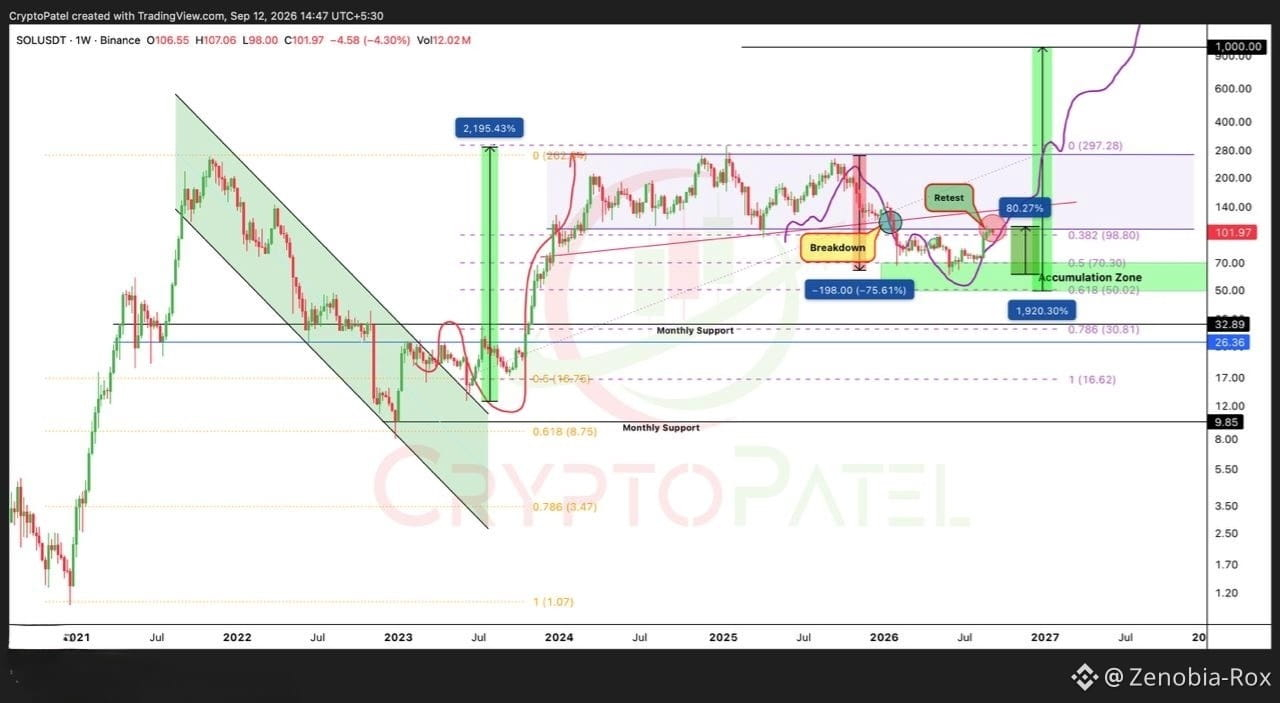
$SOL bewegt sich im Wochenchart um $101,97, ziemlich genau in einem wichtigen Fibonacci-Bereich. Der Chart zeigt eine lange Konsolidierung nach dem vorherigen Zyklus, danach einen Breakdown und nun ein mögliches Retest-/Reclaim-Setup.
Wichtige Levels aus dem Chart:
🟢 Aktuell: ~$101,97
🔑 Support: $98–$100
🟢 Große Nachfrage: $70–$50
🧱 Große Widerstandszone: ~$280–$297
🎯 Ausbruchsziel: ~$400–$600
🚀 Langfristige Projektion: ~$1.000
Das Interessante? $98–$100 ist die Linie, die ich im Blick habe. Halten und höhere Levels zurückgewinnen — dann könnte die Wochenstruktur plötzlich ganz anders aussehen.
Ein sauberer Bruch über $140–$150 würde das bullische Szenario deutlich stärken, während das Verlieren des $70-Bereichs es ernsthaft schwächen würde.
Der Chart zeigt das Setup — jetzt muss der Kurs es beweisen. 👀
Möglicher Trade-Rahmen:
Entry: $98–$105
TP1: $140–$150
TP2: $280–$297
TP3: $400+
Invalidierung: anhaltender Verlust der großen $70-Supportzone.
Keine Finanzberatung. Risikomanagement zuerst.
$SOL
{spot}(SOLUSDT)
#Altcoins #trading #BinanceSquare #CryptoTrading #SOLUSDT
🚀 SOLANA ($SOL ) — DAS GESAMTBILD WIRD INTERESSANT
$SOL bewegt sich im Wochenchart um $101,97, ziemlich genau in einem wichtigen Fibonacci-Bereich. Der Chart zeigt eine lange Konsolidierung nach dem vorherigen Zyklus, danach einen Breakdown und nun ein mögliches Retest-/Reclaim-Setup.
Wichtige Levels aus dem Chart:
🟢 Aktuell: ~$101,97
🔑 Support: $98–$100
🟢 Große Nachfrage: $70–$50
🧱 Große Widerstandszone: ~$280–$297
🎯 Ausbruchsziel: ~$400–$600
🚀 Langfristige Projektion: ~$1.000
Das Interessante? $98–$100 ist die Linie, die ich im Blick habe. Halten und höhere Levels zurückgewinnen — dann könnte die Wochenstruktur plötzlich ganz anders aussehen.
Ein sauberer Bruch über $140–$150 würde das bullische Szenario deutlich stärken, während das Verlieren des $70-Bereichs es ernsthaft schwächen würde.
Der Chart zeigt das Setup — jetzt muss der Kurs es beweisen. 👀
Möglicher Trade-Rahmen:
Entry: $98–$105
TP1: $140–$150
TP2: $280–$297
TP3: $400+
Invalidierung: anhaltender Verlust der großen $70-Supportzone.
Keine Finanzberatung. Risikomanagement zuerst.
$SOL
#Altcoins #trading #BinanceSquare #CryptoTrading #SOLUSDT
$SOL bewegt sich im Wochenchart um $101,97, ziemlich genau in einem wichtigen Fibonacci-Bereich. Der Chart zeigt eine lange Konsolidierung nach dem vorherigen Zyklus, danach einen Breakdown und nun ein mögliches Retest-/Reclaim-Setup.
Wichtige Levels aus dem Chart:
🟢 Aktuell: ~$101,97
🔑 Support: $98–$100
🟢 Große Nachfrage: $70–$50
🧱 Große Widerstandszone: ~$280–$297
🎯 Ausbruchsziel: ~$400–$600
🚀 Langfristige Projektion: ~$1.000
Das Interessante? $98–$100 ist die Linie, die ich im Blick habe. Halten und höhere Levels zurückgewinnen — dann könnte die Wochenstruktur plötzlich ganz anders aussehen.
Ein sauberer Bruch über $140–$150 würde das bullische Szenario deutlich stärken, während das Verlieren des $70-Bereichs es ernsthaft schwächen würde.
Der Chart zeigt das Setup — jetzt muss der Kurs es beweisen. 👀
Möglicher Trade-Rahmen:
Entry: $98–$105
TP1: $140–$150
TP2: $280–$297
TP3: $400+
Invalidierung: anhaltender Verlust der großen $70-Supportzone.
Keine Finanzberatung. Risikomanagement zuerst.
$SOL
#Altcoins #trading #BinanceSquare #CryptoTrading #SOLUSDT
51
·
--
Bullisch
$WLFI zieht heute weiterhin die Aufmerksamkeit über mehrere Märkte hinweg auf sich.
Das WLFI/USD1-Paar zeigt ebenfalls die breitere Stärke des Tokens: WLFI wird aktuell ungefähr in der Nähe des aktuellen Ausbruchbereichs gehandelt.
Was ich mir jetzt ansehe, ist ganz einfach: Können Käufer den Schwung nach dem ersten Impuls aufrechterhalten?
Wenn mehrere Märkte gleichzeitig Stärke zeigen, werden Liquidität und das anschließende Durchziehen wichtig. Ein starker Move kann sich fortsetzen, aber er kann sich auch schnell umkehren, wenn frühe Käufer beginnen, Gewinne mitzunehmen.
Hier möchte ich nicht blind hinterherlaufen. Ich möchte sehen, ob sich der Kurs konsolidiert, die Unterstützung hält und eine weitere Gelegenheit entsteht.
$WLFI ist definitiv einer der Namen von heute, die es sich lohnt, genau im Blick zu behalten.
$WLFI zieht heute weiterhin die Aufmerksamkeit über mehrere Märkte hinweg auf sich.
Das WLFI/USD1-Paar zeigt ebenfalls die breitere Stärke des Tokens: WLFI wird aktuell ungefähr in der Nähe des aktuellen Ausbruchbereichs gehandelt.
Was ich mir jetzt ansehe, ist ganz einfach: Können Käufer den Schwung nach dem ersten Impuls aufrechterhalten?
Wenn mehrere Märkte gleichzeitig Stärke zeigen, werden Liquidität und das anschließende Durchziehen wichtig. Ein starker Move kann sich fortsetzen, aber er kann sich auch schnell umkehren, wenn frühe Käufer beginnen, Gewinne mitzunehmen.
Hier möchte ich nicht blind hinterherlaufen. Ich möchte sehen, ob sich der Kurs konsolidiert, die Unterstützung hält und eine weitere Gelegenheit entsteht.
$WLFI ist definitiv einer der Namen von heute, die es sich lohnt, genau im Blick zu behalten.
Das WLFI/USD1-Paar zeigt ebenfalls die breitere Stärke des Tokens: WLFI wird aktuell ungefähr in der Nähe des aktuellen Ausbruchbereichs gehandelt.
Was ich mir jetzt ansehe, ist ganz einfach: Können Käufer den Schwung nach dem ersten Impuls aufrechterhalten?
Wenn mehrere Märkte gleichzeitig Stärke zeigen, werden Liquidität und das anschließende Durchziehen wichtig. Ein starker Move kann sich fortsetzen, aber er kann sich auch schnell umkehren, wenn frühe Käufer beginnen, Gewinne mitzunehmen.
Hier möchte ich nicht blind hinterherlaufen. Ich möchte sehen, ob sich der Kurs konsolidiert, die Unterstützung hält und eine weitere Gelegenheit entsteht.
$WLFI ist definitiv einer der Namen von heute, die es sich lohnt, genau im Blick zu behalten.
103
·
--
Bullisch
$WLFI zeigt heute ebenfalls Stärke gegenüber dem EUR-Paar.
Der WLFI/EUR-Markt liegt bei etwa 0,0496 US-Dollar und verzeichnet derzeit eine Bewegung von 8,30 % innerhalb von 24 Stunden.
Die breitere WLFI-Momentum ist eindeutig im Fokus, aber ich achte weiterhin stärker auf die Kursstruktur als nur auf das prozentuale Wachstum.
Nach einem starken Move kann Konsolidierung gesund sein, wenn Käufer weiterhin höhere Kursniveaus verteidigen. Was ich nicht sehen möchte, ist ein schneller Spike, gefolgt von einem unmittelbaren Breakdown.
Für jetzt ist das Momentum ein Grund, WLFI über seine aktiven Märkte hinweg im Blick zu behalten.
Der nächste Schritt ist wichtiger als die aktuelle Kerze.
Werden Käufer weiter nach oben drücken oder Gewinne mitnehmen?
$WLFI zeigt heute ebenfalls Stärke gegenüber dem EUR-Paar.
Der WLFI/EUR-Markt liegt bei etwa 0,0496 US-Dollar und verzeichnet derzeit eine Bewegung von 8,30 % innerhalb von 24 Stunden.
Die breitere WLFI-Momentum ist eindeutig im Fokus, aber ich achte weiterhin stärker auf die Kursstruktur als nur auf das prozentuale Wachstum.
Nach einem starken Move kann Konsolidierung gesund sein, wenn Käufer weiterhin höhere Kursniveaus verteidigen. Was ich nicht sehen möchte, ist ein schneller Spike, gefolgt von einem unmittelbaren Breakdown.
Für jetzt ist das Momentum ein Grund, WLFI über seine aktiven Märkte hinweg im Blick zu behalten.
Der nächste Schritt ist wichtiger als die aktuelle Kerze.
Werden Käufer weiter nach oben drücken oder Gewinne mitnehmen?
Der WLFI/EUR-Markt liegt bei etwa 0,0496 US-Dollar und verzeichnet derzeit eine Bewegung von 8,30 % innerhalb von 24 Stunden.
Die breitere WLFI-Momentum ist eindeutig im Fokus, aber ich achte weiterhin stärker auf die Kursstruktur als nur auf das prozentuale Wachstum.
Nach einem starken Move kann Konsolidierung gesund sein, wenn Käufer weiterhin höhere Kursniveaus verteidigen. Was ich nicht sehen möchte, ist ein schneller Spike, gefolgt von einem unmittelbaren Breakdown.
Für jetzt ist das Momentum ein Grund, WLFI über seine aktiven Märkte hinweg im Blick zu behalten.
Der nächste Schritt ist wichtiger als die aktuelle Kerze.
Werden Käufer weiter nach oben drücken oder Gewinne mitnehmen?
1
109
·
--
Bullisch
Übersetzung ansehen
$TREE is having a surprisingly strong session today. 🌱
The token is trading around $0.0434, up approximately 8.23% over the last 24 hours.
I’m watching this one because steady momentum can sometimes be more interesting than an immediate vertical pump. The key now is whether buyers can build a base around the current levels and continue pushing higher.
A strong move needs confirmation, though. If price starts losing the breakout area, the momentum could fade quickly.
For now, $TREE has entered my watchlist alongside today’s other active movers.
The chart is showing strength.
Now I want to see whether buyers can actually sustain it.
$TREE is having a surprisingly strong session today. 🌱
The token is trading around $0.0434, up approximately 8.23% over the last 24 hours.
I’m watching this one because steady momentum can sometimes be more interesting than an immediate vertical pump. The key now is whether buyers can build a base around the current levels and continue pushing higher.
A strong move needs confirmation, though. If price starts losing the breakout area, the momentum could fade quickly.
For now, $TREE has entered my watchlist alongside today’s other active movers.
The chart is showing strength.
Now I want to see whether buyers can actually sustain it.
The token is trading around $0.0434, up approximately 8.23% over the last 24 hours.
I’m watching this one because steady momentum can sometimes be more interesting than an immediate vertical pump. The key now is whether buyers can build a base around the current levels and continue pushing higher.
A strong move needs confirmation, though. If price starts losing the breakout area, the momentum could fade quickly.
For now, $TREE has entered my watchlist alongside today’s other active movers.
The chart is showing strength.
Now I want to see whether buyers can actually sustain it.
1
134
·
--
Bullisch
last $WLFI I erregt heute Aufmerksamkeit bei Käufern, die den Preis nach oben drücken.
Das Token liegt bei etwa 0,0569 $, derzeit mit +8,80 % in den letzten 24 Stunden.
Was mich jetzt interessiert, ist, ob sich diese Bewegung zu etwas Größerem entwickeln kann oder ob sie einfach zu einem weiteren kurzfristigen Momentum-Impuls wird.
Nach einer Bewegung wie dieser würde ich lieber sehen, wie sich der Preis konsolidiert und Unterstützung aufbaut, statt sofort einer weiteren grünen Kerze hinterherzulaufen. Wenn Käufer weiterhin die Verkaufsdruck absorbieren und die Struktur stark bleibt, wird das Setup zunehmend interessant.
Fürs Erste ist $WLFI is eines der Namen, die ich besonders im Blick habe.
Das Momentum ist da.
Die eigentliche Frage ist, ob Käufer von hier aus die Kontrolle behalten können.
last $WLFI I erregt heute Aufmerksamkeit bei Käufern, die den Preis nach oben drücken.
Das Token liegt bei etwa 0,0569 $, derzeit mit +8,80 % in den letzten 24 Stunden.
Was mich jetzt interessiert, ist, ob sich diese Bewegung zu etwas Größerem entwickeln kann oder ob sie einfach zu einem weiteren kurzfristigen Momentum-Impuls wird.
Nach einer Bewegung wie dieser würde ich lieber sehen, wie sich der Preis konsolidiert und Unterstützung aufbaut, statt sofort einer weiteren grünen Kerze hinterherzulaufen. Wenn Käufer weiterhin die Verkaufsdruck absorbieren und die Struktur stark bleibt, wird das Setup zunehmend interessant.
Fürs Erste ist $WLFI is eines der Namen, die ich besonders im Blick habe.
Das Momentum ist da.
Die eigentliche Frage ist, ob Käufer von hier aus die Kontrolle behalten können.
Das Token liegt bei etwa 0,0569 $, derzeit mit +8,80 % in den letzten 24 Stunden.
Was mich jetzt interessiert, ist, ob sich diese Bewegung zu etwas Größerem entwickeln kann oder ob sie einfach zu einem weiteren kurzfristigen Momentum-Impuls wird.
Nach einer Bewegung wie dieser würde ich lieber sehen, wie sich der Preis konsolidiert und Unterstützung aufbaut, statt sofort einer weiteren grünen Kerze hinterherzulaufen. Wenn Käufer weiterhin die Verkaufsdruck absorbieren und die Struktur stark bleibt, wird das Setup zunehmend interessant.
Fürs Erste ist $WLFI is eines der Namen, die ich besonders im Blick habe.
Das Momentum ist da.
Die eigentliche Frage ist, ob Käufer von hier aus die Kontrolle behalten können.
77
·
--
Bullisch
$SC beginnt aufzuwachen.
Das Token liegt bei etwa 0,000940 US-Dollar und zeigt eine +9,68%-Bewegung in den letzten 24 Stunden.
Es ist zwar nicht der lauteste Gewinner in der Liste, aber genau solche Bewegungen schaue ich mir gerne an, bevor ich entscheide, ob der Schwung (Momentum) noch mehr Potenzial hat.
Das Wichtigste ist jetzt der nächste Schritt. Wenn Käufer weiterhin höhere Preise verteidigen und das Handelsvolumen die Bewegung unterstützt, könnte $SC zu einer interessanten Momentum-Wette werden.
Wenn die Käufer jedoch nach dem ersten Schub verschwinden, kann der Markt schnell einen Teil der Bewegung wieder zurückgeben.
Ich beobachte den nächsten Ausbruch oder Rücksetzer genau.
Der Schwung baut sich auf. Geht es so weiter?
$SC beginnt aufzuwachen.
Das Token liegt bei etwa 0,000940 US-Dollar und zeigt eine +9,68%-Bewegung in den letzten 24 Stunden.
Es ist zwar nicht der lauteste Gewinner in der Liste, aber genau solche Bewegungen schaue ich mir gerne an, bevor ich entscheide, ob der Schwung (Momentum) noch mehr Potenzial hat.
Das Wichtigste ist jetzt der nächste Schritt. Wenn Käufer weiterhin höhere Preise verteidigen und das Handelsvolumen die Bewegung unterstützt, könnte $SC zu einer interessanten Momentum-Wette werden.
Wenn die Käufer jedoch nach dem ersten Schub verschwinden, kann der Markt schnell einen Teil der Bewegung wieder zurückgeben.
Ich beobachte den nächsten Ausbruch oder Rücksetzer genau.
Der Schwung baut sich auf. Geht es so weiter?
Das Token liegt bei etwa 0,000940 US-Dollar und zeigt eine +9,68%-Bewegung in den letzten 24 Stunden.
Es ist zwar nicht der lauteste Gewinner in der Liste, aber genau solche Bewegungen schaue ich mir gerne an, bevor ich entscheide, ob der Schwung (Momentum) noch mehr Potenzial hat.
Das Wichtigste ist jetzt der nächste Schritt. Wenn Käufer weiterhin höhere Preise verteidigen und das Handelsvolumen die Bewegung unterstützt, könnte $SC zu einer interessanten Momentum-Wette werden.
Wenn die Käufer jedoch nach dem ersten Schub verschwinden, kann der Markt schnell einen Teil der Bewegung wieder zurückgeben.
Ich beobachte den nächsten Ausbruch oder Rücksetzer genau.
Der Schwung baut sich auf. Geht es so weiter?
1
107
·
--
Bullisch
Übersetzung ansehen
$LSK is suddenly making some serious noise. 📈
A move of +104.81% in 24h is not something I’m ignoring. Price is around $0.2513, and this kind of explosive momentum usually brings both opportunity and serious volatility.
What matters now isn’t chasing the green candle. After a move this aggressive, I’d rather watch whether buyers can actually defend higher levels or if profit-taking starts hitting the market.
Momentum is clearly strong, but the next phase is where things get interesting.
I’m watching volume, pullbacks, and whether $LSK can build support above the breakout zone.
Would you chase this move or wait for a retracement?
$LSK is suddenly making some serious noise. 📈
A move of +104.81% in 24h is not something I’m ignoring. Price is around $0.2513, and this kind of explosive momentum usually brings both opportunity and serious volatility.
What matters now isn’t chasing the green candle. After a move this aggressive, I’d rather watch whether buyers can actually defend higher levels or if profit-taking starts hitting the market.
Momentum is clearly strong, but the next phase is where things get interesting.
I’m watching volume, pullbacks, and whether $LSK can build support above the breakout zone.
Would you chase this move or wait for a retracement?
A move of +104.81% in 24h is not something I’m ignoring. Price is around $0.2513, and this kind of explosive momentum usually brings both opportunity and serious volatility.
What matters now isn’t chasing the green candle. After a move this aggressive, I’d rather watch whether buyers can actually defend higher levels or if profit-taking starts hitting the market.
Momentum is clearly strong, but the next phase is where things get interesting.
I’m watching volume, pullbacks, and whether $LSK can build support above the breakout zone.
Would you chase this move or wait for a retracement?
112
·
--
Bullisch
$MTL hat gerade eine starke Momentum-Welle erwischt. 🚀
Das Token handelt derzeit um 0,335 $, aktuell mit einem Plus von +30,86% über 24 Stunden.
Das reicht, um es definitiv auf meinen Radar zu setzen, aber nach so einem Move interessiert mich mehr, was als Nächstes passiert, als nur der Prozentsatz selbst.
Wenn Käufer den kürzlich erfolgten Breakout-Bereich halten und ihn in Unterstützung verwandeln können, könnte der Trend weiterhin spannend bleiben. Aber wenn das Momentum schnell nachlässt, würde mich ein tieferer Rücksetzer nicht überraschen.
Für mich ist das eher ein „beobachten und bestätigen“-Setup als ein blinder Jagd-Move.
$MTL hat Momentum. Jetzt braucht es Struktur.
Fangen die Käufer gerade erst an?
$MTL hat gerade eine starke Momentum-Welle erwischt. 🚀
Das Token handelt derzeit um 0,335 $, aktuell mit einem Plus von +30,86% über 24 Stunden.
Das reicht, um es definitiv auf meinen Radar zu setzen, aber nach so einem Move interessiert mich mehr, was als Nächstes passiert, als nur der Prozentsatz selbst.
Wenn Käufer den kürzlich erfolgten Breakout-Bereich halten und ihn in Unterstützung verwandeln können, könnte der Trend weiterhin spannend bleiben. Aber wenn das Momentum schnell nachlässt, würde mich ein tieferer Rücksetzer nicht überraschen.
Für mich ist das eher ein „beobachten und bestätigen“-Setup als ein blinder Jagd-Move.
$MTL hat Momentum. Jetzt braucht es Struktur.
Fangen die Käufer gerade erst an?
Das Token handelt derzeit um 0,335 $, aktuell mit einem Plus von +30,86% über 24 Stunden.
Das reicht, um es definitiv auf meinen Radar zu setzen, aber nach so einem Move interessiert mich mehr, was als Nächstes passiert, als nur der Prozentsatz selbst.
Wenn Käufer den kürzlich erfolgten Breakout-Bereich halten und ihn in Unterstützung verwandeln können, könnte der Trend weiterhin spannend bleiben. Aber wenn das Momentum schnell nachlässt, würde mich ein tieferer Rücksetzer nicht überraschen.
Für mich ist das eher ein „beobachten und bestätigen“-Setup als ein blinder Jagd-Move.
$MTL hat Momentum. Jetzt braucht es Struktur.
Fangen die Käufer gerade erst an?
188
·
--
Bullisch
$PUNDIX zeigt heute eine gewisse solide Stärke.
Der Preis liegt bei etwa 0,1088 $, wobei der Token in den letzten 24 Stunden ungefähr 15,62 % zulegen konnte.
Das ist nicht der größte Move auf dem Board, aber genau das kann die Ausgangslage spannender machen. Ich schaue darauf, ob sich dieser Schwung zu einem nachhaltigen Trend entwickelt oder ob es am Ende nur wieder ein kurzfristiger Pump ist.
Für mich ist entscheidend, wie sich der Preis nach dem ersten Impuls verhält. Starke Coins geben Käufern normalerweise Gelegenheiten bei Rücksetzern, statt sofort in sich zusammenzufallen.
$PUNDIX ist definitiv einer, den ich heute im Blick behalte.
Der Schwung ist da. Können die Käufer darauf aufbauen?
$PUNDIX zeigt heute eine gewisse solide Stärke.
Der Preis liegt bei etwa 0,1088 $, wobei der Token in den letzten 24 Stunden ungefähr 15,62 % zulegen konnte.
Das ist nicht der größte Move auf dem Board, aber genau das kann die Ausgangslage spannender machen. Ich schaue darauf, ob sich dieser Schwung zu einem nachhaltigen Trend entwickelt oder ob es am Ende nur wieder ein kurzfristiger Pump ist.
Für mich ist entscheidend, wie sich der Preis nach dem ersten Impuls verhält. Starke Coins geben Käufern normalerweise Gelegenheiten bei Rücksetzern, statt sofort in sich zusammenzufallen.
$PUNDIX ist definitiv einer, den ich heute im Blick behalte.
Der Schwung ist da. Können die Käufer darauf aufbauen?
Der Preis liegt bei etwa 0,1088 $, wobei der Token in den letzten 24 Stunden ungefähr 15,62 % zulegen konnte.
Das ist nicht der größte Move auf dem Board, aber genau das kann die Ausgangslage spannender machen. Ich schaue darauf, ob sich dieser Schwung zu einem nachhaltigen Trend entwickelt oder ob es am Ende nur wieder ein kurzfristiger Pump ist.
Für mich ist entscheidend, wie sich der Preis nach dem ersten Impuls verhält. Starke Coins geben Käufern normalerweise Gelegenheiten bei Rücksetzern, statt sofort in sich zusammenzufallen.
$PUNDIX ist definitiv einer, den ich heute im Blick behalte.
Der Schwung ist da. Können die Käufer darauf aufbauen?
113
·
--
Bullisch
$VTHO heizt sich wieder auf. 🔥
Der Token handelt bei etwa 0,000660 US-Dollar und ist aktuell in 24 Stunden um 12,63% im Plus.
Was meine Aufmerksamkeit nicht nur auf den grünen Wert lenkt, ist: Ob dieser Move genug Anschlusskäufe anziehen kann, um kurzfristigen Schwung in einen klareren Trend umzuwandeln.
Nach einem starken Anstieg schaue ich normalerweise lieber erst auf die Reaktion, statt sofort einzusteigen. Wenn Käufer den Ausbruch verteidigen und das Volumen gesund bleibt, wird das Setup deutlich interessanter.
Wenn die Bewegung jedoch schnell an Schwung verliert, könnte das Gewinnmitnahmen stark treffen.
Fürs Erste ist $VTHO fest auf meiner Watchlist.
Würdest du den Ausbruch traden oder auf eine Bestätigung warten?
$VTHO heizt sich wieder auf. 🔥
Der Token handelt bei etwa 0,000660 US-Dollar und ist aktuell in 24 Stunden um 12,63% im Plus.
Was meine Aufmerksamkeit nicht nur auf den grünen Wert lenkt, ist: Ob dieser Move genug Anschlusskäufe anziehen kann, um kurzfristigen Schwung in einen klareren Trend umzuwandeln.
Nach einem starken Anstieg schaue ich normalerweise lieber erst auf die Reaktion, statt sofort einzusteigen. Wenn Käufer den Ausbruch verteidigen und das Volumen gesund bleibt, wird das Setup deutlich interessanter.
Wenn die Bewegung jedoch schnell an Schwung verliert, könnte das Gewinnmitnahmen stark treffen.
Fürs Erste ist $VTHO fest auf meiner Watchlist.
Würdest du den Ausbruch traden oder auf eine Bestätigung warten?
Der Token handelt bei etwa 0,000660 US-Dollar und ist aktuell in 24 Stunden um 12,63% im Plus.
Was meine Aufmerksamkeit nicht nur auf den grünen Wert lenkt, ist: Ob dieser Move genug Anschlusskäufe anziehen kann, um kurzfristigen Schwung in einen klareren Trend umzuwandeln.
Nach einem starken Anstieg schaue ich normalerweise lieber erst auf die Reaktion, statt sofort einzusteigen. Wenn Käufer den Ausbruch verteidigen und das Volumen gesund bleibt, wird das Setup deutlich interessanter.
Wenn die Bewegung jedoch schnell an Schwung verliert, könnte das Gewinnmitnahmen stark treffen.
Fürs Erste ist $VTHO fest auf meiner Watchlist.
Würdest du den Ausbruch traden oder auf eine Bestätigung warten?
109
Anmelden und weiter Inhalte entdecken
Krypto-Nutzer weltweit auf Binance Square kennenlernen
⚡️ Bleib in Sachen Krypto stets am Puls.
💬 Die weltgrößte Kryptobörse vertraut darauf.
👍 Erhalte verlässliche Einblicke von verifizierten Creators.
E-Mail-Adresse/Telefonnummer
Trendthemen
BitcoinCrosses$78000
481 Aufrufe
56 Kommentare
$BTC dringende Aktualisierung 🚨 Große Chance ‼️ Mach dich bereit für Short 📉
BTC prallt wie erwartet zurück. Jetzt kannst du deinen Einstieg bis zu 78.000 skalieren, denn dieser Bounce kann sich bis auf 78.000 erstrecken ..
Stop-Loss: 79.200
Ziele 🎯
TP1: 77.150
TP2: 76.450
TP3: 75.750
TP4: 75.000
$SOL and $ETH werden Bitcoin folgen.. Und dann dumpen, wie vorhergesagt 🔥
Mach immer DYOR und investiere nie alles in einen einzigen Trade
Short hier 👇
#SECReceivesGrayscaleLitecoinTrustETFFiling #ClarityActFacesProceduralVoteSept15 #US10YearTreasuryYieldNears5%
Panda Traders
·13 Likes
·5.8k Aufrufe
AvalancheIntegratesIntoUAEPassDigitalVault
0 Aufrufe
0 Kommentare
UKSeeksViewsOnTokenizingGold
0 Aufrufe
0 Kommentare