

cryptotradehead
8.9k Beiträge
cryptotradehead
Melden
Nutzer blockieren
backtesting, analyse, how to use AI for trading - can you be a good trader?
Trade eröffnen
Hochfrequenz-Trader
4.8 Jahre
7 Following
2.6K+ Follower
5.0K+ Like gegeben
Beiträge
Portfolio
Alle
Zitierungen
Übersetzung ansehen
HOW I TESTED IT
I swept 40 symbols and found three that looked profitable. I called them validated and put them live.
Then I tested the exact same settings on 751 days of price history the search had never touched. All three reversed. Not marginally - completely.
Three survivors out of 40 is roughly what pure chance produces at that sample size.
THE NUMBERS
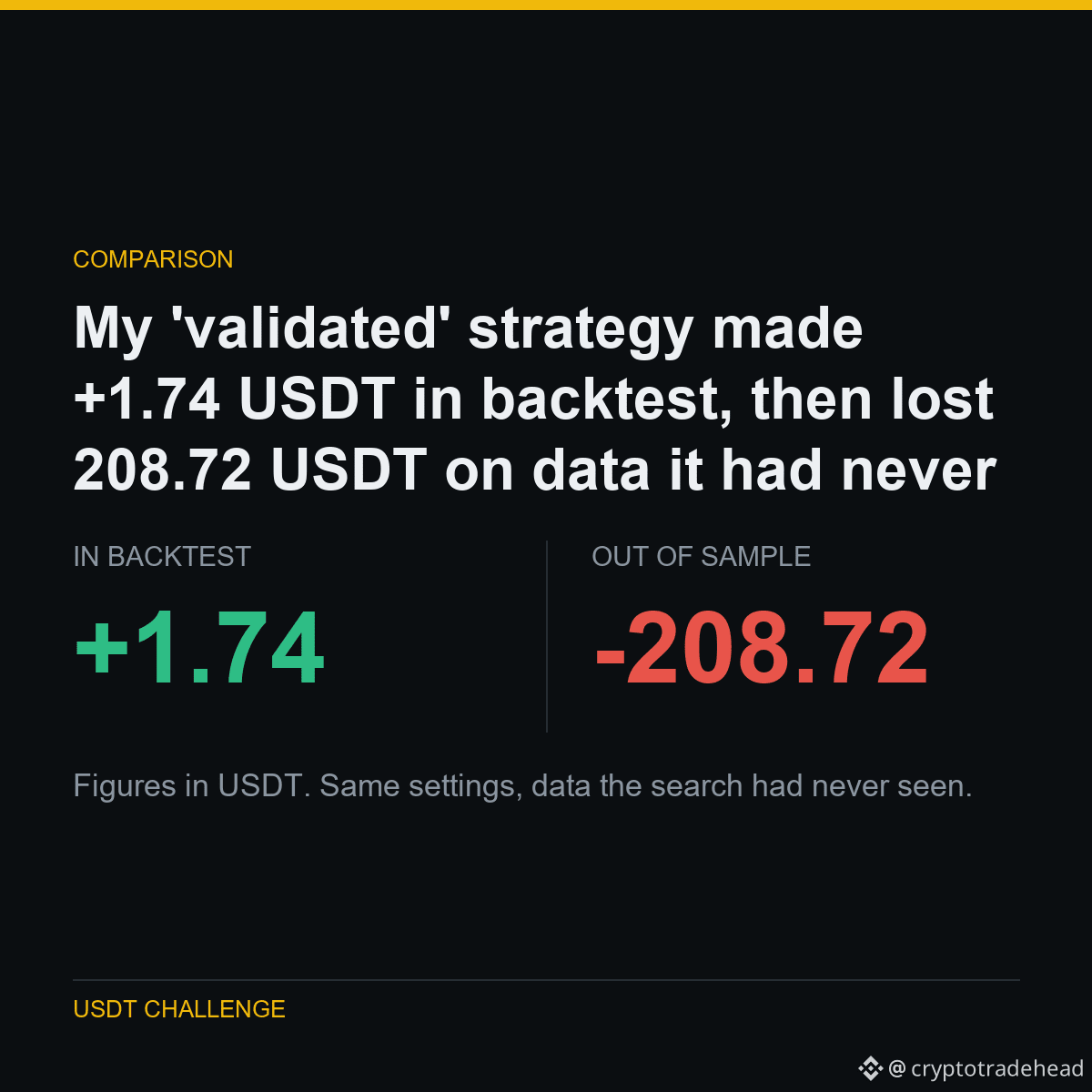
In-sample result: +1.74
Out-of-sample result: -208.72
Days of untouched data: 751
Symbols that survived: 0 of 3
Searching hard enough through random data will always produce a winner. The out-of-sample test is the only thing that tells you whether you found an edge or just found noise wearing a costume.
Part of a public experiment: 5,063 USDT to 1,000,000 USDT, every result published - including the ones that make me look bad.
Run on $BTC $ETH $BNB
#Binance #Futures #Backtesting #TradingBot #CryptoData
HOW I TESTED IT
I swept 40 symbols and found three that looked profitable. I called them validated and put them live.
Then I tested the exact same settings on 751 days of price history the search had never touched. All three reversed. Not marginally - completely.
Three survivors out of 40 is roughly what pure chance produces at that sample size.
THE NUMBERS
In-sample result: +1.74
Out-of-sample result: -208.72
Days of untouched data: 751
Symbols that survived: 0 of 3
Searching hard enough through random data will always produce a winner. The out-of-sample test is the only thing that tells you whether you found an edge or just found noise wearing a costume.
Part of a public experiment: 5,063 USDT to 1,000,000 USDT, every result published - including the ones that make me look bad.
Run on $BTC $ETH $BNB
#Binance #Futures #Backtesting #TradingBot #CryptoData
I swept 40 symbols and found three that looked profitable. I called them validated and put them live.
Then I tested the exact same settings on 751 days of price history the search had never touched. All three reversed. Not marginally - completely.
Three survivors out of 40 is roughly what pure chance produces at that sample size.
THE NUMBERS
In-sample result: +1.74
Out-of-sample result: -208.72
Days of untouched data: 751
Symbols that survived: 0 of 3
Searching hard enough through random data will always produce a winner. The out-of-sample test is the only thing that tells you whether you found an edge or just found noise wearing a costume.
Part of a public experiment: 5,063 USDT to 1,000,000 USDT, every result published - including the ones that make me look bad.
Run on $BTC $ETH $BNB
#Binance #Futures #Backtesting #TradingBot #CryptoData
3
Artikel
Übersetzung ansehen
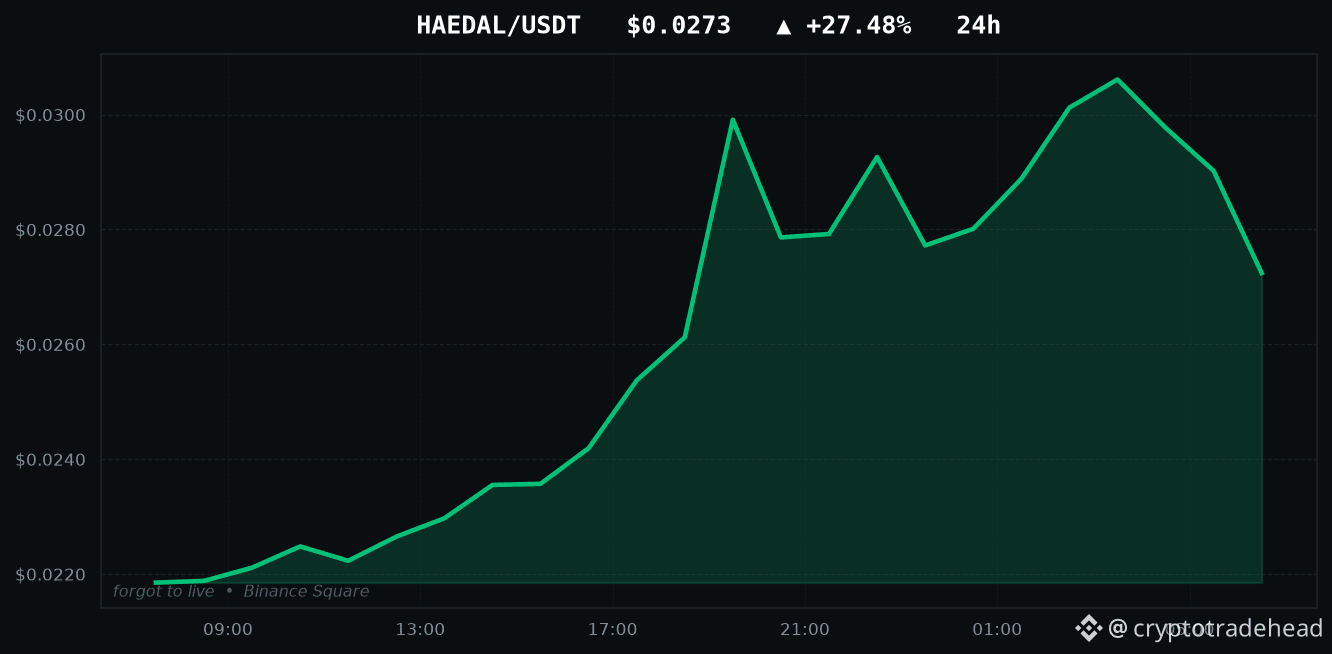
HAEDAL is up +27.48% - I tested both ways to trade itTODAY'S TOP GAINERS
HAEDAL: +27.48%
HUMA: +17.96%
BANK: +15.13%
PEPE: +14.09%
SOLV: +12.47%
Every account on this app will show you this list. Here is the part they skip.
I backtested both ways of trading a move like HAEDAL's +27.48%: buying the breakout, and fading it on the assumption it reverts. Both lost money. Not narrowly - they lost roughly the transaction cost, 0.240% per round trip, which is what a signal carrying no information looks like once you charge it fees.
A large 24-hour move tells you something already happened. It does not tell you what happens next, and the data says so in both directions.
Part of a public experiment: every strategy I test gets published, working or not.
Movers above: $HAEDAL $HUMA $BANK
#Binance #Altcoins #Futures #HAEDAL #CryptoData
HAEDAL is up +27.48% - I tested both ways to trade it
TODAY'S TOP GAINERS
HAEDAL: +27.48%
HUMA: +17.96%
BANK: +15.13%
PEPE: +14.09%
SOLV: +12.47%
Every account on this app will show you this list. Here is the part they skip.
I backtested both ways of trading a move like HAEDAL's +27.48%: buying the breakout, and fading it on the assumption it reverts. Both lost money. Not narrowly - they lost roughly the transaction cost, 0.240% per round trip, which is what a signal carrying no information looks like once you charge it fees.
A large 24-hour move tells you something already happened. It does not tell you what happens next, and the data says so in both directions.
Part of a public experiment: every strategy I test gets published, working or not.
Movers above: $HAEDAL $HUMA $BANK
#Binance #Altcoins #Futures #HAEDAL #CryptoData
HAEDAL: +27.48%
HUMA: +17.96%
BANK: +15.13%
PEPE: +14.09%
SOLV: +12.47%
Every account on this app will show you this list. Here is the part they skip.
I backtested both ways of trading a move like HAEDAL's +27.48%: buying the breakout, and fading it on the assumption it reverts. Both lost money. Not narrowly - they lost roughly the transaction cost, 0.240% per round trip, which is what a signal carrying no information looks like once you charge it fees.
A large 24-hour move tells you something already happened. It does not tell you what happens next, and the data says so in both directions.
Part of a public experiment: every strategy I test gets published, working or not.
Movers above: $HAEDAL $HUMA $BANK
#Binance #Altcoins #Futures #HAEDAL #CryptoData
2
Artikel
Übersetzung ansehen
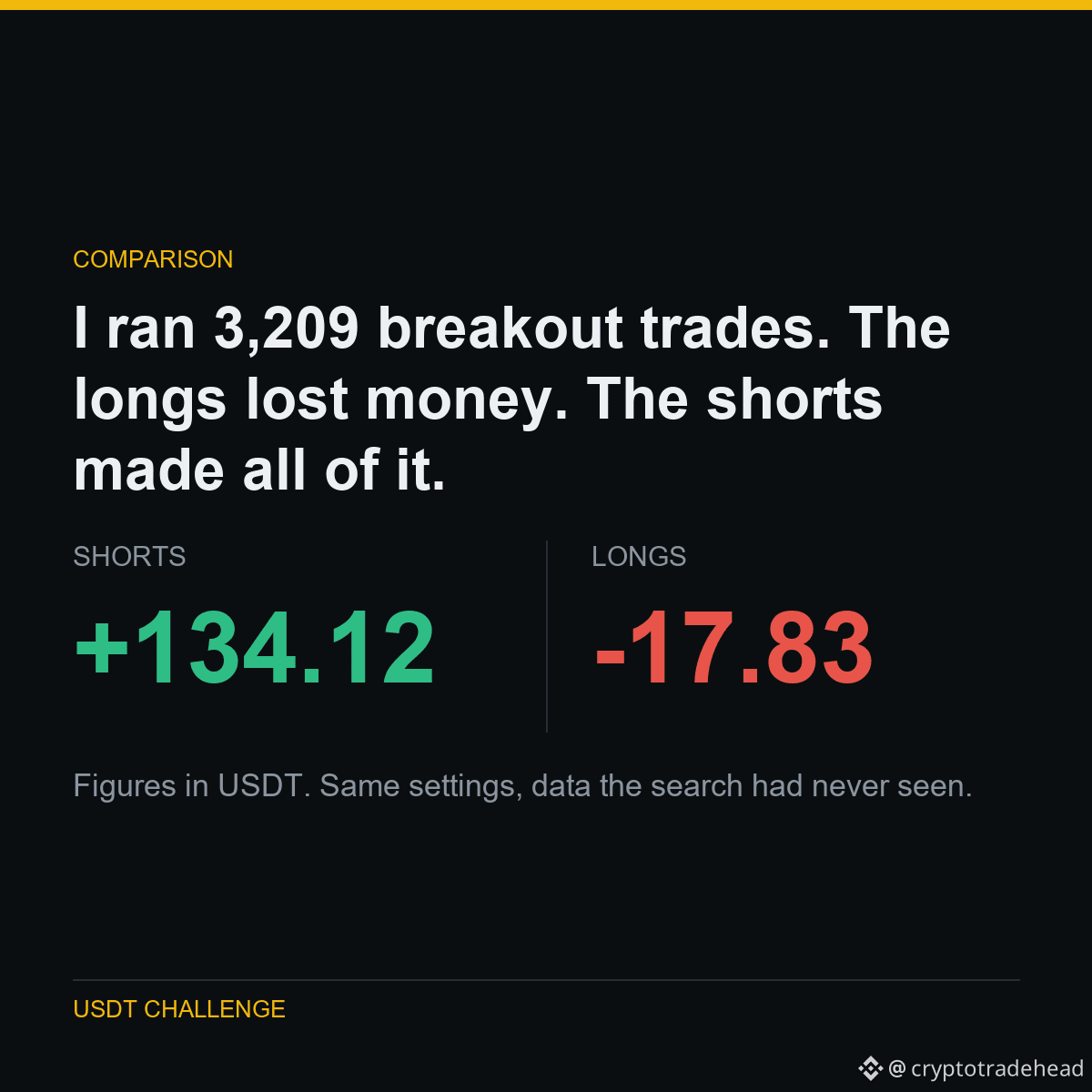
I ran 3,209 breakout trades. The longs lost money. The shorts made all of it.I ran 3,209 breakout trades. The longs lost money. The shorts made all of it.
Donchian 20 channel, ATR stop, 10 symbols, four and a half years.
If this were just riding a bull market, the longs would be the winners. They are not - they are negative.
The shorts even made money on coins that ROSE over the period. BTC gained 94% buy-and-hold, and shorting its breakdowns still returned +22.83 USDT. XRP gained 87%, shorts returned +24.27 USDT.
WHAT IT MEANS
Crypto falls faster than it rises - liquidation cascades are asymmetric. That is documented market structure, which is why this result is more believable than one that only works when everything goes up.
Part of a public experiment: 5,063 USDT to 1,000,000 USDT, every result published - including the ones that make me look bad.
Run on $BTC $XRP $LTC
#Binance #Futures #Backtesting #TradingBot #CryptoData
I ran 3,209 breakout trades. The longs lost money. The shorts made all of it.
I ran 3,209 breakout trades. The longs lost money. The shorts made all of it.
Donchian 20 channel, ATR stop, 10 symbols, four and a half years.
If this were just riding a bull market, the longs would be the winners. They are not - they are negative.
The shorts even made money on coins that ROSE over the period. BTC gained 94% buy-and-hold, and shorting its breakdowns still returned +22.83 USDT. XRP gained 87%, shorts returned +24.27 USDT.
WHAT IT MEANS
Crypto falls faster than it rises - liquidation cascades are asymmetric. That is documented market structure, which is why this result is more believable than one that only works when everything goes up.
Part of a public experiment: 5,063 USDT to 1,000,000 USDT, every result published - including the ones that make me look bad.
Run on $BTC $XRP $LTC
#Binance #Futures #Backtesting #TradingBot #CryptoData
Donchian 20 channel, ATR stop, 10 symbols, four and a half years.
If this were just riding a bull market, the longs would be the winners. They are not - they are negative.
The shorts even made money on coins that ROSE over the period. BTC gained 94% buy-and-hold, and shorting its breakdowns still returned +22.83 USDT. XRP gained 87%, shorts returned +24.27 USDT.
WHAT IT MEANS
Crypto falls faster than it rises - liquidation cascades are asymmetric. That is documented market structure, which is why this result is more believable than one that only works when everything goes up.
Part of a public experiment: 5,063 USDT to 1,000,000 USDT, every result published - including the ones that make me look bad.
Run on $BTC $XRP $LTC
#Binance #Futures #Backtesting #TradingBot #CryptoData
19
Übersetzung ansehen
HOW I TESTED IT
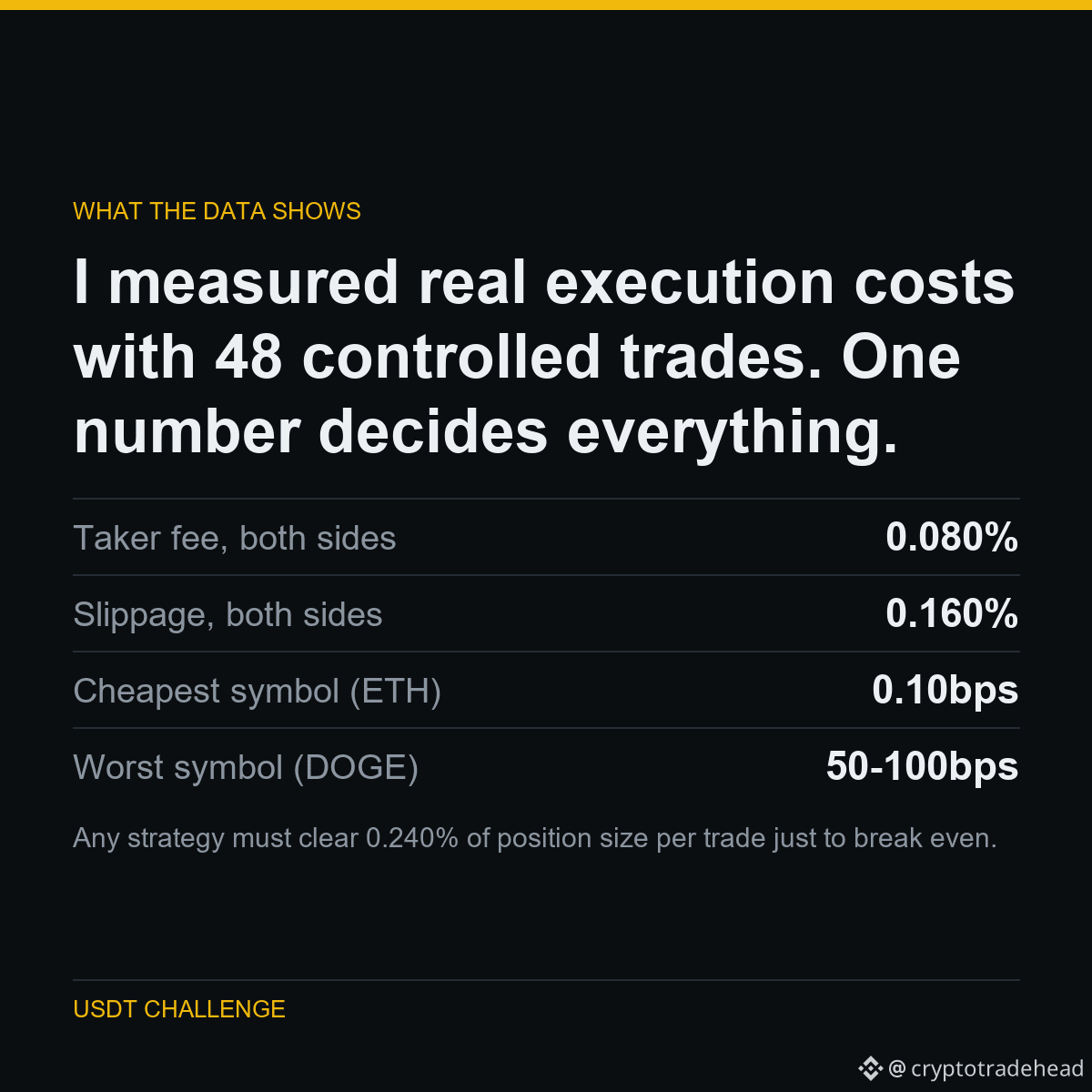
I stopped assuming what trading costs and measured it: 48 controlled round trips, entering and exiting immediately, recording the actual fill against the reference price.
Fee was constant at 0.04% per side. Slippage was not - ETH filled at essentially zero, while DOGE cost 50 to 100 basis points per round trip.
On a 150 USDT position, a round trip costs 0.36 USDT before the market moves at all.
THE NUMBERS
Taker fee, both sides: 0.080%
Slippage, both sides: 0.160%
Cheapest symbol (ETH): 0.10bps
Worst symbol (DOGE): 50-100bps
Any strategy must clear 0.240% of position size per trade just to break even. Most published setups never mention this number, which is why most published setups lose money.
Part of a public experiment: 5,063 USDT to 1,000,000 USDT, every result published - including the ones that make me look bad.
Run on $ETH $DOGE
#Binance #Futures #Backtesting #TradingBot #CryptoData
HOW I TESTED IT
I stopped assuming what trading costs and measured it: 48 controlled round trips, entering and exiting immediately, recording the actual fill against the reference price.
Fee was constant at 0.04% per side. Slippage was not - ETH filled at essentially zero, while DOGE cost 50 to 100 basis points per round trip.
On a 150 USDT position, a round trip costs 0.36 USDT before the market moves at all.
THE NUMBERS
Taker fee, both sides: 0.080%
Slippage, both sides: 0.160%
Cheapest symbol (ETH): 0.10bps
Worst symbol (DOGE): 50-100bps
Any strategy must clear 0.240% of position size per trade just to break even. Most published setups never mention this number, which is why most published setups lose money.
Part of a public experiment: 5,063 USDT to 1,000,000 USDT, every result published - including the ones that make me look bad.
Run on $ETH $DOGE
#Binance #Futures #Backtesting #TradingBot #CryptoData
I stopped assuming what trading costs and measured it: 48 controlled round trips, entering and exiting immediately, recording the actual fill against the reference price.
Fee was constant at 0.04% per side. Slippage was not - ETH filled at essentially zero, while DOGE cost 50 to 100 basis points per round trip.
On a 150 USDT position, a round trip costs 0.36 USDT before the market moves at all.
THE NUMBERS
Taker fee, both sides: 0.080%
Slippage, both sides: 0.160%
Cheapest symbol (ETH): 0.10bps
Worst symbol (DOGE): 50-100bps
Any strategy must clear 0.240% of position size per trade just to break even. Most published setups never mention this number, which is why most published setups lose money.
Part of a public experiment: 5,063 USDT to 1,000,000 USDT, every result published - including the ones that make me look bad.
Run on $ETH $DOGE
#Binance #Futures #Backtesting #TradingBot #CryptoData
29
Artikel
Übersetzung ansehen
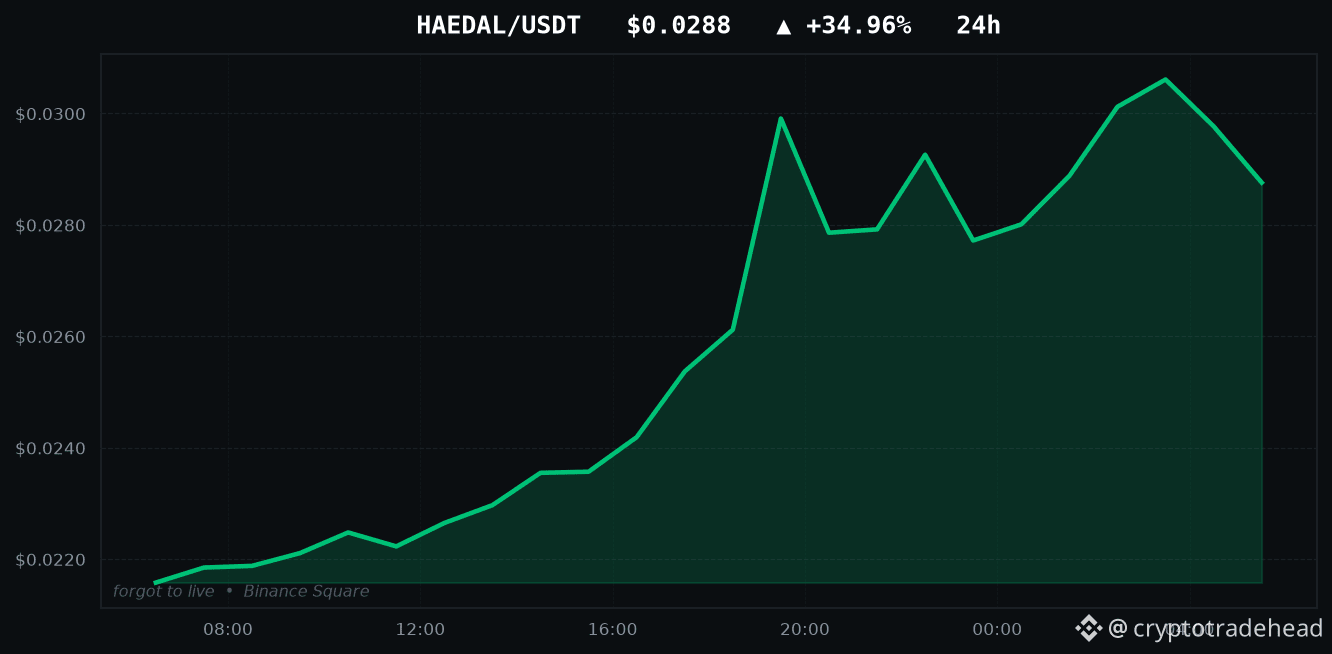
HAEDAL is up +34.96% - I tested both ways to trade itTODAY'S TOP GAINERS
HAEDAL: +34.96%
BANK: +22.57%
HUMA: +16.94%
ANIME: +11.83%
SOLV: +11.01%
Every account on this app will show you this list. Here is the part they skip.
I backtested both ways of trading a move like HAEDAL's +34.96%: buying the breakout, and fading it on the assumption it reverts. Both lost money. Not narrowly - they lost roughly the transaction cost, 0.240% per round trip, which is what a signal carrying no information looks like once you charge it fees.
A large 24-hour move tells you something already happened. It does not tell you what happens next, and the data says so in both directions.
Part of a public experiment: every strategy I test gets published, working or not.
Movers above: $HAEDAL $BANK $HUMA
#Binance #Altcoins #Futures #HAEDAL #CryptoData
HAEDAL is up +34.96% - I tested both ways to trade it
TODAY'S TOP GAINERS
HAEDAL: +34.96%
BANK: +22.57%
HUMA: +16.94%
ANIME: +11.83%
SOLV: +11.01%
Every account on this app will show you this list. Here is the part they skip.
I backtested both ways of trading a move like HAEDAL's +34.96%: buying the breakout, and fading it on the assumption it reverts. Both lost money. Not narrowly - they lost roughly the transaction cost, 0.240% per round trip, which is what a signal carrying no information looks like once you charge it fees.
A large 24-hour move tells you something already happened. It does not tell you what happens next, and the data says so in both directions.
Part of a public experiment: every strategy I test gets published, working or not.
Movers above: $HAEDAL $BANK $HUMA
#Binance #Altcoins #Futures #HAEDAL #CryptoData
HAEDAL: +34.96%
BANK: +22.57%
HUMA: +16.94%
ANIME: +11.83%
SOLV: +11.01%
Every account on this app will show you this list. Here is the part they skip.
I backtested both ways of trading a move like HAEDAL's +34.96%: buying the breakout, and fading it on the assumption it reverts. Both lost money. Not narrowly - they lost roughly the transaction cost, 0.240% per round trip, which is what a signal carrying no information looks like once you charge it fees.
A large 24-hour move tells you something already happened. It does not tell you what happens next, and the data says so in both directions.
Part of a public experiment: every strategy I test gets published, working or not.
Movers above: $HAEDAL $BANK $HUMA
#Binance #Altcoins #Futures #HAEDAL #CryptoData
35
Artikel
Übersetzung ansehen
Funding rate predicts where price goes. It just changes which direction, by year.Funding rate predicts where price goes. It just changes which direction, by year.
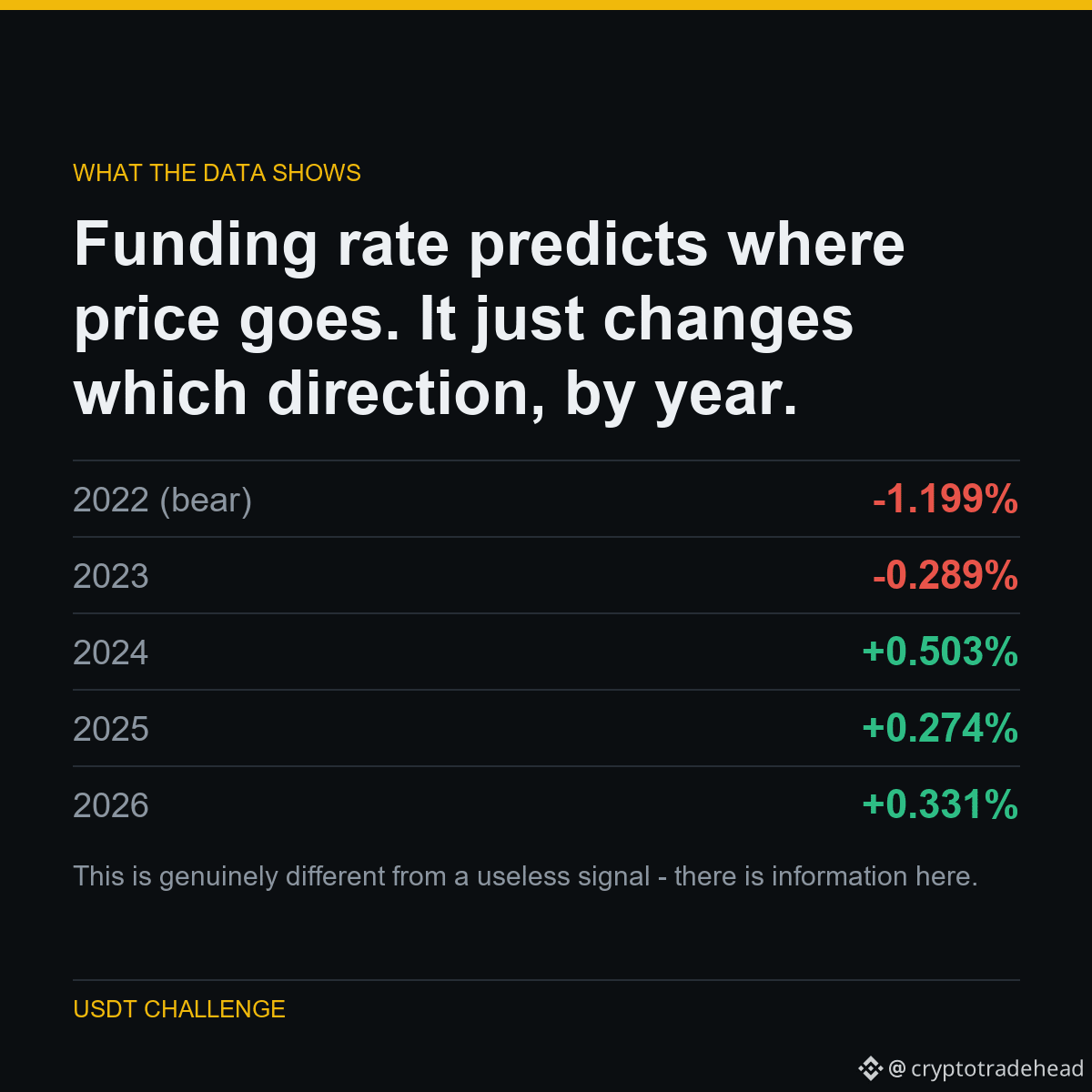
I sorted every funding print into quintiles and measured the forward 72-hour return of the highest versus the lowest.
In bear markets, high funding preceded WORSE returns - crowded longs getting squeezed. From 2024 onward it preceded BETTER returns - momentum.
The signal is real. The sign is not stable. Average it across all years and you get -0.08%, below the 0.240% it costs to trade.
WHAT IT MEANS
This is genuinely different from a useless signal - there is information here. But to use it you would need to know the regime in advance, which is the same circular problem that kills everything else.
Part of a public experiment: 5,063 USDT to 1,000,000 USDT, every result published - including the ones that make me look bad.
Run on $BTC $ETH $DOGE
#Binance #Futures #Backtesting #TradingBot #CryptoData
Funding rate predicts where price goes. It just changes which direction, by year.
Funding rate predicts where price goes. It just changes which direction, by year.
I sorted every funding print into quintiles and measured the forward 72-hour return of the highest versus the lowest.
In bear markets, high funding preceded WORSE returns - crowded longs getting squeezed. From 2024 onward it preceded BETTER returns - momentum.
The signal is real. The sign is not stable. Average it across all years and you get -0.08%, below the 0.240% it costs to trade.
WHAT IT MEANS
This is genuinely different from a useless signal - there is information here. But to use it you would need to know the regime in advance, which is the same circular problem that kills everything else.
Part of a public experiment: 5,063 USDT to 1,000,000 USDT, every result published - including the ones that make me look bad.
Run on $BTC $ETH $DOGE
#Binance #Futures #Backtesting #TradingBot #CryptoData
I sorted every funding print into quintiles and measured the forward 72-hour return of the highest versus the lowest.
In bear markets, high funding preceded WORSE returns - crowded longs getting squeezed. From 2024 onward it preceded BETTER returns - momentum.
The signal is real. The sign is not stable. Average it across all years and you get -0.08%, below the 0.240% it costs to trade.
WHAT IT MEANS
This is genuinely different from a useless signal - there is information here. But to use it you would need to know the regime in advance, which is the same circular problem that kills everything else.
Part of a public experiment: 5,063 USDT to 1,000,000 USDT, every result published - including the ones that make me look bad.
Run on $BTC $ETH $DOGE
#Binance #Futures #Backtesting #TradingBot #CryptoData
38
Artikel
Übersetzung ansehen
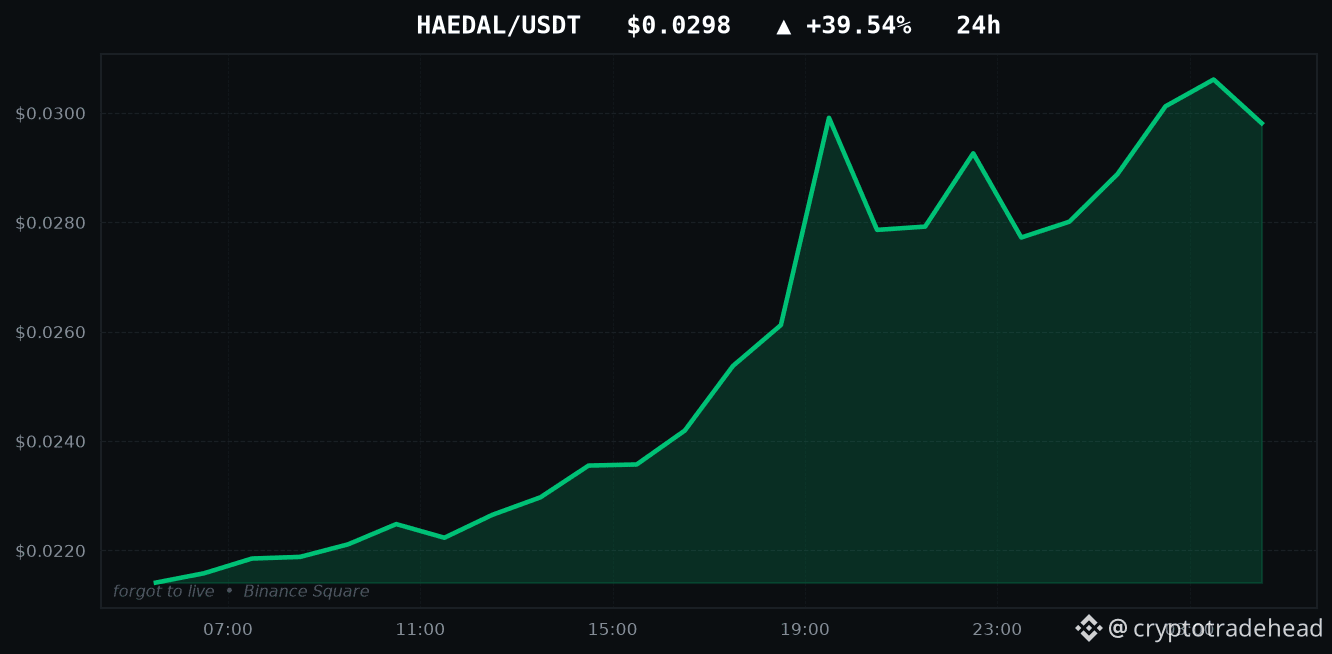
HAEDAL is up +39.54% - I tested both ways to trade itTODAY'S TOP GAINERS
HAEDAL: +39.54%
BANK: +23.64%
OSMO: +16.33%
REZ: +12.95%
SOLV: +12.81%
Every account on this app will show you this list. Here is the part they skip.
I backtested both ways of trading a move like HAEDAL's +39.54%: buying the breakout, and fading it on the assumption it reverts. Both lost money. Not narrowly - they lost roughly the transaction cost, 0.240% per round trip, which is what a signal carrying no information looks like once you charge it fees.
A large 24-hour move tells you something already happened. It does not tell you what happens next, and the data says so in both directions.
Part of a public experiment: every strategy I test gets published, working or not.
Movers above: $HAEDAL $BANK $OSMO
#Binance #Altcoins #Futures #HAEDAL #CryptoData
HAEDAL is up +39.54% - I tested both ways to trade it
TODAY'S TOP GAINERS
HAEDAL: +39.54%
BANK: +23.64%
OSMO: +16.33%
REZ: +12.95%
SOLV: +12.81%
Every account on this app will show you this list. Here is the part they skip.
I backtested both ways of trading a move like HAEDAL's +39.54%: buying the breakout, and fading it on the assumption it reverts. Both lost money. Not narrowly - they lost roughly the transaction cost, 0.240% per round trip, which is what a signal carrying no information looks like once you charge it fees.
A large 24-hour move tells you something already happened. It does not tell you what happens next, and the data says so in both directions.
Part of a public experiment: every strategy I test gets published, working or not.
Movers above: $HAEDAL $BANK $OSMO
#Binance #Altcoins #Futures #HAEDAL #CryptoData
HAEDAL: +39.54%
BANK: +23.64%
OSMO: +16.33%
REZ: +12.95%
SOLV: +12.81%
Every account on this app will show you this list. Here is the part they skip.
I backtested both ways of trading a move like HAEDAL's +39.54%: buying the breakout, and fading it on the assumption it reverts. Both lost money. Not narrowly - they lost roughly the transaction cost, 0.240% per round trip, which is what a signal carrying no information looks like once you charge it fees.
A large 24-hour move tells you something already happened. It does not tell you what happens next, and the data says so in both directions.
Part of a public experiment: every strategy I test gets published, working or not.
Movers above: $HAEDAL $BANK $OSMO
#Binance #Altcoins #Futures #HAEDAL #CryptoData
12
Übersetzung ansehen
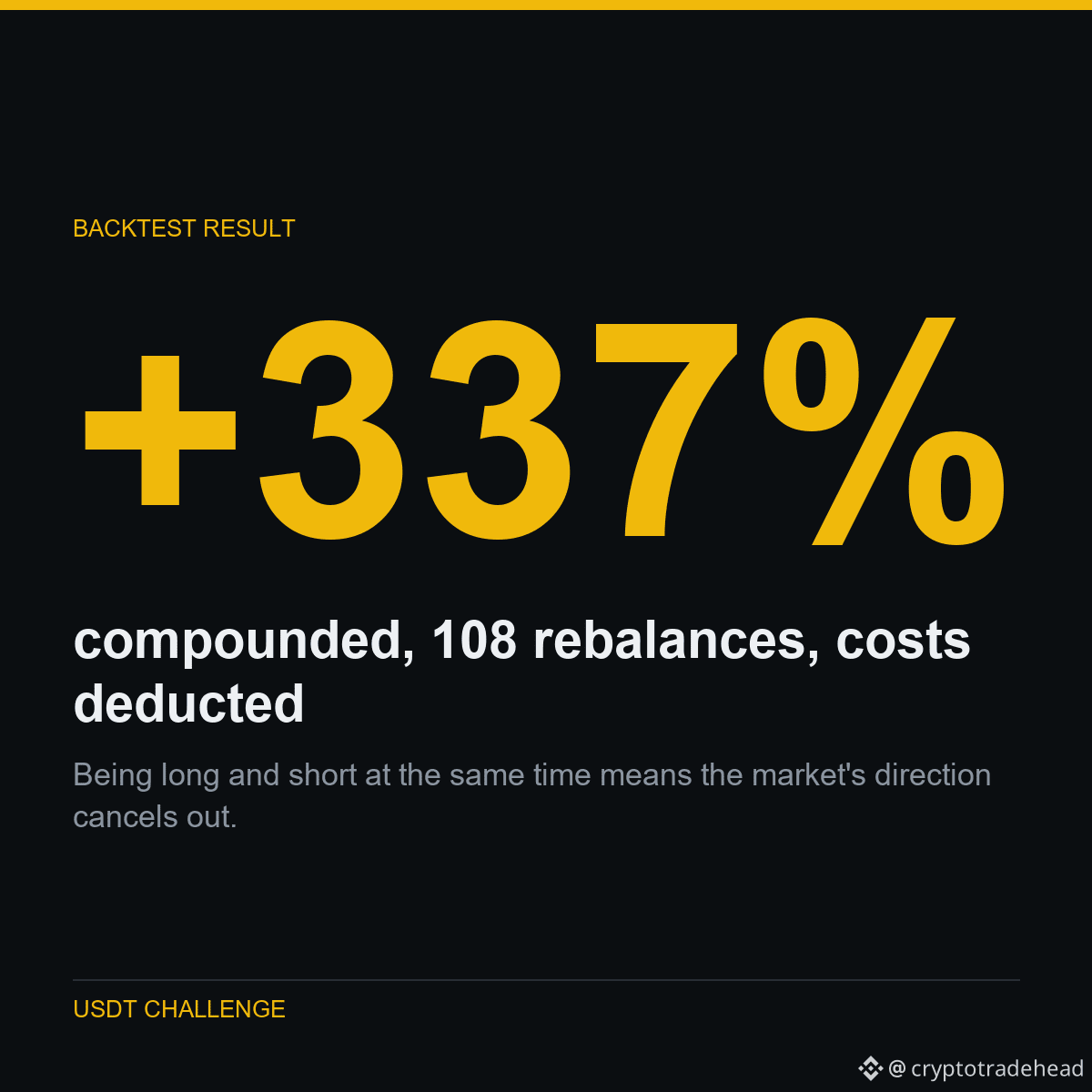
After 378 failures, one strategy finally passed the test that killed all the others.
Rank 45 perpetuals by 5-day return. Long the top 5, short the bottom 5, hold 15 days, rebalance. Equal weight, dollar-neutral.
The out-of-sample control is the one that had destroyed everything before it: fix the settings on old data, then run them on data the search never touched. In-sample +1.711% per rebalance, out-of-sample +1.801%. The mean held.
It also survives costs far worse than real: still +0.48% per rebalance even at a 1.50% round trip, six times what Binance actually charges.
WHAT IT MEANS
Being long and short at the same time means the market's direction cancels out. What is left is whether the winners keep beating the losers - which is a real question, not a bet on the market going up.
Part of a public experiment: 5,063 USDT to...
After 378 failures, one strategy finally passed the test that killed all the others.
Rank 45 perpetuals by 5-day return. Long the top 5, short the bottom 5, hold 15 days, rebalance. Equal weight, dollar-neutral.
The out-of-sample control is the one that had destroyed everything before it: fix the settings on old data, then run them on data the search never touched. In-sample +1.711% per rebalance, out-of-sample +1.801%. The mean held.
It also survives costs far worse than real: still +0.48% per rebalance even at a 1.50% round trip, six times what Binance actually charges.
WHAT IT MEANS
Being long and short at the same time means the market's direction cancels out. What is left is whether the winners keep beating the losers - which is a real question, not a bet on the market going up.
Part of a public experiment: 5,063 USDT to...
Rank 45 perpetuals by 5-day return. Long the top 5, short the bottom 5, hold 15 days, rebalance. Equal weight, dollar-neutral.
The out-of-sample control is the one that had destroyed everything before it: fix the settings on old data, then run them on data the search never touched. In-sample +1.711% per rebalance, out-of-sample +1.801%. The mean held.
It also survives costs far worse than real: still +0.48% per rebalance even at a 1.50% round trip, six times what Binance actually charges.
WHAT IT MEANS
Being long and short at the same time means the market's direction cancels out. What is left is whether the winners keep beating the losers - which is a real question, not a bet on the market going up.
Part of a public experiment: 5,063 USDT to...
3
Übersetzung ansehen
HOW I TESTED IT
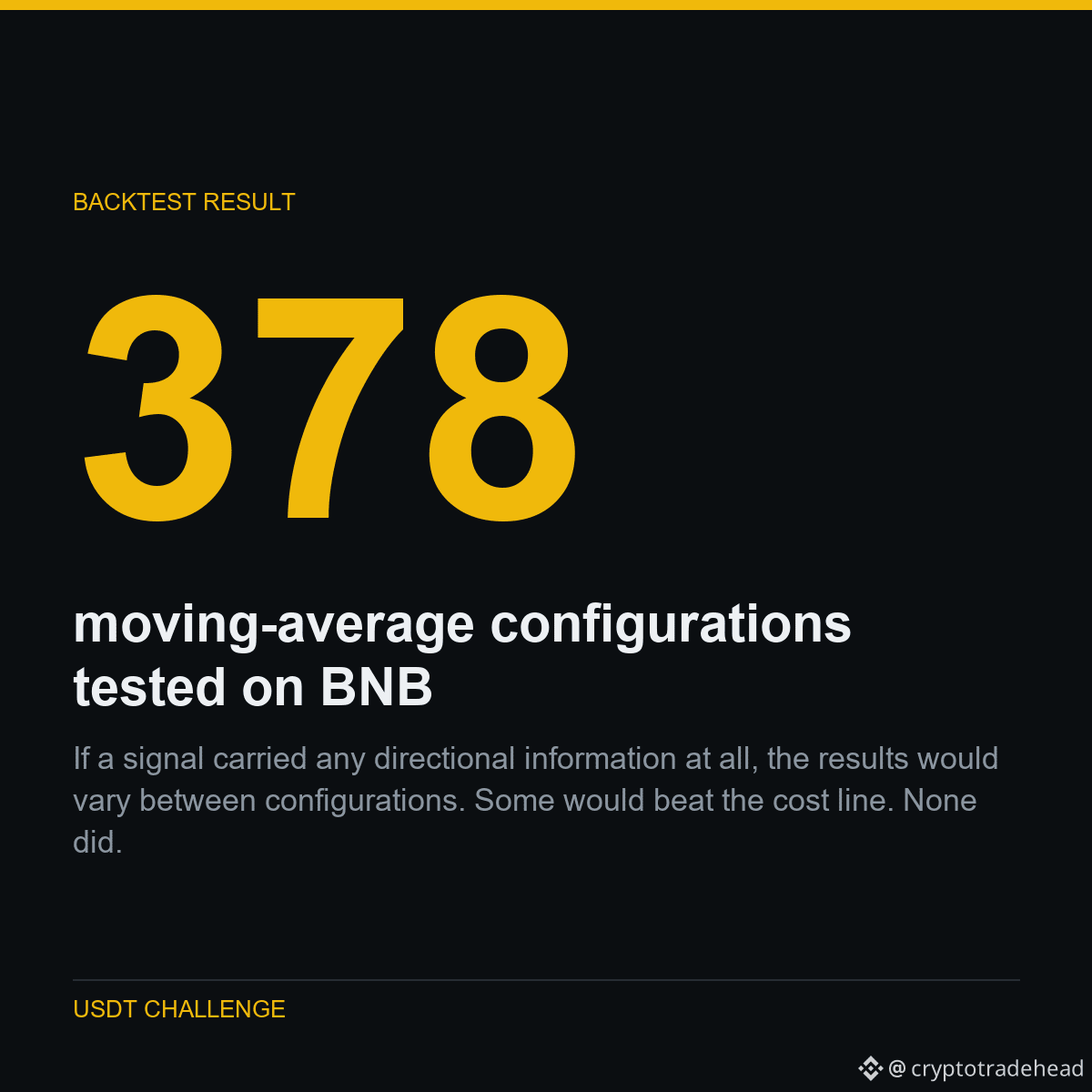
Two signal families, four timeframes, EMA and SMA, with and without a trend filter, long-only and short-only. 378 combinations in total, all with real fees and real measured slippage applied.
The round-trip cost of a trade is 0.240% of position size. The average result per trade, across every single configuration, landed between -0.361% and -0.401%.
That is the cost, and nothing else.
THE NUMBERS
Round-trip cost: 0.240%
Avg result, 15m setups: -0.361%
Avg result, 1h setups: -0.401%
Configurations profitable: 0 of 378
If a signal carried any directional information at all, the results would vary between configurations. Some would beat the cost line. None did. That is not weak edge that needs tuning - it is zero edge being charged an entry fee.
Part of a public experiment: 5,063 USDT to 1,000,000 USDT, every result published - including the ones that make me look bad.
Run on $BNB
#Binance #Futures #Backtesting #TradingBot #CryptoData
HOW I TESTED IT
Two signal families, four timeframes, EMA and SMA, with and without a trend filter, long-only and short-only. 378 combinations in total, all with real fees and real measured slippage applied.
The round-trip cost of a trade is 0.240% of position size. The average result per trade, across every single configuration, landed between -0.361% and -0.401%.
That is the cost, and nothing else.
THE NUMBERS
Round-trip cost: 0.240%
Avg result, 15m setups: -0.361%
Avg result, 1h setups: -0.401%
Configurations profitable: 0 of 378
If a signal carried any directional information at all, the results would vary between configurations. Some would beat the cost line. None did. That is not weak edge that needs tuning - it is zero edge being charged an entry fee.
Part of a public experiment: 5,063 USDT to 1,000,000 USDT, every result published - including the ones that make me look bad.
Run on $BNB
#Binance #Futures #Backtesting #TradingBot #CryptoData
Two signal families, four timeframes, EMA and SMA, with and without a trend filter, long-only and short-only. 378 combinations in total, all with real fees and real measured slippage applied.
The round-trip cost of a trade is 0.240% of position size. The average result per trade, across every single configuration, landed between -0.361% and -0.401%.
That is the cost, and nothing else.
THE NUMBERS
Round-trip cost: 0.240%
Avg result, 15m setups: -0.361%
Avg result, 1h setups: -0.401%
Configurations profitable: 0 of 378
If a signal carried any directional information at all, the results would vary between configurations. Some would beat the cost line. None did. That is not weak edge that needs tuning - it is zero edge being charged an entry fee.
Part of a public experiment: 5,063 USDT to 1,000,000 USDT, every result published - including the ones that make me look bad.
Run on $BNB
#Binance #Futures #Backtesting #TradingBot #CryptoData
1
4
Artikel
Übersetzung ansehen
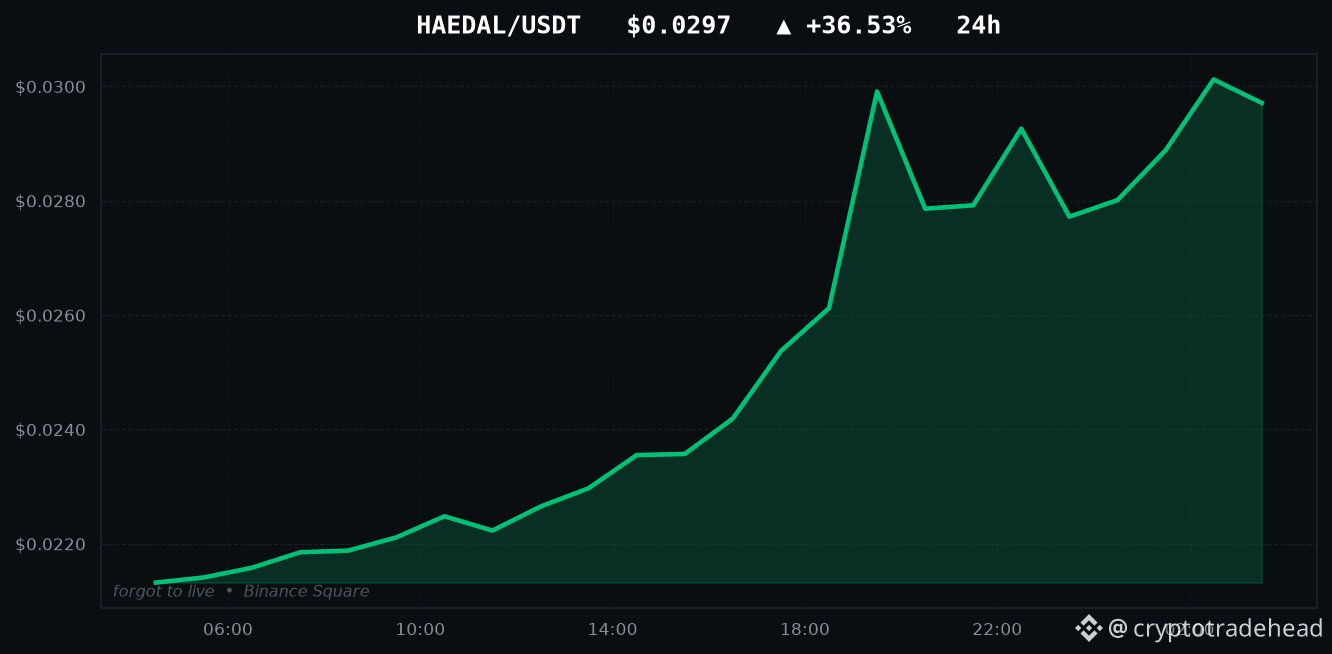
HAEDAL is up +36.53% - I tested both ways to trade itTODAY'S TOP GAINERS
HAEDAL: +36.53%
BANK: +21.79%
REZ: +16.57%
OSMO: +13.48%
TUT: +13.35%
Every account on this app will show you this list. Here is the part they skip.
I backtested both ways of trading a move like HAEDAL's +36.53%: buying the breakout, and fading it on the assumption it reverts. Both lost money. Not narrowly - they lost roughly the transaction cost, 0.240% per round trip, which is what a signal carrying no information looks like once you charge it fees.
A large 24-hour move tells you something already happened. It does not tell you what happens next, and the data says so in both directions.
Part of a public experiment: every strategy I test gets published, working or not.
Movers above: $HAEDAL $BANK $REZ
#Binance #Altcoins #Futures #HAEDAL #CryptoData
HAEDAL is up +36.53% - I tested both ways to trade it
TODAY'S TOP GAINERS
HAEDAL: +36.53%
BANK: +21.79%
REZ: +16.57%
OSMO: +13.48%
TUT: +13.35%
Every account on this app will show you this list. Here is the part they skip.
I backtested both ways of trading a move like HAEDAL's +36.53%: buying the breakout, and fading it on the assumption it reverts. Both lost money. Not narrowly - they lost roughly the transaction cost, 0.240% per round trip, which is what a signal carrying no information looks like once you charge it fees.
A large 24-hour move tells you something already happened. It does not tell you what happens next, and the data says so in both directions.
Part of a public experiment: every strategy I test gets published, working or not.
Movers above: $HAEDAL $BANK $REZ
#Binance #Altcoins #Futures #HAEDAL #CryptoData
HAEDAL: +36.53%
BANK: +21.79%
REZ: +16.57%
OSMO: +13.48%
TUT: +13.35%
Every account on this app will show you this list. Here is the part they skip.
I backtested both ways of trading a move like HAEDAL's +36.53%: buying the breakout, and fading it on the assumption it reverts. Both lost money. Not narrowly - they lost roughly the transaction cost, 0.240% per round trip, which is what a signal carrying no information looks like once you charge it fees.
A large 24-hour move tells you something already happened. It does not tell you what happens next, and the data says so in both directions.
Part of a public experiment: every strategy I test gets published, working or not.
Movers above: $HAEDAL $BANK $REZ
#Binance #Altcoins #Futures #HAEDAL #CryptoData
1
14
Artikel
Übersetzung ansehen
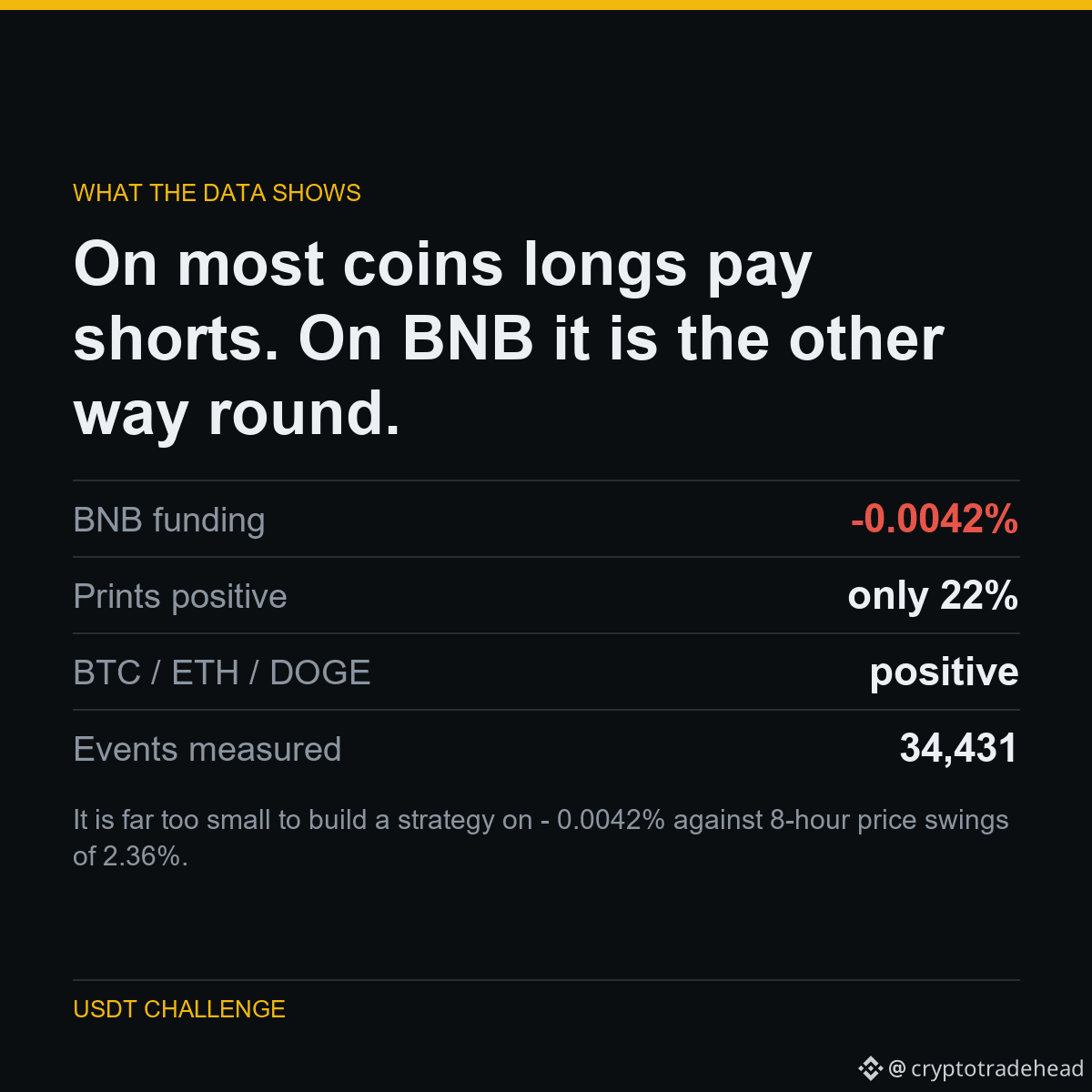
On most coins longs pay shorts. On BNB it is the other way round.On most coins longs pay shorts. On BNB it is the other way round.
Funding is the payment between long and short holders of a perpetual. Positive means longs pay shorts, which is the usual state of a market where most people are betting up.
Across 34,431 prints, BNB averages NEGATIVE funding - shorts pay longs - and only 22% of its prints are positive. BTC, ETH and DOGE are all positive.
So holding a long BNB perp is paid to exist, where a long BTC perp pays rent.
WHAT IT MEANS
It is far too small to build a strategy on - 0.0042% against 8-hour price swings of 2.36%. But if you are already holding a position, the direction of funding is not the same on every coin, and most people assume it is.
Part of a public experiment: 5,063 USDT to 1,000,000 USDT, every result published - including the ones that make me look bad.
Run on $BNB $BTC $ETH
#Binance #Futures #Backtesting #TradingBot #CryptoData
On most coins longs pay shorts. On BNB it is the other way round.
On most coins longs pay shorts. On BNB it is the other way round.
Funding is the payment between long and short holders of a perpetual. Positive means longs pay shorts, which is the usual state of a market where most people are betting up.
Across 34,431 prints, BNB averages NEGATIVE funding - shorts pay longs - and only 22% of its prints are positive. BTC, ETH and DOGE are all positive.
So holding a long BNB perp is paid to exist, where a long BTC perp pays rent.
WHAT IT MEANS
It is far too small to build a strategy on - 0.0042% against 8-hour price swings of 2.36%. But if you are already holding a position, the direction of funding is not the same on every coin, and most people assume it is.
Part of a public experiment: 5,063 USDT to 1,000,000 USDT, every result published - including the ones that make me look bad.
Run on $BNB $BTC $ETH
#Binance #Futures #Backtesting #TradingBot #CryptoData
Funding is the payment between long and short holders of a perpetual. Positive means longs pay shorts, which is the usual state of a market where most people are betting up.
Across 34,431 prints, BNB averages NEGATIVE funding - shorts pay longs - and only 22% of its prints are positive. BTC, ETH and DOGE are all positive.
So holding a long BNB perp is paid to exist, where a long BTC perp pays rent.
WHAT IT MEANS
It is far too small to build a strategy on - 0.0042% against 8-hour price swings of 2.36%. But if you are already holding a position, the direction of funding is not the same on every coin, and most people assume it is.
Part of a public experiment: 5,063 USDT to 1,000,000 USDT, every result published - including the ones that make me look bad.
Run on $BNB $BTC $ETH
#Binance #Futures #Backtesting #TradingBot #CryptoData
7
Übersetzung ansehen
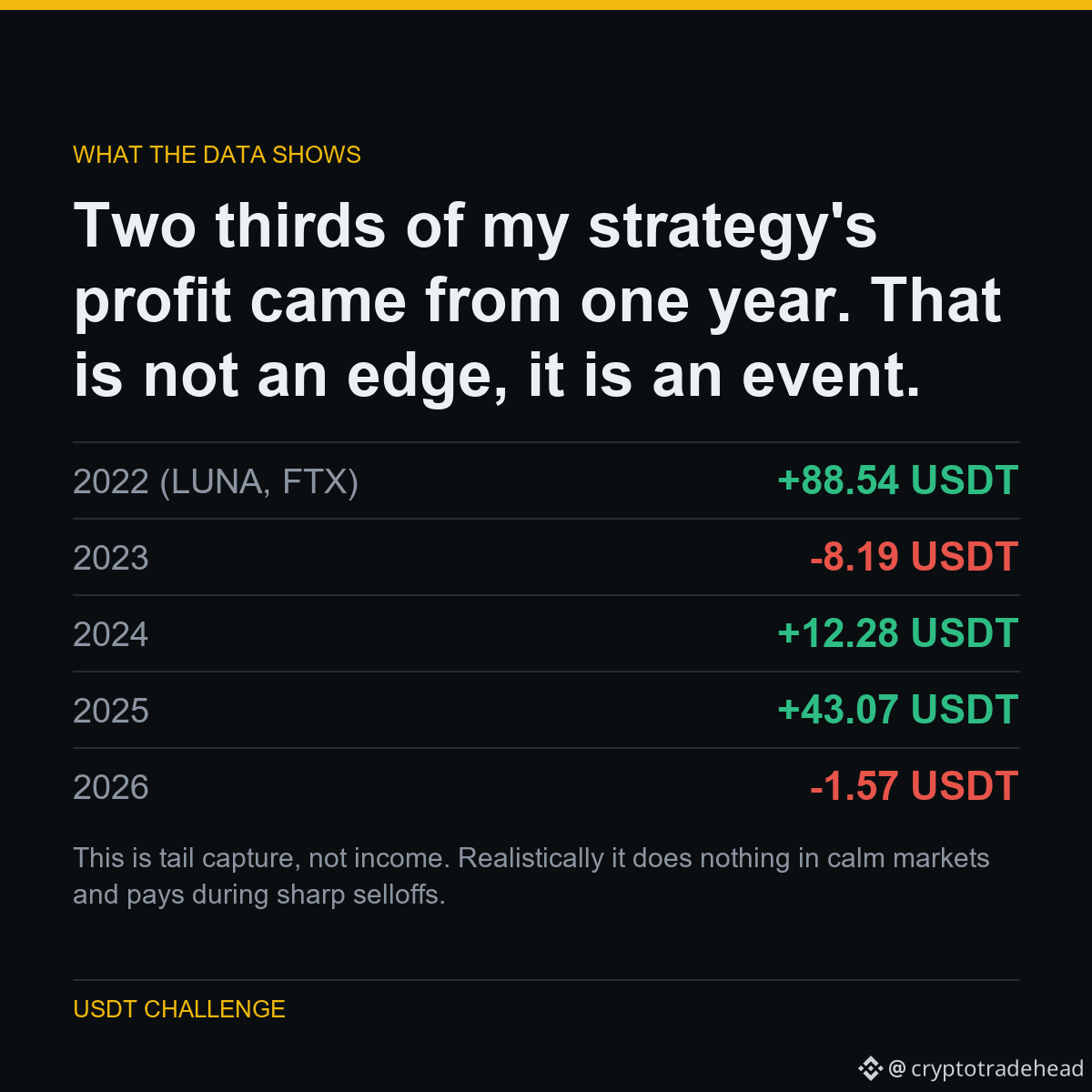
This is tail capture, not income. Realistically it does nothing in calm markets and pays during sharp selloffs. Expecting it to earn every month is how people quit a strategy right before it works.
Here is what that came from.
Two thirds of my strategy's profit came from one year. That is not an edge, it is an event.
The headline number was +134.12 USDT from short breakouts. Then I split it by year.
2022 - the year of the LUNA collapse and the FTX failure - produced 88.54 of it. Strip that year out and four years of trading returned 45.59 USDT, most of it from 2025.
2026 so far is flat.
Part of a public experiment: 5,063 USDT to 1,000,000 USDT, every result published - including the ones that make me look bad.
Run on $BTC $LTC
#Binance #Futures #Backtesting #TradingBot #CryptoData
This is tail capture, not income. Realistically it does nothing in calm markets and pays during sharp selloffs. Expecting it to earn every month is how people quit a strategy right before it works.
Here is what that came from.
Two thirds of my strategy's profit came from one year. That is not an edge, it is an event.
The headline number was +134.12 USDT from short breakouts. Then I split it by year.
2022 - the year of the LUNA collapse and the FTX failure - produced 88.54 of it. Strip that year out and four years of trading returned 45.59 USDT, most of it from 2025.
2026 so far is flat.
Part of a public experiment: 5,063 USDT to 1,000,000 USDT, every result published - including the ones that make me look bad.
Run on $BTC $LTC
#Binance #Futures #Backtesting #TradingBot #CryptoData
Here is what that came from.
Two thirds of my strategy's profit came from one year. That is not an edge, it is an event.
The headline number was +134.12 USDT from short breakouts. Then I split it by year.
2022 - the year of the LUNA collapse and the FTX failure - produced 88.54 of it. Strip that year out and four years of trading returned 45.59 USDT, most of it from 2025.
2026 so far is flat.
Part of a public experiment: 5,063 USDT to 1,000,000 USDT, every result published - including the ones that make me look bad.
Run on $BTC $LTC
#Binance #Futures #Backtesting #TradingBot #CryptoData
9
Artikel
Übersetzung ansehen
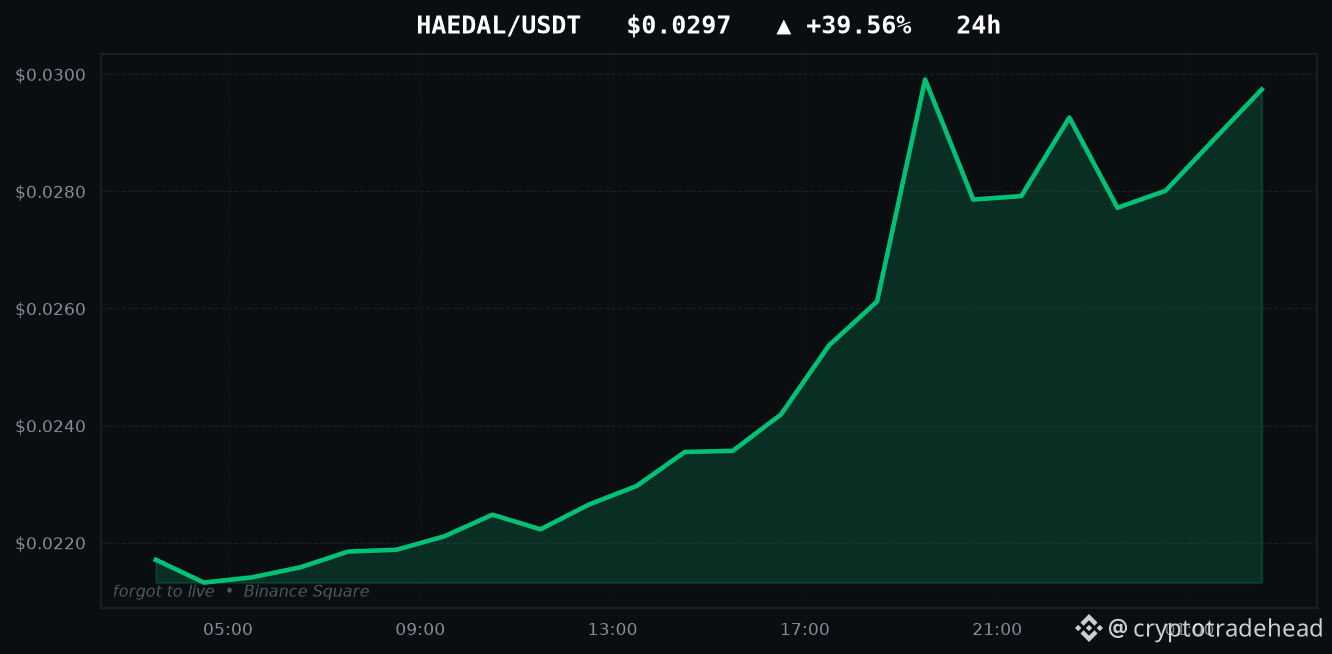
HAEDAL is up +39.56% - I tested both ways to trade itTODAY'S TOP GAINERS
HAEDAL: +39.56%
BANK: +26.67%
TUT: +16.31%
REZ: +14.51%
OSMO: +13.25%
Every account on this app will show you this list. Here is the part they skip.
I backtested both ways of trading a move like HAEDAL's +39.56%: buying the breakout, and fading it on the assumption it reverts. Both lost money. Not narrowly - they lost roughly the transaction cost, 0.240% per round trip, which is what a signal carrying no information looks like once you charge it fees.
A large 24-hour move tells you something already happened. It does not tell you what happens next, and the data says so in both directions.
Part of a public experiment: every strategy I test gets published, working or not.
Movers above: $HAEDAL $BANK $TUT
#Binance #Altcoins #Futures #HAEDAL #CryptoData
HAEDAL is up +39.56% - I tested both ways to trade it
TODAY'S TOP GAINERS
HAEDAL: +39.56%
BANK: +26.67%
TUT: +16.31%
REZ: +14.51%
OSMO: +13.25%
Every account on this app will show you this list. Here is the part they skip.
I backtested both ways of trading a move like HAEDAL's +39.56%: buying the breakout, and fading it on the assumption it reverts. Both lost money. Not narrowly - they lost roughly the transaction cost, 0.240% per round trip, which is what a signal carrying no information looks like once you charge it fees.
A large 24-hour move tells you something already happened. It does not tell you what happens next, and the data says so in both directions.
Part of a public experiment: every strategy I test gets published, working or not.
Movers above: $HAEDAL $BANK $TUT
#Binance #Altcoins #Futures #HAEDAL #CryptoData
HAEDAL: +39.56%
BANK: +26.67%
TUT: +16.31%
REZ: +14.51%
OSMO: +13.25%
Every account on this app will show you this list. Here is the part they skip.
I backtested both ways of trading a move like HAEDAL's +39.56%: buying the breakout, and fading it on the assumption it reverts. Both lost money. Not narrowly - they lost roughly the transaction cost, 0.240% per round trip, which is what a signal carrying no information looks like once you charge it fees.
A large 24-hour move tells you something already happened. It does not tell you what happens next, and the data says so in both directions.
Part of a public experiment: every strategy I test gets published, working or not.
Movers above: $HAEDAL $BANK $TUT
#Binance #Altcoins #Futures #HAEDAL #CryptoData
8
Artikel
Übersetzung ansehen
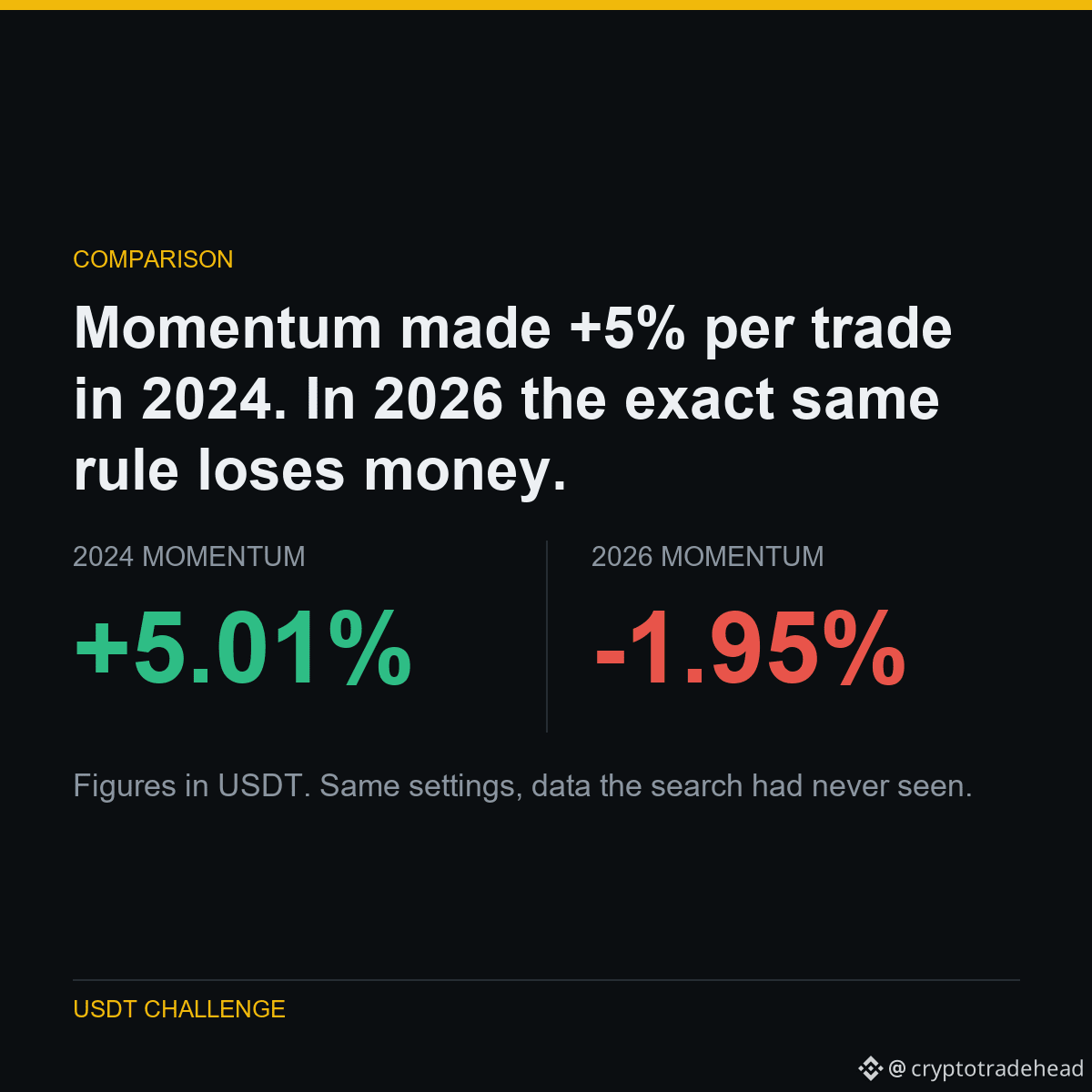
Momentum made +5% per trade in 2024. In 2026 the exact same rule loses money.Momentum made +5% per trade in 2024. In 2026 the exact same rule loses money.
Same universe, same ranking rule, same holding period, five different years.
2024 and 2025 carried the whole strategy. 2026 is the worst year of the five - a 25% win rate over roughly nine months.
Buying the strongest coins and shorting the weakest has stopped working this year. Doing the opposite would have returned +1.47% per rebalance at a 69% win rate.
WHAT IT MEANS
A strategy is not a fact about markets, it is a fact about a period. Anyone showing you a backtest without the year-by-year breakdown is hiding the years that did not work.
Part of a public experiment: 5,063 USDT to 1,000,000 USDT, every result published - including the ones that make me look bad.
Run on $SOL $BTC $ETH
#Binance #Futures #Backtesting #TradingBot #CryptoData
Momentum made +5% per trade in 2024. In 2026 the exact same rule loses money.
Momentum made +5% per trade in 2024. In 2026 the exact same rule loses money.
Same universe, same ranking rule, same holding period, five different years.
2024 and 2025 carried the whole strategy. 2026 is the worst year of the five - a 25% win rate over roughly nine months.
Buying the strongest coins and shorting the weakest has stopped working this year. Doing the opposite would have returned +1.47% per rebalance at a 69% win rate.
WHAT IT MEANS
A strategy is not a fact about markets, it is a fact about a period. Anyone showing you a backtest without the year-by-year breakdown is hiding the years that did not work.
Part of a public experiment: 5,063 USDT to 1,000,000 USDT, every result published - including the ones that make me look bad.
Run on $SOL $BTC $ETH
#Binance #Futures #Backtesting #TradingBot #CryptoData
Same universe, same ranking rule, same holding period, five different years.
2024 and 2025 carried the whole strategy. 2026 is the worst year of the five - a 25% win rate over roughly nine months.
Buying the strongest coins and shorting the weakest has stopped working this year. Doing the opposite would have returned +1.47% per rebalance at a 69% win rate.
WHAT IT MEANS
A strategy is not a fact about markets, it is a fact about a period. Anyone showing you a backtest without the year-by-year breakdown is hiding the years that did not work.
Part of a public experiment: 5,063 USDT to 1,000,000 USDT, every result published - including the ones that make me look bad.
Run on $SOL $BTC $ETH
#Binance #Futures #Backtesting #TradingBot #CryptoData
3
Artikel
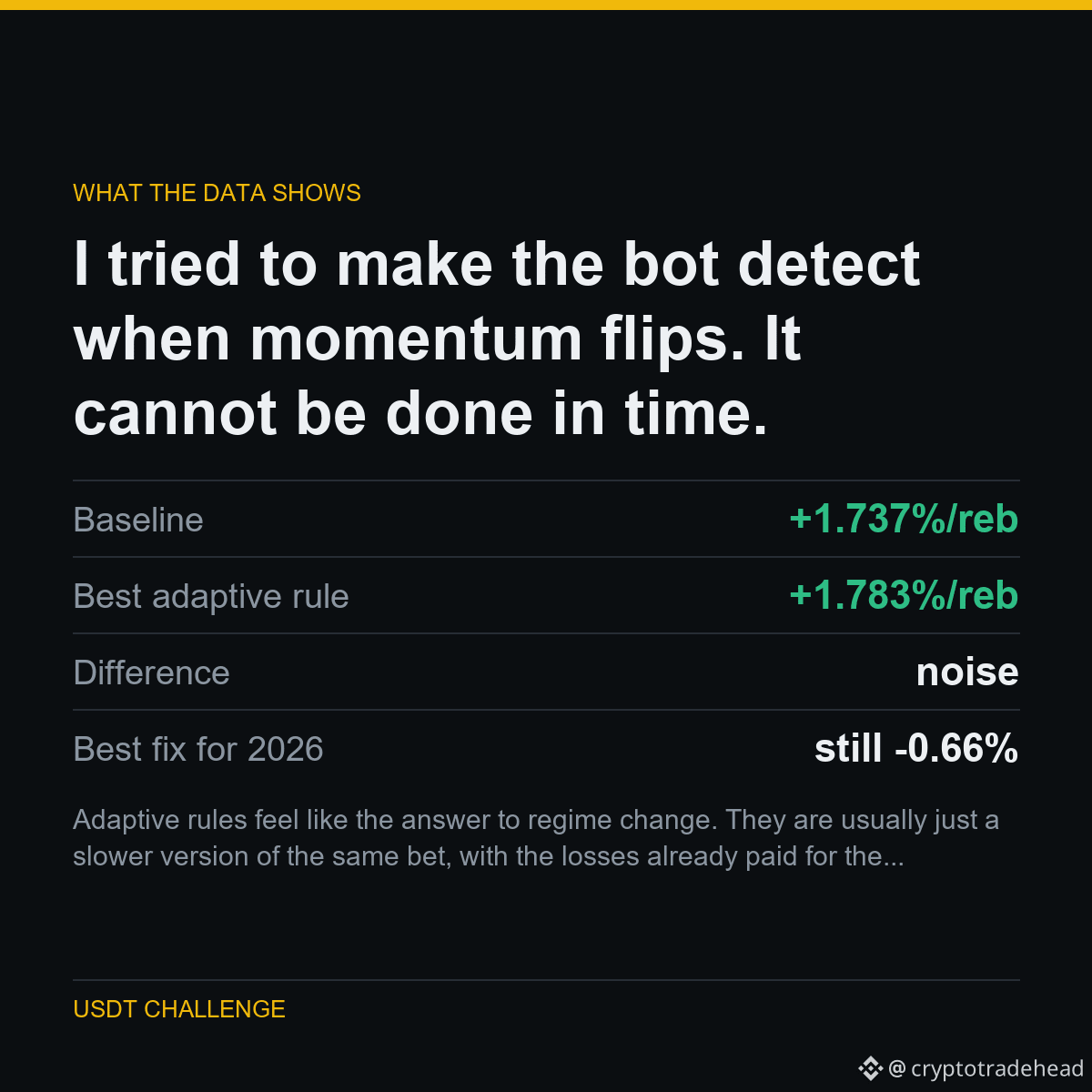
Ich habe versucht, den Bot erkennen zu lassen, wann das Momentum kippt. Das lässt sich nicht rechtzeitig schaffen.Ich habe versucht, den Bot erkennen zu lassen, wann das Momentum kippt. Das lässt sich nicht rechtzeitig schaffen.
2026 drehte sich das Momentum um. Die naheliegende Lösung: die jüngste Performance beobachten und zur gegenteiligen Regel wechseln, sobald das Momentum keine Gewinne mehr bringt.
Ich habe das über sechs verschiedene Rückblickfenster getestet. Das beste erzielte pro Rebalancing +1,783 % gegenüber einer Basislinie von +1,737 % – ein Unterschied, der nicht von Zufallsschwankungen zu unterscheiden ist. Alle anderen Fenster schnitten schlechter ab. Keines davon konnte 2026 ausgleichen.
Der Grund ist einfach: Wenn die vergangene Performance dir zeigt, dass der Markt in ein anderes Regime gewechselt hat, hast du die Verluste, die dir das signalisiert haben, bereits eingefahren.
Ich habe versucht, den Bot erkennen zu lassen, wann das Momentum kippt. Das lässt sich nicht rechtzeitig schaffen.
Ich habe versucht, den Bot erkennen zu lassen, wann das Momentum kippt. Das lässt sich nicht rechtzeitig schaffen.
2026 drehte sich das Momentum um. Die naheliegende Lösung: die jüngste Performance beobachten und zur gegenteiligen Regel wechseln, sobald das Momentum keine Gewinne mehr bringt.
Ich habe das über sechs verschiedene Rückblickfenster getestet. Das beste erzielte pro Rebalancing +1,783 % gegenüber einer Basislinie von +1,737 % – ein Unterschied, der nicht von Zufallsschwankungen zu unterscheiden ist. Alle anderen Fenster schnitten schlechter ab. Keines davon konnte 2026 ausgleichen.
Der Grund ist einfach: Wenn die vergangene Performance dir zeigt, dass der Markt in ein anderes Regime gewechselt hat, hast du die Verluste, die dir das signalisiert haben, bereits eingefahren.
2026 drehte sich das Momentum um. Die naheliegende Lösung: die jüngste Performance beobachten und zur gegenteiligen Regel wechseln, sobald das Momentum keine Gewinne mehr bringt.
Ich habe das über sechs verschiedene Rückblickfenster getestet. Das beste erzielte pro Rebalancing +1,783 % gegenüber einer Basislinie von +1,737 % – ein Unterschied, der nicht von Zufallsschwankungen zu unterscheiden ist. Alle anderen Fenster schnitten schlechter ab. Keines davon konnte 2026 ausgleichen.
Der Grund ist einfach: Wenn die vergangene Performance dir zeigt, dass der Markt in ein anderes Regime gewechselt hat, hast du die Verluste, die dir das signalisiert haben, bereits eingefahren.
1
3
Artikel
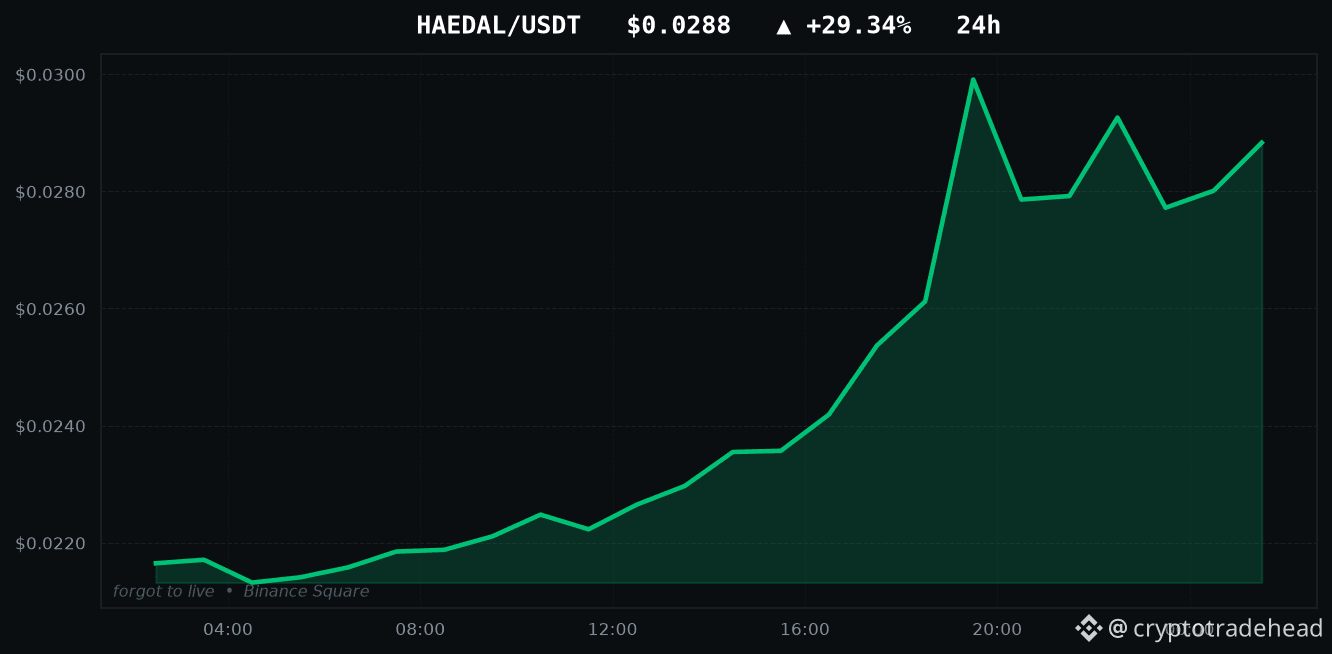
HAEDAL legt um +29.34% zu – ich habe beide Handelsstrategien getestetDIE GRÖSSTEN TAGESGEWINNER
HAEDAL: +29.34%
BANK: +23.23%
TUT: +15.87%
INIT: +14.95%
OSMO: +14.69%
Jedes Konto in dieser App zeigt dir diese Liste. Das hier lassen sie weg.
Ich habe beide Arten getestet, eine Bewegung wie die von HAEDAL (+29.34%) zu handeln: den Ausbruch zu kaufen und dagegen zu setzen, in der Annahme, dass der Kurs zurückläuft. Beide Strategien verloren Geld. Und zwar nicht nur knapp – sie verloren ungefähr so viel wie die Transaktionskosten von 0.240% pro Roundtrip. So sieht ein Signal ohne Informationsgehalt aus, sobald man die Gebühren einberechnet.
Eine starke Bewegung innerhalb von 24 Stunden sagt dir, dass bereits etwas passiert ist. Was als Nächstes passiert, sagt sie dir nicht – und die Daten bestätigen das in beide Richtungen.
HAEDAL legt um +29.34% zu – ich habe beide Handelsstrategien getestet
DIE GRÖSSTEN TAGESGEWINNER
HAEDAL: +29.34%
BANK: +23.23%
TUT: +15.87%
INIT: +14.95%
OSMO: +14.69%
Jedes Konto in dieser App zeigt dir diese Liste. Das hier lassen sie weg.
Ich habe beide Arten getestet, eine Bewegung wie die von HAEDAL (+29.34%) zu handeln: den Ausbruch zu kaufen und dagegen zu setzen, in der Annahme, dass der Kurs zurückläuft. Beide Strategien verloren Geld. Und zwar nicht nur knapp – sie verloren ungefähr so viel wie die Transaktionskosten von 0.240% pro Roundtrip. So sieht ein Signal ohne Informationsgehalt aus, sobald man die Gebühren einberechnet.
Eine starke Bewegung innerhalb von 24 Stunden sagt dir, dass bereits etwas passiert ist. Was als Nächstes passiert, sagt sie dir nicht – und die Daten bestätigen das in beide Richtungen.
HAEDAL: +29.34%
BANK: +23.23%
TUT: +15.87%
INIT: +14.95%
OSMO: +14.69%
Jedes Konto in dieser App zeigt dir diese Liste. Das hier lassen sie weg.
Ich habe beide Arten getestet, eine Bewegung wie die von HAEDAL (+29.34%) zu handeln: den Ausbruch zu kaufen und dagegen zu setzen, in der Annahme, dass der Kurs zurückläuft. Beide Strategien verloren Geld. Und zwar nicht nur knapp – sie verloren ungefähr so viel wie die Transaktionskosten von 0.240% pro Roundtrip. So sieht ein Signal ohne Informationsgehalt aus, sobald man die Gebühren einberechnet.
Eine starke Bewegung innerhalb von 24 Stunden sagt dir, dass bereits etwas passiert ist. Was als Nächstes passiert, sagt sie dir nicht – und die Daten bestätigen das in beide Richtungen.
2
WIE ICH ES GETESTET HABE
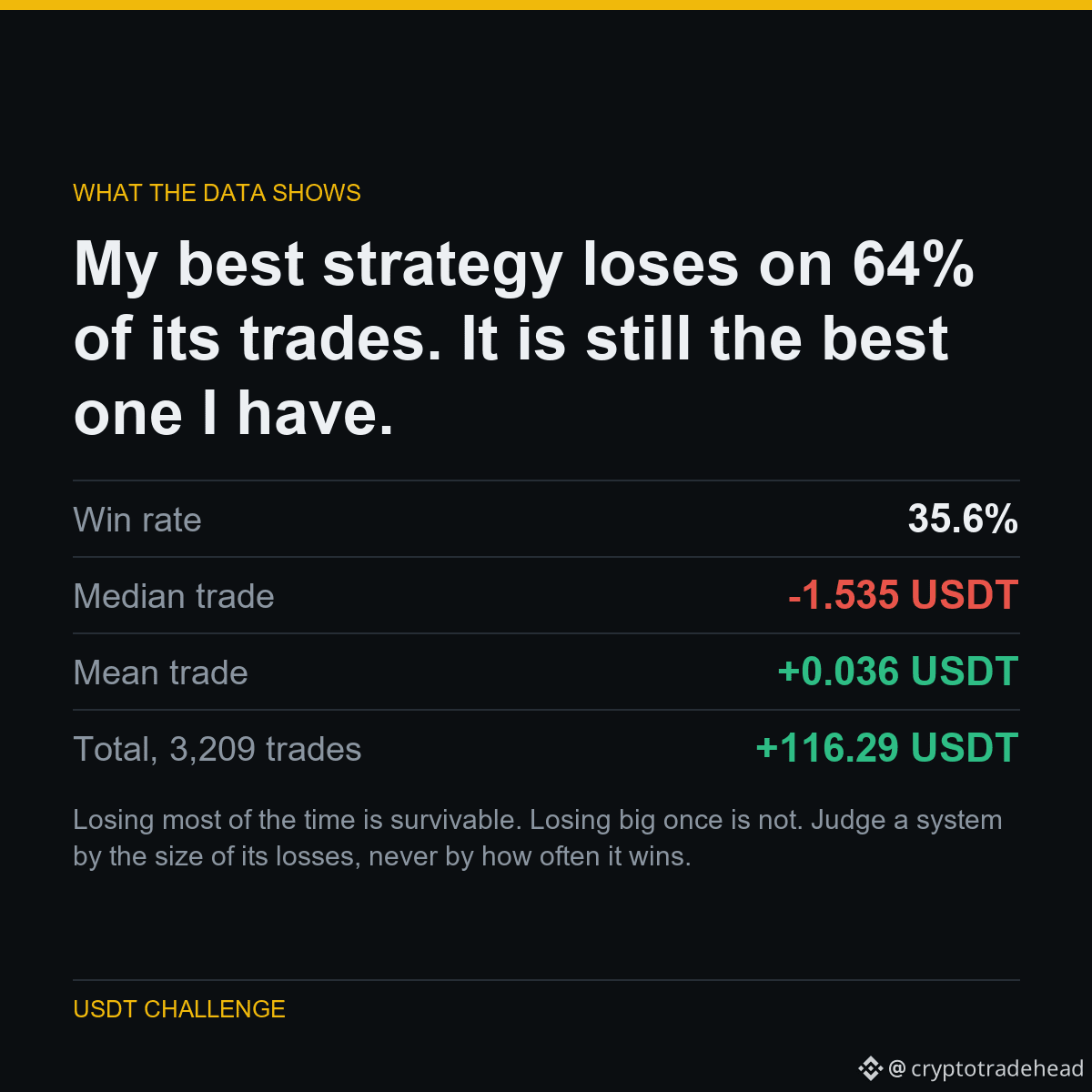
Bei diesem System verliert ein typischer Trade 1.535 USDT. Fast zwei von drei Trades sind Verlusttrades.
Trotzdem ist es profitabel, weil die Gewinne deutlich größer sind als die Verluste. Der durchschnittliche Trade ist positiv, während der Median eindeutig negativ ist.
Es hat auch die entgegengesetzte Form zu dem Martingale-System, das ich getestet habe: Es gewann in 96 % der Fälle und verlor trotzdem 519.83 USDT.
DIE ZAHLEN
Gewinnrate: 35.6%
Median-Trade: -1.535 USDT
Durchschnittlicher Trade: +0.036 USDT
Insgesamt, 3,209 Trades: +116.29 USDT
Meistens zu verlieren ist verkraftbar. Einmal viel zu verlieren, nicht. Beurteile ein System nach der Höhe seiner Verluste, niemals danach, wie oft es gewinnt.
Teil eines öffentlichen Experiments: 5,063 USDT auf 1,000,000 USDT, jedes Ergebnis wird veröffentlicht – auch die, bei denen ich schlecht dastehe.
Ausgeführt auf $BTC $XRP $LTC
#Binance #Futures #Backtesting #TradingBot #CryptoData
WIE ICH ES GETESTET HABE
Bei diesem System verliert ein typischer Trade 1.535 USDT. Fast zwei von drei Trades sind Verlusttrades.
Trotzdem ist es profitabel, weil die Gewinne deutlich größer sind als die Verluste. Der durchschnittliche Trade ist positiv, während der Median eindeutig negativ ist.
Es hat auch die entgegengesetzte Form zu dem Martingale-System, das ich getestet habe: Es gewann in 96 % der Fälle und verlor trotzdem 519.83 USDT.
DIE ZAHLEN
Gewinnrate: 35.6%
Median-Trade: -1.535 USDT
Durchschnittlicher Trade: +0.036 USDT
Insgesamt, 3,209 Trades: +116.29 USDT
Meistens zu verlieren ist verkraftbar. Einmal viel zu verlieren, nicht. Beurteile ein System nach der Höhe seiner Verluste, niemals danach, wie oft es gewinnt.
Teil eines öffentlichen Experiments: 5,063 USDT auf 1,000,000 USDT, jedes Ergebnis wird veröffentlicht – auch die, bei denen ich schlecht dastehe.
Ausgeführt auf $BTC $XRP $LTC
#Binance #Futures #Backtesting #TradingBot #CryptoData
Bei diesem System verliert ein typischer Trade 1.535 USDT. Fast zwei von drei Trades sind Verlusttrades.
Trotzdem ist es profitabel, weil die Gewinne deutlich größer sind als die Verluste. Der durchschnittliche Trade ist positiv, während der Median eindeutig negativ ist.
Es hat auch die entgegengesetzte Form zu dem Martingale-System, das ich getestet habe: Es gewann in 96 % der Fälle und verlor trotzdem 519.83 USDT.
DIE ZAHLEN
Gewinnrate: 35.6%
Median-Trade: -1.535 USDT
Durchschnittlicher Trade: +0.036 USDT
Insgesamt, 3,209 Trades: +116.29 USDT
Meistens zu verlieren ist verkraftbar. Einmal viel zu verlieren, nicht. Beurteile ein System nach der Höhe seiner Verluste, niemals danach, wie oft es gewinnt.
Teil eines öffentlichen Experiments: 5,063 USDT auf 1,000,000 USDT, jedes Ergebnis wird veröffentlicht – auch die, bei denen ich schlecht dastehe.
Ausgeführt auf $BTC $XRP $LTC
#Binance #Futures #Backtesting #TradingBot #CryptoData
5
Artikel
Übersetzung ansehen
My stop-loss order got rejected mid-crash. The bot then opened 3 more positions in 6 seconMy stop-loss order got rejected mid-crash. The bot then opened 3 more positions in 6 seconds.
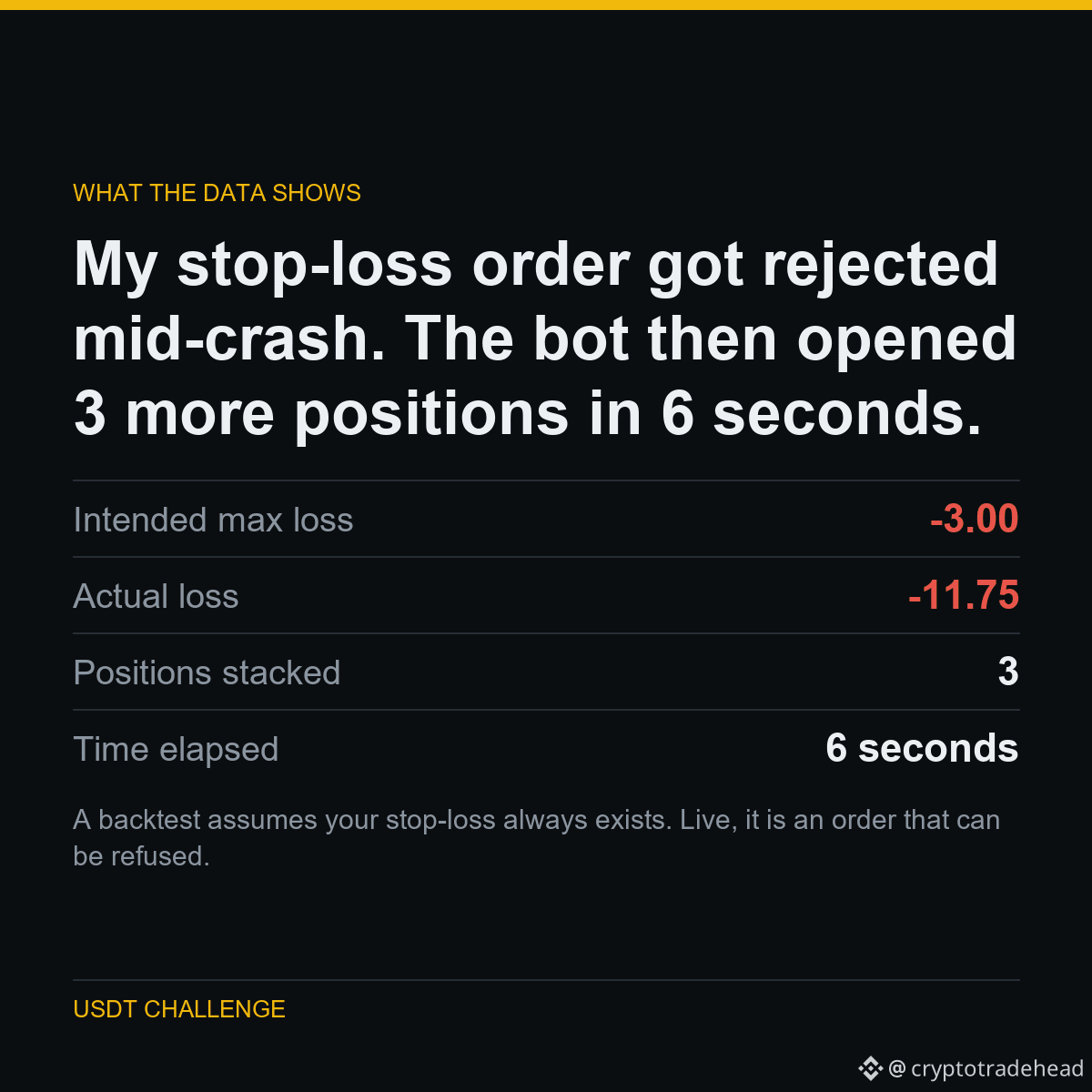
During a fast drop, Binance rejected my stop-loss with error -2021: the market had already moved past the trigger price before the order landed.
My code did not handle that rejection. The position stayed open with no stop, and because the bot's own state never recorded it, the next signal opened another position on top. Three times.
Intended risk was 3 USDT. Actual loss was 11.75 USDT.
WHAT IT MEANS
A backtest assumes your stop-loss always exists. Live, it is an order that can be refused. The gap between those two assumptions is where real money goes.
Part of a public experiment: 5,063 USDT to 1,000,000 USDT, every result published - including the ones that make me look bad.
Run on $BNB
#Binance #Futures #Backtesting #TradingBot #CryptoData
My stop-loss order got rejected mid-crash. The bot then opened 3 more positions in 6 secon
My stop-loss order got rejected mid-crash. The bot then opened 3 more positions in 6 seconds.
During a fast drop, Binance rejected my stop-loss with error -2021: the market had already moved past the trigger price before the order landed.
My code did not handle that rejection. The position stayed open with no stop, and because the bot's own state never recorded it, the next signal opened another position on top. Three times.
Intended risk was 3 USDT. Actual loss was 11.75 USDT.
WHAT IT MEANS
A backtest assumes your stop-loss always exists. Live, it is an order that can be refused. The gap between those two assumptions is where real money goes.
Part of a public experiment: 5,063 USDT to 1,000,000 USDT, every result published - including the ones that make me look bad.
Run on $BNB
#Binance #Futures #Backtesting #TradingBot #CryptoData
During a fast drop, Binance rejected my stop-loss with error -2021: the market had already moved past the trigger price before the order landed.
My code did not handle that rejection. The position stayed open with no stop, and because the bot's own state never recorded it, the next signal opened another position on top. Three times.
Intended risk was 3 USDT. Actual loss was 11.75 USDT.
WHAT IT MEANS
A backtest assumes your stop-loss always exists. Live, it is an order that can be refused. The gap between those two assumptions is where real money goes.
Part of a public experiment: 5,063 USDT to 1,000,000 USDT, every result published - including the ones that make me look bad.
Run on $BNB
#Binance #Futures #Backtesting #TradingBot #CryptoData
2
Artikel
Übersetzung ansehen
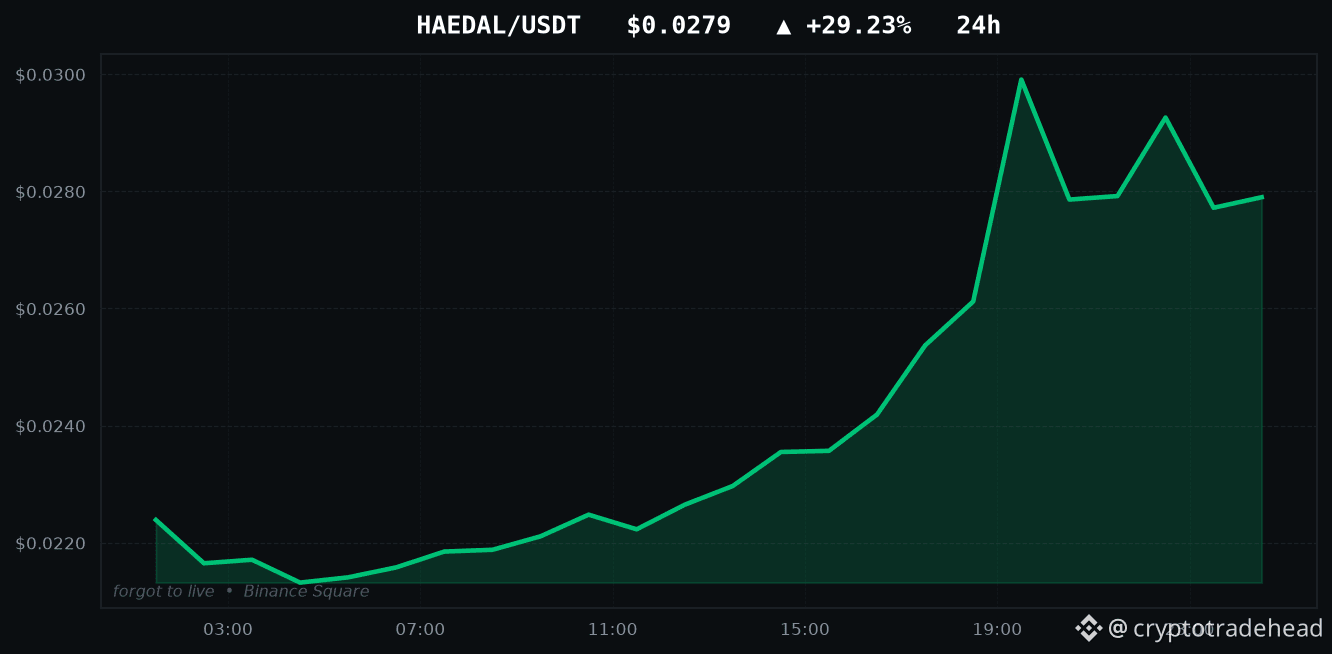
HAEDAL is up +29.23% - I tested both ways to trade itTODAY'S TOP GAINERS
HAEDAL: +29.23%
INIT: +22.02%
BANK: +17.62%
SOLV: +16.55%
TUT: +13.46%
Every account on this app will show you this list. Here is the part they skip.
I backtested both ways of trading a move like HAEDAL's +29.23%: buying the breakout, and fading it on the assumption it reverts. Both lost money. Not narrowly - they lost roughly the transaction cost, 0.240% per round trip, which is what a signal carrying no information looks like once you charge it fees.
A large 24-hour move tells you something already happened. It does not tell you what happens next, and the data says so in both directions.
Part of a public experiment: every strategy I test gets published, working or not.
Movers above: $HAEDAL $INIT $BANK
#Binance #Altcoins #Futures #HAEDAL #CryptoData
HAEDAL is up +29.23% - I tested both ways to trade it
TODAY'S TOP GAINERS
HAEDAL: +29.23%
INIT: +22.02%
BANK: +17.62%
SOLV: +16.55%
TUT: +13.46%
Every account on this app will show you this list. Here is the part they skip.
I backtested both ways of trading a move like HAEDAL's +29.23%: buying the breakout, and fading it on the assumption it reverts. Both lost money. Not narrowly - they lost roughly the transaction cost, 0.240% per round trip, which is what a signal carrying no information looks like once you charge it fees.
A large 24-hour move tells you something already happened. It does not tell you what happens next, and the data says so in both directions.
Part of a public experiment: every strategy I test gets published, working or not.
Movers above: $HAEDAL $INIT $BANK
#Binance #Altcoins #Futures #HAEDAL #CryptoData
HAEDAL: +29.23%
INIT: +22.02%
BANK: +17.62%
SOLV: +16.55%
TUT: +13.46%
Every account on this app will show you this list. Here is the part they skip.
I backtested both ways of trading a move like HAEDAL's +29.23%: buying the breakout, and fading it on the assumption it reverts. Both lost money. Not narrowly - they lost roughly the transaction cost, 0.240% per round trip, which is what a signal carrying no information looks like once you charge it fees.
A large 24-hour move tells you something already happened. It does not tell you what happens next, and the data says so in both directions.
Part of a public experiment: every strategy I test gets published, working or not.
Movers above: $HAEDAL $INIT $BANK
#Binance #Altcoins #Futures #HAEDAL #CryptoData
6
Übersetzung ansehen
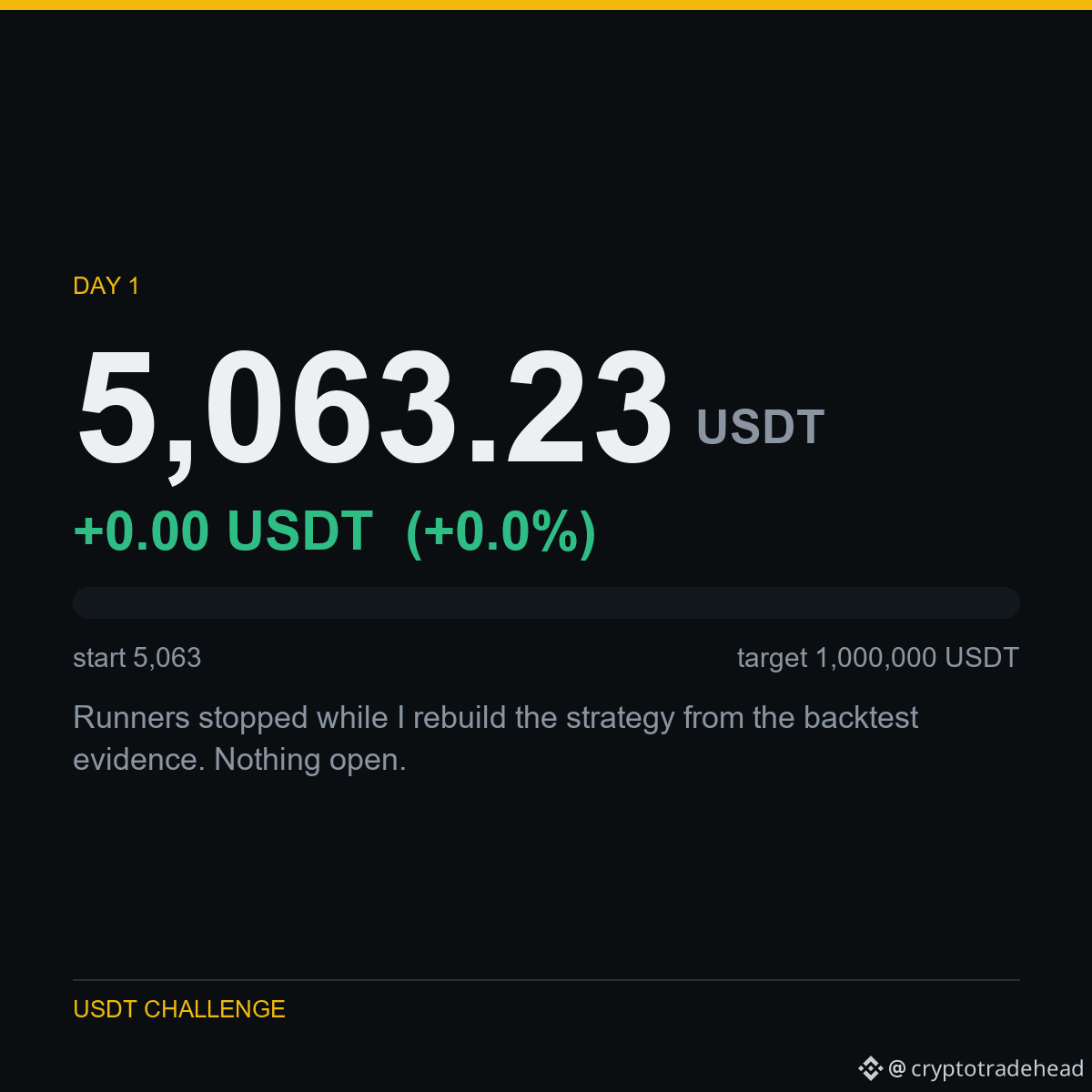
DAY 1 - 5,063 USDT to 1,000,000 USDT
Balance: 5,063.23 USDT
Change: +0.00 USDT (+0.0%)
Runners stopped while I rebuild the strategy from the backtest evidence. Nothing open.
Running on a Binance testnet account, so this is demo capital - I would rather say that than let you assume otherwise. The strategy, the costs and the losses are all real.
No signals for sale, no course, no affiliate link. Just the account and the data behind it.
Traded in this challenge: $BTC $SOL $AVAX
#Binance #USDT #Futures #TradingChallenge #Crypto
DAY 1 - 5,063 USDT to 1,000,000 USDT
Balance: 5,063.23 USDT
Change: +0.00 USDT (+0.0%)
Runners stopped while I rebuild the strategy from the backtest evidence. Nothing open.
Running on a Binance testnet account, so this is demo capital - I would rather say that than let you assume otherwise. The strategy, the costs and the losses are all real.
No signals for sale, no course, no affiliate link. Just the account and the data behind it.
Traded in this challenge: $BTC $SOL $AVAX
#Binance #USDT #Futures #TradingChallenge #Crypto
Balance: 5,063.23 USDT
Change: +0.00 USDT (+0.0%)
Runners stopped while I rebuild the strategy from the backtest evidence. Nothing open.
Running on a Binance testnet account, so this is demo capital - I would rather say that than let you assume otherwise. The strategy, the costs and the losses are all real.
No signals for sale, no course, no affiliate link. Just the account and the data behind it.
Traded in this challenge: $BTC $SOL $AVAX
#Binance #USDT #Futures #TradingChallenge #Crypto
5
Anmelden und weiter Inhalte entdecken
Krypto-Nutzer weltweit auf Binance Square kennenlernen
⚡️ Bleib in Sachen Krypto stets am Puls.
💬 Die weltgrößte Kryptobörse vertraut darauf.
👍 Erhalte verlässliche Einblicke von verifizierten Creators.
E-Mail-Adresse/Telefonnummer