Binance Square

HammadAli2148

Like, comment &share my post_let's grow together X Twitter Account: @HammadAli812945
Trade eröffnen
Hochfrequenz-Trader
1.6 Jahre
757 Following
17.2K+ Follower
12.9K+ Like gegeben
632 Geteilt
Beiträge
Portfolio
·
--
Artikel
Übersetzung ansehen
I Woke Up One Day and Realized Most Crypto Games Were Lying to UsLet me tell you something that took me way too long to figure out. I have been playing games and watching crypto projects for a few years now and there is one thing almost every single web3 game has in common and it is not a good thing. They all promise you the world. They tell you that you will earn tokens, build things, own land, be part of something big. And for the first few weeks it actually feels that way. The game is fresh, the community is excited, the token price is moving and everything feels like you are early to something special. Then slowly things start breaking down. The token starts bleeding because there is too much of it floating around and nobody is actually using it for anything that matters. The rewards stop making sense. The players who came in just to farm and dump start leaving. And what you are left with is a half empty world where the only people still playing are the ones who got in early enough to not care about the economics anymore. I fell for this cycle more times than I want to admit. And then I found @pixels and honestly it changed how I think about this whole space. What Pixels Actually Is And Why It Hits Different Pixels is a web3 farming and exploration game that runs on the Ronin Network and before you zone out because you have heard that pitch a hundred times let me tell you what makes it actually different. The game itself feels like something your older sibling would have played on a Game Boy. It has that retro pixel art style that looks like Stardew Valley or Harvest Moon. You farm, you explore, you build, you interact with other players in this open world that genuinely feels alive. It is casual enough that you can pick it up without feeling like you need a university degree to understand the mechanics but deep enough that you can spend hours in it without even noticing. But the interesting part is not the gameplay. The interesting part is what they built around it. $PIXEL is the native token of the entire Pixels ecosystem and unlike most projects that just slap a token on top of a game and call it web3 the team at Pixels actually thought about what the token should do and why anyone would want to hold it instead of just dumping it the moment they earn some. You use PIXEL to mint NFTs inside the game. Every future NFT in the Pixels world requires PIXEL which means the more the game grows the more actual demand there is for the token from people who genuinely want to use it not just trade it. You use it to buy VIP Battle Passes that unlock exclusive content. You use it to join Guilds which are basically social clubs inside the game where players team up and work together. You use it for premium upgrades that make your gameplay experience smoother. And eventually it will be used for governance meaning the community will actually have a say in how the project develops. This is not a token that exists just to exist. It has real jobs inside a real world that real people spend real time in. The Stacked Ecosystem Is Where Things Get Really Interesting Here is something that I do not think enough people are talking about when they discuss Pixels. A few weeks ago the team announced something called Stacked and at first I thought it was just another buzzword announcement. But when I actually read into it I realized this is genuinely one of the more thoughtful things I have seen a gaming project do. Stacked is essentially an AI powered engagement and rewards platform that Pixels built internally over four years of running their own live game economy. They generated over twenty five million dollars in revenue and reached a million daily active users building this system for themselves and now they are opening it up to other game studios. Think about what that means. Stacked tracks what players are actually doing inside games in real time. It then uses an AI engine to figure out the best way to re engage players who might be drifting away. And it does this without anyone having to manually sit there and segment audiences or manage campaigns. They tested this on their own veteran players who had not spent anything in over thirty days. After running personalized re engagement offers through Stacked they saw a 178 percent increase in people actually spending, a 129 percent increase in active days played, and a 131 percent return on what they spent on rewards. Those are not made up numbers. That is their own internal data from their own game. The founder Luke Barwikowski said it best. Most reward systems treat every player the same and optimize for the wrong things. Stacked is built to reward the actions that actually matter. Coming back. Progressing. Spending. Contributing to a healthy economy. That sentence alone tells you more about the philosophy of this team than any whitepaper ever could. The Staking System Is Not Just An Add On It Is The Foundation Recently Pixels launched staking for PIXEL and the way they designed it is worth paying attention to. In most projects staking just means you lock your token somewhere and get more tokens back. It is circular and it does not really solve anything because you are just printing more supply and hoping the price holds. Pixels did something fundamentally different. When you stake PIXEL you are not just locking it away to earn passive rewards. You are actually voting with your stake about which games inside the Pixels ecosystem deserve to grow. The more PIXEL staked to a specific game the bigger that game's reward pool becomes. So stakers become the decentralized curators of the entire ecosystem. They decide which games get resources and which ones need to prove themselves first. This is being rolled out in phases. Right now only hand picked games are part of it. Then it opens up so that rewards flow based on how much stake a game attracts. Eventually any game that hits a minimum activity threshold can join the ecosystem. And in the final phase when the ecosystem is generating positive returns the team plans to even support other tokens for user acquisition while PIXEL remains the core token for staking rewards. They are also introducing vPIXEL soon which is a spend only reward token. It lets you spend inside the ecosystem without worrying about what they call Farmer Fees which are essentially small costs associated with withdrawing tokens. So if you want to spend in Pixel Dungeons or any other game inside the ecosystem you can use vPIXEL and keep your main PIXEL stack intact. It is a small detail but it shows a level of thoughtfulness about player experience that most projects completely ignore. Chapter Two Is Coming And The Economic Model Is Changing One of the smarter decisions Pixels has made is phasing out their old inflationary currency called BERRY and moving everything to a single PIXEL economy. In the old model players were earning BERRY constantly and the oversupply was putting constant downward pressure on the whole system. By consolidating to one token and making that token harder to earn through more strategic gameplay the team is aligning the incentives of players with the long term health of the project. Chapter Two is the next big update coming to the game. It introduces guilds in a bigger way, new exploration mechanics, and a completely redesigned task system where players have to actually think about how they earn token rewards. This is not just a content update. It is a fundamental rethinking of how the economy works so that the people who are genuinely engaged get rewarded more than the people who are just there to extract value and leave. There was actually a milestone hit in May of last year where for the first time more tokens were being deposited into the game economy than were being withdrawn. That is the kind of signal you want to see from a project that is trying to build something sustainable. It means real players are genuinely spending inside the world not just cashing out. How This Compares To How Ecosystems Usually Work In Crypto I want to draw a quick comparison here because I think it helps put things in perspective. When you look at tokens like $SPK in the SpeakEasy ecosystem the model is built around rewarding content creators for the value they bring to a network over time. It is a slow burn approach where participation accumulates into ownership and the more you contribute the more stake you build. That philosophy of rewarding genuine participation over speculation is something that PIXEL shares in its own way. And when you look at something like $VELVET which is focused on creating seamless value within its own defined ecosystem the parallel with Pixels is also clear. PIXEL is not trying to be everywhere at once. It is going deep inside a specific world, making itself essential to every meaningful action inside that world, and expanding only when the foundation is solid enough to support it. The best projects in this space do not try to solve everything. They solve one thing really well and build outward from there. That is exactly what Pixels is doing. The Real Story Here Is Longevity I want to end with something that I genuinely believe and that I think is the most important thing about Pixels as a project. Most crypto gaming projects are not building for five years from now. They are building for the next token unlock, the next pump, the next wave of retail attention. And you can feel that in how they make decisions. Everything is optimized for the short term because the people running it are thinking short term. Pixels feels different and I say that not because of hype but because of the actual decisions they have made. Simplifying the token economy even when it meant killing a currency people were already using. Building Stacked as a real product with four years of live data behind it. Designing staking as a curation mechanism instead of just a lock and earn scheme. Preparing Chapter Two to fix the economic problems before they get worse instead of papering over them with new token drops. These are not the moves of a team trying to exit. These are the moves of people who actually want to build a world that players come back to for years. Whether you are someone who plays web3 games or someone who just follows projects from the outside this is one worth paying close attention to right now. Not because of where the token price is today but because of the infrastructure they are quietly putting in place for where this could be tomorrow. @pixels is building something real. PIXEL is not just a game token. It is the backbone of an entire economy that is still in its early chapters. And the best chapters always start slow before they go somewhere unforgettable. #pixel {future}(SPKUSDT) {future}(PIXELUSDT) {future}(VELVETUSDT)

I Woke Up One Day and Realized Most Crypto Games Were Lying to Us

Let me tell you something that took me way too long to figure out.
I have been playing games and watching crypto projects for a few years now and there is one thing almost every single web3 game has in common and it is not a good thing. They all promise you the world. They tell you that you will earn tokens, build things, own land, be part of something big. And for the first few weeks it actually feels that way. The game is fresh, the community is excited, the token price is moving and everything feels like you are early to something special.
Then slowly things start breaking down. The token starts bleeding because there is too much of it floating around and nobody is actually using it for anything that matters. The rewards stop making sense. The players who came in just to farm and dump start leaving. And what you are left with is a half empty world where the only people still playing are the ones who got in early enough to not care about the economics anymore.
I fell for this cycle more times than I want to admit. And then I found @Pixels and honestly it changed how I think about this whole space.
What Pixels Actually Is And Why It Hits Different
Pixels is a web3 farming and exploration game that runs on the Ronin Network and before you zone out because you have heard that pitch a hundred times let me tell you what makes it actually different.
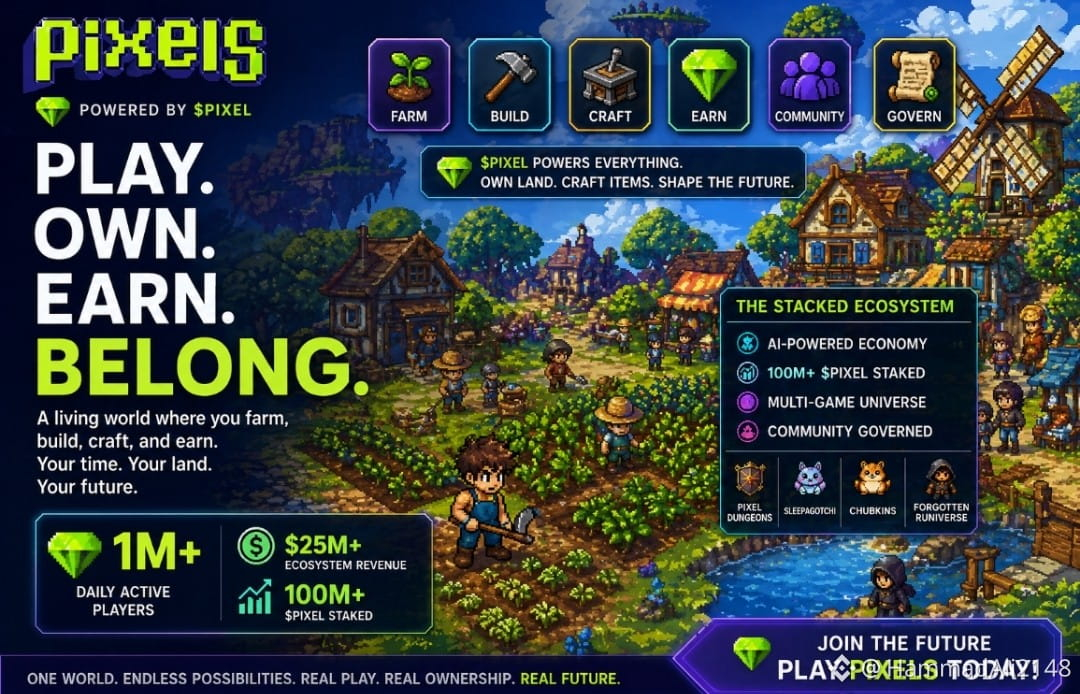
The game itself feels like something your older sibling would have played on a Game Boy. It has that retro pixel art style that looks like Stardew Valley or Harvest Moon. You farm, you explore, you build, you interact with other players in this open world that genuinely feels alive. It is casual enough that you can pick it up without feeling like you need a university degree to understand the mechanics but deep enough that you can spend hours in it without even noticing.
But the interesting part is not the gameplay. The interesting part is what they built around it.
$PIXEL is the native token of the entire Pixels ecosystem and unlike most projects that just slap a token on top of a game and call it web3 the team at Pixels actually thought about what the token should do and why anyone would want to hold it instead of just dumping it the moment they earn some.
You use PIXEL to mint NFTs inside the game. Every future NFT in the Pixels world requires PIXEL which means the more the game grows the more actual demand there is for the token from people who genuinely want to use it not just trade it. You use it to buy VIP Battle Passes that unlock exclusive content. You use it to join Guilds which are basically social clubs inside the game where players team up and work together. You use it for premium upgrades that make your gameplay experience smoother. And eventually it will be used for governance meaning the community will actually have a say in how the project develops.
This is not a token that exists just to exist. It has real jobs inside a real world that real people spend real time in.
The Stacked Ecosystem Is Where Things Get Really Interesting
Here is something that I do not think enough people are talking about when they discuss Pixels.
A few weeks ago the team announced something called Stacked and at first I thought it was just another buzzword announcement. But when I actually read into it I realized this is genuinely one of the more thoughtful things I have seen a gaming project do.
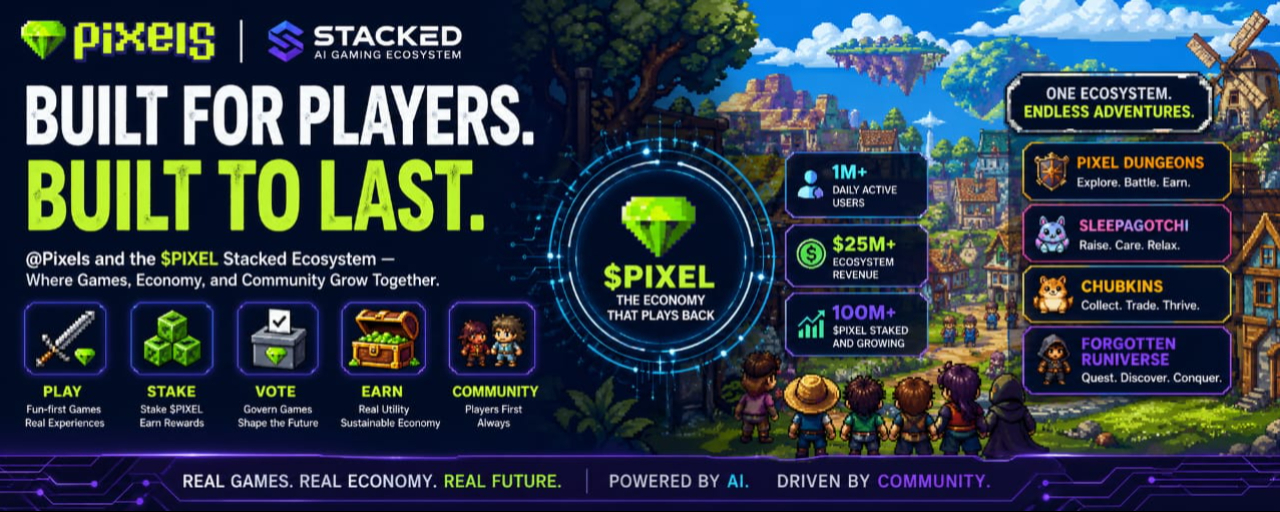
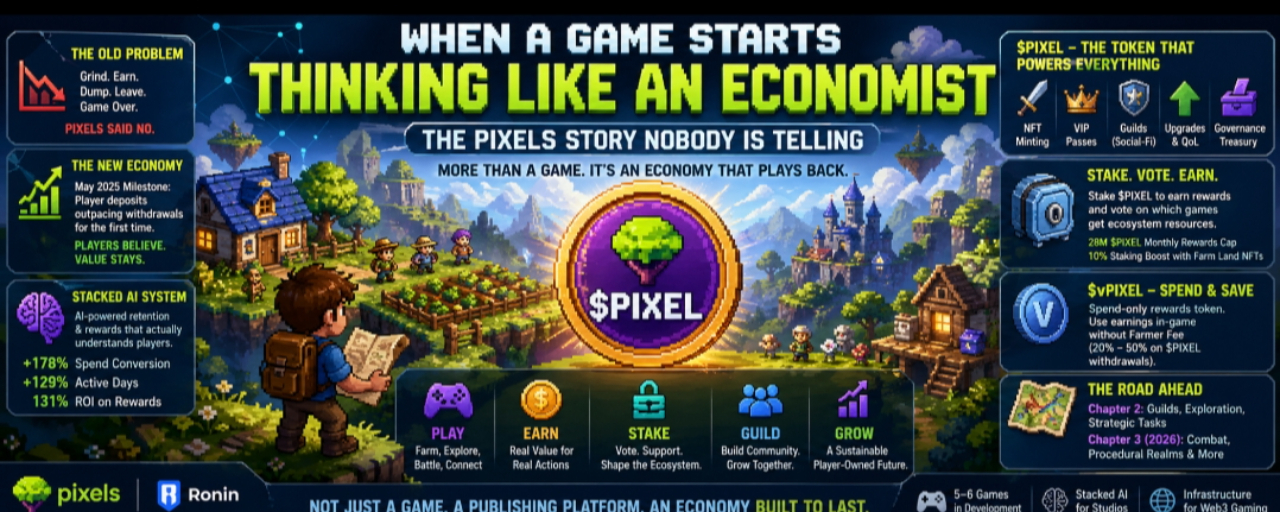
Stacked is essentially an AI powered engagement and rewards platform that Pixels built internally over four years of running their own live game economy. They generated over twenty five million dollars in revenue and reached a million daily active users building this system for themselves and now they are opening it up to other game studios.
Think about what that means. Stacked tracks what players are actually doing inside games in real time. It then uses an AI engine to figure out the best way to re engage players who might be drifting away. And it does this without anyone having to manually sit there and segment audiences or manage campaigns.
They tested this on their own veteran players who had not spent anything in over thirty days. After running personalized re engagement offers through Stacked they saw a 178 percent increase in people actually spending, a 129 percent increase in active days played, and a 131 percent return on what they spent on rewards. Those are not made up numbers. That is their own internal data from their own game.
The founder Luke Barwikowski said it best. Most reward systems treat every player the same and optimize for the wrong things. Stacked is built to reward the actions that actually matter. Coming back. Progressing. Spending. Contributing to a healthy economy.
That sentence alone tells you more about the philosophy of this team than any whitepaper ever could.
The Staking System Is Not Just An Add On It Is The Foundation
Recently Pixels launched staking for PIXEL and the way they designed it is worth paying attention to.
In most projects staking just means you lock your token somewhere and get more tokens back. It is circular and it does not really solve anything because you are just printing more supply and hoping the price holds. Pixels did something fundamentally different.
When you stake PIXEL you are not just locking it away to earn passive rewards. You are actually voting with your stake about which games inside the Pixels ecosystem deserve to grow. The more PIXEL staked to a specific game the bigger that game's reward pool becomes. So stakers become the decentralized curators of the entire ecosystem. They decide which games get resources and which ones need to prove themselves first.
This is being rolled out in phases. Right now only hand picked games are part of it. Then it opens up so that rewards flow based on how much stake a game attracts. Eventually any game that hits a minimum activity threshold can join the ecosystem. And in the final phase when the ecosystem is generating positive returns the team plans to even support other tokens for user acquisition while PIXEL remains the core token for staking rewards.
They are also introducing vPIXEL soon which is a spend only reward token. It lets you spend inside the ecosystem without worrying about what they call Farmer Fees which are essentially small costs associated with withdrawing tokens. So if you want to spend in Pixel Dungeons or any other game inside the ecosystem you can use vPIXEL and keep your main PIXEL stack intact. It is a small detail but it shows a level of thoughtfulness about player experience that most projects completely ignore.
Chapter Two Is Coming And The Economic Model Is Changing
One of the smarter decisions Pixels has made is phasing out their old inflationary currency called BERRY and moving everything to a single PIXEL economy. In the old model players were earning BERRY constantly and the oversupply was putting constant downward pressure on the whole system. By consolidating to one token and making that token harder to earn through more strategic gameplay the team is aligning the incentives of players with the long term health of the project.
Chapter Two is the next big update coming to the game. It introduces guilds in a bigger way, new exploration mechanics, and a completely redesigned task system where players have to actually think about how they earn token rewards. This is not just a content update. It is a fundamental rethinking of how the economy works so that the people who are genuinely engaged get rewarded more than the people who are just there to extract value and leave.
There was actually a milestone hit in May of last year where for the first time more tokens were being deposited into the game economy than were being withdrawn. That is the kind of signal you want to see from a project that is trying to build something sustainable. It means real players are genuinely spending inside the world not just cashing out.
How This Compares To How Ecosystems Usually Work In Crypto
I want to draw a quick comparison here because I think it helps put things in perspective.
When you look at tokens like $SPK in the SpeakEasy ecosystem the model is built around rewarding content creators for the value they bring to a network over time. It is a slow burn approach where participation accumulates into ownership and the more you contribute the more stake you build. That philosophy of rewarding genuine participation over speculation is something that PIXEL shares in its own way.
And when you look at something like $VELVET which is focused on creating seamless value within its own defined ecosystem the parallel with Pixels is also clear. PIXEL is not trying to be everywhere at once. It is going deep inside a specific world, making itself essential to every meaningful action inside that world, and expanding only when the foundation is solid enough to support it.
The best projects in this space do not try to solve everything. They solve one thing really well and build outward from there. That is exactly what Pixels is doing.
The Real Story Here Is Longevity
I want to end with something that I genuinely believe and that I think is the most important thing about Pixels as a project.
Most crypto gaming projects are not building for five years from now. They are building for the next token unlock, the next pump, the next wave of retail attention. And you can feel that in how they make decisions. Everything is optimized for the short term because the people running it are thinking short term.
Pixels feels different and I say that not because of hype but because of the actual decisions they have made. Simplifying the token economy even when it meant killing a currency people were already using. Building Stacked as a real product with four years of live data behind it. Designing staking as a curation mechanism instead of just a lock and earn scheme. Preparing Chapter Two to fix the economic problems before they get worse instead of papering over them with new token drops.
These are not the moves of a team trying to exit. These are the moves of people who actually want to build a world that players come back to for years.
Whether you are someone who plays web3 games or someone who just follows projects from the outside this is one worth paying close attention to right now. Not because of where the token price is today but because of the infrastructure they are quietly putting in place for where this could be tomorrow.
@Pixels is building something real. PIXEL is not just a game token. It is the backbone of an entire economy that is still in its early chapters.
And the best chapters always start slow before they go somewhere unforgettable.
#pixel
Also, ich habe mich jetzt eine Weile mit Pixels beschäftigt und ehrlich gesagt macht dieses Projekt etwas, was die meisten Krypto-Spiele nie versuchen, nämlich dir das Gefühl zu geben, dass deine Zeit im Spiel zählt und echten Wert hat. Pixels ist ein Farming- und Abenteuer-Spiel, das auf Blockchain basiert, wo du dein Land, deine Werkzeuge, deine Ernte und alles, was du verdienst, tatsächlich besitzt – nicht irgendeine Firma, die hinter einem Server sitzt. Der Token, der all dem zugrunde liegt, ist $PIXEL , der die gesamte Wirtschaft im Spiel antreibt, von Landkäufen über den Handel mit Ressourcen bis hin zu Upgrades deiner Farm. Was das von regulären Spielen unterscheidet, ist, dass das Stacked-Ökosystem rund um Pixels sich zu etwas Ernsthaftem entwickelt, wo die Spieler nicht nur spielen, sondern tatsächlich verdienen und echte digitale Vermögenswerte aufbauen, die auch außerhalb des Spiels Wert haben. $SPK und $VELVET sind Teil dieses größeren Ökosystems und zeigen, wie miteinander verbundene alles wird, wo ein Token in einen anderen einspeist und einen ganzen Kreislauf von Wert schafft. Die Community innerhalb von Pixels ist wirklich aktiv; die Leute handeln mit Ernten, helfen sich gegenseitig beim Farmen, und das Spiel fügt ständig neue Features hinzu, die dich dazu bringen, jeden einzelnen Tag zurückzukommen – was in der Blockchain-Gaming-Welt selten ist, denn die meisten Projekte starten und werden schnell still. Aber Pixels bleibt am Puls der Zeit. Wenn du noch nie ein Spiel ausprobiert hast, bei dem dein In-Game-Einsatz tatsächlich in etwas Reales übersetzt wird, dann ist Pixels und PIXEL ehrlich gesagt einer der besten Orte, um jetzt zu starten. @pixels #pixel {future}(SPKUSDT) {future}(PIXELUSDT) {future}(VELVETUSDT)
Also, ich habe mich jetzt eine Weile mit Pixels beschäftigt und ehrlich gesagt macht dieses Projekt etwas, was die meisten Krypto-Spiele nie versuchen, nämlich dir das Gefühl zu geben, dass deine Zeit im Spiel zählt und echten Wert hat.
Pixels ist ein Farming- und Abenteuer-Spiel, das auf Blockchain basiert, wo du dein Land, deine Werkzeuge, deine Ernte und alles, was du verdienst, tatsächlich besitzt – nicht irgendeine Firma, die hinter einem Server sitzt. Der Token, der all dem zugrunde liegt, ist $PIXEL , der die gesamte Wirtschaft im Spiel antreibt, von Landkäufen über den Handel mit Ressourcen bis hin zu Upgrades deiner Farm.
Was das von regulären Spielen unterscheidet, ist, dass das Stacked-Ökosystem rund um Pixels sich zu etwas Ernsthaftem entwickelt, wo die Spieler nicht nur spielen, sondern tatsächlich verdienen und echte digitale Vermögenswerte aufbauen, die auch außerhalb des Spiels Wert haben. $SPK und $VELVET sind Teil dieses größeren Ökosystems und zeigen, wie miteinander verbundene alles wird, wo ein Token in einen anderen einspeist und einen ganzen Kreislauf von Wert schafft.
Die Community innerhalb von Pixels ist wirklich aktiv; die Leute handeln mit Ernten, helfen sich gegenseitig beim Farmen, und das Spiel fügt ständig neue Features hinzu, die dich dazu bringen, jeden einzelnen Tag zurückzukommen – was in der Blockchain-Gaming-Welt selten ist, denn die meisten Projekte starten und werden schnell still. Aber Pixels bleibt am Puls der Zeit.
Wenn du noch nie ein Spiel ausprobiert hast, bei dem dein In-Game-Einsatz tatsächlich in etwas Reales übersetzt wird, dann ist Pixels und PIXEL ehrlich gesagt einer der besten Orte, um jetzt zu starten.
@Pixels #pixel
Artikel
Pixels hat mich zurück ins Gaming geholt und diesmal war tatsächlich etwas andersIch hatte völlig aufgegeben, was Gaming angeht. Nicht dramatisch, ich habe einfach langsam das Interesse verloren. Jedes Spiel fühlte sich gleich an, man grindet, verbringt Zeit und schließt die App ohne etwas vorzuzeigen. Dann hat mir jemand von Pixels erzählt. Ich habe ehrlich gesagt nichts erwartet. Ein Farming-Spiel, das auf Blockchain basiert, klang entweder zu nerdig oder zu langweilig oder beides. Aber ich habe es trotzdem ausprobiert, und nach ein paar Stunden wurde mir klar, dass es sich nicht nur um ein Spiel handelte. Das war eine ganze lebendige Wirtschaft, an der ich tatsächlich teilnahm, und je mehr ich es erkundete, desto mehr verstand ich, warum die Leute im April 2026 so ernsthaft darüber sprechen.

Pixels hat mich zurück ins Gaming geholt und diesmal war tatsächlich etwas anders

Ich hatte völlig aufgegeben, was Gaming angeht. Nicht dramatisch, ich habe einfach langsam das Interesse verloren. Jedes Spiel fühlte sich gleich an, man grindet, verbringt Zeit und schließt die App ohne etwas vorzuzeigen. Dann hat mir jemand von Pixels erzählt. Ich habe ehrlich gesagt nichts erwartet. Ein Farming-Spiel, das auf Blockchain basiert, klang entweder zu nerdig oder zu langweilig oder beides. Aber ich habe es trotzdem ausprobiert, und nach ein paar Stunden wurde mir klar, dass es sich nicht nur um ein Spiel handelte. Das war eine ganze lebendige Wirtschaft, an der ich tatsächlich teilnahm, und je mehr ich es erkundete, desto mehr verstand ich, warum die Leute im April 2026 so ernsthaft darüber sprechen.
Weißt du, was wirklich verrückt ist? Ich bin schon lange genug im Crypto-Bereich, um hundert Projekte zu sehen, die "play to earn" versprechen und nach sechs Monaten verschwinden. Aber Pixels macht etwas ganz anderes, und sobald du es verstehst, kannst du es nicht mehr ignorieren. Pixels ist nicht nur ein Spiel. Es ist eine ganze lebendige Welt, die auf der Blockchain basiert, wo deine Zeit und Mühe wirklich etwas bedeuten. Du farmst, du craftest, du baust, du tradest, und alles, was du tust, schafft echten Wert im Ökosystem. Das Land, das du besitzt, gehört dir. Die Items, für die du grindest, gehören dir. Niemand kann dir das wegnehmen. Jetzt wird es wirklich interessant. $PIXEL ist der Herzschlag dieser ganzen Welt. Jede Transaktion, jedes Upgrade, jede Landaktivität läuft darüber. Und das gestapelte Ökosystem rund um Pixels wächst auf eine Weise, die den Token jeden einzelnen Tag nützlicher macht, nicht nur für Spekulation, sondern für echte In-Game-Nachfrage. Schau dir auch an, was im breiteren Markt passiert. Coins wie $CHIP und $BAS zeigen den Leuten, dass utility-backed Tokens mit echten Ökosystemen anders abschneiden als zufällige Hype-Coins. Pixels und PIXEL fallen in dieselbe Kategorie von Tokens, wo das Projekt tatsächlich etwas bewirkt. Die täglich aktiven Spieler, die Landwirtschaftswirtschaft, das Crafting-System, die Gildenmechanik - all das schafft organische Nachfrage nach PIXEL, die nicht nur von einem einzigen Bullrun oder einem Tweet eines Influencers abhängt. Wenn du Pixels noch nicht erkundet hast, verbringe 30 Minuten im Spiel, und du wirst verstehen, warum diese Community ständig wächst. @pixels #pixel {future}(CHIPUSDT) {future}(PIXELUSDT) {future}(BASUSDT)
Weißt du, was wirklich verrückt ist? Ich bin schon lange genug im Crypto-Bereich, um hundert Projekte zu sehen, die "play to earn" versprechen und nach sechs Monaten verschwinden. Aber Pixels macht etwas ganz anderes, und sobald du es verstehst, kannst du es nicht mehr ignorieren.
Pixels ist nicht nur ein Spiel. Es ist eine ganze lebendige Welt, die auf der Blockchain basiert, wo deine Zeit und Mühe wirklich etwas bedeuten. Du farmst, du craftest, du baust, du tradest, und alles, was du tust, schafft echten Wert im Ökosystem. Das Land, das du besitzt, gehört dir. Die Items, für die du grindest, gehören dir. Niemand kann dir das wegnehmen.
Jetzt wird es wirklich interessant. $PIXEL ist der Herzschlag dieser ganzen Welt. Jede Transaktion, jedes Upgrade, jede Landaktivität läuft darüber. Und das gestapelte Ökosystem rund um Pixels wächst auf eine Weise, die den Token jeden einzelnen Tag nützlicher macht, nicht nur für Spekulation, sondern für echte In-Game-Nachfrage.
Schau dir auch an, was im breiteren Markt passiert. Coins wie $CHIP und $BAS zeigen den Leuten, dass utility-backed Tokens mit echten Ökosystemen anders abschneiden als zufällige Hype-Coins. Pixels und PIXEL fallen in dieselbe Kategorie von Tokens, wo das Projekt tatsächlich etwas bewirkt.
Die täglich aktiven Spieler, die Landwirtschaftswirtschaft, das Crafting-System, die Gildenmechanik - all das schafft organische Nachfrage nach PIXEL, die nicht nur von einem einzigen Bullrun oder einem Tweet eines Influencers abhängt.
Wenn du Pixels noch nicht erkundet hast, verbringe 30 Minuten im Spiel, und du wirst verstehen, warum diese Community ständig wächst.
@Pixels #pixel
Artikel
Pixels: Das Spiel, das dir tatsächlich Geld fürs Spielen bezahltOkay, lass mich dir etwas erzählen, das mir neulich passiert ist und das meine Denkweise über Gaming und Krypto zusammen völlig verändert hat. Ich habe spät in der Nacht wie gewohnt durch Binance Square gescrollt und immer wieder gesehen, dass Leute über @pixels sprechen, und ich habe es ignoriert, weil ich ehrlich dachte, es sei nur eines dieser "play to earn"-Spiele, die alles versprechen und nichts halten. Du kennst den Typ. Große Versprechungen, schicke Webseite, und dann sechs Monate später ist der Token um 90% gefallen und jeder hat weitergemacht.

Pixels: Das Spiel, das dir tatsächlich Geld fürs Spielen bezahlt

Okay, lass mich dir etwas erzählen, das mir neulich passiert ist und das meine Denkweise über Gaming und Krypto zusammen völlig verändert hat.
Ich habe spät in der Nacht wie gewohnt durch Binance Square gescrollt und immer wieder gesehen, dass Leute über @Pixels sprechen, und ich habe es ignoriert, weil ich ehrlich dachte, es sei nur eines dieser "play to earn"-Spiele, die alles versprechen und nichts halten. Du kennst den Typ. Große Versprechungen, schicke Webseite, und dann sechs Monate später ist der Token um 90% gefallen und jeder hat weitergemacht.
Ich habe heute etwas bemerkt, das die meisten Menschen völlig übersehen @pixels Pixels ist nicht nur ein Spiel, mein Freund, es ist eine ganze lebendige Welt, in der du Bauernhöfe bauen, neue Länder erkunden, Dinge von Grund auf neu erstellen kannst, und alles, was du besitzt, gehört dir tatsächlich auf der Blockchain, kein Unternehmen kann es dir nehmen, das ist die wahre Magie hier Und das Herz dieser ganzen Welt ist der PIXEL-Token, wenn du ein NFT prägen möchtest, benötigst du PIXEL, wenn du einen VIP Battle Pass möchtest, benötigst du PIXEL, wenn du einer Gilde beitreten möchtest, benötigst du PIXEL, also ist dies kein Token, der in deiner Brieftasche nutzlos herumliegt, er arbeitet jeden einzelnen Tag im Spiel, du hältst Macht und Währung gleichzeitig in einem Token Als Pixels zum Ronin-Netzwerk wechselten, war das der Moment, in dem ich erkannte, dass diese Leute es ernst meinen mit dem Aufbau von etwas Langfristigem, Ronin wurde speziell für Gaming entwickelt, es ist schnell, es ist günstig, und Transaktionen erfolgen ohne Verzögerung oder hohe Gebühren, also ist es jedes Mal, wenn PIXEL innerhalb des Ökosystems bewegt wird, reibungslos und nahtlos Jetzt kommt der Teil, der Pixels von fast allem anderen da draußen unterscheidet, die Governance-Funktion, du bist nicht nur ein Spieler, du bist tatsächlich ein Entscheidungsträger, du kannst über die Gemeinschaftskasse abstimmen, du hast ein echtes Mitspracherecht, wo dieses Spiel als Nächstes hingeht, und diese Art von Eigentum ist es, was $PIXEL von Token wie $RAVE und $ARIA unterscheidet, denn hier existieren Nutzen und echtes Eigentum zusammen an einem Ort Wenn du darüber nachdenkst, ernsthaft im Web3-Gaming aktiv zu werden, dann verdienen @pixels und PIXEL jetzt deine volle Aufmerksamkeit, das ist kein Hype, das ist ein funktionierendes Ökosystem, das jeden Tag wächst #pixel {future}(RAVEUSDT) {future}(PIXELUSDT) {future}(ARIAUSDT)
Ich habe heute etwas bemerkt, das die meisten Menschen völlig übersehen
@Pixels Pixels ist nicht nur ein Spiel, mein Freund, es ist eine ganze lebendige Welt, in der du Bauernhöfe bauen, neue Länder erkunden, Dinge von Grund auf neu erstellen kannst, und alles, was du besitzt, gehört dir tatsächlich auf der Blockchain, kein Unternehmen kann es dir nehmen, das ist die wahre Magie hier
Und das Herz dieser ganzen Welt ist der PIXEL-Token, wenn du ein NFT prägen möchtest, benötigst du PIXEL, wenn du einen VIP Battle Pass möchtest, benötigst du PIXEL, wenn du einer Gilde beitreten möchtest, benötigst du PIXEL, also ist dies kein Token, der in deiner Brieftasche nutzlos herumliegt, er arbeitet jeden einzelnen Tag im Spiel, du hältst Macht und Währung gleichzeitig in einem Token
Als Pixels zum Ronin-Netzwerk wechselten, war das der Moment, in dem ich erkannte, dass diese Leute es ernst meinen mit dem Aufbau von etwas Langfristigem, Ronin wurde speziell für Gaming entwickelt, es ist schnell, es ist günstig, und Transaktionen erfolgen ohne Verzögerung oder hohe Gebühren, also ist es jedes Mal, wenn PIXEL innerhalb des Ökosystems bewegt wird, reibungslos und nahtlos
Jetzt kommt der Teil, der Pixels von fast allem anderen da draußen unterscheidet, die Governance-Funktion, du bist nicht nur ein Spieler, du bist tatsächlich ein Entscheidungsträger, du kannst über die Gemeinschaftskasse abstimmen, du hast ein echtes Mitspracherecht, wo dieses Spiel als Nächstes hingeht, und diese Art von Eigentum ist es, was $PIXEL von Token wie $RAVE und $ARIA unterscheidet, denn hier existieren Nutzen und echtes Eigentum zusammen an einem Ort
Wenn du darüber nachdenkst, ernsthaft im Web3-Gaming aktiv zu werden, dann verdienen @Pixels und PIXEL jetzt deine volle Aufmerksamkeit, das ist kein Hype, das ist ein funktionierendes Ökosystem, das jeden Tag wächst
#pixel
Artikel
Warum Pixels das Spiel ist, das 2025 tatsächlich Sinn machtLass mich dir etwas erzählen, das mir vor ein paar Monaten passiert ist, und ich denke, viele Menschen im Krypto- und Gaming-Bereich werden sich mit dieser Geschichte identifizieren können, weil sie meine Sicht auf Blockchain-Spiele komplett verändert hat. Ich habe seit Jahren von Play-to-Earn-Spielen gehört und ehrlich gesagt fühlten sich die meisten von ihnen wie ein Job an, der dir fast nichts bezahlte, und das Gameplay war so langweilig, dass man sich jeden einzelnen Tag zwingen musste, sich einzuloggen, nur um einige Token zu sammeln, die wahrscheinlich in sechs Monaten nichts wert sein würden. Ich habe ein paar von ihnen ausprobiert und jedes Mal hatte ich das Gefühl, als würde ich als Liquiditätsquelle benutzt werden, anstatt tatsächlich Spaß zu haben. Das Spiel kümmerte sich nicht darum, dass ich Spaß hatte, es kümmerte sich nur darum, meine Brieftasche verbunden zu halten.

Warum Pixels das Spiel ist, das 2025 tatsächlich Sinn macht

Lass mich dir etwas erzählen, das mir vor ein paar Monaten passiert ist, und ich denke, viele Menschen im Krypto- und Gaming-Bereich werden sich mit dieser Geschichte identifizieren können, weil sie meine Sicht auf Blockchain-Spiele komplett verändert hat.
Ich habe seit Jahren von Play-to-Earn-Spielen gehört und ehrlich gesagt fühlten sich die meisten von ihnen wie ein Job an, der dir fast nichts bezahlte, und das Gameplay war so langweilig, dass man sich jeden einzelnen Tag zwingen musste, sich einzuloggen, nur um einige Token zu sammeln, die wahrscheinlich in sechs Monaten nichts wert sein würden. Ich habe ein paar von ihnen ausprobiert und jedes Mal hatte ich das Gefühl, als würde ich als Liquiditätsquelle benutzt werden, anstatt tatsächlich Spaß zu haben. Das Spiel kümmerte sich nicht darum, dass ich Spaß hatte, es kümmerte sich nur darum, meine Brieftasche verbunden zu halten.
Ich erinnere mich an das erste Mal, als ich von Pixels hörte. Ich dachte ehrlich gesagt, es sei nur ein weiteres einfaches Farming-Spiel, das versucht, die Krypto-Welle zu reiten, aber je mehr ich es erkundete, desto mehr wurde mir klar, dass dies etwas ist, das sich wirklich von allem anderen im Web3-Gaming unterscheidet. Pixels ist ein Open-World-Spiel, in dem du dein Land bewirtschaftest, Pflanzen anbaust, Ressourcen sammelst und eine ganze lebendige Welt erkundest. Der schöne Teil ist, dass alles, was du hier tust, tatsächlich dir gehört, weil alles auf der Blockchain lebt, die vom Ronin-Netzwerk betrieben wird, das speziell für Spiele entwickelt wurde, sodass Transaktionen schnell, reibungslos und fast kostenlos sind. Und genau im Zentrum all dessen steht $PIXEL , der Token, der das gesamte Ökosystem zum Leben erweckt. Du kannst $PIXEL verwenden, um NFTs zu prägen, VIP-Battle-Pässe zu kaufen, Gilden beizutreten und Premium-Funktionen im Spiel freizuschalten, was bedeutet, dass je mehr du spielst, desto mehr wird dieser Token Teil deiner täglichen Erfahrung, nicht nur etwas, das in deiner Brieftasche sitzt. Was @pixels wirklich auszeichnet, ist, dass sie Verbindungen zu über 90 Web3-Projekten aufgebaut haben, darunter große Namen, was bedeutet, dass dies nicht mehr nur ein Spiel ist, sondern ein vollständiges Ökosystem, in dem deine Zeit und Mühe tatsächlich in echten Wert übersetzt werden. Und die Governance-Seite ist auch spannend, denn $PIXEL -Inhaber werden schließlich über die Richtung der Gemeinschaftskasse abstimmen können, was bedeutet, dass die Spieler tatsächlich ein Mitspracherecht haben, wie das Spiel wächst und sich entwickelt. So sollte sich Web3-Gaming anfühlen: Eigentum, Gemeinschaft und eine Welt, die es wert ist, jeden einzelnen Tag betreten zu werden. @pixels #pixel {future}(PIXELUSDT)
Ich erinnere mich an das erste Mal, als ich von Pixels hörte. Ich dachte ehrlich gesagt, es sei nur ein weiteres einfaches Farming-Spiel, das versucht, die Krypto-Welle zu reiten, aber je mehr ich es erkundete, desto mehr wurde mir klar, dass dies etwas ist, das sich wirklich von allem anderen im Web3-Gaming unterscheidet.
Pixels ist ein Open-World-Spiel, in dem du dein Land bewirtschaftest, Pflanzen anbaust, Ressourcen sammelst und eine ganze lebendige Welt erkundest. Der schöne Teil ist, dass alles, was du hier tust, tatsächlich dir gehört, weil alles auf der Blockchain lebt, die vom Ronin-Netzwerk betrieben wird, das speziell für Spiele entwickelt wurde, sodass Transaktionen schnell, reibungslos und fast kostenlos sind.
Und genau im Zentrum all dessen steht $PIXEL , der Token, der das gesamte Ökosystem zum Leben erweckt. Du kannst $PIXEL verwenden, um NFTs zu prägen, VIP-Battle-Pässe zu kaufen, Gilden beizutreten und Premium-Funktionen im Spiel freizuschalten, was bedeutet, dass je mehr du spielst, desto mehr wird dieser Token Teil deiner täglichen Erfahrung, nicht nur etwas, das in deiner Brieftasche sitzt.
Was @Pixels wirklich auszeichnet, ist, dass sie Verbindungen zu über 90 Web3-Projekten aufgebaut haben, darunter große Namen, was bedeutet, dass dies nicht mehr nur ein Spiel ist, sondern ein vollständiges Ökosystem, in dem deine Zeit und Mühe tatsächlich in echten Wert übersetzt werden.
Und die Governance-Seite ist auch spannend, denn $PIXEL -Inhaber werden schließlich über die Richtung der Gemeinschaftskasse abstimmen können, was bedeutet, dass die Spieler tatsächlich ein Mitspracherecht haben, wie das Spiel wächst und sich entwickelt.
So sollte sich Web3-Gaming anfühlen: Eigentum, Gemeinschaft und eine Welt, die es wert ist, jeden einzelnen Tag betreten zu werden.
@Pixels
#pixel
Artikel
Ich folge Pixels, seit niemand etwas darüber wusste — Was gerade passiert, ist wirklichVerschieden Lass mich ehrlich zu dir sein, denn ich denke, du verdienst Ehrlichkeit mehr als Hype, und ich bin jemand, der lange genug sowohl im Gaming als auch im Krypto-Bereich unterwegs ist, um zu wissen, wann etwas tatsächlich etwas Echtes aufbaut, im Gegensatz zu einem Projekt, das nur Lärm macht, bis der Token fällt und jeder verschwindet. Pixels ist nicht diese Art von Projekt, und ich möchte dir genau erklären, warum ich das glaube, indem ich dich durch alles führe, was kürzlich passiert ist, denn die Zahlen und die Struktur, die sie aufgebaut haben, erzählen eine Geschichte, die wirklich schwer zu ignorieren ist.

Ich folge Pixels, seit niemand etwas darüber wusste — Was gerade passiert, ist wirklich

Verschieden

Lass mich ehrlich zu dir sein, denn ich denke, du verdienst Ehrlichkeit mehr als Hype, und ich bin jemand, der lange genug sowohl im Gaming als auch im Krypto-Bereich unterwegs ist, um zu wissen, wann etwas tatsächlich etwas Echtes aufbaut, im Gegensatz zu einem Projekt, das nur Lärm macht, bis der Token fällt und jeder verschwindet.
Pixels ist nicht diese Art von Projekt, und ich möchte dir genau erklären, warum ich das glaube, indem ich dich durch alles führe, was kürzlich passiert ist, denn die Zahlen und die Struktur, die sie aufgebaut haben, erzählen eine Geschichte, die wirklich schwer zu ignorieren ist.
Ich erinnere mich an die Zeit, als die Leute sagten, dass Gaming und Krypto nicht gut zusammenpassen, und ehrlich gesagt, ich glaubte das auch, bis ich anfing, darauf zu achten, was @pixels seit Jahren still im Hintergrund aufbaut. Pixels ist nicht nur ein Spiel, in dem man farmt und Quests erfüllt, es ist eine ganze lebendige Wirtschaft, in der deine Zeit und Mühe tatsächlich etwas Reales bedeuten und das das gesamte Gefühl des Spielens verändert. Das größte, was kürzlich passiert ist, ist der Start des Stacked-Ökosystems und des $PIXEL Staking-Systems, und hier wird es wirklich interessant, denn es ist nicht das übliche langweilige Staking, bei dem du Token einfach sperrst und wartest, es ist etwas viel Schlaueres als das. Wenn du PIXEL stakest, entscheidest du buchstäblich, welche Spiele im Ökosystem mehr Belohnungen und Ressourcen verdienen, sodass die Community der Entscheidungsträger wird und nicht nur ein Teilnehmer ist, der am Rande zuschaut, wie Entwickler tun, was sie wollen. Momentan sind drei Spiele in diesem Ökosystem live, nämlich Core Pixels, Pixel Dungeons und Forgotten Runiverse, und die Spieler haben bereits über 176 Millionen $PIXEL Tokens gestaket, was dir zeigt, dass das Vertrauen der Community hier nicht falsch oder künstlich ist, es ist echter Schwung. Und dann gibt es Stacked, die KI-gesteuerte Plattform, die Pixels nach vier Jahren des Betriebs ihrer eigenen Live-Spielwirtschaft entwickelt hat, und sie hat bereits einen Anstieg von 178 Prozent in der Konversion gezeigt, als sie es nutzten, um Veteranen-Spieler zurückzubringen, die aufgehört hatten, Geld auszugeben, und eine Rendite von 131 Prozent auf die Belohnungsausgaben, was alles andere als kleine Zahlen sind. Die Vision ist einfach, aber kraftvoll, denn jedes Spiel, das diesem Ökosystem beitritt, muss um die Unterstützung der Community beim Staking konkurrieren, was bedeutet, dass nur Spiele, die den Spielern tatsächlich echten Wert bieten, hier überleben und wachsen werden. Dies ist die Art von Modell, die GameFi seit langem benötigt, und Pixels ist das Unternehmen, das es tatsächlich richtig aufbaut, nicht nur darüber spricht. $PIXEL #pixel {future}(PIXELUSDT)
Ich erinnere mich an die Zeit, als die Leute sagten, dass Gaming und Krypto nicht gut zusammenpassen, und ehrlich gesagt, ich glaubte das auch, bis ich anfing, darauf zu achten, was @Pixels seit Jahren still im Hintergrund aufbaut.
Pixels ist nicht nur ein Spiel, in dem man farmt und Quests erfüllt, es ist eine ganze lebendige Wirtschaft, in der deine Zeit und Mühe tatsächlich etwas Reales bedeuten und das das gesamte Gefühl des Spielens verändert.
Das größte, was kürzlich passiert ist, ist der Start des Stacked-Ökosystems und des $PIXEL Staking-Systems, und hier wird es wirklich interessant, denn es ist nicht das übliche langweilige Staking, bei dem du Token einfach sperrst und wartest, es ist etwas viel Schlaueres als das.
Wenn du PIXEL stakest, entscheidest du buchstäblich, welche Spiele im Ökosystem mehr Belohnungen und Ressourcen verdienen, sodass die Community der Entscheidungsträger wird und nicht nur ein Teilnehmer ist, der am Rande zuschaut, wie Entwickler tun, was sie wollen.
Momentan sind drei Spiele in diesem Ökosystem live, nämlich Core Pixels, Pixel Dungeons und Forgotten Runiverse, und die Spieler haben bereits über 176 Millionen $PIXEL Tokens gestaket, was dir zeigt, dass das Vertrauen der Community hier nicht falsch oder künstlich ist, es ist echter Schwung.
Und dann gibt es Stacked, die KI-gesteuerte Plattform, die Pixels nach vier Jahren des Betriebs ihrer eigenen Live-Spielwirtschaft entwickelt hat, und sie hat bereits einen Anstieg von 178 Prozent in der Konversion gezeigt, als sie es nutzten, um Veteranen-Spieler zurückzubringen, die aufgehört hatten, Geld auszugeben, und eine Rendite von 131 Prozent auf die Belohnungsausgaben, was alles andere als kleine Zahlen sind.
Die Vision ist einfach, aber kraftvoll, denn jedes Spiel, das diesem Ökosystem beitritt, muss um die Unterstützung der Community beim Staking konkurrieren, was bedeutet, dass nur Spiele, die den Spielern tatsächlich echten Wert bieten, hier überleben und wachsen werden.
Dies ist die Art von Modell, die GameFi seit langem benötigt, und Pixels ist das Unternehmen, das es tatsächlich richtig aufbaut, nicht nur darüber spricht.
$PIXEL #pixel
Artikel
Ich dachte, Pixels wäre nur ein weiteres Web3-Spiel, das in sechs Monaten sterben würde – ich lag völlig falschIch erinnere mich noch an das erste Mal, als mir jemand von Pixels erzählt hat. Meine sofortige Reaktion war die gleiche wie bei den meisten Menschen im Krypto-Bereich – "oh toll, ein weiteres Blockchain-Farming-Spiel mit einem Token, der in drei Monaten auf null gehen wird." Ich hatte dieses Muster so oft gesehen, dass ich aufhörte, diesen Projekten Aufmerksamkeit zu schenken, bevor ich ihnen überhaupt eine echte Chance gab. Aber etwas brachte mich dazu, mich tatsächlich hinzusetzen und Pixels richtig zu spielen, seine Wirtschaft zu verstehen, zu lesen, was sie tatsächlich unter der Oberfläche aufbauten, und was ich fand, hat mich wirklich überrascht, denn das ist kein Spiel mit einem daran befestigten Token, das ist ein wirtschaftliches Ökosystem mit einem daran befestigten Spiel, und dieser Unterschied klingt klein, aber er verändert alles darüber, wie man über @pixels nachdenken sollte.

Ich dachte, Pixels wäre nur ein weiteres Web3-Spiel, das in sechs Monaten sterben würde – ich lag völlig falsch

Ich erinnere mich noch an das erste Mal, als mir jemand von Pixels erzählt hat. Meine sofortige Reaktion war die gleiche wie bei den meisten Menschen im Krypto-Bereich – "oh toll, ein weiteres Blockchain-Farming-Spiel mit einem Token, der in drei Monaten auf null gehen wird." Ich hatte dieses Muster so oft gesehen, dass ich aufhörte, diesen Projekten Aufmerksamkeit zu schenken, bevor ich ihnen überhaupt eine echte Chance gab. Aber etwas brachte mich dazu, mich tatsächlich hinzusetzen und Pixels richtig zu spielen, seine Wirtschaft zu verstehen, zu lesen, was sie tatsächlich unter der Oberfläche aufbauten, und was ich fand, hat mich wirklich überrascht, denn das ist kein Spiel mit einem daran befestigten Token, das ist ein wirtschaftliches Ökosystem mit einem daran befestigten Spiel, und dieser Unterschied klingt klein, aber er verändert alles darüber, wie man über @Pixels nachdenken sollte.
Die Entdeckung der faszinierenden Welt von Pixels entführt Sie in ein browserbasiertes Farming- und Sozial-Blockchain-Universum, in dem jede Handlung – von der Aussaat von Samen bis zur Herstellung von Gegenständen und dem Aufbau von Freundschaften – echten Besitz und dauerhaften Wert schafft, dank der innovativen Vision von @pixels , die Gemeinschaft und Kreativität auf eine Weise priorisiert, die das konventionelle Gaming übertrifft. Dies wird wunderschön durch das Stacked-Ökosystem ergänzt, eine zentrale Belohnungs-App, die smart On-Chain-Vermögenswerte aus den Beiträgen der Spieler verteilt, um nachhaltige Vorteile und tiefere Beteiligung auf der gesamten Pixels-Plattform zu schaffen. Angetrieben vom $PIXEL token, das Staking-Vorteile, Governance-Rechte und Fortschritte im Gameplay für Inhaber als wichtige Interessengruppen freischaltet, sind Pixels und sein Stacked-Ökosystem ein Leuchtfeuer für die Zukunft des Web3-Gamings, gefüllt mit Ermächtigung und Innovation. #pixel $PIXEL {future}(PIXELUSDT)
Die Entdeckung der faszinierenden Welt von Pixels entführt Sie in ein browserbasiertes Farming- und Sozial-Blockchain-Universum, in dem jede Handlung – von der Aussaat von Samen bis zur Herstellung von Gegenständen und dem Aufbau von Freundschaften – echten Besitz und dauerhaften Wert schafft, dank der innovativen Vision von @Pixels , die Gemeinschaft und Kreativität auf eine Weise priorisiert, die das konventionelle Gaming übertrifft. Dies wird wunderschön durch das Stacked-Ökosystem ergänzt, eine zentrale Belohnungs-App, die smart On-Chain-Vermögenswerte aus den Beiträgen der Spieler verteilt, um nachhaltige Vorteile und tiefere Beteiligung auf der gesamten Pixels-Plattform zu schaffen. Angetrieben vom $PIXEL token, das Staking-Vorteile, Governance-Rechte und Fortschritte im Gameplay für Inhaber als wichtige Interessengruppen freischaltet, sind Pixels und sein Stacked-Ökosystem ein Leuchtfeuer für die Zukunft des Web3-Gamings, gefüllt mit Ermächtigung und Innovation. #pixel $PIXEL
Artikel
Übersetzung ansehen
From Humble Pixel Soil to a Thriving MultiGame Universe: How Stacked is Rewriting Sustainable GameFIOut here, where games meet code in strange new ways, a different kind of story takes root. Not with loud claims of change, yet with quiet moments - like clicking dirt tiles beneath a bright sky. A person sits down, opens Pixels for the first time on Ronin Network, plants seeds just because it feels good. Slowly, without fanfare, that small act grows. What seemed like casual fun becomes more: neighbors wave from nearby farms, items pass hands, ideas spark between strangers online. The token called $PIXEL slips through each exchange, not as a gimmick, but as part of daily rhythm. Time passes. Plots widen. Crops multiply. So do conversations. Behind the scenes, something solid holds up this world - not magic, nor luck, but design choices others skipped. While similar games crashed under their own weight - flooding markets, burning out users - this one kept balance. Players aren’t cash machines tapped dry; they’re builders who stay because effort means something. Rewards come, yes, though never fast enough to feel hollow. Trust builds quieter than hype, stronger than trends. This place breathes differently From this steady ground, built slowly through four years of testing and adjusting with live feedback, comes something different - an ecosystem where games no longer stand apart but link together in a shared rhythm. Not just connected, but alive, with $PIXEL moving not as currency alone but as energy behind rewards, commitment, growth, and lasting worth across experiences. Imagine it clearly: someone familiar with Web3 gaming’s loose ends - hopping from title to title, grabbing drops that fade fast amid bloated supply - now lands somewhere stable. Here, inside Stacked, each move counts. Tilling soil in Pixels. Fighting floors in Pixel Dungeons. Building routines in Sleepapgotchi. Testing frontiers in Chubkins. All actions feed one personal record, shaped quietly by smart systems tracking how people actually play, using light tools embedded in games to sense patterns, align tasks, adapt goals - all while keeping identities unseen, untouched. Not just another layer on top, this shift runs deep - a built-in economic brain powered by artificial intelligence. Studio teams tap into it using everyday questions, no coding required. Because of that, they spot who's leaving, track wasted rewards money, trigger focused comebacks. Results inside Pixels show what happens: old players turning spenders again jumped by 178 percent. Time spent playing rose sharply too - up 129 percent. Every dollar put into rewards pulled in $2.31 back. All made possible without constant back-and-forth between analysts and creators. Over a million people use this every day. More than 25 million dollars has flowed through its main system. Compared to Stacked’s full reach - that touches five million players and passes out over two hundred million in real payouts - those numbers look small. Still, the trend stands clear: $PIXEL matters more each month. It buys virtual land, powers advanced creation, fuels group projects. Now it also unlocks instant cryptocurrency payouts, amplifies social bonuses, supports challenges tied to progress - not repetition. Spending feeds growth. Teamwork lifts everyone. Value keeps expanding because of how it's used, not just how much moves It goes beyond surface details when you look closely at how Stacked tackles deep flaws baked into old GameFi systems - models that collapsed under their own weight as new players flooded in, devaluing tokens until interest faded. Instead of repeating that cycle, it builds a common reward structure letting outside game makers join easily, borrowing powerful solutions shaped during Pixels’ rise, making sure each token release supports actual gameplay engagement and lasting users, not just price spikes. Suddenly, Pixel stops being just currency inside one farm-themed world and begins linking separate games together, carrying player profiles smoothly from title to title, opening varied ways to earn through active play incentives, boosted payouts for user-generated content hitting 2.0x or higher, plus team-based collaborations that grow natural player networks - all unfolding on a slow, deliberate timeline favoring strong foundations over fast sprawl. People matter most here, though, shown plainly in stories of gamers using earnings for real things: buying a motorcycle for their household, launching tiny enterprises, covering everyday costs that once felt out of reach. This happens because Stacked puts control in players' hands, offering immediate transfers to digital wallets, with plans ahead to add PayPal access, vouchers, and trade options turning effort in games into concrete outcomes. Looking close, you see @pixels didn’t just tweak a hit game - they changed how Web3 games survive. Instead of copying what worked before, their system uses behavior clues to hand out rewards in smarter ways, slowing down token floods. Developers earn better, yet stay clear of pushy ad traps that drain user joy. Pixels grows stronger here, not as flash-in-the-pan currency but as steady glue across games and apps, holding value because people keep using it. Start at those blocky little farms where players first clicked around with wonder - now fast forward to live systems run by smart coordination, feeding incentives through many linked experiences. This isn’t built for quick wins; every login streak means something real, part of a working world shaped over time. Studios notice. They bring new ideas knowing the base already holds firm, skipping trial-and-error chaos thanks to foundations already alive and tested Here we go again, another twist in the tale unfolding step by step. Not just noise - real motion, steady shifts piling up behind the scenes. What shows up now isn’t closure but momentum, loud and clear. While countless chains crumble from empty talk, @pixels builds quietly, differently. Its world grows not through hype but choices made over time: shape things with care, tune systems until they click, put players at the center like it actually matters. That focus turns Pixel into something alive inside games, not stuck on charts. Ownership means something here. Value sticks around. The experience pulls you in without shouting. More will find their way here soon, drawn by what works, not what's promised. Watch closely. Be part of it. See how far this goes #pixel {future}(PIXELUSDT)

From Humble Pixel Soil to a Thriving MultiGame Universe: How Stacked is Rewriting Sustainable GameFI

Out here, where games meet code in strange new ways, a different kind of story takes root. Not with loud claims of change, yet with quiet moments - like clicking dirt tiles beneath a bright sky. A person sits down, opens Pixels for the first time on Ronin Network, plants seeds just because it feels good. Slowly, without fanfare, that small act grows. What seemed like casual fun becomes more: neighbors wave from nearby farms, items pass hands, ideas spark between strangers online. The token called $PIXEL slips through each exchange, not as a gimmick, but as part of daily rhythm. Time passes. Plots widen. Crops multiply. So do conversations. Behind the scenes, something solid holds up this world - not magic, nor luck, but design choices others skipped. While similar games crashed under their own weight - flooding markets, burning out users - this one kept balance. Players aren’t cash machines tapped dry; they’re builders who stay because effort means something. Rewards come, yes, though never fast enough to feel hollow. Trust builds quieter than hype, stronger than trends. This place breathes differently
From this steady ground, built slowly through four years of testing and adjusting with live feedback, comes something different - an ecosystem where games no longer stand apart but link together in a shared rhythm. Not just connected, but alive, with $PIXEL moving not as currency alone but as energy behind rewards, commitment, growth, and lasting worth across experiences. Imagine it clearly: someone familiar with Web3 gaming’s loose ends - hopping from title to title, grabbing drops that fade fast amid bloated supply - now lands somewhere stable. Here, inside Stacked, each move counts. Tilling soil in Pixels. Fighting floors in Pixel Dungeons. Building routines in Sleepapgotchi. Testing frontiers in Chubkins. All actions feed one personal record, shaped quietly by smart systems tracking how people actually play, using light tools embedded in games to sense patterns, align tasks, adapt goals - all while keeping identities unseen, untouched.

Not just another layer on top, this shift runs deep - a built-in economic brain powered by artificial intelligence. Studio teams tap into it using everyday questions, no coding required. Because of that, they spot who's leaving, track wasted rewards money, trigger focused comebacks. Results inside Pixels show what happens: old players turning spenders again jumped by 178 percent. Time spent playing rose sharply too - up 129 percent. Every dollar put into rewards pulled in $2.31 back. All made possible without constant back-and-forth between analysts and creators. Over a million people use this every day. More than 25 million dollars has flowed through its main system. Compared to Stacked’s full reach - that touches five million players and passes out over two hundred million in real payouts - those numbers look small. Still, the trend stands clear: $PIXEL matters more each month. It buys virtual land, powers advanced creation, fuels group projects. Now it also unlocks instant cryptocurrency payouts, amplifies social bonuses, supports challenges tied to progress - not repetition. Spending feeds growth. Teamwork lifts everyone. Value keeps expanding because of how it's used, not just how much moves
It goes beyond surface details when you look closely at how Stacked tackles deep flaws baked into old GameFi systems - models that collapsed under their own weight as new players flooded in, devaluing tokens until interest faded. Instead of repeating that cycle, it builds a common reward structure letting outside game makers join easily, borrowing powerful solutions shaped during Pixels’ rise, making sure each token release supports actual gameplay engagement and lasting users, not just price spikes. Suddenly, Pixel stops being just currency inside one farm-themed world and begins linking separate games together, carrying player profiles smoothly from title to title, opening varied ways to earn through active play incentives, boosted payouts for user-generated content hitting 2.0x or higher, plus team-based collaborations that grow natural player networks - all unfolding on a slow, deliberate timeline favoring strong foundations over fast sprawl. People matter most here, though, shown plainly in stories of gamers using earnings for real things: buying a motorcycle for their household, launching tiny enterprises, covering everyday costs that once felt out of reach. This happens because Stacked puts control in players' hands, offering immediate transfers to digital wallets, with plans ahead to add PayPal access, vouchers, and trade options turning effort in games into concrete outcomes.

Looking close, you see @Pixels didn’t just tweak a hit game - they changed how Web3 games survive. Instead of copying what worked before, their system uses behavior clues to hand out rewards in smarter ways, slowing down token floods. Developers earn better, yet stay clear of pushy ad traps that drain user joy. Pixels grows stronger here, not as flash-in-the-pan currency but as steady glue across games and apps, holding value because people keep using it. Start at those blocky little farms where players first clicked around with wonder - now fast forward to live systems run by smart coordination, feeding incentives through many linked experiences. This isn’t built for quick wins; every login streak means something real, part of a working world shaped over time. Studios notice. They bring new ideas knowing the base already holds firm, skipping trial-and-error chaos thanks to foundations already alive and tested
Here we go again, another twist in the tale unfolding step by step. Not just noise - real motion, steady shifts piling up behind the scenes. What shows up now isn’t closure but momentum, loud and clear. While countless chains crumble from empty talk, @Pixels builds quietly, differently. Its world grows not through hype but choices made over time: shape things with care, tune systems until they click, put players at the center like it actually matters. That focus turns Pixel into something alive inside games, not stuck on charts. Ownership means something here. Value sticks around. The experience pulls you in without shouting. More will find their way here soon, drawn by what works, not what's promised. Watch closely. Be part of it. See how far this goes
#pixel
Das Eintauchen in die Reise von Pixels offenbart eine meisterhafte Anpassung im Web3-Gaming, wo @pixels das Stacked-Ökosystem geschaffen hat, eine belohnte LiveOps-Engine mit einem KI-Spielökonom, der präzise Belohnungen liefert, um die Bindungsumsätze und den Lebenszeitwert zu steigern, nachdem über 200 Millionen Belohnungen für Millionen von Spielern verwaltet wurden und 25 Millionen Dollar Umsatz über Pixel Dungeons und mehr generiert wurden. Dies schafft ein nachhaltiges Play-to-Earn, frei von Bots und Abflüssen, während es $PIXEL als loyalitätswährung über Ökosysteme hinweg erhöht und letztlich eine Zukunft von datengestütztem Gemeinschaftswert und dauerhaftem Wachstum im #pixel -Bereich schmiedet. $PIXEL {future}(PIXELUSDT)
Das Eintauchen in die Reise von Pixels offenbart eine meisterhafte Anpassung im Web3-Gaming, wo @Pixels das Stacked-Ökosystem geschaffen hat, eine belohnte LiveOps-Engine mit einem KI-Spielökonom, der präzise Belohnungen liefert, um die Bindungsumsätze und den Lebenszeitwert zu steigern, nachdem über 200 Millionen Belohnungen für Millionen von Spielern verwaltet wurden und 25 Millionen Dollar Umsatz über Pixel Dungeons und mehr generiert wurden. Dies schafft ein nachhaltiges Play-to-Earn, frei von Bots und Abflüssen, während es $PIXEL als loyalitätswährung über Ökosysteme hinweg erhöht und letztlich eine Zukunft von datengestütztem Gemeinschaftswert und dauerhaftem Wachstum im #pixel -Bereich schmiedet.
$PIXEL
Übersetzung ansehen
"From Pixel Farms to Sustainable Ecosystems: How Stacked is Redefining Rewards with $PIXEL and AI"In the vibrant, ever-evolving pixelated world of Pixels, where every farm plot, every crafted tool, and every community gathering feels like a living breathing ecosystem, I found myself drawn back time and again not just by the nostalgic charm of retro graphics or the thrill of open-world exploration on the Ronin blockchain, but by something far deeper—a profound shift in how players like me could truly own our time, our efforts, and our rewards in a way that felt sustainable rather than fleeting. Picture this: years ago, as a dedicated farmer logging in daily to tend virtual crops, raise pixelated livestock, and trade with neighbors in bustling town squares, the promise of play-to-earn felt electric, like stepping into a digital frontier where skill and persistence could translate directly into real value. Yet, beneath that initial excitement lay the harsh realities that plagued so many Web3 gaming experiments—uncontrolled bot farms draining resources overnight, reward pools evaporating under relentless exploitation, economies spiraling into hyperinflation before collapsing entirely, leaving loyal players with nothing but faded memories and empty wallets. It was a cycle of hype and heartbreak that tested the resilience of even the most passionate communities, forcing studios to confront a fundamental truth: generic reward systems simply could not withstand the adversarial pressures of real-world player behavior at scale. This is the story of how the Pixels team, having navigated these very trenches through years of live experimentation, reverse-engineered a revolutionary solution that has now blossomed into Stacked—a rewarded LiveOps engine powered by an intelligent AI game economist, designed not merely to distribute incentives but to intelligently nurture long-term engagement, retention, and genuine economic health across the entire ecosystem, all while elevating the role of $PIXEL as the unifying fuel for sustainable growth. From the very first moments of immersion in Pixels, where the simple act of planting seeds or completing a daily quest could spark a sense of ownership backed by blockchain transparency, it became clear that the game's magic stemmed from its community-driven ethos, but the old reward mechanisms often undermined that foundation by prioritizing short-term dopamine hits over enduring value creation. Enter Stacked, born directly from the battle-hardened infrastructure that the Pixels developers had meticulously refined internally over four intense years of iteration, trial, error, and relentless optimization within their own titles. This is no vaporware concept sketched on a whiteboard or hyped in a pitch deck; it is production-grade technology already proven in the fires of millions of active players across Pixels, Pixel Dungeons, and Chubkins, where it has seamlessly processed hundreds of millions of targeted rewards while contributing to over $25 million in generated revenue. What sets Stacked apart from the flood of generic quest boards and play-to-earn gimmicks that litter the Web3 landscape is its core philosophy: delivering the right reward to the right player at precisely the right moment, informed by deep behavioral analytics rather than blanket distributions that inevitably attract bots and exploiters. The AI game economist layer acts as an ever-vigilant strategist, sifting through vast cohorts of player data to uncover hidden patterns—questions like why high-value whales might disengage between days three and seven of their journey, or what specific mechanics loyal users consistently engage with before hitting the critical day-thirty retention milestone, or which in-game activities correlate most strongly with lifetime value growth. These insights do not sit idle in dashboards; they translate instantly into actionable experiments, allowing studios to deploy hyper-personalized campaigns that boost metrics across retention, revenue, and player lifetime value without the wasteful guesswork that has doomed so many predecessors. Delving deeper into the mechanics reveals a transformative infrastructure moat built on years of accumulated wisdom in fraud prevention, anti-bot defenses, and scalable behavioral modeling—elements that most competitors can only dream of replicating because they require not just code, but lived experience surviving adversarial usage at millions of users per day. Stacked redirects what traditional gaming studios pour into opaque advertising platforms straight back into the hands of genuine players who demonstrate meaningful engagement, shifting from idle time sinks or spammy ad-watching loops to quests and challenges that genuinely matter within the game's narrative fabric. Players earn real-world value—whether in crypto payouts, cash equivalents via gift cards or PayPal, or flexible in-game assets—fostering a virtuous cycle where marketing budgets become direct player incentives, auditable on-chain and measurable in real-time impact. This fundamental realignment means more of the economic pie flows to users rather than intermediaries, creating a fairer, more resilient ecosystem that rewards loyalty and creativity over exploitation. For the broader $PIXEL token, this evolution marks a pivotal expansion of utility: no longer confined to a single-title currency, $PIXEL is evolving into the cross-ecosystem rewards and loyalty backbone, powering incentives across an expanding network of integrated games while transitioning toward a stake-only model that emphasizes long-term holding and participation. Staking $PIXEL now unlocks exclusive perks, supports development across multiple projects, and grants access to governance-like influence in shaping future expansions, directly tying token holders to the infrastructure's success. As Stacked opens its doors to external studios beyond the Pixels family, the demand surface for $PIXEL broadens exponentially—every new integration creates fresh utility layers, from reward distributions to cross-game identity and shared economies, positioning the token as infrastructure fuel rather than a isolated asset vulnerable to single-game volatility. What makes this approach so compelling from a business and crypto perspective is its risk profile: Stacked operates as B2B infrastructure for live game operations, decoupling its value from the fortunes of any one title and instead anchoring it in proven, battle-tested systems that have already demonstrated tangible lifts in key performance indicators. The AI economist democratizes advanced game management by allowing even smaller teams to query complex behavioral questions in plain language and receive instant, deployable recommendations—no need for armies of data scientists or months of manual analysis. Imagine a studio asking why a particular onboarding funnel leaks players or where reward budgets are inefficiently leaking, then immediately testing optimized offers that recalibrate the economy on the fly; this insight-to-action loop compresses what once took quarters into hours, accelerating innovation while safeguarding against the economic pitfalls that have claimed countless Web3 projects. Fraud-resistant design, honed through real adversarial pressure, ensures sustainability at scale, turning what was once a vulnerability into a competitive edge that builds trust and longevity. For $PIXEL holders and enthusiasts, this translates into a deeper narrative of value accrual: as the ecosystem grows through Stacked's adoption, the token's role as the shared rewards layer enhances its scarcity dynamics through staking mechanisms and cross-game utility, potentially driving organic demand without relying on speculative hype alone. The Pixels team has walked the walk, transforming internal challenges into a platform that not only sustains their flagship experience but pioneers a new standard for Web3 gaming economics—one where player incentives align perfectly with studio goals, creating compounding network effects that benefit everyone involved. As we reflect on this journey from the early pixelated struggles to the sophisticated, AI-augmented horizon unfolding today, it becomes evident that Pixels, through the launch and maturation of Stacked, has not merely iterated on play-to-earn but fundamentally redefined it into a sustainable, player-centric model that prioritizes depth, fairness, and measurable impact. The hundreds of millions of rewards distributed, the millions of engaged users, and the substantial revenue milestones serve as undeniable receipts, proving that thoughtful design rooted in real data can overcome the industry's historical shortcomings. By empowering studios to redirect value flows directly to their communities and expanding $PIXEL's horizons as a versatile ecosystem currency, this initiative stands as a beacon for the future of blockchain gaming—a future where ownership feels authentic, rewards feel earned, and communities thrive without the boom-and-bust cycles of the past. For anyone invested in the pixel universe, whether as a farmer tilling digital soil, a builder crafting unique experiences, or a holder staking Pixel for the long haul, the message is clear: the infrastructure is here, the technology is live, and the opportunities are expanding. Follow the official project account @pixels on Binance Square for the latest updates, dive into the ecosystem with pixel , and become part of this transformative wave. The pixelated lands are calling, and with Stacked at the helm, they promise a brighter, more rewarding adventure ahead for all who engage. #pixel

"From Pixel Farms to Sustainable Ecosystems: How Stacked is Redefining Rewards with $PIXEL and AI"

In the vibrant, ever-evolving pixelated world of Pixels, where every farm plot, every crafted tool, and every community gathering feels like a living breathing ecosystem, I found myself drawn back time and again not just by the nostalgic charm of retro graphics or the thrill of open-world exploration on the Ronin blockchain, but by something far deeper—a profound shift in how players like me could truly own our time, our efforts, and our rewards in a way that felt sustainable rather than fleeting. Picture this: years ago, as a dedicated farmer logging in daily to tend virtual crops, raise pixelated livestock, and trade with neighbors in bustling town squares, the promise of play-to-earn felt electric, like stepping into a digital frontier where skill and persistence could translate directly into real value. Yet, beneath that initial excitement lay the harsh realities that plagued so many Web3 gaming experiments—uncontrolled bot farms draining resources overnight, reward pools evaporating under relentless exploitation, economies spiraling into hyperinflation before collapsing entirely, leaving loyal players with nothing but faded memories and empty wallets. It was a cycle of hype and heartbreak that tested the resilience of even the most passionate communities, forcing studios to confront a fundamental truth: generic reward systems simply could not withstand the adversarial pressures of real-world player behavior at scale. This is the story of how the Pixels team, having navigated these very trenches through years of live experimentation, reverse-engineered a revolutionary solution that has now blossomed into Stacked—a rewarded LiveOps engine powered by an intelligent AI game economist, designed not merely to distribute incentives but to intelligently nurture long-term engagement, retention, and genuine economic health across the entire ecosystem, all while elevating the role of $PIXEL as the unifying fuel for sustainable growth.
From the very first moments of immersion in Pixels, where the simple act of planting seeds or completing a daily quest could spark a sense of ownership backed by blockchain transparency, it became clear that the game's magic stemmed from its community-driven ethos, but the old reward mechanisms often undermined that foundation by prioritizing short-term dopamine hits over enduring value creation. Enter Stacked, born directly from the battle-hardened infrastructure that the Pixels developers had meticulously refined internally over four intense years of iteration, trial, error, and relentless optimization within their own titles. This is no vaporware concept sketched on a whiteboard or hyped in a pitch deck; it is production-grade technology already proven in the fires of millions of active players across Pixels, Pixel Dungeons, and Chubkins, where it has seamlessly processed hundreds of millions of targeted rewards while contributing to over $25 million in generated revenue. What sets Stacked apart from the flood of generic quest boards and play-to-earn gimmicks that litter the Web3 landscape is its core philosophy: delivering the right reward to the right player at precisely the right moment, informed by deep behavioral analytics rather than blanket distributions that inevitably attract bots and exploiters. The AI game economist layer acts as an ever-vigilant strategist, sifting through vast cohorts of player data to uncover hidden patterns—questions like why high-value whales might disengage between days three and seven of their journey, or what specific mechanics loyal users consistently engage with before hitting the critical day-thirty retention milestone, or which in-game activities correlate most strongly with lifetime value growth. These insights do not sit idle in dashboards; they translate instantly into actionable experiments, allowing studios to deploy hyper-personalized campaigns that boost metrics across retention, revenue, and player lifetime value without the wasteful guesswork that has doomed so many predecessors.
Delving deeper into the mechanics reveals a transformative infrastructure moat built on years of accumulated wisdom in fraud prevention, anti-bot defenses, and scalable behavioral modeling—elements that most competitors can only dream of replicating because they require not just code, but lived experience surviving adversarial usage at millions of users per day. Stacked redirects what traditional gaming studios pour into opaque advertising platforms straight back into the hands of genuine players who demonstrate meaningful engagement, shifting from idle time sinks or spammy ad-watching loops to quests and challenges that genuinely matter within the game's narrative fabric. Players earn real-world value—whether in crypto payouts, cash equivalents via gift cards or PayPal, or flexible in-game assets—fostering a virtuous cycle where marketing budgets become direct player incentives, auditable on-chain and measurable in real-time impact. This fundamental realignment means more of the economic pie flows to users rather than intermediaries, creating a fairer, more resilient ecosystem that rewards loyalty and creativity over exploitation. For the broader $PIXEL token, this evolution marks a pivotal expansion of utility: no longer confined to a single-title currency, $PIXEL is evolving into the cross-ecosystem rewards and loyalty backbone, powering incentives across an expanding network of integrated games while transitioning toward a stake-only model that emphasizes long-term holding and participation. Staking $PIXEL now unlocks exclusive perks, supports development across multiple projects, and grants access to governance-like influence in shaping future expansions, directly tying token holders to the infrastructure's success. As Stacked opens its doors to external studios beyond the Pixels family, the demand surface for $PIXEL broadens exponentially—every new integration creates fresh utility layers, from reward distributions to cross-game identity and shared economies, positioning the token as infrastructure fuel rather than a isolated asset vulnerable to single-game volatility.
What makes this approach so compelling from a business and crypto perspective is its risk profile: Stacked operates as B2B infrastructure for live game operations, decoupling its value from the fortunes of any one title and instead anchoring it in proven, battle-tested systems that have already demonstrated tangible lifts in key performance indicators. The AI economist democratizes advanced game management by allowing even smaller teams to query complex behavioral questions in plain language and receive instant, deployable recommendations—no need for armies of data scientists or months of manual analysis. Imagine a studio asking why a particular onboarding funnel leaks players or where reward budgets are inefficiently leaking, then immediately testing optimized offers that recalibrate the economy on the fly; this insight-to-action loop compresses what once took quarters into hours, accelerating innovation while safeguarding against the economic pitfalls that have claimed countless Web3 projects. Fraud-resistant design, honed through real adversarial pressure, ensures sustainability at scale, turning what was once a vulnerability into a competitive edge that builds trust and longevity. For $PIXEL holders and enthusiasts, this translates into a deeper narrative of value accrual: as the ecosystem grows through Stacked's adoption, the token's role as the shared rewards layer enhances its scarcity dynamics through staking mechanisms and cross-game utility, potentially driving organic demand without relying on speculative hype alone. The Pixels team has walked the walk, transforming internal challenges into a platform that not only sustains their flagship experience but pioneers a new standard for Web3 gaming economics—one where player incentives align perfectly with studio goals, creating compounding network effects that benefit everyone involved.
As we reflect on this journey from the early pixelated struggles to the sophisticated, AI-augmented horizon unfolding today, it becomes evident that Pixels, through the launch and maturation of Stacked, has not merely iterated on play-to-earn but fundamentally redefined it into a sustainable, player-centric model that prioritizes depth, fairness, and measurable impact. The hundreds of millions of rewards distributed, the millions of engaged users, and the substantial revenue milestones serve as undeniable receipts, proving that thoughtful design rooted in real data can overcome the industry's historical shortcomings. By empowering studios to redirect value flows directly to their communities and expanding $PIXEL 's horizons as a versatile ecosystem currency, this initiative stands as a beacon for the future of blockchain gaming—a future where ownership feels authentic, rewards feel earned, and communities thrive without the boom-and-bust cycles of the past. For anyone invested in the pixel universe, whether as a farmer tilling digital soil, a builder crafting unique experiences, or a holder staking Pixel for the long haul, the message is clear: the infrastructure is here, the technology is live, and the opportunities are expanding. Follow the official project account @Pixels on Binance Square for the latest updates, dive into the ecosystem with pixel , and become part of this transformative wave. The pixelated lands are calling, and with Stacked at the helm, they promise a brighter, more rewarding adventure ahead for all who engage. #pixel
Play-to-earn-Gaming war lange von Bots und nicht nachhaltigen Ökonomien betroffen, die das Vertrauen der Spieler untergraben, aber das Pixels-Team nutzte diese Lektionen, um Stacked zu entwickeln, eine belohnte LiveOps-Engine mit einem KI-Spielökonom, die Belohnungen liefert, um die Bindung, den Umsatz und den LTV zu steigern. Es hat Hunderte Millionen Belohnungen verarbeitet und über 25 Millionen Dollar Umsatz für das Pixels-Ökosystem generiert. Während $PIXEL sich zu dem belohnenden Währungs-Kanal für das gesamte Ökosystem entwickelt, der echten Wert für engagierte Spieler schafft, schafft @pixels eine nachhaltige Zukunft, in der $PIXEL die Loyalität der Spieler stärkt. #pixel {spot}(PIXELUSDT)
Play-to-earn-Gaming war lange von Bots und nicht nachhaltigen Ökonomien betroffen, die das Vertrauen der Spieler untergraben, aber das Pixels-Team nutzte diese Lektionen, um Stacked zu entwickeln, eine belohnte LiveOps-Engine mit einem KI-Spielökonom, die Belohnungen liefert, um die Bindung, den Umsatz und den LTV zu steigern. Es hat Hunderte Millionen Belohnungen verarbeitet und über 25 Millionen Dollar Umsatz für das Pixels-Ökosystem generiert. Während $PIXEL sich zu dem belohnenden Währungs-Kanal für das gesamte Ökosystem entwickelt, der echten Wert für engagierte Spieler schafft, schafft @Pixels eine nachhaltige Zukunft, in der $PIXEL die Loyalität der Spieler stärkt. #pixel
Artikel
Von Farming-Hype zu nachhaltigen Imperien: Wie Pixels Stacked gebaut hat, um das kaputte Belohnungssystem des Web3-Gamings zu reparierenIn den pulsierenden digitalen Grenzen des Web3-Gamings, wo Pixel nicht nur als visuelle Freuden flackern, sondern als Tore zu echtem wirtschaftlichem Empowerment, entfaltet sich die Geschichte der Pixels wie eine epische Saga der Resilienz mitten im Chaos. Sie begann in einer Welt, die hungrig nach Play-to-Earn-Modellen war, die Eigentum und Belohnungen versprachen, jedoch zu oft flüchtigen Hype, botverseuchte Ökonomien und unvermeidliche Zusammenbrüche lieferten, die die Spieler desillusioniert und die Entwickler in Aufregung versetzten. Stellen Sie sich ein lebendiges, pixeliertes Universum vor, in dem Bauern virtuelle Länder bestellen, Abenteurer sich auf Quests begeben und Gemeinschaften auf geteilter Kreativität gedeihen – nur um zu sehen, wie die Schatten unsustainable Tokenomics groß aufragen, die Ressourcen schneller verbrauchen, als sie sie wieder auffüllen könnten. Das Pixels-Team, das von den frühesten Tagen an in diesem Kampffeld verwurzelt war, erlebte aus erster Hand, wie generische Belohnungssysteme opportunistisches Farming anlockten, das Vertrauen der Spieler untergruben und letztendlich in der Bedeutungslosigkeit verschwanden. Aber anstatt die Niederlage zu akzeptieren, begaben sie sich auf eine tiefgreifende Reise der Rückentwicklung dessen, was wirklich eine blühende Spielökonomie aufrechterhält, und zogen aus Millionen von Spielerinteraktionen und hart erkämpften Lektionen, die kein Whitepaper je erfassen könnte. Diese Erzählung der Transformation führte zur Geburt von Stacked, der belohnten LiveOps-Engine, die leise das Pixels-Ökosystem revolutioniert hat und potenzielle Fallstricke in Säulen langfristigen Erfolgs verwandelt hat.

Von Farming-Hype zu nachhaltigen Imperien: Wie Pixels Stacked gebaut hat, um das kaputte Belohnungssystem des Web3-Gamings zu reparieren

In den pulsierenden digitalen Grenzen des Web3-Gamings, wo Pixel nicht nur als visuelle Freuden flackern, sondern als Tore zu echtem wirtschaftlichem Empowerment, entfaltet sich die Geschichte der Pixels wie eine epische Saga der Resilienz mitten im Chaos. Sie begann in einer Welt, die hungrig nach Play-to-Earn-Modellen war, die Eigentum und Belohnungen versprachen, jedoch zu oft flüchtigen Hype, botverseuchte Ökonomien und unvermeidliche Zusammenbrüche lieferten, die die Spieler desillusioniert und die Entwickler in Aufregung versetzten. Stellen Sie sich ein lebendiges, pixeliertes Universum vor, in dem Bauern virtuelle Länder bestellen, Abenteurer sich auf Quests begeben und Gemeinschaften auf geteilter Kreativität gedeihen – nur um zu sehen, wie die Schatten unsustainable Tokenomics groß aufragen, die Ressourcen schneller verbrauchen, als sie sie wieder auffüllen könnten. Das Pixels-Team, das von den frühesten Tagen an in diesem Kampffeld verwurzelt war, erlebte aus erster Hand, wie generische Belohnungssysteme opportunistisches Farming anlockten, das Vertrauen der Spieler untergruben und letztendlich in der Bedeutungslosigkeit verschwanden. Aber anstatt die Niederlage zu akzeptieren, begaben sie sich auf eine tiefgreifende Reise der Rückentwicklung dessen, was wirklich eine blühende Spielökonomie aufrechterhält, und zogen aus Millionen von Spielerinteraktionen und hart erkämpften Lektionen, die kein Whitepaper je erfassen könnte. Diese Erzählung der Transformation führte zur Geburt von Stacked, der belohnten LiveOps-Engine, die leise das Pixels-Ökosystem revolutioniert hat und potenzielle Fallstricke in Säulen langfristigen Erfolgs verwandelt hat.
Die Reise der Pixel im Web3-Gaming war eine von Resilienz gegenüber den typischen Mängeln der Play-to-Earn-Modelle, die von Bots und nicht nachhaltigen Ökonomien geplagt sind. Dies führte das Team dazu, Stacked als eine belohnte LiveOps-Engine mit einem KI-Spielökonomen zu innovieren, der gezielte Belohnungen liefert, um die Bindung, den Umsatz und den LTV basierend auf tiefen Spielerinsights und Datenanalysen für nachhaltiges Wachstum zu steigern. Bereits bewiesen durch Hunderte Millionen verarbeiteter Belohnungen und über 25 Millionen Dollar an generierten Einnahmen, positioniert es $PIXEL als den wachsenden Kern-Token für bereichsübergreifende Belohnungen und Loyalität und leitet Werte an echte Spieler in einem betrugsresistenten System weiter, das auf realen Produktionserfahrungen basiert. Zusammenfassend kann die Gemeinschaft, indem sie @pixels verfolgt und $PIXEL {spot}(PIXELUSDT) mit #pixel unterstützt, an einer Zukunft teilnehmen, in der durchdachtes Design langfristigen Erfolg und Spielerempowerment gewährleistet.
Die Reise der Pixel im Web3-Gaming war eine von Resilienz gegenüber den typischen Mängeln der Play-to-Earn-Modelle, die von Bots und nicht nachhaltigen Ökonomien geplagt sind. Dies führte das Team dazu, Stacked als eine belohnte LiveOps-Engine mit einem KI-Spielökonomen zu innovieren, der gezielte Belohnungen liefert, um die Bindung, den Umsatz und den LTV basierend auf tiefen Spielerinsights und Datenanalysen für nachhaltiges Wachstum zu steigern. Bereits bewiesen durch Hunderte Millionen verarbeiteter Belohnungen und über 25 Millionen Dollar an generierten Einnahmen, positioniert es $PIXEL als den wachsenden Kern-Token für bereichsübergreifende Belohnungen und Loyalität und leitet Werte an echte Spieler in einem betrugsresistenten System weiter, das auf realen Produktionserfahrungen basiert. Zusammenfassend kann die Gemeinschaft, indem sie @Pixels verfolgt und $PIXEL
mit #pixel unterstützt, an einer Zukunft teilnehmen, in der durchdachtes Design langfristigen Erfolg und Spielerempowerment gewährleistet.
Artikel
Übersetzung ansehen
From P2E Collapse to AI-Powered Rewards: Pixels’ Stacked Revolution with $PIXEL #pixelIn the chaotic early chapters of web3 gaming, countless players stepped into pixelated realms with hearts full of optimism, lured by the seductive promise that their time, skill, and dedication could translate directly into tangible rewards capable of reshaping their financial realities. Yet what unfolded was a far more sobering tale, one where the very mechanics designed to empower participants instead invited waves of opportunistic bots and exploitative farming strategies that systematically drained liquidity, eroded community trust, and ultimately collapsed entire economies under the unsustainable weight of extraction over genuine engagement. This was no abstract cautionary story whispered in Discord channels; it was the lived reality that the dedicated team behind Pixels confronted head-on as they scaled their own vibrant, community-driven universe from humble beginnings into a thriving metaverse populated by millions of active adventurers. Through relentless iteration, painful setbacks, and meticulous observation of what truly separated fleeting hype from enduring success, they reverse-engineered the flaws plaguing the broader play-to-earn landscape, forging not merely a patch but a complete architectural overhaul that would redefine how rewards flow in gaming ecosystems worldwide. That profound evolution crystallized into Stacked, the rewarded LiveOps engine born directly from the Pixels team's battle-hardened expertise, layered with an intelligent AI game economist that transforms raw player data into actionable, predictive intelligence capable of guiding studios toward smarter, more sustainable decisions. Far from another superficial quest board or fleeting incentive scheme that collapses under adversarial pressure, Stacked stands as production-proven infrastructure already embedded deep within the Pixels ecosystem, where it has processed over 200 million rewards across millions of engaged players while contributing to more than $25 million in cumulative revenue for the core game alone. This is infrastructure that has withstood real-world scaling challenges, incorporating sophisticated fraud prevention systems, behavioral analytics at unprecedented depth, and anti-bot fortifications honed through years of adversarial testing—elements that most competitors can only dream of replicating without decades of hands-on refinement. Within this framework, rewards are no longer distributed indiscriminately or gamed through idle repetition; instead, they target the right player at the right moment for actions that genuinely matter, whether through meaningful progression in Pixel Dungeons, creative expression in Chubkins, or cross-game loyalty milestones that build lasting retention rather than short-term extraction. What elevates Stacked beyond conventional reward platforms is its AI-driven core, a genuine differentiator that functions like an embedded economist capable of dissecting cohort behaviors with surgical precision to uncover hidden patterns invisible to traditional analytics. Imagine querying why high-value whales begin to disengage between days three and seven of their journey, or identifying the precise in-game mechanics that correlate most strongly with players who remain loyal well beyond day thirty, or even surfacing experiments that could redirect reward budgets away from leaking inefficiencies toward activities proven to boost lifetime value. These insights do not sit idle in dashboards; they feed directly back into the LiveOps loop, enabling studios to launch real-money campaigns—whether in crypto, cash, or gift cards—that deliver measurable lifts in retention, revenue, and long-term player satisfaction. For the Pixels community, this translates into a fundamental shift where the marketing dollars once funneled into external acquisition platforms now circulate directly back to the players who show up, engage authentically, and contribute to the ecosystem's vitality, creating a virtuous cycle that aligns incentives across developers, participants, and the broader economy. At the heart of this expanding universe lies PIXEL, which transcends its origins as the singular utility token of one title to become the dynamic fuel powering a cross-ecosystem rewards and loyalty layer that grows more resilient with every new integration. No longer confined to isolated gameplay loops, PIXEL now underpins sustainable reward distribution across the Pixels family and, through Stacked's B2B infrastructure, positions itself for adoption by external studios seeking the same battle-tested sustainability that has already delivered proven returns on ad spend exceeding 2x within the core game. This token utility expansion is not theoretical speculation but a data-backed reality forged in production, where hundreds of millions of processed rewards have demonstrated PIXEL's capacity to drive real engagement without the inflationary pitfalls that doomed earlier play-to-earn experiments. By channeling value straight to users who demonstrate behavioral loyalty rather than bot-like repetition, PIXEL reinforces a moat built on years of accumulated wisdom around fraud resistance, scalable behavioral data, and reward design principles that prioritize long-term health over fleeting volume. Studios gain the flexibility to experiment with multiple reward types while maintaining PIXEL as the core currency, ensuring that as the ecosystem broadens to encompass new titles and partners, demand surfaces multiply organically without diluting the token's foundational role in staking, governance, and cross-game progression. This infrastructure play represents a deeper philosophical pivot in web3 gaming, one that redirects billions in traditional industry ad budgets away from opaque middlemen and toward the very players whose passion sustains these virtual worlds, all while providing auditable ROI metrics that satisfy even the most rigorous investors. The Pixels team's approach—built entirely in production rather than polished decks—embodies the kind of pragmatic innovation that crypto audiences have grown weary of waiting for from vaporware projects. Here, sustainability is not a marketing buzzword but a measurable outcome: rewards that enhance retention without draining treasuries, AI insights that prevent churn before it escalates, and an economic model resilient enough to survive adversarial usage at scale. As more external studios plug into Stacked's engine, the ripple effects extend far beyond a single game, positioning PIXEL as the connective tissue for a maturing web3 gaming sector where play truly pays in ways that reward depth over superficiality and community over exploitation. In conclusion, the Pixels journey illustrates a powerful truth about the future of blockchain gaming: true innovation emerges not from chasing hype cycles but from confronting failures head-on, learning from them, and engineering systems that place sustainable value creation at the center of every design decision. Through Stacked, the team has not only secured the longevity of their own ecosystem but has laid the groundwork for an industry-wide transformation where players receive a greater share of the economic upside they help generate, studios achieve predictable growth without wasteful spending, and tokens like $PIXEL thrive as engines of genuine utility across interconnected experiences. For anyone passionate about the next chapter of play-to-earn—one defined by intelligence, fairness, and longevity—there has never been a more compelling moment to engage directly with the source. Follow @pixels on Binance Square to stay immersed in the latest developments, explore the expanding utility of $PIXEL, and become part of the conversation shaping this revolution with #pixel . The pixels are aligning, and the rewards of tomorrow are being earned today through participation in a system designed to endure and empower for years to come .$PIXEL {future}(PIXELUSDT)

From P2E Collapse to AI-Powered Rewards: Pixels’ Stacked Revolution with $PIXEL #pixel

In the chaotic early chapters of web3 gaming, countless players stepped into pixelated realms with hearts full of optimism, lured by the seductive promise that their time, skill, and dedication could translate directly into tangible rewards capable of reshaping their financial realities. Yet what unfolded was a far more sobering tale, one where the very mechanics designed to empower participants instead invited waves of opportunistic bots and exploitative farming strategies that systematically drained liquidity, eroded community trust, and ultimately collapsed entire economies under the unsustainable weight of extraction over genuine engagement. This was no abstract cautionary story whispered in Discord channels; it was the lived reality that the dedicated team behind Pixels confronted head-on as they scaled their own vibrant, community-driven universe from humble beginnings into a thriving metaverse populated by millions of active adventurers. Through relentless iteration, painful setbacks, and meticulous observation of what truly separated fleeting hype from enduring success, they reverse-engineered the flaws plaguing the broader play-to-earn landscape, forging not merely a patch but a complete architectural overhaul that would redefine how rewards flow in gaming ecosystems worldwide.
That profound evolution crystallized into Stacked, the rewarded LiveOps engine born directly from the Pixels team's battle-hardened expertise, layered with an intelligent AI game economist that transforms raw player data into actionable, predictive intelligence capable of guiding studios toward smarter, more sustainable decisions. Far from another superficial quest board or fleeting incentive scheme that collapses under adversarial pressure, Stacked stands as production-proven infrastructure already embedded deep within the Pixels ecosystem, where it has processed over 200 million rewards across millions of engaged players while contributing to more than $25 million in cumulative revenue for the core game alone. This is infrastructure that has withstood real-world scaling challenges, incorporating sophisticated fraud prevention systems, behavioral analytics at unprecedented depth, and anti-bot fortifications honed through years of adversarial testing—elements that most competitors can only dream of replicating without decades of hands-on refinement. Within this framework, rewards are no longer distributed indiscriminately or gamed through idle repetition; instead, they target the right player at the right moment for actions that genuinely matter, whether through meaningful progression in Pixel Dungeons, creative expression in Chubkins, or cross-game loyalty milestones that build lasting retention rather than short-term extraction.

What elevates Stacked beyond conventional reward platforms is its AI-driven core, a genuine differentiator that functions like an embedded economist capable of dissecting cohort behaviors with surgical precision to uncover hidden patterns invisible to traditional analytics. Imagine querying why high-value whales begin to disengage between days three and seven of their journey, or identifying the precise in-game mechanics that correlate most strongly with players who remain loyal well beyond day thirty, or even surfacing experiments that could redirect reward budgets away from leaking inefficiencies toward activities proven to boost lifetime value. These insights do not sit idle in dashboards; they feed directly back into the LiveOps loop, enabling studios to launch real-money campaigns—whether in crypto, cash, or gift cards—that deliver measurable lifts in retention, revenue, and long-term player satisfaction. For the Pixels community, this translates into a fundamental shift where the marketing dollars once funneled into external acquisition platforms now circulate directly back to the players who show up, engage authentically, and contribute to the ecosystem's vitality, creating a virtuous cycle that aligns incentives across developers, participants, and the broader economy.
At the heart of this expanding universe lies PIXEL, which transcends its origins as the singular utility token of one title to become the dynamic fuel powering a cross-ecosystem rewards and loyalty layer that grows more resilient with every new integration. No longer confined to isolated gameplay loops, PIXEL now underpins sustainable reward distribution across the Pixels family and, through Stacked's B2B infrastructure, positions itself for adoption by external studios seeking the same battle-tested sustainability that has already delivered proven returns on ad spend exceeding 2x within the core game. This token utility expansion is not theoretical speculation but a data-backed reality forged in production, where hundreds of millions of processed rewards have demonstrated PIXEL's capacity to drive real engagement without the inflationary pitfalls that doomed earlier play-to-earn experiments. By channeling value straight to users who demonstrate behavioral loyalty rather than bot-like repetition, PIXEL reinforces a moat built on years of accumulated wisdom around fraud resistance, scalable behavioral data, and reward design principles that prioritize long-term health over fleeting volume. Studios gain the flexibility to experiment with multiple reward types while maintaining PIXEL as the core currency, ensuring that as the ecosystem broadens to encompass new titles and partners, demand surfaces multiply organically without diluting the token's foundational role in staking, governance, and cross-game progression.

This infrastructure play represents a deeper philosophical pivot in web3 gaming, one that redirects billions in traditional industry ad budgets away from opaque middlemen and toward the very players whose passion sustains these virtual worlds, all while providing auditable ROI metrics that satisfy even the most rigorous investors. The Pixels team's approach—built entirely in production rather than polished decks—embodies the kind of pragmatic innovation that crypto audiences have grown weary of waiting for from vaporware projects. Here, sustainability is not a marketing buzzword but a measurable outcome: rewards that enhance retention without draining treasuries, AI insights that prevent churn before it escalates, and an economic model resilient enough to survive adversarial usage at scale. As more external studios plug into Stacked's engine, the ripple effects extend far beyond a single game, positioning PIXEL as the connective tissue for a maturing web3 gaming sector where play truly pays in ways that reward depth over superficiality and community over exploitation.
In conclusion, the Pixels journey illustrates a powerful truth about the future of blockchain gaming: true innovation emerges not from chasing hype cycles but from confronting failures head-on, learning from them, and engineering systems that place sustainable value creation at the center of every design decision. Through Stacked, the team has not only secured the longevity of their own ecosystem but has laid the groundwork for an industry-wide transformation where players receive a greater share of the economic upside they help generate, studios achieve predictable growth without wasteful spending, and tokens like $PIXEL thrive as engines of genuine utility across interconnected experiences. For anyone passionate about the next chapter of play-to-earn—one defined by intelligence, fairness, and longevity—there has never been a more compelling moment to engage directly with the source. Follow @Pixels on Binance Square to stay immersed in the latest developments, explore the expanding utility of $PIXEL , and become part of the conversation shaping this revolution with #pixel . The pixels are aligning, and the rewards of tomorrow are being earned today through participation in a system designed to endure and empower for years to come .$PIXEL
In den frühen Chaos des Play-to-Earn-Gamings sah das Pixels-Team Projekte scheitern durch Bots und nicht nachhaltige Ökonomien, die das Vertrauen der Spieler erschütterten, was sie inspirierte, Stacked zu schaffen, eine belohnte LiveOps-Engine mit einem KI-Spielökonomen, der gezielte Belohnungen für Retention und Wachstum liefert, nachdem Hunderte von Millionen Belohnungen verarbeitet wurden und über 25 Millionen Dollar Umsatz durch LTV-Optimierung und Verhaltensanalysen erzielt wurden. Die tiefe Einsicht besteht darin, Marketingbudgets auf echte Spieler umzuleiten, $PIXEL als die belohnte Währungswährung über Ökosysteme hinweg zu erweitern, mit steigender Nachfrage, die durch Jahre der Betrugsprävention unterstützt wird. Zusammenfassend führt Pixels nachhaltiges Web3-Gaming, wo $PIXEL echten Wert und Wachstum für alle schafft – folge @pixels , engagiere dich mit $PIXEL und #pixel {future}(PIXELUSDT)
In den frühen Chaos des Play-to-Earn-Gamings sah das Pixels-Team Projekte scheitern durch Bots und nicht nachhaltige Ökonomien, die das Vertrauen der Spieler erschütterten, was sie inspirierte, Stacked zu schaffen, eine belohnte LiveOps-Engine mit einem KI-Spielökonomen, der gezielte Belohnungen für Retention und Wachstum liefert, nachdem Hunderte von Millionen Belohnungen verarbeitet wurden und über 25 Millionen Dollar Umsatz durch LTV-Optimierung und Verhaltensanalysen erzielt wurden. Die tiefe Einsicht besteht darin, Marketingbudgets auf echte Spieler umzuleiten, $PIXEL als die belohnte Währungswährung über Ökosysteme hinweg zu erweitern, mit steigender Nachfrage, die durch Jahre der Betrugsprävention unterstützt wird. Zusammenfassend führt Pixels nachhaltiges Web3-Gaming, wo $PIXEL echten Wert und Wachstum für alle schafft – folge @Pixels , engagiere dich mit $PIXEL und #pixel
Melde dich an, um weitere Inhalte zu entdecken
Krypto-Nutzer weltweit auf Binance Square kennenlernen
⚡️ Bleib in Sachen Krypto stets am Puls.
💬 Die weltgrößte Kryptobörse vertraut darauf.
👍 Erhalte verlässliche Einblicke von verifizierten Creators.
E-Mail-Adresse/Telefonnummer
Sitemap
Cookie-Präferenzen
Nutzungsbedingungen der Plattform