
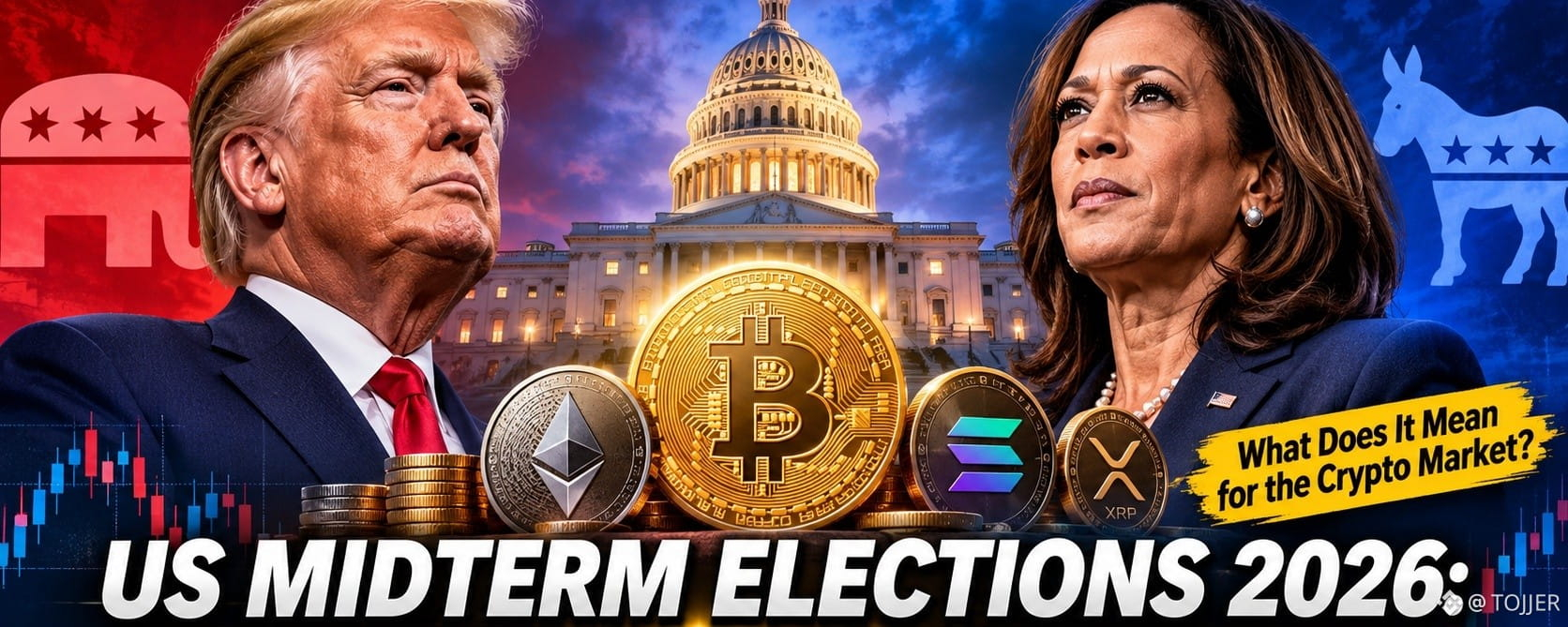

🇺🇸 US MIDTERM ELECTIONS 2026: Democrats Take Congress — Is Bitcoin Facing a New Political Risk?
How Washington's Political Shift Could Reshape Bitcoin, Ethereum, Solana, and the Global Crypto Market
The November 3, 2026, US midterm elections have delivered a major political shift. Democrats have secured control of both the Senate and the House of Representatives, creating a new balance of power in Washington.
This development could have significant implications for cryptocurrency regulation, institutional investment, and the future of America's digital asset industry.
For crypto investors, one important question remains:
Could this political shift become a bullish or bearish catalyst for Bitcoin and altcoins?
1. A New Political Landscape in Washington
With Democrats controlling both chambers of Congress, President Donald Trump's administration could face greater challenges when advancing its legislative agenda.
The cryptocurrency industry spent approximately $200 million on the election cycle, but some of its most expensive political investments failed, including its campaign against Democrat Sherrod Brown in Ohio.
This result raises questions about the industry's political influence and its ability to advance crypto-friendly legislation.
Source: Reuters, November 4, 2026.
2. The CLARITY Act Faces Greater Uncertainty
One of the biggest concerns for crypto investors is the future of the CLARITY Act.
The proposed legislation aims to establish clearer regulatory responsibilities between the Securities and Exchange Commission (SEC) and the Commodity Futures Trading Commission (CFTC).
However, the bill failed to advance in a September Senate procedural vote.
With Democrats gaining control of Congress, the legislation could face further revisions, negotiations, or delays.
The current Congress is scheduled to end on January 3, 2027. If the legislation does not become law before then, it would need to be introduced again in the next Congress.
This creates another source of uncertainty for the US crypto industry.
3. Potential Impact on Bitcoin (BTC)
Bitcoin could experience indirect pressure from political uncertainty.
Bearish factors:
- Delays in comprehensive crypto regulation.
- Greater uncertainty for institutional investors.
- Potentially tighter regulatory oversight.
- Reduced confidence in the short-term US crypto policy outlook.
Bullish factors:
- Bipartisan negotiations could produce stronger regulatory clarity.
- Better investor protection could support long-term adoption.
- Institutional participation could continue despite political changes.
The political shift does not automatically determine Bitcoin's direction. Global liquidity, interest rates, ETF flows, and investor sentiment remain important factors.
4. Which Cryptocurrencies Could Be Affected?
The political changes could influence several major digital assets through regulation, institutional adoption, and market sentiment.
Bitcoin (BTC)
As the largest cryptocurrency, Bitcoin could be affected by changes in institutional sentiment, investment flows, and US regulatory policy.
Ethereum (ETH)
Regulatory developments involving staking, decentralized finance (DeFi), and tokenized financial products could influence Ethereum's institutional adoption.
Solana (SOL)
Solana's ecosystem could be affected by changes in token classification, exchange regulations, and the treatment of blockchain-based financial products.
Regulatory clarity surrounding digital assets and payment infrastructure could influence institutional interest in XRP and its broader payment ecosystem.
Stablecoins (USDT and USDC)
Stablecoin regulation could affect issuers, exchanges, payment providers, and the business models surrounding stablecoin rewards and distribution.
These assets are not guaranteed to move in the same direction. Their exposure to regulatory developments differs.
5. The Bigger Picture: Politics and Crypto Are Becoming More Connected
The 2026 midterm elections demonstrate how closely cryptocurrency has become connected to American politics.
The outcome could shift the regulatory debate from simply establishing crypto-friendly legislation toward stronger oversight, consumer protection, anti-money-laundering measures, and restrictions on potential conflicts of interest.
However, stronger regulation does not necessarily mean the end of crypto growth.
Clear and balanced rules could help legitimate businesses attract institutional capital and build greater public trust.
6. What Should Investors Monitor Next?
Over the coming weeks and months, investors should pay attention to:
1. The future of the CLARITY Act.
2. New congressional proposals regarding crypto regulation.
3. SEC and CFTC policy developments.
4. Bitcoin ETF inflows and outflows.
5. Institutional investment in BTC, ETH, and SOL.
6. Stablecoin regulation and its impact on the digital payment industry.
These developments could create both risks and opportunities across the cryptocurrency market.
FINAL THOUGHTS
The 2026 US midterm elections are more than a political event. They could represent an important turning point for cryptocurrency regulation in the world's largest financial market.
Bitcoin, Ethereum, Solana, XRP, and the broader digital asset ecosystem may face new challenges, but also new opportunities.
For investors, the smartest approach is to look beyond political headlines.
Monitor regulatory developments, follow institutional capital flows, and understand how political decisions influence market liquidity.
In today's cryptocurrency market, understanding geopolitics is becoming just as important as understanding technical analysis.
Disclaimer: This article is for informational and educational purposes only. It does not constitute financial or investment advice.
---