

I'd rewrite it like this to make it feel even more human, conversational, and reflective—without headings and without sounding like it follows a template.
I wasn't looking for Newton Protocol.
It was one of those ordinary moments where I had several tabs open, switching between market charts, reading through a few blockchain updates, and trying to understand where AI is actually taking the crypto industry. Most of the time those sessions end the same way. I close a few tabs, bookmark one or two articles, and move on because so many projects seem to be solving the same problems with different words.
That's what I expected this time too.
When I first opened Newton Protocol, I assumed it would be another project built around AI trading. It talked about AI-driven strategies, automation, and infrastructure, which sounded familiar enough. AI has become part of almost every conversation in crypto recently, so it takes something unusual to make me stop reading out of habit and start reading out of curiosity.
Somewhere along the way, I realized the project wasn't making me think about trading at all.
Instead, it made me think about trust.
That surprised me because trust wasn't the word I expected to walk away with.
We've become comfortable talking about AI as if the only thing that matters is how smart the models become. Every new release is measured by better reasoning, larger context windows, faster responses, or improved accuracy. But intelligence has never been the only thing that determines whether people are willing to rely on a system.
The more I thought about it, the more I realized that blockchains were never just about moving money. They were about creating environments where people didn't have to rely entirely on one another. Rules were written into code, transactions became transparent, and verification replaced assumptions.
Now AI seems to be changing the conversation again.
If software starts making financial decisions on behalf of people, then we're entering a completely different kind of relationship with technology. It's no longer just a tool sitting on the screen waiting for instructions. It begins acting on its own within limits we decide beforehand.
That feels like a much bigger change than simply adding AI to crypto.
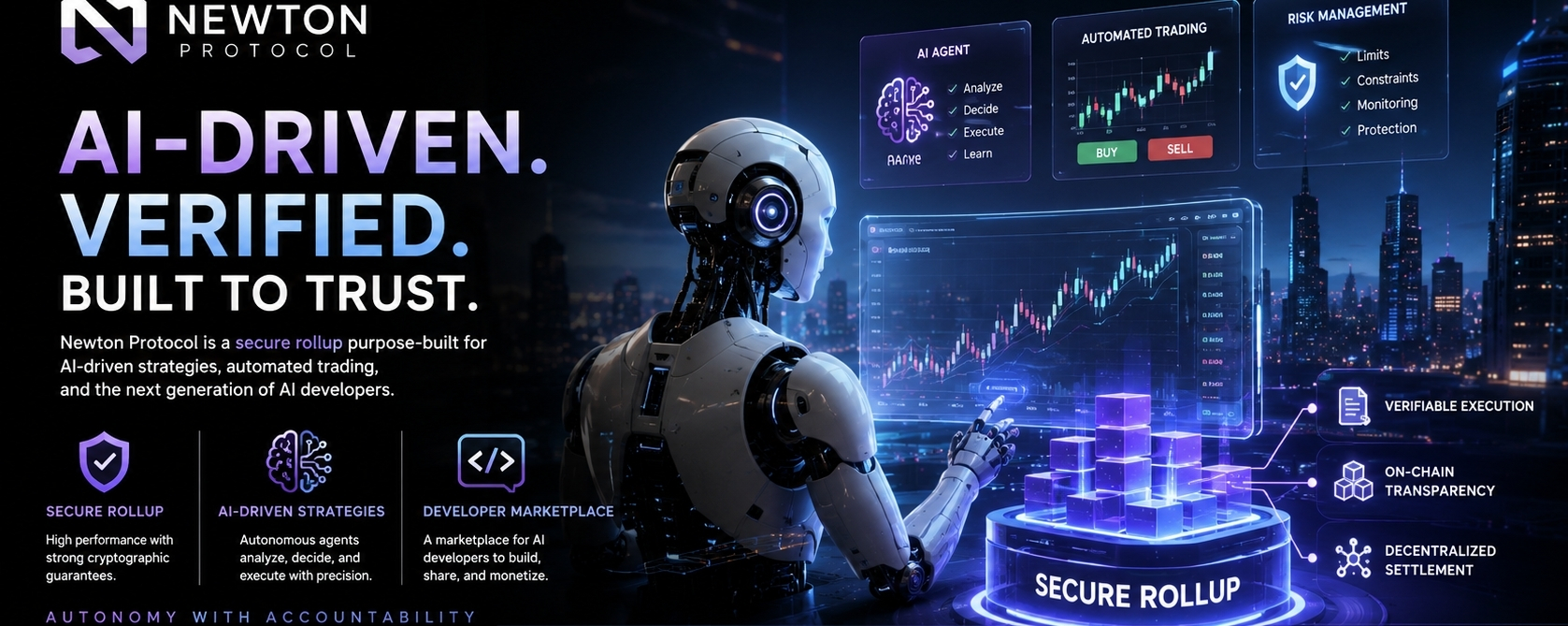
What caught my attention about Newton Protocol was that it seemed to acknowledge this shift. Instead of asking how much more an AI agent can do, it quietly raises another question: how should an AI be allowed to operate once it has permission to act?
I kept thinking about that long after I closed the documentation.
In everyday life, trust isn't built because someone is capable of doing everything. It's built because responsibilities are clearly defined. People know what they can do, what they can't do, and who is accountable when something goes wrong.
Technology often forgets that.
We spend so much time building systems that can do more that we rarely stop to ask whether they should.
AI makes that question impossible to ignore.
An autonomous agent doesn't get tired or distracted. It doesn't hesitate before repeating the same action thousands of times. If it's working properly, that's an advantage. If something goes wrong, the consequences can grow just as quickly.
Maybe that's why infrastructure matters more than it first appears.
It's easy to be impressed by intelligent software. It's much harder to design an environment where intelligence remains predictable, transparent, and accountable. Reading about Newton made me feel that this might actually be the more important challenge.
Of course, I don't know whether Newton Protocol will become one of the projects that shapes this space in the years ahead. Crypto has a long history of technically impressive ideas that struggled because adoption never arrived. Building good infrastructure is only part of the journey. Developers have to build on it, users have to trust it, and real-world applications have to prove that the design works under pressure.
Those are difficult problems, and no whitepaper can solve them overnight.
At the same time, I appreciate projects that leave me with questions instead of trying to convince me they already have every answer.
Newton Protocol did that.
It reminded me that the future of AI in blockchain probably isn't about creating agents that can do everything for us. It's about creating systems where those agents can operate without asking everyone else to blindly trust them.
That feels like a healthier direction.
The more I think about it, the more I believe the next chapter of crypto won't simply be faster networks or smarter algorithms. It will be about finding a balance between autonomy and accountability, between intelligence and transparency, between automation and human confidence.
I started reading Newton Protocol expecting another AI project.
I finished wondering whether the real innovation isn't artificial intelligence itself, but the quiet infrastructure that makes intelligent systems worthy of trust in the first place.
That's not a conclusion I expected to reach that afternoon, but it was probably the most valuable thing I took away from the experience.
