
I've rewritten it to sound more natural, reflective, and like it was written by a real person thinking through the topic rather than presenting an analysis.
This morning, I was making breakfast when an old Saraiki song by Attaullah Khan Esakhelvi came on: "Qameez Teri Kali." I didn't stop to listen because of the lyrics. It was the familiarity of it. Some things stay with you for years without demanding attention, yet they still shape how you think. For some reason, that quiet moment reminded me of Newton Protocol (NEWT) and how, in crypto, the details that get the least attention often end up mattering the most.
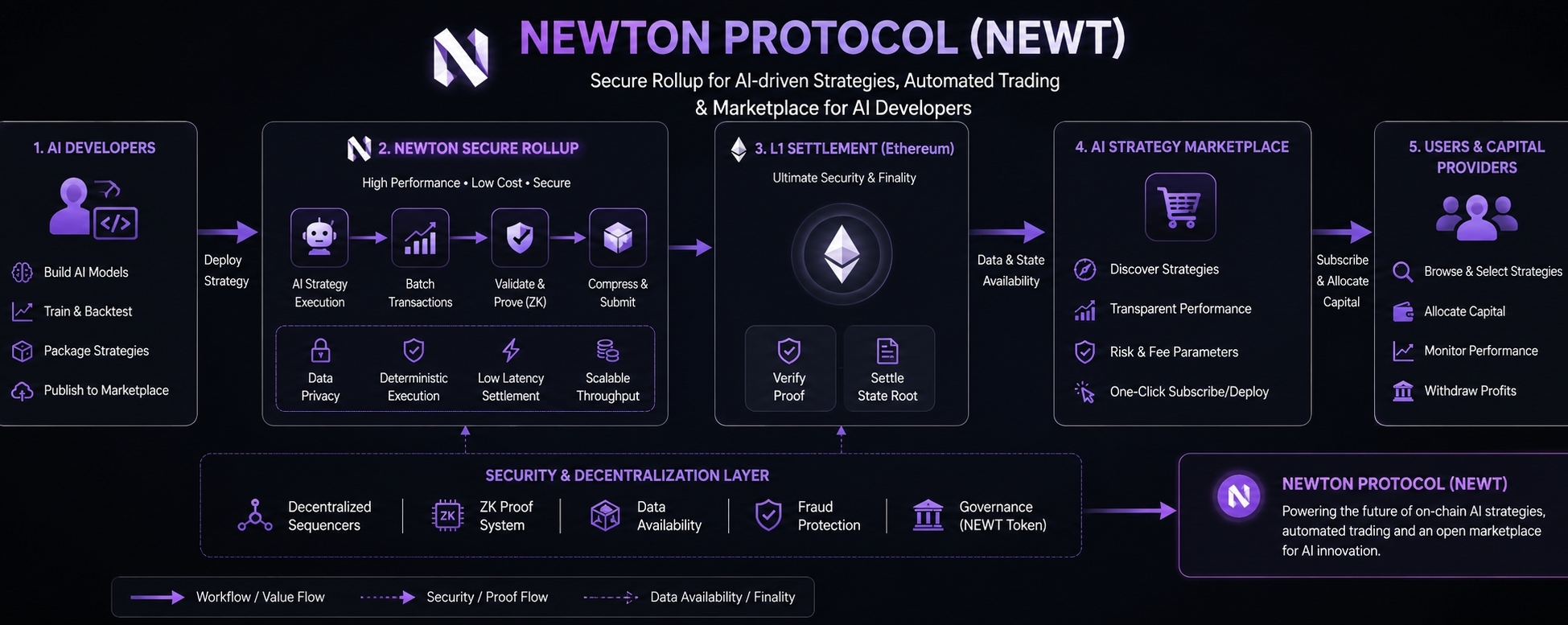
Over the past few days, I've been reading about Newton Protocol. Most conversations naturally focus on its goal of building a secure rollup for AI-driven strategies, automated trading, and a marketplace for AI developers. That's the exciting part because it's easy to picture what the technology could become.
But I kept drifting back to the tokenomics.
I've learned that whenever a project sounds impressive, it's worth asking a less exciting question: if this network succeeds, who actually benefits the most over time?
That's where token allocation starts to matter.
Whenever I see a token distribution chart, I don't immediately judge whether the numbers are good or bad. Instead, I try to understand the story they're telling. How much is reserved for the team? How much went to early investors? How much is set aside for the ecosystem, community incentives, liquidity, or the treasury? Every percentage represents a decision about ownership, influence, and future incentives.
Then there's vesting.
People usually describe vesting as a protection mechanism, and that's true to some extent. But I think of it more like opening the curtains little by little instead of all at once. The room doesn't suddenly become bright. The light slowly changes over time. Token unlocks work in a similar way. They don't always create immediate selling pressure, but they constantly change the balance between supply and demand.
That's why I never look at circulating supply without asking what comes next.
I've also become a little skeptical whenever people celebrate a fixed maximum supply as if that alone guarantees long-term value.
Scarcity definitely matters.
But a limited number of tokens doesn't automatically make those tokens valuable. A rare book still needs someone who wants to read it. In crypto, real demand usually comes from people actually using the network rather than simply believing the supply is limited.
For Newton Protocol, that means the long-term value of NEWT probably depends less on the headline supply cap and more on whether developers, traders, and AI applications genuinely rely on the protocol over time.
The ecosystem allocation is another piece I always pay attention to.
It's easy to call it a growth fund, but whether it creates lasting value depends on how it's used. If those tokens encourage real builders to stay, the network becomes stronger. If they mainly create short-term activity that disappears once rewards dry up, the numbers can look healthier than the reality.
That difference isn't always obvious at first.
The same goes for decentralization.
I've started separating technical decentralization from economic decentralization because they aren't necessarily the same thing. A protocol can be open, transparent, and technically decentralized while a relatively small group still controls a meaningful share of the tokens. Neither fact automatically cancels out the other, but I think both deserve equal attention.
Another thing I've stopped believing is that every scheduled unlock is "already priced in."
Markets don't behave like spreadsheets. Even when everyone knows an unlock date months in advance, people still react differently when it actually happens. Some hold, some sell, some buy the dip, and others simply wait. Human behavior rarely follows a neat financial model.
The more I study crypto, the more I feel that tokenomics isn't really about numbers.
It's about incentives.
It's about understanding who has reasons to build, who has reasons to hold, and who has reasons to leave.
Newton Protocol has an ambitious vision, especially where AI automation and secure on-chain execution are concerned. Whether that vision succeeds will depend on the technology, but I think its tokenomics will quietly shape who captures the value created along the way.
Maybe that's the question I keep coming back to whenever I read another whitepaper.
Are tokenomics really designed to spread opportunity across a growing network, or are they simply a slower, more polished way of concentrating ownership before everyone notices?
.
#BTCExchangeSupplyFallsTo9YearLow
#USLaunchesNewStrikesAgainstIran
#AIRotationKoreanChipmakersSlumpChinaTechSurges $NEWT $EVAA $LAB @NewtonProtocol #Newt