
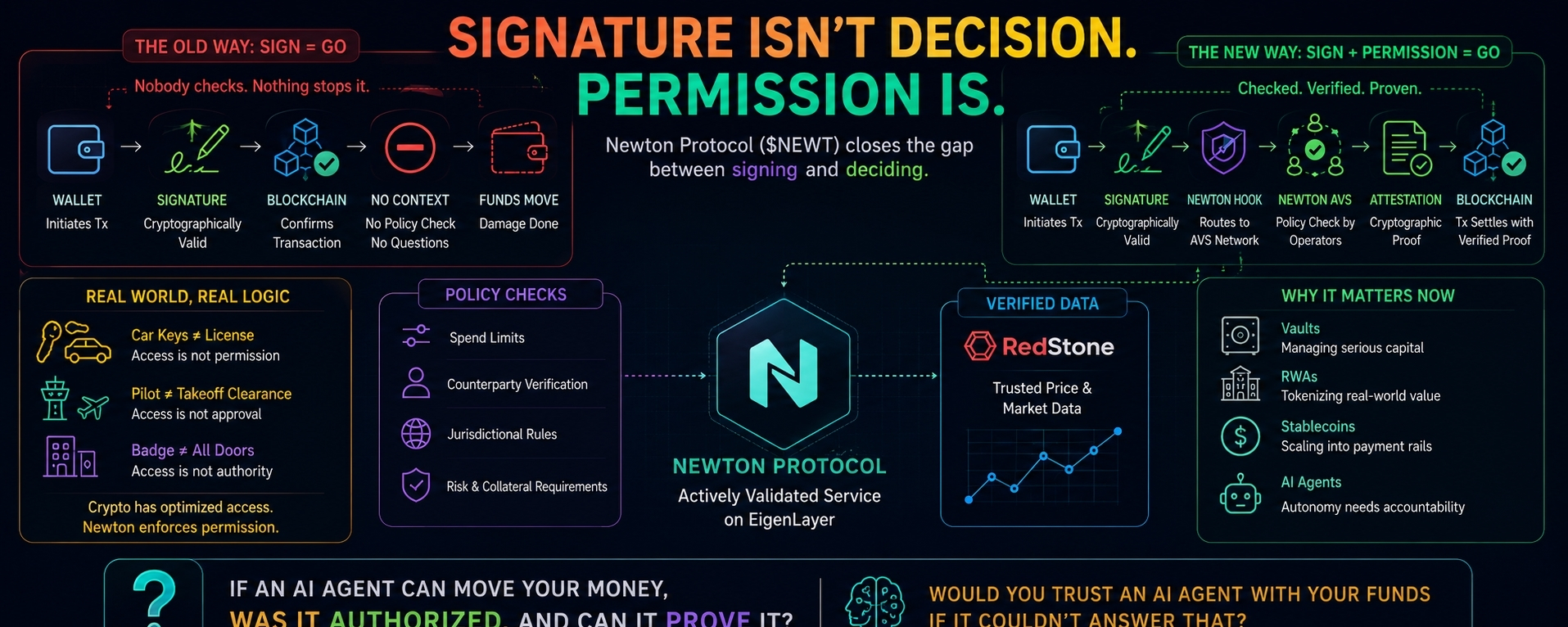
I lost money once trusting a signature. The wallet approved, the transaction went through, everything looked clean on the screen. It was only after the funds were gone that I understood the real problem: the chain confirmed I signed, but it never asked whether I should have. Nobody checked. Nothing stopped it. A signature moved, and that was treated as enough.
That gap between signing and deciding is exactly what Newton Protocol ($NEWT) is built to close.
Most of crypto still treats a valid signature as proof of good judgment. It isn't. Think about how permission actually works outside of crypto. A father hands his son the car keys — that's trust, not a license to drive on the highway alone at night. A pilot holds full access to the cockpit, but the tower still has to clear the flight before wheels leave the ground. An employee can badge into the building, but that doesn't mean every door on every floor opens for them. Access and permission are two different things. Crypto has spent a decade optimizing the first and mostly ignoring the second.
For years that was fine. Transactions were simple, users were mostly retail, and the worst case was a bad trade you made yourself. But the market underneath us has changed. Vaults are managing serious capital. Real-world assets are getting tokenized. Stablecoins are scaling into payment rails. And AI agents are starting to hold wallets and move value with no human checking the final step. At that scale, a signature isn't a decision anymore. It's just a formality that happens to be cryptographically valid.
This is where Newton's architecture actually earns the comparison to infrastructure rather than narrative. It runs as an Actively Validated Service on EigenLayer, meaning it borrows Ethereum's restaked security rather than bootstrapping trust from zero. When a transaction is initiated, a lightweight hook routes the request to Newton's network, where operators evaluate it against policies before it settles — spend limits, counterparty checks, jurisdictional rules — and return a cryptographic attestation, a verifiable receipt that the transaction actually met the conditions it claimed to meet.
That mechanism only works if the data behind it is trustworthy, which is why Newton's mainnet beta shipped its VaultKit SDK alongside a live integration with RedStone for verified price and market data — so a collateral check or risk rule isn't referencing a number that could be stale or manipulated. This isn't a roadmap slide. It's operating today, with a named data partner enforcing real conditions on real transactions.
That's the deeper shift here. The next phase of Web3 won't be won by whoever has the fastest execution or the flashiest automation. It'll be won by whoever can answer a harder question: not just "did this transaction happen," but "should it have happened, and can you prove why." Vaults need that. RWAs need that. Stablecoins moving at scale need that. And AI agents, the ones we're about to hand real financial autonomy to, need it most of all.
So here's the question I keep coming back to, the one that started all of this for me. If an AI agent can hold a wallet and move your money, "did it sign" can't be where the conversation ends anymore. The real question has to be: was it authorized, and can it prove it?
Would you trust an AI agent with your funds if it couldn't answer that?